
Atlantic Coast Life Accumulation Protector Plus Annuity – 10% Bonus Growth with Index Flexibility and Built-In Security
Atlantic Coast Life Accumulation Protector Plus Annuity – 10% Bonus Growth with Index Flexibility and Built-In Security
At Diversified Insurance Brokers, we work with individuals who want long-term retirement growth without exposing their life savings to direct market volatility. The Atlantic Coast Life Accumulation Protector Plus Fixed Indexed Annuity, issued by Atlantic Coast Life Insurance Company, is structured for pre-retirees and retirees who value principal protection, tax-deferred compounding, and the opportunity to enhance accumulation through a premium bonus and modern index strategies. Before evaluating this product in detail, buyers must understand a critical fact about the issuing carrier.

Important Carrier Rating Disclosure: Atlantic Coast Life Insurance Company holds an AM Best B++ (Good) financial strength rating — below the A- minimum threshold that most financial advisors and industry professionals recommend for new annuity purchases. B++ does not indicate insolvency or imminent distress, but it does indicate a lower level of financial strength than carriers in the A tier and above. For a 10-year commitment, this distinction is material: every guarantee in the contract — principal protection, credited interest lock-in, health event waivers, death benefit, and any rider benefits — is backed solely by Atlantic Coast Life’s claims-paying ability. State guaranty associations typically provide backstop protection (usually up to $250,000 per contract per insurer) but are not FDIC insurance and are not equivalent to carrier financial strength. Additionally, Atlantic Coast Life’s NAIC Complaint Index is materially above the national average. Both of these factors should be carefully weighed alongside the product’s features before making a purchase decision. Buyers who require an A- or higher carrier rating should evaluate competing bonus FIAs from higher-rated carriers.
Ensure you are receiving the absolute top rates
Current Fixed Annuity Rates
Compare today’s best fixed annuity rates from top carriers.
Current Bonus Annuity Rates
See which annuities offer the highest upfront bonus today.
Request an Annuity Quote
Submit our annuity request form to get personalized rate options.
Lifetime Income Calculator
Estimate how much guaranteed income your annuity could provide.
Atlantic Coast Life Accumulation Protector Plus: Key Product Features at a Glance
| Product Feature | Details |
|---|---|
| Issuing Carrier | Atlantic Coast Life Insurance Company, Charleston, South Carolina. Member of the A-CAP Family. Founded 1925. AM Best: B++ (Good) — below the A- threshold most financial advisors recommend as a minimum for new annuity purchases. NAIC Complaint Index materially above the national average. Available in approximately 35 states. State guaranty association coverage typically applies (usually up to $250,000 per contract per insurer — not FDIC insurance). Not FDIC insured. All guarantees backed by claims-paying ability of Atlantic Coast Life Insurance Company. |
| Product Type | Single-premium deferred fixed indexed annuity (FIA). 10-year surrender period. No annual contract or administrative fees on the base contract. Principal protected from negative index performance. Tax-deferred growth. Not a direct market investment. Not FDIC insured. Available in approximately 35 states — confirm state availability at time of application. |
| Minimum Initial Premium | $5,000 minimum initial premium. Single premium only. Eligible funding types: non-qualified funds, IRA rollover, 401(k) rollover, and other qualified plan assets. |
| Premium Bonus and Vesting Schedule | A one-time premium bonus is immediately credited to the account value at issue. The bonus percentage is a declared rate — the carrier’s official product documentation confirms a base bonus in the range that has been marketed at various levels; always confirm the current bonus percentage on the rate sheet in effect at your application date. Do not rely on marketing materials or page titles for the current figure. The bonus is subject to a 10-year vesting schedule: 10% of the total bonus vests each year, reaching 100% vested at the beginning of the 11th policy year. Non-vested bonus is forfeited upon early surrender or excess withdrawals. The bonus is fully vested in the death benefit and in any optional guaranteed lifetime withdrawal benefit payment from the time of purchase. |
| Surrender Charge Period | 10-year surrender charge period. Surrender charges and MVA apply to withdrawals above the free withdrawal amount during the period. No surrender charges on death benefit payments. Annuity payments (settlement options) may begin after the fifth contract year in most states (after the first contract year in Florida). After the 10-year surrender period ends, full access to the account value is available without charges. |
| Free Withdrawal Provision | Base contract (without Rate Enhancement Rider): up to 5% of the account value per year, starting in the second contract year. Maximum 2 withdrawals per contract year. Minimum withdrawal: $250. Minimum account value after withdrawal: $2,500. RMDs available penalty-free starting year two (greater of 5% or the RMD amount). With Rate Enhancement Rider: free withdrawal upgrades to 10% of account value annually. The 10% free withdrawal referenced elsewhere in marketing materials for this product applies only when the Rate Enhancement Rider is purchased — the base contract standard is 5%, which is below the 10% industry norm. |
| Health Event Waivers | Nursing Home Waiver: full surrender or partial withdrawal available without MVA, surrender charges, or loss of any applicable non-vested premium bonus under qualifying conditions. Nursing home waiver does NOT include home health care. Terminal Illness Waiver: full surrender or partial withdrawal available without MVA, surrender charges, or loss of non-vested bonus under qualifying conditions. Both waivers included at no additional cost. Specific qualifying conditions and documentation requirements are detailed in the contract disclosure. |
| Rate Enhancement Rider (Optional) | Annual charge: 0.95% of account value, deducted annually regardless of index performance. When elected: (1) free withdrawal upgrades from 5% to 10% of account value annually; (2) fixed account rate, participation rates, cap rates, and trigger rates across all indexed strategies are enhanced to higher declared levels; (3) 110% Return of Premium guarantee — if the rider is purchased and the contract remains in force for 10 years, the cash surrender value will be at least 110% of premium paid, adjusted for withdrawals. The 0.95% annual charge reduces the account value in zero-credit years as well as in positive-credit years. |
| Index Crediting Strategies | S&P 500 (multiple crediting options, excluding dividends); Momentum Index (volatility-controlled index; service mark of Solactive AG; participation rates on 1-year and 2-year point-to-point strategies guaranteed for 10 years from issue date, provided Atlantic Coast Life maintains index access); Diversified Macro 5 Index / CS ESG Macro 5 Index (product of MerQube; combines equity, fixed income, commodities, and currencies with a daily risk control mechanism; 0.50% embedded servicing fee deducted from the index level; participation rates on 1-year and 2-year strategies guaranteed for 10 years from issue). Fixed account available. 11 total crediting strategies across 1-, 2-, and 3-year periods. Allocations adjustable on contract anniversary coinciding with end of a crediting period. |
| Death Benefit | Death benefit equals the greater of: (1) account value minus any non-vested premium bonus, or (2) minimum guaranteed surrender value as of the date of death. No withdrawal charges or MVA apply to death benefit payments. The premium bonus is fully vested in the death benefit from the time of purchase — beneficiaries receive the full account value without the non-vested bonus deduction that would apply on a living surrender. Settlement options: spousal continuation; lump sum; period certain; life with period certain; and others. |
| Tax Treatment | Interest grows tax-deferred until withdrawal. Non-qualified: LIFO taxation (earnings distributed first). Qualified accounts: full distributions taxed as ordinary income. Withdrawals before age 59½ subject to 10% IRS early withdrawal penalty. An annuity inside a qualified plan provides no additional tax deferral. Not FDIC insured. |
About Atlantic Coast Life Insurance Company: Carrier Context and What B++ Means in Practice
Atlantic Coast Life Insurance Company was founded in 1925 and is headquartered in Charleston, South Carolina. It is a member of the A-CAP Family of insurance companies and distributes products through independent agents and financial professionals in approximately 35 states. That geographic footprint is meaningfully narrower than most A-rated or A+-rated FIA carriers reviewed in this series, the majority of which are available in 45 or more states.
The AM Best B++ (Good) rating is the single most consequential carrier evaluation factor for anyone considering the Accumulation Protector Plus. B++ is the 7th highest of AM Best’s 16 ratings — two full notches below A-, which is the minimum that most professional financial advisors specify for annuity carrier selection, and three notches below the A level where carriers such as American Equity, Forethought/Global Atlantic, and F&G operate. All of the income FIAs and accumulation FIAs reviewed in this series — Midland National (A+), North American (A+), Athene (A+), Allianz Life (A+), Aspida (A-), Delaware Life (A-), F&G (A), American Equity (A), Ameritas (A), American National (A) — carry ratings at or above the A- threshold. Atlantic Coast Life does not meet that threshold. That does not mean the Accumulation Protector Plus will not perform as contractually described — B++ is not a distress rating and Atlantic Coast Life has been operating for a century. What it means is that the financial cushion standing between the carrier’s obligations and potential adverse conditions is thinner than what A-rated carriers provide. For a commitment lasting 10 years, that distinction matters in a way it might not for a shorter-duration product.
The NAIC Complaint Index measures consumer complaints received by state insurance commissioners relative to a carrier’s market share. A score above 1.0 means the carrier receives more complaints than expected for its size. Atlantic Coast Life’s NAIC Complaint Index is materially above 1.0 — the complaint rate is substantially higher than what the carrier’s market presence would predict, which is a service quality signal buyers should factor into their evaluation. This is not a financial strength indicator, but it is relevant context for buyers who want to understand what the post-sale experience with this carrier has looked like for other policyholders. For a complete carrier evaluation, our dedicated resource on whether Atlantic Coast Life is a good insurance company covers the full profile.
How a Fixed Indexed Annuity Protects Principal While Pursuing Growth
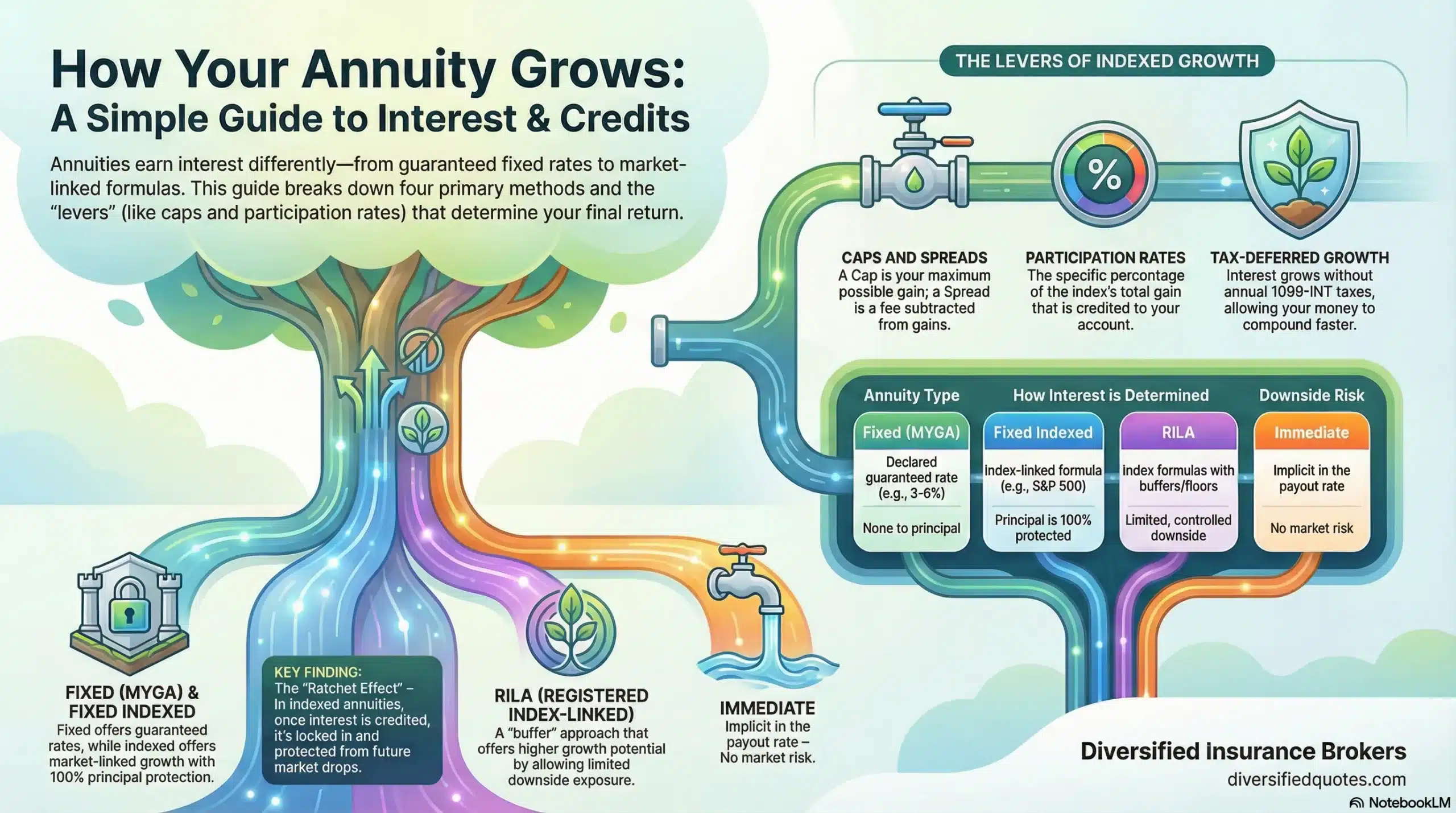
Unlike directly invested market accounts, a fixed indexed annuity credits interest based on the performance of selected indices while protecting the contract value from downside losses. If the index experiences negative performance during a crediting period, the accumulated value is not reduced due to market declines — the credit for that period is 0%, and all prior-period gains remain locked in. This annual reset structure means that a bad market year produces zero growth, not a loss, and the following year’s credit is measured from the same starting value rather than from a reduced base. That distinction separates indexed annuities from variable products in a way that is fundamental to retirement planning: the sequence-of-returns risk that can devastate a portfolio during market downturns in the early years of retirement is structurally neutralized for the portion of assets inside an FIA. If you would like a deeper explanation of crediting strategies, caps, spreads, participation rates, and annual lock-in mechanics, reviewing how a fixed indexed annuity works provides the full technical framework before comparing product designs.
For pre-retirees in the final accumulation years, the zero-floor design addresses one of the most damaging wealth-destruction scenarios in retirement: a major market loss at or near retirement, combined with ongoing income withdrawals, that permanently impairs a portfolio’s ability to sustain income for two or three decades. An FIA allocation cannot produce this scenario — the worst-case outcome is zero credited interest in a given year, not a permanent loss of principal. This allows a retirement plan to use the FIA allocation as the stability anchor while other asset classes handle longer-term growth and inflation exposure. The stability function of the FIA is independent of the carrier’s financial rating — in terms of market performance, the zero-floor guarantee is mathematically identical at a B++ carrier as at an A+ carrier. The financial rating affects the carrier’s ability to honor its contractual obligations over the long term, which is a separate and equally important evaluation dimension.
The Premium Bonus: Mechanics, Vesting, and What to Confirm at Application
The premium bonus is one of the Accumulation Protector Plus’s most prominently marketed features. The bonus is immediately credited to the account value at issue — not to a separate income base or benefit base calculation, but directly to the accumulation account from which all growth, surrender values, free withdrawals, and ultimately the standard death benefit are derived. This means the bonus provides an immediate, real increase to the starting account value on day one. A buyer who deposits $200,000 into the APP and receives a bonus — whether the current declared rate is at the lower or higher end of the range that has been marketed for this product — begins day one with a higher account value than the premium alone would produce, and all subsequent index credits compound on that higher base throughout the 10-year accumulation period.
The bonus percentage is a declared rate that should be confirmed on the current rate sheet at the time of application. Marketing materials and page titles for this product have referenced bonus percentages at various levels — confirming the actual current rate with the carrier or your agent before submitting an application is essential and non-negotiable. The mechanics of the vesting schedule are the same regardless of the specific bonus percentage: 10% of the total bonus vests each year, with the full bonus 100% vested at the beginning of the 11th policy year. In the first year, none of the bonus is vested from the surrender perspective — if the contract is fully surrendered in year one, the complete bonus is recaptured. At the start of year six, 50% of the bonus is vested and cannot be recaptured on surrender. This graduated vesting aligns with the 10-year surrender period and creates an additional incentive to hold the contract to maturity, but it also creates a meaningful penalty structure for buyers who need to access more than the free withdrawal amount before the bonus is fully vested.
Two buyer-favorable exceptions to the vesting schedule are important to understand. First, the premium bonus is fully vested in the death benefit from the time of purchase — beneficiaries who inherit early in the contract receive the full account value including the complete bonus, without the recapture that would apply on a living early surrender. Second, the bonus is fully vested in any optional guaranteed lifetime withdrawal benefit rider payment from the start. These exceptions mean that the vesting risk is asymmetric: it applies to living surrenders and excess withdrawals, but not to the death benefit or to income from an optional income rider. For buyers who are primarily concerned about whether the bonus will be preserved for their beneficiaries if they die during the surrender period, the full death benefit vesting from day one is a meaningful protection. If you want to understand how bonus structures compare across carriers and whether a premium bonus consistently produces better long-term accumulation than a non-bonus alternative with higher cap rates, our guide on bonus annuity comparisons provides that framework.
The Index Menu: What Makes the Accumulation Protector Plus Structurally Distinctive
The Accumulation Protector Plus offers 11 total crediting strategies across 1-year, 2-year, and 3-year crediting periods, drawing on three index platforms plus a fixed account. The index selection is where the product creates its most genuine differentiation from competing FIAs — not through the S&P 500 strategies, which are available on virtually every FIA in the market, but through the Momentum Index and Diversified Macro 5 Index strategies and their 10-year participation rate guarantees.
The S&P 500 strategies are available in multiple formats across different crediting periods, but buyers who want maximum S&P 500 cap rate or participation rate exposure in an FIA should evaluate this product’s S&P 500 rates against competing carriers before committing. The A+-rated carriers reviewed in this series — particularly Athene, whose Apollo investment advantage consistently produces S&P 500 cap rates materially higher than most competitors — will typically provide more competitive S&P 500 crediting terms than Atlantic Coast Life can deliver at its carrier size and rating level. The APP’s comparative advantage is elsewhere in its index menu.
The Momentum Index is a volatility-controlled proprietary index with service marks owned by Solactive AG, one of Europe’s largest independent index calculation and administration firms. It is designed to identify and capture upward market momentum while managing volatility exposure through a built-in risk control mechanism. The distinctive feature within the APP is that the participation rates on the Momentum Index 1-year and 2-year point-to-point strategies are guaranteed for 10 years from the issue date — provided Atlantic Coast Life maintains access to the index. This multi-year rate guarantee on a specific strategy is uncommon in the FIA market and provides buyers who allocate to the Momentum Index with meaningful certainty about their crediting economics for the entire surrender period. Most FIA products declare participation rates annually, subject to reset — the rate a buyer receives at issue may not be the rate available at year two renewal. The Momentum Index 10-year guarantee eliminates that uncertainty on this strategy for the full contract duration.
The Diversified Macro 5 Index — also marketed as the CS ESG Macro 5 Index — is an index produced by MerQube that combines an equity component with a macro component spanning fixed income, commodities, and currencies, complemented by a daily risk control mechanism targeting 5% annualized volatility. The ESG orientation in the equity component reflects environmental, social, and governance screening that is increasingly relevant to buyers who want responsible investment exposure within a principal-protected structure. The index embeds a 0.50% annual servicing fee in its calculation — buyers should understand that the participation rate on this strategy applies to an index return that already has this embedded fee deducted from it, which reduces net credits compared to a clean equity index return at the same nominal participation rate. The Diversified Macro 5 Index participation rates on 1-year and 2-year strategies also carry the 10-year guarantee, providing the same long-term rate certainty as the Momentum Index. For a complete understanding of how embedded index fees and volatility control mechanisms affect net credited interest, our overview of index annuity crediting methods explains the mechanics across all major crediting approaches.
The ability to adjust allocations on the contract anniversary coinciding with the end of a crediting period gives buyers flexibility to shift between strategies as their priorities evolve. A buyer who allocates to 2-year Momentum Index strategies at issue can reallocate at the end of that 2-year period to 1-year strategies, or to the S&P 500, or to the fixed account, based on conditions and preferences at that anniversary. This reallocation flexibility combined with the 10-year participation rate guarantee on the Momentum and Diversified Macro 5 strategies creates an interesting planning dynamic: a buyer who wants rate certainty for the full decade can lock into the guaranteed-rate strategies at issue and hold them, while a buyer who wants flexibility can reallocate at each crediting period end.
The Rate Enhancement Rider: Full Analysis of the 0.95% Annual Cost and What It Buys
The Rate Enhancement Rider is the most consequential product decision buyers make when evaluating the Accumulation Protector Plus, and it deserves a thorough evaluation because electing it changes three separate dimensions of the contract simultaneously: liquidity, crediting rates, and the 110% Return of Premium guarantee.
On the liquidity dimension: the base contract provides 5% annual free withdrawals, which is below the 10% industry standard. Buyers who need or want 10% annual access to their contract value — whether for income supplementation, planned expenses, or simply the liquidity standard they expect from any FIA they own — must elect the Rate Enhancement Rider to receive it. The 0.95% annual fee is therefore partly a liquidity access fee for buyers who need 10% withdrawals. From this perspective, the rider election is not optional for buyers with meaningful liquidity requirements: they either accept 5% free withdrawal or pay 0.95% annually for 10%. This is an important planning distinction because competing A-rated bonus FIAs in this comparison set — including the Aspida Synergy Choice Bonus and the Delaware Life PrimeStart Bonus 10 — provide 10% annual free withdrawals as the base contract standard with no additional fee.
On the crediting rate dimension: when the Rate Enhancement Rider is elected, Atlantic Coast Life declares enhanced cap rates, participation rates, and trigger rates across all indexed strategies. The Momentum Index participation rate in particular receives a substantial enhancement — the degree of enhancement should be confirmed on the current rate sheet, but it is a meaningful difference in growth potential between the base and rider versions of the contract. Buyers who are specifically attracted to the Momentum Index’s 10-year guaranteed participation rate may find that the rider version of that rate provides materially more growth potential than the base version, making the rider election a crediting rate decision in addition to a liquidity decision.
On the 110% ROP guarantee: if the Rate Enhancement Rider is purchased and the contract remains in force for 10 years without surrender, the cash surrender value at year 10 will be at least 110% of the original premium paid, adjusted for withdrawals. On a $100,000 premium with no withdrawals, the minimum at year 10 is $110,000. This floor provides protection against the scenario where cumulative index credits — net of the 0.95% annual rider fee across the decade — are insufficient to produce a surrender value that exceeds premium. In markets where index strategies produce consistent positive credits, the actual surrender value should substantially exceed $110,000 by year 10. The 110% ROP guarantee is most valuable as insurance against an extended flat-market decade where the fee drag significantly erodes the net accumulation. Buyers should evaluate the 0.95% annual fee — approximately $950 per year on a $100,000 account value growing at modest rates, more as the account grows — against the combined benefit of 10% free withdrawals, enhanced crediting rates, and the 110% ROP floor to determine whether the rider is economically justified for their specific situation. A side-by-side illustration at current rates showing both the base and rider versions is the most reliable decision tool. For a complete understanding of how surrender charges interact with free withdrawal provisions over a 10-year period, our explanation of annuity surrender charges provides the full mechanics.
Liquidity, Tax Deferral, Death Benefit Design, and Who This Product Fits Best
The Accumulation Protector Plus’s liquidity framework must be understood in its two distinct states: without the Rate Enhancement Rider (5% free withdrawal, the base provision) and with the rider (10% free withdrawal, at 0.95% annual cost). The 5% base provision is the most significant liquidity limitation in this product relative to industry standards, and it should be treated as the default assumption unless the rider is specifically confirmed at purchase. In the second contract year and beyond, buyers can also take the greater of 5% or their RMD amount from a qualified account without penalty, which means buyers relying on this product for IRA funds subject to RMDs can meet their distribution obligations without triggering surrender charges — RMDs do not bump up against the 5% ceiling in the way that planned income distributions might.
The nursing home and terminal illness waivers provide meaningful additional liquidity for qualifying health events. Unlike many competing FIA health event waivers that require minimum periods of confinement before the waiver activates, the Atlantic Coast Life waivers also waive the non-vested bonus recapture — meaning a buyer who triggers a waiver event does not face the additional financial penalty of losing their unvested bonus on top of the situation that triggered the waiver. This is a buyer-favorable design element that should be clearly understood before purchase. The nursing home waiver does not cover home health care — the confinement must be to a qualifying institutional care facility.
Tax deferral operates the same way on the APP as on any other deferred annuity: credited interest compounds without annual taxation until withdrawal. For non-qualified funds, the last-in-first-out rule applies, meaning earnings come out first and are taxed as ordinary income. For qualified funds, all distributions are taxed as ordinary income as they are received. Reviewing how annuities are taxed before implementation provides clarity on how to coordinate distributions with Social Security, pension income, or other retirement income sources. At death, beneficiaries receive the greater of the account value minus non-vested bonus or the minimum guaranteed surrender value — with no surrender charges applied — and with the premium bonus fully vested in the death benefit from the time of purchase regardless of when death occurs. The full vesting of the bonus in the death benefit means that even a buyer who dies in year two, when only 20% of the bonus would have been vested from a living surrender perspective, has their beneficiaries receive the full account value including 100% of the bonus credited at issue. Beneficiaries can elect a lump sum, spousal continuation, or various settlement option structures. For more on how annuity death benefits are structured and how to coordinate beneficiary designations with broader estate planning, our resource on annuity beneficiary death benefits covers the full range of options.
The Accumulation Protector Plus is most appropriate for buyers who are specifically attracted to the Momentum Index’s 10-year guaranteed participation rate or the Diversified Macro 5 Index’s ESG and macro diversification — features that are genuinely uncommon in the broader FIA market; who are comfortable with a B++ carrier rating after fully understanding what that means for a 10-year commitment and the state guaranty association backstop; who can plan within the 5% annual free withdrawal provision or who elect the Rate Enhancement Rider for 10% liquidity; who find the 110% ROP guarantee with rider a meaningful floor relative to its cost; and who are located in one of the approximately 35 approved states. It is less appropriate for buyers who require an A- or higher carrier financial strength rating — which applies to the majority of professional advisors’ minimum standards and to buyers who want the strongest possible financial backing for a decade-long commitment; buyers who need 10% annual free withdrawals without paying an additional rider fee; buyers who want the highest available S&P 500 cap rates in the FIA market; and buyers in states where the APP is not available. For buyers whose primary concern is finding the safest type of annuity structure available, our resource on what is the safest type of annuity provides the framework for evaluating carrier strength, product type, and guarantee structure together. For buyers still determining whether an annuity belongs in their plan at all, our analysis of whether annuities are worth it covers the full range of contract types, risk profiles, and income objectives.
Related Pages
Explore additional annuity and retirement planning resources.
Financial Protection Essentials
Insurance planning resources covering post-surgery underwriting, retirement income planning, and conservative annuity strategies.
Talk to an Advisor or Request Your Annuity Quote
Ready to explore this annuity in more detail—or compare it with other carriers to see if even higher rates are available? With guaranteed income, principal protection, and long-term growth potential on the line, making the right choice is essential. The experienced advisors at Diversified Insurance Brokers will guide you through the options and design a strategy tailored to your retirement goals.
Schedule here:
calendly.com/jason-dibcompanies/diversified-quotes
Licensed in all 50 states • Fiduciary, family-owned since 1980
FAQs: Atlantic Coast Life Accumulation Protector Plus Annuity
What premium bonus percentage does the APP actually pay, and how do I confirm it?
The premium bonus on the Accumulation Protector Plus is a declared rate that varies and should be confirmed on the rate sheet in effect at the time of your application. Marketing materials and product titles for this product have referenced bonus percentages at various levels — none of those figures should be treated as the current guaranteed rate without direct verification on Atlantic Coast Life’s current rate sheet. The bonus mechanics are consistent regardless of the specific declared percentage: the bonus is immediately credited to the account value at issue, it is subject to a 10-year vesting schedule where 10% vests each year reaching 100% at the start of year 11, and it is fully vested in both the death benefit and any optional GLWB rider payment from the time of purchase. The practical implication is that the bonus percentage confirmed at application is the figure that should drive any accumulation projections — and that figure must come from the current rate sheet, not from marketing copy. We pull current rate sheets at the time of every client illustration precisely because declared rates change between rate periods.
The carrier is rated B++ — should that be disqualifying for most buyers?
Whether B++ is disqualifying depends on the buyer’s specific situation, risk tolerance, and whether they are working with an advisor who applies a minimum carrier rating standard. The honest answer from our perspective is that the majority of professional financial advisors do apply a minimum of A- for new annuity purchase recommendations, and Atlantic Coast Life’s B++ does not meet that standard. For buyers who are working with a fiduciary advisor, the advisor’s minimum rating guideline should be determinative — if they require A- or higher, the APP is not a compliant recommendation under their standard of care. For buyers working independently, the B++ rating requires a conscious and informed decision: understanding that every guarantee in the 10-year contract is backed by a carrier whose financial strength buffer is thinner than A-rated alternatives, and that state guaranty associations (typically $250,000 per contract per insurer) provide a backstop but not equivalent protection. B++ does not mean the carrier is going to fail — Atlantic Coast Life has operated since 1925. It means the cushion is smaller. For buyers who find the APP’s specific features — particularly the 10-year guaranteed participation rates on the Momentum and Diversified Macro 5 indices — compelling enough to justify the B++ carrier tier, that is a decision that can be made with clear eyes after reviewing competing A-rated alternatives at current rates. For buyers who have any ambiguity about whether they are comfortable at B++, the answer should be to evaluate A-rated alternatives first and return to the APP only if those alternatives do not serve the specific planning need.
Why is the base free withdrawal 5% rather than the standard 10%?
The standard in the FIA market is 10% annual free withdrawal from the accumulated value or the contract premium, starting in the second contract year. The Accumulation Protector Plus base contract provides 5% — half the industry standard — with 10% available only through the Rate Enhancement Rider at an additional annual charge of 0.95%. The carrier’s product design ties the enhanced liquidity to the rider in order to bundle the 10% free withdrawal with the enhanced crediting rates and the 110% ROP guarantee, creating a rider election that addresses multiple planning needs simultaneously. For buyers who need 10% annual access, the rider is not truly optional — it is required. The 0.95% annual fee becomes effectively a liquidity fee in that scenario, in addition to its role as a crediting rate enhancer and ROP guarantee purchaser. For buyers who can plan within 5% annually — which may be appropriate for those using the APP purely for long-term accumulation with no intention of taking withdrawals before year 10, or those whose only qualified account distribution need is an RMD which is separately accommodated — the base contract avoids the 0.95% annual drag. Every buyer considering this product should evaluate whether their actual expected withdrawal pattern requires 10% annually or whether 5% is genuinely sufficient, because the answer determines whether the rider is mandatory or discretionary for their situation.
What is the 10-year guaranteed participation rate, and why is it significant?
The 10-year guaranteed participation rate is the most structurally distinctive feature of the Accumulation Protector Plus. In the FIA market, participation rates are generally declared at contract issue and guaranteed only for the current crediting term — typically one year. At each renewal, the carrier can adjust the rate within a stated contractual minimum. This creates meaningful uncertainty for buyers who plan accumulation projections based on today’s declared rate: the rate in year two, three, or five may be different. The APP guarantees the participation rates on the Momentum Index 1-year and 2-year point-to-point strategies and the Diversified Macro 5 Index 1-year and 2-year point-to-point strategies for 10 years from the issue date — provided Atlantic Coast Life maintains access to those indices. The rate declared at issue on these strategies is the rate that applies for the entire decade, regardless of interest rate changes, market conditions, or the carrier’s competitive positioning. This eliminates the renewal rate risk on these specific strategies for the full surrender period. For buyers who are drawn to the Momentum Index or Diversified Macro 5 strategies specifically, this 10-year rate certainty is a genuine planning advantage. The caveat is that it is contingent on Atlantic Coast Life maintaining access to the underlying indices — if the carrier loses access, the 10-year guarantee may not apply on the affected strategy going forward. Confirm the index availability contingency language in the current contract disclosure before relying on this guarantee in long-term accumulation projections.
How does the 110% ROP guarantee work, and when does it actually matter?
The 110% Return of Premium guarantee is a contractual floor available when the Rate Enhancement Rider is elected and the contract is held for the full 10-year surrender period without surrender. It ensures that the cash surrender value at year 10 will be at least 110% of the original premium paid, adjusted for any withdrawals taken during the contract period. The guarantee matters most in the scenario where the indexed strategies produce minimal or no credits over the decade, and the 0.95% annual rider fee has eroded the account value to the point where the final surrender value would otherwise be below the 110% threshold. In that scenario, the carrier is obligated to bring the surrender value up to 110% of premium. In a normal or positive market environment where index strategies credit meaningful interest — even modestly — the actual surrender value will be well above 110% of premium by year 10, and the ROP guarantee is simply a backstop that never comes into play. The guarantee is best understood as insurance against an extended flat-market decade combined with the fee drag of the rider. Whether that insurance is worth the 0.95% annual premium depends on the buyer’s view of the next decade’s market environment and how much certainty they place on the 110% floor versus the expected upside from the enhanced crediting rates the rider also provides. Buyers who are primarily interested in the enhanced crediting rates should model the full accumulation projection under both rider-elected and rider-free scenarios at current rates — not just the 110% ROP floor — to evaluate the rider’s total value proposition.
How does the death benefit preserve the bonus, and what options do beneficiaries have?
The premium bonus vesting schedule — which recaptures non-vested bonus on living early surrenders — does not apply to the death benefit. From the time of purchase, the premium bonus is fully vested in the death benefit, meaning that if the contract owner passes away in year two when only 20% of the bonus would have been vested from a surrender perspective, the beneficiaries still receive the full account value including 100% of the credited bonus, plus all credited index interest, without any non-vested bonus deduction and without surrender charges. This full death benefit vesting from day one is a meaningful protection for buyers who are concerned about what their beneficiaries receive if they die early in the contract period. The death benefit is calculated as the greater of the account value minus any non-vested premium bonus (in this case zero, since the bonus is fully vested at death) or the minimum guaranteed surrender value as of the date of death. Since the bonus is fully vested in the death benefit, this effectively means beneficiaries receive the full account value. Beneficiaries have several settlement options: they may elect a lump sum, which provides immediate access to the full death benefit as a single payment; spousal continuation, where the spouse as sole primary beneficiary assumes ownership and continues the contract in force; period certain payments over a defined number of years; or life with period certain payments that guarantee income for the longer of lifetime or a specified period. The appropriate settlement option depends on the beneficiary’s tax situation and income needs, and we recommend beneficiaries consult with a tax professional before making an irrevocable election between a lump sum and installment options.
Who is the Accumulation Protector Plus best suited for, and who should evaluate alternatives?
The Accumulation Protector Plus is most appropriate for buyers who are specifically drawn to the Momentum Index’s 10-year guaranteed participation rate or the Diversified Macro 5 Index’s ESG and macro diversification — features that are genuinely uncommon in the broader FIA market and that provide a structural planning advantage not replicable at this time in most A-rated carrier products; who are located in one of the approximately 35 approved states; who have evaluated the B++ carrier rating with clear eyes and are comfortable making a 10-year commitment to a carrier below the A- tier after factoring in the state guaranty association backstop; who can work within the 5% base free withdrawal or who elect the Rate Enhancement Rider for 10% liquidity and find the combined cost-benefit of the rider — enhanced crediting rates, 10% withdrawals, and 110% ROP floor — worth the 0.95% annual charge; and who have a minimum $5,000 premium to commit for the full 10-year period. The APP is less appropriate for buyers who apply an A- or higher carrier minimum — which is the standard for most professional advisors and for buyers who want maximum financial strength backing a decade-long commitment; buyers who need 10% free withdrawals without paying an additional annual rider fee, as competing A-rated bonus FIAs provide 10% free withdrawal as the base contract standard; buyers who want the highest available S&P 500 cap rates in the FIA market, as A+-rated carriers with institutional investment advantages consistently deliver higher S&P 500 caps; buyers in states where the APP is not available; and buyers whose evaluation framework prioritizes carrier financial strength as the primary filter, in which case A-rated alternatives should be evaluated first and the APP considered only if those alternatives fail to serve the specific feature need that makes the APP unique — the 10-year guaranteed participation rate on the Momentum or Diversified Macro 5 Index strategies.
About the Author:
Jason Stolz, CLTC, CRPC, DIA, CAA and Chief Underwriter at Diversified Insurance Brokers (NPN 20471358), is a senior insurance and retirement professional with more than 25 years of real-world experience helping individuals, families, and business owners protect their income, assets, and long-term financial stability. As a long-time partner of the nationally licensed independent agency Diversified Insurance Brokers, Jason provides trusted guidance across multiple specialties—including fixed and indexed annuities, long-term care planning, personal and business disability insurance, life insurance solutions, Group Health, Travel Medical and Evacuation Insurance, and short-term health coverage. Diversified Insurance Brokers maintains active contracts with over 100 highly rated insurance carriers, ensuring clients have access to a broad and competitive marketplace.
His practical, education-first approach has earned recognition in publications such as VoyageATL, and contributions from his agency featured in Kiplinger and GoBankingRates— highlighting his commitment to financial clarity and client-focused planning. Drawing on deep product knowledge and years of hands-on field experience, Jason helps clients evaluate carriers, compare strategies, and build retirement and protection plans that are both secure and cost-efficient. Visitors who want to explore current annuity rates and compare options across multiple insurers can also use this annuity quote and comparison tool.
Explore More Annuity Options: Browse our complete guide to Best Fixed Indexed Annuity Products — covering individual fixed indexed annuity product reviews from top-rated carriers from 100+ carriers.
Last Reviewed: June 22, 2026 |
Reviewed by: Jason Stolz, CLTC, CRPC, DIA, CAA
Chief Underwriter, Diversified Insurance Brokers, Inc. | NPN: 20471358 | Diversified Insurance Brokers, Inc. — Licensed in all 50 states
Fact Checked by: Tonia Pettitt, CMIP©
Medicare Specialist, Diversified Insurance Brokers, Inc. | NPN: 14374308 | Diversified Insurance Brokers, Inc. — Licensed in all 50 states
Did you find this content helpful? Leave us a Google review — it helps others find trustworthy guidance too.
Editorial Standards: Diversified Insurance Brokers maintains rigorous editorial standards to ensure accuracy, clarity, and independence in all content. Learn more about our editorial standards and commitment to transparency.
