
Atlantic Coast Life Safe Harbor Bonus Guarantee Annuity – Fixed Returns With First-Year Growth Boost
As an Independent Annuity Broker, we compare rates across 100+ carriers and 1,000 different annuities— not just one company’s product offerings — to find the best fit for your goals.
Atlantic Coast Life Safe Harbor Bonus Guarantee Annuity – Fixed Returns With First-Year Growth Boost
At Diversified Insurance Brokers, we work with clients who value certainty. The Safe Harbor Bonus Guarantee Annuity, issued by Atlantic Coast Life Insurance Company, is a single-premium deferred fixed annuity available in 3, 5, 6, 7, 10, and 20-year guarantee periods. Before evaluating the Safe Harbor, one product characteristic must be understood clearly: the Safe Harbor credits simple interest, not compound interest. Each year’s interest credit is calculated on the original premium amount, not the growing accumulated balance. The stated rate — including the first-year bonus rate — will appear higher than a compound-equivalent rate from competing MYGAs producing the same terminal value. Comparing the Safe Harbor against competing MYGAs on stated rate is an invalid comparison; comparison must be done on accumulated dollar value at maturity. The first-year bonus is a higher stated simple interest rate in Year 1 — it is not a compound enhancement that amplifies subsequent compounding. Buyers who understand this structure and want the highest possible simple interest rate at a defined term from ACL’s B++ carrier will find the Safe Harbor consistently near the top of simple-interest rate tables. Buyers who are comparing it against compound-interest MYGAs must convert to compound-equivalent yield or compare on accumulated value. Reviewing current fixed annuity rates across the full market — noting which are simple interest (SI) versus compound — provides the correct competitive benchmark.

Ensure you are receiving the absolute top rates
Current Fixed Annuity Rates
Compare today’s best fixed annuity rates from top carriers.
Current Bonus Annuity Rates
See which annuities offer the highest upfront bonus today.
Request an Annuity Quote
Submit our annuity request form to get personalized rate options.
Lifetime Income Calculator
Use our calculator to see how much guaranteed income your annuity can provide.
Atlantic Coast Life Safe Harbor Bonus Guarantee: Key Product Features at a Glance
| Product Feature | Details |
|---|---|
| Issuing Carrier | Atlantic Coast Life Insurance Company. Charleston, South Carolina. Founded 1925. Part of the A-CAP family. AM Best: B++ (Good) — below the A-tier carrier benchmark. Available in approximately 35 states — confirm at application. NAIC Complaint Index: higher than expected for its market share. Spousal continuation available. Not FDIC insured. All guarantees backed solely by claims-paying ability of Atlantic Coast Life Insurance Company. |
| Product Type and Terms | Single-premium deferred fixed annuity (MYGA). Available in 3-year, 5-year, 6-year, 7-year, 10-year, and 20-year guarantee periods. SIMPLE INTEREST — not compound interest. Stated rates appear higher than compound-equivalent yields; always compare on accumulated dollar value at maturity against compound-interest MYGAs. Tax-deferred growth. MVA applies on excess withdrawals. Minimum premium: $5,000. Qualified and non-qualified funding accepted. Single premium only. |
| First-Year Simple Interest Bonus | All terms except the 20-year include a higher stated simple interest rate in Year 1 — effectively a 1% bonus rate for the first year on top of the declared renewal rate. Because this is simple interest, the Year 1 bonus enhances the total stated interest for that year, calculated on the original premium. The bonus does not compound on itself in subsequent years; subsequent years apply the renewal simple interest rate to the original premium. The 20-year term does not include the first-year bonus. Confirm the current Year 1 bonus rate and the renewal rate for your specific term at application — the spread between Year 1 and subsequent years determines the true effective yield. |
| Simple Interest vs. Compound: The Rate Comparison Adjustment | This is the most critical buyer evaluation step. Simple interest calculates each year’s credit on the original premium only. A 7.40% simple rate on $100,000 credits $7,400 per year — not on a growing balance. Over 7 years, total interest = $51,800 (simple). A competing compound-interest MYGA at 6.40% on the same $100,000 over 7 years produces approximately $54,200 — more total interest despite being 100 basis points lower in stated rate. Always compare the Safe Harbor against competing MYGAs using accumulated value illustrations, not stated rate labels. Rate tracking sites appropriately mark the Safe Harbor with “SI” (Simple Interest) to signal this. Reviewing the best MYGA rates across the full market — noting which are SI and which are compound — is the correct first step. |
| Liquidity — No Withdrawal Riders | The Safe Harbor offers no optional withdrawal riders. There is no Accumulated Interest Withdrawal Rider and no Preferred 10% Free Withdrawal Rider. The only optional rider is the Death Benefit Rider. The primary non-penalty liquidity provision is RMDs from qualified accounts — these are confirmed penalty-free. Any other withdrawal during the guarantee period triggers surrender charges and MVA. This is the defining liquidity distinction between the Safe Harbor and the sister product, the Safe Haven Bonus Guarantee, which offers optional Accumulated Interest and Preferred 10% Free Withdrawal Riders (at a rate cost). Buyers who need any ongoing access beyond RMDs must use the Safe Haven version, not Safe Harbor. |
| Surrender Charges and MVA | Surrender charge schedule starts at 9% across all initial terms. During renewal guarantee periods, surrender charges are 5% regardless of the guarantee period length. Market Value Adjustment (MVA) also applies on excess withdrawals. Both surrender charges and MVA are waived at death if the Death Benefit Rider is elected. At end of each guarantee period: 30-day window to surrender, renew, or annuitize penalty-free. If no action, new term begins with new surrender charges and rates. |
| No Health Event Waivers | The Safe Harbor does not include nursing home confinement or terminal illness waivers. This is a meaningful gap relative to many competing MYGAs — for example, the American Equity GuaranteeShield includes both nursing home and terminal illness waivers at no cost from an A-rated carrier. Buyers who want health event waiver protection alongside their MYGA should compare the Safe Harbor against carriers that include these provisions as standard. The Safe Haven version also does not include health event waivers — this is an ACL MYGA family-wide gap. |
| Death Benefit — Two Structures | Without Death Benefit Rider: Beneficiaries receive either (a) Cash Surrender Value as a lump sum (subject to applicable surrender charges and MVA), or (b) the Full Account Value paid as annual installments over a 5-year period without surrender charges or MVA. Spousal continuation available as an alternative. With Death Benefit Rider (−0.25% annual rate reduction): Surrender charges and MVA fully waived on a lump-sum payment at death — beneficiaries receive the full account value immediately without penalties. Required for owners ages 86–90 on most terms. Required for 20-year term owners ages 70–75. All Florida contracts include it automatically (priced into rates). Riders must be added at application; cannot be added later. |
| Tax Treatment | Interest grows tax-deferred — no annual 1099 during accumulation. Non-qualified: LIFO — earnings distributed first, taxed as ordinary income; cost basis returned tax-free. Qualified accounts: full distributions taxed as ordinary income. No additional tax deferral for qualified accounts beyond the plan itself. Withdrawals before age 59½ subject to 10% IRS early withdrawal penalty. Not FDIC insured. |
Simple Interest and the First-Year Bonus: What They Mean for Your Accumulated Value
The Safe Harbor’s most important feature is also its most misunderstood. Because it credits simple interest, each year’s interest credit is fixed at a percentage of the original premium — not the growing accumulated balance. This produces a statement that can look competitive on a rate sheet but may produce less total accumulated value than a compound-interest MYGA at a lower stated rate. The first-year bonus intensifies this dynamic: Year 1 credits at a higher rate, creating an attractive year-one jump in account value. But in Years 2 through the end of the term, the renewal simple interest rate applies to the original premium only — not to the now-larger Year 1 accumulated value. The practical implication: the compound-equivalent yield of the Safe Harbor over a multi-year term is materially lower than the stated Year 1 bonus rate, and also lower than the stated renewal rate. Buyers who see a 7.40% Year 1 rate and a 6.40% renewal rate and conclude they are earning 6.40%–7.40% compounding are misreading the product. The compound-equivalent effective annual rate over the full term is the figure that enables a valid comparison against compound-interest MYGAs from A-rated carriers. Rate tracking services mark the Safe Harbor with “SI” (Simple Interest) and display the compound-equivalent rate alongside the stated rate for exactly this reason. Reviewing fixed annuities vs. CDs and how tax deferral interacts with simple vs. compound interest provides the full accumulated-value comparison framework. For buyers making the case for the Safe Harbor, it rests on rate leadership: ACL’s stated simple interest rates are frequently among the highest in the MYGA market at the same terms, and even after converting to compound-equivalent yield, some term-premium combinations still lead the market on accumulated value. That determination requires an accumulated value illustration at your specific premium and term — and Diversified Insurance Brokers provides those comparisons before any application commitment.
Safe Harbor vs. Safe Haven: Choosing the Right ACL MYGA
The Safe Harbor and Safe Haven Bonus Guarantee share the same ACL carrier, the same 6-term menu (3, 5, 6, 7, 10, 20 years), and a similar first-year bonus structure. Their differences are fundamental. Safe Harbor uses simple interest; Safe Haven uses compound interest. Safe Harbor offers no withdrawal riders; Safe Haven offers three optional riders (Accumulated Interest Withdrawal at −0.05%, Preferred 10% Free Withdrawal at −0.15%, Death Benefit at −0.25%) that allow buyers to build in liquidity at a stated rate cost. Safe Harbor’s stated rates are typically higher than Safe Haven’s for the same term — because the absence of withdrawal rider infrastructure and simple-interest structure allow ACL to offer a higher stated rate. But the comparison must convert to compound-equivalent yield and accumulated value: a higher Safe Harbor simple rate may produce less terminal value than a lower Safe Haven compound rate over multi-year terms. The correct decision: buyers who want any form of periodic access to funds before maturity — interest income, annual 10% access, or otherwise — must use Safe Haven; Safe Harbor provides no such mechanism beyond RMDs. Buyers who want pure accumulation with no access needs and are willing to accept simple interest and no withdrawal provisions in exchange for the highest possible stated rate may find Safe Harbor appropriate. Also relevant: Safe Harbor includes no nursing home or terminal illness waivers — both products share this gap. For buyers who want health event waivers from ACL, the ACL Income Navigator includes terminal illness and nursing home waivers as part of its structure. The ACL Accumulation Protector Plus FIA is an alternative for buyers who want ACL but prefer index-linked growth potential over a declared rate.
Tax Deferral, IRA Rollovers, and CD Repositioning
The Safe Harbor’s tax deferral advantage over bank CDs operates at the same level as any MYGA: interest credited annually accumulates without current-year taxation, while CD interest generates a 1099 each year it accrues. The nuance with simple interest: because each year’s credit is the same fixed dollar amount (not growing on a compound balance), the annual untaxed dollar amount that remains in the contract each year is fixed rather than growing. The tax deferral advantage is still real — particularly for buyers in higher marginal tax brackets where each year’s untaxed credit dollar produces meaningful bracket relief — but it is a fixed-dollar benefit rather than an accelerating one. For the detailed comparison of how annuities outperform taxable CDs at equivalent nominal rates across different tax brackets, reviewing fixed annuities vs. CDs covers the full calculation. For buyers repositioning maturing CDs, reviewing how to transfer a CD into an annuity covers the process. For IRA or 403(b) rollover buyers, reviewing how to transfer an IRA to an annuity and 403(b) to annuity rollover mechanics ensures the transfer is executed correctly. For qualified account holders subject to required minimum distributions, RMDs are confirmed penalty-free on the Safe Harbor — the only non-penalty liquidity provision in the base contract. Coordinating Safe Harbor maturity with Social Security timing and other income sources reduces bracket surprises; reviewing how Social Security and annuities work together covers that coordination. The Safe Harbor also works well in a fixed annuity ladder — particularly for pure accumulation buyers who want staggered maturity windows without any liquidity access during each term, capturing different stated rates across 3, 5, 6, and 7-year contracts simultaneously. For buyers evaluating whether the Safe Harbor’s rate premium over A-rated carriers justifies the B++ carrier and no-liquidity structure, reviewing the highest guaranteed payout annuities and how fixed indexed annuities compare structurally provides the full decision framework. At death, the death benefit mechanics — and specifically whether the Death Benefit Rider is elected — determine whether beneficiaries receive a lump sum at full account value or must choose between the cash surrender value lump sum and the 5-year installment option. The sequence of returns risk that principal protection addresses is relevant for buyers coming out of equity markets looking for a guaranteed rate for a defined period, and reviewing whether annuities are worth it for a specific situation provides the broader decision framework. For non-qualified account buyers, reviewing how non-qualified annuities work covers the LIFO tax treatment and basis recovery mechanics at distribution.
Related Pages
Explore additional Atlantic Coast Life products and MYGA planning resources.
Financial Protection Essentials
Fixed annuity and MYGA education resources covering simple interest mechanics, tax treatment, and retirement income planning.
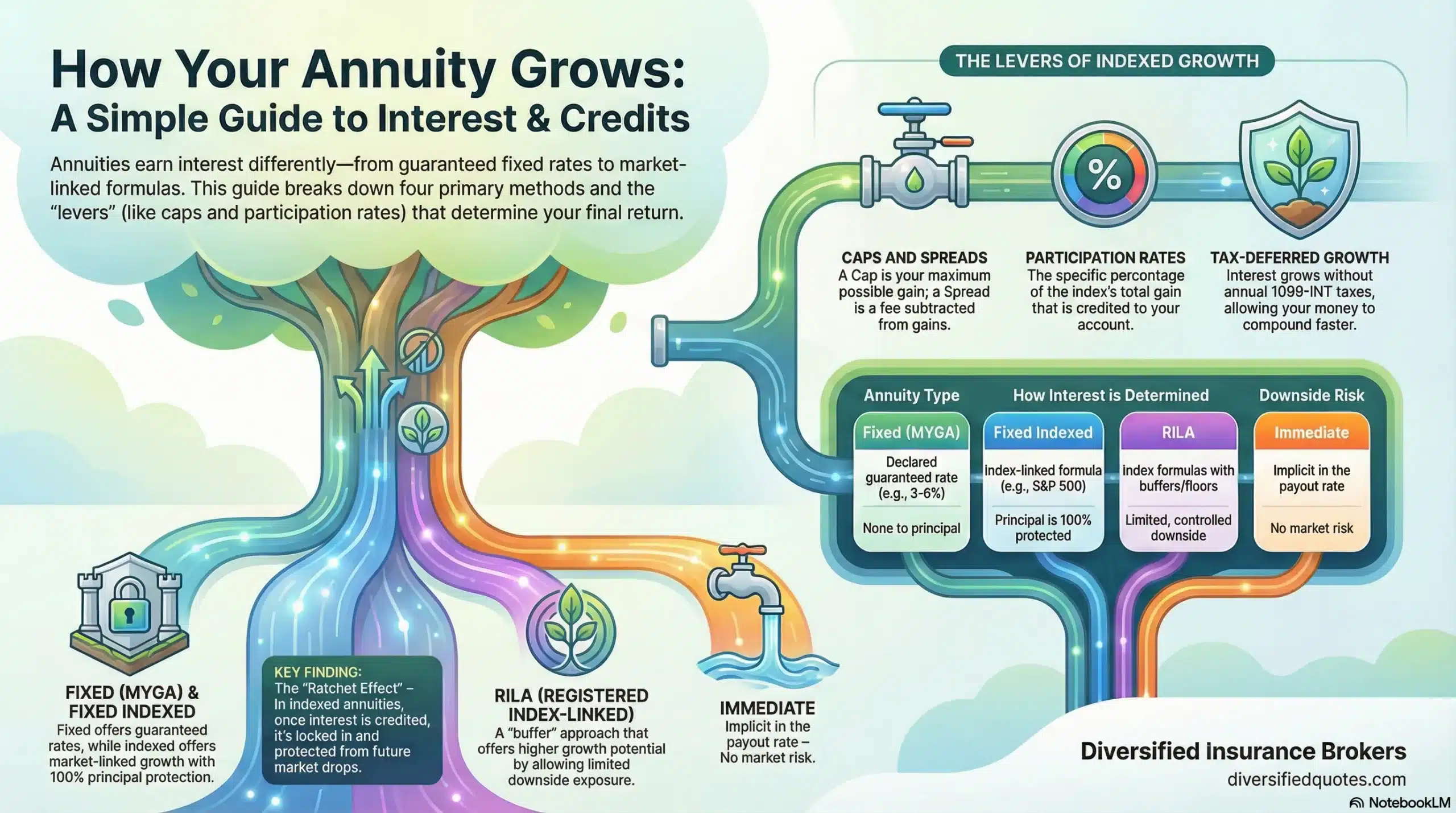
Talk to an Advisor or Request Your Annuity Quote
Ready to explore this annuity in more detail—or compare it with other carriers to see if even higher rates are available? With guaranteed income, principal protection, and long-term growth potential on the line, making the right choice is essential. The experienced advisors at Diversified Insurance Brokers will guide you through the options and design a strategy tailored to your retirement goals.
Schedule here:
calendly.com/jason-dibcompanies/diversified-quotes
Licensed in all 50 states • Fiduciary, family-owned since 1980
FAQs: Atlantic Coast Life Safe Harbor Bonus Guarantee Annuity
The Safe Harbor rate looks higher than competing MYGAs — is it really a better deal?
Not automatically — and this is the central evaluation question. The Safe Harbor credits simple interest, which means each year’s credit is calculated on the original premium, not the growing accumulated balance. A higher stated simple interest rate can produce less total accumulated value than a lower compound interest rate at a competing MYGA. Example using a 7-year term: at 7.40% simple interest on $100,000, Year 1 credits $7,400, and each subsequent year at a 6.40% renewal rate credits $6,400 — total over 7 years approximately $51,000. A competing compound-interest MYGA at 6.40% on the same $100,000 compounds and produces approximately $54,200 over 7 years — more total interest despite being 100 basis points lower in stated rate. The compound-equivalent effective yield of the Safe Harbor over its full term is materially lower than the stated Year 1 rate or the stated renewal rate. Rate tracking services mark the Safe Harbor “SI” and display the compound-equivalent rate to enable valid comparisons. ACL’s Safe Harbor does still frequently produce competitive accumulated values even after the compound adjustment — particularly at the high end of its term menu — but this requires confirmation with accumulated value illustrations at your specific premium and term, not stated rate labels. Reviewing the best MYGA rates from A-rated compound-interest carriers at the same terms is the prerequisite step. Carriers like the Nationwide Secure Growth, Lincoln MYGuarantee Plus, and United of Omaha Ultra-Secure Plus offer compound-interest MYGAs from A+ carriers — the comparison must be done on accumulated value to be valid.
How does the Safe Harbor differ from the Safe Haven — and which one should I choose?
The Safe Haven Bonus Guarantee and Safe Harbor share the same ACL carrier and the same 6-term menu (3, 5, 6, 7, 10, 20 years), but they are fundamentally different products. Safe Harbor: simple interest, no withdrawal riders (only RMDs are penalty-free), higher stated rates, designed for pure accumulation with no access needs. Safe Haven: compound interest, three optional withdrawal riders (Accumulated Interest at −0.05%, Preferred 10% at −0.15%, Death Benefit at −0.25%), lower stated compound rates but typically more accumulated value over multi-year terms due to compounding. The decision is binary: if you need any non-RMD periodic access to this money during the term — interest income, emergency access, regular distributions — you must use Safe Haven, because Safe Harbor provides no mechanism for it. If you have confirmed separate liquidity, want pure accumulation, and are comfortable with simple interest and no access, Safe Harbor is appropriate. Safe Harbor’s higher stated rates make it superficially attractive, but always compare on accumulated value with the compound adjustment applied. Both products lack nursing home and terminal illness waivers — this is an ACL MYGA family-wide gap. If health event waivers are a priority, products like the American Equity GuaranteeShield or the Pacific Guardian Life Diamond Head include those waivers at no cost from A-rated carriers.
Does the death benefit work differently if I don’t elect the Death Benefit Rider?
Yes — and the distinction matters significantly for legacy planning. Without the Death Benefit Rider, beneficiaries have two options: (1) receive the Cash Surrender Value as a lump sum — this means if the owner dies during the surrender period, surrender charges and MVA are applied, potentially reducing what beneficiaries receive from the full account value; or (2) receive the Full Account Value paid as annual installments over 5 years — no surrender charges or MVA, but the value is distributed over 5 years rather than immediately. The 5-year installment option is the mechanism that gives beneficiaries access to the full value without charges, but only as a structured payment stream. With the Death Benefit Rider (−0.25% annual rate reduction), surrender charges and MVA are fully waived on a lump-sum death benefit payment — beneficiaries receive the full account value immediately as a single payment. For families that need immediate lump-sum liquidity at death, the Death Benefit Rider is worth the 0.25% rate reduction. For families that can accommodate a 5-year payment schedule, the base contract’s installment option delivers the full value without the rate cost. This two-structure death benefit design is also found on the sister product, the Safe Haven, where the Death Benefit Rider similarly costs 0.25% in rate. Reviewing annuity beneficiary death benefits covers how inherited annuity proceeds are taxed across both structures and what payment elections beneficiaries can make.
Which term should I choose — and what makes the 20-year option unusual?
The 6-term menu — 3, 5, 6, 7, 10, and 20 years — gives the Safe Harbor unusual granularity compared to most MYGAs that offer only 3, 5, and 7 years. The 6-year term fills the gap between 5 and 7 for buyers whose planning horizon falls in that window. The 10-year term is uncommon among high-rate simple-interest MYGAs. The 20-year term is exceptional — almost no other MYGA carrier offers a 20-year declared-rate product. It targets buyers who want to lock in today’s rates for a very long horizon. Key 20-year distinctions: no first-year bonus (all other terms include the bonus), Death Benefit Rider required for buyers ages 70–75, and the surrender period extends the full 20 years with 9% starting charges. The standard term decision logic applies to shorter options: match the maturity date to the planning horizon, compare the rate differential between terms (longer typically pays more stated rate), and critically — convert each term’s stated rate to its compound-equivalent effective yield before comparing across terms and against competing compound-interest MYGAs. The fixed annuity ladder strategy can be applied across Safe Harbor terms — funding 3-year, 5-year, and 7-year contracts simultaneously for staggered maturity windows. For the Safe Harbor this works particularly well for pure accumulation buyers who don’t need mid-term access, as each contract matures into a full penalty-free window without any ongoing withdrawal complexity.
How does Atlantic Coast Life’s B++ rating affect my evaluation of the Safe Harbor?
AM Best B++ (Good) is two notches below A- and three below A — it means AM Best assesses ACL’s financial cushion as adequate but not at the Excellent level held by A-tier carriers. ACL has operated since 1925 as part of the A-CAP family, so it is not a new company. But the below-A-bracket rating is a real structural risk consideration, particularly for buyers allocating above state guaranty association limits (typically $100,000–$250,000 per contract per insurer depending on state). The rate premium ACL offers on the Safe Harbor relative to A-rated carriers is the compensating factor — buyers must evaluate whether that rate premium, on an accumulated-value basis after compound-adjustment, is sufficient to justify the carrier financial strength differential. Additional signal: ACL’s NAIC Complaint Index is higher than expected for its market share, relevant for long-term interactions across multi-year contracts. Some financial advisors establish a personal minimum of A- or A for carrier selection; for those buyers, the Safe Harbor is disqualified regardless of rate. For buyers comfortable with B++ who are allocating within state guaranty limits and want to maximize accumulated value, ACL’s rate leadership is real — but must be verified on a compound-equivalent accumulated value basis against A-rated alternatives at the same term and premium. Safe fixed annuity options from A+ carriers like the Nationwide Secure Growth (A+, NAIC Complaint Index 0) provide the direct comparative data for that evaluation.
About the Author:
Jason Stolz, CLTC, CRPC, DIA, CAA and Chief Underwriter at Diversified Insurance Brokers (NPN 20471358), is a senior insurance and retirement professional with more than 25 years of real-world experience helping individuals, families, and business owners protect their income, assets, and long-term financial stability. As a long-time partner of the nationally licensed independent agency Diversified Insurance Brokers, Jason provides trusted guidance across multiple specialties—including fixed and indexed annuities, long-term care planning, personal and business disability insurance, life insurance solutions, Group Health, Travel Medical and Evacuation Insurance, and short-term health coverage. Diversified Insurance Brokers maintains active contracts with over 100 highly rated insurance carriers, ensuring clients have access to a broad and competitive marketplace.
His practical, education-first approach has earned recognition in publications such as VoyageATL, and contributions from his agency featured in Kiplinger and GoBankingRates— highlighting his commitment to financial clarity and client-focused planning. Drawing on deep product knowledge and years of hands-on field experience, Jason helps clients evaluate carriers, compare strategies, and build retirement and protection plans that are both secure and cost-efficient. Visitors who want to explore current annuity rates and compare options across multiple insurers can also use this annuity quote and comparison tool.
Explore More Annuity Options: Browse our complete guide to What Is a Fixed Annuity? — covering fixed annuities, MYGAs, laddering strategies & conservative growth options from 100+ carriers.
Last Reviewed: June 23, 2026 |
Reviewed by: Jason Stolz, CLTC, CRPC, DIA, CAA
Chief Underwriter, Diversified Insurance Brokers, Inc. | NPN: 20471358 | Diversified Insurance Brokers, Inc. — Licensed in all 50 states
Fact Checked by: Tonia Pettitt, CMIP©
Medicare Specialist, Diversified Insurance Brokers, Inc. | NPN: 14374308 | Diversified Insurance Brokers, Inc. — Licensed in all 50 states
Did you find this content helpful? Leave us a Google review — it helps others find trustworthy guidance too.
Editorial Standards: Diversified Insurance Brokers maintains rigorous editorial standards to ensure accuracy, clarity, and independence in all content. Learn more about our editorial standards and commitment to transparency.
