
Allianz Accumulation Advantage+ Fixed Index Annuity – Growth Potential With Flexibility and Protection
As an Independent Annuity Broker, we compare rates across 100+ carriers and 1,000 different annuities— not just one company’s product offerings — to find the best fit for your goals.
Allianz Accumulation Advantage+ Fixed Index Annuity – Growth Potential With Flexibility and Protection
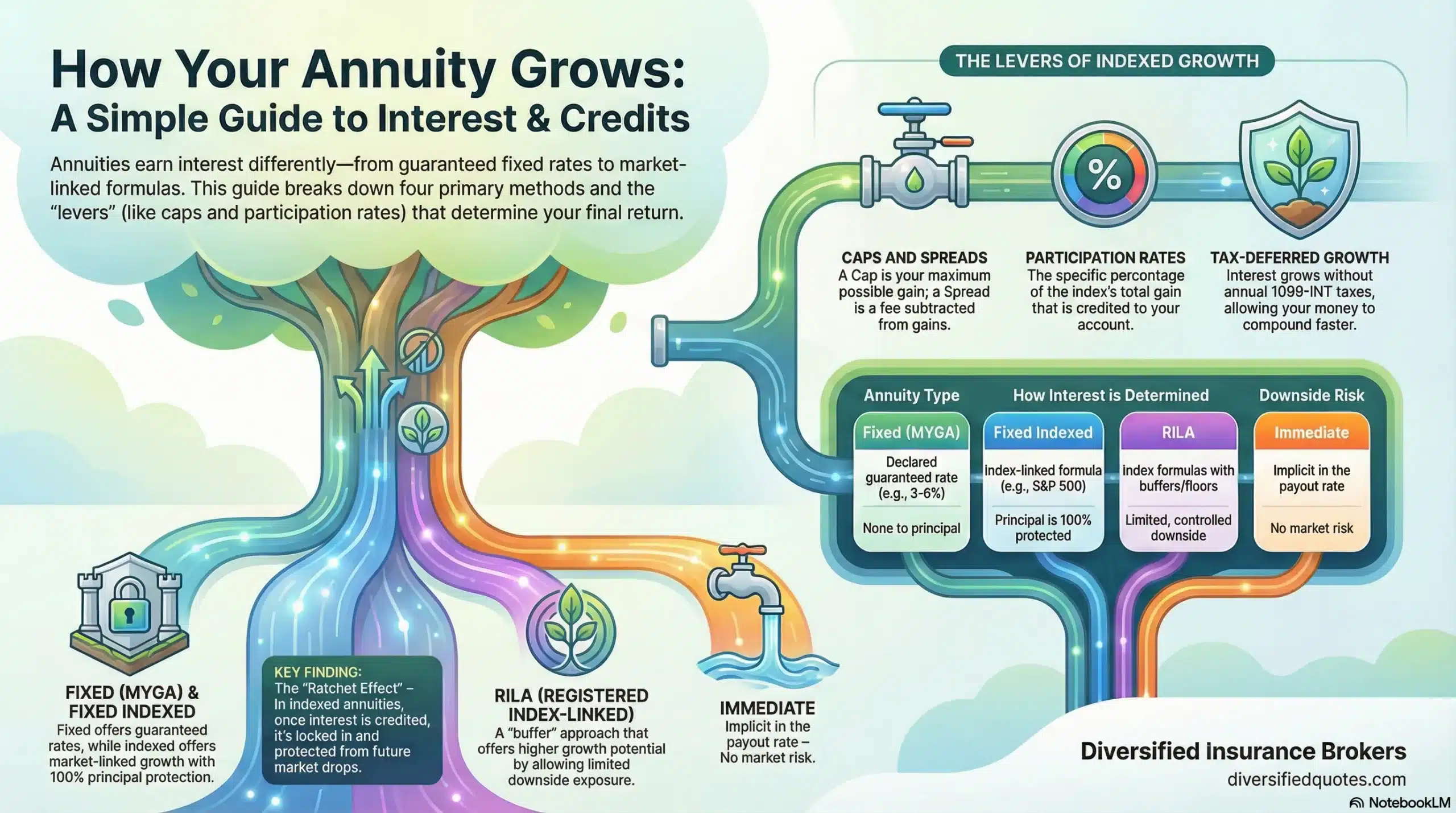
At Diversified Insurance Brokers, we help clients design retirement strategies that balance growth potential with true principal protection. The Allianz Accumulation Advantage+ Fixed Index Annuity, issued by Allianz Life Insurance Company of North America, is a single-premium deferred fixed indexed annuity built for long-term accumulation with a 14% premium bonus, multiple index crediting strategies, and Index Lock features that give policyholders active tools for protecting gains mid-term. It is a pure accumulation product — there is no income rider, no GLWB, and no guaranteed lifetime withdrawal benefit. Buyers whose primary objective is maximizing lifetime income from the outset should evaluate income-oriented FIAs instead. For buyers who want principal protection from market losses, a meaningful bonus to accelerate the compounding base, and index-linked growth potential during a defined accumulation horizon of 10 or more years, the Accumulation Advantage+ is purpose-built for that objective. Understanding how a fixed indexed annuity works — and specifically how crediting methods, participation rates, spreads, and caps influence long-term outcomes — is the prerequisite for evaluating whether the Accumulation Advantage+ is the right accumulation vehicle for your specific horizon and premium.

Ensure you are receiving the absolute top rates
Current Fixed Annuity Rates
Compare today’s best fixed annuity rates from top carriers.
Current Bonus Annuity Rates
See which annuities offer the highest upfront bonus today.
Request an Annuity Quote
Submit our annuity request form to get personalized rate options.
Lifetime Income Calculator
Use our calculator to see how much guaranteed income your annuity can provide.
Allianz Accumulation Advantage+: Key Product Features at a Glance
| Product Feature | Details |
|---|---|
| Issuing Carrier | Allianz Life Insurance Company of North America. Minneapolis, MN. Subsidiary of Allianz SE (global). Operating since 1896. AM Best: A+ (Superior) — 2nd highest of 13 categories. S&P: AA. Comdex: 93. $18.7 billion in policyholder distributions in 2025. Not available in New York. Not FDIC insured. All guarantees backed by claims-paying ability of Allianz Life Insurance Company of North America. |
| Product Type and Term | Single-premium deferred fixed indexed annuity (FIA). 10-year surrender period. Minimum premium: $20,000. Maximum: $2,000,000 without prior approval. Additional premiums accepted during first 18 months ($25–$25,000 per addition without approval; larger amounts with Allianz approval). Additional premiums not allowed in any contract year after a partial withdrawal or RMD. No optional paid riders — accumulation-only product. No income rider, no GLWB. Tax-deferred growth. MVA applies on excess withdrawals. Bonus annuity disclosures apply. |
| 14% Premium Bonus and Vesting Schedule | A 14% premium bonus is credited immediately to the accumulation value on all premiums received during the first 18 contract months. The bonus is subject to a 10-year vesting schedule: 10% of the bonus vests each contract year. If the contract is surrendered before the start of year 11, the unvested portion of the bonus is clawed back. At the start of year 11, 100% of the bonus is fully vested. Important exception: at death, the full bonus (including unvested portions) is paid to beneficiaries. The bonus is a genuine accumulation value enhancement — unlike the Allianz 222’s PIV bonus, it applies to the actual contract value, not only to an income base. Bonus annuity disclosure: may include higher surrender charges, longer surrender periods, lower caps, higher spreads, or other restrictions not found in non-bonus FIAs. |
| Index Crediting Options | Five index options with up to 16 strategies total (15 indexed + 1 fixed): (1) S&P 500® Index — annual point-to-point cap-based; (2) S&P 500 Futures Excess Return Index — participation rate-based; (3) Bloomberg US Dynamic Balance ER III Index — volatility-controlled, participation rate-based; (4) PIMCO Tactical Balanced ER Index — multi-asset volatility-controlled; (5) Morgan Stanley Strategic Trends 10 ER Index — trend-following volatility-controlled; (6) Fixed interest option — declared rate, guaranteed for one year and reset annually. Multi-year point-to-point strategies available on select indices (allocation charge up to 2.5% maximum; current allocation charge: 0% — confirm at renewal). All strategies carry a zero floor — negative index performance cannot reduce accumulation value. Caps, spreads, and participation rates declared at issue and on each contract anniversary within contractual minimums. |
| Index Lock and Auto Lock | Index Lock: Manual feature allowing the contract owner to lock in the current index value at any point during a crediting period. Once locked, that value is used to calculate the interest credit at the end of the term regardless of subsequent index movement — capturing gains and protecting them from reversal. Auto Lock: Automated version allowing the owner to pre-set upper and/or lower index interest percentage targets. When the index interest rate hits the set target during the crediting period, it locks automatically. Both features are included at no additional charge. Index Lock is an active management tool — using it effectively requires monitoring the index and making deliberate decisions, not reacting emotionally to short-term volatility. |
| Free Withdrawal Provision | After the first contract year (following the last premium payment), the greater of 10% of paid premiums or 10% of the beginning-of-year accumulation value may be withdrawn annually without surrender charges or MVA. Carryover provision: unused free withdrawal percentage carries over to the following year, up to a maximum of 20% cumulative in any year. Free withdrawals taken during a crediting period still receive pro-rated indexed interest credit for that period if the index closes positively at the end of the term. RMDs from qualified accounts qualify as free withdrawals with prior notice to Allianz. |
| Nursing Home / Hospital Provision (No Cost) | If the contract owner is admitted to a qualifying nursing home, assisted living facility, or hospital after the first contract year and remains confined for at least 30 days in any 35-day period, the owner may elect to begin annuity income payments based on the full accumulation value. Payments are made in equal amounts for a period chosen by the owner of at least 5 years and no more than 9 years. No additional charge. Important distinction: this provision triggers an annuity payment structure — it is not a waiver of surrender charges for a lump sum withdrawal. Access is structured as a period-certain income stream from the full accumulated value, not a cash-out. For buyers comparing this provision against true nursing home surrender charge waivers on other FIAs, reviewing annuities with nursing home care riders covers the structural differences. |
| Surrender Charges and MVA | 10-year surrender charge period. Excess withdrawals above the free amount trigger surrender charges plus an unvested bonus reduction. Market Value Adjustment (MVA) tied to Bloomberg US Intermediate Corporate Bond Index yield changes — can be positive or negative depending on rate environment at time of withdrawal. After year 10: fully liquid, no surrender charges, no MVA, no unvested bonus reduction — full accumulation value available without restriction. Annuitization available after 5 contract years based on accumulation value. |
| Death Benefit | At death, beneficiaries receive the greatest of: accumulation value, guaranteed minimum value, or total withdrawals — no surrender charges. Full unvested bonus included in the death benefit, even if death occurs before full vesting at year 11. This means beneficiaries receive the complete bonus-enhanced value regardless of where in the vesting schedule the owner was at time of death. Spousal continuation available. Assets pass directly to named beneficiaries in most cases, typically bypassing probate. |
| Tax Treatment | Interest grows tax-deferred — no annual 1099 during accumulation. Non-qualified: LIFO — earnings distributed first, taxed as ordinary income; cost basis returned tax-free. Qualified accounts: full distributions taxed as ordinary income. No additional tax deferral for qualified accounts beyond the plan itself. Withdrawals before age 59½ subject to 10% IRS early withdrawal penalty. Eligible funding sources: Non-Qualified, IRA, Roth IRA, IRA Rollover, SEP IRA, 401(k), 403(b), 401(a), Profit Sharing, Pension, KEOGH, TSP, Inherited IRA, Roth Conversion. Not FDIC insured. |
The 14% Bonus and 10-Year Vesting: What It Means in Practice
The 14% premium bonus on the Accumulation Advantage+ is a genuine accumulation value enhancement — unlike the Allianz 222’s PIV bonus which applies only to an income calculation base, the Accumulation Advantage+’s 14% bonus goes directly into the accumulation value that represents actual contract worth. On a $100,000 premium, the accumulation value starts at $114,000 on day one, and that $114,000 immediately begins compounding through index credits. The compounding impact over 10 years is meaningful. The vesting schedule is the critical offsetting constraint: 10% of the bonus vests per year, so in year 1 only 10% ($1,400) is locked in — the remaining $12,600 is subject to clawback if surrendered in year 1. By year 5, half the bonus is vested ($7,000) and half remains at risk. Only at the start of year 11 is the full $14,000 permanently locked. For buyers who plan to hold through the full 10-year surrender period — and who have confirmed separate liquidity for any foreseeable needs outside the annuity — the vesting schedule is simply a contractual term that doesn’t affect them. For buyers with any meaningful probability of needing early access beyond the 10% annual free withdrawal, the unvested bonus clawback combined with surrender charges and MVA creates a compounding early-exit cost. Understanding how surrender charges work alongside the vesting schedule before committing is the prerequisite for any Accumulation Advantage+ allocation. Buyers positioning IRA rollovers into this product should review how to transfer an IRA to an annuity and review 401(k) rollover mechanics before initiating any qualified transfer, and ensure the current year’s RMD obligation is satisfied before the funds move.
Index Lock, Auto Lock, and the Carryover Free Withdrawal: Distinctive Structural Features
The Accumulation Advantage+’s Index Lock and Auto Lock features reflect Allianz’s long track record of FIA innovation. Index Lock allows the owner to lock in a favorable index value at any point during a crediting period — once locked, subsequent index declines before the crediting anniversary don’t reduce the locked credit. Auto Lock automates this by letting the owner pre-set gain targets; when the index interest percentage hits the target, it locks automatically. Both features are genuinely useful active management tools for buyers who monitor their contract and want to protect mid-term gains from late-period market reversals. The 10% annual free withdrawal provision includes a meaningful carryover feature: if the full 10% free withdrawal is not used in a given year, the unused percentage carries forward to the next year up to a maximum of 20% cumulative. This gives buyers who go several years without withdrawals a larger penalty-free access window when they do need funds. Free withdrawals taken during a crediting period also receive pro-rated indexed interest credit if the crediting period closes positively — meaning you aren’t penalized with zero credit for a year when you took a free withdrawal, as long as the index was positive. These two provisions — the carryover and the pro-rata credit — make the Accumulation Advantage+’s liquidity structure meaningfully more flexible than many competing FIAs’ standard 10% provision. Reviewing how free withdrawal rules work across FIA products provides the comparative context. The sequence of returns risk the Accumulation Advantage+ addresses — by protecting the principal from market losses during accumulation — is the same structural problem it’s designed for.
The Accumulation Advantage+ in the Allianz Lineup and How It Compares to Competing Accumulation FIAs
Within the Allianz FIA family, the Accumulation Advantage+ occupies the pure accumulation position. The Allianz 222 is income-architecture first — its bonuses build a Protected Income Value for lifetime withdrawals, and accumulation value growth is secondary. The Allianz 360 applies a 105% interest bonus that enhances both the accumulation value and an income base simultaneously — suitable for buyers who want accumulation value growth alongside income base building. The Allianz Core Income 7 provides a 7-year surrender period for income-focused buyers with a nearer time horizon. The Accumulation Advantage+ is the right Allianz product when the buyer’s sole objective for this capital is accumulation — growing the contract value through index credits with principal protection, no income rider fees reducing credited interest, and a 14% bonus boosting the compounding base from day one. Allianz also announced in April 2026 two new accumulation FIAs: the Accumulation Advantage 5 (5-year surrender period, no premium bonus, no product fee) and the Accumulation Advantage Classic (includes non-volatility-controlled S&P 500 Futures Index ER and new crediting methods). Buyers who want a shorter commitment or a cleaner non-bonus structure should ask Diversified Insurance Brokers about these newer options alongside the Accumulation Advantage+. For buyers evaluating whether the Accumulation Advantage+ or a competing accumulation FIA produces more total accumulated value at their specific premium and horizon — comparing against products like the Athene Ascent Pro 10 Bonus on pure accumulation metrics — a current illustrated accumulated value comparison at equivalent premiums and terms is the only reliable evaluation. Reviewing the best fixed indexed annuities across the full market and reviewing whether annuities are worth it for your specific situation provides the broader planning framework. At the end of the 10-year period, many buyers transition to an income product — reviewing whether to annuitize or use an income rider on a separate product covers the options at maturity. Coordinating the maturity event with Social Security timing is a key tax planning step — reviewing how Social Security and annuities work together before planning any distributions reduces bracket surprises. For buyers comparing guaranteed accumulation alternatives — whether a MYGA with declared rates makes more sense than an FIA with index-linked upside — reviewing annuities with the highest guaranteed payout and how those structures compare to the Accumulation Advantage+’s growth mechanics provides the full decision context. And reviewing annuity beneficiary death benefits — including the Accumulation Advantage+’s unique death benefit that includes the full unvested bonus — covers the estate planning dimension before any commitment.
Related Pages
Explore additional Allianz products and FIA accumulation planning resources.
Financial Protection Essentials
FIA accumulation resources covering bonus mechanics, crediting strategy selection, and retirement income planning at maturity.
Talk to an Advisor or Request Your Annuity Quote
Ready to explore this annuity in more detail—or compare it with other carriers to see if even higher rates are available? With guaranteed income, principal protection, and long-term growth potential on the line, making the right choice is essential. The experienced advisors at Diversified Insurance Brokers will guide you through the options and design a strategy tailored to your retirement goals.
Licensed in all 50 states • Fiduciary, family-owned since 1980
FAQs: Allianz Accumulation Advantage+ Fixed Index Annuity
The 14% bonus sounds compelling — what are the real strings attached?
The 14% premium bonus is a genuine accumulation value enhancement — it goes directly into the contract value that represents your actual money, which makes it meaningfully different from income-base bonuses like those in the Allianz 222 that only enhance an income calculation. On $100,000 of premium, the accumulation value starts at $114,000, and that full $114,000 compounds from day one. The strings: a 10-year vesting schedule at 10% per year. In year 1, only $1,400 of the bonus is permanently locked in; the other $12,600 is subject to clawback if surrendered. By year 5, $7,000 is vested and $7,000 remains at risk. At the start of year 11, 100% is vested. The important exception is death: if the owner dies at any point, the full unvested bonus is included in the death benefit — beneficiaries receive the complete bonus-enhanced value. The vesting schedule combined with surrender charges and MVA creates three simultaneous early-exit costs. A buyer who surrenders in year 3 faces: (1) surrender charge on excess withdrawals; (2) MVA adjustment; (3) unvested bonus clawback on 70% of the $14,000 bonus. That compounding early-exit cost is why this product is appropriate only for buyers who have confirmed they won’t need access beyond the 10% annual free withdrawal for the full 10-year period. As Allianz itself discloses: bonus annuities may include higher surrender charges, longer surrender periods, lower caps, and other restrictions compared to non-bonus FIAs. Reviewing how surrender charges work and modeling the specific early-exit cost at your premium and anticipated withdrawal scenario is an essential step before any commitment.
How does the Accumulation Advantage+ handle nursing home confinement — is it a surrender charge waiver?
The Accumulation Advantage+’s nursing home provision is a specific annuity payment option — it is not a surrender charge waiver for a lump sum withdrawal, and buyers who evaluate it as equivalent to nursing home waivers on other FIAs may be misled by the distinction. If the owner is admitted to a qualifying nursing home, assisted living facility, or hospital after the first contract year and remains confined for at least 30 days in any 35-day period, the owner can elect to begin receiving annuity income payments based on the full accumulation value. Payments are equal and distributed over a period the owner selects of at least 5 years and no more than 9 years. No additional charge. What this means in practice: the full accumulation value converts to a structured payment stream for the chosen period. This is more restrictive than the nursing home waivers available on competing FIAs — for example, the American Equity BalanceShield 10 includes an Enhanced Benefit Rider with 100% penalty-free access as a lump sum withdrawal upon qualifying nursing home confinement, and the Athene Ascent Pro 10 Bonus similarly includes a full waiver rather than a structured payment trigger. For buyers who want full lump-sum access upon nursing home confinement, the Accumulation Advantage+’s provision may be insufficient — a structured period-certain payment may not provide the immediate liquidity needed for lump-sum care facility deposits or large one-time expenses. Reviewing annuities with nursing home care riders covers the full spectrum of nursing home provisions across FIA carriers, including the structural differences between period-certain payment triggers and full surrender charge waivers.
Which index strategy should I choose — and should I use volatility-controlled or traditional indices?
The choice between the traditional S&P 500 strategy and volatility-controlled proprietary indices is the most consequential allocation decision within the Accumulation Advantage+. The S&P 500 annual point-to-point cap strategy is the most transparent option — the cap rate is the maximum credited, the S&P 500’s documented historical performance is the benchmark, and there are no embedded index costs or volatility targeting mechanisms. If the S&P 500 gains 20% and the cap is 10%, you credit 10%. If it falls, you credit 0%. The volatility-controlled indices — Bloomberg US Dynamic Balance ER III, PIMCO Tactical Balanced ER, Morgan Stanley Strategic Trends 10 ER — support higher participation rates because their volatility-targeting methodology makes them cheaper for Allianz to hedge. A 100%–165% participation rate on these indices sounds impressive compared to a 10% S&P 500 cap. But in strong bull market years, volatility-controlled indices frequently credit significantly less than the S&P 500 because their dynamic risk management actively reduces equity exposure during periods of elevated volatility — precisely when equity gains tend to be strongest. The net result: in strong markets, the S&P 500 cap strategy often produces more credited interest despite the cap; in flat or mildly positive markets, the high-participation volatility strategies may produce more. The S&P 500 Futures Excess Return Index is a hybrid — futures-based with participation rate, sitting between the two in risk and return characteristics. The multi-year point-to-point strategies on select indices are available for buyers who want a longer measurement period, subject to an allocation charge (currently 0%, maximum 2.5% — monitor at renewal). Reviewing FIA crediting methods in full — including how volatility-controlled indices differ from raw equity benchmarks and why higher participation rates don’t necessarily mean higher credits — provides the analytical foundation for this choice. Many buyers diversify across multiple strategies within the same contract rather than committing 100% to one.
Is the Accumulation Advantage+ the right Allianz product — or should I consider the 222, 360, or Core Income 7 instead?
The answer depends entirely on whether your primary objective for this capital is accumulation or lifetime income. The Accumulation Advantage+ is the right choice when accumulation is the sole objective — growing contract value through index credits with no income rider reducing credited interest and no income base mechanics adding complexity. The 14% bonus going directly into the accumulation value is the defining advantage. The Allianz 222 (current 222+) is right when lifetime income maximization is the primary goal — its bonuses build a Protected Income Value, not accumulation value, and the entire product architecture is optimized for generating the largest possible guaranteed lifetime withdrawal. The accumulation value in the 222 is secondary. The Allianz 360 occupies a middle position: its 105% interest bonus applies to both the accumulation value and an income base simultaneously — buyers who want their accumulation value to also benefit from the interest multiplier (not just an income base) get that here. The Allianz Core Income 7 reduces the commitment to 7 years for income-oriented buyers who want a shorter surrender period. The Accumulation Advantage+ also now has two siblings announced in April 2026: the Accumulation Advantage 5 (5-year surrender, no bonus, no product fee) for buyers who want a shorter commitment without the vesting complexity, and the Accumulation Advantage Classic (new crediting methods including non-volatility-controlled S&P 500 Futures Index ER). Buyers should ask Diversified Insurance Brokers for a full current illustration comparison across these options at their specific premium before committing to any Allianz product.
What happens at the end of 10 years — what are my options?
At the start of year 11, the Accumulation Advantage+ becomes fully liquid: no surrender charges, no MVA, no unvested bonus reduction. The full accumulation value — including 100% of the now-fully-vested premium bonus and all credited index interest — is available without restriction. Four principal options exist at that point. First, continue accumulating: the contract continues compounding tax-deferred, with the owner reallocating among index strategies on each anniversary. There is no requirement to exit at year 10. Second, withdraw as a lump sum: the full accumulation value is available penalty-free as a lump sum at any point after year 10. Third, annuitize: convert the accumulation value into a guaranteed income stream through annuity payments — period-certain options from 5 to 10+ years are available. Annuitization is irrevocable. Reviewing whether to annuitize or use an income rider on a separate product covers the structural comparison for this decision. Fourth, 1035 exchange: transfer the full accumulation value into a new annuity — often an income-focused FIA like the American Equity IncomeShield 10 or Athene Ascent Pro 10 Bonus — to access a GLWB or income rider for the income distribution phase without triggering a taxable event. Coordinating the timing of distributions with Social Security claiming and other income sources, and ensuring any distributions after age 73 satisfy required minimum distribution obligations, are the key planning steps before any year-10 decision.
About the Author:
Jason Stolz, CLTC, CRPC, DIA, CAA and Chief Underwriter at Diversified Insurance Brokers (NPN 20471358), is a senior insurance and retirement professional with more than 25 years of real-world experience helping individuals, families, and business owners protect their income, assets, and long-term financial stability. As a long-time partner of the nationally licensed independent agency Diversified Insurance Brokers, Jason provides trusted guidance across multiple specialties—including fixed and indexed annuities, long-term care planning, personal and business disability insurance, life insurance solutions, Group Health, Travel Medical and Evacuation Insurance, and short-term health coverage. Diversified Insurance Brokers maintains active contracts with over 100 highly rated insurance carriers, ensuring clients have access to a broad and competitive marketplace.
His practical, education-first approach has earned recognition in publications such as VoyageATL, and contributions from his agency featured in Kiplinger and GoBankingRates— highlighting his commitment to financial clarity and client-focused planning. Drawing on deep product knowledge and years of hands-on field experience, Jason helps clients evaluate carriers, compare strategies, and build retirement and protection plans that are both secure and cost-efficient. Visitors who want to explore current annuity rates and compare options across multiple insurers can also use this annuity quote and comparison tool.
Explore More Annuity Options: Browse our complete guide to Best Fixed Indexed Annuity Products — covering individual fixed indexed annuity product reviews from top-rated carriers from 100+ carriers.
Last Reviewed: June 24, 2026 |
Reviewed by: Jason Stolz, CLTC, CRPC, DIA, CAA
Chief Underwriter, Diversified Insurance Brokers, Inc. | NPN: 20471358 | Diversified Insurance Brokers, Inc. — Licensed in all 50 states
Fact Checked by: Tonia Pettitt, CMIP©
Medicare Specialist, Diversified Insurance Brokers, Inc. | NPN: 14374308 | Diversified Insurance Brokers, Inc. — Licensed in all 50 states
Did you find this content helpful? Leave us a Google review — it helps others find trustworthy guidance too.
Editorial Standards: Diversified Insurance Brokers maintains rigorous editorial standards to ensure accuracy, clarity, and independence in all content. Learn more about our editorial standards and commitment to transparency.
