
Annuity Playbook
Annuity Playbook
At Diversified Insurance Brokers, we believe that understanding your annuity options shouldn’t feel overwhelming. That’s why we’ve created the Annuity Playbook—a comprehensive, easy-to-follow guide designed to help you make confident decisions about your retirement income strategy. Backed by decades of experience and access to over 100 top-rated carriers, our playbook gives you insider knowledge on how annuities work, the different types available, and how to choose the right one for your goals.

Retirement income planning can feel overwhelming. You have multiple potential income sources—Social Security, pensions (if you have one), investment withdrawals, and potentially annuities—and you need to coordinate them strategically to maximize income, minimize taxes, and protect against outliving your assets. That’s exactly why we created the Annuity Playbook: a comprehensive, actionable framework for understanding how annuities fit into modern retirement planning and how to structure guaranteed income without sacrificing flexibility or control. The Annuity Playbook is designed for busy people who want clarity, not complexity—practical guidance on annuity options without the sales pitch.
At Diversified Insurance Brokers, we’ve spent decades helping retirees build multi-layered income strategies using annuities alongside other assets. We’ve seen what works, what doesn’t, and where people typically get confused. The Annuity Playbook distills that real-world experience into a step-by-step roadmap that covers product selection, rate shopping, rider choices, tax coordination, and income structuring. Whether you’re newly retired, approaching retirement, or already receiving income and considering whether to add guarantees, the Annuity Playbook provides the framework you need to make confident decisions about annuities and how they serve your specific retirement goals. For those interested in understanding the complete picture, exploring our complete annuity playbook resource provides additional depth.
Request Your Free Annuity Playbook Today
Download the Playbook
Get the complete Annuity Playbook with strategies, checklists, and planning templates.
Get Your CopyCurrent Rates & Illustrations
See personalized income estimates based on 100+ carrier options.
View RatesModel Your Guaranteed Income
Use our calculator to see income scenarios based on your Annuity Playbook strategy.
What’s Inside the Annuity Playbook: Core Modules and Strategies
The Annuity Playbook is organized into modules that build on each other, starting with foundational concepts and progressing to strategy implementation. The first module in the Annuity Playbook covers the income-floor strategy: identifying your essential monthly expenses and determining how much guaranteed income you need to cover them. This calculation starts by listing your essential monthly expenses—housing (mortgage or rent), utilities, food, healthcare premiums, transportation, insurance, minimum debt payments—intentionally excluding discretionary items like travel or dining out. The Annuity Playbook walks you through this exercise step-by-step because it’s the foundation that shapes all subsequent decisions. Understanding lifetime income planning from the start helps you build on this foundation properly. Too many people approach annuities backwards, asking “How much should I invest?” when the Annuity Playbook teaches them to ask first, “How much monthly income do I actually need?”
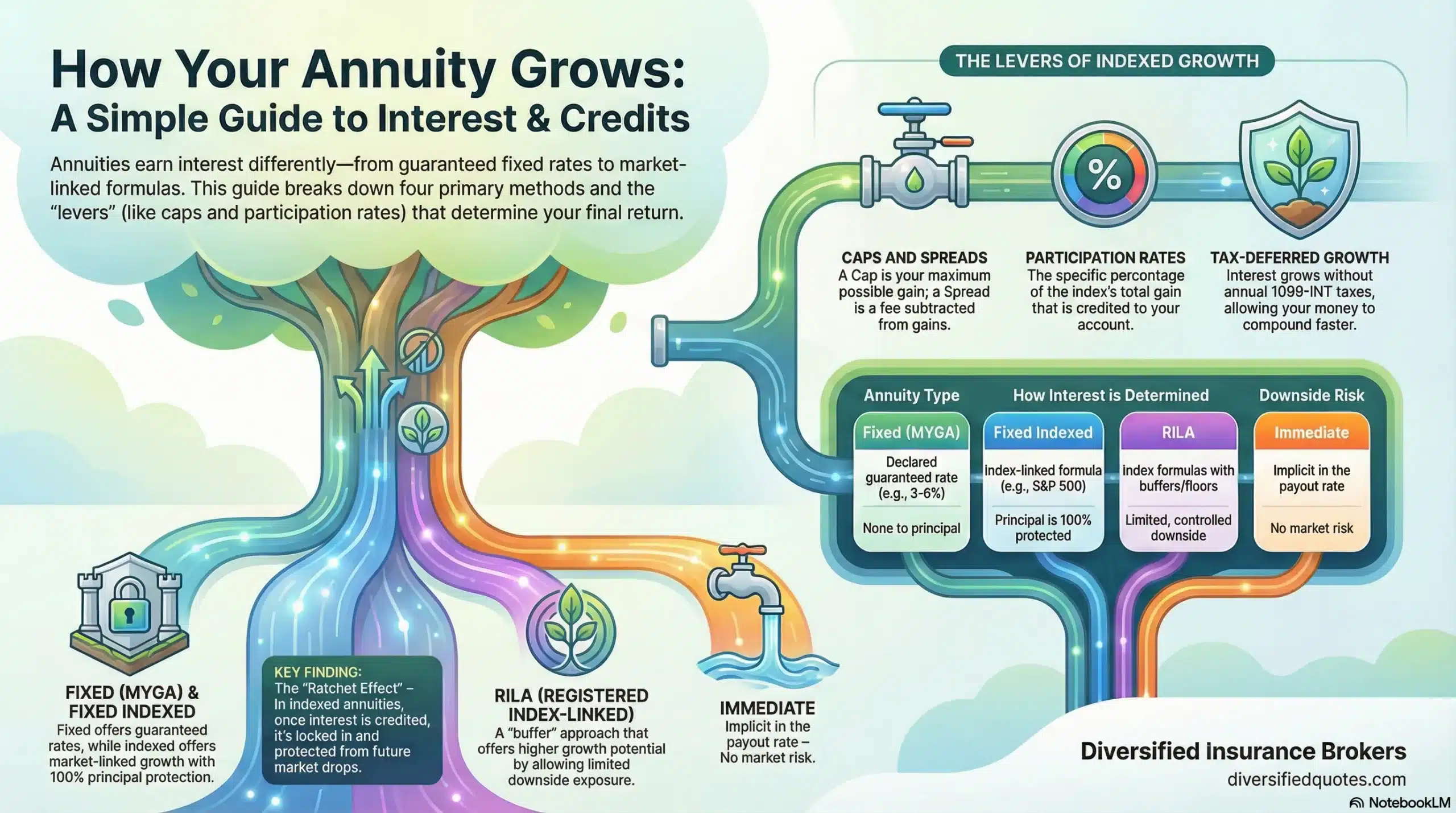
The second module of the Annuity Playbook covers product selection: understanding the different annuity types available and which structures best support your income goal. The Annuity Playbook compares fixed annuities (locked interest rates with no market exposure), fixed indexed annuities (market-linked crediting with downside protection), immediate income annuities (guaranteed income beginning within 12 months), and deferred income annuities (guaranteed income beginning at a future date). The Annuity Playbook helps you understand the trade-offs: fixed annuities offer certainty but low growth; indexed annuities offer growth potential but with caps and participation rates; immediate annuities provide income now but less deferral benefit; deferred annuities defer income but often provide higher eventual payouts. Exploring MYGA annuity options can also provide insights into alternative fixed-rate structures. Real retirees rarely need every type—the Annuity Playbook helps you identify which structures match your specific situation.
The third module in the Annuity Playbook covers income riders and guaranteed lifetime withdrawal benefits (GLWB). An income rider is a contract feature that guarantees you can withdraw a specific percentage annually, regardless of market performance. The Annuity Playbook explains how income riders work and what fees they charge (typically 0.75%-1.25% annually), and when they make sense versus traditional lifetime income annuities. Many retirees appreciate the flexibility income riders provide—you maintain access to your account value while receiving guaranteed withdrawal guarantees. The Annuity Playbook helps you compare this to immediate annuities, where you surrender liquidity but typically get higher guaranteed payments. For those considering how GLWB riders work, the Annuity Playbook provides detailed side-by-side analysis.
The fourth module of the Annuity Playbook addresses payout structure decisions: single life vs. joint life, guaranteed periods, inflation adjustments, and how these choices affect monthly income. The Annuity Playbook emphasizes anchoring essentials (housing, food, utilities, insurance, baseline healthcare) to high-reliability income sources—Social Security, pensions, and guaranteed annuity income—leaving more variable market withdrawals for “nice-to-have” spending. This strategy, which the Annuity Playbook calls “bucketing,” reduces sequence-of-returns risk by ensuring essential needs are protected regardless of market performance. Understanding annuity benefits in this context helps you see how structure affects long-term security.
How the Annuity Playbook Addresses Common Planning Mistakes
One of the most valuable aspects of the Annuity Playbook is identifying common mistakes retirees make and showing you how to avoid them. The Annuity Playbook explicitly calls out over-annuitizing: putting too much of your assets into guaranteed income and reducing flexibility or inheritance potential. The Annuity Playbook teaches a principle: annuitize only essential expenses, not discretionary spending. Understanding annuity surrender charges helps you appreciate why maintaining liquidity matters. This distinction is critical because it changes how much of your portfolio should become a guaranteed income stream versus remaining invested for growth and liquidity.
The Annuity Playbook also warns against timing mistakes. Purchasing a Single Premium Immediate Annuity (SPIA) at age 62 when you could wait until 70 or 72 means accepting lower monthly income per dollar for the rest of your life. The Annuity Playbook helps you model this trade-off: if deferring five years increases income 20-30%, that’s meaningful. Understanding how much larger premiums pay across different ages helps you see the age-income relationship clearly. Conversely, waiting too long means you leave years of retirement income on the table. The Annuity Playbook provides frameworks for deciding whether to start immediately, defer, or use a ladder strategy combining both.
The Annuity Playbook also addresses the inflation problem. Fixed income annuities provide predictable payments, but they don’t grow to keep pace with inflation. After 20 years, what was adequate income becomes inadequate. The Annuity Playbook discusses inflation-adjusted annuities (which start lower but grow over time), using other portfolio portions to cover inflation, or planning from the start to cover inflation through discretionary-spending withdrawals from your investment portfolio. Those interested in tax-efficient strategies should also explore Roth conversions as part of the Annuity Playbook framework. Without this Annuity Playbook guidance, retirees often overlook inflation entirely and face purchasing-power erosion.
Finally, the Annuity Playbook warns against skipping the gap calculation. Many people purchase annuities based on a lump sum (“I have $500,000 to invest”) rather than an income target (“I need $2,500 monthly”). The Annuity Playbook reverses this: start with your income need and work backward to determine the premium required. Understanding how annuity payout calculators work helps you run these scenarios. This approach ensures your annuity options align with your actual income need rather than an arbitrary asset amount. Exploring retirement income calculators gives you additional tools beyond the Annuity Playbook to validate your gap calculations.
Annuity Playbook Strategy Table: Comparing Scenarios by Life Stage and Income Need
| Life Stage / Situation | Annuity Playbook Recommendation | Primary Benefits | Key Trade-Off |
|---|---|---|---|
| Age 50-55, Income Not Needed Yet | Deferred Income Annuity (DIA); lock rates now for future income | Higher guaranteed income at start date; rate certainty; tax deferral | Reduced liquidity; long deferral period |
| Age 60-65, Approaching Retirement | Fixed Indexed Annuity with GLWB or immediate SPIA for essential income | Balance growth potential and guarantees; flexibility to access funds if needed | Rider fees; moderate income vs. pure SPIAs |
| Age 65+, Income Needed Now | Single Premium Immediate Annuity (SPIA) for baseline; supplement with portfolio withdrawals | Highest guaranteed income per dollar; income begins immediately; certainty | Surrender of principal; reduced liquidity; no growth |
| Married Couple, Want Survivor Protection | Joint-life SPIA or FIA with GLWB (100% survivor benefit) | Income continues for surviving spouse; household stability protected | 15-25% lower monthly payment vs. single-life option |
| Large Portfolio, Want Tax Efficiency | Non-qualified annuity with tax-efficient withdrawal structure; MYGA for principal parking | Tax deferral on earnings; exclusion ratio reduces taxable income; CD-like safety | Surrender charges during accumulation phase |
| 401(k) / IRA Rollover, Want Guarantees | Qualified SPIA or FIA with GLWB; consider QLAC for RMD efficiency | Tax-deferred growth continues; guaranteed income from tax-advantaged funds; RMD coordination | Full payment taxable as ordinary income; reduced RMD flexibility |
The Annuity Playbook’s Four-Layer Income Architecture
One of the core concepts in the Annuity Playbook is the idea of layered income: rather than relying on a single source, build multiple income streams that work together and offset each other’s weaknesses. The first layer of the Annuity Playbook’s architecture is guaranteed income floor: Social Security plus any guaranteed annuity income. This combined payment must cover essential expenses—the non-negotiable monthly costs you must meet regardless of market performance. Understanding whether Social Security is taxable helps you plan the after-tax income from this layer. This layer should absorb approximately 80-100% of essential expenses, leaving no room for market risk.
The second layer in the Annuity Playbook is flexible income from your investment portfolio. You withdraw a percentage annually from stocks, bonds, or funds based on a guardrail approach (typically 3.5%-5% depending on market conditions and your specific situation). This layer covers discretionary spending—travel, hobbies, helping family members, one-time expenses. Because it comes from investments rather than guarantees, you can adjust it based on market conditions and your actual spending needs that year. Understanding sequence-of-returns risk helps you appreciate why this layering approach matters.
The third layer of the Annuity Playbook is tax-efficient withdrawal sequencing. By strategically withdrawing from taxable accounts first, then pre-tax retirement accounts, then Roth accounts (in later years), the Annuity Playbook helps you manage tax brackets, reduce Medicare IRMAA premiums, and coordinate with RMD calculations. The Annuity Playbook emphasizes that tax planning is not separate from annuity planning—they’re interconnected decisions that must be coordinated. Understanding how annuities are taxed in retirement becomes critical for this layer.
The fourth and final layer in the Annuity Playbook is legacy planning. After essential and discretionary income needs are met, any remaining assets serve the purpose of leaving an inheritance or making charitable gifts. The Annuity Playbook discusses how different annuity structures affect legacy potential: pure life annuities surrender principal upon death, while annuities with beneficiary riders or period-certain guarantees preserve some legacy value. Understanding what happens to your annuity when you die helps you decide how much to annuitize.
How the Annuity Playbook Integrates With Social Security and Pension Planning
One of the most underutilized aspects of retirement planning covered in the Annuity Playbook is Social Security claiming strategy coordination. If you delay claiming Social Security from age 62 to age 70, your benefit increases about 8% per year. That’s a powerful enhancement—turning a $2,000 monthly benefit into a $2,960 monthly benefit by age 70. The challenge is bridging the gap between when you retire and when Social Security begins. This is where the Annuity Playbook shines: using an immediate annuity or portfolio withdrawals to cover essential expenses before age 70, coordinating with higher Social Security when it arrives. For many couples, one spouse claims early (at 62-67) while the other delays to 70, with annuity income filling gaps as needed. The Annuity Playbook walks you through these scenarios carefully. Understanding how to not run out of money in retirement requires coordinating these timing decisions.
For those with pensions, the Annuity Playbook explains how to coordinate pension income with annuities. A pension typically provides a fixed monthly amount, which becomes part of your guaranteed income floor. The Annuity Playbook then helps you calculate how much additional guaranteed income (via annuities) is needed to meet your essential expenses, and whether your existing pension alone provides sufficient guarantees or whether supplementary guaranteed income is prudent. Exploring pension alternatives through the Annuity Playbook lens helps you understand how annuities can replicate or enhance pension-like income.
The Annuity Playbook’s Approach to Carrier Selection and Rate Shopping
The Annuity Playbook emphasizes that not all carriers offer the same rates or terms. For the same age, premium, and payout structure, Carrier A might pay $2,000 monthly while Carrier B pays $2,150 monthly—an 8% difference that compounds to substantial lifetime value. The Annuity Playbook teaches you to compare carriers rather than accepting the first quote. This is why working with an independent advisor who accesses 100+ carriers matters: it ensures your Annuity Playbook strategy gets implemented across the carriers offering the best rates, not just one company’s best offering. Checking resources like Is Northwestern Mutual a Good Insurance Company? or Is Principal a Good Insurance Company? helps you evaluate carrier quality alongside rates.
The Annuity Playbook also addresses the importance of carrier financial strength. The guaranteed income promised by an annuity is only as strong as the insurance company issuing it. The Annuity Playbook recommends selecting carriers rated A- or higher by AM Best to ensure long-term stability of your guaranteed income stream. The Annuity Playbook also discusses state guaranty associations, which provide additional protection if an insurer faces financial difficulties.
The Annuity Playbook’s Tax Coordination Strategies
Tax planning and annuity planning are inseparable, yet many retirees plan them separately. The Annuity Playbook brings them together. When you receive income from a qualified annuity (funded with pre-tax IRA or 401(k) dollars), the full payment is taxable as ordinary income. When you receive income from a non-qualified annuity (funded with after-tax savings), an exclusion ratio determines what portion of each payment is tax-free return of principal and what portion is taxable earnings. The Annuity Playbook helps you understand which structure makes sense given your total tax picture. For those rolling over retirement accounts, understanding how to transfer a 401(k) to an annuity becomes important.
The Annuity Playbook also addresses coordination with Medicare IRMAA (Income-Related Monthly Adjustment Amount) thresholds. Your Modified Adjusted Gross Income (MAGI) determines your Medicare premium. If you’re near a threshold, adding taxable annuity income might push you into a higher premium bracket. The Annuity Playbook teaches you to calculate this impact before implementing your strategy. In some cases, using non-qualified annuities (where only part of the income is taxable due to the exclusion ratio) is more tax-efficient than qualified annuities. Understanding whether annuity death benefits are taxable also helps with comprehensive tax planning.
The Annuity Playbook’s Advice on Common Rider Selections
The Annuity Playbook covers the main riders (additional contract features) available on modern annuities. Income riders guarantee lifetime withdrawals. Long-term care riders provide enhanced benefits if you need nursing-home or in-home care. Death-benefit riders protect your heirs. Each rider adds cost (typically 0.5%-1.5% annually depending on the rider and product). The Annuity Playbook helps you decide which riders align with your goals and which represent unnecessary cost. For most retirees, an income rider or a traditional immediate annuity serves core income needs; additional riders are supplementary unless specific concerns (like long-term care risk) make them prudent. Understanding how much an annuity income rider costs helps you evaluate value.
Why Working With a Professional to Implement Your Annuity Playbook Matters
The Annuity Playbook provides the framework, but implementation requires expertise. Selecting the right annuity structure for your specific situation, comparing carrier rates and terms, coordinating with tax planning, confirming product availability in your state, managing the application process, and ensuring proper beneficiary designations all require specialized knowledge. An independent advisor using the Annuity Playbook can help you avoid costly mistakes and ensure your strategy is tailored to your actual circumstances rather than generic recommendations.
For those evaluating whether annuities are right for you, our resource on whether annuities are worth it provides additional perspective. For those ready to explore specific products, resources on common annuity myths and common objections help you navigate misconceptions. Our annuity rescue plan can help those reviewing existing contracts for improvement opportunities.
Key Takeaways: What the Annuity Playbook Teaches You
The Annuity Playbook teaches that successful retirement income planning starts with clarity: How much monthly income do you actually need? Which sources (Social Security, pensions, annuities, portfolio withdrawals) will provide it? What trade-offs make sense given your age, health, wealth, and family situation? The Annuity Playbook walks you through these decisions systematically, avoiding the mistake of either over-annuitizing (losing too much flexibility) or under-annuitizing (leaving yourself exposed to market risk on essential expenses).
The Annuity Playbook emphasizes that annuities are not standalone investments—they’re income engineering tools that fit into comprehensive retirement strategies. The best Annuity Playbook implementation coordinates guaranteed income with portfolio withdrawals, Social Security claiming, tax planning, and legacy objectives. Rather than asking “Should I buy an annuity?” the Annuity Playbook framework helps you ask “What portion of my income should come from guarantees, and which products best deliver that guarantee?” With this perspective, annuities become strategic tools rather than generic products. Ready to apply the Annuity Playbook framework to your situation? Working with an independent annuity broker gives you access to 100+ carriers and professional guidance in implementing your strategy. Request your Annuity Playbook copy today to start your planning journey with clarity, confidence, and a structured approach to retirement income decisions.
Related Annuity Planning Resources
Explore complete guides, strategy frameworks, and decision tools.
Financial Protection Essentials
Coordinate your Annuity Playbook strategy with comprehensive protection planning.
Talk With an Advisor Today
Choose how you’d like to connect—call or message us, then book a time that works for you.
Schedule here:
calendly.com/jason-dibcompanies/diversified-quotes
Licensed in all 50 states • Fiduciary, family-owned since 1980
Frequently Asked Questions About the Annuity Playbook
What exactly is included in the Annuity Playbook?
The Annuity Playbook includes step-by-step modules covering income-floor calculations, product selection guides, payout structure decisions, rider evaluations, tax coordination strategies, Social Security integration, carrier comparison frameworks, and implementation checklists. It’s a complete framework, not just product descriptions.
Who should use the Annuity Playbook?
The Annuity Playbook is designed for pre-retirees (age 55+), current retirees evaluating guaranteed income, couples planning survivor protection, savers wanting to shift from growth to income, and anyone rolling over retirement accounts seeking tax-efficient guarantees. If you’re within 10 years of retirement or already retired, the Annuity Playbook applies.
Does the Annuity Playbook tell me exactly which product to buy?
No. The Annuity Playbook teaches you how to think about product selection and provides frameworks for deciding between immediate vs. deferred income, single vs. joint payouts, fixed vs. indexed crediting, and income riders vs. traditional annuities. Final product selection depends on your specific situation, which is why professional guidance on the Annuity Playbook is valuable.
How does the Annuity Playbook approach the income-floor strategy?
The Annuity Playbook teaches you to calculate essential monthly expenses (excluding discretionary spending), add your Social Security + pension income, and determine the gap. That gap is then covered by guaranteed annuity income. This ensures essential needs are protected from market risk while remaining assets stay invested for growth and liquidity.
Does the Annuity Playbook cover tax implications?
Yes. The Annuity Playbook explains qualified vs. non-qualified annuities, exclusion ratios, Medicare IRMAA coordination, and how to coordinate annuity withdrawals with other income for optimal tax positioning. The Annuity Playbook doesn’t provide specific tax advice but teaches you the concepts so you can work with a tax advisor effectively.
What does the Annuity Playbook say about Social Security claiming?
The Annuity Playbook explains how delaying Social Security from 62 to 70 increases your benefit, and how annuities can bridge the gap during those delay years. The Annuity Playbook helps you model scenarios: claim early + use portfolio withdrawals, claim at full retirement age + use annuity income, or delay to 70 + use immediate annuities. Each strategy has trade-offs.
Does the Annuity Playbook address spouse/beneficiary concerns?
Yes. The Annuity Playbook explains joint-life payouts, guaranteed periods that protect heirs, and beneficiary treatment under different structures. The Annuity Playbook helps couples decide whether survivor income protection is worth the monthly payment reduction, and how to structure annuities alongside other assets for comprehensive legacy planning.
How does the Annuity Playbook address carrier selection?
The Annuity Playbook teaches you that rates and terms vary significantly between carriers for the same product. The Annuity Playbook emphasizes comparing multiple carriers (ideally 100+) to find the best combination of rates, guarantees, and financial strength. The Annuity Playbook also recommends checking AM Best ratings to ensure carrier stability.
What mistakes does the Annuity Playbook help you avoid?
The Annuity Playbook explicitly warns against over-annuitizing (losing too much flexibility), purchasing immediate annuities too early (leaving higher deferred income on the table), ignoring inflation, and buying based on lump-sum amounts instead of income needs. The Annuity Playbook teaches systematic decision-making to avoid these common pitfalls.
Is the Annuity Playbook free?
Yes. The Annuity Playbook is complimentary when you request a quote or consultation with Diversified Insurance Brokers. You’ll also receive updates when carrier rates or rules change, keeping your Annuity Playbook strategy current.
How do I implement my Annuity Playbook strategy?
After reviewing the Annuity Playbook, work with an independent advisor to tailor your strategy to your specific situation, compare carrier rates and products, confirm availability in your state, manage underwriting and applications, and coordinate beneficiary designations and broader financial planning. Professional implementation ensures your Annuity Playbook framework is executed correctly.
About the Author:
Jason Stolz, CLTC, CRPC, DIA, CAA and Chief Underwriter at Diversified Insurance Brokers (NPN 20471358), is a senior insurance and retirement professional with more than 25 years of real-world experience helping individuals, families, and business owners protect their income, assets, and long-term financial stability. As a long-time partner of the nationally licensed independent agency Diversified Insurance Brokers, Jason provides trusted guidance across multiple specialties—including fixed and indexed annuities, long-term care planning, personal and business disability insurance, life insurance solutions, Group Health, Travel Medical and Evacuation Insurance, and short-term health coverage. Diversified Insurance Brokers maintains active contracts with over 100 highly rated insurance carriers, ensuring clients have access to a broad and competitive marketplace.
His practical, education-first approach has earned recognition in publications such as VoyageATL, and contributions from his agency featured in Kiplinger and GoBankingRates— highlighting his commitment to financial clarity and client-focused planning. Drawing on deep product knowledge and years of hands-on field experience, Jason helps clients evaluate carriers, compare strategies, and build retirement and protection plans that are both secure and cost-efficient. Visitors who want to explore current annuity rates and compare options across multiple insurers can also use this annuity quote and comparison tool.
Explore More Annuity Options: Browse our complete guide to Annuities 101 — covering annuity education, planning guides, pros & cons, how to choose & buy from 100+ carriers.
Last Reviewed: May 26, 2026 |
Reviewed by: Jason Stolz, CLTC, CRPC, DIA, CAA
Chief Underwriter, Diversified Insurance Brokers, Inc. | NPN: 20471358 | Diversified Insurance Brokers, Inc. — Licensed in all 50 states
Fact Checked by: Tonia Pettitt, CMIP©
Medicare Specialist, Diversified Insurance Brokers, Inc. | NPN: 14374308 | Diversified Insurance Brokers, Inc. — Licensed in all 50 states
Did you find this content helpful? Leave us a Google review — it helps others find trustworthy guidance too.
Editorial Standards: Diversified Insurance Brokers maintains rigorous editorial standards to ensure accuracy, clarity, and independence in all content. Learn more about our editorial standards and commitment to transparency.
