
Retirement Income Calculator
Retirement Income Calculator

Jason Stolz CLTC, CRPC, DIA, CAA
If you are trying to answer “How much income can I safely take in retirement?” you are already thinking about the right problem. Retirement income is not just about how much you have saved — it is about how that savings converts into dependable monthly cash flow. Markets fluctuate. Inflation compounds quietly in the background. Taxes reduce what you actually spend. A retirement income calculator helps translate your assets into something more meaningful: income you can count on and plan around.
At Diversified Insurance Brokers, we help retirees and pre-retirees design retirement income strategies that combine protection, growth potential, and predictable income. Some households want maximum certainty. Others prefer flexibility. Most people ultimately benefit from a blended approach: stable income to cover essential expenses, paired with flexible assets that can grow or adjust over time. This page will help you use a retirement income calculator intelligently — so you understand not just the output, but what assumptions are driving it. Numbers without context can be misleading. The goal is clarity.
Request a Retirement Income Review
We’ll translate your savings into a structured income plan and compare guaranteed-income options alongside traditional withdrawal strategies.
Turning Savings Into Sustainable Retirement Income
A retirement income calculator should help you estimate how long your money may last and how much income it can reasonably generate. That sounds simple, but distribution planning is fundamentally different from accumulation planning. When you are working and contributing, time smooths out volatility. Once you retire and begin withdrawals, the timing of returns becomes critical — and the sequence of those returns can determine whether a retirement plan succeeds or fails regardless of what the average annual return looks like on paper.
This is why many retirees first focus on protecting principal and reducing downside risk before committing to a withdrawal plan. If markets decline in the early years of retirement, selling investments to fund withdrawals can permanently impair portfolio longevity in a way that cannot be recovered simply by waiting for markets to rebound. That is why reviewing strategies for protecting your funds in retirement often becomes part of the income planning conversation before a withdrawal rate is ever selected. The calculator below allows you to model lifetime income scenarios rather than just portfolio projections — and that distinction matters. Instead of only asking “How long will my money last?” you can explore “What level of income could be guaranteed for life regardless of how markets perform?”
Why Withdrawal Strategy Matters More Than Account Size
Many retirees focus heavily on their total savings balance. But long-term sustainability depends far more on withdrawal behavior than on the headline number. A portfolio of $1,000,000 can fail relatively quickly if withdrawals are too aggressive in the early years. A more modest portfolio can last decades with disciplined planning and appropriate income structuring. The relationship between balance and income is not as linear as most people assume — and a retirement income calculator helps reveal that gap clearly.
Sequence of returns risk — the danger of experiencing market losses early in retirement while simultaneously taking withdrawals — is one of the most misunderstood risks retirees face. Two people with identical average returns over a 20-year retirement can experience dramatically different portfolio outcomes based purely on when the bad years fall. Early losses combined with ongoing withdrawals create a compounding deficit that later recoveries cannot fully repair. This is one of the primary reasons guaranteed income approaches are evaluated alongside portfolio withdrawal strategies — not as an either/or decision, but as a structural answer to the sequence risk problem. If you want to understand how lifetime income structures function in practice, our resource on how annuities can pay income for life explains how various payout methods affect flexibility and long-term income certainty. For those evaluating the specific risks retirees underestimate most often, our resource on sequence of returns risk provides a detailed explanation of how timing interacts with withdrawal strategy.
Using Fixed and Indexed Strategies in Retirement Income Planning
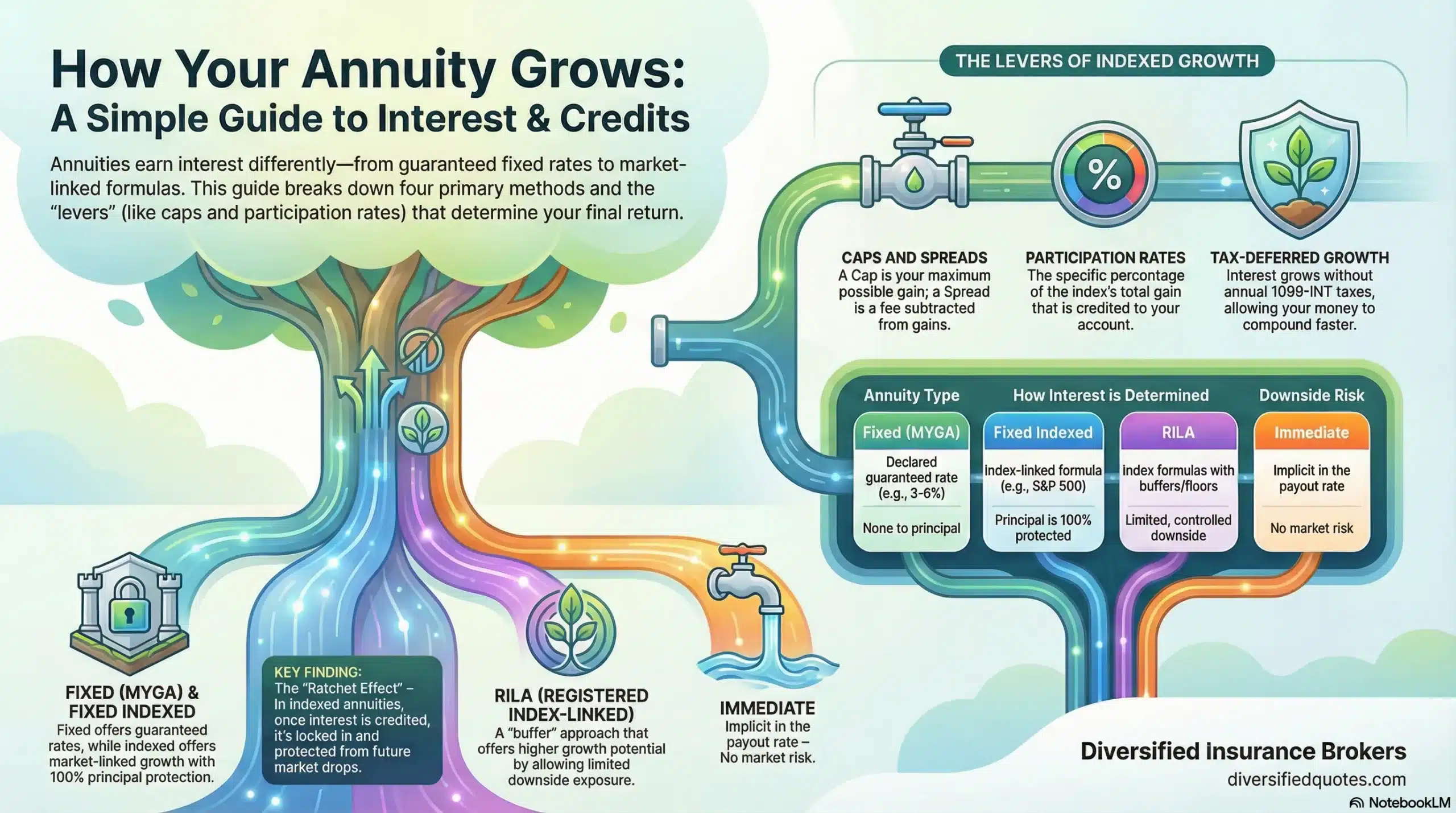
Many retirees consider fixed-rate annuities when stability is the primary objective. Multi-year guaranteed annuities — MYGAs — provide a declared interest rate locked for a defined contract period, allowing part of the portfolio to grow without market volatility exposure while the rest remains invested for growth. If you are comparing fixed-rate options across carriers, our resource on the best MYGA annuity rates shows how guaranteed rates are currently positioned across top-rated carriers. For those interested in the broader fixed annuity landscape, our resource on understanding multi-year guaranteed annuities covers how these products fit within a complete retirement income strategy.
Others evaluate fixed indexed annuities, which tie interest credits to a market index while protecting principal from index losses. Some FIA designs include income riders that create guaranteed lifetime withdrawal benefits — providing income that cannot be outlived regardless of what happens to the underlying account value. If you are comparing those structures, our resource on the highest bonus FIA rates shows how different carriers position bonuses and income features in current market conditions. For those evaluating how FIAs differ from standard fixed annuities on a structural level, our resource on what is a fixed indexed annuity provides the foundational explanation.
Income Riders and Guaranteed Lifetime Withdrawal Benefits
When retirees talk about “income for life,” they are often referring to a guaranteed lifetime withdrawal benefit attached to a deferred annuity through an income rider. These riders create a benefit base — sometimes called an income base or protected benefit base — that may grow at a defined roll-up rate during the deferral period and then determines the guaranteed withdrawal amount when income begins. Understanding that the benefit base and the actual account value are different figures is one of the most important concepts for anyone evaluating income rider projections.
Before comparing income projections from different carriers, it helps to review what a GLWB is and then understand how a GLWB works in practice. These resources explain how income percentages are calculated, how roll-up rates compound the benefit base during deferral, and what happens if you withdraw more than the guaranteed amount in a given year. It is also important to understand cost. Income riders are not free — reviewing whether income riders have fees and how those fees interact with net account value growth is essential for making an honest comparison between riders across different carrier products. For those evaluating whether a lifetime income rider is the right structure versus other income alternatives, our resource on whether to consider a lifetime income rider walks through the key decision factors.
Coordinating Retirement Income With Social Security
For most retirees, Social Security forms the foundation of retirement income — the guaranteed, inflation-adjusted baseline that continues for life regardless of market performance. The more predictable and sufficient your baseline income is, the less pressure your investment portfolio carries to generate withdrawal-ready cash during market downturns. Many retirees coordinate annuity income specifically to fill the gap between Social Security benefits and total monthly expense needs, creating a complete guaranteed income floor before relying on portfolio withdrawals for discretionary spending.
To better understand how these income sources work together in practice, our resource on how Social Security and annuities work together covers the coordination logic and why the sequence of claiming Social Security relative to annuity income start dates can meaningfully affect total lifetime income. For retirees concerned about the adequacy of Social Security as a foundation, our resource on whether you are leaving Social Security benefits on the table covers common claiming mistakes that reduce lifetime benefits and how to avoid them.
Taxes and the Retirement Income Calculator
A retirement income calculator becomes far more useful when tax realities are factored in rather than ignored. Withdrawals from traditional retirement accounts — 401(k), 403(b), Traditional IRA — are taxed as ordinary income. That means the gross withdrawal amount is not your spendable income; what you actually keep depends on your marginal tax bracket, state income tax rates, and how retirement income interacts with Social Security benefit taxation thresholds. Running a retirement income projection without accounting for this gap can produce spending estimates that are meaningfully overstated.
Because tax brackets can shift as income sources change throughout retirement — particularly around Required Minimum Distribution ages when mandatory taxable distributions from pre-tax accounts begin — many retirees benefit from coordinated withdrawal sequencing across different account types. Understanding how different retirement account types are taxed at withdrawal, how annuity distributions are treated for tax purposes, and when Roth conversions might improve the long-term tax picture are all dimensions of retirement income planning that a calculator alone cannot optimize. Our resource on how annuities are taxed in retirement covers the complete tax treatment framework for annuity income. For those evaluating how pension-like income structures interact with the broader tax picture, our resource on pension replacement through guaranteed lifetime income provides important context. If you are unsure when professional planning guidance makes the most difference, our resource on when to meet with a financial advisor helps identify the planning milestones where guidance produces the most value.
See Today’s Fixed Annuity Rates
Compare guaranteed rate options designed to stabilize retirement income.
View Fixed RatesCompare Bonus Income Strategies
Explore indexed annuity designs structured for income planning.
View Bonus RatesGet Help Building a Clear Retirement Income Plan
Send us your basics and we’ll compare income strategies across leading carriers.
Request an Income ReviewRelated Retirement Income Resources
Talk With an Advisor Today
Choose how you’d like to connect—call or message us, then book a time that works for you.
Schedule here:
calendly.com/jason-dibcompanies/diversified-quotes
Licensed in all 50 states • Fiduciary, family-owned since 1980
Retirement Income Calculator FAQs
A retirement income calculator helps estimate how much monthly income your savings may generate in retirement and how long your money might last based on key inputs like withdrawal rate, investment return assumptions, inflation rate, and retirement timeline. The most useful retirement income calculators go beyond simple portfolio balance projections — they allow you to model guaranteed income scenarios alongside portfolio withdrawals so you can see how much income could be secured for life versus how much depends on continued portfolio performance. At Diversified Insurance Brokers, our calculator allows you to model guaranteed lifetime income from annuity structures alongside traditional withdrawal strategies, giving you a more complete picture of what your savings can actually support before you commit to an income plan.
Different retirement income calculators produce different results because they use different underlying assumptions — and small differences in assumptions compound into large differences in projected outcomes over a 20- or 30-year retirement horizon. The most significant variables that differ across calculators include the assumed annual investment return, the assumed inflation rate applied to expenses, whether Social Security income is factored in and how, whether taxes are modeled on withdrawals, how required minimum distributions are handled after a certain age, and whether the calculation assumes a fixed or flexible withdrawal amount over time. A calculator that assumes a 7% annual investment return will show dramatically different results from one that assumes 5%, even if every other input is identical. Understanding which assumptions drive any particular calculator output — and whether those assumptions are realistic for your specific situation — is as important as knowing how to enter your numbers correctly.
Sequence of returns risk — the danger of experiencing significant market losses early in retirement while simultaneously taking withdrawals — is one of the most consequential and least understood risks retirees face. When you are in the accumulation phase and markets decline, you can simply wait for recovery without selling investments. Once you are in the withdrawal phase, you must sell assets to fund expenses regardless of where markets are, and those sales at depressed prices permanently remove shares from your portfolio that can never participate in the eventual recovery. The result is that two retirees with identical average annual returns over a 20-year period can experience dramatically different outcomes — one succeeding and one running out of money — based purely on the sequence in which good and bad years fall. This is why building a guaranteed income floor through annuity income or other protected income sources is frequently evaluated as a structural solution: it reduces or eliminates the need to sell invested assets during market downturns, allowing the portfolio to recover without the compounding damage of simultaneous withdrawals.
A standard retirement projection focuses on portfolio balance over time — it projects how your account value changes each year based on assumed returns, withdrawals, and inflation, and tells you when the balance reaches zero. This is useful for understanding portfolio longevity but does not address the core retirement income challenge: you need income to continue for as long as you live, which is inherently unknown. Lifetime income planning takes a fundamentally different approach by focusing on creating income that is guaranteed to continue regardless of how long you live or how markets perform. Instead of projecting when a portfolio runs out, lifetime income planning identifies how much of your income need can be covered by contractually guaranteed sources — Social Security, pension income, and annuity income — and how much depends on continued portfolio performance. When essential expenses are covered by guaranteed income sources, the portfolio can be managed with more flexibility and less risk aversion, because a market decline does not immediately threaten your ability to pay for housing, food, and healthcare.
Yes — inflation is one of the most important and most frequently underestimated factors in retirement income planning, particularly for retirees who may spend 20 to 30 years in retirement. Even modest inflation rates compound significantly over long periods. An expense that costs $5,000 per month today will cost considerably more in 20 years if costs rise at even a 3% annual rate, meaning a fixed income level that covers expenses comfortably at retirement may cover a significantly smaller share of expenses by the midpoint or late stage of retirement. Retirement income planning should account for inflation in two ways: by projecting how expenses will grow over the retirement horizon, and by evaluating how well income sources keep pace with rising costs. Social Security includes a cost-of-living adjustment that provides some inflation protection. Fixed annuity income without an inflation rider does not automatically increase. Building inflation protection — either through COLA riders on income, maintaining a growth-oriented portfolio component, or other strategies — into the overall income plan is an important part of designing a retirement income strategy that remains viable across a long retirement.
Yes — taxes significantly affect the spendable income generated by retirement withdrawals, and ignoring taxes in retirement income projections produces estimates that can be meaningfully overstated relative to what you can actually spend. Withdrawals from traditional pre-tax retirement accounts — 401(k), 403(b), Traditional IRA — are taxed as ordinary income at your marginal rate in the year of withdrawal. This means a $60,000 annual withdrawal from a pre-tax IRA does not translate to $60,000 of spendable income — the net amount after federal and state income taxes could be substantially less depending on your overall income level. Non-qualified annuity distributions are taxed on the earnings portion as ordinary income. Qualified annuity distributions from pre-tax funded contracts are fully taxable as ordinary income. Roth account distributions that meet qualified distribution requirements are tax-free. Running retirement income projections without modeling the tax layer on withdrawals can lead to underestimating how much gross income is needed to achieve a target net spending level — which in turn leads to undersaving or underestimating withdrawal needs during the retirement planning process.
The concept of a “safe withdrawal rate” refers to the percentage of a portfolio that can be withdrawn annually with a high probability of the portfolio lasting through a defined retirement period — most commonly 30 years. The 4% rule is the most frequently cited guideline, originating from research suggesting that withdrawing 4% of the initial portfolio value annually, adjusted for inflation each year, had historically provided high survival probability across most 30-year retirement periods. However, the appropriate withdrawal rate for any individual situation depends on the specific retirement timeline, the expected portfolio return and volatility, the flexibility of the withdrawal amount if needed, the availability of other income sources like Social Security and annuity income, and the consequences of portfolio depletion. In today’s environment, many financial planning practitioners suggest that 4% may be aggressive for retirements that could last 30 to 40 years, and a range of 3% to 3.5% is sometimes cited as a more conservative starting point for longer retirements. The most important insight from withdrawal rate research is that having even a partial guaranteed income floor — through Social Security, a pension, or annuity income — meaningfully reduces the pressure placed on the portfolio withdrawal rate, because essential expenses are covered by guaranteed sources regardless of what the portfolio does in any given year.
Annuities address a fundamental limitation of portfolio-only retirement income strategies: they can provide income that is guaranteed to continue for life regardless of how long you live or how financial markets perform during your retirement. A retirement income calculator that only models portfolio withdrawals shows you when the money runs out under various scenarios — but it cannot eliminate the risk of outliving assets, only model the probability. An annuity integrated into the retirement income plan converts a portion of savings into a guaranteed income stream that addresses longevity risk directly. In practical terms, annuities often serve as the bridge between Social Security income — which typically covers baseline needs partially — and the total income needed to cover monthly expenses. By ensuring essential expenses are covered by guaranteed sources, the remainder of the portfolio can be invested with more flexibility, potentially allowing for higher growth potential in the portion of savings that is not needed immediately for income. The right structure — whether a fixed deferred annuity, a fixed indexed annuity with an income rider, or an immediate income annuity — depends on the retiree’s timeline, income objectives, legacy goals, and overall financial picture.
Professional guidance produces the most value at specific planning milestones — and the transition into or near retirement is the most consequential one. If you are within 5 to 10 years of retirement, the decisions you make now about savings allocation, Social Security timing, Roth conversion strategy, and income structure will significantly shape the resources available throughout retirement. If you are already retired and concerned about how long your portfolio will last, whether your withdrawal rate is sustainable, or how to coordinate different income sources most efficiently, a structured income review can identify both risks and opportunities that are not visible from a single account view. If you are managing multiple accounts — IRA, 401(k), taxable brokerage, pension, and Social Security — the sequencing of withdrawals across these sources has meaningful tax implications that benefit from coordinated planning. And if you have a spouse whose income needs and longevity must both be planned for simultaneously, the joint income strategy is considerably more complex than individual planning and warrants careful analysis before income decisions are finalized. At Diversified Insurance Brokers, our retirement income review process compares guaranteed income options across more than 100 carriers alongside traditional withdrawal strategies so that the plan you build is grounded in realistic options rather than general projections.
A multi-year guaranteed annuity and an income annuity serve different roles in retirement income planning, and understanding the distinction helps clarify which tool is appropriate for which objective. A MYGA is a deferred accumulation vehicle — it provides a guaranteed interest rate locked for a defined period, typically two to ten years, during which the account grows without market volatility. The MYGA is designed for safe accumulation and can be structured as a ladder of contracts maturing at different points to provide liquidity at planned intervals. It does not by itself provide lifetime income unless it is later annuitized or transitioned to an income product. An income annuity — whether a single premium immediate annuity or a fixed indexed annuity with a guaranteed lifetime withdrawal benefit rider — is designed specifically to generate ongoing income, either immediately or at a future defined start date. The income is typically guaranteed to continue for the annuitant’s lifetime, addressing longevity risk directly. The two products are not interchangeable but can be used in combination within a broader retirement income architecture: MYGAs providing safe near-term accumulation and optionality, and income annuities providing the guaranteed income floor that makes the overall strategy sustainable regardless of longevity or market performance.
About the Author:
Jason Stolz, CLTC, CRPC, DIA, CAA and Chief Underwriter at Diversified Insurance Brokers (NPN 20471358), is a senior insurance and retirement professional with more than 25 years of real-world experience helping individuals, families, and business owners protect their income, assets, and long-term financial stability. As a long-time partner of the nationally licensed independent agency Diversified Insurance Brokers, Jason provides trusted guidance across multiple specialties—including fixed and indexed annuities, long-term care planning, personal and business disability insurance, life insurance solutions, Group Health, Travel Medical and Evacuation Insurance, and short-term health coverage. Diversified Insurance Brokers maintains active contracts with over 100 highly rated insurance carriers, ensuring clients have access to a broad and competitive marketplace.
His practical, education-first approach has earned recognition in publications such as VoyageATL, and contributions from his agency featured in Kiplinger and GoBankingRates— highlighting his commitment to financial clarity and client-focused planning. Drawing on deep product knowledge and years of hands-on field experience, Jason helps clients evaluate carriers, compare strategies, and build retirement and protection plans that are both secure and cost-efficient. Visitors who want to explore current annuity rates and compare options across multiple insurers can also use this annuity quote and comparison tool.
Explore More Annuity Options: Browse our complete guide to How Much Does an Annuity Pay? — covering annuity payout calculators, income amounts & interest rates by investment size from 100+ carriers.
Explore More: Browse our complete Lifetime Income Planning guide — covering retirement income strategies, account transfers & annuity income solutions from 100+ carriers.
Last Reviewed: June 15, 2026 |
Reviewed by: Jason Stolz, CLTC, CRPC, DIA, CAA
Chief Underwriter, Diversified Insurance Brokers, Inc. | NPN: 20471358 | Diversified Insurance Brokers, Inc. — Licensed in all 50 states
Fact Checked by: Tonia Pettitt, CMIP©
Medicare Specialist, Diversified Insurance Brokers, Inc. | NPN: 14374308 | Diversified Insurance Brokers, Inc. — Licensed in all 50 states
Did you find this content helpful? Leave us a Google review — it helps others find trustworthy guidance too.
Editorial Standards: Diversified Insurance Brokers maintains rigorous editorial standards to ensure accuracy, clarity, and independence in all content. Learn more about our editorial standards and commitment to transparency.
