
Disability Insurance for the Railroad Industry
As an Independent Disability Insurance Broker, we have access to exclusive discounts and negotiated pricing most captive agents can’t offer — see the full breakdown near the end of this page.
Disability Insurance for the Railroad Industry

Jason Stolz CLTC, CRPC, DIA, CAA
Railroad workers live inside a legal and regulatory universe that exists nowhere else in American employment law — and understanding that universe is the essential starting point for any honest conversation about disability insurance in this industry. Most American workers injured on the job file a workers’ compensation claim. Railroad workers do not. Instead, they are governed by the Federal Employers Liability Act (FELA), a 1908 law that gives railroad employees the right to sue their employer directly for negligence rather than accept the limited administrative remedy of workers’ compensation. FELA allows railroad workers to pursue economic and non-economic damages including pain and suffering — but it requires proving railroad negligence, which workers’ comp does not. Separately, railroad workers are covered not by Social Security but by the Railroad Retirement Board (RRB), a federal program that provides disability annuities, retirement benefits, and survivor benefits that in many cases exceed what Social Security would provide. These two structural facts — FELA instead of workers’ comp, RRB instead of Social Security — define how disability planning works for railroad employees differently than for workers in every other major American industry.
The income at stake is substantial. As of July 2024, Class I railroad craft employees began earning between $90,000 and $140,000 annually in wages depending on craft, with an average of approximately $111,000. When healthcare, paid time off, and retirement contributions are included, the total average compensation package ranges from approximately $135,000 to nearly $190,000, with an average of $160,000 — making the total package approximately 40% above the national average for all workers. The BLS reports a median annual wage of $75,680 for railroad workers across all occupations in May 2024. More than 80% of Class I railroad employees are unionized through one of 12 major rail labor organizations, making freight rail one of the most highly organized industries in the American workforce. At Diversified Insurance Brokers, we help railroad workers across all crafts and roles understand precisely how FELA, the RRB disability annuity, and individual disability insurance interact — and where the gaps that individual coverage must fill actually exist. Our disability insurance services overview provides essential background on how individual income protection is structured.
Protect Your Railroad Income
Compare disability insurance options designed for railroad workers across all crafts — understanding the FELA and RRB context that makes this coverage decision unique.
Request Disability Insurance OptionsQuestions? Call 800-533-5969
FELA: Why Railroad Workers Don’t File Workers’ Compensation
The Federal Employers Liability Act is the foundational legal reality of railroad employment that no disability insurance conversation for railroad workers can skip. FELA was passed in 1908 because Congress determined that standard workers’ compensation frameworks — which provide limited administrative benefits regardless of fault — were inadequate for an industry with the injury profile of railroading. FELA instead gives railroad workers the right to sue their employer directly in federal or state court for negligence. A successful FELA claim can recover medical expenses, lost wages, future earning capacity, and pain and suffering — a far more complete remedy than workers’ comp provides. The companion Locomotive Inspection Act makes railroads 100% liable for injuries resulting from any mechanical defect in railroad equipment, without the need to prove negligence separately.
FELA is genuinely more favorable to injured workers than workers’ comp in many cases — but it has a critical limitation that directly shapes the individual disability insurance need: FELA requires litigation. A railroad worker injured on the job must hire an attorney, build a negligence case, and navigate a legal process that can take months to years before any recovery is received. During that entire period — from the day of injury through the conclusion of the legal proceeding — the worker’s income may be entirely interrupted. The railroad is not obligated to continue salary during a FELA dispute. Whatever the worker’s bank account contains at the moment of injury is what stands between them and their monthly obligations while the FELA case proceeds. Individual disability insurance that begins paying benefits after the elimination period — regardless of the FELA case status, the railroad’s liability, or the litigation timeline — is the financial protection that bridges that gap. The two systems are not redundant. They address different problems: FELA addresses eventual legal remedy; disability insurance addresses immediate income replacement.
The Railroad Retirement Board Disability Annuity: The Built-In Baseline
The Railroad Retirement Board operates an entirely separate federal retirement and disability system for railroad workers — distinct from Social Security — funded by railroad employer and employee payroll contributions. For long-service railroad employees, RRB benefits at retirement can be substantially higher than equivalent Social Security payments. On the disability side, the RRB provides disability annuities for railroad workers who become totally disabled — but the structure of those annuities creates the same kind of income gap that Social Security Disability creates for workers in other industries who rely on it as their only protection.
The RRB disability annuity has important qualification requirements. The occupational disability benefit requires 10 years of railroad service for workers under 60, and the total disability benefit has different qualification thresholds. The application and approval process takes time — months in most cases, longer if the initial application is denied and appeal is required. During the application period, a disabled railroad worker receives no RRB disability income. And the RRB benefit amount, while often more generous than Social Security would provide, is still calculated to replace only a portion of career earnings — not the full income that a working railroad employee generates during peak earning years. A Class I railroad craft employee averaging $111,000 in annual wages who becomes disabled will find that the RRB annuity, however well-structured, does not replace that income dollar for dollar.
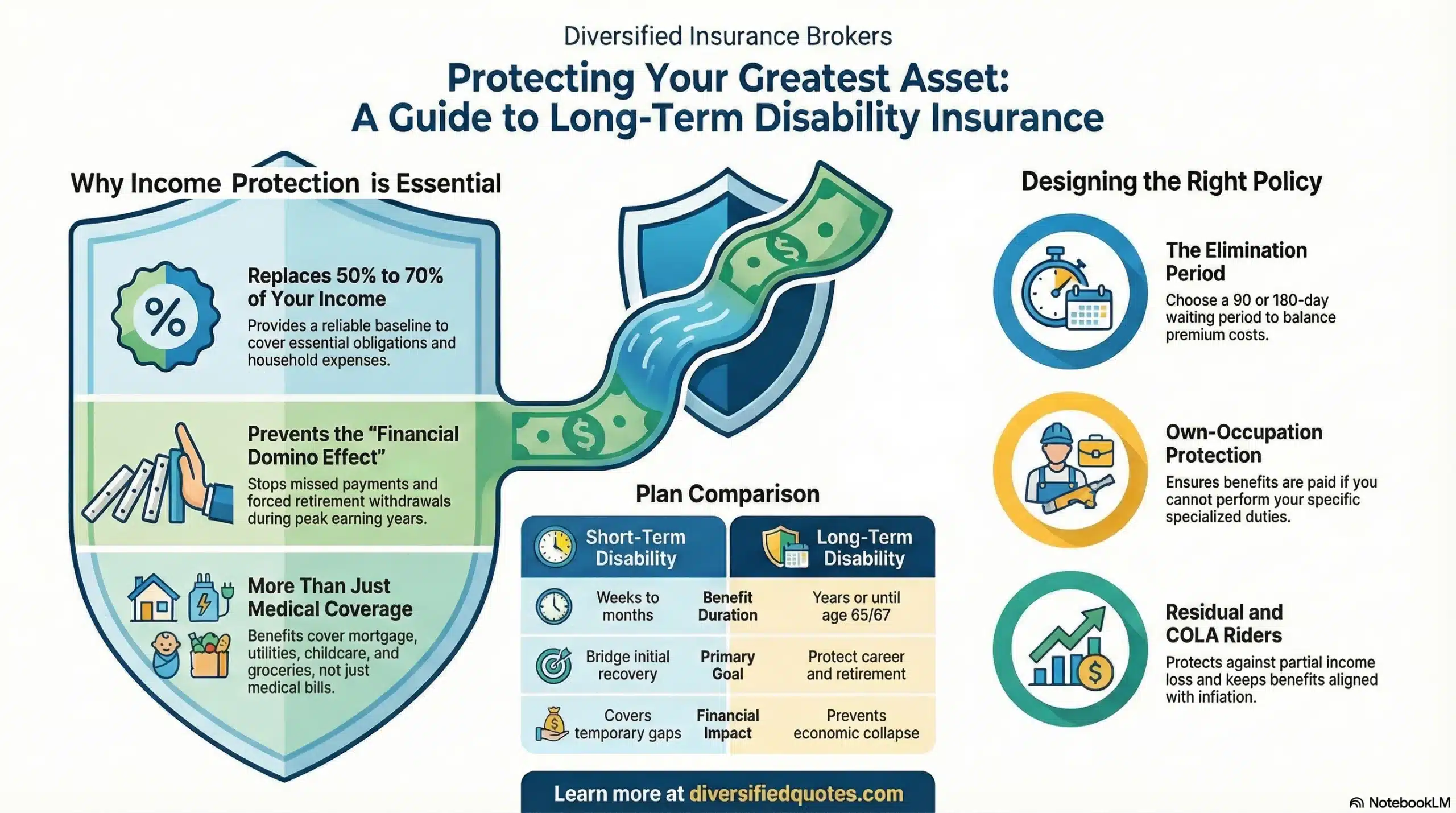
Individual disability insurance for railroad workers is specifically designed to fill the gap between the RRB disability benefit and actual pre-disability income — the portion of income that neither FELA litigation recovery nor RRB annuity addresses during the period immediately following a disabling event. Our resource on short-term vs. long-term disability insurance explains how the two coverage layers work together, and our resource on how much disability insurance you need provides the framework for calculating the income gap that individual coverage must address after RRB and other benefits are factored in.
The Physical Hazards of Railroad Work by Craft
Railroading involves a range of crafts and roles with distinct physical hazard profiles — and disability insurance planning for railroad workers is most useful when it reflects the actual hazards of the specific craft rather than a generic heavy-industry assessment.
Locomotive engineers work in climate-controlled train cabs that are substantially more comfortable than most outdoor industrial environments — but they are exposed to the whole-body vibration of operating large diesel-electric locomotives across thousands of miles annually, the loud noise of diesel prime movers and horn systems that generates documented noise-induced hearing loss risk, and the sustained cognitive demands of operating trains safely across all weather conditions and terrain types. Engineers whose long routes take them away from home for extended periods accumulate the cardiovascular and sleep disruption risks of sustained fatigue and irregular schedule work that federal rest hour regulations exist specifically to limit. An engineer who develops a cognitive impairment, significant hearing loss that affects safe train operation, or a cardiovascular condition that triggers FRA medical disqualification faces career-ending consequences for which the RRB disability annuity provides baseline relief but individual disability insurance provides the income gap coverage that matters financially.
Conductors and trainmen work in significantly more physically demanding conditions than engineers — moving between cars, working in rail yards, climbing ladders on freight cars, and managing the physical tasks of freight and passenger train operations. Conductors on freight trains face slip, trip, and fall hazards from climbing on and off moving and stationary equipment; the heavy lifting demands of manual railcar work; and in rail yard environments, the proximity to heavy moving equipment that generates crush and struck-by injury risk. The BLS specifically notes that railroad workers’ schedules include nights, weekends, and holidays because trains operate 24 hours a day — and extra-board workers hired as substitutes face the most irregular and unpredictable schedule exposure.
Rail yard workers and maintenance crews face the most acute physical hazard environment in the railroad industry. Maintenance of Way employees who maintain tracks, signals, and rail infrastructure work in environments with proximity to active train traffic — the struck-by hazard that produces the most severe railroad occupational injuries. The East Palestine, Ohio, derailment investigation revealed that Norfolk Southern had eliminated track heat measurement positions that experienced workers had held, delegating those functions to workers with insufficient training — illustrating how cost-cutting pressure in railroad operations can compromise the safety margins that protect maintenance workers in the field. For these workers, the injury consequences when things go wrong are severe and often career-ending.
Whole-Body Vibration, Noise, and Long-Latency Occupational Disease
Two occupational health hazards specific to railroad work deserve particular attention because they develop over career-length timeframes and are often not recognized as disabilities until the cumulative damage becomes clinically significant.
Whole-body vibration from locomotive operation is a documented occupational health risk. Engineers and other railroad workers who spend thousands of hours on operating equipment absorb vibration frequencies through the seat and cab structure that, over career-length exposure, contribute to lumbar disc degeneration and back conditions documented in locomotive crew occupational health research. This is not acute traumatic injury — it is cumulative occupational disease that develops slowly and becomes apparent when the engineer whose back has been absorbing locomotive vibration for 20 years develops a lumbar condition that prevents safe train operation. Individual disability insurance that covers occupational disease — conditions that develop from the documented occupational exposures of railroad work rather than from a single incident — is the protection that addresses this disability pathway.
Noise-induced hearing loss is a second long-latency occupational disease risk for railroad workers. The Federal Railroad Administration has specific noise exposure regulations for railroad environments, reflecting the documented hearing loss risk from diesel locomotive noise, horn systems, and rail yard equipment. An engineer whose hearing loss reaches the threshold that triggers FRA medical standards concerns faces potential certification consequences that individual disability insurance must address when they produce inability to continue railroad work. The critical planning point: applying for disability insurance before any documented audiological testing shows significant hearing loss produces the most comprehensive coverage, because documented hearing changes at application can result in exclusion riders on hearing-related conditions. Our resource on disability insurance with preexisting conditions explains how documented occupational health findings affect underwriting outcomes for railroad workers.
Historical asbestos exposure is a third long-latency concern for veteran railroad workers. Asbestos was historically prevalent in locomotive insulation, brake linings, railcar components, and station and yard infrastructure — and railroad workers with significant tenure in the industry prior to the late 1970s may carry historical asbestos exposure that creates mesothelioma and asbestosis risk with latency periods measured in decades. For workers in this situation, the intersection of historical exposure, potential occupational disease, and current disability insurance coverage is a nuanced planning consideration that our advisors are equipped to help navigate.
The Extra-Board Worker: The Highest Financial Vulnerability in the Industry
Among railroad workers, the extra-board worker — hired as a substitute or temporary employee for specific routes when regular crews are unavailable — faces the most acute financial vulnerability during a disability event. Extra-board engineers and conductors have irregular schedules by definition: they work when called, rest when not needed, and may have weeks of active work followed by periods of reduced assignment depending on railroad operational needs. This irregular income structure means there is no predictable biweekly paycheck to project forward — income depends on being called and being able to accept assignments.
When an extra-board worker becomes disabled, income cessation is immediate — there are no assignments to fulfill and therefore no earnings. The irregularity of extra-board income also complicates disability insurance income documentation, since prior year tax returns may show significant income variation that makes benefit amount calculation less straightforward than for craft employees with consistent regular wages. Our resource on disability insurance for independent contractors covers the income documentation considerations for workers with variable income structures, and our resource on disability insurance elimination periods explained addresses how the waiting period before benefits begin should be calibrated to an extra-board worker’s more volatile financial position.
What Individual Disability Insurance Does That FELA and RRB Cannot
The most important planning insight for railroad workers is understanding precisely what individual disability insurance does that the FELA legal remedy and the RRB disability annuity cannot do, and why having all three is the comprehensive protection that no single element alone provides.
FELA provides a legal remedy — the right to sue for damages when the railroad’s negligence caused the injury. But FELA requires proving negligence, takes months to years to resolve, and produces a lump-sum settlement or judgment rather than monthly income replacement during the disability period. FELA is not income replacement insurance. It is a legal claim. The two are categorically different.
The RRB disability annuity provides a federal benefit baseline — monthly income for qualifying railroad workers who become totally disabled. But RRB qualification requires railroad service tenure, application takes time, benefits begin after an approval process, and the annuity replaces only a portion of the pre-disability wage rather than replicating it. For a Class I craft employee earning $111,000 annually, the income gap between RRB benefit and actual wages is real and meaningful.
Individual disability insurance fills both gaps simultaneously — paying benefits during the period when FELA litigation is pending and RRB application is processing, and continuing to supplement the RRB benefit with additional monthly income once RRB payments begin. The elimination period calibration should account for how long the railroad worker can sustain their financial obligations using existing savings and any sick leave or paid time off before benefits must begin. For railroad workers with union-negotiated sick leave accumulation, a longer elimination period is possible; for extra-board workers with limited savings and irregular income, a shorter elimination period is the responsible design choice. Our resource on own-occupation disability insurance explains how the policy definition should be structured to protect the specific craft functions of a railroad career — not just a generic ability to work in some capacity. For railroad workers with existing coverage who want an independent evaluation, our disability insurance second opinion service provides a carrier-neutral review.
Get Disability Insurance Quotes for Railroad Workers
We compare options across carriers while accounting for your specific craft, RRB baseline, and FELA context — so your coverage actually fills the gaps that exist in your specific situation.
Request Disability Insurance OptionsQuestions? Call 800-533-5969
Financial Protection Essentials
Income protection resources and disability insurance planning tools for railroad workers across all crafts.
Related Pages
Talk With an Advisor Today
Choose how you’d like to connect—call or message us, then book a time that works for you.
Schedule here:
calendly.com/jason-dibcompanies/diversified-quotes
Licensed in all 50 states • Fiduciary, family-owned since 1980
FAQs: Disability Insurance for the Railroad Industry
If I’m covered by FELA, do I still need disability insurance?
Yes — and the reason is that FELA and individual disability insurance solve completely different problems. FELA gives you the right to sue your employer for negligence and pursue economic damages including lost wages, pain and suffering, and future earning capacity. It is a legal remedy — and like all legal remedies, it requires proving negligence, hiring an attorney, and navigating a litigation process that takes months to years before any recovery arrives. During that entire period, your income may be entirely stopped while your mortgage, car payment, utilities, and every other monthly obligation continues without interruption.
Individual disability insurance pays monthly income replacement benefits starting after the elimination period — regardless of whether a FELA case has been filed, regardless of how the litigation is proceeding, and regardless of what the railroad’s liability position is. It is not contingent on proving anything. It starts paying when a licensed physician certifies that you cannot perform the material duties of your craft, and it continues paying through the benefit period. FELA resolves an eventual legal claim. Disability insurance addresses immediate income. A railroad worker who relies on FELA alone for income protection is relying on a legal proceeding to cover their rent — which is exactly what it was never designed to do.
How does the Railroad Retirement Board disability annuity affect how much individual coverage I need?
The RRB disability annuity functions similarly to Social Security Disability Insurance for railroad workers — it provides a federal benefit baseline that replaces a portion of your pre-disability income, but not all of it. For a Class I craft employee earning $111,000 annually in base wages with a total compensation package averaging $160,000, the gap between RRB annuity and actual pre-disability income is meaningful. The right individual disability insurance benefit amount is the monthly income gap between what the RRB disability annuity will provide and what your actual monthly financial obligations require — not a redundant replacement of the RRB benefit, but a precise supplement to it.
There are two important timing considerations. First, the RRB application and approval process takes time — a railroad worker does not receive RRB disability income on the first day they cannot work. Individual disability insurance with an appropriate elimination period bridges the gap between disability onset and RRB benefit commencement. Second, RRB qualification requires railroad service tenure — workers with fewer years of service may not qualify for the occupational disability benefit and may face different thresholds for total disability coverage. Our resource on how much disability insurance you need provides the framework for calculating this gap precisely based on your specific wage level and estimated RRB benefit.
What makes disability insurance for locomotive engineers different from other physically demanding occupations?
The most significant difference is the FRA medical certification requirement. Locomotive engineers must meet Federal Railroad Administration medical standards to operate trains — which means that a health condition that would allow a worker in almost any other physical occupation to continue working with modifications can disqualify an engineer from their primary craft entirely. A significant hearing loss, a cardiac arrhythmia, poorly controlled diabetes, or a seizure disorder that would not end an office worker’s career can end a locomotive engineer’s federally certified operating career. The engineer’s professional function is tied to a federal certification that health conditions can revoke — which makes the own-occupation disability definition especially critical.
Under a true own-occupation definition, a locomotive engineer who loses FRA certification due to a medical condition receives disability benefits even if they theoretically could perform some other non-operating employment. Under any-occupation standards, the same engineer might be denied benefits because they retain capacity for work that doesn’t require FRA certification. The own-occupation definition must specifically protect the locomotive engineer’s craft function — federally certified train operation — not merely a generic ability to work. Our resource on own-occupation disability insurance explains how this distinction applies in practice for specialized licensed occupations.
Are occupational diseases like hearing loss and back conditions covered under railroad disability insurance?
Yes — individual disability insurance covers income loss when an occupational disease produces a qualifying disability under the policy definition, regardless of whether the condition resulted from a single incident or from cumulative occupational exposure over time. A locomotive engineer whose noise-induced hearing loss from decades of diesel locomotive operation reaches the threshold that impairs safe train operation has experienced a qualifying disability — not a workers’ comp event (railroad workers don’t have workers’ comp), not necessarily a FELA claim (proving the railroad’s negligence for a cumulative occupational disease requires specific legal analysis), but a disability insurance event that individual income replacement coverage addresses directly.
The critical planning point is timing: applying for disability insurance before cumulative occupational health conditions have been documented in medical records produces the most comprehensive coverage. A railroad worker who applies at age 28 upon entering their first craft position — before any documented audiological changes, lumbar findings from whole-body vibration exposure, or other occupational health history — obtains coverage without exclusion riders on the conditions most likely to eventually affect their career. Applying at age 45 after documented audiological testing shows measurable hearing loss may produce exclusion riders that limit precisely the coverage most needed. Our resource on disability insurance with preexisting conditions explains how documented health history affects underwriting outcomes.
How should extra-board workers think about disability insurance differently from regular craft employees?
Extra-board workers face a more acute financial vulnerability than regular craft employees for two compounding reasons. First, income is inherently irregular — extra-board assignments depend on railroad operational needs, so there is no predictable biweekly paycheck. When disability prevents accepting assignments, the income that was already variable drops to zero. There is no sick leave cushion, no consistent base from which to draw. Second, the irregular income also makes disability insurance income documentation less straightforward — prior year tax returns may show significant variation that affects benefit amount calculation. An extra-board worker who earned $95,000 in one year and $70,000 the following year has a different income documentation situation than a regular engineer earning consistent annual wages.
For extra-board workers, the elimination period calibration is especially important. A 90-day elimination period assumes the worker has roughly 3 months of savings to bridge the gap before benefits begin. Given the income variability of extra-board work, this assumption may be unrealistic — a shorter 30-day or 60-day elimination period provides faster benefit onset at a modestly higher premium cost. The elimination period should reflect actual financial reserves rather than an idealized assumption. Our resource on disability insurance elimination periods explained provides the full framework for this calibration based on actual savings and monthly obligations.
About the Author:
Jason Stolz, CLTC, CRPC, DIA, CAA and Chief Underwriter at Diversified Insurance Brokers (NPN 20471358), is a senior insurance and retirement professional with more than 25 years of real-world experience helping individuals, families, and business owners protect their income, assets, and long-term financial stability. As a long-time partner of the nationally licensed independent agency Diversified Insurance Brokers, Jason provides trusted guidance across multiple specialties—including fixed and indexed annuities, long-term care planning, personal and business disability insurance, life insurance solutions, Group Health, Travel Medical and Evacuation Insurance, and short-term health coverage. Diversified Insurance Brokers maintains active contracts with over 100 highly rated insurance carriers, ensuring clients have access to a broad and competitive marketplace.
His practical, education-first approach has earned recognition in publications such as VoyageATL, and contributions from his agency featured in Kiplinger and GoBankingRates— highlighting his commitment to financial clarity and client-focused planning. Drawing on deep product knowledge and years of hands-on field experience, Jason helps clients evaluate carriers, compare strategies, and build retirement and protection plans that are both secure and cost-efficient. Visitors who want to explore current annuity rates and compare options across multiple insurers can also use this annuity quote and comparison tool.
Explore More Disability Insurance Options: Browse our complete guide to Disability Insurance for Transportation, Maritime & Hazardous Occupations — covering truck drivers, flight attendants, merchant marines, divers, chauffeurs & drivers from 100+ carriers.
Last Reviewed: May 15, 2026 |
Reviewed by: Jason Stolz, CLTC, CRPC, DIA, CAA
Chief Underwriter, Diversified Insurance Brokers, Inc. | NPN: 20471358 | Diversified Insurance Brokers, Inc. — Licensed in all 50 states
Fact Checked by: Tonia Pettitt, CMIP©
Medicare Specialist, Diversified Insurance Brokers, Inc. | NPN: 14374308 | Diversified Insurance Brokers, Inc. — Licensed in all 50 states
Did you find this content helpful? Leave us a Google review — it helps others find trustworthy guidance too.
Editorial Standards: Diversified Insurance Brokers maintains rigorous editorial standards to ensure accuracy, clarity, and independence in all content. Learn more about our editorial standards and commitment to transparency.
