
Disability Insurance for Oil and Natural Gas Industries
As an Independent Disability Insurance Broker, we have access to exclusive discounts and negotiated pricing most captive agents can’t offer — see the full breakdown near the end of this page.
Disability Insurance for Oil and Natural Gas Industries

Jason Stolz CLTC, CRPC, DIA, CAA
Disability insurance for oil and natural gas industries is one of the most critical financial protections available to workers in an industry that the CDC and Bureau of Labor Statistics data have consistently identified as carrying one of the highest occupational fatality rates of any American industry — historically running at approximately 25 deaths per 100,000 workers, roughly seven times the all-industry average fatality rate of 3.5 per 100,000 documented across all U.S. workers. Oil and gas workers include a broad range of occupations across the full extraction and production value chain: wellhead pumpers and service unit operators who maintain and operate production equipment at well sites; roughnecks, roustabouts, and derrick operators who perform the physical drilling and maintenance work on rig floors; petroleum engineers who design extraction systems and optimize production; pipeline workers who transport extracted product; refinery operators who process crude oil and natural gas into usable products; and the full range of specialized technical and professional roles that the industry requires across upstream, midstream, and downstream operations. The Bureau of Labor Statistics reports a median annual wage of $52,610 for oil and gas workers in May 2024, with the lowest 10% earning below $36,860 and the top 10% earning above $82,100. Petroleum engineers and senior technical professionals earn significantly more — median wages for petroleum engineers were $131,800 in May 2024. This income, generated through demanding work in hazardous environments, often under rotation schedules that take workers away from home for weeks at a time, deserves income protection that continues whether or not the worker can return to the well site, the rig floor, or the refinery after a disability event. At Diversified Insurance Brokers, we help oil and gas industry workers and professionals across all roles and settings design disability coverage that reflects the genuine hazard profile of their work and the specific financial planning considerations of a high-paying, high-risk career. For foundational disability insurance context, our disability insurance services overview provides essential background, and our resource on disability insurance for high-risk occupations addresses how underwriting approaches elevated-risk occupations specifically.
Protect Your Income in the Oil and Gas Industry
Compare disability insurance options designed for oil and gas workers and professionals across all sectors and positions.
Request Disability Insurance Options
Questions? Call 800-533-5969
The Oil and Gas Industry and Its Occupational Health Reality
The oil and gas industry encompasses an extraordinarily broad range of occupations, environments, and risk profiles — from offshore drilling platforms in the Gulf of Mexico and the North Sea to onshore shale plays in the Permian Basin and the Bakken, from pipeline maintenance across thousands of miles of transmission infrastructure to refinery operations in large industrial complexes that run continuous processes 24 hours a day. What unites all of these roles is the shared reality of working in an industry where the consequences of equipment failure, process failure, transportation incidents, and atmospheric hazard exposure can be immediate, severe, and life-altering.
The National Institute for Occupational Safety and Health (NIOSH), which has conducted extensive research on oil and gas extraction worker safety, has documented that during the period 2003 to 2013, 1,189 oil and gas extraction workers died on the job — an average of 108 deaths per year with an annual fatality rate of 25.0 per 100,000 workers. Transportation incidents accounted for 40% of these fatalities, equipment contact events for another 26%, and fires and explosions for a significant additional share. These figures reflect a dramatic improvement from earlier decades due to increased automation, improved safety protocols, and regulatory enforcement — but they still place oil and gas extraction among the most fatality-prone industries in the American workforce. For workers who survive occupational injuries and accidents but sustain disabling injuries, the income consequences are just as severe and long-lasting as fatalities — and disability insurance is the financial protection that addresses those consequences.
The industry also employs a substantial workforce in roles that carry different but still significant risk profiles. Support services workers — the service company employees who make up more than half of all oil and gas fatalities according to NIOSH data — often work in environments and under scheduling pressures that generate elevated risk compared to operator company employees. Pipeline workers face the risks of pipeline maintenance work including confined space entry, hazardous atmosphere exposure, and the physical demands of maintaining large infrastructure systems across all weather conditions and terrain types. Refinery workers manage the risks of continuous process operations including high-pressure systems, high-temperature processes, and the chemical exposure hazards of the refining environment. Each segment of the industry carries its own risk profile, and disability insurance must be designed with the specific occupation in mind.
Transportation Incidents: The Leading Cause of Oil and Gas Worker Fatalities and Severe Injuries
Transportation incidents are the single largest cause of both fatalities and serious disabling injuries in the oil and gas extraction industry, consistently accounting for approximately 40% of all occupational fatalities in the sector according to CDC and BLS data. The transportation hazard in oil and gas work arises from the combination of remote well site locations that require extensive road travel on often-poorly-maintained field roads, long driving hours and driver fatigue from rotation schedules that push workers to reach well sites or rig locations after extended travel, the hazards of driving heavy equipment and service vehicles in weather and terrain conditions that commercial drivers rarely encounter, and the increasing use of large truck convoys to move drilling equipment and supplies on public roads in active oil field development areas.
Motor vehicle accidents in oil and gas field work produce some of the most severe disabling injuries in the industry: traumatic brain injuries, spinal cord injuries, multiple fracture injuries, and lower extremity crush injuries from vehicle collisions and rollovers in field conditions. An oil field service worker who sustains a spinal cord injury in a field road accident faces not only the immediate trauma of the injury and the medical treatment process — which may include surgery, rehabilitation, and years of ongoing care — but the long-term income consequences of a disability that may prevent return to the physically demanding field work that generated their income. Disability insurance providing income replacement from the first day of qualifying disability through years of recovery is the financial protection that prevents this occupational tragedy from becoming a financial catastrophe as well. Our resource on own-occupation disability insurance explains how the policy definition must protect the specific physical functions of field work rather than just a generic ability to perform some employment.
Equipment Contact and Rig Floor Injuries
Contact with objects and equipment — the second largest category of oil and gas fatalities and serious injuries after transportation — reflects the specific hazards of working in close proximity to the heavy rotating and reciprocating equipment of drilling operations: drill pipe, drill collars, tongs, catlines, draw works, crown blocks, and the full array of powerful mechanical systems that make up a working drilling rig. Struck-by incidents from falling objects, caught-in/between incidents from moving equipment, and crush injuries from heavy equipment movement generate the traumatic injuries that have historically defined the severe injury profile of rig floor work.
Even with the increased automation of modern drilling rigs — hydraulic catwalks, iron roughnecks, and other automated pipe handling systems that reduce direct human contact with the most hazardous mechanical operations — rig floor work remains physically demanding and mechanically hazardous. A roughneck or derrickman who sustains a hand injury, arm fracture, or shoulder injury from equipment contact faces weeks to months of inability to perform the physical rig floor work that generates their income. A more severe injury producing permanent functional limitation — loss of finger or hand function, rotator cuff tear requiring surgical repair, or spinal injury from a falling object — can end or permanently alter a rig career that may represent years of developed expertise and above-average compensation. Disability insurance with a benefit period that extends across the full recovery timeline — and in severe cases to age 65 — is the protection that addresses these long-duration income risks.
Fire, Explosion, and Chemical Exposure Hazards
Fires and explosions represent the most catastrophic acute injury scenario in oil and gas work, producing the burn injuries, blast injuries, and inhalation injuries that result in the most severe and long-duration disabilities in the industry. Well blowouts, pipeline ruptures, refinery process failures, and the combustion of hydrocarbon vapors in enclosed or poorly ventilated spaces generate the fire and explosion events that cause catastrophic burns — injuries requiring months of hospitalization, repeated surgical procedures, and extended rehabilitation that may never produce complete functional recovery. A worker who sustains serious burns in an oil field fire faces a disability that may last years, cost millions in medical treatment, and permanently alter physical capability and appearance in ways that affect return to work in virtually any demanding physical role.
Chemical exposure hazards in oil and gas work are diverse and significant. Hydrogen sulfide — H2S — is a highly toxic gas that occurs naturally in many oil and gas formations and can reach dangerous concentrations around well sites, in storage tanks, and in confined spaces during production operations. H2S exposure at high concentrations produces rapid loss of consciousness and death; at lower concentrations, it produces respiratory irritation, neurological effects, and the chronic health consequences that develop from repeated sub-acute exposure over years of field work. Benzene exposure from crude oil, condensate, and natural gas liquids handling is a documented occupational carcinogen exposure for oil and gas workers at all levels of the production system. Silica dust exposure from hydraulic fracturing operations — where high volumes of silica sand are used as a proppant — has generated significant NIOSH occupational health research concern about silicosis risk for workers in the immediate vicinity of mixing and pumping operations during fracking jobs.
Disability insurance covering occupational disease — the health conditions that develop from documented chemical and toxic substance exposure over years of oil and gas work — provides the income replacement that addresses these long-latency disability pathways when they produce qualifying functional impairment. Applying for coverage before any documented chemical exposure-related health history appears in medical records is the optimal approach. Our resource on disability insurance with preexisting conditions explains how documented health history affects underwriting outcomes for oil and gas workers.
Musculoskeletal Injuries From Physically Demanding Field Work
Beyond acute traumatic events, oil and gas field work generates significant cumulative musculoskeletal loading from the sustained physical demands of the occupation: carrying heavy equipment across well sites and rig locations, manual handling of pipe and tools under field conditions, physically demanding maintenance work in awkward confined postures, and the whole-body vibration exposure of operating or riding in heavy vehicles and equipment across rough terrain. The BLS Survey of Occupational Injuries and Illnesses consistently shows elevated musculoskeletal injury rates for extraction industry workers — particularly back injuries, shoulder injuries, and knee injuries from the combination of heavy physical work and the demanding terrain of field operations.
A service unit operator or roustabout who develops a lumbar disc herniation from the sustained manual material handling demands of field work faces weeks to months of inability to perform the physical functions the job requires — particularly in the physically demanding early-career field roles that many oil and gas workers begin their careers in before advancing to more supervisory or technical positions. These musculoskeletal injuries, while less dramatic than traumatic equipment accidents, represent the largest volume of lost-time disability events for field workers and are directly addressed by disability insurance income replacement. The residual disability rider is important for oil and gas workers whose musculoskeletal conditions may reduce physical capability below full field work demands without producing total inability to work — paying proportionately when income declines due to reduced capacity. Our resource on residual disability insurance benefits explained covers how this rider works in practice.
Offshore and Remote Work: Additional Risk Factors and Isolation
Offshore oil and gas workers — those employed on drilling platforms, production platforms, and floating production storage and offloading vessels in the Gulf of Mexico, offshore Alaska, and international waters — face an additional set of risk factors beyond those of onshore field workers. The offshore environment adds marine transportation hazards (helicopter transfers and boat transfers to and from platforms), the risks of working at elevation over water, the confined platform environment, and critically, the geographic isolation from emergency medical care that makes the consequences of any serious injury or medical event more severe on an offshore platform than on an onshore well site accessible by road ambulance.
Remote onshore work — in the Permian Basin, the Bakken, the Powder River Basin, and other geographically remote oil field areas — shares the isolation from immediate medical care that makes injury consequences more severe and recovery timelines longer than the same injury would produce in an urban or suburban work environment. An oil field worker who sustains a serious injury at a remote well site may wait 30 to 60 minutes or more for emergency medical response to arrive, compounding the severity of the initial injury. Disability insurance that covers the income consequences of these injuries regardless of geographic location, employer response, or workers’ compensation system timelines is the essential protection for workers in remote and offshore environments.
The rotation schedule structure of offshore and many remote onshore oil and gas operations — commonly 14 days on, 14 days off, 28 days on, 28 days off, or various other schedules that concentrate work into intensive periods followed by leave periods — creates an income structure that is entirely binary during the work rotation. Like merchant mariners and other rotation-schedule workers, an oil field worker who cannot return to their work rotation due to disability experiences immediate and total income cessation. There is no gradual reduction in workload or phased return to modified duty on a 28-days-on rotation schedule — either the worker can meet the physical requirements of the next hitch or they cannot, and if they cannot, the rotation income stops completely.
Income Structure Across the Oil and Gas Workforce
Oil and gas industry compensation varies significantly across the broad range of occupations the industry encompasses. BLS May 2024 data places the median annual wage for oil and gas workers at $52,610, with the top 10% earning above $82,100. Wellhead pumpers — one of the two largest occupations in oil and gas extraction — and service unit operators at the median level generate solid middle-class incomes with the premium pay, overtime, and benefits packages that oil and gas industry employers typically provide. Moving up through the occupational hierarchy, petroleum engineers earned a BLS median of $131,800 in May 2024; first-line supervisors of extraction workers and experienced field supervisors earn compensation well above the field worker median. Refinery operators — petroleum pump system operators, refinery operators, and gaugers — earned mean wages of $96,650 according to BLS May 2024 data for petroleum and coal products manufacturing. Senior technical, management, and engineering roles in the oil and gas industry can generate total compensation of $150,000 to $200,000 or more annually when base salary, performance bonuses, and benefits are included.
The financial exposure of disability across this income range is substantial. A field service worker earning $65,000 annually who sustains a disabling back injury at age 34 and requires 18 months of treatment and recovery faces nearly $100,000 in lost income during that period — a financial disruption that can take years to fully recover from in terms of depleted savings, accumulated debt, and interrupted retirement contributions. Against this exposure, disability insurance premiums representing a few percent of the protected income are a straightforwardly compelling investment. Our resource on how much disability insurance you need helps translate specific income and financial obligations into appropriate benefit amounts, and our resource on whether disability insurance is worth it provides the full value framework.
High-Risk Occupation Classification and What It Means for Oil and Gas Workers
Disability insurance carriers classify occupations into risk tiers that affect both premium and available policy provisions. Oil and gas extraction workers — particularly those in active field roles including roustabouts, roughnecks, service unit operators, wellhead pumpers, and drilling crew members — are typically classified in lower occupation classes that reflect the industry’s documented elevated injury and fatality rates. This classification means higher premiums and potentially more limited benefit period and definition options than professional office occupations receive. However, lower occupation class does not mean uninsurable — it means that carrier selection is especially important.
Different carriers classify specific oil and gas occupation categories differently, and working with an independent broker who understands how specific carriers approach oil and gas field work classifications is the most effective way to identify the strongest available coverage terms before any application is submitted. More technical and professional roles in the industry — petroleum engineers, geologists, reservoir engineers, drilling engineers, and other professional roles — may receive more favorable occupation class ratings that provide access to stronger policy provisions at lower premiums. Our resource on why working with an independent disability insurance broker matters explains how carrier-specific occupation classification knowledge drives better coverage outcomes, and our resource on high-risk disability insurance coverage options covers what is available when both occupation and health history present underwriting complexity.
Workers’ Compensation and Its Limitations for Oil and Gas Workers
Oil and gas workers are covered by state workers’ compensation programs, which provide medical treatment coverage and partial wage replacement for work-related injuries and occupational diseases. However, workers’ compensation has systematic limitations that make individual disability insurance a necessary complement rather than a sufficient substitute. Workers’ comp income replacement typically covers only approximately two-thirds of pre-injury wages subject to state maximum weekly benefit caps that may be well below an experienced oil and gas worker’s actual earnings. Workers’ comp benefits are limited in duration, subject to administrative disputes about injury causation and compensability, and structured as a one-time settlement negotiation in many cases that does not provide ongoing income replacement for extended disability periods.
Individual disability insurance fills these gaps by providing ongoing income replacement based on inability to work — regardless of employer fault, regardless of whether the condition is classified as work-related, and regardless of the administrative timelines of a workers’ comp claim. A petroleum engineer who develops a back condition from years of field work that cannot be directly attributed to a single work incident, or an oil field worker whose disabling condition arises from a combination of occupational and non-occupational factors, may receive limited workers’ comp support. Individual disability insurance addresses the income replacement need comprehensively regardless of those classification questions. Our resource on short-term vs. long-term disability insurance explains how both protection layers address different phases of income interruption and work together to provide comprehensive income protection.
Coverage Design for Oil and Gas Professionals
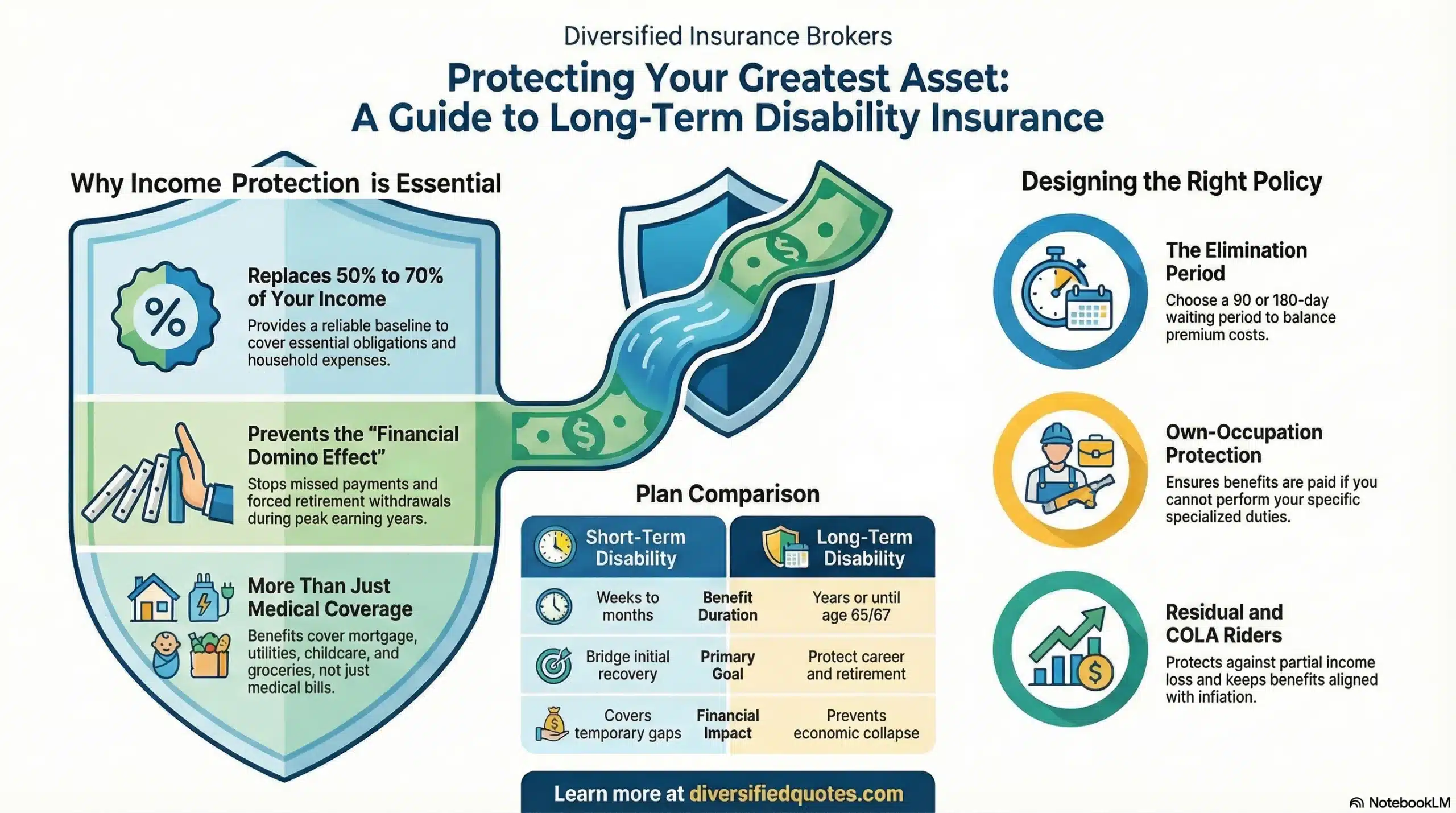
Effective disability insurance for oil and gas workers integrates the occupation’s specific physical hazard profile, income structure, and the financial planning considerations of a career that may involve high compensation with limited portability into non-oil-and-gas roles if disability prevents return to field work. The most important policy design elements are the own-occupation definition — protecting the specific physical functions of the oil and gas role — a benefit period extending as long as available for the occupation class, a benefit amount reflecting actual total compensation including overtime and shift differential pay, and a future increase option that allows coverage to expand as career income grows through advancement without new medical underwriting.
For oil and gas workers who own their own service companies or operate as independent contractors — a common arrangement in the oil field services sector where many specialized technicians and service providers operate as independent businesses — business overhead expense coverage may also be appropriate to protect the fixed costs of an operating business during a disability period. Our resource on business overhead disability insurance explains how BOE coverage works alongside personal disability insurance for self-employed oil field contractors, and our resource on disability insurance for independent contractors covers the specific considerations for contract-based oil field workers. For workers with existing coverage who want an independent evaluation, our disability insurance second opinion service provides a carrier-neutral review.
When to Apply: Early Application Is Critical in High-Risk Industries
For oil and gas workers, the timing of a disability insurance application is especially consequential because the occupational health conditions most likely to create underwriting complications — musculoskeletal conditions from physically demanding field work, chemical exposure-related health history, hearing loss from sustained equipment and drilling noise, and the cumulative health effects of rotation schedule work — can develop and become documented quickly in an active oil field career. A roughneck who applies at age 22 upon entering the oil and gas industry for the first time obtains the most comprehensive coverage at the lowest available lifetime premium before any occupational health history has accumulated. A service worker who applies at age 40 after 15 years of field work faces both significantly higher age-based premiums and the probability that documented occupational health conditions from years of field work will limit coverage options or add exclusion riders.
The future increase option purchased with an early base policy allows coverage to expand as oil and gas career income grows through advancement — from entry-level field positions through supervisory and technical roles — without new medical underwriting. This preserves insurability regardless of what occupational health developments occur during the working years, which is especially important in an industry where cumulative occupational exposure can produce documented health findings that complicate future underwriting. Our resource on disability insurance future insurability riders explains how this protection works, and our resource on how to get the best disability insurance rates explains all the factors that determine coverage quality and cost for high-risk occupation applicants.
Get Disability Insurance Quotes for Oil and Gas Industry Workers
We compare options across carriers for oil and gas professionals to find the right combination of coverage strength, definition, and value for your specific role.
Request Disability Insurance Options
Questions? Call 800-533-5969
Financial Protection Essentials
Income protection resources and disability insurance planning tools for oil and gas industry workers and professionals.
Residual Disability Insurance Benefits Explained
Disability Insurance Elimination Periods Explained
Disability Insurance Future Insurability Rider
Short-Term vs. Long-Term Disability Insurance
High-Risk Disability Insurance Coverage Options
Are Disability Insurance Payments Taxable?
Talk With an Advisor Today
Choose how you’d like to connect—call or message us, then book a time that works for you.
Schedule here:
calendly.com/jason-dibcompanies/diversified-quotes
Licensed in all 50 states • Fiduciary, family-owned since 1980
FAQs: Disability Insurance for Oil and Natural Gas Industries
Can oil and gas workers get disability insurance given the high-risk occupation classification?
Yes — disability insurance is available for oil and gas industry workers, though the application process is more complex than for lower-risk occupations and not every carrier will write coverage for all field roles. Oil and gas field occupations are typically classified in lower occupation classes that reflect the industry’s documented elevated injury and fatality rates, meaning higher premiums and in some cases limitations on benefit period or definition options compared to professional office occupations. However, these limitations are navigable with the right carrier selection.
Different carriers classify specific oil and gas occupation categories differently — a wellhead pumper, a service unit operator, a petroleum engineer, and a refinery operator may each receive different classifications from different carriers based on their specific underwriting guidelines. Working with an independent broker who understands how specific carriers approach oil and gas field work classifications is the most effective way to identify the strongest available coverage terms before any application is submitted. Our resource on disability insurance for high-risk occupations explains how underwriting approaches elevated-risk work in detail.
Why is individual disability insurance necessary when workers’ compensation already covers oil field injuries?
Workers’ compensation provides important baseline coverage for work-related injuries, but it leaves significant income protection gaps. Workers’ comp income replacement typically covers only approximately two-thirds of pre-injury wages subject to state maximum weekly benefit caps that may be well below an oil and gas worker’s actual earnings. Benefits are limited in duration, subject to administrative disputes about causation and compensability, and frequently structured as one-time settlements rather than ongoing income replacement. A worker whose disability arises from conditions not directly attributable to a single work incident, or from the combination of occupational and non-occupational factors, may receive limited or no workers’ comp support.
Individual disability insurance fills these gaps by providing ongoing income replacement based on inability to work — regardless of employer fault, regardless of whether the condition is classified as strictly work-related, and regardless of administrative timelines. An oil and gas worker who develops a disabling back condition from years of physically demanding field work, or who sustains a non-work-related illness that prevents return to field operations, has a disability that workers’ comp does not address and that individual disability insurance directly covers. Our resource on whether disability insurance is worth it provides the full value framework for evaluating this protection.
What are the most common disability scenarios for oil and gas workers?
Three primary disability pathways affect oil and gas workers with the highest frequency and severity. Transportation incidents — vehicle accidents during field road travel, vehicle rollovers at well sites, and highway accidents during rig moves — are the single largest cause of severe disabling injuries, producing traumatic brain injuries, spinal cord injuries, and multiple fracture injuries that may require months to years of recovery and in some cases permanent functional limitation. Equipment contact injuries from the mechanical hazards of drilling and production operations — crush injuries, struck-by incidents from falling objects, and caught-in injuries from rotating equipment — represent the second major acute disability pathway.
Musculoskeletal conditions from the sustained physical demands of field work — lumbar disc conditions from manual material handling, shoulder injuries from overhead work, and knee conditions from working on uneven terrain and equipment — represent the highest-volume disability category even if individual events are less dramatic than traumatic accidents. Chemical exposure conditions including respiratory disease from H2S and VOC exposure, silicosis risk from hydraulic fracturing operations, and the long-term occupational disease consequences of benzene and other carcinogen exposure represent a fourth pathway with potentially longer latency between exposure and disability onset.
How does rotation schedule work affect disability insurance for oil and gas workers?
The rotation schedule structure common in offshore and many remote onshore oil and gas operations creates a distinctive income pattern that makes disability insurance especially important and coverage design especially significant. Many oil and gas workers operate on 14 days on / 14 days off, 28 days on / 28 days off, or similar schedules where all income is generated during the work rotation period. When disability prevents return to the next rotation, income stops completely and immediately — there is no modified duty arrangement, no partial work option during recovery, and no gradual income reduction that allows financial planning adjustment before the full impact hits.
This binary on/off income structure means a disability event produces immediate and total financial impact. The elimination period calibration on a disability policy must account for this reality — a 90-day elimination period on a rotation schedule means three full work rotations without income before benefits begin. For workers with limited financial reserves, a shorter elimination period that begins replacing income sooner is worth the additional premium cost. Our resource on disability insurance elimination periods explained provides the framework for calibrating this choice to actual financial reserves.
What policy provisions matter most for oil and gas workers?
Four provisions are most critical. First: an own-occupation or as-strong-as-available disability definition that protects the specific physical demands of the oil and gas role — the field work, equipment operation, rig floor function, or technical function that generates the income — rather than just a generic ability to work somewhere. Second: a benefit amount reflecting actual total compensation including overtime, shift differentials, and hazard pay that are common in oil and gas and often excluded from employer group policy benefit calculations. Third: a benefit period extending as long as available for the occupation class — a disabling injury at age 35 from a rig accident represents decades of potential income loss that a short benefit period barely addresses.
Fourth: a future increase option allowing coverage to expand as oil and gas career income grows through experience and advancement without new medical underwriting — critical in an industry where cumulative occupational exposure makes future health history impossible to predict. The residual disability rider is also important for partial disability scenarios — an oil field worker who can return to some modified duty but cannot fully resume physically demanding field operations has experienced real income loss that proportionate benefits address. Our resource on residual disability insurance benefits explained covers how this works.
When is the best time for an oil and gas worker to apply for disability insurance?
The optimal time is as early as possible — ideally upon entering the industry before the first field rotation, or at the very latest during the earliest years before occupational health history has accumulated. Oil and gas field work accumulates occupational health history quickly: musculoskeletal conditions from physically demanding work, hearing changes from equipment and drilling noise, and chemical exposure health history can all appear in medical records within years of active field employment. Each documented condition at the time of a later application can produce exclusion riders that limit coverage for the most likely future disability scenarios.
A field worker who applies at age 22 before their first offshore hitch or before their first season of land field work obtains the lowest locked-in lifetime premium at the cleanest health history point, with the broadest available coverage terms. A worker who applies at age 42 after 20 years of field work faces not only significantly higher premiums but a documented health history that may limit coverage options substantially. The future increase option purchased with an early policy allows coverage to expand as oil and gas career income grows without new medical underwriting — preserving insurability regardless of what occupational health developments occur during active working years. Our resource on how to get the best disability insurance rates explains all the factors that determine coverage quality and cost.
About the Author:
Jason Stolz, CLTC, CRPC, DIA, CAA and Chief Underwriter at Diversified Insurance Brokers (NPN 20471358), is a senior insurance and retirement professional with more than 25 years of real-world experience helping individuals, families, and business owners protect their income, assets, and long-term financial stability. As a long-time partner of the nationally licensed independent agency Diversified Insurance Brokers, Jason provides trusted guidance across multiple specialties—including fixed and indexed annuities, long-term care planning, personal and business disability insurance, life insurance solutions, Group Health, Travel Medical and Evacuation Insurance, and short-term health coverage. Diversified Insurance Brokers maintains active contracts with over 100 highly rated insurance carriers, ensuring clients have access to a broad and competitive marketplace.
His practical, education-first approach has earned recognition in publications such as VoyageATL, and contributions from his agency featured in Kiplinger and GoBankingRates— highlighting his commitment to financial clarity and client-focused planning. Drawing on deep product knowledge and years of hands-on field experience, Jason helps clients evaluate carriers, compare strategies, and build retirement and protection plans that are both secure and cost-efficient. Visitors who want to explore current annuity rates and compare options across multiple insurers can also use this annuity quote and comparison tool.
Explore More Disability Insurance Options: Browse our complete guide to Disability Insurance for Agriculture, Natural Resources & Outdoor Industries — covering farmers, ranchers, fishermen, foresters, miners, oil & gas workers & outdoor industries from 100+ carriers.
Last Reviewed: May 15, 2026 |
Reviewed by: Jason Stolz, CLTC, CRPC, DIA, CAA
Chief Underwriter, Diversified Insurance Brokers, Inc. | NPN: 20471358 | Diversified Insurance Brokers, Inc. — Licensed in all 50 states
Fact Checked by: Tonia Pettitt, CMIP©
Medicare Specialist, Diversified Insurance Brokers, Inc. | NPN: 14374308 | Diversified Insurance Brokers, Inc. — Licensed in all 50 states
Did you find this content helpful? Leave us a Google review — it helps others find trustworthy guidance too.
Editorial Standards: Diversified Insurance Brokers maintains rigorous editorial standards to ensure accuracy, clarity, and independence in all content. Learn more about our editorial standards and commitment to transparency.
