
Best Annuities for TSP Rollover
As an Independent Annuity Broker, we compare rates across 100+ carriers and 1,000 different annuities— not just one company’s product offerings — to find the best fit for your goals.
Best Annuities for TSP Rollover

Jason Stolz CLTC, CRPC, DIA, CAA
At Diversified Insurance Brokers, we work with federal employees, uniformed service members, and civilians leaving government service who are navigating one of the most consequential financial decisions in their retirement transition: what to do with a Thrift Savings Plan account when they separate from service. The TSP is a genuinely excellent retirement savings vehicle while you are employed — among the lowest-cost institutional plans available anywhere in the United States. But the moment you separate from federal service, the TSP’s relative strengths begin competing with the private marketplace’s strengths, and the correct decision is not automatically one or the other. It depends entirely on your goals: whether you want guaranteed declared-rate growth, protected index-linked accumulation, or guaranteed lifetime income. This guide covers the best annuity options for a TSP rollover, organized by planning objective rather than by product type, so the decision framework starts with your needs rather than with a product recommendation. Working with us gives you access to an Independent Annuity Broker, meaning we shop the entire market, not just a select few carriers.
Understanding the full pros and cons of annuity structures is the starting point before any TSP rollover evaluation — because rolling into an annuity is one of four broad options available to a separated TSP participant, not the only option or automatically the best one. The four options are: keep the balance in the TSP, roll over to an IRA and self-direct the investments, roll over to a new employer plan (if your next employer’s plan accepts incoming rollovers), or roll over to an IRA and fund an annuity contract. Each has distinct advantages and limitations, and the TSP’s own built-in options — particularly the G Fund — have characteristics that genuinely cannot be replicated in the private market. Acknowledging those characteristics honestly is the foundation of a complete TSP rollover evaluation rather than a reflexive recommendation in either direction.
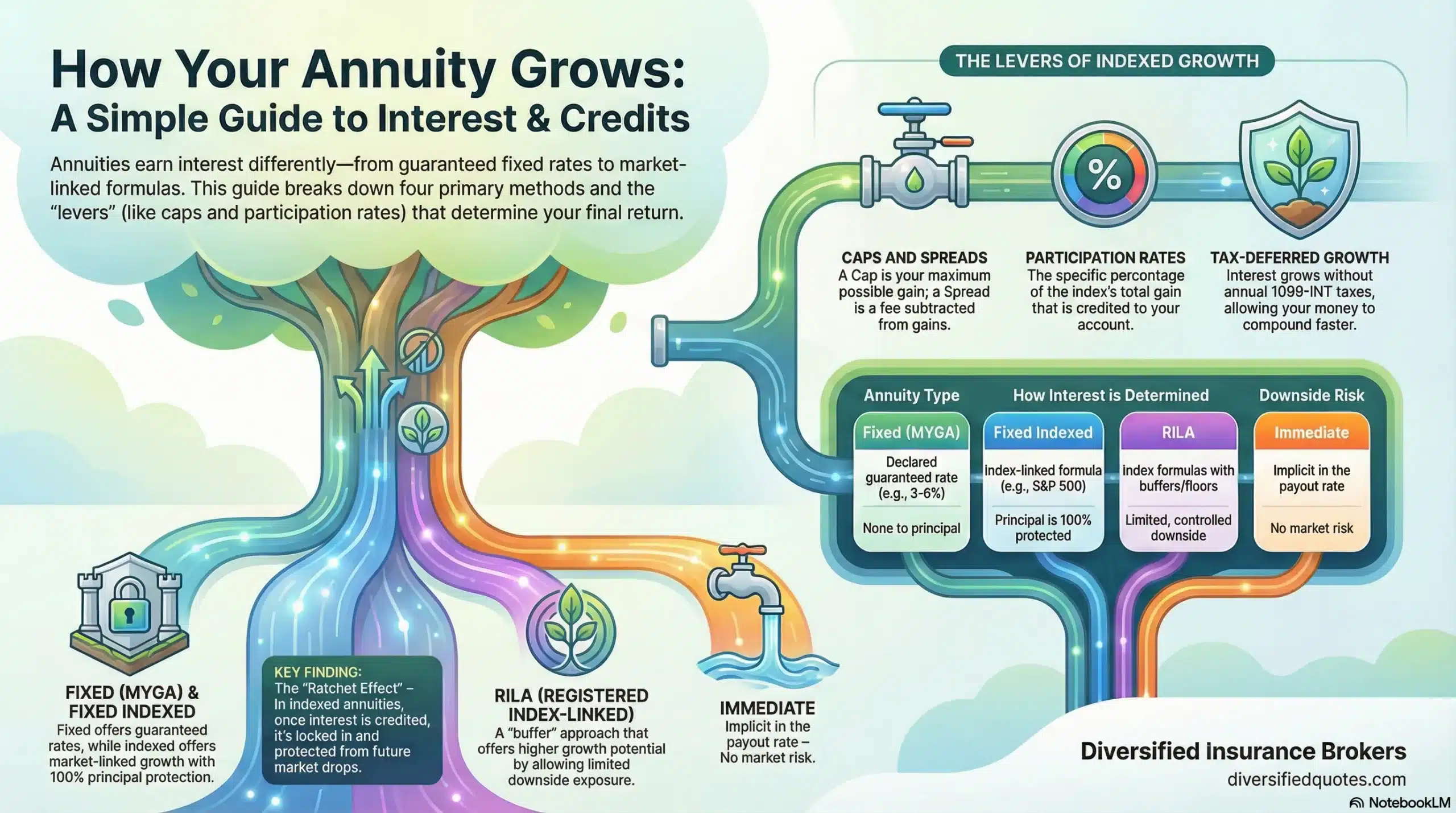
For the federal employees, military members, and civil servants reading this: the annuity options covered in this guide span the full planning spectrum. A Multi-Year Guaranteed Annuity (MYGA) provides declared-rate certainty comparable to what the TSP’s G Fund offers, but with longer rate-lock periods (up to 10 years), full tax deferral, and access to the competitive private marketplace’s declared rates. A Fixed Indexed Annuity (FIA) provides principal protection with market-linked growth potential — participating in index gains subject to caps or participation rates while guaranteeing that market declines do not reduce your account value. And a lifetime income annuity — whether a Single Premium Immediate Annuity (SPIA) or a Deferred Income Annuity (DIA) — converts your accumulated TSP balance into a guaranteed monthly income stream for life, addressing the longevity risk that the TSP’s investment-based options cannot resolve by themselves. Which of these, if any, is the right destination for your TSP balance depends on the specifics of your retirement plan — and this guide covers the analytical framework for evaluating each option clearly.
Ensure you are receiving the absolute top rates
Current Fixed Annuity Rates
Compare today’s best fixed annuity rates from top carriers.
Current Bonus Annuity Rates
See which annuities offer the highest upfront bonus today.
Request an Annuity Quote
Submit our annuity request form to get personalized rate options.
Lifetime Income Calculator
Use our calculator to see how much guaranteed income your annuity can provide.
What Makes the TSP Unique — and Why the Rollover Decision Deserves Careful Analysis
Before evaluating any annuity option, every TSP participant should understand two features of the TSP that genuinely cannot be replicated in the private marketplace: the G Fund and the expense ratio structure. Both are legitimate reasons to consider keeping some or all of your TSP balance in the plan even after separation, and no honest TSP rollover evaluation should proceed without acknowledging them.
The G Fund — Government Securities Investment Fund — is unique among all retirement savings vehicles available to American investors. Unlike a traditional money market fund or short-term bond fund, the G Fund invests exclusively in specially issued non-marketable U.S. Treasury securities. What makes it distinctive is the rate it earns: by law, the G Fund receives the weighted average yield of all outstanding U.S. Treasury notes and bonds with more than four years to maturity — effectively earning a long-term bond rate. But it does so with the liquidity and principal protection of a short-term instrument. There is no credit risk, no interest rate risk to principal, and no possibility of negative return in any period. The G Fund rate adjusts monthly based on the prevailing Treasury yield environment. This combination — long-term rates with short-term safety — is not available anywhere in the private market at any price. There is no MYGA, CD, money market fund, or stable value fund outside the TSP that replicates it. If the G Fund is a significant portion of your TSP allocation and its characteristics are important to your retirement plan, that is a meaningful argument for keeping at least a portion of your balance in the TSP rather than rolling the full amount out.
The TSP’s expense ratios are among the lowest of any institutional retirement plan in the country. While specific expense ratios change annually and are published on tsp.gov (flag: verify current figures at tsp.gov before citing), they have historically been a small fraction of what comparable mutual funds charge in the private marketplace. For participants whose primary objective is low-cost equity market exposure during accumulation, the TSP’s C Fund (tracking the S&P 500) and S Fund (tracking small- and mid-cap stocks) provide that exposure at institutional pricing that private market alternatives rarely match. The rollover decision should acknowledge this: when you move TSP assets into a private-market product, you are trading the TSP’s extraordinary cost efficiency for other benefits — guaranteed rates, principal protection, income guarantees, or planning flexibility — that the TSP does not provide. The trade-off is legitimate and often correct, but it should be acknowledged explicitly rather than glossed over in the rollover process.
Annuity Options for TSP Rollover — Side-by-Side Comparison
| Planning Dimension | MYGA (Fixed Rate Annuity) | Fixed Indexed Annuity (FIA) | Income Annuity (SPIA / DIA) | Stay in TSP |
|---|---|---|---|---|
| Rate / Return Certainty | Highest — declared rate locked for full 2–10 year term. Exact maturity value calculable at purchase. No scenario range; one guaranteed number. | Moderate — 0% floor guarantees no loss; upside is a range based on index performance. Annual credited interest varies; not predictable to a single number at purchase. | Highest on income — exact monthly payment guaranteed for life at purchase. Payment does not change with markets, rates, or longevity. Accumulation certainty is replaced by income certainty. | Varies by fund. G Fund: declared rate certainty monthly. C/S/I Funds: fully market-exposed; no floor, full volatility. Lifecycle funds: blend determined by target date. |
| Principal Protection | Full — principal plus earned interest guaranteed by the issuing carrier. No market exposure. Backed by the carrier’s financial strength and state guaranty association protections. | Full on indexed accounts — 0% floor prevents any market-caused decline. Annual reset locks in prior gains permanently; future declines restart from the current level. | Not applicable in the traditional sense — premium is exchanged for the income stream; there is no accumulation account value to protect. The guarantee is the income, not the principal. | G Fund: full principal protection by the U.S. government. C/S/I Funds: no protection; full market risk. TSP does not offer an indexed fund option with a 0% floor. |
| Growth Potential | Fixed — grows only at the declared rate. No participation in market gains beyond the stated rate regardless of how well markets perform during the guarantee period. | Variable upside — in positive index years, credited interest may significantly exceed a comparable MYGA rate. Choosing the right index strategy affects growth potential meaningfully. See our guide to choosing indexes in an annuity. | None — income annuities do not have an accumulation phase after purchase. The premium is converted to an income stream; there is no investment account growing alongside the income payments. | C and S Funds provide full equity market upside with no cap. I Fund provides international exposure. G Fund provides only its monthly declared rate; Lifecycle Funds blend equity and fixed based on target date. |
| Income and Liquidity Options | 10% annual free withdrawal (most contracts; year two onward for some); full access at maturity. Surrender charges apply to excess during the guarantee period. Maturity value can be repositioned into an income product or new accumulation contract. | 10% annual free withdrawal; health waivers; optional income riders (GLWB) if available on the specific product. Full access at maturity for repositioning. Surrender charges apply to excess during surrender period. | Highly illiquid — once premium is exchanged for the income stream, the trade is typically irrevocable. No account value to access. Income payments continue for the guaranteed period regardless of future needs. | Installments, partial withdrawals, and full withdrawal available after separation. No surrender charges — TSP does not have a surrender period. Annual RMDs from traditional TSP beginning at required beginning date. |
| Best Planning Objective | Knowing exactly what the balance will be at a future date; replacing G Fund characteristics with a longer rate lock and competitive private market yields; conservative accumulation for buyers who cannot accept any return uncertainty. | Growing the TSP rollover with principal protection over a 7–10 year horizon; wanting market participation without C/S Fund downside risk; building an accumulation base that can later convert to income. | Replacing the income certainty of a federal pension; guaranteeing income for life regardless of investment performance or longevity; converting an accumulated TSP balance directly into a pension-like income stream. | Satisfied with TSP fund options; prioritizing ultra-low costs and G Fund access; planning to take installment distributions over many years; still considering options and not ready to commit to a long-term annuity structure. |
| Comparison to G Fund | The best competitor to the G Fund in the private market. Longer rate locks (5, 7, 10 years vs. G Fund’s monthly rate) may offer a yield advantage in flat or declining rate environments; competitive A-rated carriers match or exceed G Fund rates in many rate environments. | Not a G Fund replacement — the FIA’s indexed upside potential means return variability the G Fund does not have. Better suited for TSP participants who want more growth potential than the G Fund provides rather than an equivalent substitute for it. | Not comparable — income annuities do not serve the same accumulation function as the G Fund. They solve a different problem: longevity risk and income certainty rather than principal protection with growth. | G Fund is only accessible within the TSP. Rolling out of the TSP permanently surrenders G Fund access. This is an irreversible decision — once assets leave the TSP, they cannot be returned. |
MYGA After TSP Rollover — Declared-Rate Certainty in the Private Market
A Multi-Year Guaranteed Annuity is the closest private-market equivalent to what the TSP’s G Fund provides conceptually — a defined, contractually guaranteed interest rate with full principal protection — but with several structural advantages that the G Fund cannot offer. The most significant is the rate-lock period. The G Fund’s rate adjusts monthly based on the prevailing Treasury yield environment, meaning the effective rate you earn on your G Fund balance changes continuously and cannot be locked in for a defined future period. A MYGA locks a declared rate for the full 3, 5, 7, or 10-year guarantee period at purchase, regardless of how the interest rate environment moves during that time. In a declining rate environment, the MYGA’s locked rate continues compounding at the original declared level while the G Fund’s monthly rate falls with the Treasury market.
The competitive MYGA marketplace — across 75+ carriers at multiple rating tiers — means that declared rates in the private market often compare favorably to the G Fund’s prevailing rate, particularly at the 5- to 10-year term lengths where the MYGA’s options budget can be allocated more generously. For TSP participants who have been using the G Fund as their primary safe-money allocation and are separating from service, a MYGA with a competitive 5- or 7-year declared rate from an A-rated carrier provides: the same principal protection (backed by carrier financial strength and state guaranty association protections); full tax deferral during the guarantee period (identical to the G Fund’s tax treatment within the TSP qualified wrapper); 10% annual free withdrawals for liquidity (most G Fund participants use annual distributions rather than full surrenders); and the flexibility to reposition at maturity into a new MYGA, an FIA, or an income annuity based on market conditions at that time. A MYGA laddering strategy — splitting the rollover across 3-year, 5-year, and 7-year MYGA contracts simultaneously — replicates the TSP’s installment distribution flexibility while capturing competitive declared rates across the full yield curve.
Carriers like Gainbridge Life have built MYGA products specifically optimized for IRA rollover efficiency, with digital-first application processes that can make the TSP-to-IRA-to-MYGA pathway straightforward for federal employees who prefer a streamlined execution. When evaluating any MYGA for a TSP rollover, the carrier’s AM Best financial strength rating is the most important due diligence variable — the declared rate guarantee is only as strong as the carrier’s ability to fulfill it, and an A- or higher AM Best rating is the standard most conservative financial planners apply before placing retirement rollover assets.
Fixed Indexed Annuity After TSP Rollover — Protected Growth Beyond G Fund Returns
A Fixed Indexed Annuity addresses a specific and common dissatisfaction that many TSP participants have with the G Fund: it is safe but it is not growing at the rate needed to keep up with inflation or to build meaningful additional retirement assets. The C Fund and S Fund do provide market-level growth, but with full equity downside risk — not suitable for the portion of a federal employee’s retirement assets that needs to be protected from sequence-of-returns risk near or in retirement. The FIA fills the gap between the G Fund’s safety-without-growth and the C/S Fund’s growth-without-safety. For the portion of your TSP rollover that needs to grow beyond G Fund rates but cannot afford the C/S Fund’s full market exposure, an FIA provides: the 0% floor that prevents market-caused principal loss; index-linked growth potential through S&P 500, Nasdaq-100, or volatility-controlled index strategies in positive market years; full tax deferral identical to the TSP’s qualified wrapper; and the 10% annual free withdrawal provision for liquidity during the surrender period.
The sequence-of-returns risk context is particularly relevant for federal employees who are transitioning from accumulation to distribution: you are at exactly the point in the retirement timeline where a severe market drawdown in the early years of retirement does the most permanent damage to portfolio sustainability. An FIA protects the portion of the rollover allocated to it from that specific risk — the early-retirement drawdown that is most destructive precisely because withdrawals are being taken from a declining portfolio. By allocating a meaningful portion of the TSP rollover to an FIA and leaving the remainder in market-exposed vehicles (either within the TSP in C/S/I Funds or in a self-directed IRA with equity funds), the federal retiree creates a protected floor allocation that does not need to be liquidated during market declines — allowing the market-exposed allocation to recover without the compounding damage of forced distributions.
Income Annuity After TSP Rollover — Building a Private Pension
For federal employees who participate in FERS rather than CSRS, the federal pension (FERS basic benefit) is typically more modest than the CSRS pension, and the TSP is intended to fill a larger portion of the retirement income need. For these participants — and for military members whose retirement income may not fully cover essential expenses — converting some or all of the TSP rollover into a guaranteed lifetime income stream through a Single Premium Immediate Annuity (SPIA) or Deferred Income Annuity (DIA) addresses longevity risk in a way that no investment-based strategy can replicate. A SPIA converts the rollover premium into monthly guaranteed income payments beginning immediately (typically within 30 days of purchase); a DIA defers the income start date — sometimes by years or even decades — allowing the income amount to be significantly higher at activation than a SPIA purchased at the same time for the same premium.
The income annuity is the only retirement vehicle that guarantees income for as long as you live regardless of how long that is — which is precisely the risk that federal retirees face that neither the G Fund nor the C Fund can address contractually. A FERS employee who retires at 62, collects Social Security at 67, and lives to 91 faces a 29-year retirement span. An income annuity purchased with a portion of the TSP rollover at retirement provides income across every one of those years — whether markets are strong or weak, whether interest rates rise or fall, whether the carrier’s portfolio outperforms or underperforms. For federal employees whose FERS pension plus Social Security does not fully cover essential monthly expenses, an income annuity sized to fill that specific gap creates a guaranteed income floor that removes the sequence-of-returns risk from the essential expense coverage entirely, leaving the remaining TSP and other assets to grow without distribution pressure.
TSP Rollover Mechanics — Direct vs. Indirect, Traditional vs. Roth
Understanding how to execute a TSP rollover correctly is as important as knowing which annuity to fund with the proceeds. The rollover mechanics are verified from TSP.gov and IRS Publication 721, and getting them wrong creates costly, sometimes irreversible tax consequences. A direct rollover — also called a trustee-to-trustee transfer — instructs the TSP to send your account balance directly to the receiving IRA custodian or plan administrator without the funds ever passing through your hands. In a direct rollover, no federal income tax is withheld, no 60-day reinvestment deadline applies, and the full amount of the distribution arrives at the destination account intact. This is the correct method for virtually all TSP rollover situations, and understanding how qualified plan transfers work mechanically — specifically the form completion, the receiving institution certification requirements, and the timeline — prevents the common errors that convert a tax-free transfer into a taxable distribution. An indirect rollover — where the TSP sends a check to you personally — triggers mandatory 20% federal income tax withholding on the taxable portion. You then have 60 days to deposit the full distribution amount (including the withheld 20%) into the receiving account. If you deposit only the 80% you received without replacing the withheld 20% from other sources, that 20% is treated as a taxable distribution — potentially plus the 10% early distribution penalty if you are under 59½. The indirect rollover is almost always the wrong method when a direct rollover is available.
The Traditional-to-Traditional and Roth-to-Roth matching rules are the second critical mechanic. A Traditional TSP balance rolled to a Traditional IRA is not a taxable event — the funds remain pre-tax and continue deferring taxes until distribution. A Roth TSP balance rolled to a Roth IRA is also not a taxable event. Converting a Traditional TSP balance to a Roth IRA is a taxable event — the full converted amount is added to ordinary income in the year of the conversion. This Roth conversion strategy can be appropriate in specific tax planning contexts (particularly in low-income years between retirement and Social Security activation), but it is a deliberate tax planning decision, not an inadvertent outcome. Outstanding TSP loans must be repaid before completing a full rollover — if an outstanding loan is not repaid before the distribution is processed, the loan balance is treated as a deemed distribution, which is taxable and potentially subject to the 10% penalty, and cannot be rolled over. Finally, married FERS and uniformed services participants with total TSP account balances over $3,500 who want to do a total withdrawal must obtain notarized spousal consent — their spouse is entitled by law to a joint life annuity with survivor benefits, and any other withdrawal option requires the spouse to formally waive that right.
RMDs, TSP-Specific Rules, and What You Give Up By Rolling Out
Several TSP-specific rules interact with the rollover decision in ways that many federal employees are not fully aware of. Required Minimum Distributions apply to traditional TSP accounts beginning at the required beginning date — the April 1 following the year the participant turns 73 (or 75 for those born in 1960 or later under SECURE 2.0). Unlike IRAs where the aggregation rule allows multiple IRA accounts’ RMDs to be satisfied from any one account, TSP RMDs must be taken from the TSP itself — the IRA aggregation rule does not apply to TSP accounts. Understanding how RMDs work under SECURE 2.0 — particularly the extended RMD ages, the modified penalty structure, and how Roth balances are treated — is part of the TSP rollover evaluation, because rolling the traditional TSP balance into a Traditional IRA makes the RMD subject to IRA aggregation rules (which can be more flexible for multi-account owners) while rolling into a qualified annuity requires that the annuity’s free withdrawal provision accommodate the RMD amount from that specific contract.
The G Fund access issue bears repeating as a permanent consideration: once assets leave the TSP, they cannot be returned. The TSP accepts incoming rollovers from IRAs and eligible employer plans, but the form specifying this — TSP Form TSP-60 — explicitly requires an open TSP account. Separated participants who have closed their TSP account by doing a full rollover cannot reopen it for a new rollover back in. If the G Fund’s characteristics become valuable to you after the rollover — perhaps in a future rising rate environment when the G Fund’s long-term rate with short-term safety looks attractive again — the option to access it within the TSP will no longer be available. This permanence is worth weighing explicitly in the rollover analysis rather than treating the rollover as reversible.
Ready to compare annuity options for your TSP rollover against your specific retirement timeline?
Request Your Personalized TSP Rollover Analysis
Financial Protection Essentials
Explore life insurance, disability coverage, and specialty protection options for federal employees, military members, and working professionals.
Explore Annuity Rollover Options by Account Type
Every retirement account rolls over differently. Choose your plan type below to see the specific rules, tax treatment, and best annuity strategies for your situation.
Talk With an Advisor Today
Choose how you’d like to connect—call or message us, then book a time that works for you.
Schedule here:
calendly.com/jason-dibcompanies/diversified-quotes
Licensed in all 50 states • Fiduciary, family-owned since 1980
Should I keep my TSP or roll it over to an annuity — how do I decide?
The TSP-versus-rollover decision is not a binary choice that has a universal correct answer — it depends on which TSP features you actually value and whether those features are replicated in the private market alternative you are considering. The case for keeping your TSP is strongest when: you are a significant G Fund user who values the combination of long-term Treasury rates with short-term principal protection that no private-market vehicle can replicate; you are satisfied with the C, S, and I Fund options for equity market exposure; your distribution needs are straightforward installment payments that the TSP can accommodate without a surrender structure; and you do not have a specific income conversion, principal protection with upside, or multi-carrier comparison objective that the TSP cannot serve. The case for rolling over is strongest when: you need a guaranteed lifetime income stream that the TSP’s investment-based options cannot provide contractually; you want principal protection plus indexed upside potential that the TSP does not offer (the TSP has no FIA-equivalent product); you want to lock in a competitive declared rate for 5–10 years through a MYGA in a declining rate environment; you are consolidating multiple retirement accounts and the TSP creates unnecessary complexity; or you want beneficiary planning flexibility that the TSP’s more limited beneficiary designation structure does not allow. Many federal employees end up with a partial rollover — keeping a portion in the TSP for G Fund access and cost efficiency while rolling a portion out for annuity benefits — which is a valid strategy. The TSP allows partial withdrawals after separation, and a partial rollover is not an all-or-nothing decision. Understanding the full pros and cons of annuities relative to investment-based alternatives is the foundational framework before any rollover decision is finalized.
How are distributions from a TSP-funded annuity taxed?
Understanding how annuity distributions are taxed when the annuity is funded by a TSP rollover is more straightforward than non-qualified annuity taxation, but has several TSP-specific nuances. When a traditional TSP balance is rolled directly into a Traditional IRA and then used to purchase an annuity within that IRA (a qualified annuity), every dollar of distribution from the annuity is taxable as ordinary income — because no taxes were ever paid on either the original TSP contributions or the credited interest earned inside the annuity. This is identical to how direct TSP distributions are taxed; the annuity wrapper does not change the tax treatment of the underlying qualified money. The 10% early distribution penalty applies to distributions before age 59½, with exceptions including separation from service at age 55 or later (the Rule of 55 applies to the employer plan itself — once rolled to an IRA, you lose this exception; the annuity rollover to an IRA means the Rule of 55 no longer applies). When a Roth TSP balance is rolled to a Roth IRA and used to purchase an annuity, qualified distributions from the Roth annuity are tax-free — the same treatment as Roth IRA distributions. An important TSP-to-Roth consideration: the 5-year aging period for qualified Roth distributions restarts at the Roth IRA level when Roth TSP funds are rolled to a Roth IRA. The 5-year period your Roth TSP funds satisfied does not carry over to the new Roth IRA. For income annuity (SPIA) distributions from a qualified annuity, the full payment is taxable as ordinary income — there is no exclusion ratio as there is for non-qualified income annuities, because the entire premium is pre-tax money.
Can I use SEPPs or 72(q) distributions from a TSP-funded annuity before age 59½?
Understanding how Substantially Equal Periodic Payments (SEPPs) work under IRC Section 72(t) — the IRA equivalent of the TSP’s own separation-from-service early distribution exception — is particularly relevant for federal employees who separate before age 55 and need income from their rolled-over TSP assets before age 59½ without triggering the 10% penalty. Once a traditional TSP balance is rolled to a Traditional IRA and then to an annuity, the TSP’s own early distribution exceptions (including the Rule of 55, which allows penalty-free distributions at separation from service at 55 or later) no longer apply — the IRA rules govern instead. Under IRS Section 72(t), substantially equal periodic payments taken from the IRA/annuity under an approved calculation method (life expectancy, annuitization, or amortization) are exempt from the 10% early distribution penalty. The SEPP must continue for the longer of 5 years or until age 59½, and any modification before that period ends retroactively reinstates the penalty for all prior distributions plus interest. The critical annuity-specific consideration: a SEPP payment stream that exceeds the annuity contract’s annual free withdrawal provision will trigger surrender charges on the excess even though the SEPP is penalty-exempt from an IRS perspective. The surrender charge is a contract provision, not an IRS rule. Buyers planning to use SEPPs from an annuity must confirm that the SEPP calculation produces a required payment amount within the contract’s annual free withdrawal percentage before committing to both the SEPP election and the annuity product. Understanding how 72(q) distributions work for non-qualified annuities provides the parallel framework for any non-qualified annuity assets that may be part of the broader retirement plan alongside the TSP rollover.
How does a TSP rollover annuity interact with RMDs?
When a traditional TSP balance is rolled to a Traditional IRA and then used to fund an annuity, that annuity becomes part of the IRA universe for RMD purposes. Unlike TSP RMDs — which must be satisfied from the TSP account directly — IRA RMDs benefit from the aggregation rule: the total RMD across all Traditional IRAs can be satisfied by withdrawing from any one or any combination of those IRA accounts. This means a federal retiree who has both a rollover IRA holding the former TSP balance (in an annuity) and a separate Traditional IRA can satisfy the entire combined RMD from the non-annuity IRA — leaving the annuity’s free withdrawal provision intact for the annuity contract itself without triggering surrender charges. The annuity contract’s free withdrawal provision — typically 10% of the account value annually — must be sufficient to cover the RMD calculated from that specific annuity IRA contract if the RMD cannot be satisfied from another account. For a recently rolled TSP balance in a 7- or 10-year MYGA or FIA, the RMD in the early surrender years may well fit within the 10% free provision; as the account grows and the required withdrawal percentage increases with age, confirming adequate liquidity becomes more important. Understanding how surrender charges interact with RMDs — and whether excess RMD amounts (above the free provision) trigger surrender charges plus any applicable MVA — is part of the pre-commitment due diligence for any federal retiree placing TSP rollover assets into an annuity with a surrender period.
How does the TSP annuity option within the plan compare to rolling out and buying a private-market income annuity?
The TSP does offer an annuity option — participants can use their TSP balance to purchase a life annuity through a contracted annuity provider selected by the Federal Retirement Thrift Investment Board. This built-in option is worth understanding before evaluating a private-market SPIA or DIA as a rollover destination. The TSP’s built-in annuity is structured as a single premium immediate annuity: you exchange your TSP balance for a guaranteed monthly income stream for life, with several payout options (life only, joint life with spouse, 10-year certain period, etc.). The fundamental limitation of the TSP’s built-in annuity relative to the private marketplace: competition. The TSP negotiates its annuity rates with a single contracted provider, which means you receive that provider’s rate for your age, sex, and premium amount — there is no ability to shop the rates across dozens of SPIA carriers the way you can in the private marketplace. Private-market SPIA rates vary meaningfully across carriers — sometimes by 5–15% in the monthly payment amount for the same premium — because each carrier’s actuarial model, investment portfolio, and pricing strategy differs. By rolling the TSP to a Traditional IRA and purchasing a SPIA from the most competitive private-market carrier for your specific situation, you may secure a meaningfully higher guaranteed monthly income than the TSP’s single-carrier built-in option provides. This is the primary financial case for the rollover-then-SPIA pathway versus the TSP-internal annuity option. For federal employees who also want to explore what an annuity can replace in the context of leaving a government plan, our resource on what to do with a 401(a) after retirement covers the adjacent decision framework for state and local government employees in similar defined contribution plan situations.
About the Author:
Jason Stolz, CLTC, CRPC, DIA, CAA and Chief Underwriter at Diversified Insurance Brokers (NPN 20471358), is a senior insurance and retirement professional with more than 25 years of real-world experience helping individuals, families, and business owners protect their income, assets, and long-term financial stability. As a long-time partner of the nationally licensed independent agency Diversified Insurance Brokers, Jason provides trusted guidance across multiple specialties—including fixed and indexed annuities, long-term care planning, personal and business disability insurance, life insurance solutions, Group Health, Travel Medical and Evacuation Insurance, and short-term health coverage. Diversified Insurance Brokers maintains active contracts with over 100 highly rated insurance carriers, ensuring clients have access to a broad and competitive marketplace.
His practical, education-first approach has earned recognition in publications such as VoyageATL, and contributions from his agency featured in Kiplinger and GoBankingRates— highlighting his commitment to financial clarity and client-focused planning. Drawing on deep product knowledge and years of hands-on field experience, Jason helps clients evaluate carriers, compare strategies, and build retirement and protection plans that are both secure and cost-efficient. Visitors who want to explore current annuity rates and compare options across multiple insurers can also use this annuity quote and comparison tool.
Explore More Lifetime Income Options: Browse our complete guide to How to Transfer a Retirement Account to an Annuity — covering IRA, 401k, 403b, TSP, pension, Roth IRA, SEP IRA, 457b & more rollover guides from 100+ carriers.
Last Reviewed: July 6, 2026 |
Reviewed by: Jason Stolz, CLTC, CRPC, DIA, CAA
Chief Underwriter, Diversified Insurance Brokers, Inc. | NPN: 20471358 | Diversified Insurance Brokers, Inc. — Licensed in all 50 states
Fact Checked by: Tonia Pettitt, CMIP©
Medicare Specialist, Diversified Insurance Brokers, Inc. | NPN: 14374308 | Diversified Insurance Brokers, Inc. — Licensed in all 50 states
Did you find this content helpful? Leave us a Google review — it helps others find trustworthy guidance too.
Editorial Standards: Diversified Insurance Brokers maintains rigorous editorial standards to ensure accuracy, clarity, and independence in all content. Learn more about our editorial standards and commitment to transparency.
