
How to Roll Over a 403b or 401k into a Guaranteed Annuity
How to Roll Over a 403b or 401k into a Guaranteed Annuity

Jason Stolz CLTC, CRPC, DIA, CAA
Rolling over a 403(b) or 401(k) into a guaranteed annuity is one of the most consequential retirement decisions most people will make — and it deserves more than a single-company product pitch. If you have built a meaningful balance inside an employer plan, the rollover decision is not just about moving money. It is about protecting what you have already earned, controlling taxes through the transition, and turning accumulated savings into predictable cash flow you can actually build a retirement around. At Diversified Insurance Brokers, Jason Stolz, CLTC, CRPC, DIA, CAA helps clients nationwide compare fixed annuities and fixed indexed annuities for retirement income goals — especially when the money is coming from an employer plan rollover. The objective is never to sell an annuity. The objective is to build the best retirement structure for your risk tolerance, timeline, and income needs, using products that actually match how people retire in the real world.
For many families, the biggest fear is not missing out on growth. It is watching retirement collide with market volatility at exactly the wrong moment. A portfolio can look strong on paper but still fail in retirement if withdrawals are forced during a downturn — a risk with a specific name and a specific mechanism described in detail in our resource on sequence of returns risk. That is why more people today are looking at guaranteed annuity options when they leave a job, retire, or consolidate old accounts. A properly structured rollover can keep money tax-deferred, reduce sequence-of-returns exposure, and create lifetime income planning options that most 401(k) and 403(b) investment menus simply do not offer. Before committing to any structure, it helps to understand what your accumulated balance will actually sustain over a 25-to-30-year retirement without a guaranteed income floor — our resource on how long a 401(k) lasts in retirement covers the withdrawal math that makes the case for a protected income layer more concretely than any rate comparison can.
Ensure you are receiving the absolute top rates
Current Fixed Annuity Rates
Compare today’s best fixed annuity rates from top carriers.
Current Bonus Annuity Rates
See which annuities offer the highest upfront bonus today.
Request an Annuity Quote
Submit our annuity request form to get personalized rate options.
Lifetime Income Calculator
Get a real-world estimate of the guaranteed income your 403(b) or 401(k) rollover could generate based on your age and premium amount.
What Is a 403(b) or 401(k) Rollover?
A rollover is the process of moving money from one qualified retirement account to another qualified retirement structure without triggering immediate taxes. A 401(k) is typically offered by private employers, while a 403(b) is often used by schools, hospitals, and nonprofit organizations. In both cases, the balance is generally pre-tax — meaning the IRS allows transfer as long as the money stays inside a qualified or tax-deferred environment. When someone says “I want to roll my 401(k) into an annuity,” what they usually mean is: “I want to move part or all of my employer plan into a contract that protects principal and can create predictable income.” That is possible, and it is done every day. The key is doing it correctly so the transfer is handled as a direct rollover and not treated as a taxable distribution. For a deeper breakdown of how rollovers are structured and how to avoid the withholding mistakes that create unexpected tax bills, our resource on what is a direct rollover covers the mechanics in full.
Why People Roll Over Retirement Plans Into Guaranteed Annuities
Retirement is not just about growing money — it is about using money reliably. When you transition from saving to spending, the risk profile shifts entirely. A portfolio can perform well over 20 years and still fail in retirement if withdrawals are forced during a market downturn in the early years. Guaranteed annuities are designed for that stage. Instead of relying on market performance to determine the retirement outcome, a fixed annuity or fixed indexed annuity uses contractual guarantees to define how interest is credited and how income can be turned on. That does not mean annuities replace investments completely — it means they can be used strategically to cover the expenses that must be paid regardless of market conditions, while other assets handle discretionary and growth-oriented goals.
One of the most practical advantages is that annuities reduce the retirement stress that comes from daily market monitoring. When part of your plan is contract-defined, you can build a retirement structure that feels stable even when markets are not. For a broader view of how this protection-first philosophy fits into retirement income planning, our resource on how to protect your funds in retirement covers the full framework. For retirees evaluating whether an annuity in their overall plan is objectively worth the commitment, our resource on are annuities worth it covers the evidence-based framework for when the protected income structure consistently outperforms market-dependent withdrawal strategies — and when it does not. And for perspective on common misunderstandings that cause people to reject annuities prematurely, our resource on what most people get wrong about annuities covers the five misconceptions that prevent people from evaluating the rollover option objectively.
Fixed vs. Fixed Indexed — Two Guaranteed Paths With Very Different Outcomes
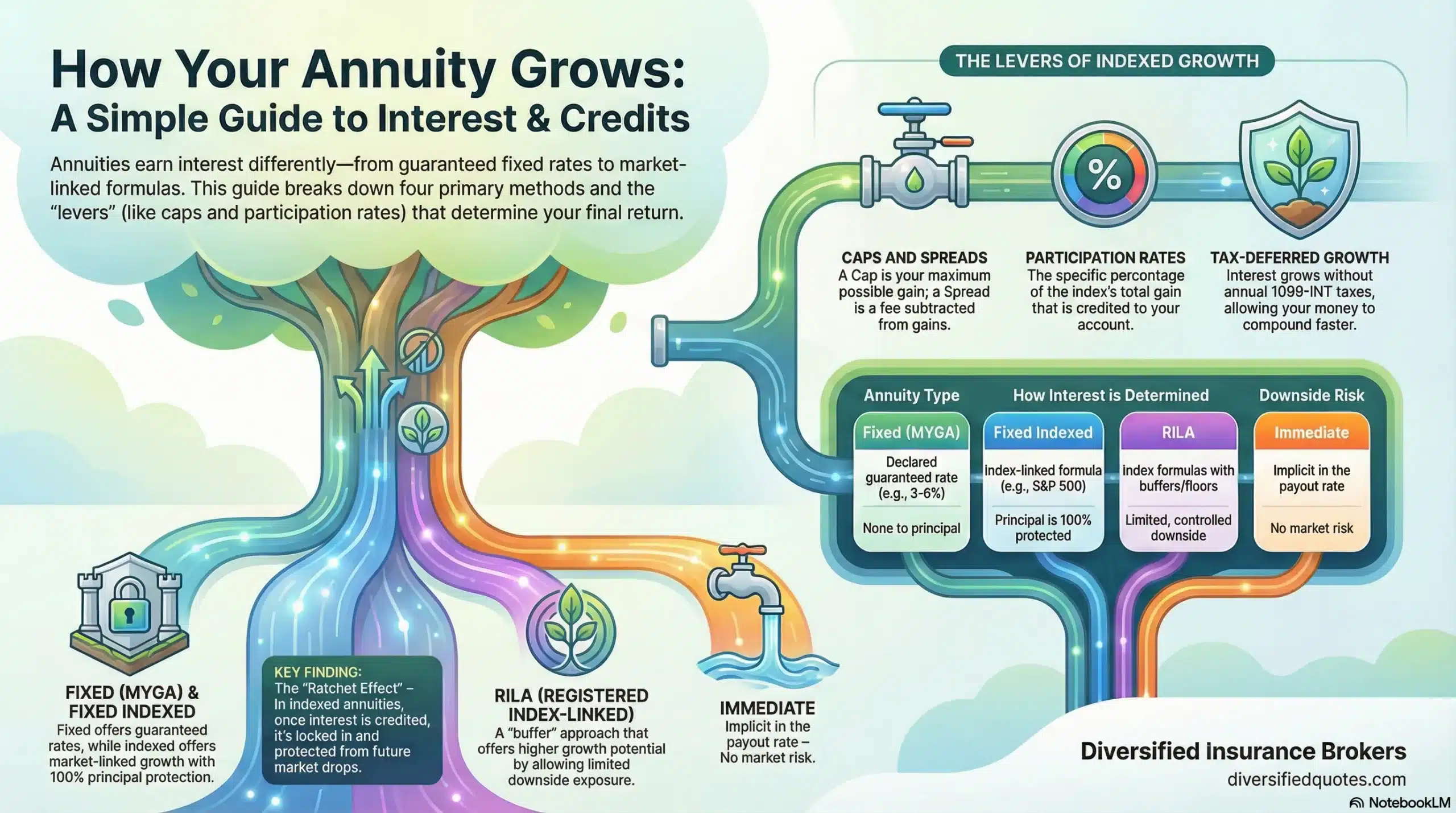
When people say “guaranteed annuity” for a rollover, they usually mean one of two categories: a fixed annuity (including Multi-Year Guaranteed Annuities, or MYGAs) or a fixed indexed annuity. Both can protect principal. Both avoid direct market losses. But they behave very differently over time, especially when you factor in liquidity, time horizon, and income rider options.
A fixed annuity credits a declared interest rate for a specific period. Many retirees use these when they want a predictable accumulation period before turning income on later, or as a bond and CD alternative for retirement assets that need stability without market exposure. For a direct look at where rates stand today before entering any rollover conversation, our resource on current fixed annuity rates provides the competitive rate benchmark across carriers. For retirees with larger balances ($300K+) who want to maximize the rate advantage of locking in multi-year guarantees, our resource on MYGA strategies for affluent individuals covers how high-balance rollovers interact with MYGA laddering strategies and rate-lock timing decisions.
A fixed indexed annuity uses a market index as the basis for crediting interest while still protecting principal from market declines. The tradeoff is that gains are limited by caps, participation rates, or spreads. When structured properly with an income rider, this can provide meaningful long-term accumulation potential without market downside — and the income rider converts the accumulated value into predictable lifetime withdrawals at a later date. For a clean breakdown of how these two structures differ across all the dimensions that matter most for a rollover decision, our resource on fixed annuities vs. fixed indexed annuities covers the full comparison. For an objective look at how to evaluate any specific annuity product against your goals before committing, our resource on how to pick the right annuity covers the objective-first selection framework that consistently produces better product fit than shopping for the highest advertised rate.
Choosing the Right Rollover Structure — Decision Framework by Profile
Selecting the right annuity type for a 403(b) or 401(k) rollover is not a one-size-fits-all decision. The right structure depends on how much time you have before income is needed, what other income sources exist, whether you want a bonus on the rollover, and how much flexibility you might need during the surrender period. The table below maps common rollover profiles to the annuity structures that typically fit them best — along with the planning considerations that distinguish each scenario.
General reference only. Actual product suitability depends on individual financial situation, time horizon, income needs, and state availability. This is not a recommendation. Consult with a licensed advisor before any rollover decision.
| Rollover Profile | Primary Goal | Recommended Structure | Why It Fits | Key Planning Point |
|---|---|---|---|---|
| 5–10 years from retirement, want to protect accumulated balance | Principal protection + moderate growth | Fixed Indexed Annuity (FIA) with income rider for future activation | Income base grows via roll-up rate while you work; index strategies provide accumulation potential; 0% floor protects against downturns | Match surrender period to retirement timeline; ensure rider fee is justified by roll-up rate advantage |
| Retiring now, wants guaranteed income as soon as possible | Immediate or near-immediate guaranteed lifetime income | Fixed Annuity (MYGA) with income annuitization, or FIA with immediate income rider activation | Converts lump sum to defined payment stream; removes portfolio withdrawal stress immediately | Coordinate income start date with Social Security and any pension income to avoid unnecessary income stacking |
| Retiring now, wants growth for 5–10 years before income starts | Accumulation + future income certainty | FIA with GLWB income rider — income base growing during deferral period | Roll-up rates on income base can significantly increase guaranteed withdrawal amount at income start; ideal for delayed income strategy | Compare roll-up rate versus rider fee annually; evaluate withdrawal factor improvement at older income start ages |
| Large balance ($400K+), rate certainty is the priority | Maximum tax-deferred growth at locked rate | MYGA (Multi-Year Guaranteed Annuity) — 3-to-7-year term with competitive declared rate | Predictable guaranteed crediting over the term; ideal bond/CD replacement; no market exposure or income rider complexity | Consider laddering across multiple MYGA terms to optimize rate-lock and renewal flexibility; confirm free withdrawal provisions |
| Educator / nonprofit worker with 403(b) + pension, supplemental income needed | Supplement pension with flexible additional income stream | FIA with income rider, or fixed annuity for stable growth until supplemental income is needed | Pension covers base expenses; annuity provides a controllable supplemental income layer without adding market risk | Coordinate annuity income start with pension COLA provisions; avoid over-annuitizing if pension + Social Security already covers core needs |
| Already at or past RMD age, needs systematic distributions | Structured distributions that satisfy RMD and create reliable income | Qualified annuity structured for RMD-compatible systematic withdrawals; income rider activation | Annuity income payments can satisfy RMD requirements while providing contract-defined consistency over time | Confirm annuity structure handles RMD calculation correctly; avoid surrender charges on mandatory distributions |
| Wants upfront bonus credited to rollover premium | Immediate balance enhancement through premium bonus | Bonus FIA with extended surrender period (8–12 years) and premium bonus | Premium bonus credited to Accumulation Value at contract issue; enhances starting base for income or accumulation | Evaluate bonus vesting schedule; compare net outcome to non-bonus alternatives at same crediting rates before selecting |
Step-by-Step: How to Roll Over a 401(k) or 403(b) Into an Annuity Correctly
The best way to roll over a 401(k) or 403(b) into a guaranteed annuity is a direct rollover — sometimes called a trustee-to-trustee transfer. In a proper rollover, the money never becomes “yours” personally during the transfer. The plan sends it directly to the receiving insurance carrier. In most cases, this is done either by electronic transfer or by check made payable to the new carrier “for the benefit of” the account owner. That wording is what keeps it qualified and preserves tax deferral. If the transfer is done incorrectly — if a check is made payable to you, even temporarily — the IRS may treat it as a taxable distribution, which can create withholding, penalties, and a completely avoidable tax bill on a significant amount of money.
Once the annuity is issued, it stays inside the qualified retirement structure. The money continues to grow tax-deferred. Later, withdrawals are taxed as ordinary income, just like distributions from a 401(k) or IRA. Many retirees appreciate this structure because it keeps the tax deferral intact while adding more control over the outcome — turning an employer plan into a personal retirement strategy with clearer guardrails and contractual guarantees instead of market-dependent projections.
Important Rollover Rules That Often Surprise People
The first surprise is that not every 401(k) or 403(b) allows partial rollovers while you are still employed. Many plans only allow rollovers after separation from service or retirement, although some offer in-service distributions after a certain age. Confirming what your specific plan allows before selecting any annuity is the first step — product selection should not happen before eligibility is confirmed.
The second surprise is that many employer plans automatically withhold 20% in taxes if you request a distribution check payable to yourself. This is why indirect rollovers are risky. Even if you intend to redeposit the funds within 60 days, the withholding creates a gap you must replace out-of-pocket to avoid taxation on the withheld amount. The 60-day clock and the withholding rules catch more people than almost any other rollover mistake.
The third surprise is that many employer plans have specific rules for beneficiary designations and spousal consent that do not automatically carry over to the new annuity. You want to coordinate the beneficiary transition carefully so the annuity is titled correctly and aligned with your estate plan — not just your retirement income goals. A simple annual review prevents major downstream problems. For a checklist of what to review each year after a rollover is complete, our resource on the annual beneficiary review checklist covers the specific items that need attention after an account transfer to prevent the kind of silent estate planning misalignment that only surfaces at the worst possible time.
Should You Roll Over All of It or Only Part?
In most real retirement plans, the best answer is “it depends.” Some people want to roll over everything because they are done with market risk and want contract-defined stability. Others want to keep a portion invested and only transfer the amount needed to build baseline income. Both approaches can be valid — the best decision is based on what the money needs to do. One of the most practical planning methods is to separate money into “income you must have” and “growth you can tolerate.” Essential retirement expenses — housing, basic bills, food, and healthcare — if those depend entirely on market performance, retirement becomes stressful. If those expenses are partially covered by guaranteed income, everything else becomes easier to manage. This is the core logic behind treating guaranteed annuities as a pension alternative — replicating what a defined-benefit plan would have provided, but built from your own accumulated savings rather than an employer’s promise.
Bonus Annuities and the Rollover Opportunity
Some retirees rolling over a 403(b) or 401(k) choose bonus annuity products that apply an upfront premium bonus to the rollover amount — immediately enhancing the starting Accumulation Value by a defined percentage. For a rollover of $250,000, a 10% premium bonus would credit an additional $25,000 to the contract value at issuance, giving the growth and income calculations a head start. The tradeoff is typically a longer surrender period, lower ongoing crediting rates compared to non-bonus alternatives, and in some products, vesting provisions that mean the bonus is only fully yours after the full surrender period. Before selecting a bonus annuity for a rollover, understanding how vesting works is critical — our resource on what is a bonus annuity vesting schedule covers how bonus vesting timelines work, why carriers structure bonuses with vesting periods, and how to evaluate whether the bonus produces a better net outcome than a non-bonus product with stronger crediting rates over the same time horizon. For a comprehensive look at the current bonus annuity rate environment, our resource on current bonus annuity rates provides the competitive benchmark. For the baseline fixed rate comparison without the bonus, our fixed annuity rates resource covers the MYGA side of the market.
How Much Does Rolling Over Into an Annuity Cost?
For most people, the direct rollover itself carries no transaction cost — there is no fee to transfer from an employer plan to an annuity, and the transfer preserves tax deferral. The “cost” of an annuity is structural rather than transactional: it shows up as the surrender charge period (which limits access during the surrender window), the internal spread or cap on crediting strategies (which limits upside relative to the underlying index), and in income-rider products, the annual rider fee. For a plain-language breakdown of how annuity costs are structured and what they actually mean for your long-term outcome, our resource on how much does an annuity cost covers the fee transparency question that every rollover candidate should ask before signing any application. Understanding the cost structure is the only way to evaluate whether the contractual guarantees justify the tradeoffs.
Fixed Annuity Term Length — The Most Overlooked Rollover Decision
When shopping rollover annuities, many people focus exclusively on “the rate.” But the term length is often just as important. A short-term annuity may offer flexibility but reprices sooner and may not lock in today’s rate environment for long. A longer-term annuity may lock in guarantees but comes with longer surrender schedules that limit access if your situation changes. This matters specifically for rollover funds because a 401(k) or 403(b) balance is often money you want to protect long-term. If you might need significant access in the next few years, flexibility matters more than the rate. If you are building steady income for later, longer guarantees may be a better fit. A solid approach is to match the annuity term length to your actual retirement income timeline — not your aspirational one. That way you are not forcing yourself into early withdrawals with surrender charges later. For retirees who want a shorter commitment period as a bridge strategy before converting to a longer-term structure, our resource on short-term annuity options for retirees covers the 3-to-5-year structures that fit a bridge positioning strategy particularly well. For connecting those short-term options to broader rollover planning, our resource on how to choose the right annuity covers the decision-making framework across term length, product type, and income needs.
How Income Riders Work and Why They Matter for Rollovers
If your primary goal is guaranteed lifetime income, the annuity type matters — but so does the income structure within it. Many fixed indexed annuities offer optional income riders that create a separate income base used to calculate lifetime withdrawals. That income base may grow by a roll-up rate during the deferral period and later generates predictable withdrawal amounts based on your age at income start. This is one of the most valuable features available for rollover funds specifically: the income rider transforms retirement planning from guesswork into contract math. Not everyone needs a rider, but for people who want reliable, predictable lifetime income from their 401(k) or 403(b) rollover, it can be the most important feature in the product. For a clear explanation of how these guarantees work, including the specific mechanics of the income base, roll-up rates, and withdrawal factors, our resource on how annuity income riders work covers the full framework. And for a deeper look at guaranteed lifetime withdrawal benefits specifically — including how the withdrawal factor interacts with the income base at different ages to produce the actual income number — our resource on guaranteed lifetime withdrawal benefits explained covers the specific calculation mechanics that determine the actual dollar amount you will receive for life.
Additional Rollover Coordination — PPA Annuity and LTC Planning
For retirees who want to coordinate their 401(k) or 403(b) rollover with long-term care planning, the Pension Protection Act (PPA) annuity structure provides an adjacent strategy worth understanding. A PPA annuity uses assets held in a qualified annuity to pay for long-term care benefits on a tax-free basis — an option that could allow rollover funds sitting in an annuity to serve double duty as both a retirement income vehicle and a tax-efficient LTC funding mechanism if care becomes necessary. Our resource on what is a Pension Protection Act PPA annuity covers this structure in detail — the eligibility requirements, how the LTC benefit is structured inside the annuity contract, and how it coordinates with qualified rollover funds specifically. For the broader comparison of how annuity income can interact with other financial products in a fully integrated retirement plan, our resource on how annuity payments interact with other financial vehicles covers the coordination context.
403(b) Rollovers for Teachers and Nonprofit Employees
403(b) accounts are common among teachers, school systems, hospitals, and nonprofit organizations. Many of these employees build strong balances over decades, but the investment menus are often limited and some plans include higher fees than participants realize. When retirement approaches, many educators want to simplify and protect their retirement funds — especially if they no longer want market volatility to dictate their retirement lifestyle alongside a pension that already covers the baseline. Rolling a 403(b) into a guaranteed annuity can be a strong strategy when the goal is to build stable supplemental income that coordinates cleanly with pension and Social Security timing. The American Equity AssetShield series, for example, is one product category used by teachers evaluating rollover options — our resource on the American Equity BalanceShield 10 covers a specific product in this category designed for protection-first accumulation. For a dedicated resource on how educators specifically approach this rollover decision — including how to coordinate the 403(b) transition with pension income, Social Security timing, and healthcare transition planning — our resource on annuity rollover options for teachers covers that audience specifically.
What About Required Minimum Distributions (RMDs)?
If you are rolling money from a 401(k) or 403(b) into a qualified annuity, RMDs still apply. The IRS requires minimum distributions after you reach the applicable RMD age under current law (73 under SECURE 2.0), and annuities do not eliminate that requirement. Instead, the strategy must work inside the rules. Some annuity structures are designed to support retirement distribution planning in a smoother way — particularly when the goal is stable income rather than random withdrawals. The key is that the annuity must be structured with retirement cash flow in mind, not just the highest advertised interest rate. Our resource on required minimum distributions covers the rules, timing, and how RMD amounts are calculated across different account types — essential context for anyone rolling over a qualified employer plan into an annuity who is already close to or past the RMD age.
Common Mistakes to Avoid When Moving a 401(k) Into an Annuity
Most rollover problems come from paperwork mistakes, not product mistakes. A bad rollover is rarely the annuity’s fault — it is usually a process breakdown that creates taxes, delays, or incorrect titling. The most common error is requesting a distribution payable to the account owner instead of the receiving carrier — that triggers withholding and creates a 60-day scramble nobody wants. Another mistake is choosing an annuity without confirming liquidity rules relative to actual needs. A guaranteed annuity is not a checking account. If significant access may be needed soon, the product type and term length must match that reality. Most annuities provide annual penalty-free withdrawal allowances (typically 10% of contract value), but that amount may not be sufficient for unexpected large expenses. A third mistake is ignoring beneficiary alignment — retirement accounts and annuities do not always follow the same default beneficiary rules, and failing to update the annuity beneficiary designation after the rollover is one of the most common estate planning oversights. Finally, focusing only on the highest advertised rate without clarifying the underlying goal is a mistake that causes people to end up in the wrong product type for their actual objectives. If the goal is lifetime income, then the income rider, withdrawal factors, and contract terms matter far more than a headline crediting rate. Our resource on working with an independent annuity broker covers why comparing multiple carriers simultaneously — rather than relying on a single company’s presentation of its own product — consistently produces better rollover outcomes for the same premium amount and time horizon.
Why Diversified Insurance Brokers for Rollover Planning
Rolling over a 401(k) or 403(b) is one of the most important retirement decisions most people will ever make. It should be handled as a retirement planning strategy — not a product transaction. Our advisors help clients compare annuity structures with a focus on income clarity, principal protection, and long-term planning flexibility across more than 100 top-rated carriers. We are a family-owned fiduciary insurance agency licensed nationwide, and our job is to help you understand your options, avoid rollover mistakes, and pick the structure that actually fits the retirement you want — not the one that generates the most commission for any individual advisor.
Request a Free Annuity Rollover Review
We’ll compare guaranteed annuity rollover options and show what your retirement income could look like — based on your real timeline, balance, and goals.
Request a Rollover Review Call 800-533-5969Related Retirement Rollover Pages
Explore related rollover and retirement-income resources that connect directly to 401(k) and 403(b) annuity planning.
Related Annuity Education Pages
Foundational resources covering how annuities work, surrender charges, income mechanics, and suitability evaluation.
Explore Annuity Rollover Options by Account Type
Every retirement account rolls over differently. Choose your plan type below to see the specific rules, tax treatment, and best annuity strategies for your situation.
Talk With an Advisor Today
Choose how you’d like to connect—call or message us, then book a time that works for you.
Schedule here:
calendly.com/jason-dibcompanies/diversified-quotes
Licensed in all 50 states • Fiduciary, family-owned since 1980
FAQs: Rolling Over a 403(b) or 401(k) into a Guaranteed Annuity
Can I roll over my 401(k) or 403(b) without paying taxes?
Yes — a direct rollover allows you to transfer funds from an employer plan to a qualified annuity without triggering current taxes or penalties. The key is that the distribution must go directly from the employer plan to the receiving insurance carrier without passing through your personal bank account. In a direct rollover (trustee-to-trustee transfer), the check is made payable to the new carrier for the benefit of the account owner, which preserves tax-deferred status. If you receive the funds personally first, the plan administrator is required to withhold 20% for taxes, and you must replace that withheld amount from your own funds within 60 days to avoid taxation on the withheld portion — a mistake that costs many people thousands of dollars unnecessarily.
What type of annuity is best for rollover funds?
Fixed annuities (including MYGAs) and fixed indexed annuities are the most commonly used for 401(k) and 403(b) rollovers. Fixed annuities credit a declared interest rate for a defined period — straightforward, predictable, and ideal as a bond or CD alternative for retirement savings that need stability. Fixed indexed annuities credit interest based on an external index (such as the S&P 500) while protecting principal from market losses, and many include optional income riders that convert the accumulated value into lifetime withdrawals at a defined rate. The best type depends on your income timeline, liquidity needs, balance size, and whether immediate or deferred income is the priority. There is no single best product — there is the best product for a specific set of goals, which is why comparing multiple carriers and structures before committing is always more valuable than selecting based on a single rate comparison.
How long does the rollover process take?
Typically two to four weeks from the time you initiate the rollover paperwork to the time the annuity is funded and issued. The timeline depends primarily on how quickly your employer plan processes the transfer request — some plans process within a week, while others (particularly government and union plans) may take longer. The receiving insurance carrier’s processing time adds a few days after the funds arrive. Some plans require specific forms or spousal consent documentation that can extend the timeline if not addressed upfront. Starting the process with all required documentation organized — including your plan account information, the annuity application, and any spousal consent forms — minimizes delays and prevents the rollover from sitting in a processing queue unnecessarily.
Can I roll over after retiring or changing jobs?
Yes. You can roll over at retirement, at job change or separation from service, or in some cases during employment if your plan offers in-service distributions. In-service distribution availability varies by plan design — some plans allow in-service withdrawals after age 59½ or after a defined number of years of plan participation, while others only allow distributions after separation from service. Confirming your specific plan’s rules is the first step before selecting any annuity product. Rolling over at retirement or job change is the most common scenario and is straightforward once eligibility is confirmed. Rolling over a portion of the balance while still employed requires verifying in-service distribution eligibility first.
What are the benefits of rolling into a guaranteed annuity?
The primary benefits are principal protection (the contract value cannot decline due to market losses), predictable income (contract-defined withdrawals that do not depend on market performance), and continued tax-deferred growth — the same tax treatment as the original employer plan without any taxable event at transfer. For retirees specifically, the behavioral benefit is also significant: removing the temptation or necessity to monitor daily market movements for funds that are committed to covering essential retirement expenses. Additional benefits depending on the specific product include optional lifetime income riders that guarantee withdrawals for life regardless of how long you live, health-based waiver provisions (nursing home and terminal illness), and death benefit provisions that pass the full remaining value to beneficiaries without probate in most states.
Can I include income riders in a rollover annuity?
Yes. Many fixed indexed annuities available for qualified rollover funds include optional Guaranteed Lifetime Withdrawal Benefit (GLWB) riders that create a separate income base growing at a defined roll-up rate during the deferral period. When you activate income, the rider calculates withdrawals as a percentage of the income base — typically based on your age at income start, with higher withdrawal factors available at older ages. These riders allow the rollover funds to generate guaranteed monthly or annual income for life without requiring annuitization of the contract. The income payments continue for life even if the underlying account value is depleted, as long as the withdrawals have followed the rider’s rules. The tradeoff is an annual rider fee (typically 0.5% to 1.5%) deducted from the account value regardless of market performance or interest crediting in any given year.
Will I lose access to my funds after rolling over?
Most annuities designed for rollover funds include a 10% annual penalty-free withdrawal provision starting in the first or second contract year. This allows access to 10% of the contract value each year without surrender charges or Market Value Adjustment — covering most routine income needs during the surrender period. Beyond that 10%, withdrawals are subject to the surrender charge schedule applicable to the current contract year, which declines annually until it reaches zero at the end of the surrender period. Many products also include health-based waivers: in the event of qualifying nursing home confinement or terminal illness, the full contract value becomes accessible without surrender charges. The liquidity picture for a rollover annuity is therefore not binary — it is a 10% free allowance plus health-based emergency access, which is sufficient for most retirement income management needs.
What if I already started taking 401(k) withdrawals?
You can still roll over the remaining balance after withdrawals have begun. The withdrawals already taken are taxable distributions and cannot be reversed, but they do not affect your ability to roll over the remaining funds in the account. The rollover is applied to the current account balance at the time of transfer. One important exception: if you are already past the RMD age and required minimum distributions have begun from the account, the RMD amount for the current year must be distributed first before the remaining balance is rolled over. You cannot roll over an RMD — it must be received as a taxable distribution first. After the current-year RMD is satisfied, the remaining balance can be transferred as a direct rollover to the annuity.
How does this affect my Required Minimum Distributions?
RMDs still apply to qualified annuities — rolling over a 401(k) or 403(b) into an annuity does not eliminate the RMD obligation. Once the annuity is issued inside a qualified structure, the account value is included in the RMD calculation each year after you reach the applicable RMD age (currently 73 under SECURE 2.0). The annuity must be structured to allow RMD distributions without triggering surrender charges, which most qualified annuities address through their annual free withdrawal provisions. If the annuity has been annuitized, the annuity payment stream may satisfy the RMD requirement, but this requires specific analysis based on the payment structure. Working with both the annuity carrier and a tax advisor to confirm the RMD compliance structure before the rollover is issued prevents compliance problems later.
Can educators roll over 403(b) plans into annuities?
Yes. Teachers and other 403(b) participants can roll their plan balances directly into annuities through the same direct rollover process that applies to 401(k) plans. Many educators find that 403(b) rollovers are straightforward because the plans often already use custodial accounts or insurance products as investment vehicles, making the transfer to an insurance carrier a familiar process. The key steps are confirming separation from service or in-service eligibility, requesting the direct rollover from the plan administrator, and completing the annuity application with the receiving carrier. For educators who also receive pension income and want to understand how the annuity rollover coordinates with pension payments, Social Security timing, and healthcare coverage during the transition period, the planning considerations are covered in detail in our resource on annuity rollover options specifically for teachers and nonprofit employees.
How do I compare different annuity rollover options across carriers?
Meaningful comparison of rollover annuities across carriers requires evaluating: the surrender charge schedule for the full term, the current crediting rates or participation rates on all available strategies, any income rider roll-up rates and withdrawal factors by age, any bonus amounts and vesting schedules, the annual rider fee (if applicable), the free withdrawal provision and how it is calculated, and the carrier’s financial strength ratings and renewal rate history. Many carriers advertise attractive first-year rates that reset to lower levels at renewal — understanding the carrier’s renewal rate track record is as important as the initial rate when the rollover is for a 7-to-10-year period. Working with an independent broker who accesses multiple carriers simultaneously and runs side-by-side illustrations with current rate sheets consistently produces better comparison quality than evaluating any single carrier’s own product positioning. The rollover decision deserves the same level of due diligence as any major financial commitment of equivalent size.
Can I roll over just part of my 401(k) or 403(b) into an annuity?
Yes — partial rollovers are allowed in many plans, particularly after separation from service or retirement. This is the approach used in layered retirement income strategies: rolling a defined portion into a guaranteed annuity to cover essential income needs while leaving the remainder in a market-based account for growth and discretionary spending. The partial rollover amount should be sized to the specific income need it is intended to address — income for essential expenses is the most common sizing benchmark. The portion left in market-based investments can continue growing without the constraints of an annuity surrender period. This approach also allows the annuity to serve its designed purpose (stable guaranteed income) while the investment portfolio serves its purpose (growth and opportunistic spending), rather than trying to force one structure to serve all retirement needs simultaneously.
About the Author:
Jason Stolz, CLTC, CRPC, DIA, CAA and Chief Underwriter at Diversified Insurance Brokers (NPN 20471358), is a senior insurance and retirement professional with more than 25 years of real-world experience helping individuals, families, and business owners protect their income, assets, and long-term financial stability. As a long-time partner of the nationally licensed independent agency Diversified Insurance Brokers, Jason provides trusted guidance across multiple specialties—including fixed and indexed annuities, long-term care planning, personal and business disability insurance, life insurance solutions, Group Health, Travel Medical and Evacuation Insurance, and short-term health coverage. Diversified Insurance Brokers maintains active contracts with over 100 highly rated insurance carriers, ensuring clients have access to a broad and competitive marketplace.
His practical, education-first approach has earned recognition in publications such as VoyageATL, and contributions from his agency featured in Kiplinger and GoBankingRates— highlighting his commitment to financial clarity and client-focused planning. Drawing on deep product knowledge and years of hands-on field experience, Jason helps clients evaluate carriers, compare strategies, and build retirement and protection plans that are both secure and cost-efficient. Visitors who want to explore current annuity rates and compare options across multiple insurers can also use this annuity quote and comparison tool.
Explore More Annuity Options: Browse our complete guide to Bonus Annuity Pros and Cons — covering bonus annuity comparisons, 401k rollovers, Roth conversions & tax strategies from 100+ carriers.
Last Reviewed: July 4, 2026 |
Reviewed by: Jason Stolz, CLTC, CRPC, DIA, CAA
Chief Underwriter, Diversified Insurance Brokers, Inc. | NPN: 20471358 | Diversified Insurance Brokers, Inc. — Licensed in all 50 states
Fact Checked by: Tonia Pettitt, CMIP©
Medicare Specialist, Diversified Insurance Brokers, Inc. | NPN: 14374308 | Diversified Insurance Brokers, Inc. — Licensed in all 50 states
Did you find this content helpful? Leave us a Google review — it helps others find trustworthy guidance too.
Editorial Standards: Diversified Insurance Brokers maintains rigorous editorial standards to ensure accuracy, clarity, and independence in all content. Learn more about our editorial standards and commitment to transparency.
