
Can Annuity Payments be Used to Pay for Life Insurance
As an Independent Life Insurance Broker, we compare rates across 100+ carriers and prescreen every application before submission.
As an Independent Annuity Broker, we compare rates across 100+ carriers and 1,000 different annuities— not just one company’s product offerings — to find the best fit for your goals.
Can Annuity Payments be Used to Pay for Life Insurance

Jason Stolz CLTC, CRPC, DIA, CAA
One of the most elegant retirement planning strategies — and one of the least discussed — is using guaranteed lifetime income from a fixed indexed annuity to fund the premiums on a life insurance policy. When the numbers align correctly, the annuity essentially pays for the life insurance. The retiree does not need to pull additional income from savings or investments to keep the policy in force. The income rider does it automatically, month after month, for life — which means the life insurance stays in force for life, regardless of how long the retiree lives.
At Diversified Insurance Brokers, we call this a floor-and-legacy strategy. The annuity creates the income floor. The life insurance creates the legacy. Together, they accomplish two goals simultaneously — protected retirement income and a growing tax-free death benefit — using a single coordinated premium decision rather than two separate funding obligations. This page illustrates how this strategy works with a real planning scenario, explains what makes it work and when it does not, and walks through the key design decisions that determine whether the numbers align cleanly enough to justify the approach.
Model This Strategy for Your Situation
We’ll run personalized illustrations comparing annuity income against whole life premium requirements for your age, premium, and goals.
The Core Concept — When Annuity Income Equals a Life Insurance Premium
The strategy works when the guaranteed monthly income from an annuity income rider matches the monthly premium required to fund a meaningful permanent life insurance policy. When those two numbers align — which requires deliberate planning and carrier comparison across both products — the retiree effectively self-funds the life insurance using a guaranteed income stream that cannot be outlived. Even if the retiree lives to 95 or beyond, the income keeps paying, the premium keeps being funded, and the death benefit keeps growing through paid-up additions and dividend participation in a mutual carrier’s surplus.
This is not a theoretical idea. The alignment of annuity income and life insurance premium is a quantifiable outcome that can be planned for, tested, and illustrated. When the required annuity premium to generate a specific monthly income is significantly lower than the life insurance face amount that same monthly income can support, the economics become genuinely compelling. The retiree effectively converts a lump sum of assets into two permanent financial instruments: one that pays for life and one that transfers wealth at death. Understanding how fixed indexed annuities work and how whole life insurance works as separate structures is the foundation for seeing how they function as a coordinated pair.
A Real Planning Scenario — The Numbers
Consider a male retiree, age 71, in good health, who has approximately $475,000 to $500,000 allocated to this strategy. Using a fixed indexed annuity with an immediate income rider designed for someone who needs income starting right away — not deferred — the annuity is structured to generate $3,449 per month in guaranteed lifetime income from the moment the contract is issued. That income is contractually guaranteed for life regardless of how the underlying index performs and regardless of how long the retiree lives.
The required premium to generate that $3,449 per month varies meaningfully across carriers depending on income base bonus structure, rider fee, roll-up mechanics, and the specific crediting assumptions used in the illustration. The best carrier for this specific scenario — based on a side-by-side comparison of five carriers — requires a premium of approximately $475,724 to generate the target income. This is the most efficient use of capital: the lowest required initial premium to achieve the targeted monthly income of $3,449. Other carriers require anywhere from $483,000 to $502,000 to generate the same income. That spread — nearly $27,000 in initial premium difference for identical income — illustrates exactly why comparing across carriers rather than defaulting to a single company is such a financially significant step in this strategy.
Now consider the life insurance side. A male, age 72, qualifying at a preferred non-tobacco underwriting class, can obtain a $500,000 permanent whole life policy from a top-rated mutual carrier — one that has paid dividends consistently for well over 150 years — for a monthly premium of $3,448.68. That is one cent less than the target annuity income of $3,449 per month. The annuity income effectively covers the entire life insurance premium — to the dollar — for life. The retiree does not reach into savings to pay the premium. The income rider funds it automatically every month. Understanding what annuity suitability means in this context is important — the annuity must be appropriate for the retiree’s overall financial situation, not just structurally elegant as part of this combined strategy.
What the Life Insurance Produces — The Legacy Side
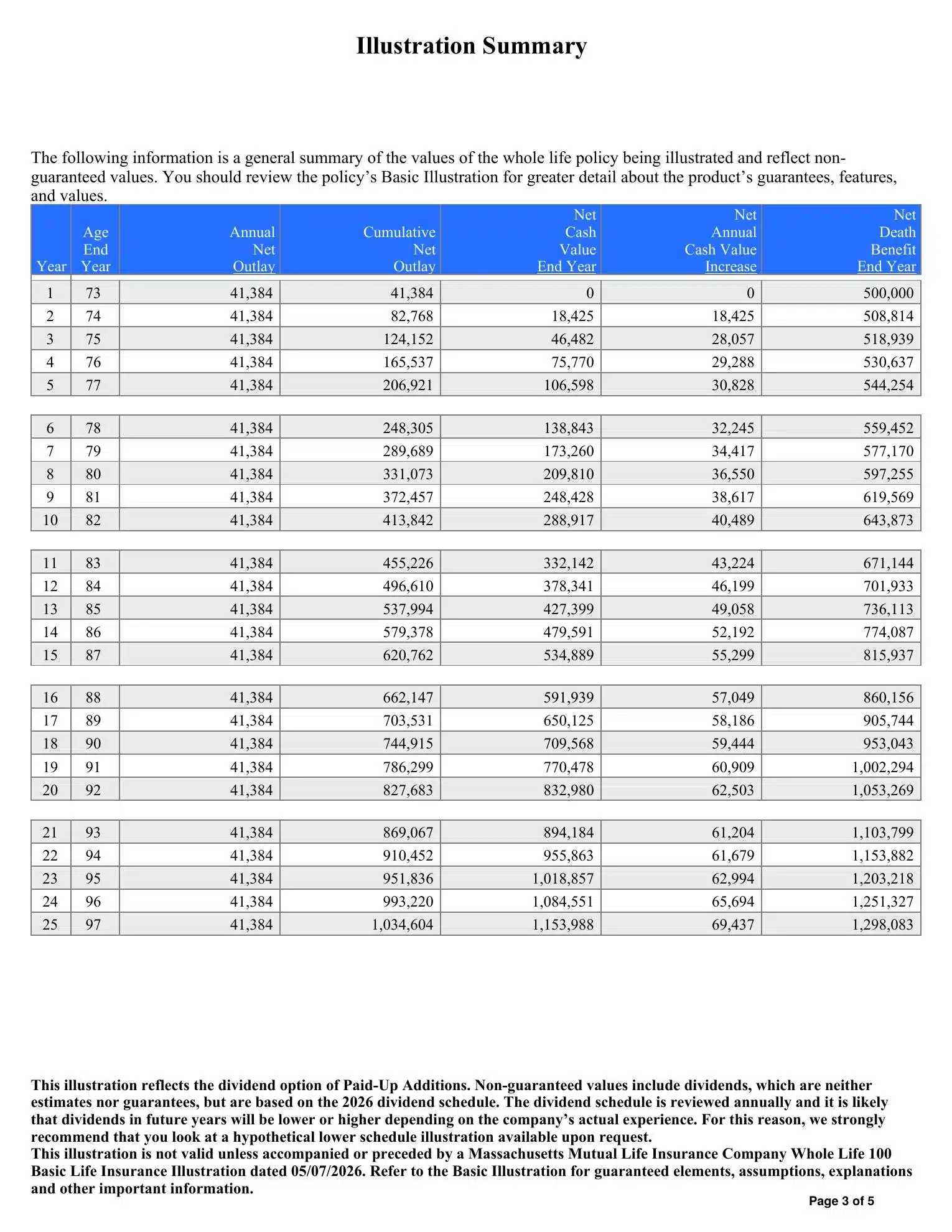
The MassMutual Whole Life 100 policy in this scenario is structured with paid-up additions as the dividend option — meaning dividends are used to purchase additional fully paid-up life insurance, which adds to both the death benefit and the total cash value year over year. The death benefit does not stay static. It grows. At the end of year 10, the projected non-guaranteed total death benefit is approximately $643,873 — $143,873 more than the original $500,000 face amount. By year 20, the projected death benefit reaches approximately $1,053,269. The cash value at year 20 is projected at approximately $832,980 — which exceeds the total cumulative premium paid through year 20 of roughly $827,683.
That cash value crossover — where the total accumulated non-guaranteed policy value exceeds the cumulative premium invested — illustrates the long-term efficiency of a well-structured participating whole life policy from a mutual carrier with a strong dividend history. The policy is not a MEC — the MEC limit on this illustration is $53,314 per year, well above the $41,384 annual premium, meaning the favorable tax treatment of policy loans and withdrawals is fully preserved. Policy loans remain non-taxable as long as the policy is in force, supporting the use of the policy as a tax-efficient legacy vehicle and potential future supplemental income source. Our resource on whether whole life insurance is worth it covers the long-term accumulation mechanics in more detail, and our resource on what a MEC is explains why the MEC limit is such an important design checkpoint in any whole life policy funded at meaningful premium levels.
| Policy Year | Age | Annual Premium | Non-Guar. Cash Value | Non-Guar. Death Benefit |
|---|---|---|---|---|
| 5 | 77 | $41,384 | $106,598 | $544,254 |
| 10 | 82 | $41,384 | $288,917 | $643,873 |
| 15 | 87 | $41,384 | $534,889 | $815,937 |
| 20 | 92 | $41,384 | $832,980 | $1,053,269 |
| 28 (paid up) | 100 | $41,384 | $1,418,411 | $1,418,411 |
Non-guaranteed values based on 2026 dividend schedule. Dividends are not guaranteed. Policy: MassMutual Whole Life 100, Male 72, Select Preferred Non-Tobacco, paid-up additions option. Refer to the Basic Illustration for guaranteed elements.
Why the Annuity Design Matters — Comparing Carriers
The annuity side of this strategy is not a commodity purchase. The required premium to generate a specific target income varies significantly across carriers, and that difference — sometimes $25,000 or more for identical income — directly affects how much capital is available for the life insurance premium and whether the income number aligns closely enough with the whole life premium to make the strategy practical. The most efficient carrier for this scenario generates the target income of $3,449 per month with a required premium approximately $25,000 lower than the least efficient of the top five carriers evaluated. Over the life of the strategy, that $25,000 difference in initial premium compounds into a meaningful difference in the retiree’s remaining liquid capital.
Carrier selection for the income annuity in this strategy also involves evaluating the income rider’s enhanced benefit features. In the Talcott Financial EverGuard Assurance 10 scenario — the most capital-efficient option in this illustration — the early path income rider includes an enhanced payment provision: if the covered life becomes unable to perform two of six Activities of Daily Living after the first contract year, the monthly income benefit doubles for up to five years. That means $3,449 per month becomes $6,898 per month during a qualifying health event — precisely the period when expenses are most likely to spike. This built-in feature adds long-term care income supplementation to what is already a retirement income and legacy strategy. Our resource on how fixed annuities offer guaranteed growth without market volatility provides context on the principal protection mechanics that sit underneath the income rider, and our resource on the power of laddering fixed annuities for retirement income covers how multiple annuity structures can complement each other when the overall income need is larger than a single contract is designed to handle.
How the Two Instruments Work Together
The strategy pairs two permanent financial instruments — a fixed indexed annuity with a lifetime income rider and a participating whole life policy — each doing a distinct job within the same plan. The table below shows how the roles, mechanics, and outcomes of each instrument complement each other rather than overlap.
| Planning Dimension | Fixed Indexed Annuity (Income Rider) | Participating Whole Life Insurance |
|---|---|---|
| Primary Job | Generate guaranteed lifetime income | Create and grow a tax-free death benefit |
| Principal Risk | Protected from market loss | Guaranteed minimum cash value in contract |
| Income / Premium | Pays guaranteed monthly income for life | Requires fixed level monthly premium for life of policy |
| Key Connection | Monthly income funds the insurance premium | Premium kept in force by the annuity income |
| Tax Treatment (Income) | Partially or fully taxable as ordinary income | Policy loans non-taxable while policy in force (non-MEC) |
| Tax Treatment (Death) | Remaining value taxable to beneficiaries | Death benefit generally income-tax-free to beneficiaries |
| Longevity Benefit | Income never stops regardless of how long retiree lives | Longer life = more dividends = larger death benefit |
| Growth Mechanism | Index-linked crediting with downside protection | Paid-up additions funded by annual dividends |
| Liquidity | Penalty-free withdrawals up to contract limit; surrender charges apply beyond | Cash value accessible via policy loans or partial surrenders |
| If Retiree Lives to 90+ | Income continues — no depletion risk | Death benefit significantly larger than original face amount |
What Makes This Strategy Work — and When It Does Not
This strategy works when four conditions are met simultaneously. The annuity must generate enough guaranteed income to fully cover the life insurance premium without requiring any additional out-of-pocket funding from savings. The life insurance must be structured at a face amount that produces meaningful death benefit relative to the premium cost at the insured’s age and health class. The retiree must have no near-term liquidity need for the capital allocated to the annuity — because annuities with income riders are long-duration commitments, not liquid reserves. And the underwriting outcome for the life insurance must match or exceed the assumptions used in the planning illustration, which requires that health is documented accurately and the carrier is selected with the insured’s actual health profile in mind. Our resource on how whole life insurance works explains the policy mechanics that determine whether the death benefit and cash value projections in the illustration are realistic for the specific product being recommended.
The strategy does not work well when the required premium to generate the target income is too large relative to available capital, when the insured’s health class does not produce competitive life insurance pricing, when liquidity needs are significant and the capital cannot be fully committed to an annuity surrender schedule, or when the income target exceeds what the premium comparison allows for. It also requires careful sequencing — the annuity should generally be structured first so the income number is confirmed before the life insurance illustration is finalized, ensuring the premium alignment is based on actual guaranteed income rather than projected income. Our resource on annuity surrender charges is worth reviewing as part of this planning conversation, since the annuity in this strategy is intended as a long-duration commitment rather than a flexible asset.
The Tax Architecture of This Strategy
Both instruments in this strategy carry favorable tax treatment that amplifies their long-term value. The annuity income in a non-qualified contract is partially taxable as ordinary income — each withdrawal is treated as a proportional blend of cost basis and gain, with the gain portion taxable and the basis portion not — but for a qualified account, distributions are fully taxable as ordinary income. The whole life insurance death benefit is generally received income-tax-free by the named beneficiary, regardless of how large it has grown. Policy loans against the cash value are not taxable income as long as the policy remains in force and is not a MEC. This creates a planning architecture where the annuity provides spending income, the life insurance provides tax-free legacy transfer, and the combination generates a multi-dimensional outcome from a single premium decision. For those also considering how this strategy interacts with Roth accounts and broader tax diversification, our resource on what a backdoor Roth IRA is provides useful context on how to build a tax-efficient income picture across multiple vehicles. The interaction between annuity income and broader retirement tax planning — including how distributions affect Social Security provisional income and IRMAA thresholds — is covered in our resource on how annuities are taxed in retirement.
Ensure you are receiving the absolute top rates
Current Fixed Annuity Rates
Compare today’s best fixed annuity rates from top carriers.
Current Bonus Annuity Rates
See which annuities offer the highest upfront bonus today.
Request an Annuity Quote
Submit our annuity request form to get personalized rate options.
Lifetime Income Calculator
Use our calculator to see how much guaranteed income your annuity can provide.
Estate and Legacy Planning Implications
The life insurance component of this strategy does something no annuity can do on its own: it guarantees a specific, growing, income-tax-free death benefit regardless of when the insured passes away. The annuity income rider is not designed to pass wealth — it is designed to replace income during retirement. When the covered life ends, the remaining annuity value may pass to beneficiaries depending on the contract terms, but this is typically not the primary legacy vehicle. The life insurance is. A permanent participating whole life policy structured with paid-up additions creates a death benefit that compounds with dividends over time. The longer the insured lives — supported by the annuity income that keeps the policy in force — the larger the projected death benefit becomes. At age 100, the policy illustrates a death benefit of approximately $1,418,411 on a $500,000 initial face amount, growing through decades of dividend reinvestment. For heirs, that benefit arrives income-tax-free and outside of probate when ownership and beneficiary designations are structured correctly. Our resource on using a trust as life insurance beneficiary covers how trust ownership can be used to further optimize the estate planning dimension of the life insurance component when estate tax is a consideration. Our resource on per stirpes vs. per capita beneficiary designations addresses how the beneficiary designation itself determines how proceeds flow to heirs.
How to Model This Strategy for Your Situation
The specific numbers in the scenario above — the required annuity premium, the life insurance face amount, and the monthly premium alignment — are the product of a deliberate multi-step planning process. The first step is identifying the available capital and confirming that a meaningful portion can be committed to the annuity without creating liquidity problems. The second step is establishing the target income number — ideally matching a specific recurring expense or supplementing a specific income gap. The third step is comparing annuity carriers and income rider designs to find the most capital-efficient structure for generating that target income, using side-by-side illustrations with identical inputs. The fourth step is obtaining a life insurance illustration at the premium amount the annuity income will generate, confirming the face amount, underwriting class assumptions, and projected policy values. The fifth step is reviewing the combined outcome — income provided, legacy created, tax treatment, surrender constraints, and underwriting requirements — before either product is applied for.
At Diversified Insurance Brokers, we have the independent access to complete both sides of this analysis: carrier comparison for the annuity income structure and carrier comparison for the life insurance design. Our resource on pension replacement and guaranteed lifetime income covers the broader context for using annuity income as a retirement foundation, and our resource on life insurance strategies the wealthy use covers how permanent life insurance integrates into broader financial and estate planning in a way that parallels the legacy objective in this strategy. For a broader look at how combining annuity income and permanent life insurance fits within the overall retirement income landscape, our resource on what the best retirement income annuity is provides a decision framework for evaluating when annuity income structures are most appropriate relative to other income sources.
See If This Strategy Works for Your Numbers
We’ll compare annuity income options and whole life premium requirements side by side to determine whether the alignment works for your age, capital, and goals.
Related Strategy Resources
Whole Life Insurance
Lifetime Income Annuity

Talk With an Advisor Today
Choose how you’d like to connect—call or message us, then book a time that works for you.
Schedule here:
calendly.com/jason-dibcompanies/diversified-quotes
Licensed in all 50 states • Fiduciary, family-owned since 1980
Can Annuity Payments Be Used to Pay for Life Insurance — FAQs
Yes — when the strategy is structured correctly, the guaranteed monthly income from an annuity income rider can match the monthly premium required for a meaningful permanent life insurance policy closely enough that the annuity effectively funds the insurance automatically. This is not a coincidence — it requires deliberate planning that begins with identifying the target income number, comparing annuity carriers to find the most capital-efficient structure for generating that income, and then obtaining a life insurance illustration at the premium amount the income will support. When the numbers align — and with careful multi-carrier comparison they can often be made to align very closely — the retiree converts a lump sum of assets into two permanent financial instruments: one that provides income for life and one that transfers growing, income-tax-free wealth at death. The strategy depends on the annuity income being guaranteed and permanent, which is why income rider design and carrier financial strength are both essential components of the analysis.
A fixed indexed annuity with an immediate or early-activation income rider is typically the most appropriate annuity structure for this strategy, particularly for retirees who need income to begin right away rather than after a deferral period. The income rider creates a contractually guaranteed withdrawal amount that begins at a specific activation point and continues for the life of the covered individual regardless of what the underlying index does and regardless of how long the retiree lives. The principal is protected from market loss, the income is predictable, and the amount is fixed — which makes it a reliable premium source for a life insurance policy that also requires a fixed, predictable monthly payment. MYGA-style fixed annuities can also be used, but they do not provide guaranteed lifetime income — they provide a guaranteed rate for a defined term, after which the income stream must be restructured. Income rider designs from carriers with strong financial strength ratings and histories of maintaining competitive crediting parameters are generally preferred for this application because the annuity relationship must be reliable across decades, not just during the initial contract period.
The required initial premium to generate a specific guaranteed monthly income varies significantly across annuity carriers — sometimes by $25,000 or more for identical income targets, age, and contract structure. In a strategy where the annuity income is being used to fund a life insurance premium, that initial premium difference is direct capital that could either remain liquid, fund additional life insurance face amount, or simply be preserved as part of the overall financial plan. A carrier that requires $475,000 to generate the target income is meaningfully more capital-efficient than one requiring $502,000 for the same result. Beyond initial premium efficiency, the income rider’s design features also matter — specifically whether the rider includes enhanced payment provisions for long-term care scenarios, how the income base grows, what the rider fee is, and whether there are step-up mechanisms that could increase income over time. Comparing these features across five or more carriers using identical inputs — same age, same gender, same state, same premium, same income start date — is the only reliable way to identify the best-fit structure for this strategy.
Permanent life insurance — specifically participating whole life from a highly rated mutual carrier — is the most appropriate life insurance structure for this strategy because it shares the same core characteristic as the annuity: permanence. A term policy would expire, potentially leaving the retiree with an income stream that no longer has a corresponding life insurance policy to fund. A universal life policy could work in some scenarios but introduces more sensitivity to funding levels and credited interest performance over time. Participating whole life from a mutual carrier with a strong dividend history provides contractually guaranteed level premiums, guaranteed minimum cash value growth, and a death benefit that grows through the reinvestment of dividends into paid-up additions — creating an asset that gets larger over time rather than remaining static. The key carrier characteristics for the life insurance side are financial strength ratings, long-term dividend track record, and participation in a mutual ownership structure where surplus is returned to policyholders. These characteristics directly determine how the policy performs over the decades it is expected to remain in force.
When the whole life policy is structured with paid-up additions as the dividend option — which is the most common design for cash value and death benefit growth optimization — each year’s dividend is used to purchase additional fully paid-up life insurance. This additional insurance requires no further premium and itself earns future dividends, creating a compounding effect on both the cash value and the death benefit year over year. The death benefit does not stay at the original face amount. It grows. In a well-illustrated scenario, the death benefit at year 10 may be $140,000 or more above the original face amount, and by year 20 may be approaching or exceeding twice the original face amount depending on the carrier’s dividend performance. This growth is projected based on the current dividend schedule and is not guaranteed — dividends may be higher or lower in future years depending on the carrier’s actual investment experience, mortality experience, and expense management. The long-term dividend track record of the carrier is therefore a critical evaluation criterion for the life insurance side of this strategy.
For a properly structured participating whole life policy, the base premium does not change. Level premiums guaranteed for the life of the policy are one of the core contractual features of whole life insurance — the same amount is due every month for the duration of the premium-paying period regardless of the insured’s age at that future point, regardless of health changes, and regardless of how the policy’s cash value has performed. This premium certainty is exactly what makes whole life the appropriate life insurance vehicle for this strategy. Because the life insurance premium is fixed and guaranteed while the annuity income is also contractually guaranteed, the two instruments lock together as a stable, predictable system. The annuity income will fund the life insurance premium not just today but 10, 20, or 30 years from now at exactly the same monthly amount — which is a planning certainty that no market-based income source can provide. The only circumstance that would disrupt this alignment is a voluntary change to the life insurance policy itself, such as a face amount increase that raises the required premium.
The tax picture for this strategy involves two distinct instruments with different tax characteristics. Annuity income from a non-qualified contract is partially taxable as ordinary income under the exclusion ratio — each distribution includes a proportional blend of taxable gain and non-taxable return of cost basis. For a qualified annuity held inside an IRA, distributions are fully taxable as ordinary income. This means some or all of the monthly annuity income will be taxable in the year received, and that income may affect provisional income calculations for Social Security taxation, Medicare IRMAA surcharge thresholds, and overall tax bracket management. The life insurance side provides different tax treatment: the death benefit is generally received income-tax-free by named beneficiaries, the cash value grows tax-deferred, and policy loans are not taxable income as long as the policy remains in force and is not a modified endowment contract. This creates a situation where the retiree accepts some income taxation on the annuity distributions in exchange for a growing, income-tax-free legacy asset. Coordinating these tax implications with broader retirement income sources — Social Security, retirement accounts, and other taxable income — requires careful planning and ideally involves coordination between an insurance advisor and a tax professional.
No — and the suitability evaluation for this strategy involves the same rigorous standards that apply to any retirement income or life insurance recommendation. The annuity side must be appropriate given the retiree’s overall financial situation, including available liquid assets outside the annuity commitment, existing income sources, and genuine long-term comfort with the surrender schedule. The life insurance side must be appropriate given health, insurability, and whether a permanent death benefit is genuinely part of the planning objective. This strategy is typically most appropriate for retirees in good health who have sufficient assets that the capital committed to the annuity does not create liquidity constraints, who have a clear legacy objective for the life insurance component, who do not need market participation or flexibility from the assets being allocated to this strategy, and who understand the nature of both instruments and their respective constraints before committing. It is not appropriate as a method of generating income from assets that may be needed for near-term expenses, and it is not appropriate when the health required for favorable life insurance underwriting is not present or uncertain.
Our process for this strategy involves independent access to both the annuity and life insurance marketplaces, which is essential because the strategy requires optimizing both instruments simultaneously rather than defaulting to a single carrier’s solution for either side. On the annuity side, we compare income rider designs from multiple carriers using identical inputs — age, gender, state, premium amount, and income start date — to identify the carrier and rider combination that generates the target income most capital-efficiently while also evaluating enhanced benefit features, rider fees, and long-term income base mechanics. On the life insurance side, we compare permanent policy designs, evaluate the insured’s underwriting profile, and identify the carrier most likely to produce the best available premium rate and cash value performance for the specific health class. We then align the two illustrations to confirm that the income from the annuity covers the premium from the life insurance with enough margin to account for realistic variations in the planning inputs. The final step is reviewing the combined outcome — income provided, legacy created, tax architecture, liquidity constraints, and underwriting requirements — in a clear side-by-side format so the decision is based on the complete picture rather than either instrument in isolation.
The most meaningful risk in this strategy is not market risk — both instruments eliminate direct market exposure to principal. The primary risk is longevity planning misalignment: specifically, that the retiree needs access to the capital committed to the annuity for an unexpected purpose — a long-term care event, a major medical expense, a family obligation — during the annuity’s surrender period when accessing principal above the penalty-free withdrawal amount would trigger charges. This is why liquidity planning is the foundational step in evaluating this strategy. The capital allocated to the annuity must be genuinely available for long-duration commitment, and a meaningful separate liquid reserve must exist outside the strategy to handle unexpected expenses. A secondary risk is the assumption that the retiree’s health will remain insurable at the anticipated class at the time of life insurance application. If health changes significantly between the planning conversation and the application date, the life insurance premium may be higher than the illustration assumed, potentially misaligning with the annuity income amount. Pre-underwriting evaluation before finalizing the annuity premium target is the most practical way to reduce this risk.
About the Author:
Jason Stolz, CLTC, CRPC, DIA, CAA and Chief Underwriter at Diversified Insurance Brokers (NPN 20471358), is a senior insurance and retirement professional with more than 25 years of real-world experience helping individuals, families, and business owners protect their income, assets, and long-term financial stability. As a long-time partner of the nationally licensed independent agency Diversified Insurance Brokers, Jason provides trusted guidance across multiple specialties—including fixed and indexed annuities, long-term care planning, personal and business disability insurance, life insurance solutions, Group Health, Travel Medical and Evacuation Insurance, and short-term health coverage. Diversified Insurance Brokers maintains active contracts with over 100 highly rated insurance carriers, ensuring clients have access to a broad and competitive marketplace.
His practical, education-first approach has earned recognition in publications such as VoyageATL, and contributions from his agency featured in Kiplinger and GoBankingRates— highlighting his commitment to financial clarity and client-focused planning. Drawing on deep product knowledge and years of hands-on field experience, Jason helps clients evaluate carriers, compare strategies, and build retirement and protection plans that are both secure and cost-efficient. Visitors who want to explore current annuity rates and compare options across multiple insurers can also use this annuity quote and comparison tool.
Explore More Life Insurance Options: Browse our complete guide to How Life Insurance Works — covering term life, whole life, final expense, annuity alternatives & more from 100+ carriers.
Explore More Annuity Options: Browse our complete guide to Annuity Strategies & Retirement Income — covering tax strategies, retirement income planning, lifetime income & annuity comparisons from 100+ carriers.
Last Reviewed: June 15, 2026 |
Reviewed by: Jason Stolz, CLTC, CRPC, DIA, CAA
Chief Underwriter, Diversified Insurance Brokers, Inc. | NPN: 20471358 | Diversified Insurance Brokers, Inc. — Licensed in all 50 states
Fact Checked by: Tonia Pettitt, CMIP©
Medicare Specialist, Diversified Insurance Brokers, Inc. | NPN: 14374308 | Diversified Insurance Brokers, Inc. — Licensed in all 50 states
Did you find this content helpful? Leave us a Google review — it helps others find trustworthy guidance too.
Editorial Standards: Diversified Insurance Brokers maintains rigorous editorial standards to ensure accuracy, clarity, and independence in all content. Learn more about our editorial standards and commitment to transparency.
