
Per Stirpes vs Per Capita
Per Stirpes vs Per Capita

Jason Stolz CLTC, CRPC, DIA, CAA
Choosing between per stirpes vs per capita is one of the most important beneficiary decisions you will ever make on a life insurance policy. While the terms sound technical, the difference between them can completely change who ultimately receives your death benefit. The choice determines whether inheritance follows a family branch or whether it simply shifts to the surviving named beneficiaries. In real-world estate situations, that distinction can significantly impact children, grandchildren, blended families, and long-term generational planning goals — often in ways that are not discovered until a claim is filed and the family learns too late that the designation did not accomplish what the insured intended.
Beneficiary designations override your will. That means even if your estate documents say one thing, your life insurance contract controls the payout. Because of that, beneficiary structure should never be an afterthought. It should be coordinated with your broader protection plan, including how your policies are layered and how the designations interact with other financial accounts that carry their own beneficiary elections. Beneficiary designation mistakes covers the most common errors that cause death benefits to be distributed in ways the policyholder never intended — and how each mistake can be corrected before it becomes irrevocable. If you are structuring multiple policies for flexibility, review our life insurance laddering guide to see how coverage design and beneficiary strategy work together across a coordinated portfolio of policies.
Not Sure If Your Beneficiary Designations Are Structured Correctly?
We’ll review your existing policies, model real-world inheritance outcomes, and make sure your beneficiary language aligns with your estate plan.
See Real-Term Rates Side by Side
Life Insurance Quoter
Understanding Per Stirpes
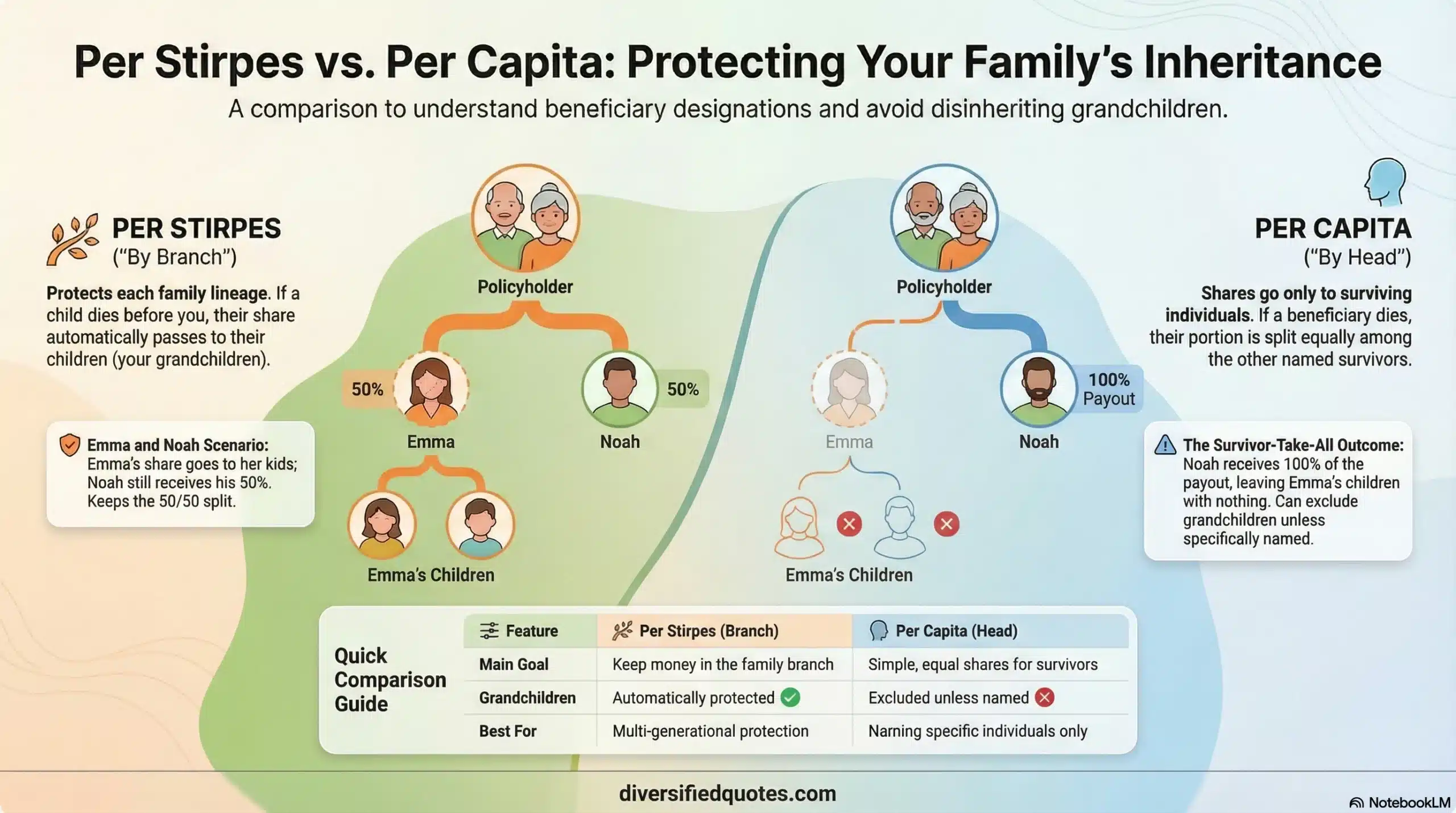
The term per stirpes translates to “by branch.” In practice, this means each child’s branch of the family keeps its intended share of the death benefit. If one of your named beneficiaries passes away before you, their portion does not disappear or shift to surviving beneficiaries. Instead, it automatically flows down to their children — your grandchildren — preserving the inheritance within the original family branch. This structure protects generational continuity and ensures that a deceased child’s lineage is not unintentionally disinherited simply because that child happened to predecease the policyholder.
Consider a policyholder who names two children as equal beneficiaries with per stirpes designation. If one child passes away before the policyholder and leaves behind two children of their own, per stirpes ensures those grandchildren inherit their parent’s original 50% share — each receiving 25% of the total death benefit. The surviving child still receives their original 50% allocation. The family branch remains intact, even though one generation has passed before the claim occurs. Without the per stirpes designation, that outcome would not happen automatically — the deceased child’s share would instead shift to the surviving sibling under a per capita structure, or the policy might face complications if the designation falls into the estate.
This approach is often preferred in multi-generational wealth planning or when family circumstances differ meaningfully across branches. If one child has children and another does not, per stirpes preserves fairness across the family tree by protecting each branch rather than redistributing everything to the surviving sibling who happens to be alive at the time of the claim. Families planning long-term financial support for dependents with special needs frequently prioritize this continuity — the per stirpes structure combined with appropriate trust planning ensures that the intended portion reaches the correct branch regardless of the sequence in which family members pass. Life insurance for a special needs child covers the estate planning intersection between life insurance and special needs funding that makes per stirpes designation particularly important in these family structures. Special needs trust and life insurance covers how trust structures coordinate with life insurance beneficiary designations to protect a special needs beneficiary’s government benefit eligibility while still providing inheritance. Life insurance for autistic individuals covers how maintaining a protected inheritance stream is critical in planning situations involving autistic dependents who may require lifelong financial support.
Ensure you are receiving the absolute top rates
Current Fixed Annuity Rates
Compare today’s best fixed annuity rates from top carriers.
Current Bonus Annuity Rates
See which annuities offer the highest upfront bonus today.
Request an Annuity Quote
Submit our annuity request form to get personalized rate options.
Lifetime Income Calculator
Use our calculator to see how much guaranteed income your annuity can provide.
Understanding Per Capita
The term per capita means “by head.” Under this structure, if one named beneficiary dies before you, their share is redistributed evenly among the surviving named beneficiaries rather than flowing down to that deceased beneficiary’s children. The inheritance does not automatically pass to that person’s children unless they were separately and specifically listed on the policy as beneficiaries in their own right. The per capita structure prioritizes equal distribution among the individuals who are alive and named at the time of the claim, without regard for family branches or the downstream interests of grandchildren.
Using the same two-child example, if one child predeceases the policyholder under a per capita designation, the surviving child receives the entire death benefit. The deceased child’s own children — the policyholder’s grandchildren — would not inherit anything unless they were specifically named on the policy. This structure can be appropriate in smaller families or when equal distribution among surviving named individuals is the deliberate and informed objective. However, it can unintentionally exclude an entire generation of grandchildren from a death benefit that the policyholder would have wanted to reach them had they understood the distinction between the two structures when they completed the beneficiary form.
Families with young children often overlook this distinction at policy inception, completing beneficiary forms quickly without fully considering what happens if a named beneficiary dies first. The per capita outcome — where a grandchild’s inheritance disappears because a parent predeceased the grandparent — is rarely the intent, but it is frequently the result when per stirpes language is not specified. Life insurance planning for parents with young children explains how beneficiary decisions integrate into long-term financial protection design and why the per stirpes versus per capita choice is one of the most important form elections a young parent makes at policy application.
Per Stirpes vs Per Capita: Key Differences at a Glance
| Scenario | Per Stirpes Result | Per Capita Result |
|---|---|---|
| One of two named children predeceases the insured and has children of their own | Deceased child’s share passes to their children (grandchildren of insured); surviving child keeps their original share | Surviving child receives the entire death benefit; deceased child’s children receive nothing unless separately named |
| Both named children predecease the insured; one has children and one does not | Grandchildren of the child who had children inherit that child’s share; the childless branch ends | No surviving named beneficiaries — benefit may flow to the estate unless contingent beneficiaries exist |
| Named beneficiary predeceases insured but has no children | That branch ends; share typically redistributes among remaining branches or falls to contingent beneficiaries | Surviving named beneficiaries divide the share equally among themselves |
| Blended family with stepchildren and biological children as named beneficiaries | Each named individual’s branch is preserved — biological grandchildren inherit their parent’s share if a parent predeceases | Surviving named beneficiaries divide the deceased beneficiary’s share — may unintentionally shift inheritance between family branches |
| Special needs beneficiary who cannot receive inheritance directly without jeopardizing benefits | Per stirpes directs share to the correct branch; trust as beneficiary controls distribution to protect benefit eligibility | Per capita may shift the share away from the intended recipient; trust coordination essential regardless of designation type |
| All named beneficiaries survive the insured | No difference — each named beneficiary receives their stated percentage exactly as designated | No difference — each named beneficiary receives their stated percentage exactly as designated |
Blended Families and Second Marriages
Beneficiary structure becomes especially consequential in blended families where the definition of “family” spans biological children, stepchildren, children from previous relationships, and a current spouse who may have competing or overlapping interests in the estate. In second marriages, many individuals name a current spouse as primary beneficiary and children from prior relationships as contingent beneficiaries — a structure that appears straightforward but can produce unintended outcomes depending on whether per stirpes or per capita language governs the contingent level. If per stirpes is specified at the contingent level, each child’s branch remains protected if both spouses pass away. If per capita is used instead, inheritance may shift entirely to surviving children, potentially disproportionately benefiting one branch of a blended family at the expense of another.
In second marriage situations where a spouse is named as sole primary beneficiary, the per stirpes versus per capita question becomes most critical at the contingent beneficiary level — because the primary beneficiary election determines what happens if the spouse predeceases, and the contingent designation determines how the benefit is divided among children from potentially different family branches. A policyholder with biological children and stepchildren who intends equal treatment across all branches should specify per stirpes at the contingent level and confirm that all intended branches are represented by named individuals. Without that structure, a stepchild who predeceases the insured may inadvertently lose their branch’s share in favor of surviving biological children, producing an outcome that directly contradicts the policyholder’s stated wishes.
High-risk underwriting situations can also affect planning timelines and create urgency around getting beneficiary structure correct before a policy is placed. If coverage involves elevated risk factors such as hazardous occupations, prior health conditions, or other underwriting concerns, policy approval and structure require careful coordination that may leave less time for beneficiary analysis. Our overview of high-risk life insurance strategies outlines how underwriting realities intersect with estate design decisions and why getting the right policy issued as efficiently as possible — with correct beneficiary language from the start — is essential in elevated-risk situations. Best high-risk life insurance companies covers the carrier comparison for applicants with factors that limit market access and require specialty underwriting.
When a Trust May Be More Appropriate Than Per Stirpes or Per Capita
In more complex estates, naming a trust as beneficiary may provide greater control than relying solely on per stirpes or per capita language in the beneficiary form. Trust structures can govern timing of distributions, protect minor children from receiving large lump sums before they are financially mature, address special needs planning without jeopardizing government benefit eligibility, and coordinate estate tax strategies across multiple assets and policies. In those cases, the beneficiary designation on the life insurance policy points to the trust rather than to individuals directly, and the trust document governs all distribution decisions according to its terms. The per stirpes versus per capita question then applies within the trust document’s own distribution language rather than on the policy itself.
The irrevocable life insurance trust is a specialized structure that accomplishes multiple objectives simultaneously — removing the death benefit from the taxable estate, providing professional trustee oversight of distribution, and establishing the terms under which beneficiaries receive proceeds at the trustee’s discretion rather than all at once. What is an irrevocable life insurance trust covers how ILITs are structured, funded, and administered and why they are used in high-net-worth estate planning as a companion to large permanent life insurance policies. Trust as life insurance beneficiary covers the mechanics of naming a trust as the policy beneficiary and how the interaction between the policy and the trust document determines actual distribution outcomes. How to get a will and trust online covers options for establishing foundational estate documents for families who need beneficiary coordination but have not yet created the underlying legal framework. Why a special needs trust covers the specific reasons a trust is required — not merely preferred — when a beneficiary with disabilities is involved, and how the trust protects that beneficiary’s eligibility for essential government assistance programs. Choosing a special needs trustee covers the selection criteria that determine whether the trustee can effectively carry out the distribution intent over what may be a decades-long administration horizon.
Coordination With Annuities and Retirement Accounts
Beneficiary language is not limited to life insurance. Annuities and retirement accounts carry their own beneficiary designations, and the distribution mechanics can differ significantly from life insurance policy payouts — creating the possibility of inconsistency across a retirement and estate plan if the elections are not reviewed together. An annuity with a per stirpes designation distributes accumulated value to the deceased beneficiary’s children in the same general way as a life insurance policy, but the tax treatment of inherited annuity proceeds differs based on whether the annuity was funded with qualified or non-qualified dollars and the relationship between the inheriting beneficiary and the original owner. Annuity beneficiary and death benefit rules covers how beneficiary designations function across different annuity contract designs and what options are available to beneficiaries upon the owner’s death. Are annuity death benefits taxable addresses how the death benefit is taxed relative to the contract’s cost basis — a critical consideration when coordinating annuity beneficiary structure with life insurance beneficiary strategy. Inherited non-qualified annuity and inherited qualified annuity cover the distribution options and tax treatment for beneficiaries under each funding structure — the information needed to align annuity beneficiary elections with the broader per stirpes or per capita framework governing the estate plan.
It is also important to remember that beneficiary forms should be reviewed after every major life event — marriage, divorce, birth of a child, adoption, death of a beneficiary, or significant change in family structure. Even a beneficiary designation that was thoughtfully structured at the time of application can become outdated or misaligned with current family circumstances if it is not revisited periodically. Aligning beneficiary elections with current coverage amounts is equally important, because a death benefit that was appropriately sized for one family configuration may no longer serve the intended purpose after the family has grown or changed. How much life insurance costs helps retirees and active policyholders evaluate whether current policy sizes match evolving family needs. Getting a second opinion on your life insurance quote is the most direct way to confirm whether both the coverage structure and beneficiary designations are competitive and correctly aligned for the current situation. How premium financing works for estate planning covers the advanced strategy relevant when large permanent life insurance policies are being used specifically for estate planning purposes — where beneficiary structure, trust coordination, and policy ownership interact across a comprehensive estate design.
Practical Steps for Getting Beneficiary Structure Right
Because beneficiary designations carry legal and financial consequences that cannot be undone after the insured’s death, the process of reviewing and confirming these elections deserves the same deliberate attention as choosing coverage amounts and policy types. A small wording choice — per stirpes versus per capita, or the absence of any specification when a carrier defaults to one or the other — can determine whether grandchildren inherit automatically or whether a entire generation of descendants is unintentionally excluded from a death benefit that was meant for them. Getting this right requires reviewing the current designation on every policy, understanding what happens in each named beneficiary scenario under both structures, confirming that the written designation reflects the actual intent, and verifying that contingent beneficiaries are named and structured appropriately so the policy never pays into the estate by default. Life insurance quotes covers the starting point for new coverage, and confirming beneficiary structure is a core component of the application and placement process for every new policy.
Make Sure Your Policy Pays Exactly the Way You Intend
We’ll walk through real-life distribution scenarios and coordinate your beneficiary language with your overall estate and insurance strategy.
Related Life Insurance Planning Guides
Talk With an Advisor Today
Choose how you’d like to connect—call or message us, then book a time that works for you.
Schedule here:
calendly.com/jason-dibcompanies/diversified-quotes
Licensed in all 50 states • Fiduciary, family-owned since 1980
Frequently Asked Questions: Per Stirpes vs Per Capita
What is the difference between per stirpes and per capita on a life insurance policy?
Per stirpes means “by branch” — if a named beneficiary predeceases the insured, that beneficiary’s share automatically passes to their children rather than shifting to the surviving named beneficiaries. Per capita means “by head” — if a named beneficiary predeceases the insured, their share is redistributed equally among the surviving named beneficiaries, and the deceased beneficiary’s children receive nothing unless they were separately named. The practical difference is significant: per stirpes preserves inheritance within family branches across generations, while per capita concentrates the inheritance among whoever survives. Most estate planners recommend per stirpes for families with children and grandchildren because it protects the intended distribution even when the sequence of deaths does not follow the expected pattern.
Does a beneficiary designation override a will?
Yes — beneficiary designations on life insurance policies, annuities, and retirement accounts override the instructions in a will. The life insurance contract is a legal agreement between the policyholder and the insurance company, and the death benefit is paid according to the contract’s beneficiary designation regardless of what the will says. This is why beneficiary structure must be coordinated with the overall estate plan rather than treated as a secondary administrative task. If a will directs assets equally among three children but a life insurance policy names only one child as beneficiary with no contingent designations, the policy proceeds go entirely to the named beneficiary regardless of the will’s intent. Periodic review of all beneficiary designations — not just the will — is essential for ensuring the estate plan actually accomplishes its objectives.
Which is better for blended families — per stirpes or per capita?
Per stirpes is generally more appropriate for blended families because it preserves the intended allocation for each family branch regardless of the sequence in which beneficiaries predecease the insured. In a blended family with biological children and stepchildren named as contingent beneficiaries, per capita designation means that if one child predeceases the insured, the surviving beneficiaries — which may be a mix of biological and step family — divide the deceased’s share. Per stirpes ensures the deceased beneficiary’s own children inherit their parent’s share, keeping inheritance within the intended family branch. For complex blended family situations, working with an estate planning attorney alongside the life insurance strategy is strongly recommended to ensure beneficiary language on all documents aligns with the intended distribution outcome.
When should I name a trust as beneficiary instead of individuals?
Naming a trust as beneficiary is appropriate when the per stirpes or per capita election alone is insufficient to accomplish the distribution goals. Common situations include minor children who cannot legally manage a large lump-sum inheritance directly, beneficiaries with special needs whose government benefit eligibility would be jeopardized by direct receipt of inherited assets, estates large enough to require estate tax planning, and situations where the insured wants to control the timing and conditions of distributions rather than delivering a lump sum at death. A trust as beneficiary allows the trustee to distribute proceeds according to the trust document’s terms — which can span years or decades — rather than in a single immediate payment to a beneficiary who may not be prepared to manage a large amount responsibly at the time of the claim.
How often should I review my life insurance beneficiary designations?
Beneficiary designations should be reviewed after every major life event — marriage, divorce, birth or adoption of a child, death of a named beneficiary, significant change in family structure, or any material change to the estate plan. Beyond event-driven reviews, an annual review of all beneficiary designations alongside the broader insurance and estate plan is a best practice that prevents designations from drifting out of alignment with current family circumstances. Common problems that develop over time include ex-spouses who remain named beneficiaries after divorce, deceased individuals who are still listed as primary beneficiaries with no contingent designations in place, and outdated percentage allocations that no longer reflect the insured’s current intentions. A periodic policy review addresses all of these issues before they become irrevocable problems at the time of a claim.
About the Author:
Jason Stolz, CLTC, CRPC, DIA, CAA and Chief Underwriter at Diversified Insurance Brokers (NPN 20471358), is a senior insurance and retirement professional with more than 25 years of real-world experience helping individuals, families, and business owners protect their income, assets, and long-term financial stability. As a long-time partner of the nationally licensed independent agency Diversified Insurance Brokers, Jason provides trusted guidance across multiple specialties—including fixed and indexed annuities, long-term care planning, personal and business disability insurance, life insurance solutions, Group Health, Travel Medical and Evacuation Insurance, and short-term health coverage. Diversified Insurance Brokers maintains active contracts with over 100 highly rated insurance carriers, ensuring clients have access to a broad and competitive marketplace.
His practical, education-first approach has earned recognition in publications such as VoyageATL, and contributions from his agency featured in Kiplinger and GoBankingRates— highlighting his commitment to financial clarity and client-focused planning. Drawing on deep product knowledge and years of hands-on field experience, Jason helps clients evaluate carriers, compare strategies, and build retirement and protection plans that are both secure and cost-efficient. Visitors who want to explore current annuity rates and compare options across multiple insurers can also use this annuity quote and comparison tool.
Explore More Life Insurance Options: Browse our complete guide to Business Life Insurance — covering buy-sell agreements, key person, contract indemnity & group life from 100+ carriers.
Last Reviewed: June 16, 2026 |
Reviewed by: Jason Stolz, CLTC, CRPC, DIA, CAA
Chief Underwriter, Diversified Insurance Brokers, Inc. | NPN: 20471358 | Diversified Insurance Brokers, Inc. — Licensed in all 50 states
Fact Checked by: Tonia Pettitt, CMIP©
Medicare Specialist, Diversified Insurance Brokers, Inc. | NPN: 14374308 | Diversified Insurance Brokers, Inc. — Licensed in all 50 states
Did you find this content helpful? Leave us a Google review — it helps others find trustworthy guidance too.
Editorial Standards: Diversified Insurance Brokers maintains rigorous editorial standards to ensure accuracy, clarity, and independence in all content. Learn more about our editorial standards and commitment to transparency.
