
Best Annuities for Solo 401k Rollover
As an Independent Annuity Broker, we compare rates across 100+ carriers and 1,000 different annuities— not just one company’s product offerings — to find the best fit for your goals.
Best Annuities for Solo 401k Rollover

Jason Stolz CLTC, CRPC, DIA, CAA
At Diversified Insurance Brokers, we work with self-employed professionals, consultants, freelancers, and owner-only business operators who face a retirement plan transition that is rarely purely voluntary: the Solo 401(k) rollover. Unlike most retirement plan rollovers — which happen when someone leaves an employer — the Solo 401(k) rollover is often triggered by the evolution of the business itself. You hired your first full-time W-2 employee. Your LLC dissolved. You sold the business and took a W-2 job. Your business grew past the point where a single-participant plan makes administrative sense. Or you simply reached the accumulation milestone where you want to convert years of maximized contributions — both employee deferrals and employer profit-sharing components — into a protected, structured asset that cannot be eroded by market volatility in the years when you can no longer afford to absorb it. The Solo 401(k) rollover is the retirement planning transition that self-employed Americans execute when their working chapter closes and their income-drawing chapter begins. Choosing the right annuity as the rollover destination shapes how that income chapter unfolds for decades.
The Solo 401(k) — also called the Individual 401(k) or Self-Employed 401(k) — is available to any business owner or self-employed individual with no full-time W-2 employees other than a spouse. It is among the highest-contribution retirement plan structures available anywhere in the U.S. tax code, combining an employee elective deferral with an employer profit-sharing contribution that together allow annual accumulation significantly beyond what IRAs, SIMPLE IRAs, or SEP IRAs permit. Self-employed individuals who have maximized contributions across a career may enter the rollover phase with substantially larger balances than participants of other small business retirement plans — which changes the annuity evaluation calculus in meaningful ways. Larger rollover balances qualify for enhanced declared rates at most MYGA carriers, more competitive cap and participation rate terms at FIA carriers, and higher guaranteed monthly income amounts at SPIA issuers than smaller balances command. The Solo 401(k) rollover is not just about choosing an annuity type — it is about deploying a high-accumulation balance into the right protective structure at exactly the moment when market risk becomes the primary enemy of retirement sustainability. Our companion guides covering the best annuities for a TSP rollover and best annuities for a SIMPLE IRA rollover cover the parallel evaluation framework for those account types — the Solo 401(k) rollover shares the same annuity product landscape but begins from a distinctly different accumulation profile, trigger scenario, and compliance checklist.
Before evaluating any annuity option, two Solo 401(k)-specific administrative requirements must be addressed: the outstanding loan payoff and the Form 5500-EZ filing. Unlike Traditional IRAs, SIMPLE IRAs, or TSP accounts, a Solo 401(k) may carry an outstanding loan — borrowed against the participant’s own vested balance at favorable interest rates, repaid via payroll deductions or scheduled payments. When the Solo 401(k) is terminated for rollover purposes, any outstanding loan balance that has not been repaid is treated by the IRS as a deemed taxable distribution — subject to ordinary income taxes plus the 10% early distribution penalty if the participant is under 59½. Repaying or retiring the outstanding loan balance before initiating the rollover is not optional; it is a precondition for executing a tax-free transfer of the full account value. The Form 5500-EZ requirement applies when the plan is being terminated and plan assets exceeded $250,000 at any point. The form must be filed by the last day of the seventh month following the plan year end — for calendar-year plans, that means July 31. Late filing carries a penalty of $250 per day up to $150,000, though the IRS First-Time Penalty Relief program may waive this for first-time violators. These compliance steps do not affect the annuity product selection itself, but they must be completed as part of the rollover sequence before any funds can move.
Ensure you are receiving the absolute top rates
Current Fixed Annuity Rates
Compare today’s best fixed annuity rates from top carriers.
Current Bonus Annuity Rates
See which annuities offer the highest upfront bonus today.
Request an Annuity Quote
Submit our annuity request form to get personalized rate options.
Lifetime Income Calculator
Use our calculator to see how much guaranteed income your annuity can provide.
Why Solo 401(k) Participants Roll Over — And Why the Trigger Changes the Annuity Answer
The Solo 401(k) rollover is unusual among qualified plan transitions because the rollover trigger is often structural rather than strictly voluntary. Understanding which trigger scenario applies to you determines the planning timeline, the compliance sequence, and — critically — the urgency of moving assets into an annuity versus taking a measured approach to the transition. The table below maps the most common Solo 401(k) rollover triggers to the annuity strategy that most naturally fits each scenario.
Best Annuity Strategy by Solo 401(k) Rollover Trigger
| Rollover Trigger | Best Annuity Fit | Primary Reason | Special Consideration |
|---|---|---|---|
| Business sold or dissolved — retirement imminent | SPIA or DIA (Income Annuity) | The accumulation chapter is complete. No future contributions will occur. Converting to guaranteed lifetime income solves the primary risk — longevity — directly. The Solo 401(k)’s high balance may fund a meaningful private pension stream. | Timing: business sale proceeds plus Solo 401(k) rollover happening simultaneously can create a high-income tax year. Consider whether deferring the SPIA income start date (DIA) better aligns with the tax picture. |
| Hired first W-2 employee — plan must convert or terminate | FIA with 7–10 year surrender period | The business is growing — retirement is likely still years away. The FIA provides principal protection plus indexed growth potential across the remaining accumulation window while the business’s new 401(k) continues building contributions. | The new employer plan may continue receiving contributions; the Solo 401(k) rollover annuity serves as the protected accumulation base alongside the active plan. Confirm surrender period aligns with the retirement timeline before committing. |
| Transitioning to W-2 employment — Solo business winding down | MYGA (3–7 year term) | The rollover participant is now building in an employer plan. The Solo 401(k) balance serves as a separate protected accumulation rung. A MYGA locks in a competitive declared rate for the transition period without surrender risk that conflicts with the new plan’s trajectory. | Term selection should align with anticipated retirement date so the MYGA matures at the point the participant is ready to evaluate the full balance for income conversion or reinvestment. |
| Reached high-accumulation retirement threshold — no longer needs to accumulate aggressively | FIA with income rider or split allocation | The balance is large enough that competitive cap rates on an FIA may produce growth above most declared-rate alternatives. An income rider converts the accumulated base to guaranteed lifetime withdrawals on demand without requiring annuitization. | Large balance: confirm the carrier has no single-contract maximum premium that would require splitting the rollover across two contracts. Most A-rated FIA carriers accept large IRA rollovers without issue but verify before application. |
| Both spouses participated — rolling over two separate balances simultaneously | Split annuity approach: MYGA + FIA or SPIA + FIA | Each spouse’s account is separate and independent. The spouse with the larger balance may be better served by the FIA or income annuity; the spouse with the smaller balance may prefer the simplicity of a MYGA declared rate. Neither spouse’s rollover constrains the other’s annuity selection. | Both spouses’ accounts require separate Form 5500-EZ analysis (if assets exceeded $250K for either account). Beneficiary designations for each annuity must be handled independently for each spouse’s contract. |
The Investment Breadth Trade-Off — Self-Directed Solo 401(k) to Annuity
One of the most significant planning conversations specific to Solo 401(k) participants is the breadth-of-investment trade-off. A properly structured self-directed Solo 401(k) can invest in real estate, private notes, private equity, precious metals, cryptocurrency, and other alternative assets that are unavailable in standard brokerage accounts and most IRAs. Participants who have used this breadth actively — holding rental properties within the plan, lending private notes at interest rates above market, or investing in private placements — face a fundamentally different transition question than participants whose Solo 401(k) held conventional mutual funds and ETFs. When alternative investments are involved, the rollover itself may require liquidation of those positions before the cash can transfer to the Traditional IRA annuity — and some alternative investments may not be readily liquid at any price, which creates a timing and sequencing problem that must be resolved before the annuity application is submitted. For Solo 401(k) participants whose plans held only conventional financial assets, the rollover to a Traditional IRA and subsequent annuity funding is straightforward. For participants with alternative investments inside the plan, the rollover requires an asset-by-asset liquidation plan, a realistic timeline for each position’s conversion to cash, and in some cases a phased rollover approach where liquid assets transfer first while illiquid positions are wound down separately.
After this liquidity transition, the annuity serves as the protective replacement for the alternative investment portfolio’s principal. Self-directed Solo 401(k) participants who have grown accustomed to the possibility of double-digit returns from private lending or real estate within the plan are moving to a structure that guarantees no loss but limits upside through caps and participation rates. Understanding the full pros and cons of annuities in this specific context — transitioning from an alternative-investment portfolio to a guaranteed structure — requires an honest accounting of what the annuity provides (contractual principal protection, index-linked growth potential, guaranteed income options) against what it requires the participant to give up (unlimited investment breadth, private market access, loan provision). The annuity does not need to replace the Solo 401(k)’s entire alternative investment return profile; it needs to be the right structure for the specific portion of the retirement balance that requires protection during the distribution phase. A participant who transitions the Solo 401(k) to a guaranteed growth annuity structure while maintaining other non-retirement capital in alternative investments has preserved both the protection the annuity provides and the return potential the alternative investments offer — outside of the retirement plan where the Solo 401(k)’s structural advantages are no longer available.
MYGA After Solo 401(k) Rollover — Rate Lock and Certainty for the Transition Period
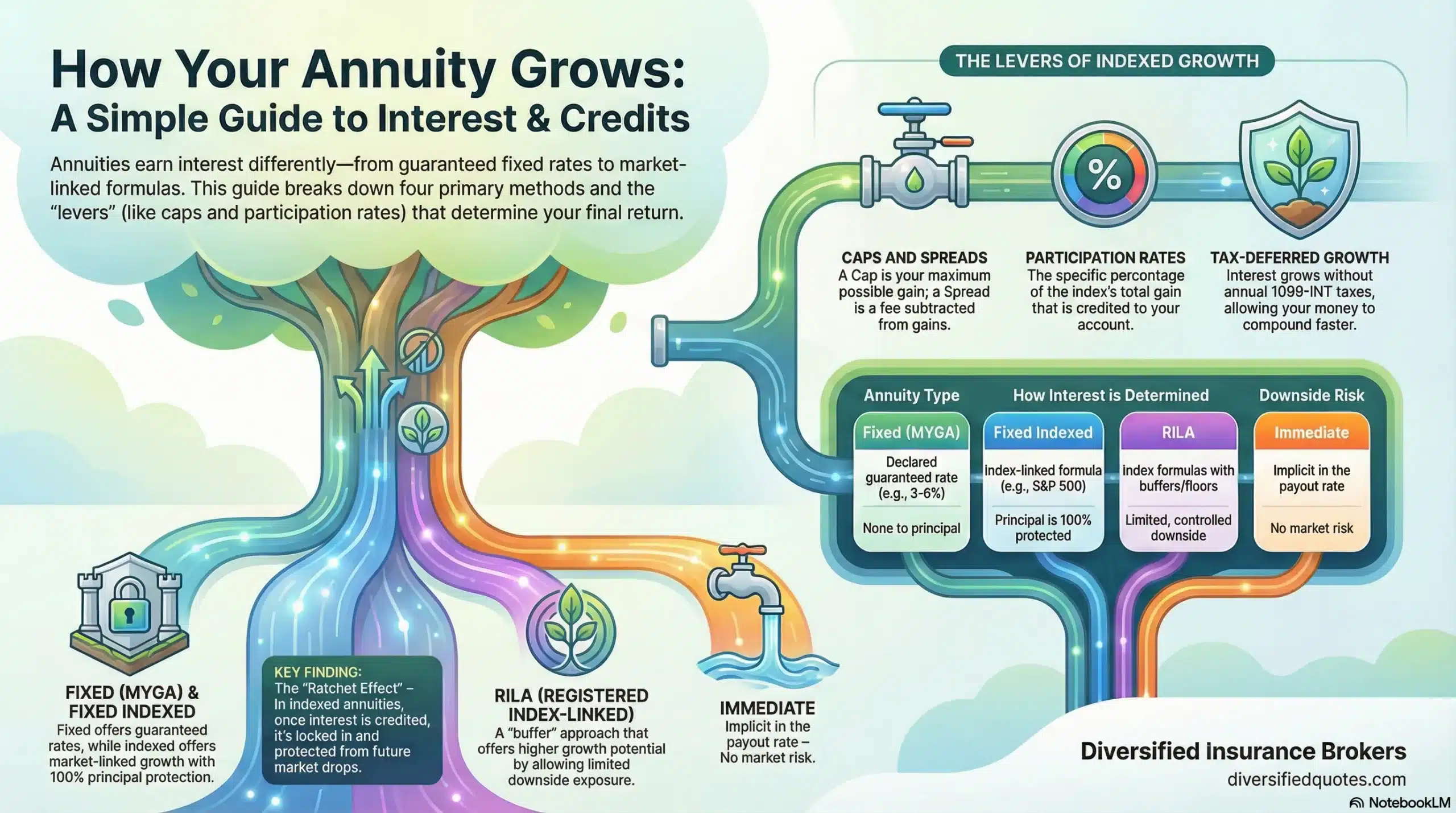
A Multi-Year Guaranteed Annuity is the most appropriate annuity structure for Solo 401(k) participants who are mid-transition — leaving self-employment, entering W-2 employment or retirement, and needing the accumulated balance to be protected and growing predictably during the transitional period. The MYGA’s core advantage in this context is timeline matching: you select a 3, 5, or 7-year declared rate guarantee that locks in precisely as long as you need the funds to remain protected and accumulating before they are needed for income, repositioning, or full withdrawal. A MYGA laddering approach — splitting the Solo 401(k) rollover across two or three MYGA contracts with staggered maturities — creates rolling access points at 3, 5, and 7 years, allowing each portion to be evaluated for repositioning into the most competitive product available at that maturity date rather than committing the full balance to a single declared rate in a single rate environment. High Solo 401(k) balances benefit most from this approach: not because any single MYGA maturity is problematic, but because locking a large balance into any single product and rate environment for a decade introduces concentration risk that a laddered structure naturally distributes. Comparing the MYGA’s declared-rate structure against the FIA’s indexed crediting approach for a large Solo 401(k) rollover requires modeled scenarios across the full MYGA term rather than a single favorable-year projection — the MYGA’s guaranteed outcome is the relevant benchmark against which the FIA’s range of outcomes should be evaluated.
FIA After Solo 401(k) Rollover — Protected Growth for Peak-Accumulation Participants
A Fixed Indexed Annuity is the appropriate structure for Solo 401(k) participants who have high accumulated balances, retirement horizons of 7 or more years, and a growth objective that a MYGA’s declared rate cannot satisfy — but who are not yet ready to convert the accumulation to income. The FIA provides the 0% floor that protects the Solo 401(k) rollover’s accumulated value from market-caused losses while allowing indexed growth potential that can meaningfully exceed MYGA declared rates in positive market environments. For the self-employed business owner who has spent a career building assets aggressively through maximized contributions, transitioning to an FIA is not a retreat from growth — it is the intelligent deployment of the accumulated base into a structure that protects the decades of compounding that created the balance, while continuing to grow it at indexed market-linked rates. Our guide to choosing the correct indexes in an FIA covers the full analytical framework — including why one-year annual point-to-point crediting is structurally superior to two-year or multi-year crediting periods for maximizing at-bats to earn interest across the surrender period — which applies with particular force for high-balance Solo 401(k) rollovers where the difference in effective average credited interest over 10 years translates into meaningful dollar differences at maturity.
Large Solo 401(k) rollovers may also qualify for enhanced FIA crediting terms that standard balance purchasers cannot access. Some FIA carriers offer enhanced cap rates, higher participation rates, or reduced spreads for premiums above $100,000 or $250,000 thresholds. A Solo 401(k) participant rolling over a substantial balance should always confirm whether a premium band exists at the carrier before comparing cap rates — the advertised cap rate for a $50,000 investment may be meaningfully lower than the cap rate for the same product funded at $500,000. This premium-band dynamic means that the competitive FIA product for a large Solo 401(k) rollover may differ from the competitive product for a smaller IRA rollover — and the evaluation must be run using the actual rollover amount, not the product’s minimum premium terms. For participants comparing a bonus annuity structure against a non-bonus FIA for the Solo 401(k) rollover, the large premium context changes the break-even analysis: a carrier funding an upfront bonus from its options budget at a $500,000 premium uses more of that budget on the bonus than at a $50,000 premium, which may produce more pronounced cap rate compression than at smaller premium levels — making the non-bonus FIA’s ongoing crediting advantage more durable across the full surrender period for large Solo 401(k) rollover balances.
Income Annuity After Solo 401(k) Rollover — Converting Decades of Maximized Contributions to a Private Pension
The highest-and-best use of a large Solo 401(k) rollover balance for a participant at or near retirement is often the income annuity — converting a substantial accumulated asset into a guaranteed monthly income stream that cannot be outlived, cannot be reduced by market performance, and does not require ongoing investment management decisions during retirement. Self-employed individuals who have spent careers without access to employer pension plans are often the most underserved retirement income group: they have Social Security (if they paid self-employment taxes), they have their accumulated Solo 401(k) balance, and they have whatever other assets they built outside the plan. Converting a meaningful portion of the Solo 401(k) rollover into a Single Premium Immediate Annuity or a Deferred Income Annuity creates the pension stream that was never available through employment — funded by the Solo 401(k) participant’s own contributions rather than an employer’s. For a self-employed professional who has maximized contributions over a full career, the resulting SPIA income stream may rival or exceed what a defined benefit pension would have provided, producing a guaranteed lifetime monthly income that removes sequence-of-returns risk from the essential expense coverage entirely. Understanding lifetime income annuity structures — how the SPIA’s monthly payment is determined, how joint-life and period-certain options affect the payment amount, and how DIA deferral periods amplify the future monthly payment — provides the framework for sizing the income annuity component of the Solo 401(k) rollover correctly. Our resource on pension alternatives using annuities specifically addresses the self-employed individual’s position — having accumulated wealth without the institutional pension infrastructure — and covers how income annuities fill that structural gap in a way that no investment portfolio can match contractually. For the sequence-of-returns risk that most imperils the self-employed retiree who has no pension backstop, the income annuity provides the most direct contractual solution: guaranteed income regardless of market conditions in the years that matter most.
Rollover Mechanics — Form 5500-EZ, Loan Payoff, and the Direct Transfer Sequence
The Solo 401(k) termination and rollover sequence has a specific compliance order that must be respected before any funds can transfer to an annuity. Step one: address all outstanding loans. Any unpaid Solo 401(k) loan balance not repaid before the plan is terminated becomes a deemed distribution — a taxable event that may also trigger the 10% early distribution penalty. The loan must be repaid in full, refinanced as a personal loan from an outside source, or offset against the participant’s account balance (triggering the deemed distribution consequence). This is not optional and cannot be addressed retroactively after the plan has been closed. Step two: liquidate all plan assets to cash if the plan holds illiquid positions (real estate, private notes, alternative investments). Step three: initiate a direct trustee-to-trustee transfer from the Solo 401(k) custodian to a Traditional IRA at the receiving institution. The receiving institution must certify that it can accept the rollover. This direct transfer carries no 20% withholding requirement, no 60-day reinvestment deadline, and no one-per-year rollover limitation (the one-per-year rule applies to indirect IRA-to-IRA rollovers, not to direct plan-to-IRA transfers). Understanding how qualified plan rollovers to annuities work mechanically — including the receiving institution certification requirements, the timing of annuity funding from within the IRA, and the surrender charge implications of committing the full IRA balance to an annuity contract — prevents the sequential errors that can delay or partially impair the tax-free rollover. Step four: fund the annuity from within the Traditional IRA once the funds have settled at the IRA custodian. Step five: file Form 5500-EZ if required (plan assets exceeded $250,000 in any prior plan year). Step six: maintain documentation of the plan termination, the rollover, and the final Form 5500-EZ filing for at least six years in case of audit. Understanding how surrender charges work during the commitment period — and how the annuity’s 10% annual free provision interacts with planned distributions and Required Minimum Distributions — is the final due diligence piece before the annuity application is signed.
Solo 401(k) participants should also understand what changes at the IRA level after the rollover. The Solo 401(k) allowed plan loans — borrowed at prime-plus-one percent against the vested balance, repaid on a schedule, with no early distribution penalty. Once the assets leave the Solo 401(k) and enter a Traditional IRA annuity, the loan provision disappears permanently. IRAs do not allow loans under any circumstances. The loss of the loan provision is one of the most practically significant structural changes in the transition from Solo 401(k) to IRA annuity, and it must be factored into liquidity planning before the rollover is executed: if you anticipate needing large lump-sum access to retirement funds before age 59½ — for a business opportunity, a real estate purchase, or an emergency — the IRA’s SEPP framework under Section 72(t) is the primary tool, but it is far less flexible than the Solo 401(k)’s loan provision and triggers a multi-year commitment to a specific payment schedule that cannot be modified without retroactive penalties. For participants who anticipate potential liquidity needs before retirement age, maintaining an adequate emergency reserve outside the rollover annuity — before committing the full Solo 401(k) balance to an annuity contract’s surrender schedule — is a necessary planning step, not a conservative excess.
Ready to evaluate annuity options for your Solo 401(k) rollover?
Request Your Personalized Solo 401(k) Rollover Analysis
Financial Protection Essentials
Explore disability coverage, life insurance, and specialty protection options for self-employed professionals and business owners.
Explore Annuity Rollover Options by Account Type
Every retirement account rolls over differently. Choose your plan type below to see the specific rules, tax treatment, and best annuity strategies for your situation.
Talk With an Advisor Today
Choose how you’d like to connect—call or message us, then book a time that works for you.
Schedule here:
calendly.com/jason-dibcompanies/diversified-quotes
Licensed in all 50 states • Fiduciary, family-owned since 1980
What happens to an outstanding Solo 401(k) loan when I roll over to an annuity?
An outstanding Solo 401(k) loan at the time of plan termination creates one of the most expensive unresolved compliance problems in the rollover process — and it must be addressed before any assets can transfer tax-free to the Traditional IRA annuity. When a qualified plan loan is outstanding at plan termination, the outstanding balance is treated by the IRS as a deemed distribution: a taxable event that adds the full outstanding loan balance to ordinary income in the year of termination, and triggers the 10% early distribution penalty if the participant is under age 59½. The deemed distribution happens automatically — it is not optional, and it cannot be reversed. A Solo 401(k) participant with a $75,000 outstanding loan balance at termination who is in the 24% federal bracket and under age 59½ faces approximately $25,500 in combined federal taxes (24% + 10%) on that $75,000 — before state taxes. Three approaches to resolving the loan before rollover: First, full repayment — the participant pays the outstanding loan balance back to the plan from personal funds before the plan is terminated, restoring the full balance to the rollover pool. Second, outside refinancing — the participant takes a personal loan from a bank or other lender and uses the proceeds to repay the plan loan, converting the plan liability into a personal liability outside the retirement account structure. Third, acceptance of the deemed distribution consequence — if the tax cost of the deemed distribution is acceptable in the context of the overall rollover plan (for example, the participant is in a low-income tax year due to business wind-down), accepting the deemed distribution and rolling only the net remaining balance is a valid, if expensive, option. Once assets leave the Solo 401(k) and enter the Traditional IRA, the loan provision is permanently gone. Understanding how the annuity’s free withdrawal provision replaces the loan flexibility that the Solo 401(k) provided — specifically what the 10% annual free provision can and cannot accommodate compared to a plan loan’s flexibility — is essential for right-sizing liquidity reserves outside the annuity before committing the full rollover balance to the contract.
How does the Form 5500-EZ requirement affect the Solo 401(k) rollover timeline?
The Form 5500-EZ is the annual reporting form required for Solo 401(k) plans with assets that exceeded $250,000 at the end of any plan year. It must also be filed for the final plan year when the plan is terminated — regardless of whether the assets are above or below the $250,000 threshold at termination — if the plan ever exceeded $250,000 during its existence. The form must be filed by the last day of the seventh month after the plan year ends. For calendar-year plans (January–December), this means July 31 of the year following the final plan year. For fiscal-year plans, the deadline adjusts accordingly. The Form 5500-EZ requirement does not delay the rollover itself — the assets can be transferred from the Solo 401(k) to the Traditional IRA and then to the annuity on the normal rollover timeline, before the Form 5500-EZ deadline. The form is a reporting requirement documenting the plan’s final status, not a prerequisite for the rollover execution. However, it must be completed on time and retained with the plan termination documentation. The IRS penalty for late filing is $250 per day, with a cap of $150,000 per delinquent filing. The IRS First-Time Penalty Relief program may waive this penalty if the participant has no prior filing infractions and the failure was not due to willful neglect — but this relief is not guaranteed and requires an explicit application. Participants who are unsure whether they exceed the $250,000 threshold should review year-end statements for the plan’s full history, not just the termination year, since the threshold triggers based on the highest year-end balance during the plan’s existence, not only the termination balance. Understanding how the Solo 401(k) rollover to an annuity is reported on tax forms — specifically Form 1099-R for the distribution and Form 5498 for the IRA contribution — provides the complete tax documentation picture for the rollover year.
How does the SECURE 2.0 part-time worker rule affect Solo 401(k) eligibility and rollover timing?
SECURE 2.0 introduced a significant expansion of who counts as an eligible plan participant under the long-term part-time employee rules: employees who have worked at least 500 hours in two consecutive years now qualify for plan participation. This rule, which began phasing in starting with the 2023 plan year, directly affects Solo 401(k) eligibility for business owners who have consistent part-time workers. The traditional threshold was 1,000 hours per year to trigger full-time employee status and disqualify the Solo 401(k). Under SECURE 2.0’s expanded rule, an employee working 520 hours in each of two consecutive years — roughly 10 hours per week — now qualifies for participation, forcing the business owner to either convert the Solo 401(k) to a traditional multi-participant 401(k) plan that covers the eligible part-time employee, or terminate the Solo 401(k) and roll the assets to an IRA. The timing implication: business owners who employ consistent part-time workers should evaluate their part-time hours carefully to determine whether SECURE 2.0’s expanded rules have already created a plan qualification problem that requires resolution now, rather than waiting until the issue becomes an IRS audit finding. A Solo 401(k) that should have been terminated due to part-time employee eligibility but was not is a non-qualified plan for the disqualified years — which creates a significant retroactive tax problem. For business owners who determine that the SECURE 2.0 rule has already triggered disqualification, the rollover to a Traditional IRA annuity should be executed promptly and the compliance situation addressed with a tax professional. Understanding other SECURE 2.0 provisions that affect retirement plans — including the extended RMD ages, the catch-up contribution changes for ages 60–63, and the modifications to plan distribution rules — provides the full SECURE 2.0 context that the Solo 401(k) rollover decision occurs within.
How does a large Solo 401(k) rollover compare to a 401(a) or 403(b) rollover for annuity planning purposes?
The Solo 401(k) rollover and the institutional plan rollover — from a 401(a) plan or 403(b) — share the same basic annuity evaluation framework (MYGA for certainty, FIA for protected growth, SPIA/DIA for income) but differ in several participant-profile and administrative dimensions that affect how the evaluation proceeds. The Solo 401(k) participant is always self-employed; the 401(a) and 403(b) participants are typically government or nonprofit employees with institutional plan administrators managing the distribution process on their behalf. The Solo 401(k) participant must handle the termination and Form 5500-EZ process independently, often without the administrative support that institutional plan participants receive from HR departments. The loan payoff requirement is more likely to affect Solo 401(k) participants than 403(b) participants since Solo 401(k) plans frequently carry plan loans while 403(b) participants may not have exercised the loan provision. The investment breadth question is uniquely Solo 401(k): self-directed Solo 401(k) participants may hold real estate, private notes, or alternative assets that must be liquidated before the rollover can proceed — institutional plan participants hold conventional fund investments that liquidate immediately. From the annuity product evaluation standpoint, the high-balance dimension of the Solo 401(k) rollover is the most relevant differentiator: many self-employed professionals who have maximized contributions over a full career arrive at the rollover with balances that qualify for premium-band pricing advantages at major FIA and MYGA carriers. Running the annuity evaluation at the actual rollover balance — not at the carrier’s minimum premium — is essential for Solo 401(k) participants whose balance qualifies for enhanced terms unavailable to smaller-balance buyers. Whether annuities are a good investment in this high-balance rollover context depends on the specific carrier terms available at the rollover amount and the participant’s specific income timeline — which requires a current illustration from the carriers at the actual premium level.
If both my spouse and I participated in the Solo 401(k), how does the annuity rollover work for each of us?
When both spouses have participated in the Solo 401(k) — which is permitted when the spouse performs services for the business and receives compensation — each spouse has a separate, independent account balance within the plan. The accounts are not jointly owned; each spouse’s balance belongs to that spouse’s retirement savings. When the Solo 401(k) is terminated for rollover purposes, each spouse’s balance must roll to that spouse’s own separate Traditional IRA. The spouse cannot roll their balance to their partner’s IRA; the funds follow the owner. For annuity planning, this independence creates both flexibility and a sequencing opportunity. Each spouse’s balance can be directed to a different annuity type based on each person’s individual retirement timeline, income need, and risk preference. If the primary earner has a substantially larger balance — a common outcome when the business owner contributed both employee deferrals and employer profit-sharing while the spouse contributed only employee deferrals — the primary earner’s rollover may be best served by a large-premium FIA with premium-band enhanced cap rates, while the spouse’s smaller balance may be best served by a MYGA that provides declared-rate simplicity without surrender period complexity. The beneficiary designation for each annuity contract must be handled independently: the primary earner’s annuity names the spouse as primary beneficiary, and the spouse’s annuity names the primary earner as primary beneficiary — or whichever beneficiary structure best serves the couple’s estate planning objectives. Understanding how annuity death benefits transfer to spouses and beneficiaries — specifically whether the surviving spouse can continue the contract, exercise an income rider for life, or receive a lump sum — is part of the spousal rollover planning conversation that the Solo 401(k)’s dual-account structure makes particularly relevant. The 72(t) SEPP rules apply independently to each spouse’s account: one spouse can initiate a SEPP without affecting the other’s account, providing income planning flexibility that the joint-account structure of some other plan types does not offer. For any non-qualified annuity assets held alongside the Solo 401(k) rollover — from personal savings, inheritances, or prior non-qualified annuities — the 72(q) framework rather than 72(t) governs distribution planning, and the two frameworks should be coordinated rather than managed independently to optimize the overall income tax picture across the couple’s combined retirement assets.
About the Author:
Jason Stolz, CLTC, CRPC, DIA, CAA and Chief Underwriter at Diversified Insurance Brokers (NPN 20471358), is a senior insurance and retirement professional with more than 25 years of real-world experience helping individuals, families, and business owners protect their income, assets, and long-term financial stability. As a long-time partner of the nationally licensed independent agency Diversified Insurance Brokers, Jason provides trusted guidance across multiple specialties—including fixed and indexed annuities, long-term care planning, personal and business disability insurance, life insurance solutions, Group Health, Travel Medical and Evacuation Insurance, and short-term health coverage. Diversified Insurance Brokers maintains active contracts with over 100 highly rated insurance carriers, ensuring clients have access to a broad and competitive marketplace.
His practical, education-first approach has earned recognition in publications such as VoyageATL, and contributions from his agency featured in Kiplinger and GoBankingRates— highlighting his commitment to financial clarity and client-focused planning. Drawing on deep product knowledge and years of hands-on field experience, Jason helps clients evaluate carriers, compare strategies, and build retirement and protection plans that are both secure and cost-efficient. Visitors who want to explore current annuity rates and compare options across multiple insurers can also use this annuity quote and comparison tool.
Explore More Lifetime Income Options: Browse our complete guide to How to Transfer a Retirement Account to an Annuity — covering IRA, 401k, 403b, TSP, pension, Roth IRA, SEP IRA, 457b & more rollover guides from 100+ carriers.
Last Reviewed: July 6, 2026 |
Reviewed by: Jason Stolz, CLTC, CRPC, DIA, CAA
Chief Underwriter, Diversified Insurance Brokers, Inc. | NPN: 20471358 | Diversified Insurance Brokers, Inc. — Licensed in all 50 states
Fact Checked by: Tonia Pettitt, CMIP©
Medicare Specialist, Diversified Insurance Brokers, Inc. | NPN: 14374308 | Diversified Insurance Brokers, Inc. — Licensed in all 50 states
Did you find this content helpful? Leave us a Google review — it helps others find trustworthy guidance too.
Editorial Standards: Diversified Insurance Brokers maintains rigorous editorial standards to ensure accuracy, clarity, and independence in all content. Learn more about our editorial standards and commitment to transparency.
