
Disability Insurance for Sports Agents
Disability Insurance for Sports Agents

Jason Stolz CLTC, CRPC, DIA, CAA
Sports agents occupy one of the most financially dynamic and relationship-intensive professions in American business. Their entire income structure is built on commission — a percentage of the contracts they negotiate for the athletes they represent, plus endorsement and marketing deal commissions that add to the base player contract earnings. Sports agents earn most of their income through a commission-based structure, in which they take a set percent of their clients’ contracts and endorsement deals. NFL agents are capped at 3%, NBA agents at 4%, and NHL agents at 5%. At the high end, this produces extraordinary income: NFL agents can earn between $800,000 and $54 million on contract commissions alone, and NBA agents can generate $4.7 million to $48 million in commission range depending on client caliber. At the middle of the market, sports agents working with multiple professional clients across different leagues generate variable but substantial commission income that scales directly with their personal availability, professional relationships, and negotiating capacity.
When a disability interrupts a sports agent’s ability to work — impairing their cognitive function, communication capacity, travel availability, or the relationship intensity that professional athlete representation demands — the financial consequences arrive faster and more severely than in most other professions. Unlike a salaried employee whose income continues while on disability leave until benefits begin, a commission-based sports agent’s income stops or erodes the moment their capacity to generate client activity is impaired. And the relationship-dependent nature of sports representation means that extended absence does not result in a steady client base waiting for the agent to return — athletes in professional sports routinely seek competitive representation when their current agent becomes unavailable, creating permanent income loss that extends well beyond the disability period itself.
At Diversified Insurance Brokers, we help sports agents and entertainment industry representatives build disability income protection that reflects the commission structure, the relationship dependency, and the specific underwriting mechanics that govern income documentation for this profession. Our resources on disability insurance for the self-employed, disability insurance for 1099 workers, and disability insurance for professional athletes provide related context for both agents and the clients they serve.
Disability Insurance for Sports Agents and Athletic Representatives
Income protection designed for the commission structure, variable earnings, and relationship-intensive demands of professional sports representation.
Request a Disability Insurance Quote
Call 800-533-5969
How Commission Income Creates Unique Disability Risk
The commission-based income structure that defines sports agency creates a disability risk profile that is fundamentally different from salaried employment and from most other professional practices. A salaried attorney or physician who becomes disabled loses income predictably proportional to their working capacity. A sports agent who becomes disabled may lose income disproportionately, because their income depends not just on their current working capacity but on the client relationships and professional reputation they have built over years — assets that depreciate rapidly under extended absence.
Consider the practical scenario: an NFL agent who represents twelve active players has built a roster that generates commission income from negotiated contracts and endorsement deals. If that agent becomes disabled and unable to manage client relationships for six months during a key free agency period, multiple clients may transition to other representation — not because the agent failed, but because professional athletes in high-stakes contract environments cannot afford an unavailable representative. When the agent recovers, they return not just to their own recovery challenge but to a partially depleted client roster that may take years to rebuild. The income loss from this client erosion extends far beyond the period of physical disability, creating a financial damage pattern that standard disability policies may undervalue if they are calibrated only to the duration of the acute disability event rather than the total income impact.
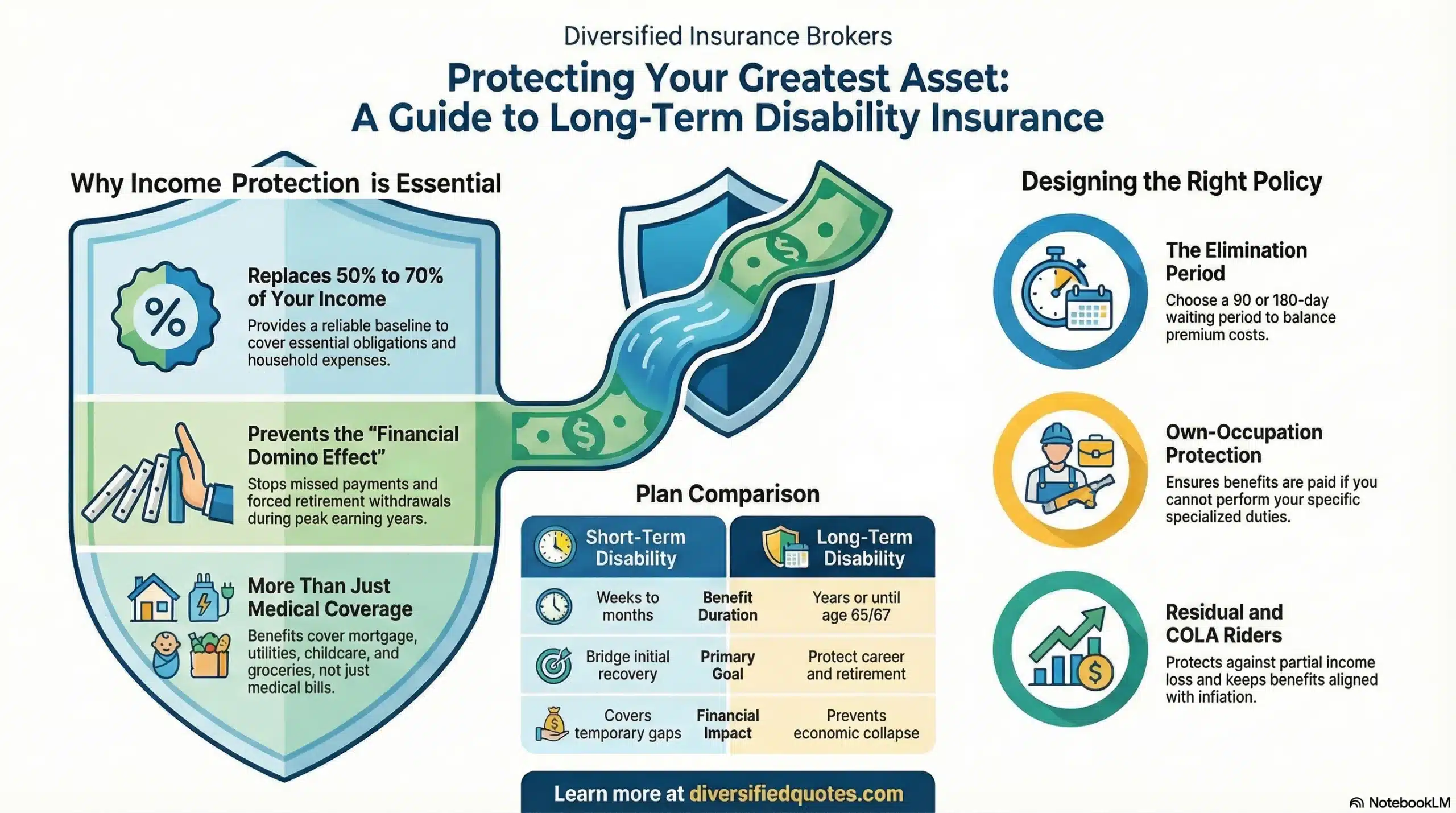
The residual disability rider is the most important policy provision for addressing this risk. It pays proportional benefits based on actual income loss when a disability reduces income by 20% or more — even if the agent is still partially working. An agent who can work 60% of normal capacity earns roughly 60% of previous commission income and receives 40% of the monthly benefit from the residual rider. This proportional approach reflects the actual economics of commission-based income far more accurately than a binary total-versus-no-disability determination. Our resource on residual disability insurance benefits explained covers the calculation mechanics for variable-income professionals in detail.
Licensing, Certification, and the Professional Infrastructure
Sports agents are among the most credentialed professionals in the representation industry. NFLPA certification requires passing a proctored examination, annual fees, attendance at required seminars, and maintenance of mandatory professional liability insurance. You are prohibited from recruiting or representing any players until you have been notified that you have passed the exam, paid the required NFLPA Agent annual fee, and obtained the required liability insurance. The NFLPA annual fee is currently $1,500 for agents representing fewer than 10 active players and $2,000 for those representing 10 or more. NBPA, MLB, NHL, and other league certifications carry their own annual fees, examination requirements, and compliance obligations.
This professional infrastructure — the certifications, the annual fees, the required insurance, the seminar attendance — represents fixed career costs that continue regardless of whether the agent is actively generating income. A disability that removes an agent from practice for an extended period does not eliminate these ongoing professional maintenance obligations; maintaining them while income stops creates financial pressure that disability benefits must address. The fixed costs of maintaining professional certifications, paying annual fees, and satisfying continuing obligations while disabled can be substantial over a multi-year disability claim, making adequate benefit amount selection particularly important for agents who want to preserve their professional standing during a disability recovery period.
Income Documentation and Underwriting Mechanics
| Income Documentation Factor | Impact on Disability Underwriting | Strategic Implication |
|---|---|---|
| Variable Commission Income | Averaged across 2–3 tax years; high and low years both affect the basis | Apply during or shortly after peak contract cycle years when average is highest |
| Self-Employment Deductions | Net taxable income used for benefit calculation; deductions reduce the base | Understand what components each carrier includes; documentation timing matters |
| Contract Cycle Concentration | Large one-time commissions from major contracts can spike income in specific years | Carriers may apply income stability analysis; understand how spikes are treated |
| Growing Income Trend | Future increase option allows coverage to grow as roster and income grow | Elect maximum FIO at initial application; update coverage as income grows |
| Firm Employment vs. Independent | W-2 employed agents document differently than self-employed independents | Documentation requirements differ; commission components may not all be W-2 |
Occupational Classification: An Advantage for Office-Based Agents
Sports agents who work primarily in office-based settings — conducting negotiations by phone and in person, reviewing contracts, managing client relationships, conducting due diligence, and attending athletic events as a professional observer — typically qualify for Class 4 or Class 5 occupational ratings. These are among the most favorable available classifications, producing lower premiums and access to the strongest available policy provisions. The absence of physical job hazards, the office-based work environment, and the professional fee-for-service nature of the income structure all support favorable classification for sports agents in standard practice settings.
True own-occupation disability insurance is the appropriate policy standard for sports agents. The own-occupation definition pays benefits when a disability prevents the insured from performing the material and substantial duties of their specific occupation — sports representation work — even if they could theoretically perform other employment. An agent who develops a cognitive condition that prevents the high-intensity negotiation, relationship management, and contract analysis that professional sports representation requires but who could theoretically work in another field receives full disability benefits under a true own-occupation policy. This protection is essential for a professional whose income is linked to a specific skill set and relationship network that cannot simply be transferred to an alternative occupation.
Coordination with Entertainment Industry Representation
Sports agents who also represent entertainers, recording artists, or media personalities beyond the athletic world face income structures that may span multiple client categories with different contract timing, endorsement patterns, and seasonal concentration. Our resource on disability insurance for the entertainment industry covers representation professionals whose client portfolios extend into music, acting, and media — the disability planning approach is consistent across sports and entertainment representation, but the income documentation may involve multiple commission streams from different league and industry sources that require comprehensive documentation at application.
For agents who have grown their practices to include stock broker or financial advisor functions for athlete clients, our resource on disability insurance for stock brokers and our overview of entertainment industry disability planning provide relevant context for the crossover professional services dimension that many full-service sports agents provide.
Protect Your Commission Income as a Sports Agent
We build income protection plans that reflect variable commission structures, relationship dependency, and the own-occupation needs of professional sports representation.
Get Your Sports Agent Disability Quote
Call 800-533-5969
Related Disability Insurance Pages
Talk With an Advisor Today
Choose how you’d like to connect—call or message us, then book a time that works for you.
Schedule here:
calendly.com/jason-dibcompanies/diversified-quotes
Licensed in all 50 states • Fiduciary, family-owned since 1980
FAQs: Disability Insurance for Sports Agents
Why is the residual disability rider especially important for sports agents?
Because sports agents’ income scales directly with their working capacity and client activity, partial disability produces proportional income loss rather than a binary all-or-nothing scenario. An agent who can work 60% of normal capacity earns roughly 60% of previous commission income — but may not meet the total disability threshold for full benefits without a residual rider. The residual rider pays proportional benefits based on actual income loss when disability reduces income by 20% or more, making partial disability scenarios financially manageable rather than financially catastrophic. For commission-based professionals whose income reflects every hour of availability and every client relationship maintained, partial disability is often the more common and more financially damaging scenario than complete incapacity. Our resource on residual disability insurance benefits explains the calculation mechanics in full.
How is a sports agent’s commission income documented for disability underwriting?
Disability carriers calculate insurable income for commission-based self-employed agents from a multi-year average of net taxable income from personal and business tax returns — typically two to three years. Variable commission income, including spikes from major contract negotiations, is averaged into the calculation rather than being credited at its peak value. Agents who experienced particularly high income in one or two years may find the multi-year average understates their sustainable earning capacity, while those in growth phases may find it understates current income. The strategic implication is that the timing of disability insurance applications — applying during or shortly after peak income periods when the multi-year average is highest — produces the best available benefit basis. Our resource on disability insurance for 1099 workers covers the documentation mechanics in depth.
What are the NFLPA and other league certification requirements for agents?
NFLPA certification requires passing a proctored examination, paying annual fees of $1,500 to $2,000 depending on the number of active clients represented, attending required annual seminars, obtaining mandatory professional liability insurance, and negotiating at least one player contract within each three-year period. Failure to meet any of these requirements causes certification to lapse, and NFL clubs are notified that the agent is no longer permitted to negotiate contracts. NBPA, MLB, NHL, and other league certifications carry their own parallel requirements. These ongoing professional obligations continue whether or not the agent is generating income — making adequate disability benefit amounts that can cover both personal income and professional maintenance costs important for agents who want to preserve their certification and return to practice after a disability recovery period.
What occupational class do sports agents receive?
Office-based sports agents whose primary duties involve contract negotiation, client relationship management, and advisory services — without regular physical activity requirements — typically qualify for Class 4 or Class 5 occupational ratings. These are among the most favorable available, producing lower premiums and access to the strongest policy provisions including true own-occupation definitions, non-cancelable guaranteed renewable terms, and the full range of available riders. Agents who travel extensively, attend practice facilities regularly, or work in environments with physical activity requirements may receive slightly different classification treatment depending on how the specific carrier evaluates the occupational risk profile. Confirming the accurate occupational class at application and selecting true own-occupation coverage is the foundation of an effective disability strategy for sports representation professionals.
About the Author:
Jason Stolz, CLTC, CRPC, DIA, CAA and Chief Underwriter at Diversified Insurance Brokers (NPN 20471358), is a senior insurance and retirement professional with more than 25 years of real-world experience helping individuals, families, and business owners protect their income, assets, and long-term financial stability. As a long-time partner of the nationally licensed independent agency Diversified Insurance Brokers, Jason provides trusted guidance across multiple specialties—including fixed and indexed annuities, long-term care planning, personal and business disability insurance, life insurance solutions, Group Health, Travel Medical and Evacuation Insurance, and short-term health coverage. Diversified Insurance Brokers maintains active contracts with over 100 highly rated insurance carriers, ensuring clients have access to a broad and competitive marketplace.
His practical, education-first approach has earned recognition in publications such as VoyageATL, and contributions from his agency featured in Kiplinger and GoBankingRates— highlighting his commitment to financial clarity and client-focused planning. Drawing on deep product knowledge and years of hands-on field experience, Jason helps clients evaluate carriers, compare strategies, and build retirement and protection plans that are both secure and cost-efficient. Visitors who want to explore current annuity rates and compare options across multiple insurers can also use this annuity quote and comparison tool.
Explore More Disability Insurance Options: Browse our complete guide to Disability Insurance for Legal, Finance & White Collar Professionals — covering attorneys, accountants, bankers, executives, financial planners & business professionals from 100+ carriers.
Last Reviewed: May 18, 2026 |
Reviewed by: Jason Stolz, CLTC, CRPC, DIA, CAA
Chief Underwriter, Diversified Insurance Brokers, Inc. | NPN: 20471358 | Diversified Insurance Brokers, Inc. — Licensed in all 50 states
Fact Checked by: Tonia Pettitt, CMIP©
Medicare Specialist, Diversified Insurance Brokers, Inc. | NPN: 14374308 | Diversified Insurance Brokers, Inc. — Licensed in all 50 states
Did you find this content helpful? Leave us a Google review — it helps others find trustworthy guidance too.
Editorial Standards: Diversified Insurance Brokers maintains rigorous editorial standards to ensure accuracy, clarity, and independence in all content. Learn more about our editorial standards and commitment to transparency.
