
Disability Income Insurance for Real Estate Agents
As an Independent Disability Insurance Broker, we have access to exclusive discounts and negotiated pricing most captive agents can’t offer — see the full breakdown near the end of this page.
Disability Income Insurance for Real Estate Agents

Jason Stolz CLTC, CRPC, DIA, CAA
Real estate agents operate in one of the most financially exposed occupations in the American economy. Commission-only income that stops completely when showings and negotiations stop, no employer disability coverage, a business overhead structure that continues regardless of production, and an income documentation profile that creates unique underwriting challenges — the combination makes disability insurance both more important and more complex for real estate professionals than most agents initially realize. Disability insurance services for commission-based self-employed professionals address this specific exposure, and the broader income protection insurance framework covers how individual policies are structured when earnings flow through 1099 income streams rather than a predictable salary.
The most important planning reality for real estate professionals: approximately 90% of disabilities arise from illness, not workplace accidents. Cancer, heart disease, neurological conditions, diabetes complications, mental health disorders, and other medical conditions are far more likely to interrupt a real estate career than a property-related injury. Workers’ compensation covers only occupational injuries and illnesses — roughly 5% of disabling conditions — leaving the other 95% unaddressed by any government program. Social Security Disability Insurance provides a safety net, but average monthly benefits run approximately $1,634 — nowhere near enough to sustain a real estate professional’s household and business expenses. The financial gap between what government programs provide and what a career-interrupting disability actually costs is the specific problem that individual disability income insurance solves. At Diversified Insurance Brokers, we help real estate agents and brokers structure disability coverage that reflects how commission income is earned, documented, and protected.
Compare Disability Insurance for Real Estate Agents
We compare coverage across 100+ carriers and structure policies around commission income, business overhead, and the self-employed real estate professional’s full financial picture.
Request Disability Insurance OptionsDisability Insurance for Real Estate Agents — Key Coverage Decisions and How Commission Income Affects Each
| Coverage Dimension | How Commission Income Changes the Decision | What the Right Design Looks Like |
|---|---|---|
| Income documentation and benefit sizing | Carriers insure net income — gross commissions minus business expenses (brokerage splits, marketing, licensing, E&O insurance, MLS fees, admin costs) — not gross production; year-to-year income variability from market cycles complicates documentation; 2+ years of tax returns required to establish a consistent baseline | Benefit sized to documented net income averaged across multiple tax years; benefit amount reflects actual financial exposure — what the agent needs to cover household expenses — not peak production years that cannot be consistently documented |
| Occupational class and definition | Real estate agent occupational class varies significantly by carrier — some assign one class to all realtors; others evaluate based on income history, years in business, and production stability; agents with established, consistent multi-year income histories receive more favorable classifications than newer or income-volatile agents | Independent market comparison across multiple carriers to identify the most favorable classification for the agent’s specific income profile and experience level; own-occupation definition that covers the specific activities of real estate practice — client meetings, negotiations, property showings — not just general professional activity |
| Elimination period coordination | Commission income typically stops immediately at the start of a disability — no employer sick leave, no paid leave, no payroll continuation; pending transactions in the pipeline may close and generate some short-term income, but new business generation stops; the gap between disability onset and first benefit payment must be bridged entirely from personal savings | Elimination period matched to actual available emergency savings; agents with 90-day liquid reserves can absorb a standard 90-day EP; agents in early career or with irregular savings should consider 30-60 day EPs to prevent financial crisis before the policy activates |
| Residual disability coverage | Many real estate disabilities produce partial income loss rather than complete inability to work — recovering from surgery may allow reduced showing activity, limited client meetings, or partial transaction management before full capacity returns; commission income drops proportionally with reduced activity without crossing a total disability threshold | Residual disability rider that pays proportional benefits when income drops 20-25%+ from a qualifying condition; for commission-based agents, the residual rider is often the most practically valuable policy feature because it addresses the most common realistic disability outcome — partial income loss during recovery |
| Business overhead exposure | Active agents carry ongoing business costs — marketing campaigns, professional photography subscriptions, brokerage desk fees, MLS dues, E&O insurance premiums, licensing fees, and sometimes staff or transaction coordinator costs — that continue regardless of whether the agent is generating transactions | Personal LTD policy covering household income replacement; separate Business Overhead Expense policy covering documented fixed business costs during disability; the two policies address different financial exposures and should be structured together for agents with meaningful ongoing business overhead |
| Tax treatment | Commission income is already subject to self-employment tax at 15.3%; adding taxable disability benefits from employer-paid group plans would compound the tax burden; individually owned policies with after-tax premiums produce tax-free benefits that provide more per-dollar protection | Individually owned policy with personal after-tax premium payment; benefits generally received income-tax-free; the effective replacement ratio is higher than the gross benefit percentage implies because each benefit dollar requires no additional tax payment at claim time |
Why Real Estate Agents Need Disability Income Protection
The real estate profession requires consistent activity, networking, and physical presence. Agents must meet buyers and sellers, attend property showings, conduct negotiations, and coordinate closing transactions. These responsibilities require both physical mobility and strong mental focus. If an agent becomes unable to work due to illness or injury, their business activity may stop immediately — without a steady pipeline of transactions, income can decline within weeks. Unlike corporate employees who receive employer-provided disability benefits, real estate agents typically operate as independent contractors under brokerage firms, meaning most must secure their own disability protection if they want income replacement coverage. The more income a professional generates, the more financial exposure exists if a disability interrupts their ability to work. Disability insurance for self-employed professionals covers the foundational planning framework that applies to most real estate agents’ employment structure, and disability insurance for 1099 workers covers the specific income documentation and benefit sizing approach for commission-based 1099 professionals.
The Net Income Documentation Reality
One of the most important distinctions for real estate agents seeking disability coverage is how income is calculated for benefit purposes. Disability insurance carriers insure net income — gross commission receipts minus documented business expenses — not gross production volume. For a real estate agent who closes $2 million in transactions and earns $60,000 in gross commissions, the disability benefit is not calculated on that $60,000 before expenses. It is calculated on the net income after deducting brokerage splits, marketing costs, MLS fees, E&O premiums, administrative costs, licensing renewal fees, professional photography and listing costs, and any transaction coordinator or administrative support expenses. In high-expense markets where brokerage splits and overhead are significant, net income can be meaningfully lower than gross commission income. This is not a flaw in how coverage works — it reflects the actual income the agent needs to sustain household expenses and financial obligations. Business expenses do not continue at full rate during a disability, so the benefit is appropriately targeted at the personal income stream. Understanding this net income calculation in advance helps agents size their coverage correctly and avoid expecting a benefit that reflects gross production rather than actual spendable income. The benefit sizing calculation framework is at how much disability insurance do I need, and the full discussion of how disability insurance for independent contractors handles variable income documentation covers the mechanics directly.
Residual Disability — The Most Realistic Claim Scenario for Agents
Total disability — the complete inability to perform any real estate activities — is one end of the disability spectrum. The more common and financially impactful scenario for commission-based agents is a condition that allows partial return to work but at meaningfully reduced capacity: an agent recovering from surgery who can conduct client calls and some office-based transaction management but cannot conduct physical property showings; a back condition that limits mobility to a level that prevents extended walking of properties but allows lighter activity; a health condition that enables reduced hours but not the full engagement level required to maintain a full transaction pipeline. In all of these scenarios, commission income drops significantly — potentially by 40-60% or more — without crossing the threshold that “total disability” coverage requires. The residual disability rider pays proportional benefits when income drops 20-25%+ from a qualifying condition, capturing the income loss in that partial recovery period. For commission-based real estate agents, the residual rider is frequently the most practically valuable policy feature — because the realistic disability scenarios for this profession almost always involve partial rather than complete income loss. The distinction between short-term disability and long-term protection also matters here: short-term vs. long-term disability insurance covers how these two coverage types coordinate for commission professionals who have no employer-provided bridge between onset and long-term benefits.
Business Overhead — The Second Layer Agents Often Miss
Real estate agents who are actively producing typically carry ongoing business costs that do not automatically stop when a disability interrupts work. Marketing campaigns, brokerage desk fees, MLS memberships, E&O insurance premiums, licensing renewal fees, professional subscriptions, and any administrative or transaction coordination costs all represent fixed or recurring business expenses that continue whether or not the agent is generating transactions. A personal LTD policy replaces household income — it does not pay brokerage desk fees or marketing costs. Business overhead disability insurance and the companion disability business overhead expense framework cover this second financial layer. For agents who have built meaningful business infrastructure — active listing campaigns, buyer lead systems, and administrative support — the overhead costs during disability can accumulate quickly. Structuring both a personal LTD policy and a BOE policy together creates complete protection that keeps both the household and the business operation funded during recovery. Adjacent real estate profession planning is covered at disability insurance for real estate appraisers and disability insurance for real estate flippers and investors, whose income structures share important parallels with commission-based agency work.
Policy Design — Choosing the Right Features
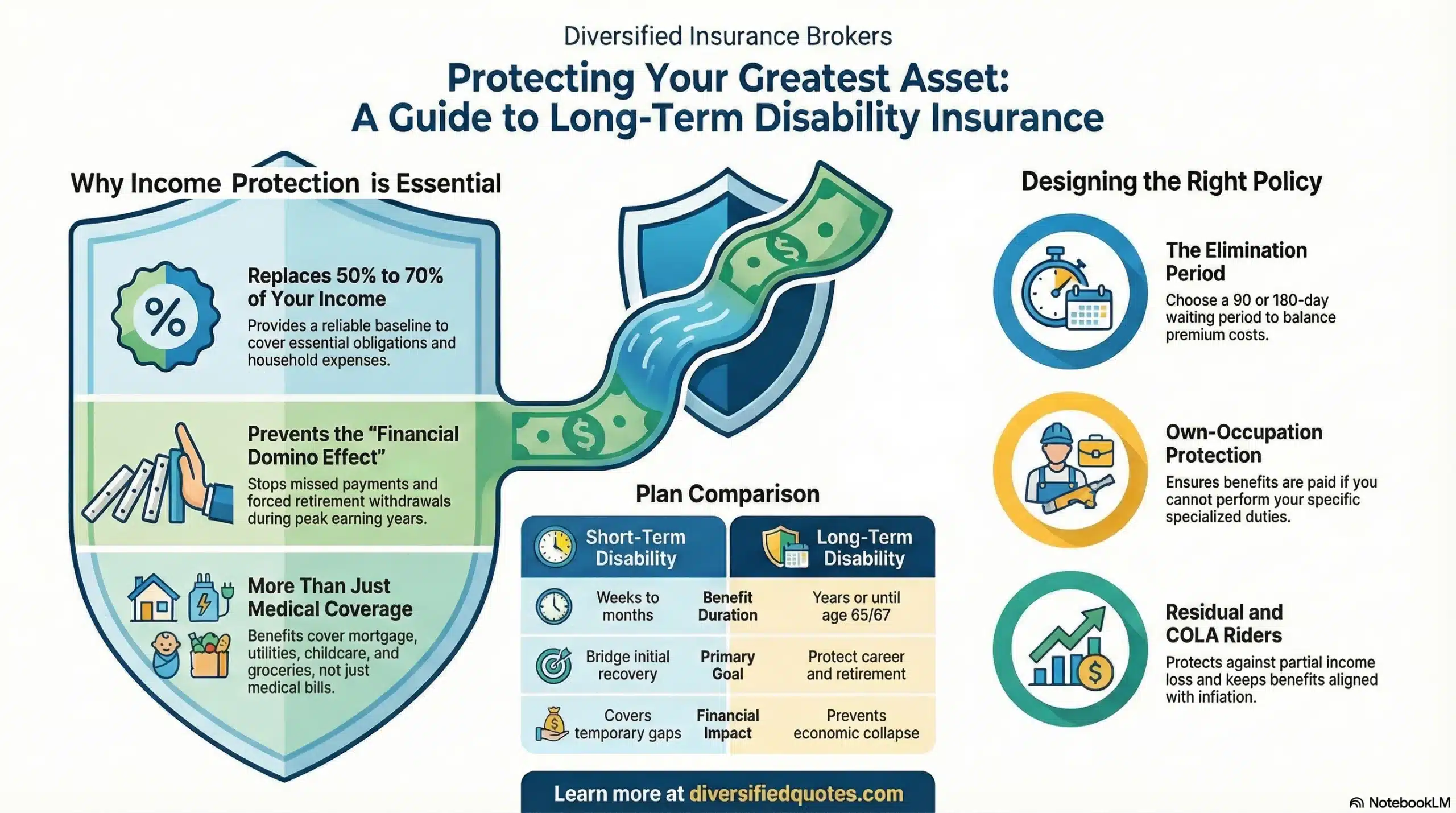
The elimination period selection should be calibrated against actual available emergency savings — the period of self-insurance before any benefits begin. For commission earners without a predictable payroll, a 30- or 60-day elimination period may be more appropriate than the standard 90-day industry benchmark if savings are limited. The benefit period should extend to retirement age — long-term disability insurance with a to-age-65 or to-age-67 benefit period provides protection against career-ending disabilities that a 2-year or 5-year cap leaves exposed. The future increase option allows coverage to expand as documented income grows without new medical underwriting — important for agents in a growth phase of their career. The full rider framework including COLA and return-to-work provisions is at disability insurance riders explained. How to evaluate and compare policy designs is at how to choose the right disability insurance policy. Tax treatment of benefits from individually owned policies with after-tax premiums — generally received tax-free — is covered at are disability insurance payments taxable. For agents who are high earners or who run team operations with meaningful business income, the planning framework is at disability insurance for high earners and business owners. For agents interested in simplified underwriting options, no-exam disability insurance covers when these programs are available and where the trade-offs lie. Commission-based sales and financial professionals in adjacent fields — financial planners and stock brokers — face similar occupational class and income documentation challenges and provide useful comparison context. For an independent evaluation of any existing or proposed disability policy, get a 2nd opinion on your disability insurance quote covers the review process. The disability insurance by occupation page covers how real estate agents compare to other commission-based and self-employed professions in occupational class and available coverage design.
Talk With an Advisor Today
Choose how you’d like to connect—call or message us, then book a time that works for you.
Schedule here:
calendly.com/jason-dibcompanies/diversified-quotes
Licensed in all 50 states • Fiduciary, family-owned since 1980
FAQs: Disability Income Insurance for Real Estate Agents
How is the disability benefit amount calculated for real estate agents with commission income?
Disability insurance carriers base benefit amounts on net income — gross commission receipts minus documented business expenses — not gross production volume. This means the agent’s brokerage split, marketing costs, MLS fees, E&O insurance premiums, licensing fees, and administrative costs are subtracted from gross commissions to arrive at the net income figure used for benefit calculation. Two to three years of tax returns are typically required to establish a consistent income baseline. Year-to-year income volatility from market cycles is usually averaged across the documented period rather than using peak production years as the sole basis.
Does workers’ compensation cover real estate agents if they become disabled?
In most cases, no — or only to a very limited extent. Most real estate agents operate as independent contractors, which typically exempts them from workers’ compensation coverage entirely. Even for agents who might have some workers’ comp eligibility, the more important point is that workers’ compensation only covers work-related injuries and illnesses — approximately 5% of disabling conditions. The other 95%, including cancer, heart disease, neurological conditions, diabetes complications, depression, anxiety, and the vast majority of illness-related disabilities, are not covered by workers’ compensation regardless of employment classification. Individual disability income insurance addresses all causes of disability, not just work-related events.
Why is residual disability coverage especially important for real estate agents?
Most real estate disabilities produce partial rather than complete inability to work. An agent recovering from surgery may be able to conduct some client calls and administrative work but cannot physically conduct property showings, open houses, or extended property walks. A back or hip condition may allow limited activity but not the full physical engagement that sustained real estate production requires. In both scenarios, commission income drops meaningfully — potentially by 40-60% or more — without meeting a total disability threshold. The residual disability rider pays proportional benefits when income drops 20-25%+ from a qualifying condition, capturing the actual income loss during partial recovery. For commission-based agents, this is frequently the most practically valuable policy feature.
Do real estate agents need Business Overhead Expense coverage in addition to personal disability insurance?
For agents with meaningful ongoing business expenses, yes. A personal LTD policy replaces household income — it does not pay brokerage desk fees, MLS memberships, marketing subscriptions, E&O premiums, or administrative support costs. Business Overhead Expense coverage specifically addresses documented fixed business costs during a disability period, keeping the business operation funded during recovery rather than forcing the agent to deplete personal disability benefits on business expenses. Agents with minimal overhead may not need this additional layer, but agents running team operations or maintaining active marketing systems typically benefit from structuring both types of coverage together.
How does the occupational class of a real estate agent affect coverage availability?
Real estate agent occupational class is notably variable across carriers — an occupational class situation where independent broker comparison matters more than most professions. Some carriers assign one standard class to all real estate agents; others evaluate based on income history, years in the profession, income stability, and production patterns. Agents with established multi-year income histories documenting consistent production typically receive more favorable classifications than newer agents with limited or volatile documentation. The occupational class assigned affects premium cost, available definitions, benefit period length, and rider availability. Identifying which carrier classifies a specific agent’s profile most favorably before submitting any application is part of structuring the coverage correctly.
About the Author:
Jason Stolz, CLTC, CRPC, DIA, CAA and Chief Underwriter at Diversified Insurance Brokers (NPN 20471358), is a senior insurance and retirement professional with more than 25 years of real-world experience helping individuals, families, and business owners protect their income, assets, and long-term financial stability. As a long-time partner of the nationally licensed independent agency Diversified Insurance Brokers, Jason provides trusted guidance across multiple specialties—including fixed and indexed annuities, long-term care planning, personal and business disability insurance, life insurance solutions, Group Health, Travel Medical and Evacuation Insurance, and short-term health coverage. Diversified Insurance Brokers maintains active contracts with over 100 highly rated insurance carriers, ensuring clients have access to a broad and competitive marketplace.
His practical, education-first approach has earned recognition in publications such as VoyageATL, and contributions from his agency featured in Kiplinger and GoBankingRates— highlighting his commitment to financial clarity and client-focused planning. Drawing on deep product knowledge and years of hands-on field experience, Jason helps clients evaluate carriers, compare strategies, and build retirement and protection plans that are both secure and cost-efficient. Visitors who want to explore current annuity rates and compare options across multiple insurers can also use this annuity quote and comparison tool.
Explore More Disability Insurance Options: Browse our complete guide to Disability Insurance for Legal, Finance & White Collar Professionals — covering attorneys, accountants, bankers, executives, financial planners & business professionals from 100+ carriers.
Last Reviewed: June 6, 2026 |
Reviewed by: Jason Stolz, CLTC, CRPC, DIA, CAA
Chief Underwriter, Diversified Insurance Brokers, Inc. | NPN: 20471358 | Diversified Insurance Brokers, Inc. — Licensed in all 50 states
Fact Checked by: Tonia Pettitt, CMIP©
Medicare Specialist, Diversified Insurance Brokers, Inc. | NPN: 14374308 | Diversified Insurance Brokers, Inc. — Licensed in all 50 states
Did you find this content helpful? Leave us a Google review — it helps others find trustworthy guidance too.
Editorial Standards: Diversified Insurance Brokers maintains rigorous editorial standards to ensure accuracy, clarity, and independence in all content. Learn more about our editorial standards and commitment to transparency.
