
Disability Insurance for Real Estate Flippers and Investors
As an Independent Disability Insurance Broker, we have access to exclusive discounts and negotiated pricing most captive agents can’t offer — see the full breakdown near the end of this page.
Disability Insurance for Real Estate Flippers and Investors

Jason Stolz CLTC, CRPC, DIA, CAA
Disability insurance for real estate flippers and investors is an income protection planning area that is more nuanced — and more important — than most real estate professionals realize, because the disability insurance options available, the income documentation required, and the occupational classification assigned to a real estate professional all depend critically on how that person actually earns their income. A hands-on house flipper who personally performs renovation work at active construction sites, a deal-focused operator who acquires, manages contractors, and sells properties from an office and project management role, and a passive buy-and-hold investor whose income flows from rental properties and appreciation all occupy fundamentally different disability insurance planning situations — even when they describe themselves using the same professional label.
The most important threshold distinction in disability insurance for real estate flippers and investors is between active earned income and passive investment income. Disability insurance covers earned income — the income generated through active professional work and personal effort. For real estate professionals, this means that active house flippers who operate as IRS-recognized dealers, reporting flipping profits on Schedule C as self-employment income, have insurable earned income that disability insurance can protect. Passive real estate investors whose income flows through Schedule E from rental properties or Schedule D from investment property sales — without the material participation and dealer status that the IRS associates with a trade or business — may have limited insurable earned income for disability insurance purposes, depending on their individual activity level and income structure.
At Diversified Insurance Brokers, we work with active real estate flippers, fix-and-flip operators, real estate developers, and real estate business owners to structure disability insurance coverage that accurately reflects how they earn, what their duty profile actually involves, and what policy features provide the most meaningful income protection when injury or illness prevents them from running their real estate business.
Protect Your Real Estate Business Income
We compare disability insurance options across 100+ carriers and match coverage to your specific real estate professional duty profile and income structure.
Request Disability Insurance OptionsThe Active vs. Passive Income Distinction — The Foundation of Everything
Disability insurance is designed to replace earned income — the income that stops when a person cannot work due to disability. For real estate professionals, the earned-income question requires careful analysis of how income is actually generated. The IRS distinction between a real estate dealer and a real estate investor is directly relevant to disability insurance underwriting, because it determines whether the income being protected is earned professional income or passive investment return.
Active house flippers who operate with the continuity, regularity, and profit-oriented intent that the IRS uses to define a trade or business are classified as self-employed dealers — reporting flipping profits on Schedule C, paying self-employment tax on net earnings, and generating the documented earned income that disability insurance carriers use as the basis for benefit calculations. For these active flipper-dealers, disability insurance planning follows the same framework as for any other self-employed business operator: Schedule C income documentation, multi-year income averaging for variable project-based revenue, and coverage structured to replace the earned income that stops when a disabling condition prevents operating the flipping business.
Passive real estate investors whose activity does not meet the IRS trade-or-business threshold — holding properties for appreciation, collecting rental income, or selling investment properties occasionally — generate income that flows through Schedule D and Schedule E rather than Schedule C, and that income is generally not earned self-employment income in the disability insurance underwriting sense. For this population, disability insurance planning centers on any other earned income they have from employment or active business activity, rather than passive real estate returns. The active-versus-passive income distinction for real estate professionals parallels the duty-based classification framework applicable to other professionals whose income structure spans multiple activity types, including real estate appraisers managing the earned-income documentation requirements of their professional practice.
The Occupational Classification Challenge for House Flippers
For active house flippers whose Schedule C income is clearly earned through a trade or business, the next critical disability insurance planning question is occupational classification — the risk tier that determines premium rates, available benefit periods, and policy feature access. Occupational classification for house flippers is more complex than for most professions because the actual duties of a flipper can span an enormous range of activity from purely physical construction labor to purely office-based deal management, and classification depends on what the flipper actually does rather than what they call themselves.
A house flipper who personally performs renovation work at active job sites — swinging hammers, running electrical, laying flooring, doing demo, and physically participating in the construction work that creates value in the property — receives an occupational classification that reflects the physical hazard and injury risk of construction site work. This is among the less favorable classification territory in disability insurance underwriting, with higher premiums, potentially shorter benefit periods, and more restricted policy feature access than office-based professional occupations receive. The construction site physical injury disability risk for hands-on flippers parallels that documented for other physical construction trade professionals, including construction superintendents and workers managing physical construction site injury disability risk.
A house flipper who operates primarily as a deal manager — sourcing acquisitions, underwriting properties, securing financing, managing contractor relationships, overseeing renovation timelines, and handling sales from an office-based management role without personally performing physical site work — receives a significantly more favorable occupational classification that reflects the cognitive, analytical, and business management nature of the actual work being performed. For this operational profile, the classification may approach that available to other business owners and real estate professionals in analytical and management roles, including property managers and real estate business operators whose predominantly office-based professional duties support favorable disability insurance classification.
The most common real estate flipper profile falls between these extremes — operators who perform some site visits and supervision while also managing the deal, financing, and sale dimensions of each project from an office. For these mixed-duty operators, presenting the accurate duty split to underwriters — documenting what percentage of professional time is office-based versus site-based, and what the site activities specifically involve — is the critical factor in achieving the most favorable available classification. An independent broker experienced in presenting real estate professional duty profiles to underwriters can navigate this classification nuance most effectively. The mixed-duty classification challenge for real estate flippers parallels that facing other business owners whose work spans both physical site and office management dimensions, including general contractors navigating the office-versus-field duty split that determines their disability insurance classification.
The Income Documentation Challenge — Lumpy, Project-Based Revenue
The second major disability insurance planning challenge for active house flippers is income documentation. Disability insurance carriers base benefit amounts on verified earned income, and for real estate flippers whose Schedule C income is inherently lumpy — generated in discrete project-completion events that may cluster in certain years and be sparse in others — documenting insurable earned income in a way that accurately reflects genuine professional earning capacity requires specific expertise.
A real estate flipper who completes three flips in one year and one flip the following year may show dramatically different net Schedule C income between those years — not because their professional skill, market access, or business model changed, but because the timing of project completion happened to concentrate in one calendar year. A benefit calculation based solely on the lower year substantially understates genuine earning capacity. A benefit calculation based solely on the higher year may overstate it relative to a sustainable run rate. Multi-year income averaging — using two to three years of Schedule C net income to establish a representative earning capacity figure — is the most accurate approach for real estate flipper income documentation, and carriers approach this averaging differently, making broker expertise in presenting the income history most favorably an important element of securing an appropriate benefit amount.
The income documentation complexity for real estate flippers is compounded by the business expense structure that reduces gross flip revenue to net Schedule C income. Property acquisition costs, renovation materials, contractor labor, holding costs, financing costs, insurance, and transaction expenses all reduce gross flip proceeds to a net figure — and it is the net Schedule C figure, not gross flip revenue, that represents insurable earned income for disability insurance purposes. Understanding how to present the income history and business expense structure most accurately for underwriting is an important element of securing coverage that genuinely reflects the flipper’s professional earning capacity. This income documentation complexity parallels that facing other variable-income self-employed business operators, including independent contractors and self-employed business operators managing variable income documentation for disability insurance underwriting.
Disability Risk Profile — What Would Actually Stop a Flipper From Working
Understanding the specific disability risk profile of real estate flipping is important for selecting the right own-occupation definition and the right supplemental riders. The disability scenarios most likely to interrupt a real estate flipping business depend on the operator’s specific duty profile — and what would constitute genuine occupational disability differs meaningfully between a hands-on physical operator and an office-based deal manager.
For hands-on flippers who personally perform renovation work, the disability risk profile includes all the acute physical injury risks of construction site work — falls from ladders and elevated surfaces, tool and equipment injuries, struck-by injuries from materials and equipment, overexertion injuries from heavy lifting and sustained physical labor, and the cumulative musculoskeletal loading that sustained construction work produces over time. Any disabling condition that prevents sustained physical construction site work — a serious back injury, a shoulder surgical repair, a hand or wrist condition from power tool use — constitutes genuine occupational disability for a flipper whose value-creation model depends on personal physical participation in the renovation process.
For office-based flipper-operators whose professional value lies in deal identification, underwriting, project management, and sales, the disability risk profile is cognitive and analytical rather than physical — neurological events, serious illness, or cognitive health conditions that prevent the sustained analytical and business management work that deal-based flipping requires. A serious illness that eliminates the deal-sourcing, underwriting, and management capacity of an experienced flipper-operator can be just as career-disabling as a physical injury is for a hands-on operator, even though the physical mechanism is entirely different. The cognitive disability risk for analytical flipper-operators parallels that facing other cognitively intensive real estate and financial professionals, including day traders and financial market professionals whose entirely cognitive and analytical professional work creates a specific cognitive disability risk profile.
The Self-Employment Financial Vulnerability of Real Estate Flippers
Active house flippers operate as self-employed business operators with all the financial vulnerability that self-employment entails when disability strikes. When a disability prevents operating the flipping business — whether through physical incapacity for site work or cognitive incapacity for deal management — the project pipeline stops generating income immediately and completely. There is no employer sick pay, no group disability plan, and no workers’ compensation coverage for self-employed sole proprietors who have not elected it. Properties in progress may still be carrying financing costs, renovation contractor commitments, and holding costs that continue regardless of the operator’s disability.
The business overhead expense dimension of real estate flipping deserves specific planning attention. A flipper who is disabled mid-project may have properties in active renovation with outstanding contractor commitments, hard money loan interest accruing, and holding costs accumulating on properties that cannot be completed or sold during the disability period. Individual disability income insurance protects the operator’s personal income, but business overhead expense coverage addresses the fixed costs of the business itself during a disability period — a particularly relevant consideration for flippers who carry significant ongoing project costs. Our resource on business overhead expense disability insurance covers how this coverage works for self-employed business operators managing ongoing fixed costs during a disabling event.
The acute financial vulnerability of the self-employed real estate flipper from disability parallels that facing other self-employed business operators with no institutional income safety net, including self-employed professionals managing income protection planning without employer-provided disability coverage and 1099 workers and independent business operators managing the complete absence of institutional disability income protection.
Case Study: Active House Flipper Earning $135,000 Per Year
Consider an active house flipper who operates as a self-employed dealer, completing four to six flips annually from a combination of office-based deal management and periodic site supervision, with contractor crews performing all physical renovation work. This flipper reports an average of $135,000 in net Schedule C income across three recent tax years. During a vehicle accident while driving to a property inspection, this flipper sustains spinal trauma and a traumatic brain injury requiring nine months of rehabilitation during which deal management, property inspections, contractor oversight, and all active business operations are medically prohibited.
| Scenario | Without Disability Insurance | With Disability Insurance |
|---|---|---|
| Monthly Income During Recovery | $0 — no employer, no sick pay, no group plan, no workers’ comp | $5,600–$6,750 individual benefit |
| 9-Month Total Income | $0 | $50,400–$60,750 |
| In-Progress Project Costs | Hard money loan interest, holding costs, and contractor commitments continue with zero project revenue | Disability benefit plus BOE coverage addresses personal income and ongoing project fixed costs |
| Long-Term Business Outcome | Financial pressure may force premature return or distressed asset sales during recovery | Recovery on medical timeline; return to active flipping when genuinely ready |
Vehicle accidents while traveling to and from property inspections, contractor meetings, and site visits are a predictable occupational hazard for real estate flippers who drive extensively as part of their professional activity — and they produce exactly the spinal and neurological injury scenario that prevents the deal management and business operations that an active flipping practice requires. Disability insurance for real estate flippers ensures that a career-disrupting accident does not simultaneously become a financial crisis during what may be a months-long recovery and rehabilitation period.
Key Policy Features for Real Estate Flipper Disability Insurance
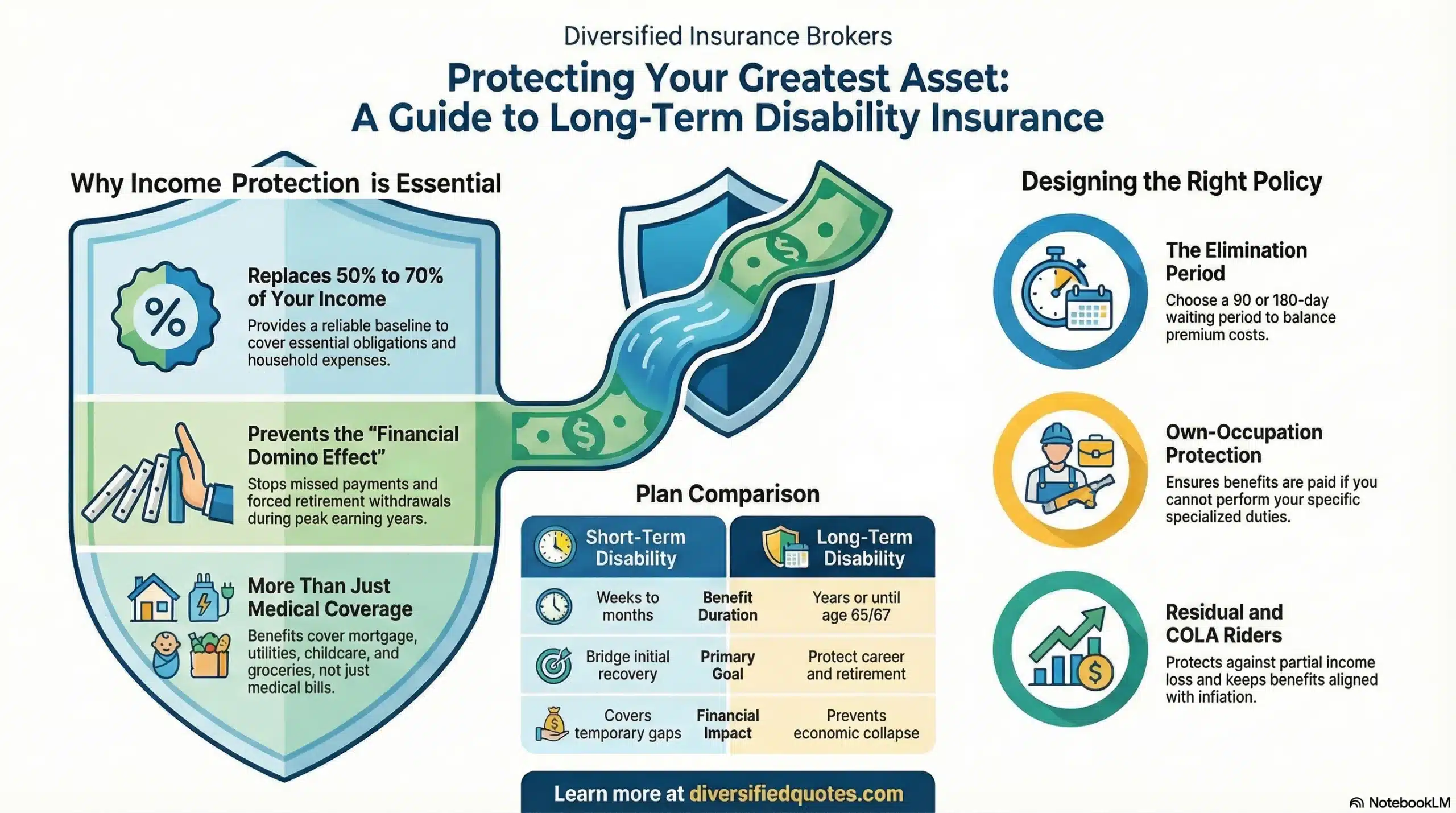
Disability insurance for real estate flippers and investors should incorporate specific policy provisions that address the mixed duty profile, the variable income structure, and the business overhead expense dimension of active flipping operations. The own-occupation definition is foundational — ensuring that a flipper who cannot perform the specific deal management, property acquisition, contractor oversight, or physical site work that their flipping model requires receives disability benefits regardless of theoretical capacity for other less professionally demanding work. Our comprehensive resource on own-occupation disability insurance explained covers how this definition protects real estate flipper income from the conditions most likely to prevent continued active flipping operations.
A residual disability rider is particularly important for real estate flippers whose conditions may reduce deal management capacity without eliminating it entirely — a flipper who can manage some business functions but cannot operate at full deal volume earns reduced income without being totally disabled. Our resource on how residual disability insurance benefits work explains how partial disability coverage supports real estate professionals through graduated capacity reductions. The elimination period should be calibrated to available financial reserves and any in-progress project carrying costs — our guide on how disability insurance elimination periods work provides the complete framework. A cost-of-living adjustment rider preserves real benefit value across extended disability periods — our resource on disability income insurance with a COLA rider explains this protection. For real estate flippers exploring short-term coverage options, our guide on how to buy short-term disability insurance covers the complete income protection picture.
Real Estate Investors With W-2 or Other Earned Income
Many real estate investors and even some active flippers maintain W-2 employment income alongside their real estate activity — either because they have not yet transitioned to full-time flipping, because they hold a professional position that generates primary income alongside part-time real estate activity, or because their real estate activity is structured as a side business supplementing primary employment. For these professionals, the disability insurance planning centers on protecting total earned income — both the W-2 employment income and any Schedule C flipping income — in a coordinated coverage structure.
The interaction between employer group disability plans and individual supplemental coverage is particularly relevant for this population. An employer group plan may protect the W-2 income component adequately but provide no coverage for the Schedule C flipping income that supplements it. Individual supplemental disability insurance structured to cover the Schedule C flipping income specifically — alongside whatever group plan addresses the W-2 component — provides complete earned income protection. The multi-source income coordination planning need for employed real estate investors parallels that facing other professionals with both employment and self-employment income, including financial planners and professional consultants managing multi-source income documentation in disability insurance planning.
Why Real Estate Flippers Need an Independent Disability Insurance Broker
Disability insurance for real estate flippers requires expertise in occupational classification for mixed office-and-site-duty real estate professional profiles, knowledge of how to document variable project-based Schedule C income most accurately for benefit calculation, experience with business overhead expense coverage for operators with ongoing project costs, and the ability to identify carriers whose underwriting guidelines most favorably accommodate active real estate dealer income structures. A standard retail disability insurance application is not optimized for the real estate flipper professional context, and a general agent unfamiliar with how different carriers classify real estate dealer income and mixed physical-analytical duty profiles will not produce the most favorable available coverage terms.
At Diversified Insurance Brokers, we work with active house flippers, fix-and-flip operators, real estate developers, and real estate business owners to structure individual disability insurance that accurately reflects how they earn, what their specific duties involve, and what policy features provide the most meaningful protection for their individual professional and business situation. Our dedicated resource on why independent disability insurance brokers matter explains the full value of this approach for professionals with complex income structures and mixed duty profiles. And our resource on whether disability insurance is worth the investment provides the foundational financial case for self-employed real estate professionals with no institutional income safety net.
Final Thoughts on Disability Insurance for Real Estate Flippers and Investors
Active real estate flippers operate genuinely productive businesses that generate meaningful earned income through deal intelligence, market knowledge, project management skill, and the sustained professional effort that successful flipping at scale requires. That earned income deserves the same quality of disability income protection that any other self-employed professional’s earned income deserves — and with the right broker guidance, accurate duty profile presentation, multi-year income documentation, and appropriate policy feature selection, meaningful disability coverage is entirely achievable for active real estate flipping professionals.
Disability insurance for real estate flippers — structured around an accurate duty-based occupational classification, calibrated to genuine multi-year flipping income, built with an own-occupation definition that protects the specific professional activities the flipping business depends on, and coordinated with business overhead expense coverage for in-progress project costs — provides the financial security that allows a real estate business built over years to survive a disability event that would otherwise eliminate both income and business continuity simultaneously.
Related Pages
Talk With an Advisor Today
Choose how you’d like to connect—call or message us, then book a time that works for you.
Schedule here:
calendly.com/jason-dibcompanies/diversified-quotes
Licensed in all 50 states • Fiduciary, family-owned since 1980
Disability Insurance for Real Estate Flippers and Investors FAQs
Active real estate flippers who operate as IRS-recognized dealers — reporting flipping profits on Schedule C as self-employment income with continuity, regularity, and profit intent — can obtain individual disability insurance to protect that earned income. The underwriting process requires clear documentation of the professional duty profile, multi-year Schedule C income history, and an accurate description of what activities the flipping business specifically involves. Passive real estate investors whose income flows through Schedule D capital gains or Schedule E rental income — without the active dealer status the IRS associates with a trade or business — have limited insurable earned income for disability insurance purposes unless they have separate W-2 or Schedule C income from other professional activities. The threshold question for any real estate professional exploring disability insurance is whether their real estate income is earned active self-employment income or passive investment return — because disability insurance covers the former but not the latter. For context on disability insurance for active real estate business operators, see our page on disability insurance for financial professionals managing self-employment income documentation.
Occupational classification for house flippers depends critically on the specific duties performed rather than the professional title. A flipper who personally performs physical renovation work at active construction sites — demolition, carpentry, electrical, plumbing, flooring, or any hands-on construction labor — receives a classification that reflects the physical hazard and injury risk of construction site work, which is among the less favorable classification territory with higher premiums and more restricted policy feature access. A flipper whose role is primarily deal management from an office — acquisition sourcing, property underwriting, contractor hiring and oversight, financing arrangement, and sale management — with contractor crews performing all physical work — receives a significantly more favorable classification that reflects the analytical and business management nature of that duty profile. Most active flippers fall between these extremes, with a mixed duty profile that requires accurate documentation of the office-versus-site time split to achieve the most favorable available classification. Presenting the duty profile accurately and strategically to underwriters is one of the most important functions an experienced independent broker performs for real estate professional disability insurance applications.
Active house flipper income documented on Schedule C as self-employment income from a real estate dealer trade or business is the income figure that disability insurance carriers use for benefit calculation purposes. Because flipping income is inherently lumpy — concentrating in years with more project completions and lower in years with fewer — most carriers use a multi-year average of net Schedule C income, typically from the two to three most recent complete tax years, to establish a representative earning capacity figure for benefit calculation. Gross flip proceeds are not the relevant figure — it is the net Schedule C income after all business expenses including acquisition costs, renovation materials, contractor labor, financing costs, holding costs, and transaction expenses that represents insurable earned income. The business expense structure of a flipping operation significantly affects net Schedule C income relative to gross flip revenue, making the accurate presentation of both gross revenues and legitimate business expenses important for supporting the desired benefit amount. For context on income documentation for self-employed real estate business operators, see our page on disability insurance for analytical professionals managing self-employment income documentation.
Own-occupation disability insurance pays benefits when a disabling condition prevents performing the specific duties of the insured’s own occupation — for a real estate flipper, the deal sourcing, property underwriting, project management, contractor oversight, and business operations that constitute their specific professional practice — regardless of whether they could theoretically perform other less specialized or less demanding work. Any-occupation coverage only pays if the insured cannot perform virtually any gainful employment. For a real estate flipper whose traumatic brain injury from an accident prevents the sustained analytical and business management capacity that deal-based flipping requires but who could theoretically do simple clerical work, any-occupation coverage provides nothing while own-occupation coverage recognizes the genuine inability to operate the flipping business and pays accordingly. The own-occupation distinction is particularly important for experienced flippers whose professional value lies in specialized market knowledge, deal analysis expertise, and contractor relationships built over years — because any-occupation coverage does not protect that specific professional earning capacity from the conditions most likely to impair it.
Business overhead expense insurance covers the fixed operating costs of a business during a disability period — paying for ongoing business expenses while the owner is disabled and unable to generate revenue. For real estate flippers, this is a particularly relevant coverage consideration because active flipping operations carry significant ongoing costs even when the operator cannot work: hard money loan interest on properties in active renovation, contractor commitments already underway on projects in progress, holding costs including property taxes and insurance, and any business operational costs that continue during a disability. Personal disability income insurance replaces the operator’s personal professional income but does not address these ongoing business costs — which must be funded from the disability benefit or personal savings if BOE coverage is not in place. For flippers who routinely carry several properties in active renovation simultaneously, the monthly business carrying costs can be substantial, making BOE coverage a meaningful component of a complete disability protection strategy alongside personal income replacement coverage.
The disability risk profile for active house flippers depends significantly on their operational model. For hands-on flippers who personally perform renovation work, the disability risk profile mirrors that of construction trades — falls from ladders and elevated surfaces, tool and power equipment injuries, struck-by incidents from materials, overexertion injuries from heavy lifting and sustained physical construction labor, and the cumulative musculoskeletal loading that sustained physical renovation work produces over time. For office-based flipper-operators whose work is primarily deal management, the disability risk profile is similar to that of other self-employed business operators — vehicle accidents while driving to property inspections and site visits, serious illness from any cause, cognitive health conditions, and any other condition that prevents sustained analytical and business management capacity. For mixed-duty operators with both physical and management components, both risk categories apply. Vehicle accidents during property-related travel are a consistent disability risk across all flipper operational models, since property inspection, contractor meetings, and market research all involve significant driving. For context on disability risks for real estate business operators, see our page on disability insurance for analytical and business professionals managing mixed cognitive and operational disability risk.
Elimination period selection for real estate flippers should account for two factors that differ from most other self-employed professionals: the absence of any institutional income bridge and the ongoing project carrying costs that may continue during a disability period. With no employer sick pay, no group disability plan, and no workers’ compensation for self-employed operators, a flipper’s income stops on day one of disability with no institutional bridge. The elimination period selection must therefore match genuinely available personal financial reserves — a 90-day elimination period is only appropriate if the flipper has 90 days of both personal living expenses and ongoing project carrying costs available in liquid savings without financial crisis. For flippers who carry significant hard money loan balances on properties in active renovation, the monthly carrying cost burden during a disability period is additive to living expense needs, potentially making a 30 or 60-day elimination period more appropriate even for operators with meaningful savings reserves. The goal is matching the elimination period to actual financial capacity, not the most affordable available option.
The best time is as early as possible in the flipping career — ideally after establishing one to two years of documented Schedule C income from flipping activity that confirms dealer status, but as early in that window as possible before any health conditions develop. Disability insurance premiums are based in part on age and health status at the time of application, and younger flippers in excellent health secure the most comprehensive coverage at the most favorable rates that will be locked in for the policy’s entire duration under the non-cancelable and guaranteed renewable provisions. For hands-on flippers, any musculoskeletal conditions from physical construction work, back or joint conditions from sustained renovation labor, or injury history from construction activity can result in exclusion riders if documented at application. The non-cancelable and guaranteed renewable provision ensures that the health classification established at application cannot be changed by the carrier regardless of what health developments occur during subsequent years of flipping activity. A future increase option rider secured early also allows benefit amounts to grow with documented flipping income as the business scales, without requiring new medical underwriting when circumstances have changed.
An independent broker with self-employed business owner and real estate professional disability insurance expertise compares occupational class assignments, own-occupation definition language, business overhead expense availability, income documentation approaches for Schedule C flipping income, residual disability rider provisions, and premium structures across multiple carriers. For real estate flippers whose application involves the specific combination of variable project-based income documentation, mixed physical and management duty profile classification, and business overhead expense coordination, carrier differences in how they approach each of these elements produce meaningfully different real-world coverage outcomes. At Diversified Insurance Brokers, we evaluate the full competitive marketplace for every real estate flipper we work with — presenting duty profiles and income histories in the most accurate and favorable way for each carrier’s underwriting approach, identifying the carriers whose classification guidelines most favorably accommodate the real estate dealer income structure, and structuring coverage that genuinely reflects how active flippers earn and what conditions would most likely prevent them from continuing to operate their real estate business at the professional level that generates their income.
About the Author:
Jason Stolz, CLTC, CRPC, DIA, CAA and Chief Underwriter at Diversified Insurance Brokers (NPN 20471358), is a senior insurance and retirement professional with more than 25 years of real-world experience helping individuals, families, and business owners protect their income, assets, and long-term financial stability. As a long-time partner of the nationally licensed independent agency Diversified Insurance Brokers, Jason provides trusted guidance across multiple specialties—including fixed and indexed annuities, long-term care planning, personal and business disability insurance, life insurance solutions, Group Health, Travel Medical and Evacuation Insurance, and short-term health coverage. Diversified Insurance Brokers maintains active contracts with over 100 highly rated insurance carriers, ensuring clients have access to a broad and competitive marketplace.
His practical, education-first approach has earned recognition in publications such as VoyageATL, and contributions from his agency featured in Kiplinger and GoBankingRates— highlighting his commitment to financial clarity and client-focused planning. Drawing on deep product knowledge and years of hands-on field experience, Jason helps clients evaluate carriers, compare strategies, and build retirement and protection plans that are both secure and cost-efficient. Visitors who want to explore current annuity rates and compare options across multiple insurers can also use this annuity quote and comparison tool.
Explore More Disability Insurance Options: Browse our complete guide to Disability Insurance for Legal, Finance & White Collar Professionals — covering attorneys, accountants, bankers, executives, financial planners & business professionals from 100+ carriers.
Last Reviewed: June 8, 2026 |
Reviewed by: Jason Stolz, CLTC, CRPC, DIA, CAA
Chief Underwriter, Diversified Insurance Brokers, Inc. | NPN: 20471358 | Diversified Insurance Brokers, Inc. — Licensed in all 50 states
Fact Checked by: Tonia Pettitt, CMIP©
Medicare Specialist, Diversified Insurance Brokers, Inc. | NPN: 14374308 | Diversified Insurance Brokers, Inc. — Licensed in all 50 states
Did you find this content helpful? Leave us a Google review — it helps others find trustworthy guidance too.
Editorial Standards: Diversified Insurance Brokers maintains rigorous editorial standards to ensure accuracy, clarity, and independence in all content. Learn more about our editorial standards and commitment to transparency.
