
Disability Insurance for Mary Kay Cosmetic Sales
As an Independent Disability Insurance Broker, we have access to exclusive discounts and negotiated pricing most captive agents can’t offer — see the full breakdown near the end of this page.
Disability Insurance for Mary Kay Cosmetic Sales

Jason Stolz CLTC, CRPC, DIA, CAA
Disability insurance for Mary Kay consultants is income protection for independent beauty consultants, Sales Directors, and National Sales Directors who operate as self-employed business owners — and who, unlike employees, have no employer-sponsored group disability coverage of any kind behind them. Every Mary Kay Independent Beauty Consultant signs an agreement as an independent contractor, not an employee. That classification carries real consequences for income protection: there is no HR department, no group disability plan, no sick pay, and no workers’ compensation safety net. When a disability prevents a Mary Kay consultant from working — from conducting skin care parties, delivering product, managing their customer base, and building their team — income stops at the same moment that household expenses continue. For consultants who have built a real, documented business generating meaningful net income, individual disability insurance is the only mechanism available to replace that income during a qualifying disability.
At Diversified Insurance Brokers, we help self-employed individuals across direct sales and independent contractor roles understand how disability insurance works, what documentation underwriters require, and how to structure coverage that genuinely protects the income their businesses generate. Our resource on disability insurance for the self-employed covers the foundational principles that apply to every independent contractor — including Mary Kay consultants at every level of the career path — and is the right starting point for understanding how this coverage works when you have no employer standing behind you.
Get Disability Insurance Quotes for Self-Employed Consultants
We compare carriers, explain the income documentation process for independent contractors, and help structure coverage based on your documented earnings.
Request Disability Insurance OptionsThe Independent Contractor Reality: No Group Coverage Exists
The single most important disability insurance fact for any Mary Kay consultant is that Mary Kay Inc. does not provide disability coverage, sick pay, or any employment benefit — because Independent Beauty Consultants are not employees. The Independent Beauty Consultant Agreement signed at enrollment establishes an independent contractor relationship. The business activities of selling Mary Kay products, building a team, and managing a customer base are the consultant’s own business operations, not employment. This means that every form of income protection must come from the consultant’s own planning rather than from an employer safety net that simply does not exist in this business model.
For many women, the Mary Kay business is one part of a household income picture that also includes a spouse’s W-2 employment with group benefits. In those households, a disability affecting the Mary Kay income may be financially manageable without a specific disability policy — particularly if the Mary Kay income is modest relative to household total income. But for consultants who have built a Mary Kay business that contributes meaningfully to household finances — especially Sales Directors and above whose commission income from their unit represents a significant and primary income stream — the absence of any institutional disability protection makes individual coverage the only available option. Our resource on what is the primary reason people buy disability insurance provides the foundational financial case for income protection that applies to self-employed independent contractors as directly as it applies to W-2 employees.
How Income Documentation Works for Mary Kay Consultants
The most important thing a Mary Kay consultant needs to understand about disability insurance underwriting is that coverage is based on documented net income — not gross sales, not retail sales volume, not commission rates, and not what the compensation plan projects as income potential. Disability insurance carriers underwriting self-employed applicants review tax returns — typically two years of Schedule C net profit — to determine what income actually exists to replace during a disability. The underwriting process looks at average net earnings after all business expenses: product costs, marketing expenses, event costs, training fees, samples, business tools, and other deductions reduce gross income to the net profit figure that insurers use to calculate maximum benefit amounts.
For a Mary Kay consultant, this means that a policy’s monthly benefit is sized to the actual Schedule C net profit documented on tax returns, divided into monthly income, and then reduced to the 60 to 70 percent replacement target that disability underwriting applies. A consultant whose Schedule C shows $30,000 in net profit annually — $2,500 per month — could be eligible for a monthly benefit of approximately $1,500 to $1,750, assuming health and other underwriting criteria are met. A Sales Director whose commission income and unit production result in $60,000 in documented annual net income could qualify for approximately $3,000 to $3,500 per month. The specific benefit available depends on the carrier, the policy form, the elimination period selected, and the applicant’s health history — but the starting point is always what the tax returns document. Accurate, complete tax filing that reflects actual business income is not just a legal obligation for self-employed consultants; it is the financial documentation that makes disability insurance coverage meaningful when needed. Our resource on how much disability insurance you need walks through the benefit sizing framework that applies to self-employed income earners.
Sales Directors and National Sales Directors: Where the Coverage Case Is Clearest
Within the Mary Kay career path, the disability insurance planning conversation is most relevant and most financially significant for Independent Sales Directors and National Sales Directors — the levels of the career path where commission income from unit production, downline teams, and leadership bonuses creates the meaningful, documented income that disability protection is designed to address. An Independent Sales Director who has built a producing unit, meets monthly production requirements consistently, and earns commission income that represents a primary household income stream has built something real and financially significant — and that income disappears entirely if a qualifying disability prevents the active business management, team leadership, recruiting, and sales activity that maintaining and growing a unit requires.
Sales Directors typically earn income from multiple sources that appear on their tax returns: commissions on unit wholesale production, personal retail sales profit, bonuses, and potentially other incentives. This income structure requires accurate documentation to establish the full insurable income picture. For Sales Directors whose Mary Kay income is a primary rather than supplemental household income stream, the financial case for disability insurance coverage is direct: the commission income that feeds household expenses stops when active business management stops. A serious illness requiring surgery and extended recovery, a back condition preventing the physical demands of sales activity and event management, or any other medical event requiring extended time away from business operations eliminates this income stream for the duration of the disability. Individual disability insurance sized to documented annual income is what provides the income replacement that fills that gap. For additional context on how commission-based and variable income earners structure disability coverage, our resource on disability insurance for financial planners provides parallel perspective on how sales professionals with variable, performance-based income approach income protection planning.
What a Disability Means for an Active Mary Kay Business
Unlike a W-2 employee who may continue earning salary during recovery, a Mary Kay consultant’s income is directly tied to ongoing active business activity. Personal retail sales require active customer contact, product delivery, and ongoing relationship management — activities that a serious illness, surgery, or injury requiring extended rest can prevent entirely. Team-building and recruiting — essential for maintaining active status requirements at higher levels and for earning team commissions — require the in-person and digital engagement that disability may prevent. For Sales Directors, unit production requirements must be met monthly — a requirement that depends on the director’s active leadership, motivation of unit members, and personal business activity. Extended absence from these activities, even during a recovery period that would be unremarkable for a salaried employee with employer sick pay, eliminates the income stream for the consultant without any institutional replacement.
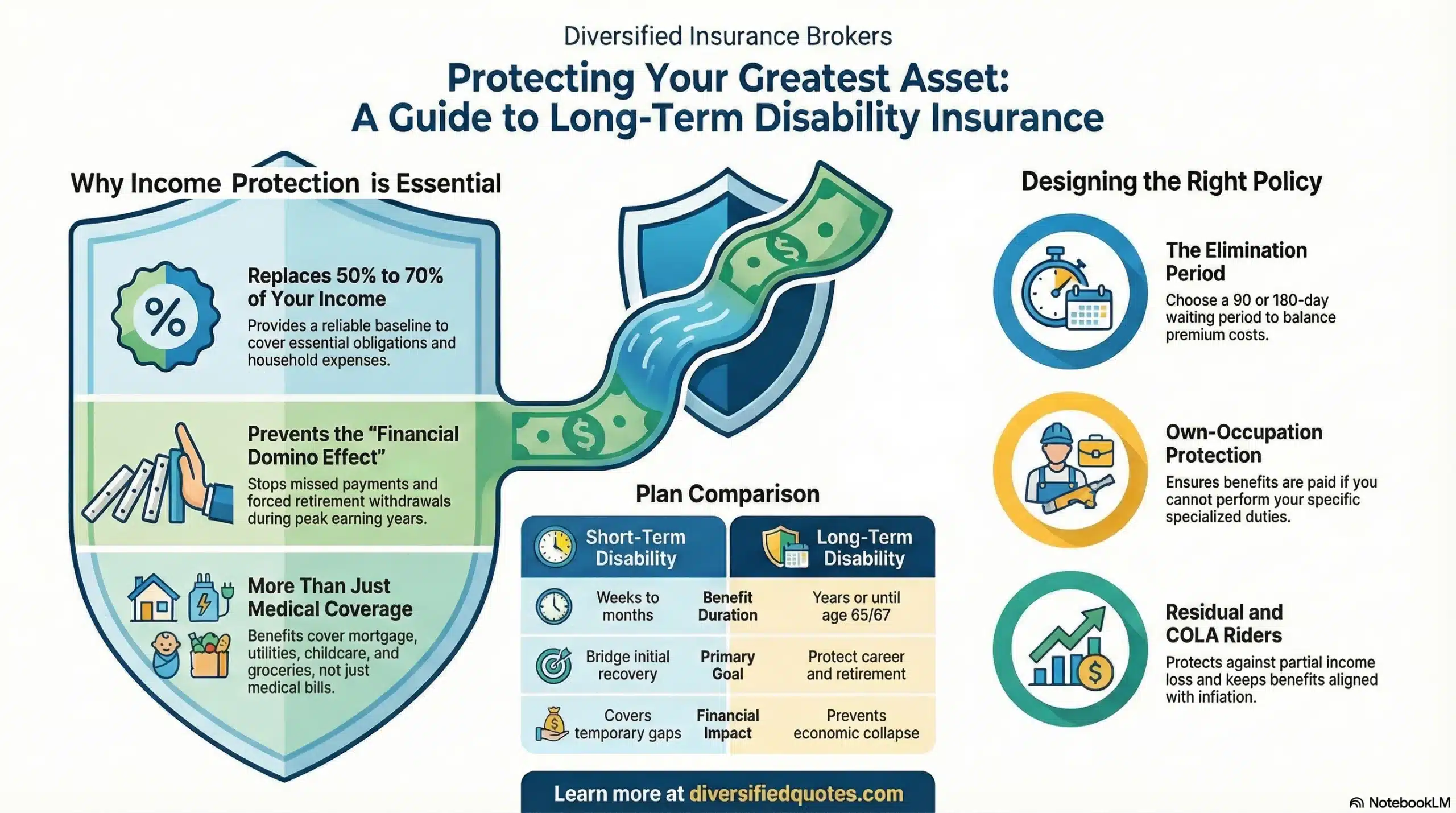
The elimination period — the waiting period before a disability policy pays benefits — is especially important for self-employed consultants to think through carefully. A consultant whose business generates income from ongoing monthly activity has no sick pay buffer during the elimination period. If savings can cover two to three months of household expenses, a 90-day elimination period reduces premiums meaningfully. If savings are limited, a 30- or 60-day elimination period ensures benefits arrive before financial pressure creates problems. Our resource on how elimination periods work covers this decision framework for self-employed individuals who must fund the elimination window entirely from savings rather than from employer sick leave.
The Occupational Classification for Direct Sales Representatives
Disability insurance carriers assign occupational class ratings that affect premium rates and coverage terms. Mary Kay Independent Beauty Consultants and Sales Directors are typically classified as direct sales representatives or independent sales agents — moderate occupational classifications that reflect the primarily sedentary, communication-based, and interpersonal nature of direct sales work. This is a more favorable classification than physical trades, reflecting that the disability risks in direct sales are primarily from general health events — illness, surgery, injury outside the work context — rather than from specific occupational hazards. The physical components of Mary Kay work — product carrying, event setup, transportation between customer visits — are modest compared to physically demanding trades, supporting a moderate classification that provides access to coverage without the higher premiums that higher-risk physical occupations carry.
For consultants who work primarily digitally — managing their Mary Kay business through online sales platforms, social media, video consultations, and e-commerce — the physical demand profile is even more sedentary, which may support a favorable classification. Accurately describing the specific duties of the consultant’s business to underwriters — the balance of in-person versus digital sales activity, any physical product delivery or event management, and the overall nature of daily business operations — affects classification outcomes. Our resource on is disability insurance expensive provides context on what premium levels look like for moderate occupational classifications at the income levels that direct sales businesses generate.
Case Study — Sales Director, Extended Recovery From Surgery
Consider a Mary Kay Sales Director whose unit generates consistent production and whose documented net commission and sales income totals $48,000 annually — $4,000 per month before taxes — representing her primary contribution to household income. After undergoing a significant surgery requiring a three-month recovery during which she cannot conduct in-person sales activity, manage unit operations, or perform the recruiting work that maintains her director status, her income from the Mary Kay business drops to essentially zero for the recovery period. The table below illustrates the financial picture.
| Scenario | No Individual Disability Coverage | Individual Disability Policy in Place |
|---|---|---|
| Monthly Income During Recovery | $0 from Mary Kay business; no sick pay, no group plan, no employer benefit of any kind | Approximately $2,400–$2,800 per month in disability benefits after elimination period, replacing 60–70% of documented net monthly income |
| Three-Month Income Gap | $12,000 in lost income that must come entirely from savings or credit while mortgage, utilities, groceries, and household bills continue | Individual policy begins paying after elimination period; household obligations remain covered through recovery |
| Business Continuity Pressure | Financial pressure drives premature return to sales activity before medical clearance to avoid further income loss | Income replacement supports full recovery on medical timeline; return to business activity when genuinely cleared |
| Long-Term Disability Scenario | Extended disability depletes household savings; director status may be lost during absence, further reducing future earning potential | Benefits continue for policy’s benefit period; financial stability maintained while medical situation resolves |
For a Sales Director whose commission income is a genuine household financial contribution, the absence of any institutional disability protection creates real financial vulnerability that savings alone may not adequately address across an extended disability. Individual disability insurance — sized to documented net income and structured with an elimination period that matches available savings — fills that gap in the only way available to an independent contractor. Our resource on short-term vs. long-term disability insurance covers how different coverage durations address different disability scenarios — from the surgical recovery that requires a few months to the serious illness that might require a year or more of recovery time.
Important Considerations Before Applying
For Mary Kay consultants evaluating disability insurance, three practical considerations are essential before approaching any carrier or broker. First, tax documentation: disability insurance underwriters will review Schedule C net profit from two years of tax returns. Consultants whose net income after legitimate business expenses is minimal will find that the available benefit amount is correspondingly modest — coverage is a reflection of documented economic reality, not sales volume projections. Second, income stability: underwriters evaluate whether self-employment income is stable or growing rather than declining. A consultant who has been building their business for two or more years with consistent documented income presents a more favorable underwriting profile than one whose income is new or highly variable. Third, the self-employed income documentation process requires preparation — organizing tax returns, profit and loss records, and business documentation before the underwriting process begins produces smoother and more accurate results.
For Mary Kay consultants who also hold W-2 employment — either as a primary job with the Mary Kay business as a side income, or as supplemental income alongside the consultant business — the disability insurance planning includes both income streams. A W-2 employer may provide group disability coverage on the employed income while individual coverage addresses the self-employment income gap. Our resources on is disability insurance worth it and how much disability insurance costs provide the financial context for evaluating whether individual coverage makes economic sense given the specific income level, household financial picture, and available savings of any individual consultant.
Why Self-Employed Individuals Need an Independent Broker
Self-employed disability insurance underwriting is more involved than standard W-2 employee applications — income documentation is more complex, occupational classification of direct sales work requires accurate presentation, and the absence of group coverage means that the individual policy must work as the primary income protection tool rather than a supplement. Not every disability insurance carrier evaluates direct sales and independent contractor occupations with equal sophistication, and identifying the carrier whose policy terms, elimination period options, and benefit structures best match the specific income level and needs of a Mary Kay consultant requires access to multiple carrier options rather than a single-carrier approach.
At Diversified Insurance Brokers, we work with self-employed individuals across direct sales, independent contracting, and entrepreneurial occupations to structure disability coverage that reflects documented income and genuine financial needs. We understand how to present self-employment income documentation accurately, how to select elimination periods and benefit durations that fit the self-employed financial picture, and how to identify carriers whose underwriting approach produces the most comprehensive available coverage for independent direct sales professionals. Our resource on why independent disability insurance brokers matter explains the full value of independent carrier access for self-employed individuals whose coverage needs require more expertise to address properly than standard employed professional applications.
Related Disability Insurance Pages
Financial Protection Essentials
Talk With an Advisor Today
Choose how you’d like to connect—call or message us, then book a time that works for you.
Schedule here:
calendly.com/jason-dibcompanies/diversified-quotes
Licensed in all 50 states • Fiduciary, family-owned since 1980
Disability Insurance for Mary Kay Consultants — FAQs
Yes — individual disability insurance is available to self-employed independent contractors including Mary Kay Independent Beauty Consultants. Because Mary Kay consultants sign an independent contractor agreement rather than an employment contract, there is no employer group disability plan available to them. Individual disability insurance is the only form of income replacement coverage available. To qualify, a consultant must have documented net income from their Mary Kay business — typically verified through Schedule C net profit on two years of federal tax returns. The available monthly benefit is sized to that documented net income, targeting 60 to 70 percent of monthly earnings. A consultant whose tax returns show minimal or no net profit after business expenses will find that little or no disability benefit can be underwritten, since there is no documented income to replace. For consultants whose businesses generate meaningful, consistent documented net income, individual disability insurance provides real income protection during a qualifying illness or injury.
Disability insurance underwriters evaluate self-employed income through federal tax returns — specifically Schedule C, which reports net profit from a sole proprietorship or independent contractor business. For a Mary Kay consultant, net profit is the gross income from sales and commissions minus all legitimate business deductions: product costs, marketing and advertising expenses, business tools and subscriptions, training costs, samples, and other business-related expenses. The resulting net profit figure — not gross sales, not the retail price of products sold, not the theoretical 50% profit margin on full retail — is what underwriters use to establish the maximum insurable monthly benefit. If a consultant’s Schedule C shows $40,000 in net profit annually, that is approximately $3,333 per month, and a disability policy could replace approximately $2,000 to $2,333 of that income. Two years of consistent, stable net income generally produces a more favorable underwriting outcome than one year of variable or newly established income. Accurate, complete tax filing is therefore both a legal obligation and the financial foundation that makes disability coverage meaningful.
It depends on whether the Mary Kay income is financially significant to the household and whether documented net income supports a meaningful monthly benefit. For consultants who participate in Mary Kay as a modest supplement to primary household income from another source — especially a spouse’s W-2 income with group benefits — the case for a dedicated individual disability policy on the Mary Kay income alone is less clear, particularly if the documented net income is small. In those households, the practical financial impact of losing the Mary Kay income during a disability may be manageable without a specific policy. For consultants whose Mary Kay income represents a meaningful household financial contribution — even if not the only income — and whose Schedule C documents consistent net profit, individual disability coverage protects that contribution in a way that nothing else can. The clearest financial case is for consultants whose Mary Kay income is primary rather than supplemental, and especially for Sales Directors and above whose commission income from unit production represents a significant and ongoing financial contribution to household expenses.
A Sales Director’s income depends on ongoing active management of their unit — motivating and supporting unit members, maintaining personal sales activity, meeting unit production requirements, and conducting the recruiting and leadership work that keeps a unit producing consistently. If a qualifying disability prevents these activities, the financial consequences are layered. Commission income from unit production may decline if the director cannot actively support and motivate unit members during the absence. Personal retail sales stop entirely if the director cannot conduct in-person or active digital sales activity. Meeting production and activity requirements necessary to maintain director status may become impossible during extended absence, with potential consequences for qualification and commission rates at various levels. Unlike a W-2 employee whose salary continues and whose employment relationship is preserved during medical leave, a Mary Kay Sales Director has no institutional mechanism protecting their income or their business status during a disability period. Individual disability insurance provides the income replacement — and the financial runway — that allows a disabled Sales Director to recover fully before returning to active business management rather than being financially forced back prematurely.
Without employer sick pay or group coverage of any kind, the elimination period decision for a self-employed Mary Kay consultant is a straightforward function of available savings: how long can the household sustain full expenses without income from the Mary Kay business before disability insurance benefits need to begin? If the consultant has three or more months of living expenses in savings, a 90-day elimination period reduces the annual premium meaningfully while leaving savings to bridge the gap. If savings are limited — covering one month or less of expenses — a 30-day elimination period ensures benefits begin arriving before household obligations create serious financial pressure. The elimination period is sometimes called the “waiting period” or “deductible period” — it is the window the policyholder self-insures through savings before the insurance company begins paying benefits. For self-employed consultants with no institutional income bridge during disability, selecting the right elimination period to match available savings is one of the most practically important decisions in structuring an individual disability policy.
Yes — individual disability insurance covers qualifying disability from any cause regardless of whether it is work-related, and this is one of the most important features of individual disability coverage for self-employed people. Unlike workers’ compensation, which covers only work-related injuries, individual disability insurance pays benefits when a qualifying medical condition — whether an illness, injury, or surgery — prevents the insured from performing their occupation’s material duties, regardless of how or where the condition originated. A Mary Kay consultant who develops cancer, suffers a serious cardiovascular event, undergoes a major surgery with extended recovery, experiences a disabling musculoskeletal condition, or faces any other medical event preventing business activity qualifies for disability benefits under an individual policy if the condition meets the policy’s disability definition and the elimination period is satisfied. The breadth of cause coverage is what makes individual disability insurance the comprehensive income protection tool that no more limited benefit — whether workers’ compensation or employer sick pay — provides.
Benefit period selection for a Mary Kay consultant depends on what financial risk the consultant most needs to protect against. For short-to-medium disability scenarios — surgery recovery, illness requiring weeks or a few months — a two-year or five-year benefit period provides coverage at a lower premium than a to-age-65 policy and addresses the most common disability duration scenarios. For consultants who depend on their Mary Kay income as a primary household income source and who would face serious long-term financial consequences from an extended disability, a longer benefit period — to age 65 or 67 — provides comprehensive protection against the possibility of a serious condition requiring years of recovery or producing permanent impairment. The premium difference between shorter and longer benefit periods is meaningful, and the right choice depends on the household’s financial resilience to an extended disability and whether savings, a spouse’s income, or other resources could sustain the household through a long-term disability beyond a shorter benefit period. These are individual financial planning decisions best evaluated with the specific household income picture, savings, and obligations in view.
Yes — disability insurance underwriters are accustomed to variable, seasonal, or performance-based self-employment income and do not require perfectly consistent monthly earnings to underwrite coverage. What matters is documented net income over time, typically evaluated using two years of Schedule C tax returns. Underwriters average the net profit across those years to establish the insurable income base. A consultant whose income varies between months but whose annual Schedule C net profit is consistent and meaningful can generally be underwritten on that average. However, significant year-to-year volatility — particularly income that is declining rather than stable or growing — may affect both the available benefit amount and the underwriting assessment of the business. Consultants with relatively new businesses generating their first year or two of documented profit may face more limited options than those with several years of established income history. Working with an independent broker who understands how self-employment income documentation is evaluated across different carriers produces better outcomes than applying without guidance through the variability of self-employed income underwriting.
About the Author:
Jason Stolz, CLTC, CRPC, DIA, CAA and Chief Underwriter at Diversified Insurance Brokers (NPN 20471358), is a senior insurance and retirement professional with more than 25 years of real-world experience helping individuals, families, and business owners protect their income, assets, and long-term financial stability. As a long-time partner of the nationally licensed independent agency Diversified Insurance Brokers, Jason provides trusted guidance across multiple specialties—including fixed and indexed annuities, long-term care planning, personal and business disability insurance, life insurance solutions, Group Health, Travel Medical and Evacuation Insurance, and short-term health coverage. Diversified Insurance Brokers maintains active contracts with over 100 highly rated insurance carriers, ensuring clients have access to a broad and competitive marketplace.
His practical, education-first approach has earned recognition in publications such as VoyageATL, and contributions from his agency featured in Kiplinger and GoBankingRates— highlighting his commitment to financial clarity and client-focused planning. Drawing on deep product knowledge and years of hands-on field experience, Jason helps clients evaluate carriers, compare strategies, and build retirement and protection plans that are both secure and cost-efficient. Visitors who want to explore current annuity rates and compare options across multiple insurers can also use this annuity quote and comparison tool.
Explore More Disability Insurance Options: Browse our complete guide to Disability Insurance for Food, Hospitality, Arts & Entertainment — covering chefs, musicians, actors, bartenders, hospitality workers & entertainment professionals from 100+ carriers.
Last Reviewed: June 8, 2026 |
Reviewed by: Jason Stolz, CLTC, CRPC, DIA, CAA
Chief Underwriter, Diversified Insurance Brokers, Inc. | NPN: 20471358 | Diversified Insurance Brokers, Inc. — Licensed in all 50 states
Fact Checked by: Tonia Pettitt, CMIP©
Medicare Specialist, Diversified Insurance Brokers, Inc. | NPN: 14374308 | Diversified Insurance Brokers, Inc. — Licensed in all 50 states
Did you find this content helpful? Leave us a Google review — it helps others find trustworthy guidance too.
Editorial Standards: Diversified Insurance Brokers maintains rigorous editorial standards to ensure accuracy, clarity, and independence in all content. Learn more about our editorial standards and commitment to transparency.
