
50-Year Term Life Insurance
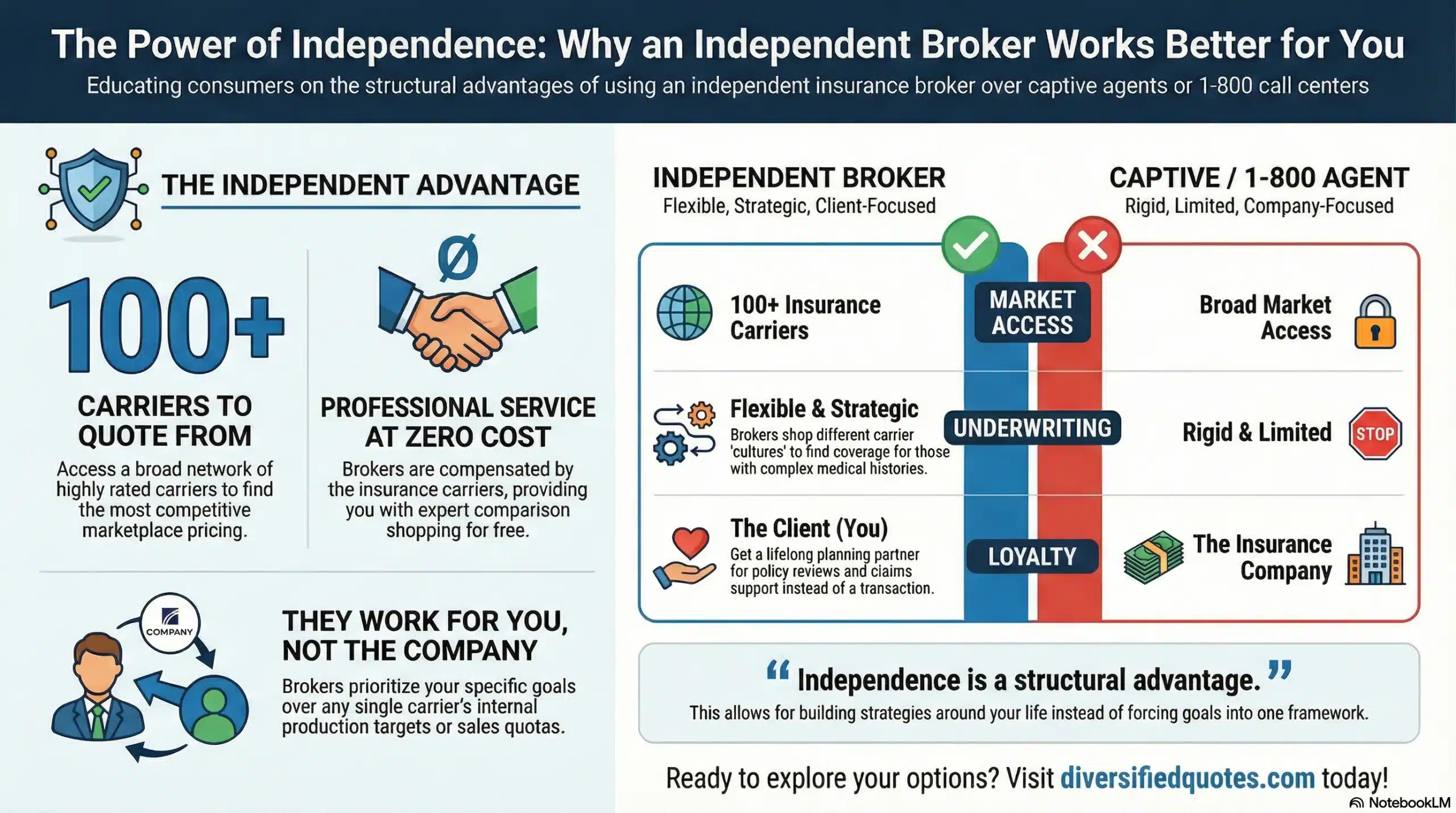
As an Independent Life Insurance Broker, we compare rates across 100+ carriers and prescreen every application before submission.
50-Year Term Life Insurance

Jason Stolz CLTC, CRPC, DIA, CAA
A search for 50-year term life insurance reflects a specific and completely reasonable planning goal: lock in life insurance coverage that can last through the decades when a household is most financially vulnerable, without stepping into the cost and structural complexity of a permanent life insurance policy, and without facing the anxiety of coverage expiring during a period when health may have changed and new underwriting is unpredictable. The planning logic is sound. The product, however, does not exist. No insurance carrier currently offers a genuine 50-year level-term life insurance policy in which the premium is contractually guaranteed level for a full half-century. The market’s longest level-term options top out at a 40 Year Term, with carrier availability and maximum issue ages determining where the ceiling sits for any specific applicant.
Understanding why 50-year term life insurance does not exist — and what does exist as a functional substitute — is the most productive response to this search. The gap between what the search implies and what the market provides is not a regulatory oversight or a missed commercial opportunity. It reflects the actuarial reality that guaranteeing a fixed premium for 50 years requires pricing assumptions about mortality, interest rates, claims experience, and longevity trends across a timeline so long that the uncertainty compounds beyond what term insurance’s pricing model is designed to absorb. At that duration, the product becomes indistinguishable in structural design from permanent life insurance — and permanent insurance has its own pricing architecture specifically built for that problem. At Diversified Insurance Brokers, when clients ask about 50-year term life insurance, we clarify the market reality and then help them build the longest, most cost-efficient coverage structure that serves the same underlying goal using real products. Our resources on what term life insurance is and how life insurance works provide the foundational context within which 50-year term life insurance alternatives are evaluated.
See Real-Term Rates Side by Side
Life Insurance Quoter
Does 50-Year Term Life Insurance Exist?
No. 50-year term life insurance — as a specific product offering a level guaranteed premium for a full 50-year term — does not exist in the United States insurance market as of the current date. The longest level-term policies available from major carriers typically reach 30, 35, or 40 years depending on the carrier, the state, and the applicant’s age at issue. Even 40-year term life insurance is available only from a limited number of carriers and only for applicants within specific age windows — typically under age 45 at issue, since a 40-year term issued at age 45 would extend coverage through age 85, pushing into mortality ranges that most term pricing models are not designed to absorb.
The practical question is not whether 50-year term life insurance exists but whether the goal behind searching for it — long-duration coverage with level premiums and simplicity — can be achieved through the products that do exist. The answer is yes, but it requires understanding which real products and strategies most effectively replicate the intent of 50-year term life insurance and choosing the right approach for the specific planning situation. Our resource on 40-year term life insurance covers the longest level-term option available in the current market, and our resource on 35-year term life insurance covers the next longest widely available option that fits more applicants across a broader age range.
What People Are Really Asking When They Search for 50-Year Term Life Insurance
The search phrase “50-year term life insurance” appears frequently enough that it warrants a careful analysis of what people actually mean by it — because the underlying intent is almost never literally a 50-year level-term product. It is a planning signal about the kind of coverage the person is trying to create, and interpreting that signal correctly is more useful than simply confirming the product does not exist.
The most common intent behind a 50-year term life insurance search is a desire for coverage that will not expire during the person’s working lifetime. Someone who is 25 years old and has just purchased a home, started a family, and is building a career is thinking about a coverage window that extends through their 70s — the period when they expect to have paid off debts, fully funded retirement savings, and reached a point where the household is financially self-sufficient. A 35-year term gets them to age 60. A 40-year term gets them to age 65. Neither extends to the full arc of working-life financial vulnerability they are imagining. The 50-year number is their intuitive answer to the question “how long until I no longer need income replacement coverage?” rather than a specific product specification.
A second common intent is the desire to avoid future underwriting uncertainty. People who search for 50-year term life insurance are often thinking about the scenario where a shorter term expires and they are forced to re-apply for new coverage at an older age with a potentially different health profile. They want to buy now — when they are young and healthy — and never have to underwrite again. This “lock it in permanently” intent is entirely rational but points toward permanent life insurance or toward maximizing term length within what the market provides, not toward a product that simply does not exist.
A third common intent is cost simplicity. People want one policy, one premium, one decision — not a portfolio of overlapping coverage that requires ongoing management. This intent aligns well with the longest available level-term products, which offer exactly the “set it and forget it” simplicity being sought, if not for the full 50-year duration imagined.
The Real Products That Come Closest to 50-Year Term Life Insurance
Three real product structures most effectively address the intent behind a 50-year term life insurance search, each with distinct tradeoffs in cost, flexibility, duration certainty, and underwriting complexity.
| Coverage Structure | Maximum Duration | Cost Profile | Underwriting Events | Best For |
|---|---|---|---|---|
| Longest available level term (35 or 40 years) | 35–40 years depending on age and carrier | Lowest of the three options; simple level premium | One underwriting event at issue only | Young applicants who want simplicity and maximum affordable coverage duration |
| Laddered term coverage structure | Customizable — up to 40+ years with multiple policies | Potentially most cost-efficient over the full timeline | Multiple underwriting events at issue; none required later if policies not renewed | Households whose coverage need declines over time as debts are paid and savings grow |
| Permanent life insurance (whole life, universal life, or GUL) | Lifetime — no expiration if properly funded | Highest premium — reflects lifetime coverage commitment | One underwriting event at issue only | Those who truly need lifetime coverage, legacy planning, or want to eliminate the risk of outliving term |
| Long-term term with conversion privileges | Term length plus optional permanent conversion during window | Term pricing now; permanent pricing later if converted | One underwriting event — conversion requires no new medical underwriting | Applicants who want term simplicity now but want the option to extend coverage if health or planning needs change |
The table illustrates why the 50-year term life insurance search is not a dead end — it is a planning conversation that starts with “what duration is realistic and what structure solves the problem most efficiently?” Our resource on the best term life insurance policy covers how to evaluate long-term options across the carrier market, and our resource on life insurance laddering covers the multi-policy structure in detail.
The Longest Level-Term Life Insurance Actually Available in the Market
For applicants who want the closest available approximation to 50-year term life insurance, the practical ceiling in the current market is 40-year level term, available from a select group of carriers and only for applicants within specific age windows. Understanding the availability and age restrictions for maximum-duration term coverage is essential context for building a realistic coverage plan.
40-year term life insurance is available from certain carriers for applicants typically between ages 18 and 45, depending on the carrier. A 40-year term issued at age 30 provides coverage through age 70. Issued at age 25, it extends to age 65. These extensions come close to the working-lifetime coverage that 50-year term life insurance searches are typically seeking, particularly for younger applicants. The premium for 40-year term reflects the extended risk window — it is higher than 20 or 30-year term for the same coverage amount — but for applicants in excellent health at younger ages, the absolute premium can still be affordable relative to the coverage duration provided.
35-year term life insurance is more widely available than 40-year term and fits a broader range of applicants, including those in the 40 to 50 age bracket who are too old for 40-year term but still want the longest possible coverage duration. A 35-year term issued at age 40 extends through age 75 — well into the period where most financial obligations are resolved and retirement savings are established. Our resources on 35-year term life insurance and 30-year term life insurance cover the specific carrier availability and age eligibility for these maximum-duration options.
30-year term life insurance is the most widely available long-duration term option and fits the broadest range of applicants across age groups. For a 30-year-old applicant, a 30-year term provides coverage through age 60 — a meaningful working-life protection window. For a 35-year-old, it extends to 65. While 30 years is shorter than the 50-year ideal being searched, it is also often the most accessible option with the widest carrier competition and therefore the most favorable pricing for strong health profiles. Our resource on 25-year term life insurance covers the next tier for applicants who want meaningful duration at lower premium levels.
Who Would Benefit Most From 50-Year Term Life Insurance If It Existed
Understanding the buyer profile that would most benefit from 50-year term life insurance helps identify whose need is best served by the longest available term options and whose need points toward permanent coverage instead. The profile for a genuine 50-year term purchaser is specific enough that it reveals why the product gap matters most for a particular subset of insurance buyers.
Young applicants in their 20s purchasing at maximum health with long financial obligation timelines are the clearest candidates for 50-year term life insurance if it existed. A 23-year-old who has just signed a 30-year mortgage, has young children, and expects to work through age 65 or beyond has a genuine 40+ year financial vulnerability window. A 30-year term leaves a 13-year gap between coverage expiration and the household’s financial self-sufficiency. A 40-year term closes that gap but is available only from a subset of carriers. A 50-year term, if it existed, would cover the entire window with one policy and one premium decision — the cleanest possible structure for this buyer.
Applicants with family longevity patterns who expect to live well into their 80s or 90s are a second profile that 50-year term life insurance would serve. For someone who expects a 90-year lifespan and purchases at age 30, even a 40-year term expires at age 70 — leaving 20 potential years of life without coverage. The concern is not necessarily income replacement at age 70 but potentially estate planning, mortgage protection on a late-in-life property, or final expense coverage that becomes important in later decades. For this buyer profile, permanent life insurance is actually the more appropriate product, since the coverage need extends beyond any practical term window.
Young business owners with long-term buy-sell agreements or partnership obligations represent a third profile. Business continuity planning sometimes requires coverage to remain in place for decades to fund a buy-sell agreement or protect a key person’s long-term contribution value. When the business timeline extends 40 or 50 years, long-duration term or permanent coverage are both relevant, and the right answer depends on whether the business obligation is expected to be temporary (favoring term) or permanent (favoring permanent coverage). Our resource on how much life insurance you need covers the needs analysis framework that anchors these duration decisions.
The Laddering Strategy: Building a 50-Year Coverage Window With Real Products
Laddering is one of the most effective techniques for approximating the duration and coverage structure of 50-year term life insurance using products that actually exist. Rather than relying on a single policy to cover the entire protection window, a laddering strategy combines multiple term policies — or a term policy alongside a permanent policy — to create a total coverage profile that matches the real pattern of household financial needs over time.
The core insight behind laddering is that most households do not need the same amount of life insurance coverage for 50 consecutive years. Coverage needs are highest in the early decades — when mortgages have large balances outstanding, when children are young and dependent, when retirement savings are minimal and a breadwinner’s death would leave the household financially devastated. Coverage needs typically decline over the following decades — as the mortgage balance is paid down, as children become financially independent, as retirement savings accumulate, and as the two-income household’s dependency on any single income stream decreases. A laddering strategy matches coverage to this natural declining need profile rather than maintaining maximum coverage through decades when that level is no longer necessary.
A practical laddering approach might combine a 40-year term policy for the base coverage amount — protecting the household through the maximum vulnerability period — with a 20 or 25-year policy for an additional coverage amount needed only during the highest-need early years (the mortgage payoff period and the years of raising dependent children). When the shorter policy expires, the household’s remaining financial obligations are smaller and the base 40-year term still provides meaningful protection through the later years. Total premium cost over the combined policy period is typically lower than maintaining the maximum coverage amount through a single longest-available term, because the higher-face-amount coverage pays for itself only through the years it is genuinely needed. Our resource on life insurance laddering covers the mechanics and design principles of this approach in comprehensive detail.
Permanent Life Insurance: When the Duration Need Genuinely Requires It
For buyers whose underlying planning need genuinely requires coverage that lasts beyond any practical term window — true lifetime protection regardless of longevity, estate planning goals, final expense certainty, or permanent business protection — permanent life insurance is the correct product category, not a workaround for the absence of 50-year term life insurance.
Permanent life insurance comes in several forms, each with different cost structures, flexibility levels, and accumulation characteristics. Whole life insurance provides fixed guaranteed premiums, guaranteed cash value growth, and guaranteed death benefit, funded by premiums that are higher than term premiums but that never increase and are paid over a defined period. Universal life insurance provides flexible premium payment options and adjustable death benefit amounts, with cash value that grows based on current interest rates credited by the carrier. Indexed universal life insurance credits interest based on external index performance with a floor against negative crediting. Guaranteed universal life insurance provides lifetime death benefit protection with minimal cash value accumulation at term-like premium levels — often the closest approximation to “term insurance that never expires” available in the permanent insurance category.
Our resources on permanent life insurance, what whole life insurance is, what indexed universal life insurance is, and what guaranteed universal life insurance is cover the distinct product structures within the permanent category. For applicants who want the simplest possible lifetime coverage with minimal complexity, guaranteed universal life insurance (GUL) is frequently the starting point — it provides a guaranteed death benefit to a specified age (often 90, 100, or 121) with fixed premium payments, functioning very similarly to long-term term coverage without the expiration date.
For applicants considering the cost comparison between long-duration term and permanent coverage, our resource on term versus whole life insurance covers the structural and economic comparison. Our resource on whether life insurance is a good investment covers how permanent life insurance’s accumulation features interact with the protection dimension to create planning value beyond the death benefit alone.
Term Conversion: The Optionality Built Into Long-Term Coverage
One of the most underutilized features of term life insurance — and one that is directly relevant to the 50-year term life insurance search — is the conversion privilege. Conversion allows a policyholder to exchange a term policy for a permanent policy from the same carrier, typically without submitting to new medical underwriting, during a specified conversion window. This means a person who purchases a 30-year or 40-year term policy today can convert part or all of it to permanent coverage during the conversion window if their planning needs or health situation later makes permanent coverage more appropriate.
The conversion feature directly addresses one of the core concerns that drives 50-year term life insurance searches: the fear that when a long-duration term expires, the policyholder will be older, potentially in worse health, and facing higher premiums or potential declines when attempting to purchase new coverage. Conversion eliminates this risk for the conversion window’s duration by preserving access to permanent coverage at the original health classification, regardless of what health changes have occurred since the original policy was issued.
Conversion privileges vary significantly by carrier — in the conversion window duration, the products available for conversion, and whether the conversion is guaranteed regardless of health. These differences are consequential: a term policy with a full-term conversion window (allowing conversion at any point during the level-premium period) provides substantially more optionality than one with a conversion window that expires at age 65 or after 20 years. Our resource on converting term to permanent life insurance covers the mechanics, window variations, and planning considerations for using conversion privileges effectively.
Why Waiting for a Nonexistent Product Is the Riskiest Strategy
The most counterproductive response to learning that 50-year term life insurance does not exist is to delay purchasing coverage while hoping the market evolves, or to continue searching for a product that currently has no carrier offering it. Delay is one of the most consequential financial planning mistakes in life insurance specifically because life insurance pricing is so strongly anchored to age and health at the time of application — two variables that move in only one direction.
Every year of delay increases the annual premium for the same coverage at the same health classification. More importantly, every year of delay is a year in which health events — a new diagnosis, a medication change, an elevated test result — can shift the applicant from a preferred or preferred-plus rate class to a standard or substandard class, or can create new exclusions or outright declines. The younger and healthier an applicant is when they lock in coverage, the better the rate class, the lower the premium, and the more favorable the total cost over the coverage period.
Our resource on the hidden costs of waiting to buy life insurance covers the specific financial math of delay — how premium differences compound over a 20 or 30-year coverage period and what the total cost differential looks like between purchasing at age 25 versus 35, for example. The fundamental insight is that the “perfect” coverage structure — whether 50-year term or the best available alternative — has diminishing value if it is purchased later at a higher price under less favorable underwriting conditions.
Underwriting Considerations for Long-Duration Coverage Decisions
Whether the solution for 50-year term life insurance intent is the longest available term, a laddered structure, or permanent coverage, underwriting determines both the feasibility and the cost. Long-duration coverage at favorable premiums requires a favorable health classification, and achieving that classification requires understanding what carriers evaluate and how to present the strongest possible application profile.
Standard life insurance underwriting evaluates: age (a primary pricing factor); tobacco and nicotine use (a significant rating factor — users typically pay substantially higher premiums than non-users); height and weight (body mass index affects rate class); blood pressure and cholesterol levels (typically evaluated through physical examination or medical records); prescription history (both current and recent past medications reveal underlying health conditions); family medical history (certain hereditary conditions affect pricing even when the applicant is currently healthy); driving record (DUI history and serious moving violations affect rate class); and major medical history (prior diagnoses, hospitalizations, and surgeries affect both eligibility and rate class).
For applicants who have had life insurance exams before, our resource on what a life insurance exam involves covers what to expect from the paramedical examination process. Some carriers offer accelerated underwriting for qualified applicants — approval based on data-driven risk assessment without a physical exam — while other applicants benefit more from traditional full underwriting because the exam results and lab work can confirm a favorable health picture that data-only underwriting might not capture. Our resource on life insurance with pre-existing conditions covers how specific health histories affect underwriting across different carriers and why carrier selection matters as much as the product category for applicants with any medical complexity.
Planning a Long-Duration Coverage Timeline by Life Stage
One of the most useful frameworks for translating the 50-year term life insurance goal into a concrete coverage plan is mapping coverage needs by life stage and then selecting the product structure that most efficiently covers each stage. This exercise reveals which years require the highest coverage and which years the need naturally decreases, which is the analytical foundation for both the single-longest-term approach and the laddering approach.
For a 25-year-old buyer, the early life stage (ages 25 to 40) typically features the highest coverage need: maximum dependent vulnerability, maximum mortgage balance, minimum retirement savings, and maximum income replacement value. The middle life stage (ages 40 to 55) features declining but still significant coverage need: children approaching independence, mortgage balance meaningfully reduced, retirement savings building but not yet sufficient to self-fund the household. The late stage (ages 55 to 65 and beyond) features the lowest coverage need: most debts resolved, children independent, retirement savings approaching or at target, and income replacement needs declining as planned retirement approaches.
For applicants considering life insurance for seniors who are later in this lifecycle and want to explore what long-duration options remain available, our resources on coverage approaches for older applicants cover the carrier landscape that applies at later issue ages. For younger applicants who are just beginning this planning, our resource on life insurance for young adults covers the specific considerations that apply at the beginning of the working lifecycle when long-duration coverage decisions have the greatest impact.
How Long-Duration Coverage Coordinates With Retirement Planning
The 50-year term life insurance search often connects to a broader question about how life insurance protection coordinates with retirement planning — specifically, how long coverage is needed to protect the household’s retirement income trajectory if a primary earner were to die before the retirement savings goal is achieved.
From a retirement planning integration perspective, life insurance coverage can be reduced or eliminated as self-insurance through savings accumulation makes it less critical. The point at which a household’s retirement savings are sufficient to replace the income lost in a breadwinner’s death — because the surviving spouse can draw on those savings to maintain lifestyle and meet financial obligations — is the theoretical endpoint for income-replacement life insurance need. The practical challenge is identifying that point in advance, because it depends on market returns, savings rates, and retirement spending levels that are themselves uncertain. Long-duration term coverage provides a guaranteed income replacement backstop during the accumulation years, regardless of what the portfolio achieves, which is the protection purpose that most cleanly connects the 50-year term life insurance search to retirement planning reality.
The death benefit from life insurance is also relevant to the tax treatment discussion that comes up in long-term planning conversations. Our resource on whether the life insurance death benefit is taxable covers the income tax treatment of proceeds, and our resource on what deaths are not covered by life insurance covers the exclusions and limitations that affect when the death benefit is payable.
Get Real Long-Duration Coverage Options Today
We’ll compare the longest available term options, permanent alternatives, and laddering strategies matched to your age, health, and coverage timeline.
Start My Life Insurance QuoteRelated Life Insurance Planning Pages
Explore term alternatives, permanent coverage, laddering strategies, and underwriting resources for long-duration planning.
Financial Protection Essentials
Coordinate long-duration life insurance planning with chronic condition underwriting, state protections, and related coverage resources.
Compare Term Life Insurance Lengths
Explore different term periods to find coverage that best matches your timeline and budget.
Talk With an Advisor Today
Choose how you’d like to connect—call or message us, then book a time that works for you.
Schedule here:
calendly.com/jason-dibcompanies/diversified-quotes
Licensed in all 50 states • Fiduciary, family-owned since 1980
Frequently Asked Questions: 50-Year Term Life Insurance
Does 50-year term life insurance exist?
No. 50-year term life insurance — defined as a single policy with a premium guaranteed level for a full 50-year period — does not exist in the current insurance market. The longest level-term options available are 35-year and 40-year policies, which are themselves available only from select carriers for applicants within specific age windows. The actuarial reason is that guaranteeing a fixed premium for 50 years requires pricing assumptions about mortality, interest, and longevity across a timeline so extended that it overlaps with risks that require permanent insurance pricing architecture rather than term pricing models.
What is the longest term life insurance available?
The longest level-term life insurance generally available in the United States market is 40-year term, offered by a select group of carriers and typically available only for applicants under age 45 at issue. 35-year term is more widely available across a broader age range. Both options provide meaningful coverage duration for younger applicants who want the longest possible protection window before coverage expires. Our resources on 40-year term life insurance and 35-year term life insurance cover carrier availability, age eligibility, and pricing for these maximum-duration options.
What is the best alternative to 50-year term life insurance?
The best alternative depends on what the underlying planning goal actually requires. If the goal is maximum affordable coverage duration with level premiums, the longest available term policy (35 or 40 years) is the starting point. If the goal is coverage that declines as household needs decline, a laddering strategy combining multiple term policies is typically most cost-efficient. If the goal is coverage that genuinely never expires — protecting against the risk of outliving any term — permanent life insurance, particularly guaranteed universal life insurance, is the appropriate product. Many applicants benefit from a combination: long-duration term for the highest-need years with conversion privileges available if permanent coverage becomes warranted.
Is permanent life insurance better than a long-term policy for very long coverage needs?
For coverage needs that genuinely extend beyond what any term policy can provide — true lifetime protection, estate planning goals, final expense certainty, or permanent business protection obligations — permanent life insurance is the correct product. Term life insurance, regardless of how long the term is, has an expiration date. Permanent insurance is designed to remain in force for life as long as it is properly funded. The tradeoff is cost: permanent insurance premiums are meaningfully higher than term premiums for the same death benefit, reflecting the permanent obligation the carrier is taking on. Guaranteed universal life insurance provides a middle-ground option — lifetime death benefit protection with minimal cash value accumulation at lower premiums than whole life — for applicants seeking simple lifetime coverage without cash value complexity.
Can I use a conversion privilege instead of searching for 50-year term?
Yes. A long-duration term policy with strong conversion privileges is one of the most effective practical alternatives to 50-year term life insurance. Starting with a 30 or 40-year term provides affordable coverage during the highest-need years, while the conversion privilege preserves the option to convert to permanent coverage at the original health classification — without new medical underwriting — during the conversion window. This approach eliminates the fear of being uninsurable later: if health changes during the term period, conversion can extend coverage to life without a new health evaluation. Conversion window terms vary significantly by carrier, so evaluating the conversion features is an important part of any long-duration term selection. Our resource on converting term to permanent life insurance covers the process and planning considerations in detail.
Should I wait for 50-year term life insurance to become available?
No. Waiting for a product that does not currently exist — while hoping the market will eventually offer it — is the most costly possible response to this search. Life insurance premiums increase with age, and every year of delay means purchasing the eventual policy at a higher age-based premium. More significantly, any health change during the waiting period can shift the applicant into a less favorable rate class, result in exclusions, or cause a decline. The insurance market’s trajectory is toward innovation in other areas (accelerated underwriting, more accessible products for high-risk profiles) rather than toward 50-year level-term products. The smartest response to the absence of 50-year term is to purchase the best available long-duration coverage now, while age and health are at their most favorable.
What is life insurance laddering and how does it simulate 50-year term coverage?
Life insurance laddering combines two or more term policies with different face amounts and different term lengths to create a total coverage profile that matches the household’s actual declining coverage need over time. Rather than maintaining maximum coverage through decades when the need is lower — which 50-year term life insurance would require — laddering targets maximum coverage only during the highest-need years and reduces coverage naturally as debts are paid and savings accumulate. The combined cost of a laddered structure is typically lower than maintaining a single maximum-coverage policy for the full timeline, while the coverage is appropriately sized at each life stage. Our resource on life insurance laddering covers the strategy in comprehensive detail.
About the Author:
Jason Stolz, CLTC, CRPC, DIA, CAA and Chief Underwriter at Diversified Insurance Brokers (NPN 20471358), is a senior insurance and retirement professional with more than 25 years of real-world experience helping individuals, families, and business owners protect their income, assets, and long-term financial stability. As a long-time partner of the nationally licensed independent agency Diversified Insurance Brokers, Jason provides trusted guidance across multiple specialties—including fixed and indexed annuities, long-term care planning, personal and business disability insurance, life insurance solutions, Group Health, Travel Medical and Evacuation Insurance, and short-term health coverage. Diversified Insurance Brokers maintains active contracts with over 100 highly rated insurance carriers, ensuring clients have access to a broad and competitive marketplace.
His practical, education-first approach has earned recognition in publications such as VoyageATL, and contributions from his agency featured in Kiplinger and GoBankingRates— highlighting his commitment to financial clarity and client-focused planning. Drawing on deep product knowledge and years of hands-on field experience, Jason helps clients evaluate carriers, compare strategies, and build retirement and protection plans that are both secure and cost-efficient. Visitors who want to explore current annuity rates and compare options across multiple insurers can also use this annuity quote and comparison tool.
Explore More Life Insurance Options: Browse our complete guide to How Life Insurance Works — covering term life, whole life, final expense, annuity alternatives & more from 100+ carriers.
Last Reviewed: May 24, 2026 |
Reviewed by: Jason Stolz, CLTC, CRPC, DIA, CAA
Chief Underwriter, Diversified Insurance Brokers, Inc. | NPN: 20471358 | Diversified Insurance Brokers, Inc. — Licensed in all 50 states
Fact Checked by: Tonia Pettitt, CMIP©
Medicare Specialist, Diversified Insurance Brokers, Inc. | NPN: 14374308 | Diversified Insurance Brokers, Inc. — Licensed in all 50 states
Did you find this content helpful? Leave us a Google review — it helps others find trustworthy guidance too.
Editorial Standards: Diversified Insurance Brokers maintains rigorous editorial standards to ensure accuracy, clarity, and independence in all content. Learn more about our editorial standards and commitment to transparency.
