
How to Reduce My Company Healthcare Costs
How to Reduce My Company Healthcare Costs

Jason Stolz CLTC, CRPC, DIA, CAA
Rising healthcare costs are one of the most persistent challenges facing business owners today. Premium increases often outpace revenue growth, renewals feel unpredictable, and employers are left absorbing higher costs without clear explanations or effective levers to pull. If you are asking how to reduce your company healthcare costs, the answer usually is not about cutting benefits — it is about restructuring how your group health plan is designed, funded, and managed.
For many companies, the problem is not employee utilization or benefit generosity. The real issue is the default “set it and forget it” approach inside traditional fully insured group health plans. When premiums bundle claims risk, administrative costs, and carrier profit into a single number, employers lose visibility and control. Reducing healthcare costs typically requires shifting from a reactive renewal mindset to a proactive strategy built around transparency, risk management, and smarter plan design. At Diversified Insurance Brokers, we work with employers nationwide to identify sustainable ways to reduce group healthcare costs while maintaining competitive benefits. In many cases, meaningful savings come from changing the structure of the plan — not simply shopping carriers each year.
Reduce Your Company Healthcare Costs
Get a practical plan review focused on structural savings — funding model, plan design, networks, and pharmacy strategy.
Contact Us for a Group Health ReviewWhy Traditional Group Health Plans Keep Getting More Expensive
Most employers experience rising costs even when nothing major seems to change. The reason is that many fully insured group health plans are priced and renewed with built-in assumptions that are not transparent to the employer. Premiums often include projected medical trend, reserves for volatility, carrier overhead, and margin. In other words, the premium number is not a pure reflection of what your employees actually used — it is a packaged price designed to protect the carrier from uncertainty across a broad risk pool.
That structure creates a frustrating dynamic: even if your team has a relatively healthy year, the renewal can still be high because the pricing model is built to anticipate risk and volatility. Employers are left responding to renewals by increasing deductibles, raising employee contributions, or reducing plan richness. Those moves can lower premiums temporarily, but they rarely solve the underlying problem. Over time, reactive changes can actually worsen the situation. If the plan becomes less attractive, healthier employees are more likely to waive coverage when they have alternatives, leaving a higher-cost enrolling population behind. That increases claims pressure and can make the plan more expensive at the next renewal — a self-reinforcing cycle that only structural change can break. For a foundational overview of employer coverage structures, our resource on group health insurance for employers provides useful context for evaluating where your current plan sits within the available spectrum of options.
Stop the Annual Renewal Surprise Cycle
When employers feel trapped, it is usually because the renewal process has become purely reactive. The carrier sends a renewal increase, the employer tries to negotiate, and then the company either accepts the increase or shifts costs to employees. The problem is that most of the real levers — funding model, network, plan design, pharmacy structure, and vendor accountability — are never addressed during this cycle. A better approach is to treat healthcare spend like any other controllable business expense: measure what is happening, identify which levers drive the most impact, and make intentional structural decisions early enough to evaluate alternatives.
Employers that stabilize costs typically follow a repeatable cycle: early review, data collection, option modeling, employee communication, and clean implementation. This cycle is what turns healthcare from a renewal hostage into a managed system. Even if you ultimately keep a fully insured plan, adopting a structured review process reduces renewal volatility because you are no longer forced into last-minute decisions under deadline pressure with no alternatives modeled. For employers currently fully insured who want to understand what the alternative funding landscape looks like before committing to a structure change, our resource on why group level funding can make sense provides a practical framework for thinking through the transition.
Shift From Fully Insured to Self-Funded or Level-Funded Group Health
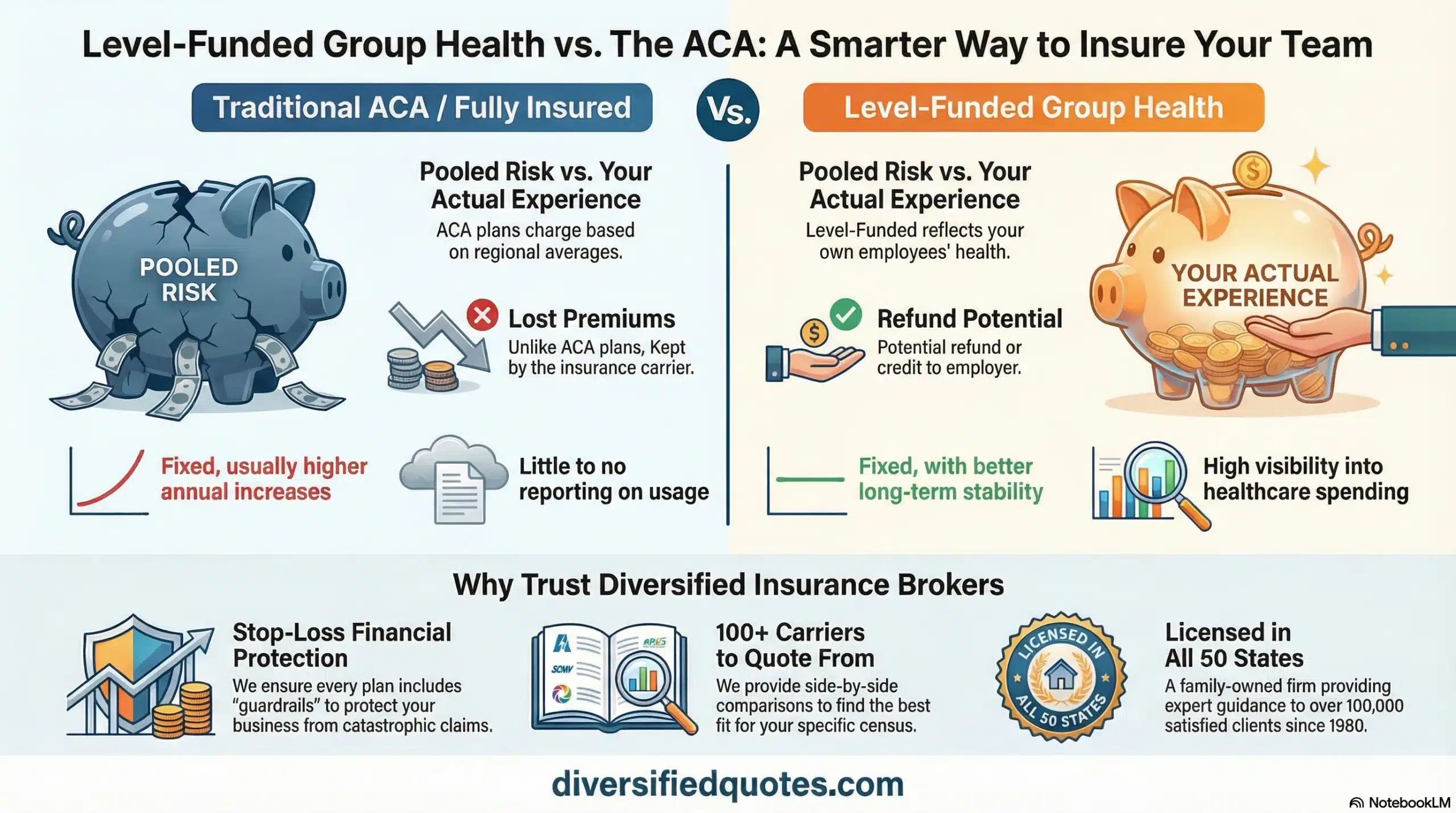
One of the most effective ways to reduce company healthcare costs is to move away from fully insured plans and explore self-funded, partially self-funded, or level-funded options. These approaches separate claims funding from administrative expenses, which makes healthcare dollars easier to track and manage. Instead of paying a bundled premium that includes claims, overhead, reserves, and carrier margin, you pay for administration and risk protection while funding claims with real visibility into what is being spent and why.
In a self-funded structure, the employer funds claims as they occur. The plan still uses a provider network and claims administration platform, but the employer has access to the utilization picture and can see what is driving spend. Stop-loss coverage caps catastrophic exposure so the plan does not represent unlimited financial risk. Level-funded structures are often the entry point for employers that want predictable monthly payments while still using a self-funded foundation. You pay a set monthly amount that includes estimated claims, administration, and stop-loss coverage. If claims are lower than expected, the plan may generate a credit or refund depending on the arrangement. If claims are higher, stop-loss protection caps the employer’s exposure. For a foundational explanation of how this model works, our resource on what is self-funded group health insurance covers the mechanics and what employers should evaluate before making the shift. For employers specifically evaluating the tax efficiency of level-funded arrangements, our resource on level-funded health insurance tax benefits explained covers how these structures interact with business tax deductions.
Leverage Stop-Loss Insurance to Cap Exposure
Stop-loss insurance is the core risk-control tool that makes self-funded and level-funded plans workable for most employers. It is designed to prevent a single catastrophic claim — or an unusually high overall claims year — from creating an unacceptable financial event for the business. Individual stop-loss limits how much the employer pays for any single member’s claims in a plan year. Once claims exceed the attachment point, the stop-loss policy reimburses eligible amounts according to the contract terms. Aggregate stop-loss limits the employer’s total claims exposure across the entire group for the plan year. If total claims exceed the aggregate attachment point, reimbursement can apply based on the contract structure.
The effectiveness of stop-loss depends on smart structuring — the attachment point level, contract type, coverage terms, reimbursement timing, and how the plan is administered all matter. Done correctly, stop-loss turns the “fear of volatility” into a defined and manageable risk range. Our resource on understanding stop-loss insurance in level-funded plans explains the key contract terms and how different stop-loss designs produce very different real-world outcomes when a high-cost claim year actually occurs.
Is Your Company the Right Size for Alternative Funding?
Employer size matters, but it is not the only determining factor. Large employers commonly self-fund because the law of large numbers stabilizes claims patterns across a large enrolled population. However, many small and mid-sized employers can still benefit from level-funded or partially self-funded arrangements when participation is strong and the workforce is reasonably stable. The practical question is not just headcount — it is whether you have stable enrollment, a predictable payroll process, and the desire to manage healthcare strategically rather than reactively.
Eligibility thresholds for group health participation vary by state and carrier, which is why many employers begin by reviewing minimum employees for group health insurance requirements before evaluating plan structure options. For very small businesses, the considerations are distinct from those of a 30- or 40-person employer — our dedicated resources on group health insurance for 10 employees, group health insurance for 20 employees, and group health insurance for 30 employees cover how available options and cost-reduction strategies evolve as the group grows. For 2-person businesses and micro-groups, our resource on best group health insurance options for 2-person businesses addresses the specific carrier landscape at the smallest end of the employer market. Even if your group is small, the right fit can exist when you use the correct plan structure and stop-loss design — and level-funded options often provide the most balanced entry point because they retain predictable monthly funding while still offering improved transparency.
Gain Access to Claims Data and Identify Cost Drivers
Transparency is one of the biggest reasons employers reduce costs with alternative funding. Fully insured plans often provide limited visibility into what is actually driving the renewal. Without meaningful data, the employer cannot make targeted improvements — the only available tools become blunt instruments like raising deductibles or increasing employee contributions. Self-funded and level-funded models typically provide reporting that helps identify key drivers such as high-cost claimants, utilization categories, outpatient versus inpatient patterns, imaging frequency, ER usage, and pharmacy spend. This does not mean policing employees — it means seeing where the plan is leaking dollars and implementing structural changes that reduce waste.
When employers can identify the categories driving spend, they can consider solutions like stronger care navigation, improved telehealth access, urgent care steering, prior authorization alignment, or vendor optimization. These steps are almost impossible to implement effectively when the employer is blind to the spend categories driving renewal pressure. Employers who want to understand what claims data actually reveals in practice — and what to do with it — should start by understanding the full alternative funding picture through our resource on self-funded group health insurance. For employers who want to know whether favorable claims experience can result in year-end savings, our resource on can small groups get health insurance refunds explains how surplus sharing works in level-funded plan designs.
Redesign Plan Benefits Strategically Without Wrecking Retention
Reducing healthcare costs does not have to mean reducing benefits. In many cases, the plan is simply designed poorly for how the employee population actually uses healthcare. Strategic plan design means aligning cost-sharing with real utilization patterns while keeping the plan easy to understand and easy to use. Employers can often reduce waste by improving incentives around primary care and urgent care usage while discouraging avoidable emergency room utilization. They can structure prescription benefits to encourage generics and preferred pharmacies without removing access to necessary medications. They can offer multiple plan options so employees can choose a value plan or a richer plan based on personal preference and budget.
The objective is not to take away coverage — it is to make the plan behave like a well-designed system: lower waste, stronger steering toward high-value care, and fewer surprises at renewal. For employers also evaluating whether 1099 contractors can participate in alternative funding arrangements alongside W-2 employees, our resource on can 1099s get group level funding addresses the eligibility and underwriting rules that govern that question. For employers evaluating whether to add supplemental benefits like dental and vision alongside medical plan redesign, our resource on Ameritas dental and vision insurance covers how these supplemental benefits pair with employer medical plans.
Address Pharmacy and Specialty Drug Costs
Prescription costs — especially specialty medications — are one of the fastest-growing components of healthcare spend. Many employers underestimate how much of the plan’s total cost is driven by pharmacy alone. Even when medical claims appear stable, pharmacy inflation can produce meaningful renewal pressure year over year. Self-funded and partially self-funded structures allow employers to evaluate pharmacy arrangements more directly, identify cost spikes, and implement smarter strategies. That can include tighter formulary management, improved specialty drug oversight, alternative sourcing solutions where appropriate, or benefit designs that reduce unnecessary brand-name utilization.
The key point is that pharmacy strategy is not an add-on consideration — for many plans, it is one of the most important and most actionable cost-reduction levers available. Employers who address pharmacy design alongside medical plan structure tend to see more sustainable results than those who focus only on the medical premium line without addressing what is driving it. For employers also evaluating whether their current plan structure maximizes tax efficiency around pharmacy and other benefit spending, our resource on level-funded health insurance tax benefits provides relevant context.
Network Strategy — One of the Biggest Hidden Cost Levers
Employers often focus on premium levels while overlooking network structure — and network structure is one of the most consequential hidden levers in group health cost management. Networks determine provider pricing, care access, and out-of-network exposure. A plan that looks cheaper on paper can become significantly more expensive in practice if it drives employees out-of-network or funnels care into higher-cost facilities because network adequacy is poor in the geographic areas where employees actually live and seek care.
When reviewing a plan, network strategy should be evaluated in the context of employee geography and typical utilization patterns. If you have remote employees or multi-state staffing, network access becomes even more critical — a network that works well in one region may leave employees in another with limited or no access to preferred providers. If most employees are concentrated in one region, a strong regional network can sometimes produce better pricing and care quality than a broad national network with inconsistent facility pricing. Network optimization is rarely about reducing provider access options. It is about aligning the plan with the provider ecosystem employees actually use and reducing the cost leakage from avoidable out-of-network claims that could have been avoided with better access design. Our resource on group health insurance for 40 employees covers how network considerations evolve as groups grow toward the 50-employee threshold and begin evaluating self-funded structures with more rigorous network evaluation.
Reduce Waste Without Cutting Benefits
Employers can frequently reduce company healthcare costs by reducing waste rather than reducing coverage. Waste shows up as avoidable ER utilization, poor chronic condition management, repeated imaging, lack of preventive care engagement, or non-optimized prescription purchasing. Most of these issues improve with better plan design and basic employee education — not with draconian benefit cuts that damage retention and recruiting. Practical examples include encouraging virtual care for minor issues, promoting urgent care for non-emergencies, clarifying how to find in-network providers, and ensuring employees understand preventive benefits that are often covered at low or no cost under most plan designs. Small improvements at the utilization level can produce meaningful claims improvements over time, especially when combined with structural changes in plan funding and design.
The employers who achieve the best long-term cost outcomes are the ones who implement simple, consistent guidance and build a plan that makes the right choice easy. When the path of least resistance for an employee leads to appropriate, cost-effective care, the plan benefits — and the employer’s renewal reflects that improvement over time. Our comprehensive resource on small employer group health insurance covers how employers at different headcounts typically approach the balance between cost reduction and benefit quality.
Compliance and Administrative Considerations
Cost reduction strategies involving self-funding do come with additional administrative considerations. Employers may take on more responsibility for plan documentation, coordination with third-party administrators, and ongoing compliance requirements under ERISA and the ACA. However, these responsibilities are manageable with the right partners and processes in place. The key is to treat administration as part of the system rather than as a burden layered on top of it. Clean eligibility rules, consistent payroll deductions, timely enrollment processing, and clear employee communication reduce administrative friction significantly.
When administration is handled correctly, employees experience the plan as straightforward and accessible — which improves participation and overall plan stability. Alternative funding should not be viewed as “more work for the sake of saving money.” It should be structured as a controlled process where the financial benefits flow from transparency and better risk alignment, and where administrative responsibilities are clearly allocated between the employer, the third-party administrator, and the stop-loss carrier from the beginning of the plan year.
Balance Employer Savings With Employee Experience
Cost reduction efforts work best when employees understand the plan and feel supported in using it. A plan change without meaningful communication often creates confusion, which then creates dissatisfaction — even when the plan is objectively strong or improved. The solution is clear and proactive communication: explain the rationale for any changes, walk through how to use the plan, and give employees a clear path for questions and support. Many employers find that offering two plan options — a value-focused option and a buy-up plan for employees who want richer benefits — simultaneously improves employee satisfaction and reduces employer cost. This approach reduces tension during renewals because employees have genuine choice rather than feeling that the plan was simply made worse.
When employees experience stable care access, easy navigation, and predictable cost-sharing, retention improves and the plan becomes easier to manage financially over time. For employers currently operating group health plans for specific workforce segments, our resources on group health insurance for physician practices and group health insurance for law firms cover how cost reduction strategies interact with the specific workforce and professional practice characteristics of those employer types.
How Diversified Insurance Brokers Helps Employers Control Healthcare Costs
We help employers move beyond surface-level solutions and focus on structural strategies that reduce healthcare costs over time. Our process starts with understanding how your plan is currently structured and where your renewal pressure is actually coming from. From there, we compare realistic alternatives, model tradeoffs honestly, and build an implementation plan that protects employee experience while achieving meaningful cost reduction. For some employers, the best solution is improving plan design within a fully insured model. For others, savings come from level-funded or self-funded structures paired with strong stop-loss design and smarter vendor strategy. The goal is not to push a single solution — it is to identify the most sustainable path forward based on your workforce, your budget, and your long-term objectives. Our resource on group medical insurance provides a broader overview of how employer coverage is structured across the full spectrum of available plan types.
Related Group Health Resources
Talk With an Advisor Today
Choose how you’d like to connect—call or message us, then book a time that works for you.
Schedule here:
calendly.com/jason-dibcompanies/diversified-quotes
Licensed in all 50 states • Fiduciary, family-owned since 1980
How to Reduce Company Healthcare Costs — FAQs
The fastest way is often to evaluate whether a self-funded or level-funded group health plan can replace a fully insured plan — particularly if claims experience has been favorable or average in recent years. In a fully insured plan, the employer is essentially paying a premium that includes the carrier’s risk charges, overhead, and profit margin regardless of actual claims performance. Moving to a self-funded or level-funded structure separates these components, which immediately creates cost visibility and, for employers with stable or favorable experience, can produce meaningful premium reduction. The transition can often be accomplished at a plan year renewal without significant disruption to employee benefit levels. For employers in situations where a full funding model shift is not immediately appropriate, strategic plan design changes — stronger urgent care steering, improved pharmacy formulary structure, and clearer employee communication about in-network navigation — can produce measurable cost reduction within the current plan year without requiring a complete structural overhaul.
Yes — many small and mid-sized employers use level-funded or partially self-funded plans to gain meaningful cost control while limiting financial risk through stop-loss insurance. Level-funded plans are specifically designed to make self-funded economics accessible to smaller employer groups by providing a fixed monthly payment structure — predictable like fully insured but with the claims transparency and potential cost savings of a self-funded foundation. If claims run favorably during the plan year, many level-funded designs return a surplus credit or refund to the employer. If claims run high, stop-loss coverage limits the employer’s total exposure to a defined maximum. The minimum group size that can practically access level-funded options varies by carrier and state, but many programs are available to employer groups as small as 10 to 15 enrolled employees. The key qualifying factors are enrollment stability, a legitimate W-2 employee base, and an employer willing to engage in proactive plan management rather than a purely passive renewal approach.
Self-funded plans do involve more employer responsibility than fully insured plans, but stop-loss insurance significantly limits financial exposure and makes the risk profile manageable for employers of many sizes. Without stop-loss, a self-funded employer would bear unlimited financial responsibility for all claims — which would genuinely be risky for most businesses. With properly structured stop-loss coverage, the employer’s maximum exposure is capped at a defined level through individual stop-loss (which limits exposure per covered member) and aggregate stop-loss (which limits total plan exposure across the entire enrolled group). In practical terms, many employers find that the “risk” of self-funding is actually lower than the risk of fully insured renewal volatility — because at least in a self-funded structure, the employer has claims visibility and cost management levers. With fully insured plans, the employer is often surprised by significant premium increases without any real understanding of what drove them or tools to address the underlying cause.
Yes — self-funded group health plans must comply with many ACA requirements and employee protections, including coverage of essential health benefits when required, prohibition on lifetime dollar limits on essential health benefits, coverage of preventive services without cost-sharing, dependent coverage up to age 26, and prohibition on pre-existing condition exclusions. Self-funded plans are governed by ERISA at the federal level rather than state insurance regulations, which is one of the reasons they can offer more plan design flexibility than fully insured small group plans that are subject to state-mandated benefit requirements. Employers implementing self-funded plans do take on plan sponsor responsibilities under ERISA, which include maintaining a summary plan description, managing claims and appeals procedures appropriately, and ensuring fiduciary compliance with plan administration. These responsibilities are manageable with the right third-party administrator and broker partners, and they do not represent a materially different compliance burden than what well-managed employers already handle.
Not necessarily — and in many cases, employers maintain or actually improve benefits while reducing costs through better plan design and improved transparency. The connection between funding model and benefit level is indirect rather than direct. A plan can be level-funded or self-funded and still offer rich benefits, strong networks, and comprehensive coverage. In fact, the transparency gained from alternative funding often enables employers to redesign benefits more strategically — eliminating waste in areas that employees do not value highly while preserving or strengthening coverage in areas that matter most for recruiting and retention. The most common concern employees have about plan changes is whether their doctors and hospitals will still be in-network and whether their out-of-pocket costs will increase. When employers communicate clearly about what is and is not changing, and when network adequacy is verified before the change, employee experience typically remains stable or improves alongside the cost reduction.
Claims data reveals the specific cost drivers behind a plan’s spending, which allows employers to make targeted structural changes rather than applying blunt instruments like across-the-board deductible increases. When an employer can see that a significant portion of claims is driven by avoidable ER utilization, the solution is improved urgent care access and employee education — not simply raising the ER copay and hoping behavior changes. When the data shows pharmacy costs are disproportionately driven by brand-name medications with generic equivalents available, the solution is formulary redesign — not an overall premium shift to employees. When the data shows a small number of high-cost claimants are driving plan experience, it raises questions about care management programs and whether those members are receiving appropriate coordination. Without claims data, none of these targeted interventions are possible — the employer is flying blind and can only make changes that affect everyone equally rather than addressing the specific patterns driving costs.
Healthcare cost strategies should be reviewed annually, but the most meaningful structural changes are typically evaluated and implemented over a multi-year horizon rather than as reactive responses to a single renewal. An annual review should include assessment of claims experience and trends, comparison of the current plan structure against available alternatives, evaluation of pharmacy spend and formulary performance, network adequacy verification, and employee satisfaction and participation data. Structural changes — shifting from fully insured to level-funded, adjusting stop-loss attachment points, restructuring plan design, or changing vendor relationships — typically require 90 to 120 days of advance planning before a plan year renewal to implement smoothly. Employers who review strategy early in the year rather than waiting until 60 days before renewal have the most options available and the most leverage in negotiations. The employers who consistently maintain below-market healthcare cost trends are almost always the ones who treat benefits as a year-round strategic priority rather than an annual administrative task.
Pharmacy — particularly specialty medications — is one of the fastest-growing and most frequently underestimated components of total healthcare spend for employer plans. Many employers focus primarily on the medical claims line when evaluating cost reduction opportunities, while pharmacy quietly drives a disproportionate share of both current spend and renewal pressure. Specialty drugs — biologics, oncology medications, and other high-cost therapies — can generate individual claims that dwarf the average medical claim and that compound significantly as more employees require these therapies over time. Even in plans without high-cost specialty claims, pharmacy overall represents a meaningful percentage of total plan cost that responds well to strategic management. Formulary design, generic substitution incentives, preferred pharmacy networks, specialty pharmacy management programs, and prior authorization alignment are all levers that can produce measurable pharmacy cost reduction without denying employees access to medically necessary medications. Employers who address pharmacy strategy alongside medical plan structure consistently achieve better overall cost outcomes than those who focus only on the medical premium.
Yes — employee healthcare literacy is one of the most cost-effective and underutilized levers available to employers. Many of the utilization patterns that drive unnecessary healthcare costs — avoidable ER visits, out-of-network claims from easily avoidable situations, failure to use preventive benefits, and inefficient prescription purchasing — are correctable through basic education and clear communication. When employees understand how to find in-network providers before care is needed rather than discovering network status after a claim has been filed, out-of-network exposure decreases. When employees understand that the urgent care center three miles from their home can treat the same conditions as the hospital ER at a fraction of the cost, ER utilization decreases. When employees understand how to request generic equivalents and which pharmacy locations offer the best pricing, pharmacy spend improves. None of these interventions require benefit cuts or complex plan restructuring — they require clear, accessible communication delivered in a format and timing that employees actually engage with. Employers who invest modestly in employee healthcare education consistently see measurable improvements in utilization patterns that compound into meaningful cost savings at renewal.
An independent broker provides access to the full competitive marketplace — comparing fully insured carriers, level-funded programs, self-funded administrators, stop-loss carriers, and supplemental benefit vendors across the market rather than being limited to a single carrier’s offerings. For employers trying to reduce healthcare costs, this market access is particularly valuable because the cost reduction opportunity often comes from changing the plan structure or vendor relationships — not from negotiating a slightly better rate from the same carrier. An independent broker can also provide honest comparative modeling: showing what a level-funded structure would have cost over the past three years if implemented, what stop-loss structures are available and at what attachment points, and how different plan designs would have affected both employer cost and employee experience. At Diversified Insurance Brokers, our process begins with understanding the employer’s actual objectives — cost reduction, retention of specific benefits, administrative simplicity, or some combination — before any product or carrier recommendation is made. The goal is the most sustainable and cost-effective plan structure for the specific workforce, not the most complex or the most familiar.
About the Author:
Jason Stolz, CLTC, CRPC, DIA, CAA and Chief Underwriter at Diversified Insurance Brokers (NPN 20471358), is a senior insurance and retirement professional with more than 25 years of real-world experience helping individuals, families, and business owners protect their income, assets, and long-term financial stability. As a long-time partner of the nationally licensed independent agency Diversified Insurance Brokers, Jason provides trusted guidance across multiple specialties—including fixed and indexed annuities, long-term care planning, personal and business disability insurance, life insurance solutions, Group Health, Travel Medical and Evacuation Insurance, and short-term health coverage. Diversified Insurance Brokers maintains active contracts with over 100 highly rated insurance carriers, ensuring clients have access to a broad and competitive marketplace.
His practical, education-first approach has earned recognition in publications such as VoyageATL, and contributions from his agency featured in Kiplinger and GoBankingRates— highlighting his commitment to financial clarity and client-focused planning. Drawing on deep product knowledge and years of hands-on field experience, Jason helps clients evaluate carriers, compare strategies, and build retirement and protection plans that are both secure and cost-efficient. Visitors who want to explore current annuity rates and compare options across multiple insurers can also use this annuity quote and comparison tool.
Browse More Resources: Return to our complete Health Insurance, Dental, Vision & Disability guide — covering short term health, dental, vision, group health & disability.
Last Reviewed: June 12, 2026 |
Reviewed by: Jason Stolz, CLTC, CRPC, DIA, CAA
Chief Underwriter, Diversified Insurance Brokers, Inc. | NPN: 20471358 | Diversified Insurance Brokers, Inc. — Licensed in all 50 states
Fact Checked by: Tonia Pettitt, CMIP©
Medicare Specialist, Diversified Insurance Brokers, Inc. | NPN: 14374308 | Diversified Insurance Brokers, Inc. — Licensed in all 50 states
Did you find this content helpful? Leave us a Google review — it helps others find trustworthy guidance too.
Editorial Standards: Diversified Insurance Brokers maintains rigorous editorial standards to ensure accuracy, clarity, and independence in all content. Learn more about our editorial standards and commitment to transparency.
