
Burial Insurance for People with High Blood Pressure
Burial Insurance for People with High Blood Pressure

Jason Stolz CLTC, CRPC
High blood pressure is one of the most common health conditions in the United States — affecting roughly half of American adults — and it is also one of the most routinely misunderstood conditions from a life insurance perspective. Many people with hypertension assume that their diagnosis automatically makes insurance expensive, difficult to obtain, or limited to policies with waiting periods. That assumption is frequently wrong. Burial insurance for people with high blood pressure is often available with day-one coverage, level premiums that never increase, and standard pricing — especially when blood pressure is controlled with medication and there are no major complications in the health history.
At Diversified Insurance Brokers, we help families and seniors nationwide compare final expense options from carriers that routinely approve applicants with hypertension. The key insight we see repeatedly in this market is that carrier selection matters far more than condition alone. The same health history that results in a graded benefit offer from one carrier may qualify for immediate level coverage from another — not because the second carrier is less careful, but because different carriers have different underwriting philosophies about controlled chronic conditions. Understanding how carriers evaluate hypertension, what they look for beyond the diagnosis, and how to match your specific health profile to the carrier most likely to provide favorable terms is what turns a frustrating shopping experience into a straightforward approval.
Instant Burial Insurance Quotes
Use our burial insurance calculator to estimate rates and compare coverage amounts in minutes—even if you’re taking blood pressure medication.
How Burial Insurance Carriers Actually Evaluate High Blood Pressure
The starting point for understanding how burial insurance underwriting treats high blood pressure is recognizing that final expense carriers are not evaluating your diagnosis — they are evaluating your risk profile. Hypertension as a diagnosis is not the risk they are pricing. The risk they are pricing is the probability that blood pressure complications — stroke, heart attack, congestive heart failure, kidney disease — will occur during the insured’s lifetime and that those complications will result in a claim. A person with perfectly controlled blood pressure who has never experienced any cardiovascular event has a fundamentally different risk profile than a person with the same diagnosis who experienced a stroke last year. Treating these two profiles as equivalent would be poor underwriting, and serious carriers don’t.
In final expense underwriting specifically — which uses simplified rather than fully underwritten application processes — the health questions are designed to capture the risk indicators that matter most without requiring a medical exam or comprehensive records review. For hypertension, the questions that appear most frequently on final expense applications address whether the applicant has been hospitalized in the past two years (often within the past 12 months for some carriers), whether the applicant has been treated for or diagnosed with heart attack, stroke, or heart failure, whether the applicant has been treated for kidney disease or is on dialysis, and whether the applicant has received treatment for or diagnosis of any specific conditions the carrier considers material. The high blood pressure diagnosis itself rarely triggers a “decline” question. What triggers adverse outcomes is the presence of complications that high blood pressure can cause when poorly managed over time.
This is why medication use is often neutral or positive in burial insurance underwriting rather than negative. A person who has been taking lisinopril, amlodipine, or metoprolol consistently for years is demonstrating that they have identified their condition, sought treatment, and are actively managing it. That behavioral profile — compliance, stability, regular medical follow-up — is exactly what carriers are trying to assess when they evaluate chronic condition risk. An applicant who reports taking blood pressure medication is not disadvantaged by that disclosure; they are showing evidence of managed risk rather than unmanaged risk.
What “Controlled” Means to an Underwriter — and Why It Matters
The term “controlled hypertension” appears in underwriting discussions frequently, but understanding specifically what underwriters mean by controlled helps applicants set realistic expectations. Control in the underwriting context is primarily behavioral and clinical, not numerical. It means the applicant is being treated, is taking their medications as prescribed, is following up with a physician, and has not experienced acute events that suggest unmanaged blood pressure progression. A blood pressure reading of 145/90 taken while an applicant is under stress is less concerning to an underwriter than a history of missed medications, no physician supervision, and a prior TIA (transient ischemic attack) suggesting inadequate blood pressure control over time.
What carriers typically identify as “uncontrolled” in simplified underwriting is less often about specific numbers (since simplified underwriting rarely requires blood pressure readings) and more often about markers of inadequate control: hospitalizations for hypertensive urgency or emergency, diagnoses of hypertensive heart disease or hypertensive nephropathy, a documented stroke or TIA (which strongly suggests prior uncontrolled hypertension), or a combination of multiple medications at maximum doses suggesting that blood pressure management is difficult. These are the signals that move an application from “standard, level benefit eligible” toward “graded benefit” or, in some cases, a decline.
For applicants who have experienced any cardiovascular or kidney event, the specific timing and recency of that event matters significantly. Many carriers apply a “lookback period” of two to three years, and a prior event that occurred more than five years ago with a stable, uncomplicated history since is evaluated very differently than an event that occurred within the past year. If your history includes a prior hospitalization that has resolved and you have been stable since, sharing that timeline clearly in the application process and working with a broker who knows which carriers take a more favorable view of stable-recovery profiles can make a meaningful difference in outcome.
Common Blood Pressure Medications and How They Typically Affect Underwriting
Many applicants worry that being on multiple medications signals a serious health problem that will trigger adverse underwriting. In reality, being on two or three common blood pressure medications is extremely common for people in their 60s and 70s, and most final expense carriers treat multi-medication hypertension as a normal senior health profile rather than an elevated risk signal.
The most commonly used antihypertensive medication classes — ACE inhibitors (lisinopril, enalapril), calcium channel blockers (amlodipine, diltiazem), ARBs (losartan, valsartan), and beta-blockers (metoprolol, atenolol) — are essentially table-stakes medications in senior final expense underwriting. Carriers see these medications on virtually every application in the target demographic and have calibrated their underwriting to account for their presence. A single medication from any of these classes, or even a combination of two or three, does not typically trigger adverse underwriting outcomes on its own.
Where medication use becomes a more significant underwriting signal is when it crosses into categories that suggest serious complications have already occurred. Medications for congestive heart failure (digoxin, certain diuretics at specific dosages, certain combinations of ACE inhibitors plus beta-blockers used specifically for heart failure management) can trigger carrier questions about whether heart failure has been diagnosed, because heart failure is a condition that most final expense carriers treat as a material underwriting factor. Dialysis medications or a prescription history showing nephrology care can signal kidney disease. These are not questions about the medications themselves but about what the medications imply about the underlying health condition.
For applicants who are on prescription drug regimens that include medications for multiple conditions — for example, blood pressure plus thyroid medication plus a diabetes medication — the question is not how many medications total but whether any of those medications signal the specific complications that carriers evaluate. Our resources on burial insurance for people with diabetes and burial insurance for people with heart conditions provide additional context for how those conditions interact with hypertension in underwriting evaluation.
Level Benefit vs. Graded Benefit: The Decision That Matters Most
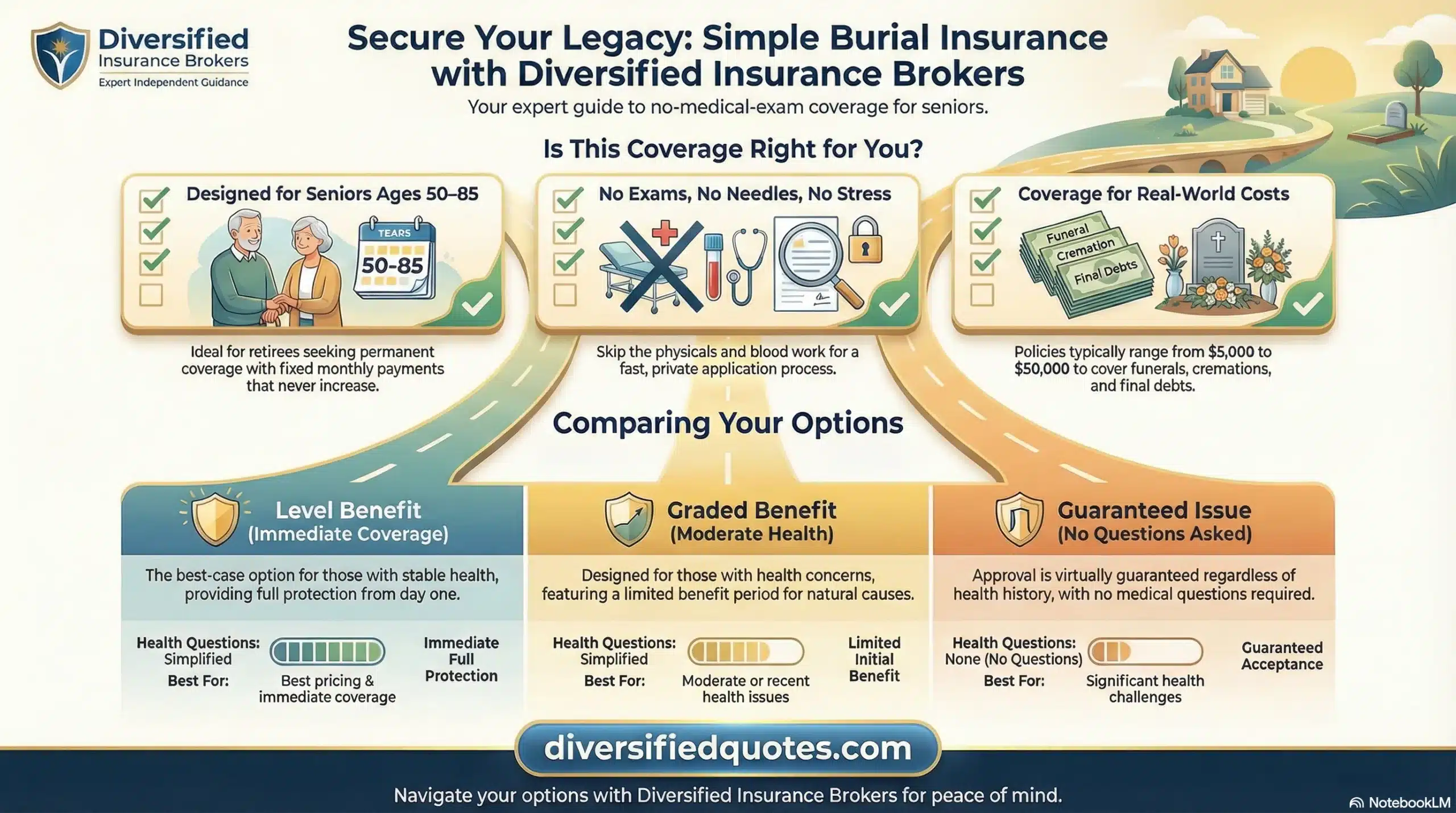
The most consequential coverage decision for someone with high blood pressure shopping for burial insurance is not which carrier to choose or what face amount to select — it is whether the policy they end up with provides level benefit (immediate, full coverage from day one) or graded benefit (limited benefit in the first two to three years, typically returning premiums plus interest if death occurs during the graded period).
Level benefit burial insurance is the preferred outcome for most applicants because the full death benefit is immediately available for natural causes of death from the moment coverage begins. The purpose of burial insurance — providing funds for final expenses when needed — is only fully served when the coverage is immediate. A policy that returns premiums plus 10% interest in the first year does not cover a $12,000 funeral if the applicant dies in month eight of coverage. This is why confirming that a policy offers immediate, level benefit coverage is the most important due diligence step in the burial insurance shopping process, and why the cheapest premium option is not always the best choice if that premium comes with benefit limitations the applicant did not fully register.
Graded benefit plans are not inherently bad products — they serve an important market by providing coverage access for applicants who do not qualify for simplified level benefit underwriting due to health history. But selecting a graded benefit plan accidentally — because the premium was lower and the applicant did not carefully review the benefit structure — is one of the most common and most easily avoidable mistakes in final expense insurance shopping. For most applicants with controlled hypertension and no major complications, a level benefit policy is available and should be the target. For applicants with more complex histories — recent hospitalizations, prior cardiovascular events, additional serious conditions — graded benefit may be the most appropriate available option, but it should be chosen deliberately with full understanding of what the benefit limitation means in practice.
Our resource on whole life burial insurance vs term explains why most people choose whole life (permanent coverage with level premiums) for final expense purposes, and our resource on burial insurance with no health exam explains how simplified underwriting allows most people with manageable health histories to qualify without a medical examination.
How Hypertension Combines With Other Conditions in Underwriting
High blood pressure rarely exists in isolation for the demographic most commonly shopping for burial insurance — people in their late 50s through 80s who have managed multiple health conditions over many years. Understanding how hypertension combines with other common conditions in burial insurance underwriting helps set realistic expectations and guides carrier selection for more complex health profiles.
Hypertension plus diabetes is perhaps the most common combination in this market. Both conditions are widely prevalent, both are managed with medications, and both are conditions that final expense carriers see on virtually every application in the target demographic. When both conditions are stable, controlled, and have not produced major complications, the combination typically does not disqualify an applicant from level benefit coverage — though some carriers may rate slightly more conservatively for the combination than for either condition alone. The complications that change the underwriting outcome are the same for the combination as for each condition individually: prior stroke, heart attack, kidney failure, or vision loss from diabetic retinopathy. Applicants with both conditions who have maintained good management and have not experienced serious complications are generally competitive candidates for level benefit burial insurance. Our resource on burial insurance for people with diabetes covers the diabetes underwriting dimension specifically.
Hypertension plus prior stroke is a more challenging combination for burial insurance underwriting. Stroke is a condition that many final expense carriers treat as a material underwriting factor — particularly recent strokes — because it is both a consequence of poorly controlled blood pressure and a significant predictor of future cardiovascular events. Carriers differ significantly in how they handle stroke history: some treat any stroke history within the past two years as an automatic graded benefit or decline; others evaluate the type of stroke, the degree of recovery, and the stability of the patient’s subsequent course. For applicants with a prior stroke who have had significant time pass since the event and have demonstrated stable recovery, the best approach is working with a broker who knows which carriers take a more favorable underwriting view of stable stroke-recovery profiles. Our resource on burial insurance for stroke survivors addresses this profile specifically.
Hypertension plus heart attack is similarly complex. A prior heart attack significantly elevates the carrier’s assessment of mortality risk, and the recency, treatment, and recovery profile all affect how different carriers evaluate the application. Many carriers impose a two-to-three-year lookback on heart attacks — meaning a heart attack that occurred more than a defined period ago with stable recovery may qualify for level benefit coverage while a recent event may result in graded benefit or decline. Carrier knowledge is critical here because the lookback periods and recovery requirements differ substantially across the carrier market. Our resource on burial insurance after a heart attack provides a detailed framework for this profile.
Hypertension plus COPD or breathing conditions is another common combination that affects underwriting outcomes primarily based on severity and treatment intensity. Mild, controlled COPD managed with maintenance inhalers is viewed very differently than severe COPD requiring oxygen therapy or frequent hospitalizations. When both hypertension and COPD are mild-to-moderate and managed, the combination typically does not prevent level benefit coverage. When COPD is severe, especially when oxygen is required, some carriers become more restrictive regardless of how well blood pressure is controlled.
Age-Specific Considerations: How Age Affects Burial Insurance for High Blood Pressure
The interaction between age and hypertension in burial insurance underwriting is more nuanced than many applicants expect. Counterintuitively, a 65-year-old with controlled hypertension may actually face fewer obstacles in burial insurance than the same person would face applying for a large traditional life insurance policy — because the smaller face amounts and simplified underwriting of final expense policies are specifically designed to serve the senior population that commonly has managed health conditions.
For applicants in their late 50s and early 60s, controlled hypertension is a condition carriers have substantial experience evaluating and pricing. The primary underwriting question is whether complications have developed. For applicants who have been on medication for years with no major events, level benefit coverage at standard rates is the norm rather than the exception across most major final expense carriers.
For applicants in their 70s and 80s — the most active final expense shopping demographic — hypertension is almost universally present, and carriers have calibrated their underwriting accordingly. The conditions that create underwriting challenges at these ages are rarely hypertension itself; they are the complications that accumulated over decades of cardiovascular exposure and aging. A 78-year-old with controlled hypertension and no major events is typically a straightforward approval for level benefit coverage. A 78-year-old with hypertension, prior stroke, kidney disease, and current oxygen use presents a very different risk profile. Our resource on burial insurance for parents over 70 provides context for how final expense shopping typically works at these ages.
Why Carrier Selection Matters More Than Any Other Variable
The most important practical insight in shopping for burial insurance with high blood pressure is that carrier selection — not product type selection, not coverage amount selection, not even benefit design selection — is the single variable that most determines whether an applicant ends up with immediate level benefit coverage at competitive pricing or with a graded benefit plan at higher relative cost. This is not a minor or marginal difference; the same health profile can produce dramatically different underwriting outcomes across different carriers because each carrier’s underwriting guidelines reflect their own actuarial assumptions, risk appetite, and market positioning.
Carrier A may have underwriting guidelines that treat any prior cardiovascular hospitalization within three years as a graded benefit indicator. Carrier B may review the specific hospitalization type and duration, and a brief observation hospitalization for controlled hypertension management may not trigger their graded benefit threshold at all. Carrier C may offer preferred rates for applicants on common hypertension medications with no complications, while Carrier D prices the same profile at standard rates. None of these carriers is wrong in their approach — they simply reflect different actuarial judgments about how to price specific risk profiles, resulting in different outcomes for the same applicant.
This carrier variation is precisely why working with an independent broker who has relationships across the final expense carrier market — and who understands the underwriting guidelines of different carriers for specific health profiles — produces better outcomes than applying directly to a single carrier or shopping exclusively through online quote tools. An online quote tool can generate a premium estimate, but it cannot tell you whether that premium corresponds to a level benefit or graded benefit policy for your specific health profile, whether there is a different carrier that would offer meaningfully better terms for the same profile, or whether the carrier’s application questions contain a specific item related to your health history that would result in an adverse underwriting outcome before you’ve invested time in the application process.
How to Use the Calculator and What to Do Next
The burial insurance calculator above provides immediate premium estimates across coverage amounts for your age and gender — a useful starting point for understanding the general range of what coverage costs and what face amounts produce premiums within your budget. Use it to compare $10,000, $15,000, $20,000, and $25,000 coverage amounts to see where the premium feels comfortable, and to get a realistic sense of what final expense coverage costs for your profile.
Keep in mind that the calculator provides estimates — actual premiums may vary depending on the specific carrier selected, the underwriting outcome for your health profile, and any tobacco or lifestyle factors that affect rating. The most useful way to use the calculator is as a budgeting tool and comparison framework, then follow up with our team to confirm which carriers’ underwriting is most favorable for your specific health history and to identify whether level benefit coverage is available at the rates the calculator suggests. Our resource on the monthly cost of a $10,000 burial policy provides additional context for how pricing at that common face amount works by age, and our resource on the burial insurance calculator explains how to interpret the estimates the tool generates.
For applicants who are concerned about affordability or managing coverage within a fixed income budget, our resource on affordable burial insurance for low-income seniors provides strategies for right-sizing coverage to a manageable premium level.
Related Burial Insurance Pages
Helpful pages that explain pricing, policy types, and how to choose the right final expense plan.
Related Health & Approval Topics
If other conditions are part of the picture, these pages explain how approvals and pricing tend to work.
Financial Protection Essentials
Lawsuit funding solutions, annuity strategies, and carrier comparisons to help strengthen long-term financial security.
Talk With an Advisor Today
Choose how you’d like to connect—call or message us, then book a time that works for you.
Schedule here:
calendly.com/jason-dibcompanies/diversified-quotes
Licensed in all 50 states • Fiduciary, family-owned since 1980
FAQs: Burial Insurance for People with High Blood Pressure
Can I get burial insurance if I take blood pressure medication?
Yes — most burial insurance carriers accept applicants who take one or more blood pressure medications, and in many cases, medication use is viewed favorably rather than negatively by underwriters. The reasoning is straightforward: an applicant who is taking prescribed blood pressure medication is demonstrating that they have identified their condition, sought medical care, and are actively managing it. That behavioral profile — treatment compliance, stability, ongoing physician supervision — is exactly what final expense underwriters are trying to assess when evaluating chronic condition risk.
Common blood pressure medications — ACE inhibitors (lisinopril, enalapril), ARBs (losartan, valsartan), calcium channel blockers (amlodipine), and beta-blockers (metoprolol, atenolol) — appear on virtually every senior final expense application and are calibrated into carrier pricing as expected elements of the senior health profile rather than as red flags. Even applicants on two or three blood pressure medications typically qualify for level benefit coverage when there are no major complications in the health history. The key is matching your profile to the carrier whose underwriting is most favorable for controlled hypertension — which is where working with an independent broker produces meaningfully better outcomes than applying to a single carrier directly.
Will I pay more for coverage if I have high blood pressure?
Usually no — when blood pressure is controlled and there are no major complications in the health history, most final expense carriers offer standard pricing rather than rated premiums. Burial insurance underwriting for hypertension focuses on whether complications have occurred, not on the diagnosis itself. An applicant with a long history of medicated, controlled hypertension and no stroke, heart attack, heart failure, or kidney disease history is typically evaluated at standard rates because their risk profile is not materially different from an applicant without hypertension at the same age.
Where pricing can be affected is when hypertension is combined with other conditions that individually affect pricing — active tobacco use, obesity, diabetes with complications, or a prior cardiovascular event. In those scenarios, the combination of risk factors may result in higher premiums at some carriers or shift the applicant toward a graded benefit structure. Carrier selection is the most effective tool for managing pricing when multiple conditions exist — because carriers differ meaningfully in how they weight combinations of manageable chronic conditions.
What blood pressure details do carriers care about most?
In simplified burial insurance underwriting, carriers focus on the consequences of blood pressure rather than the blood pressure diagnosis or specific numbers. The questions that appear most consistently on final expense applications address: whether the applicant has been hospitalized in the past one to two years and why, whether the applicant has been diagnosed with or treated for stroke or TIA (transient ischemic attack), whether the applicant has been diagnosed with or treated for heart attack or congestive heart failure, whether the applicant has been diagnosed with kidney disease or is on dialysis, and in some applications, whether the applicant has been treated for uncontrolled hypertension specifically.
The high blood pressure diagnosis itself rarely appears as a specific underwriting question on final expense applications — it is assumed to be present in a significant portion of the senior applicant population. What carriers are screening for is the presence of serious complications that create elevated near-term mortality risk. Stability indicators — length of time under treatment, absence of hospitalizations, absence of major cardiac or neurological events — are the primary favorable signals in hypertension underwriting. Applicants who can honestly answer the health questions without triggering the adverse indicators typically qualify for level benefit coverage at standard pricing regardless of how long they have had hypertension.
What if I had a recent hospitalization?
Recent hospitalizations are evaluated based on the reason for the hospitalization and when it occurred — not simply the fact that a hospitalization happened. A hospitalization for a hypertensive urgency episode that was treated and resolved without lasting damage is evaluated very differently than a hospitalization for a major stroke or heart attack. Most final expense carriers apply a lookback period — commonly 12 to 24 months — during which a covered hospitalization for specific cardiovascular or kidney-related events affects eligibility or benefit structure.
If a recent hospitalization involved a serious cardiac event (heart attack, decompensated heart failure), a stroke, or a kidney emergency, the impact on burial insurance eligibility depends on the carrier and the specific event. Some carriers will offer graded benefit coverage after a defined period following such events; others require a longer stable period before level benefit coverage is available. If the hospitalization was for an unrelated reason — surgery, infection, orthopedic issue — and your blood pressure is otherwise controlled, most carriers proceed with their standard evaluation without giving significant weight to the hospitalization itself. Working with a broker who knows carrier-specific lookback periods and recovery requirements for recent cardiac events helps identify the best available option.
Is there a waiting period for people with high blood pressure?
Many applicants with controlled high blood pressure qualify for immediate, level benefit coverage with no waiting period. A graded benefit plan — which provides limited benefit in the first two to three years rather than full immediate coverage — is more commonly triggered by recent major cardiovascular events, serious current complications, or combinations of multiple serious conditions rather than by controlled hypertension alone. The correlation between controlled hypertension and waiting periods is low when the health history is otherwise clean.
The key to confirming whether level benefit coverage is available for your specific profile is working with a broker who can pre-screen your health history against carrier underwriting guidelines before submitting an application. This prevents the frustrating experience of applying to a carrier that would result in a graded benefit offer when a different carrier would have provided level benefit coverage for the same profile. If you are comparing quotes online and see premiums that seem lower than expected, verify whether those quotes correspond to level benefit or graded benefit coverage — the distinction is the most important detail in the entire burial insurance purchase decision.
Do burial insurance companies ask for medical records?
Most final expense burial insurance policies use simplified issue underwriting, which means they do not require a full medical exam or a comprehensive medical records review as part of the application process. Instead, the underwriting is based on the applicant’s answers to a series of health questions on the application, a prescription history database check (which verifies that medications disclosed are consistent with the health history provided), and in some cases an MIB (Medical Information Bureau) database check that reveals prior insurance applications and their outcomes.
The prescription history check is the most practically significant underwriting tool for applicants with hypertension — it confirms what medications are on file, and any medication that suggests a complication (a heart failure medication, a dialysis medication, a specific oncology drug) can prompt the carrier to ask follow-up questions or apply different underwriting standards. This is another reason why working transparently with an independent broker and accurately disclosing health history matters — the prescription database check is likely to surface medications that are on record, and inconsistencies between the application and the prescription history can result in claim denials or rescissions even after a policy is issued.
Can high blood pressure plus diabetes affect approval?
Yes — the combination can increase underwriting scrutiny, though in most cases where both conditions are stable and well-managed, level benefit burial insurance remains available. The reason both conditions together receive more careful evaluation is that the combination increases the cumulative risk of the complications that carriers are trying to avoid: hypertension and diabetes together elevate the risk of kidney disease, cardiovascular events, and stroke more than either condition independently. However, this elevated risk is captured in actuarial assumptions that carriers apply to this combination — it does not mean the combination is automatically disqualifying for level benefit coverage.
The most important factors when both hypertension and diabetes are present are whether either condition has produced significant complications, whether both conditions are stable and under active medical management, and whether there are any recent hospitalizations or acute events in the health history. An applicant managing both conditions with medications, regular physician follow-up, and no major events in their history is typically a reasonable candidate for level benefit coverage at many carriers, though carrier selection is especially important because the range of outcomes across carriers is wider for the combination than for either condition alone. Our resource on burial insurance for people with diabetes provides additional guidance on the diabetes dimension of this combination.
Does family history of hypertension matter?
Not typically for burial insurance. Most final expense carriers focus on the applicant’s personal health history, current medical situation, and medications rather than family history. Family history is sometimes relevant in fully underwritten life insurance (particularly for conditions like hereditary cardiac disease or certain cancers), but simplified final expense underwriting is designed for efficiency and accessibility rather than comprehensive risk assessment. The health questions on final expense applications almost universally focus on the applicant’s own diagnoses, treatments, and hospitalizations — not their family’s health history. This makes burial insurance accessible on a reasonable basis for people with family histories of hypertension, heart disease, or stroke who are personally healthy and stable.
What if I smoke and have high blood pressure?
Smoking does increase premiums and reduces carrier options for burial insurance, but coverage remains widely available for smokers with controlled hypertension. Final expense carriers typically charge higher tobacco rates than non-tobacco rates — the premium difference for tobacco use is meaningful and applies across all health profiles, including those with controlled chronic conditions like hypertension. Some carriers are more competitive than others for tobacco users with managed health conditions, which is another reason carrier selection matters for applicants with multiple risk factors.
The combination of active tobacco use and hypertension does not typically trigger a graded benefit requirement when hypertension is controlled and there are no major complications. The tobacco rating affects the premium level, not necessarily the benefit structure. If you are comparing quotes, look at the tobacco rate category specifically to confirm that the quotes reflect tobacco pricing and not non-tobacco pricing that would be corrected at application — a quote generated at non-tobacco rates that results in a tobacco-rated policy at application changes the premium from what was estimated.
Can I be declined for high blood pressure alone?
It is uncommon to be declined for burial insurance based on controlled high blood pressure alone — with no complications and no other serious health conditions in the history. Final expense underwriting is specifically designed to provide coverage access for the senior population that commonly has managed chronic conditions, and hypertension managed with medication is among the most prevalent and most expected conditions in this demographic. Carriers that decline controlled hypertension without complications would be excluding a very large portion of their target market, which makes commercial sense only if the carrier has specific underwriting guidelines that reflect adverse experience with hypertension at certain severity levels.
Declines are more common when blood pressure is documented as uncontrolled (not being treated, or treated but with documented evidence of poor control), when serious complications have occurred (stroke, heart attack, kidney failure), or when multiple serious conditions are layered together in a way that creates cumulative risk the carrier considers outside their acceptable range. For applicants who are declined by one carrier for any combination of these factors, guaranteed issue burial insurance — which accepts all applicants regardless of health history but at higher premiums and with limited benefits in the initial years — remains available as a last-resort coverage option.
Browse Burial Insurance for High Risk Conditions
About the Author:
Jason Stolz, CLTC, CRPC, DIA, CAA and Chief Underwriter at Diversified Insurance Brokers (NPN 20471358), is a senior insurance and retirement professional with more than 25 years of real-world experience helping individuals, families, and business owners protect their income, assets, and long-term financial stability. As a long-time partner of the nationally licensed independent agency Diversified Insurance Brokers, Jason provides trusted guidance across multiple specialties—including fixed and indexed annuities, long-term care planning, personal and business disability insurance, life insurance solutions, Group Health, Travel Medical and Evacuation Insurance, and short-term health coverage. Diversified Insurance Brokers maintains active contracts with over 100 highly rated insurance carriers, ensuring clients have access to a broad and competitive marketplace.
His practical, education-first approach has earned recognition in publications such as VoyageATL, and contributions from his agency featured in Kiplinger and GoBankingRates— highlighting his commitment to financial clarity and client-focused planning. Drawing on deep product knowledge and years of hands-on field experience, Jason helps clients evaluate carriers, compare strategies, and build retirement and protection plans that are both secure and cost-efficient. Visitors who want to explore current annuity rates and compare options across multiple insurers can also use this annuity quote and comparison tool.
Explore All Burial Insurance Options: Browse our complete Burial Insurance guide — covering seniors, high risk conditions, no medical exam options & final expense planning.
Last Reviewed: May 21, 2026 |
Reviewed by: Jason Stolz, CLTC, CRPC, DIA, CAA
Chief Underwriter, Diversified Insurance Brokers, Inc. | NPN: 20471358 | Diversified Insurance Brokers, Inc. — Licensed in all 50 states
Fact Checked by: Tonia Pettitt, CMIP©
Medicare Specialist, Diversified Insurance Brokers, Inc. | NPN: 14374308 | Diversified Insurance Brokers, Inc. — Licensed in all 50 states
Did you find this content helpful? Leave us a Google review — it helps others find trustworthy guidance too.
Editorial Standards: Diversified Insurance Brokers maintains rigorous editorial standards to ensure accuracy, clarity, and independence in all content. Learn more about our editorial standards and commitment to transparency.
