
40% Return Annuity
As an Independent Annuity Broker, we compare rates across 100+ carriers and 1,000 different annuities— not just one company’s product offerings — to find the best fit for your goals.
40% Return Annuity

Jason Stolz CLTC, CRPC, DIA, CAA
The phrase “40% Return Annuity” captures a category of retirement savings structure rather than a single product, and understanding precisely what “return” means in this context is the most important analytical task for any retiree evaluating this approach. Unlike a stock that reports a 40% price appreciation or a CD that advertises a declared interest rate, the 40% return in an annuity context can refer to two fundamentally different things: a guarantee that the contract’s account value will reach at least 140% of the original premium by a specific year, or a guarantee that an income benefit base used to calculate lifetime withdrawals will reach 140% — with the actual cash surrender value being a different and potentially lower number. These two structures serve different planning purposes, carry different tradeoffs, and should be evaluated under different decision frameworks. Treating them as equivalent is the most common misunderstanding in annuity evaluation, and it is the first thing our team at Diversified Insurance Brokers works to resolve before any illustration comparison begins.
The “return” framing is also worth scrutinizing on its own terms. A 40% total return over 10 years — the most common timeframe associated with this concept — equates to approximately 3.4% compounded annually. That is not a headline rate that sounds competitive in a high-rate environment, but it comes packaged with two features that raw return numbers cannot capture: contractual minimum certainty regardless of market performance, and principal protection from direct market loss throughout the accumulation period. The financial trade is explicit — you accept a lower ceiling on potential returns in exchange for a contractually defined floor and the elimination of drawdown risk. For retirement assets where the preservation of principal matters as much as growth, that trade has real planning value. At Diversified Insurance Brokers, Jason Stolz, CLTC, CRPC, DIA, CAA helps clients evaluate this trade across more than 75 carriers, comparing the 40% return structure against current fixed alternatives and income annuity designs to identify where it fits — and where it doesn’t — in the specific retirement plan being built. Our resource on annuities overview covers the complete product landscape, and our resource on how does a fixed indexed annuity work covers the mechanics underlying most 40% return structures.
Ensure you are receiving the absolute top rates
Current Fixed Annuity Rates
Compare today’s best fixed annuity rates from top carriers.
Current Bonus Annuity Rates
See which annuities offer the highest upfront bonus today.
Request an Annuity Quote
Submit our annuity request form to get personalized rate options.
The Critical Distinction — Where Does the 40% Apply?
Before evaluating any 40% return annuity illustration, the single most important question to answer is: where does the 40% apply? The answer determines everything about how the contract should be evaluated, compared, and used in a retirement plan. Our carrier market analysis identifies two fundamentally different structures that use the 40% return framing.
In the first structure, the 40% applies to the contract’s accumulation value — the actual account value that can be surrendered for cash at the end of the accumulation period. This is the more straightforward interpretation: a $200,000 premium is contractually guaranteed to produce a minimum account value of $280,000 at the end of year 10, subject to no excess withdrawals having been taken. At that point, the $280,000 is the true walk-away value — actual dollars accessible for any purpose. This structure is most directly analogous to a defined-return investment and is what most investors instinctively assume they are purchasing when they hear “40% return annuity.” Our resource on what is the interest rate on a $100,000 annuity provides rate context for evaluating this accumulation value against alternatives.
In the second structure, the 40% applies to an income benefit base — a separate, internal accounting value used specifically to calculate the size of lifetime income withdrawals, which is often significantly higher than the actual account value or cash surrender value. A $200,000 premium might produce an income benefit base of $280,000 at year 10, but the actual cash surrender value may be a different and potentially lower number. The income benefit base is a calculation tool, not a liquid asset. This distinction matters profoundly for planning: if a retiree expects to access the “40% return” as a lump sum or as a flexible withdrawal pool, but the guarantee applies only to the income benefit base, the expectation and the reality are misaligned. Our resources on what is an income annuity benefit base, what is an income rider, and what is a GLWB cover these structures and their implications in full detail.
| Feature | 40% Applies to Account Value |
40% Applies to Income Benefit Base |
Planning Implication |
|---|---|---|---|
| What is guaranteed to reach 140%? | The actual cash account value | An internal calculation value — not the cash value | Critical — account value is liquid; benefit base is not |
| Can you access the 140% as a lump sum? | Yes — after surrender period expires | No — benefit base is used only for income calculations | Account value structure is more flexible for withdrawals |
| How is the 40% used in income planning? | Higher account value = higher income base = higher payments if an income rider is added | Directly drives the income calculation — the 140% benefit base determines the payout percentage multiplier | Both benefit income planning, but through different mechanisms |
| What happens to the value on death? | Beneficiaries typically receive the account value as death benefit | Death benefit is typically the account value, not the benefit base — often lower | Benefit base structures may provide less estate value than they appear |
| Typical rider cost? | Often no explicit income rider cost — guarantee is built into contract structure | Income rider fee typically charged annually (often 0.5–1.5% of benefit base) | Rider fees reduce account value over time — net return is lower than gross 40% |
How Vesting Schedules Deliver the 40% Return Over Time
Many 40% return annuity structures deliver the guaranteed minimum not as an all-or-nothing milestone at year 10 but through a vesting schedule that accumulates the guaranteed value incrementally over the accumulation period. A typical design credits approximately 4% of the guaranteed minimum value per year — meaning the guaranteed value at year one is 104% of premium, at year two it is 108%, at year three it is 112%, and so forth until year 10 delivers the full 140% guaranteed minimum. This gradual vesting structure has two important planning implications.
First, it means the full 40% guarantee is not instantly available — early surrender before year 10 captures only the vested portion, which may be less than the premiums paid when combined with surrender charges in early years. A retiree who surrenders the contract in year three has captured only the year-three vested value (approximately 112% of premium on the guarantee schedule) minus any applicable surrender charges, which could produce a net surrender value below the original premium. This underscores why allocating to a 40% return annuity requires genuine long-term commitment. Our resource on what is a bonus annuity vesting schedule covers the mechanics of graduated vesting in detail and explains how to evaluate where on the vesting curve a contract sits at any given surrender date.
Second, the vesting schedule creates a predictable planning ladder. Retirees who understand their contract’s vesting terms can map the minimum guaranteed value at each contract anniversary — providing a defined floor for retirement planning at each year of the accumulation period rather than just at the terminal year. This is useful for clients who may not be certain of exactly when they will need to convert the accumulation value to income, as it shows the guaranteed floor at multiple possible activation dates rather than just at the 10-year milestone.
How Index Crediting Can Push Returns Above 40%
The 40% guaranteed minimum is a contractual floor, not a ceiling. In years when the index strategies linked to the annuity perform well and credit positive interest, the contract’s accumulation value grows above the guaranteed baseline — and because the 40% is a floor, not an annualized rate cap, all additional index credits accrue on top of the guaranteed growth trajectory rather than replacing it. This “floor plus potential upside” structure is what distinguishes a 40% return annuity built on a Fixed Index Annuity chassis from a simple fixed-rate guarantee.
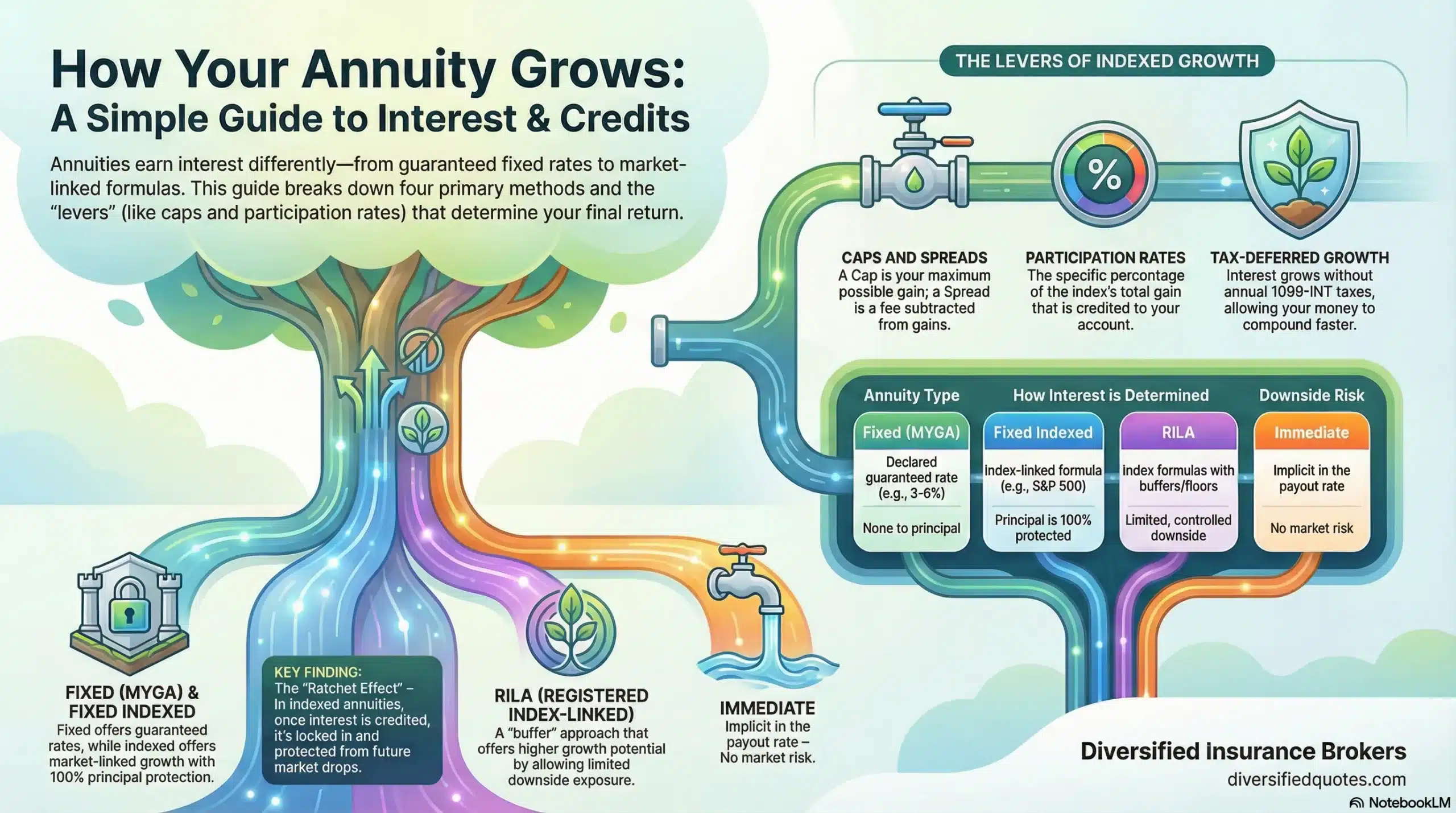
Index crediting strategies are typically evaluated and potentially adjusted at each contract anniversary, with interest credits calculated based on the performance of a linked market index (such as the S&P 500 or other benchmarks) subject to caps, participation rates, or spreads that determine what portion of index gains the contract holder captures. In strong market years, credits above the vesting schedule apply and the accumulation value can meaningfully exceed the 140% minimum at year 10. In poor market years, credits are zero — the index floor — but the vesting schedule continues accumulating toward the contractual guarantee regardless. Our resource on how do annuities earn interest explains both the index crediting and declared-rate mechanisms that drive annuity accumulation, and our resource on best fixed indexed annuities for income covers FIA selection criteria when the goal is both accumulation floor and income conversion potential.
What a 40% Return Means at Different Premium Levels
| Initial Premium | Guaranteed Minimum at Year 10 |
Guaranteed Growth Dollars |
Approx. Year 5 Vested Minimum (120%) |
Potential Value with Index Credits (illustrative) |
|---|---|---|---|---|
| $100,000 | $140,000 | $40,000 | ~$120,000 | $150,000–$175,000+ |
| $250,000 | $350,000 | $100,000 | ~$300,000 | $375,000–$440,000+ |
| $500,000 | $700,000 | $200,000 | ~$600,000 | $750,000–$875,000+ |
| $1,000,000 | $1,400,000 | $400,000 | ~$1,200,000 | $1,500,000–$1,750,000+ |
Guaranteed minimum values assume no excess withdrawals during the accumulation period. Year 5 vested minimum assumes approximately 4% annual vesting accumulation — actual vesting schedules vary by contract. “Potential value with index credits” is illustrative only and not a guarantee or projection — actual index-linked credits depend on contract terms, index performance, caps, participation rates, and spreads. Results vary by carrier and contract.
For investors allocating substantial retirement assets, the guaranteed growth dollars become correspondingly meaningful. A $1,000,000 premium with a 40% return structure guarantees $400,000 of contractual minimum growth — independent of market performance. For perspective on how this scale of accumulation converts to retirement income, our resource on how much does a $4 million annuity pay provides scale context for larger premium allocations.
Comparing the 40% Return Annuity to Alternative Structures
The 40% return annuity occupies a specific position in the annuity product spectrum — between the simplicity of a declared-rate MYGA and the income focus of an immediate or deferred income annuity. Understanding where it fits requires direct comparison against each alternative.
Fixed annuities (MYGAs) offer declared interest rates guaranteed for a specific term — straightforward accumulation without index participation. In rate environments where top 10-year MYGA rates exceed the annualized equivalent of approximately 3.4% that the 40% guarantee represents, a MYGA may deliver more total growth than the guaranteed floor of the return structure. But a MYGA provides no index upside — the declared rate is both floor and ceiling. Our resource on fixed annuity rates and our resource on current fixed annuity rates show the declared-rate environment for direct comparison at any given time.
Bonus annuities provide an upfront percentage credit to the account value or benefit base at contract issue rather than through a 10-year vesting schedule. The distinction matters for liquidity planning: a bonus annuity’s upfront credit may be subject to longer surrender schedules or adjusted crediting parameters that effectively recapture part of the bonus if the contract is surrendered early. Our resource on current bonus annuity rates shows the current bonus landscape. Deferred annuities prioritize long-term accumulation before income begins; immediate annuities convert premium directly to income payments without an accumulation phase. Our resources on what is a deferred annuity and what is an immediate annuity clarify these structural differences for investors comparing accumulation versus income-first designs.
For retirees concerned about inflation-adjusted purchasing power across the accumulation period, comparing the 40% return structure with designs that specifically address inflation is important. Our resources on SPIA with inflation protection and SPDA with inflation protection cover structures designed to grow income payments over time — a different approach to the same inflation-risk concern. For retirees curious whether the 40% return delivers adequate real purchasing power preservation, the comparison against current inflation expectations and alternative inflation-linked structures is a critical planning step. Our resource on short-term fixed indexed annuity options covers shorter-commitment FIA alternatives for investors who want indexed-linked upside without the full 10-year accumulation horizon.
Who Is a 40% Return Annuity Best For?
A 40% return annuity is most appropriate for the retirement saver who values a defined minimum outcome above the flexibility of market-exposed alternatives and who has a genuine 10-year horizon for the allocated funds. The ideal profile typically includes some combination of these characteristics: proximity to retirement (5-15 years away) with a specific income activation date in mind, a meaningful accumulation of retirement assets that can absorb a long-term commitment without liquidity strain, a preference for knowing the minimum value at a future date rather than navigating market uncertainty, and an interest in optional income conversion after the accumulation period rather than needing income immediately.
The 40% return structure is less appropriate for retirees already drawing income who need liquidity flexibility, for investors with shorter time horizons who cannot commit for 10 years, for those prioritizing the highest possible market participation without a growth cap, and for investors who need access to capital for known large expenditures within the contract period. Our resource on do annuities pay income for life covers the full spectrum of annuity income structures for retirees who are ready to begin income rather than accumulate further, and our resource on current income annuity rates shows what immediate income conversion rates look like if that is the priority. Our resource on why the top 1% use structured income solutions instead of bonds covers how sophisticated retirement portfolios integrate guaranteed growth structures as a bond replacement rather than an equity replacement — a positioning that clarifies the strategic role of the 40% return annuity in a diversified plan.
Liquidity — What You Can Access During the Accumulation Period
The 40% return annuity is a long-term commitment, but most contracts provide structured access to a portion of the account value during the accumulation period without triggering surrender charges or penalty. The standard provision allows penalty-free withdrawals of 5-10% of the account value annually after the first policy year — providing a meaningful liquidity buffer for unexpected expenses without requiring full surrender. Our resource on increasing daily benefit rider step-ups provides context on how some annuity contracts allow for structured benefit increases over time, a complementary feature to core liquidity provisions.
Withdrawals within the free withdrawal allowance typically do not reduce the guaranteed minimum proportionally if structured correctly under contract terms — though specific contract language governs this and should be reviewed carefully before any withdrawal. Withdrawals exceeding the free withdrawal amount during the surrender period trigger charges that reduce the cash surrender value and may also proportionally reduce guaranteed values. This makes pre-purchase modeling of likely liquidity needs — including healthcare expenses, home maintenance, and discretionary spending — a critical step before allocating to any 40% return structure.
Converting the 40% Return to Lifetime Income
The 40% guaranteed minimum provides substantial planning value as an accumulation floor, but its most powerful application for most retirees is as the foundation for guaranteed lifetime income conversion. After the 10-year accumulation period, the guaranteed minimum value (or the income benefit base, depending on contract structure) becomes the basis for income rider calculations — producing a predictable, contractually defined level of lifetime withdrawals that the retiree cannot outlive regardless of subsequent account performance.
For retirement plans built around income security rather than wealth maximization, the defined 140% accumulation target at year 10 provides something that market-exposed portfolios cannot: a known starting point for income calculations that is independent of sequence-of-returns risk in the years immediately before income activation. A 60-year-old who allocates $300,000 today and activates income at 70 knows that the income calculation base will be at least $420,000 regardless of what equity markets, interest rates, or economic conditions produce during the decade. Our resource on income annuity payout rates covers how lifetime income amounts are calculated from the accumulated base.
Lifetime Income Calculator
Use the calculator to estimate how much guaranteed lifetime income your 40% return annuity’s accumulated value could provide based on your age and premium amount.
Tax Efficiency and Real Return After Inflation
A 40% return over 10 years represents approximately 3.4% compounded annually. In an environment where inflation averages 2-3% annually, the real (inflation-adjusted) purchasing power preserved by the guarantee is modest but meaningful — especially compared to savings accounts or money market funds whose after-inflation returns are often negative in real terms. The tax-deferred accumulation within the annuity adds another layer of efficiency: interest credited during the accumulation period is not taxed in the year earned, allowing the full compound growth to occur without annual tax drag. For non-qualified funds, ordinary income tax applies on gains at withdrawal. For qualified funds (IRA rollovers), all withdrawals are subject to ordinary income tax and Required Minimum Distribution rules apply.
For investors comparing the net after-tax, after-inflation return of a 40% return annuity against taxable alternatives like CDs or bond funds — where interest is taxable annually even when reinvested — the annuity’s tax deferral advantage can be meaningful over a 10-year accumulation period, particularly for investors in higher marginal tax brackets. The combination of principal protection, guaranteed floor, index upside potential, and tax deferral is the package the 40% return structure is selling — not the headline percentage in isolation. Our resource on guaranteed 40% bonus retirement annuity covers the related bonus structure that applies the 40% concept differently, and our resource on how annuities are structured legally covers ownership and beneficiary considerations relevant to all annuity contract holders.
Request Your 40% Return Annuity Illustration
We compare the 40% return structure in its multiple forms across our carrier network, identify whether the guarantee applies to account value or income benefit base, compare against current fixed and bonus alternatives, and provide personalized illustrations so you evaluate actual numbers before making any commitment.
Request a Personalized QuoteRelated Annuity Planning Guides
Explore guaranteed structures, fixed rates, income riders, and annuity mechanics that connect directly to the 40% return framework.
Financial Protection Essentials
Chronic condition underwriting guidance, dental and vision options, financial firm reviews, and state-level consumer protections.
Talk With an Advisor Today
Choose how you’d like to connect—call or message us, then book a time that works for you.
Schedule here:
calendly.com/jason-dibcompanies/diversified-quotes
Licensed in all 50 states • Fiduciary, family-owned since 1980
Frequently Asked Questions: 40% Return Annuity
What is a 40% return annuity?
A 40% return annuity is typically a Fixed Index Annuity structured so the contract reaches at least 140% of the initial premium by a target year — usually year 10 — subject to vesting provisions, surrender terms, and no excess withdrawals. The “return” can apply to the actual account value (the cash-accessible value at contract maturity) or to an income benefit base used only for calculating lifetime withdrawal amounts — a distinction that changes the planning utility of the guarantee significantly. Our resource on guaranteed 40% bonus retirement annuity covers a related structure where the 40% is applied as an immediate bonus to the income base rather than through a 10-year vesting accumulation.
Is the 40% on my cash value or only on the income benefit base?
It depends entirely on the contract. Some 40% return structures apply the guarantee to the actual account value — the real cash-accessible value at the end of the accumulation period. Others apply it to an income benefit base that is an internal calculation value used only for determining lifetime income withdrawal amounts, not a cash value. These are fundamentally different structures with different planning utilities. Our resource on what is an income annuity benefit base explains this distinction in full. Always confirm which value carries the guarantee before committing to any annuity illustration.
How does the vesting schedule work in a 40% return annuity?
Many 40% return designs vest the guaranteed minimum gradually over the accumulation period — typically accumulating approximately 4% of the guaranteed value per year until the full 40% is reached at year 10. A contract surrendered at year five would provide only the five-year vested minimum (approximately 120% of premium on this schedule) minus any applicable surrender charges. Early surrender can therefore produce a net cash value below the original premium in the first several years. Our resource on what is a bonus annuity vesting schedule covers how to evaluate vesting terms across different contract designs.
Can the value end up higher than 140%?
Yes. The 40% is a contractual floor, not a ceiling. In years when the index strategies linked to the annuity credit positive interest, the accumulation value grows above the guaranteed minimum. Because the guarantee is a floor rather than the expected outcome, all additional index credits accumulate on top of the vested guaranteed value. In favorable market environments, a 40% return annuity can significantly exceed the 140% minimum at year 10. Our resource on best fixed indexed annuities for income covers how FIA crediting potential interacts with income planning.
What access do I have to my money during the accumulation period?
Most contracts allow penalty-free withdrawals of 5-10% of the account value annually after the first policy year without triggering surrender charges. Withdrawals within this allowance typically do not reduce the guaranteed minimum proportionally if structured under contract terms. Excess withdrawals during the surrender period trigger charges that reduce the cash surrender value and may proportionally reduce guaranteed values. Our resource on short-term fixed indexed annuity options covers more flexible shorter-commitment FIA alternatives for investors who need greater liquidity than a 10-year accumulation structure provides.
Are there fees associated with the 40% return guarantee?
It depends on the contract structure. When the 40% applies to the account value through a built-in contract guarantee (not an optional income rider), there may be no explicit annual rider fee — the cost of the guarantee is built into the contract’s crediting parameters (caps, participation rates, spreads). When the 40% applies to an income benefit base through an optional income rider, an annual rider fee is typically charged against the account value — often 0.5-1.5% of the benefit base per year. These fees reduce the account value over time, meaning the net return is lower than the gross 40% figure suggests. Our resource on SPDA with inflation protection provides context on how guarantees are structured and priced across different deferred annuity designs.
What happens to the value if I pass away before the 10-year period ends?
Beneficiaries typically receive the contract’s death benefit, which is ordinarily based on the account value — not the income benefit base — at the time of death. In cases where the account value exceeds the original premium, beneficiaries receive the higher amount. Some contracts include enhanced death benefit provisions that compare the account value against an accumulated minimum and pay the greater of the two. Beneficiary designations and contract ownership structure affect how the death benefit is distributed and whether the beneficiary can continue the contract. Our resource on how annuities are structured legally covers ownership and beneficiary considerations relevant to all annuity contracts.
Who is a 40% return annuity best suited for?
This approach is most appropriate for conservative retirement savers with a genuine 10-year commitment horizon who want a defined minimum accumulation outcome independent of market performance, plus the potential for additional growth if index strategies perform well. It fits best within a layered retirement plan where this allocation serves the “principal-protected accumulation” role while other assets pursue higher-risk market growth or generate current income. Our resource on why the top 1% use structured income solutions instead of bonds covers how sophisticated retirement portfolios position guaranteed growth structures as a replacement for fixed income exposure rather than as an equity alternative.
About the Author:
Jason Stolz, CLTC, CRPC, DIA, CAA and Chief Underwriter at Diversified Insurance Brokers (NPN 20471358), is a senior insurance and retirement professional with more than 25 years of real-world experience helping individuals, families, and business owners protect their income, assets, and long-term financial stability. As a long-time partner of the nationally licensed independent agency Diversified Insurance Brokers, Jason provides trusted guidance across multiple specialties—including fixed and indexed annuities, long-term care planning, personal and business disability insurance, life insurance solutions, Group Health, Travel Medical and Evacuation Insurance, and short-term health coverage. Diversified Insurance Brokers maintains active contracts with over 100 highly rated insurance carriers, ensuring clients have access to a broad and competitive marketplace.
His practical, education-first approach has earned recognition in publications such as VoyageATL, and contributions from his agency featured in Kiplinger and GoBankingRates— highlighting his commitment to financial clarity and client-focused planning. Drawing on deep product knowledge and years of hands-on field experience, Jason helps clients evaluate carriers, compare strategies, and build retirement and protection plans that are both secure and cost-efficient. Visitors who want to explore current annuity rates and compare options across multiple insurers can also use this annuity quote and comparison tool.
Explore More Annuity Options: Browse our complete guide to Bonus Annuity Pros and Cons — covering bonus annuity comparisons, 401k rollovers, Roth conversions & tax strategies from 100+ carriers.
Last Reviewed: May 25, 2026 |
Reviewed by: Jason Stolz, CLTC, CRPC, DIA, CAA
Chief Underwriter, Diversified Insurance Brokers, Inc. | NPN: 20471358 | Diversified Insurance Brokers, Inc. — Licensed in all 50 states
Fact Checked by: Tonia Pettitt, CMIP©
Medicare Specialist, Diversified Insurance Brokers, Inc. | NPN: 14374308 | Diversified Insurance Brokers, Inc. — Licensed in all 50 states
Did you find this content helpful? Leave us a Google review — it helps others find trustworthy guidance too.
Editorial Standards: Diversified Insurance Brokers maintains rigorous editorial standards to ensure accuracy, clarity, and independence in all content. Learn more about our editorial standards and commitment to transparency.
