
Single Premium Deferred Annuity (SPDA) with Inflation Protection
As an Independent Annuity Broker, we compare rates across 100+ carriers and 1,000 different annuities— not just one company’s product offerings — to find the best fit for your goals.
Single Premium Deferred Annuity (SPDA) with Inflation Protection

Jason Stolz CLTC, CRPC, DIA, CAA
A single premium deferred annuity (SPDA) with inflation protection is the answer to one of the most consequential but frequently underplanned retirement questions: will the guaranteed income I establish today still feel meaningful in 15, 20, or 25 years? The word “deferred” in SPDA means income begins at a future date you choose — typically five to fifteen years after the initial lump-sum deposit — rather than immediately. During that deferral period, the premium grows tax-deferred inside the contract. When income is activated, the structure of how payments increase (or don’t) over the full retirement horizon determines whether guaranteed income keeps pace with the rising cost of housing, healthcare, groceries, and the ordinary expenses of a long life. Inflation protection inside an SPDA specifically addresses that long-horizon risk — and it works through two fundamentally different mechanisms depending on which product structure is used. Understanding both is essential before committing to any SPDA design that includes an inflation protection component.
The first mechanism is the COLA rider (Cost-of-Living Adjustment) applied to the income payments themselves. In this design, the annuity contract establishes a rising payment schedule — income increases by a fixed percentage each year (commonly 2% or 3%), by a CPI-linked rate, or by another defined formula after income activation. The trade-off is mathematically built into the design: starting income is lower than what a level-income contract would have produced from the same premium, because the carrier is pricing the future payment increases into the reduced initial payment. This is not a penalty — it is the cost of purchasing future payment growth. A 3% compound COLA rider typically reduces the initial income payment by approximately 15-25% relative to a comparable level-income structure. The second mechanism is the income base rollup within a Fixed Indexed Annuity (FIA) with a Guaranteed Lifetime Withdrawal Benefit (GLWB) rider. Here, the inflation preparation happens during the deferral period rather than through the payment schedule after income begins: the income base grows at a guaranteed rollup rate regardless of index performance, building a larger income foundation from which the future income election is calculated. This means the income elected at activation is higher than it would have been at a lower income base — addressing inflation’s erosion of purchasing power through the accumulation of a larger income source rather than through rising payment mechanics. These two approaches are not mutually exclusive — some product designs can incorporate elements of both — but they are structurally different, and the right choice depends on how important rising payments are relative to maximizing the income base at activation.
Inflation’s impact on retirement security is not a theoretical concern — it is a documented, historically consistent erosion of purchasing power that compresses the real value of fixed-income streams across multi-decade retirements. A retirement income level that comfortably covers essential expenses in year one of retirement may cover those same expenses significantly less adequately in year twenty if inflation has risen at historical average rates throughout that period. For retirees who have significant Social Security income — which does receive an annual COLA from the government (the 2026 Social Security COLA was 2.8%) — the inflation risk on the Social Security component is partially addressed. But for retirees whose income plan relies heavily on fixed annuity income or other non-COLA-adjusted sources, the real purchasing power of that income erodes year by year. An SPDA with inflation protection directly addresses this erosion for the portion of income it covers. Our resource on Social Security planning strategies covers how to optimize the Social Security inflation protection component of the retirement income floor, and our annuities 101 resource covers the full annuity product landscape within which SPDAs with inflation protection are positioned.
Model inflation-protected income from your premium — compare structures side by side
Current Fixed Annuity Rates
Compare today’s best fixed annuity rates from top carriers.
Current Bonus Annuity Rates
See which annuities offer the highest upfront bonus today.
Request an Annuity Quote
Submit our annuity request form to get personalized rate options.
Lifetime Income Calculator
Compare level income vs. inflation-adjusted income structures — see how the crossover point shifts with premium, age, and deferral period.
What Is a Single Premium Deferred Annuity?
A single premium deferred annuity (SPDA) is an annuity contract funded with one lump-sum payment that accumulates on a tax-deferred basis during a deferral period, with income beginning at a future date rather than immediately. The “single premium” element distinguishes it from flexible premium designs that accept ongoing contributions — an SPDA’s premium is deposited once, and the entire accumulation is driven by the growth credited during the deferral period plus the tax compounding advantage of deferred taxation. The “deferred” element distinguishes it from immediate annuities (SPIAs and DIAs with very short deferral periods) — the income start date is typically five to fifteen or more years after the premium is deposited, which allows the accumulation phase to build a larger income base before income is elected. The tax deferral advantage during accumulation means that credited interest compounds without current-year income tax, allowing the accumulation to grow faster than the same dollars would in a taxable savings or CD account generating the same gross return. Our resource on what is a deferred annuity covers the foundational deferred annuity structure in full detail.
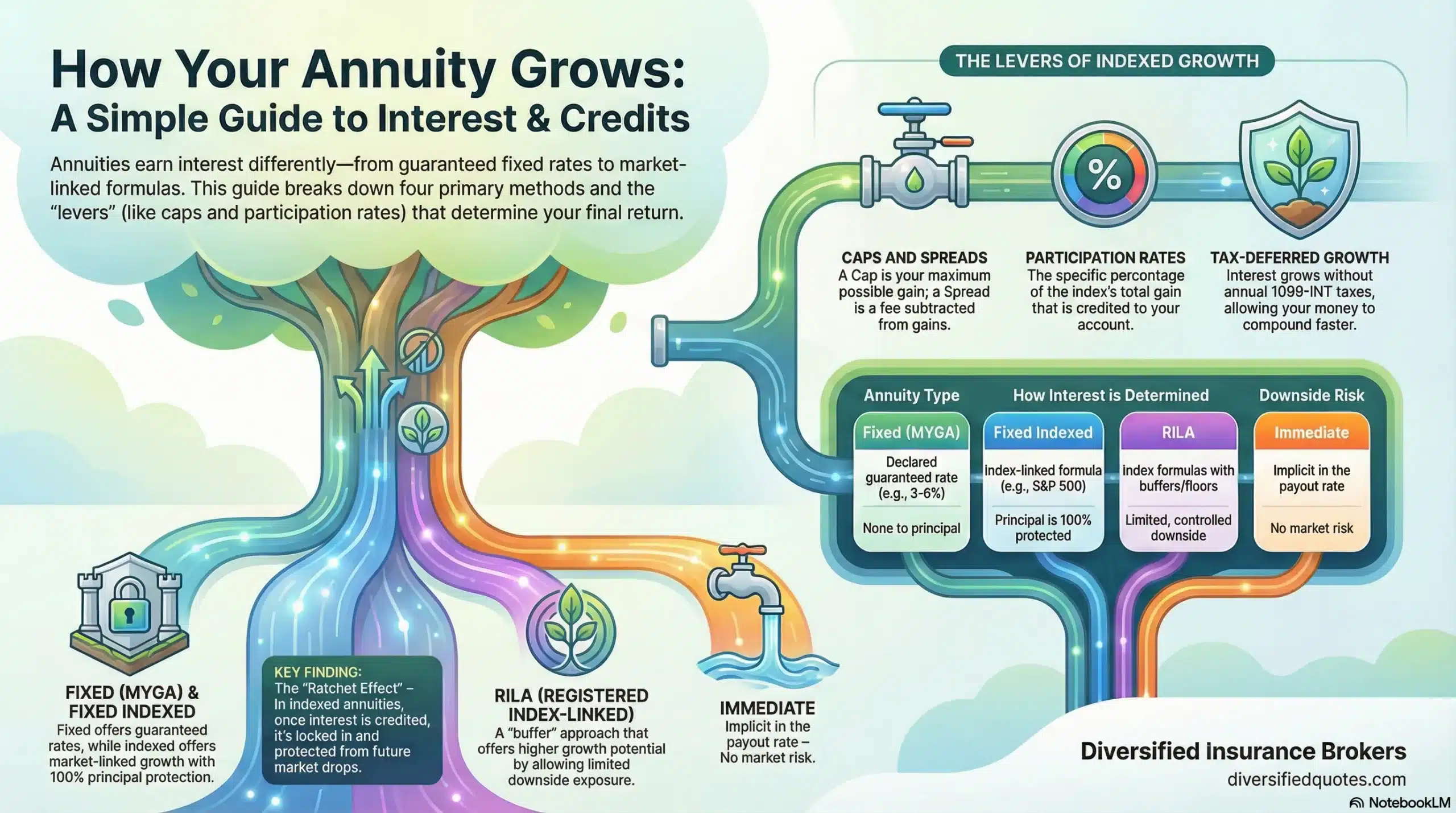
SPDAs can be structured with three different accumulation approaches, each with different growth mechanics and different implications for the inflation protection discussion that follows. A fixed-rate SPDA provides a guaranteed interest rate for a defined period — predictable, simple, and principal-protected, but growth is limited to the declared rate without upside participation. A multi-year guaranteed annuity (MYGA) is a type of fixed SPDA that guarantees the declared rate for the full term (commonly 3-10 years) rather than resetting annually — providing locked-in predictability for the entire accumulation period. A fixed indexed annuity (FIA) links interest credits to the performance of an external market index (typically the S&P 500 or similar) with a floor of zero, providing principal protection against negative index years while enabling participation in positive index performance subject to the contract’s caps or participation rates. Our resource on understanding multi-year guaranteed annuities covers the MYGA structure in depth, and our resource on what is a fixed indexed annuity covers the FIA structure. For current competitive rates across these structures, our best MYGA annuity rates and highest bonus FIA rates pages provide the market context for evaluating what is available today.
Two Ways an SPDA Can Provide Inflation Protection — A Direct Comparison
| Feature | SPDA with Level Income (No Inflation Protection) | SPDA + COLA Rider (Rising Payments) | FIA/GLWB SPDA with Income Base Rollup (Deferral Approach) |
|---|---|---|---|
| How Inflation Protection Works | None — payments are flat in nominal dollars; purchasing power erodes each year at the rate of inflation | COLA rider applied to income payments after activation — payments increase annually by a fixed % (commonly 2-3%), compounding percentage, or CPI-linked rate | Income base grows at a guaranteed rollup rate during the deferral period — a longer deferral and higher rollup rate produce a larger income base, which drives higher income when elected; indirectly prepares for inflation through income base accumulation |
| Impact on Starting Income | Highest starting income of the three structures — no future increases priced in | Lower starting income — a 3% compound COLA typically reduces starting income by 15-25% relative to level income from the same premium | Starting income at activation reflects the accumulated income base — deferral period directly determines income level; longer deferral = higher income at activation |
| Inflation Growth Mechanism | None — payment amount is locked at activation level indefinitely | Fixed % COLA: predictable, budgetable payment growth each year. CPI-linked: tracks real inflation but variable and less commonly available; carriers typically cap at 5-7% annually | Rollup rate builds income base during deferral; income amount grows with the income base until election. Post-election, income may be level or may participate in index credits depending on specific GLWB design |
| Crossover Point vs. Level Income | N/A — level income never “catches up” to inflation-adjusted options; purchasing power declines relative to inflation each year | Typically 8-12 years after income activation; after crossover, COLA payments exceed level payments and continue growing for the annuitant’s lifetime | Crossover vs. same premium at shorter deferral: immediately at activation for the income base advantage built through longer deferral; deferral discipline is the driver rather than payment escalation after activation |
| Liquidity During Deferral | Standard free-withdrawal provisions (typically 10%/year) during accumulation; surrender charges for excess | Same as level income — COLA rider applies after income activation, not during accumulation | Account value accessible via free-withdrawal provisions during deferral; income base is separate from account value; account value may be accessible as emergency reserve during deferral phase depending on contract |
| Best For | Shorter retirements or those with robust inflation hedges elsewhere (large Social Security, TIPS, etc.); maximizing near-term income when purchasing power concern is secondary | Long retirements (20-30+ years) where purchasing power erosion is the primary concern; retirees who can accept lower starting income for stronger long-term income growth | Pre-retirees 5-15 years from income need who want to accumulate an inflation-ready income base during the deferral period; those who value both income potential and some deferral-phase liquidity |
Income impacts and crossover estimates shown are illustrative approximations based on general market patterns and publicly available research on COLA rider pricing. Actual income amounts, COLA availability, rollup rates, income base payout factors, and crossover points vary significantly by carrier, product design, annuitant age, premium, deferral period, state, and date of purchase. The 15-25% starting income reduction for a 3% compound COLA rider is a market range, not a specific product guarantee. COLA riders must be added at contract purchase in most designs — they cannot be added to an existing contract after issuance. Always verify specific product features, COLA rider terms, and income projections through a formal current illustration from a licensed broker before making any contract decision.
How COLA Riders Work — The Mechanics of Rising Income
A COLA rider on an annuity income contract establishes the precise mechanism by which income payments increase after activation. The most common form is a fixed percentage COLA — the contract specifies a defined annual increase (commonly 1%, 2%, or 3%) that applies to each income payment on its anniversary date. A 3% simple COLA adds 3% of the original payment each year, so a $2,000/month starting payment grows by $60/month annually: $2,060 in year two, $2,120 in year three, and so on. A 3% compound COLA applies the increase to the previous year’s payment, not the original payment, creating an accelerating growth trajectory: $2,000 in year one, $2,060 in year two ($2,000 × 1.03), $2,122 in year three ($2,060 × 1.03), and so on — the compound version produces meaningfully more total income over a 20-30 year horizon than the simple version at the same stated rate.
A CPI-linked COLA attempts to track actual inflation more precisely by adjusting payments based on the published Consumer Price Index rather than a predetermined fixed rate. This provides stronger protection when inflation surges unexpectedly above 3%, but introduces variability that makes precise budget planning more difficult. Most carriers that offer CPI-linked COLA options apply an annual cap (commonly 5-7%) to limit their exposure in high-inflation environments, and CPI-linked options are less widely available than fixed percentage options across the carrier market. For practical retirement budget planning, a fixed 3% COLA is more widely available, more predictable, and approximately aligned with long-term historical inflation averages — making it the most commonly recommended COLA structure for retirees who value planning certainty. One critically important operational point: COLA riders are available only at the time of contract purchase. Once an annuity contract is issued with level income, the COLA option cannot be added retroactively. If inflation protection is a planning priority, it must be addressed in the original product design decision, not years after the contract is already in force. Our dedicated resource on what is COLA on an annuity covers the full mechanics of COLA rider structures including fixed vs. CPI-linked options, simple vs. compound mechanics, and the cost trade-off analysis in depth. Our resource on how annuity income riders work covers the broader income rider landscape within which COLA riders are one component.
The Income Crossover Point — The Most Important COLA Calculation
The income crossover point is the moment at which cumulative total payments received from a COLA-adjusted annuity equal and then surpass the cumulative total payments that would have been received from a level-income annuity purchased with the same premium. Before the crossover point, the level-income annuity has paid more in total because its starting payment was higher. After the crossover point, the COLA annuity pays more in total — and the gap widens each year as the compounding payment increases accumulate advantage. For many retirees, the crossover point calculation is the most useful analytical tool for deciding whether the starting income reduction of a COLA rider is economically justified by the inflation protection it provides.
As a general illustrative framework — not a specific product guarantee — with a 3% compound COLA that reduces starting income by approximately 20% relative to a level-income alternative, the crossover point typically occurs approximately 8-12 years into the income period. A retiree who activates income at age 65 with a 3% COLA and lives past 73-77 receives more total income from the COLA policy than from the comparable level policy over their lifetime. A retiree who activates the same COLA policy at 72 and lives past 80-84 also benefits. The longer the expected retirement horizon, the more compelling the COLA rider’s total value relative to the starting income reduction — which is precisely why younger retirees with long family longevity histories and those in good health are the most logical candidates for COLA rider structures. Conversely, a retiree who activates income at 80 with a shortened expected remaining lifetime may find the crossover point arrives too late relative to their planning horizon to justify the starting income reduction. Modeling the specific crossover point for your age, the exact COLA rate available, and the starting income difference from specific carrier illustrations is the correct analytical approach — the Lifetime Income Calculator above and formal carrier illustrations enable that modeling. Our resource on annuity payout calculator covers the tools available for modeling income projections across different structures.
The FIA/GLWB Approach — Building Inflation Readiness Through Income Base Growth
The Fixed Indexed Annuity with a Guaranteed Lifetime Withdrawal Benefit rider addresses inflation in the SPDA context through a fundamentally different mechanism than the COLA rider. Rather than structuring rising payments after income begins, the FIA/GLWB strategy builds inflation readiness into the accumulation phase through the income base rollup — the guaranteed growth of the income base during the deferral period that determines the future income amount. During the deferral period, the income base grows at a defined contractual rollup rate regardless of index performance: in a year the index is negative or zero, the account value receives zero credits but the income base still grows at the guaranteed rollup. In years the index produces positive credits, the account value grows from those credits, and under some FIA/GLWB designs, the income base may also participate in positive index performance through ratchet provisions. The result over a 5-10 year deferral period is an income base materially larger than the original premium — producing a correspondingly higher guaranteed income amount when the retiree elects to activate income.
This indirect inflation preparation has important practical advantages over the COLA rider approach in some planning scenarios. The income activated at the end of the deferral period reflects both the rollup accumulation and the higher payout factor that applies at the older activation age — two compounding advantages that work in the same direction. A pre-retiree who deposits an SPDA premium at age 58 with a 10-year deferral will elect income at 68 from an income base meaningfully larger than the original premium, at a higher payout factor than would have applied at 58. This combined effect can produce more monthly income at activation than the level or COLA income that would have been available from the same premium had income been elected immediately. After activation, the income itself may be level in many GLWB designs, or may participate in index credits in some more sophisticated designs — but the inflation preparation was accomplished primarily through the accumulation strategy rather than through the income escalation mechanism. Our resource on how annuity income riders work covers the GLWB rider mechanics, and our resource on fixed indexed annuity myths debunked addresses common misconceptions about how FIA crediting and income rider mechanics work in practice.
Tax Treatment — Why Rising Income Requires Long-Term Tax Planning
An SPDA with a COLA rider or with income base rollup growth creates a retirement income stream that is higher in later retirement years than in early retirement years — which has direct implications for long-term tax planning that a level-income approach does not create. For qualified SPDA contracts funded with IRA or 401(k) dollars, every dollar of every distribution is taxable as ordinary income. As payments grow through the COLA rider, the taxable income from the annuity grows each year, potentially pushing the retiree into higher marginal tax brackets, triggering higher Medicare IRMAA premium surcharges, or increasing the taxation of Social Security benefits in later retirement years. This does not mean inflation protection is undesirable — it means the long-term tax trajectory of rising income should be evaluated alongside the inflation protection benefit, with after-tax income projections rather than gross income projections as the planning benchmark.
For non-qualified SPDA contracts funded with after-tax dollars, the exclusion ratio reduces the taxable portion of each payment — but the exclusion ratio is calculated at contract issuance based on the expected payment period, and as COLA payments exceed the originally projected amount, the portion above the exclusion baseline becomes increasingly taxable in later years. The practical planning implication is that the after-tax benefit of a COLA rider compounds more favorably in accounts where the exclusion ratio reduces the initial tax burden (non-qualified) compared to fully taxable qualified accounts — though both benefit from inflation protection that maintains real purchasing power in the face of rising costs. Coordinating the annuity’s income trajectory with the household’s overall tax bracket management strategy — including Roth conversion opportunities in the early retirement years before the COLA payments reach their peak levels — is the integrated planning approach that produces the best after-tax outcomes. Our resource on are annuities worth it covers the comprehensive value proposition framework within which tax treatment is one component, and our resource on annuity beneficiary death benefits covers how income riders and COLA structures affect death benefits and beneficiary outcomes.
Who Is an SPDA With Inflation Protection the Right Choice For?
The SPDA with inflation protection — whether through a COLA rider or an FIA/GLWB deferral strategy — is most appropriate for pre-retirees who are at least five to fifteen years from their target income start date, who want tax-deferred growth with principal protection during accumulation, who expect their retirement to last 20-30 or more years, and who have identified inflation as a meaningful long-term threat to the real value of their planned guaranteed income. The planning profile that most clearly benefits from this strategy is a 55-to-65-year-old in good health with a family history of longevity who wants to establish a guaranteed income floor that will remain meaningful in their late 70s and 80s rather than being nominally fixed at the level it started in their mid-60s. This same profile also describes the retiree most at risk of healthcare cost inflation — one of the most consistent drivers of real living cost increases in later retirement — which SPDA inflation protection is specifically designed to address. Our resource on sequence of returns risk covers why the early years of retirement are particularly vulnerable to market-driven income disruption, providing context for why guaranteed income with inflation protection is valuable alongside a portfolio-based retirement income plan. Our resource on pension alternative strategies covers how SPDAs with COLA riders recreate the defined benefit pension structure for retirees without employer pension income. Our resource on how to protect your funds in retirement covers the broader asset protection architecture within which inflation-protected annuity income most effectively fits. And for an independent review of any specific SPDA proposal you have received, our second-opinion annuity quote review provides the multi-carrier comparison that confirms whether the COLA rate, income base rollup, and overall design are competitive. Our broader annuities overview covers the full product landscape, our resource on what are the best fixed annuities covers the fixed SPDA category in a broader competitive context, and our delayed retirement credits and Social Security payout increases resource covers how delaying Social Security coordinates with the SPDA deferral strategy for an integrated inflation-protected income plan.
Talk With an Advisor Today
Choose how you’d like to connect—call or message us, then book a time that works for you.
Schedule here:
calendly.com/jason-dibcompanies/diversified-quotes
Licensed in all 50 states • Fiduciary, family-owned since 1980
FAQs: Single Premium Deferred Annuity (SPDA) With Inflation Protection
What is a single premium deferred annuity (SPDA)?
An SPDA is an annuity contract funded with one lump-sum premium that grows tax-deferred during a deferral period, with income beginning at a future date rather than immediately. The premium is deposited once — unlike flexible premium designs that accept ongoing contributions — and the entire accumulation reflects the growth credited during the deferral period plus the tax compounding advantage of deferred taxation. SPDAs can be structured as fixed-rate contracts, multi-year guaranteed annuities (MYGAs), or fixed indexed annuities (FIAs). They are designed for pre-retirees who want to deposit a lump sum today and establish a guaranteed income source for a future retirement date, typically five to fifteen or more years away.
What are the two ways an SPDA can provide inflation protection?
The first is a COLA (Cost-of-Living Adjustment) rider applied to income payments after activation — payments increase annually by a fixed percentage (commonly 2-3%), a compound percentage, or a CPI-linked rate. This directly structures rising income in nominal dollars over the retirement period but reduces the starting income level by approximately 15-25% for a 3% compound COLA relative to a level-income alternative. The second is the income base rollup within an FIA/GLWB strategy — the income base grows at a guaranteed rollup rate during the deferral period, building a larger income foundation from which the future income is calculated. This prepares for inflation through accumulation rather than payment escalation: a longer deferral and higher rollup rate produce more income at activation, effectively building inflation readiness into the structure before income begins.
Does inflation protection reduce my starting annuity income?
Yes — when inflation protection is structured through a COLA rider on income payments, the starting income is lower than a comparable level-income contract because the carrier is pricing the future payment increases into the reduced initial payment. A 3% compound COLA rider typically reduces starting income by approximately 15-25% relative to a level-income structure from the same premium. This is not a penalty — it is the cost of purchasing future payment growth. The reduction is mathematically justified for retirees who expect a long retirement, because the cumulative COLA payments surpass the cumulative level payments at the crossover point (typically 8-12 years into the income period) and continue growing thereafter. For the FIA/GLWB income base rollup approach, starting income at activation reflects the accumulated income base rather than a COLA-reduced level — the inflation preparation was built into the accumulation phase rather than the payment schedule.
What is the income crossover point and why does it matter?
The income crossover point is when cumulative total payments from a COLA-adjusted annuity equal and then exceed the cumulative total payments from a level-income annuity purchased with the same premium. Before the crossover, the level-income annuity has paid more in total (because its starting payment was higher). After the crossover, the COLA annuity pays more total, and the gap widens each year as compounding payment increases accumulate. For a 3% compound COLA that reduces starting income by approximately 20%, the crossover typically occurs 8-12 years into the income period. Retirees who activate income at 65 and live past 73-77 generally receive more total lifetime income from the COLA structure. The crossover point is the key analytical tool for determining whether the starting income reduction is economically justified by the expected length of retirement.
Can I add a COLA rider to an existing annuity?
No — COLA riders are available only at the time of contract purchase. Once an annuity contract is issued with level income, the COLA option cannot be added retroactively. If you have an existing level-income annuity and want to convert it to an inflation-protected structure, annuity replacement strategies such as a 1035 exchange into a new contract that includes a COLA rider are sometimes available — but they involve timing considerations, potential surrender charges, and the new contract’s underwriting and features. The practical lesson is that inflation protection must be addressed at the original contract purchase decision, not years later after the level-income structure has already been established. If you are evaluating whether to replace an existing annuity with a COLA-enabled contract, our second-opinion annuity quote review covers the replacement strategy evaluation framework.
How is the deferral period related to inflation protection in an FIA/GLWB strategy?
In an FIA/GLWB SPDA strategy, the deferral period directly determines inflation readiness by allowing the income base to accumulate at the contract’s guaranteed rollup rate before income is elected. A longer deferral produces a larger income base — which produces higher income at activation — and the income is elected at an older age where the payout factor is also higher, compounding the income advantage. Both factors work in the same direction: more deferral produces more income at activation. This strategy addresses inflation by building a larger guaranteed income source before retirement begins, rather than through rising payment mechanics after income starts. It is particularly effective for pre-retirees 5-15 years from their income need who want to establish an income foundation that will be higher (in real terms relative to what it would have been at an earlier activation) than immediate income from the same premium would have provided.
How are SPDA payments taxed?
Tax treatment depends on whether the SPDA was funded with qualified (pre-tax) or non-qualified (after-tax) dollars. Qualified SPDAs funded with IRA or 401(k) money produce fully taxable distributions — every dollar of every payment is ordinary income. For COLA-adjusted payments that grow each year, this means taxable income from the annuity increases each year, with potential implications for marginal tax brackets, Medicare IRMAA premium surcharges, and Social Security benefit taxation in later retirement years. Non-qualified SPDAs funded with after-tax dollars use the exclusion ratio — a calculated fraction of each payment is treated as tax-free return of the original after-tax principal, reducing the taxable portion. As COLA payments grow above the originally projected level, the proportion taxable as gain increases. Long-term tax planning should include after-tax income projections, not just gross payment comparisons, when evaluating inflation protection options.
Who is the best candidate for an SPDA with inflation protection?
Pre-retirees 5-15 years from their income start date who want tax-deferred growth during accumulation, guaranteed lifetime income, principal protection, and meaningful inflation protection for a long retirement are the strongest candidates. This strategy is particularly appropriate for those in good health with family histories of longevity — the longer the expected retirement, the more valuable the inflation protection becomes relative to the starting income reduction cost of a COLA rider, and the more the income base rollup deferral strategy pays off in higher activation income. Those with significant healthcare inflation exposure in later retirement, those without employer pension income whose guaranteed income depends substantially on the annuity’s purchasing power remaining intact, and those who coordinate the SPDA’s deferral period with delayed Social Security to create a fully integrated inflation-aware income architecture are all strong fits for this strategy.
About the Author:
Jason Stolz, CLTC, CRPC, DIA, CAA and Chief Underwriter at Diversified Insurance Brokers (NPN 20471358), is a senior insurance and retirement professional with more than 25 years of real-world experience helping individuals, families, and business owners protect their income, assets, and long-term financial stability. As a long-time partner of the nationally licensed independent agency Diversified Insurance Brokers, Jason provides trusted guidance across multiple specialties—including fixed and indexed annuities, long-term care planning, personal and business disability insurance, life insurance solutions, Group Health, Travel Medical and Evacuation Insurance, and short-term health coverage. Diversified Insurance Brokers maintains active contracts with over 100 highly rated insurance carriers, ensuring clients have access to a broad and competitive marketplace.
His practical, education-first approach has earned recognition in publications such as VoyageATL, and contributions from his agency featured in Kiplinger and GoBankingRates— highlighting his commitment to financial clarity and client-focused planning. Drawing on deep product knowledge and years of hands-on field experience, Jason helps clients evaluate carriers, compare strategies, and build retirement and protection plans that are both secure and cost-efficient. Visitors who want to explore current annuity rates and compare options across multiple insurers can also use this annuity quote and comparison tool.
Browse More Resources: Return to our complete MYGA & Fixed Annuity Products guide — covering MYGA and fixed annuity products from top carriers.
Last Reviewed: June 16, 2026 |
Reviewed by: Jason Stolz, CLTC, CRPC, DIA, CAA
Chief Underwriter, Diversified Insurance Brokers, Inc. | NPN: 20471358 | Diversified Insurance Brokers, Inc. — Licensed in all 50 states
Fact Checked by: Tonia Pettitt, CMIP©
Medicare Specialist, Diversified Insurance Brokers, Inc. | NPN: 14374308 | Diversified Insurance Brokers, Inc. — Licensed in all 50 states
Did you find this content helpful? Leave us a Google review — it helps others find trustworthy guidance too.
Editorial Standards: Diversified Insurance Brokers maintains rigorous editorial standards to ensure accuracy, clarity, and independence in all content. Learn more about our editorial standards and commitment to transparency.
