
Medical Malpractice Lawsuit Funding – Fast Cash Before Settlement
Medical Malpractice Lawsuit Funding – Fast Cash Before Settlement

Jason Stolz CLTC, CRPC, DIA, CAA
When you have been injured due to medical negligence, the financial strain can be overwhelming. Lost income, mounting medical bills, and ongoing treatment costs can quickly accumulate while your case works through the legal system — a process that in medical malpractice claims often takes significantly longer than standard personal injury cases. Medical malpractice lawsuit funding provides a way to access money now so you can focus on recovery and allow your attorney to fight for the settlement that genuinely reflects the harm you have suffered rather than the amount you need today to pay the bills.
Medical malpractice cases are more complex than standard injury claims in ways that directly affect timeline and financial pressure. They involve extensive medical record collection from multiple providers, coordination with expert witnesses who must review technical records and render opinions on the standard of care, and legal processes that can span one to three years or more before a case reaches a resolution. Even when a claim is strong and the defendant’s liability is clear, delays are the norm rather than the exception. And financial pressure during those delays can push victims into early settlement decisions that do not reflect what the case is actually worth — which is exactly the outcome the opposing side is waiting for. Pre-settlement funding exists to prevent that outcome. Instead of waiting months or years for compensation, a qualified plaintiff may be able to receive a cash advance against the expected settlement value of the case, providing immediate relief for essential expenses and the financial stability to pursue the best result rather than the fastest one.
Apply for Medical Malpractice Lawsuit Funding
High funding amounts, quick approval, and zero repayment unless you win.
What Is Medical Malpractice Lawsuit Funding?
Medical malpractice lawsuit funding is structured as a non-recourse cash advance against the potential settlement or judgment of your medical malpractice claim. You may also hear it called pre-settlement funding, legal funding, a lawsuit advance, or settlement funding — the terminology varies across providers and regions, but the purpose is consistent: getting access to money now based on the expected value of the case rather than waiting for the legal process to conclude before any funds are available.
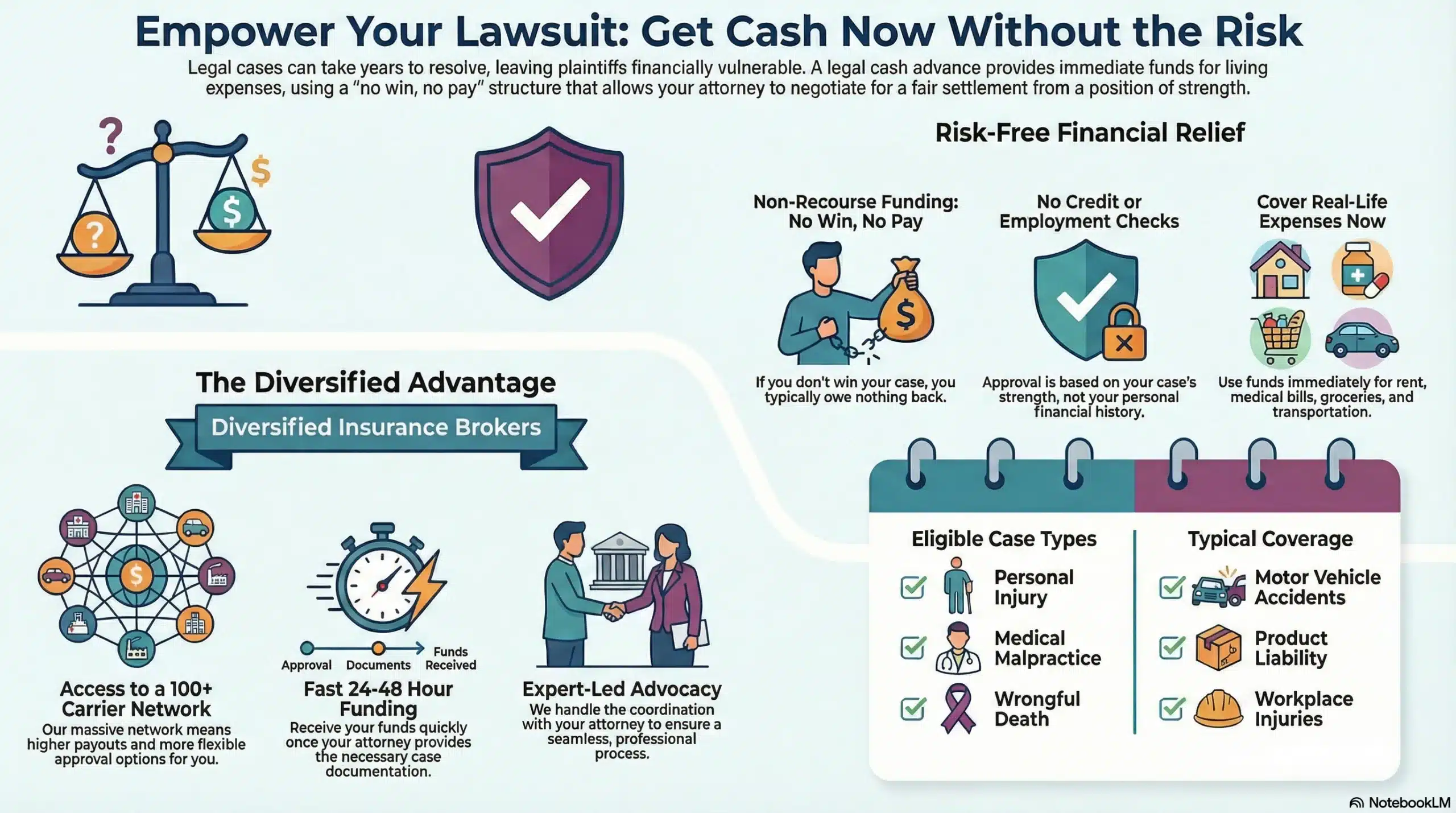
Unlike a traditional loan, medical malpractice lawsuit funding typically does not require a credit check, employment verification, or monthly payments during the pendency of the case. Approval is based primarily on the strength of the legal claim and the estimated settlement or judgment potential — not on your personal financial history or current income. Because it is non-recourse, repayment generally occurs only if the case is successful, with repayment coming from the settlement proceeds at the conclusion of the case. If there is no recovery, you typically do not repay the advance — a fundamental distinction from conventional debt products that create repayment obligations regardless of case outcome. This non-recourse structure is what makes pre-settlement funding accessible to injured plaintiffs who have no current income and whose creditworthiness has been impaired by the very injury that forms the basis of the claim. Is lawsuit funding safe? covers the key considerations and potential pitfalls that plaintiffs should understand before accepting any funding arrangement.
How Medical Malpractice Lawsuit Funding Works
Medical malpractice funding is designed to be plaintiff-friendly and attorney-coordinated, minimizing the administrative burden on the plaintiff while ensuring the funding review can be completed based on case-specific documentation. The process typically follows a straightforward sequence: the plaintiff submits a short funding request with basic case and attorney information; attorney verification confirms active legal representation and the status of the claim; case review and underwriting evaluates liability, damages, available records, and realistic settlement potential; a funding offer with full disclosure of terms is presented before any acceptance; and funding is issued after documents are signed and verification is complete.
In many cases, once documentation is received from the attorney, funding decisions can move quickly. Some clients receive money within 24 to 48 hours after attorney verification and document submission, though timing varies based on case complexity and how quickly medical records and case materials are available from the attorney’s file. Attorney responsiveness is one of the most important variables in funding timeline — cases where the attorney can promptly provide case status, liability assessment, and medical documentation move through underwriting significantly faster than cases where documentation requires additional time to compile. The application process itself is not the bottleneck — documentation is. Pre-settlement funding covers the broader category of non-recourse funding across different case types, and legal funding and pre-settlement cash advances addresses how different funding structures compare in terms of speed, transparency, and cost.
Why Medical Malpractice Claims Often Need Funding
Medical negligence cases create a distinctive type of financial pressure that differs meaningfully from other personal injury claims. In many injury cases — a minor car accident, a slip and fall with limited injuries — the plaintiff may recover relatively quickly and return to productive employment, with the primary financial impact being the immediate medical bills and short-term lost income. In medical malpractice cases, the harm is frequently severe, often permanent or long-lasting, and directly related to healthcare that was supposed to help rather than harm. A surgical error that causes permanent nerve damage, a delayed cancer diagnosis that allowed disease to progress to an advanced stage, or a birth injury that affects a child’s developmental trajectory for decades — these are cases where the damages are substantial, the timeline is long, and the plaintiff’s financial situation is often most compromised at exactly the moment when the legal process is most intense.
Medical malpractice plaintiffs commonly face large and ongoing out-of-pocket expenses for specialist care and follow-up treatment for conditions caused or worsened by the negligence, rehabilitation and physical therapy, prescription medications and medical equipment, transportation to appointments, home modifications or paid assistance for activities of daily living, and the lost income from extended inability to work. The defendant’s insurance coverage may be substantial, and the damages may be documented and compelling — but the legal process does not accelerate because the financial need is urgent. Expert reviews take time. Medical record collection from multiple providers takes time. Negotiations with well-resourced defense teams take time. And none of those timelines are influenced by how urgently the plaintiff needs to pay rent or cover medical bills. Pre-settlement funding addresses that gap directly, providing resources during the litigation period without requiring the plaintiff to compromise the case by accepting an inadequate early offer.
Common Medical Malpractice Case Types and Funding Eligibility
| Case Type | Common Examples | Key Funding Factors |
|---|---|---|
| Surgical errors | Wrong site surgery, unintended internal injury, avoidable operative complications, retained surgical instruments | Strong documentation from operative reports; liability typically clearer; damages often significant |
| Misdiagnosis / delayed diagnosis | Missed cancer diagnosis allowing progression, undetected cardiac event, untreated infection leading to sepsis | Expert testimony on standard of care critical; damages tied to stage difference at proper vs actual diagnosis |
| Birth injuries | Failure to respond to fetal distress, delayed C-section, improper use of delivery instruments, oxygen deprivation | Lifetime care costs create large damages; cases often high-value; documentation from delivery records essential |
| Medication errors | Wrong dosage prescribed or administered, incorrect medication, missed dangerous drug interactions | Pharmacy and prescribing records key; damages depend on severity of adverse outcome |
| Hospital negligence | Patient falls due to inadequate monitoring, staffing shortages causing harm, infection control failures, pressure ulcers | Institutional defendant typically well-insured; staffing and protocol records important to liability analysis |
| Anesthesia errors | Overdose, failure to monitor oxygen saturation, awareness during anesthesia, improper intubation | Anesthesia records and expert analysis critical; outcomes can be severe and permanent |
| Failure to treat | Premature discharge, failure to order appropriate follow-up, missed warning signs in test results | Damages tied to harm that developed after inadequate treatment; medical record continuity essential |
How Much Funding Can You Receive?
The amount of a medical malpractice cash advance depends on multiple interacting factors, primarily the expected gross settlement or judgment value, the anticipated attorney fees and case expenses, any medical liens held by healthcare providers who treated the malpractice injuries, potential insurance subrogation claims, and other obligations that will be satisfied from settlement proceeds before the net amount reaches the plaintiff. Funding companies typically advance only a portion of the expected net recovery to the plaintiff — the advance must be repayable from what the plaintiff actually receives after all prior obligations are satisfied, which means the advance must not consume the entire net recovery.
The strategic approach to funding is to access enough to stabilize the financial situation and eliminate the pressure that might otherwise produce an early settlement decision — without taking an amount so large that repayment of the advance and accumulated fees significantly diminishes the final settlement benefit. The most effective use of malpractice lawsuit funding is covering essential ongoing expenses during the litigation period: housing payments and utilities, groceries and daily living costs, medical expenses not covered by insurance, transportation and family needs, and prevention of financial emergencies that would otherwise create acute pressure to settle. Advance on lawsuit settlement covers the mechanics of how advances are structured against expected proceeds. Cash for lawsuit plaintiffs addresses the qualification and funding process from the plaintiff’s perspective across different case types.
What You Need to Qualify
Medical malpractice funding approvals are based on attorney verification and case documentation rather than personal financial credentials. The funding review is case-specific — the funding provider must confirm that the claim has legal merit, that the damages are supported by documentation, and that realistic settlement potential exists before issuing an advance. Common requirements include active attorney representation (most legitimate funding providers require confirmed legal representation as a condition of approval), signed authorization allowing the case to be reviewed by the funding provider, medical records supporting the malpractice claim and the resulting damages, evidence of the harm suffered including medical costs, lost income documentation, and evidence of long-term impact, available insurance coverage information for the defendant, and current case status including stage of litigation and the attorney’s assessment of settlement timeline and potential range.
The most important practical variable in how quickly funding can be arranged is attorney responsiveness and document availability. Cases where the attorney can promptly provide a case summary, relevant medical records, and confirmation of the liability theory move through underwriting most quickly. Plaintiffs who communicate to their attorneys that a funding review is coming — so the attorney can prepare to respond quickly to document requests — consistently receive faster approval decisions than plaintiffs where the attorney is reached cold by the funding provider. Cash advance for a lawsuit covers what information is typically required across the funding application process.
How Funding Helps You — And Your Case Strategy
Medical malpractice cases can take one to three years or more to resolve, and in complex cases involving catastrophic injury, cutting-edge medical issues, or large institutional defendants, timelines can extend even longer. During that entire period, the plaintiff’s household expenses, medical costs, and family obligations continue without pause. Pre-settlement lawsuit funding helps plaintiffs maintain financial stability through that timeline so the settlement decision can be made based on case value rather than personal financial desperation.
Insurance carriers and institutional defendants that are sophisticated litigation opponents understand that financial pressure on the plaintiff creates negotiating advantage for the defense. They know that a plaintiff who cannot meet housing payments, who is facing medical debt, or who is watching savings deplete month by month is more likely to accept a settlement that reflects the plaintiff’s urgency rather than the case’s merit. Legal funding directly addresses this structural disadvantage by giving the plaintiff resources to sustain the litigation without capitulating to financial pressure — which is why pre-settlement funding is frequently described as leveling the playing field between individual plaintiffs and well-resourced defendants.
Alongside legal funding, protecting your financial situation during the litigation period with appropriate insurance coverage can further reduce vulnerability. Short-term health insurance can help manage unexpected medical bills that arise during the gap between employer coverage and a settled case. High-risk disability insurance provides income protection for individuals who cannot work due to the malpractice injury. Accidental death coverage can provide financial protection for dependents. And exploring life insurance quotes during this period can ensure long-term financial security is established or maintained regardless of how the case ultimately resolves. With both legal funding and appropriate insurance protection in place, your attorney has the time and the plaintiff has the stability to pursue maximum compensation rather than a settlement driven by financial emergency. Lawsuit funding and fast legal cash advances covers the full landscape of legal funding options available to plaintiffs across different case categories.
Get Your Funds Fast
Apply for medical malpractice lawsuit funding today and receive cash in as little as 24 hours.
Related Pages
Explore more legal funding resources and related settlement advance options.
Financial Protection Essentials
Insurance and income protection resources for plaintiffs managing finances during litigation.
Talk With an Advisor Today
Choose how you’d like to connect—call or message us, then book a time that works for you.
Schedule here:
calendly.com/jason-dibcompanies/diversified-quotes
Licensed in all 50 states • Fiduciary, family-owned since 1980
Frequently Asked Questions: Medical Malpractice Lawsuit Funding
What is medical malpractice lawsuit funding and how is it different from a loan?
Medical malpractice lawsuit funding is a non-recourse cash advance against the expected settlement or judgment of your malpractice claim. It differs from a traditional loan in several fundamental ways. First, approval is based on the strength of your case and the estimated settlement potential — not your credit score, employment history, or personal financial profile. Second, repayment is contingent on case outcome: if your case does not result in a recovery, you typically do not repay the advance under a truly non-recourse agreement. Third, there are no monthly payments during the pendency of the case — repayment comes from settlement proceeds at the conclusion. This structure makes lawsuit funding accessible to plaintiffs whose financial situation has been impaired by the very injury that forms the basis of their legal claim — which is precisely the population that conventional lenders would decline.
How long does it take to get funded for a medical malpractice case?
Timing depends primarily on documentation availability and attorney responsiveness rather than the application process itself. Once an attorney confirms representation and provides the necessary case documentation — including medical records, a case summary, liability assessment, and damages information — funding decisions can often be reached within 24 to 48 hours. Medical malpractice cases can require more documentation than standard injury claims because liability depends on medical records and expert analysis rather than a straightforward accident report, which can add time if records are not yet assembled in the attorney’s file. The most effective way to accelerate the funding timeline is to notify your attorney that a funding review is coming so they can be prepared to respond to document requests promptly when the funding provider reaches out for case information.
Do I need an attorney to qualify for medical malpractice lawsuit funding?
Yes — active attorney representation is required by most legitimate lawsuit funding providers, and it is especially important in medical malpractice cases. The attorney serves as the primary point of contact for the funding provider’s underwriting review, providing documentation, confirming case status, and ultimately executing the funding agreement and repayment from settlement proceeds. Medical malpractice claims specifically require attorney involvement because the liability analysis depends on expert medical opinion about the standard of care — which only a qualified attorney with the appropriate expert consultants can properly develop and present. Funding providers who offer advances without attorney representation should be approached with significant caution, as they may not be evaluating cases with the rigor that protects the plaintiff from taking on inappropriate risk.
How much can I receive in a medical malpractice cash advance?
The amount available depends on the estimated gross settlement or judgment value, the anticipated attorney fees, medical liens held by providers who treated the malpractice injuries, and other obligations that will be satisfied from settlement proceeds before the plaintiff receives the net amount. Funding companies advance only a portion of the expected net recovery to ensure the advance and accumulated fees can be repaid from proceeds without consuming the entire benefit of the settlement. Medical malpractice cases involving severe injuries, permanent disability, or catastrophic outcomes often support larger advances because the expected settlement value is higher. The strategic goal is to access enough to stabilize the financial situation and eliminate the pressure for an early settlement — not necessarily to maximize the advance amount, which can reduce the final net benefit of a successful resolution.
Will accepting lawsuit funding affect my case or settlement?
Accepting pre-settlement funding does not directly affect the litigation strategy, the case’s merit, or the opposing party’s obligations. The funding arrangement is between the plaintiff, their attorney, and the funding provider — it does not involve the defendant or their insurer, and it does not change the legal standard or burden of proof in the case. However, the repayment obligation from settlement proceeds is a material factor in evaluating net recovery, and the accumulated fees under a funding arrangement reduce the plaintiff’s final take-home amount. This is why the amount of funding accepted should be calibrated to actual financial needs during the litigation period rather than maximized, and why reviewing the terms with the attorney before signing any funding agreement is strongly recommended to ensure the arrangement fits the overall case strategy and financial goals.
About the Author:
Jason Stolz, CLTC, CRPC, DIA, CAA and Chief Underwriter at Diversified Insurance Brokers (NPN 20471358), is a senior insurance and retirement professional with more than 25 years of real-world experience helping individuals, families, and business owners protect their income, assets, and long-term financial stability. As a long-time partner of the nationally licensed independent agency Diversified Insurance Brokers, Jason provides trusted guidance across multiple specialties—including fixed and indexed annuities, long-term care planning, personal and business disability insurance, life insurance solutions, Group Health, Travel Medical and Evacuation Insurance, and short-term health coverage. Diversified Insurance Brokers maintains active contracts with over 100 highly rated insurance carriers, ensuring clients have access to a broad and competitive marketplace.
His practical, education-first approach has earned recognition in publications such as VoyageATL, and contributions from his agency featured in Kiplinger and GoBankingRates— highlighting his commitment to financial clarity and client-focused planning. Drawing on deep product knowledge and years of hands-on field experience, Jason helps clients evaluate carriers, compare strategies, and build retirement and protection plans that are both secure and cost-efficient. Visitors who want to explore current annuity rates and compare options across multiple insurers can also use this annuity quote and comparison tool.
Explore All Lawsuit Loan & Legal Funding Options: Browse our complete guide to Lawsuit Loans & Legal Funding — covering pre-settlement funding, lawsuit cash advances, injury claims & more.
Last Reviewed: June 15, 2026 |
Reviewed by: Jason Stolz, CLTC, CRPC, DIA, CAA
Chief Underwriter, Diversified Insurance Brokers, Inc. | NPN: 20471358 | Diversified Insurance Brokers, Inc. — Licensed in all 50 states
Fact Checked by: Tonia Pettitt, CMIP©
Medicare Specialist, Diversified Insurance Brokers, Inc. | NPN: 14374308 | Diversified Insurance Brokers, Inc. — Licensed in all 50 states
Did you find this content helpful? Leave us a Google review — it helps others find trustworthy guidance too.
Editorial Standards: Diversified Insurance Brokers maintains rigorous editorial standards to ensure accuracy, clarity, and independence in all content. Learn more about our editorial standards and commitment to transparency.
