
Pre Settlement Cash Advance – Fast, High-Payout Funding
Pre Settlement Cash Advance – Fast, High-Payout Funding

Jason Stolz CLTC, CRPC, DIA, CAA
A pre-settlement cash advance lets you access part of your anticipated settlement now, so you can cover essential expenses while your case is still pending. When you are dealing with an injury, missed work, ongoing medical treatment, and an uncertain legal timeline, financial pressure can build fast. Rent is still due. Utilities do not pause. Groceries and childcare cost the same whether your case is active or not. And if your injury has limited your ability to work, the gap between today and settlement day can become extremely difficult to manage — not because your case lacks merit, but because the legal system and the demands of daily life run on entirely different timelines. What is pre-settlement funding covers the foundational mechanics and terminology for plaintiffs encountering this option for the first time and trying to understand how it differs from conventional borrowing.
That is exactly what pre-settlement funding is designed for: short-term financial stability during a long legal process. Instead of accepting a quick, low settlement just to keep your household afloat, you can use a cash advance to reduce financial pressure and give your attorney the time needed to pursue the outcome your case deserves. At Diversified Insurance Brokers, we work with one of the largest legal funding networks in the country. That network approach matters because it helps you access better offers than a single provider can typically deliver — often with faster approvals and clearer communication coordinated through your attorney rather than around them.
Apply for a Pre-Settlement Cash Advance
Fast approval, higher payouts, and zero repayment if you lose your case.
What Is a Pre-Settlement Cash Advance?
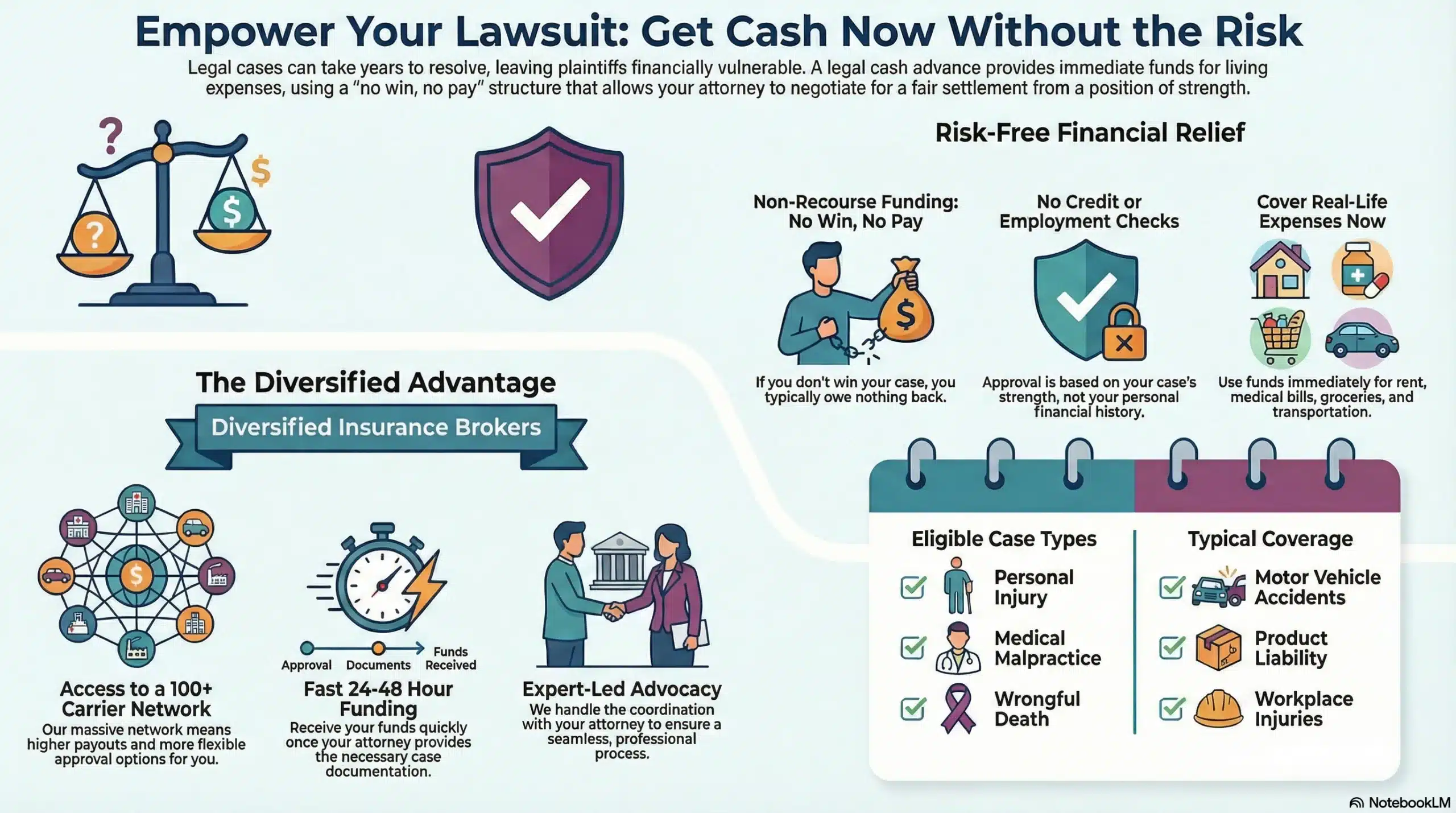
A pre-settlement cash advance — also called pre-settlement funding, a lawsuit cash advance, or a legal funding advance — is typically a non-recourse advance based on your anticipated settlement or judgment amount. Non-recourse means that repayment generally depends on your case outcome rather than your personal financial situation. If your case does not result in a settlement or judgment in your favor, you typically do not repay the advance — provided your agreement clearly states the non-recourse structure. This is what distinguishes pre-settlement funding from a conventional loan in the most fundamental sense: a traditional loan requires repayment regardless of what happens in your case, while a non-recourse pre-settlement advance ties the repayment obligation to the outcome of the legal claim itself.
This is why many people describe pre-settlement funding as having no personal financial risk compared to traditional borrowing: there are generally no monthly payments while the case is pending, and approval is based on the strength and estimated value of the legal claim rather than your credit score, employment status, or income history. The effective collateral is the case itself — not your personal assets, not your home, not your credit. An injured plaintiff who is unemployed because of the injury and has poor credit history can often qualify for pre-settlement funding when they would be declined for virtually any traditional lending product, because the funding company is evaluating the case rather than the borrower. How lawsuit loans work covers the mechanics and terminology in detail for plaintiffs comparing options and trying to understand what they are actually agreeing to when they accept a funding offer.
You will also see the term “loan” used frequently in this context online. While some people say “pre-settlement loan,” the legal structure in most cases is closer to an advance or a purchase of an interest in the settlement proceeds rather than a conventional loan transaction. The label matters less than the contract language. What matters is that you understand exactly how repayment is calculated, what the cost structure looks like over different time periods, and how the funding company gets paid when the case resolves. Money during a lawsuit covers the full picture of how plaintiffs navigate financial needs during active litigation and what options exist beyond pre-settlement funding for managing the financial gap between injury and resolution.
Why Plaintiffs Use Pre-Settlement Funding
Most people do not plan to seek legal funding when they file a claim. They do it because the legal process and real life do not run on the same timeline, and the gap between them creates financial consequences that accumulate faster than most plaintiffs anticipate when their case begins. Even strong cases with clear liability can take many months or longer to resolve due to medical treatment timelines, record collection, expert witness review, insurance carrier negotiation strategies, litigation scheduling, and court backlogs that have extended in recent years. Throughout that entire period, the financial obligations of daily living continue without interruption regardless of the case status.
One of the most powerful and most underappreciated benefits of pre-settlement funding is its role in protecting settlement value. Insurance companies and defense attorneys are sophisticated negotiators who understand that a financially distressed plaintiff has a compressed time horizon — the pressure to accept any reasonable offer becomes overwhelming when rent is past due, utilities are about to be disconnected, or medical bills are going to collections. When a plaintiff can sustain household financial stability through a cash advance, that leverage largely disappears. Settlement decisions can be made based on what the case is actually worth rather than what is needed to survive this week. Cash for lawsuit plaintiffs covers the qualification and funding process from the plaintiff’s perspective across different case types and financial situations. How much you can get from pre-settlement funding covers the specific factors that drive funding amount calculations and provides a framework for realistic expectations before submitting an application.
Pre-Settlement Cash Advance vs. Traditional Loan: Key Differences
| Feature | Pre-Settlement Cash Advance | Traditional Loan |
|---|---|---|
| Approval based on | Strength of the legal claim — liability, damages, insurance coverage, and probability of recovery | Borrower’s credit score, income, employment history, and debt-to-income ratio |
| Repayment obligation | Non-recourse — repayment generally depends on case outcome; if no recovery, typically no repayment owed | Recourse — full repayment required regardless of any external circumstances or outcomes |
| Monthly payments | None while case is pending — repayment comes from settlement proceeds at case resolution | Monthly payments begin immediately and continue regardless of financial situation |
| Credit check required | Generally no — approval is case-based, not borrower-based | Yes — credit history is a primary approval factor |
| Employment required | No — injured and unemployed plaintiffs frequently qualify based on case strength alone | Yes — income verification is standard; unemployment typically disqualifies applicants |
| Risk if case is lost | Typically no repayment required under true non-recourse structure — funding company assumes case risk | Full repayment still required — borrower bears all financial risk regardless of any external circumstance |
| Attorney involvement | Required — documentation coordinated through attorney; repayment structured through settlement disbursement | None — entirely independent of any legal representation or case outcome |
| Cost structure | Typically higher than conventional credit — reflects the risk the funding company assumes by waiting for case resolution | Lower interest rates reflecting lower lender risk — but monthly payments create immediate cash flow pressure |
How a Pre-Settlement Cash Advance Works
Pre-settlement funding is attorney-coordinated by design, because legitimate funding decisions are case-based and documentation-based rather than borrower-based. The funding company needs attorney verification and actual case documentation to evaluate the claim — which is both what protects the plaintiff from being offered more than their case can support and what protects the funding company from advancing against a claim that lacks the documented merit to produce a recovery. Any funding company that offers a large advance without speaking to the attorney or reviewing documentation should be approached with significant caution — legitimate approvals are documentation-driven, not sales-driven.
The process generally follows a straightforward sequence. The plaintiff submits a request with basic case details and attorney contact information. The funding company contacts the attorney for case verification and required documentation. The underwriting team reviews the file — evaluating liability clarity, damages documentation, available insurance coverage, and the expected timeline to resolution — and either makes an offer with disclosed terms or declines the application with an explanation. If an offer is made, the plaintiff and attorney review the terms before anything is accepted. Once the agreement is signed, funds are typically issued quickly — in many cases within 24 to 48 hours after documentation is complete and the agreement is executed. Timing depends heavily on how quickly the attorney provides documentation, how complete the medical records are, and how clear the liability picture is at the time of application. Cases with well-documented liability and treatment records move fastest; cases that are early-stage or have incomplete documentation may take longer or may not qualify until the file develops further. Injury lawsuit cash advance covers how funding specifically helps personal injury plaintiffs manage the financial gap between injury and resolution. Get cash before your case settles and get cash before your lawsuit settles cover the application process and what to expect at each stage for plaintiffs moving through the funding request for the first time.
How Much Can You Receive?
Funding amounts are generally based on the estimated settlement value, available insurance coverage and collectability, existing liens, attorney fees, case costs, and the overall strength of the claim. Funding companies advance only a portion of anticipated net recovery — not the gross settlement amount — because the settlement proceeds must also cover attorney contingency fees, case expenses, medical liens or subrogation claims, and other obligations that reduce the net amount the plaintiff actually receives. Advancing too much relative to the expected net recovery would leave insufficient proceeds at settlement to repay the advance, which serves no one’s interests.
Early-stage cases with unclear liability may qualify for smaller advances or be declined until the file develops further documentation. Cases with clear liability, strong medical documentation, documented damages, and stable treatment records can often support larger offers because the underwriting picture is more complete and the probability of recovery is better established. The most important strategic principle for any plaintiff considering pre-settlement funding is to borrow only what is genuinely needed for essential expenses — not the maximum amount available. Because costs accumulate over the life of the case, a larger advance combined with a longer case timeline can significantly reduce the net recovery at settlement. Taking only what is needed for stability while the attorney negotiates from a position of strength produces better outcomes than maximizing the advance amount. How much you can get from pre-settlement funding covers the specific factors that drive funding amount calculations in detail.
What Your Attorney Needs to Provide
Attorney involvement is a structural requirement of legitimate pre-settlement funding — not a procedural formality. The decision is based on real case facts that only the attorney can provide reliably, and the repayment structure is embedded in the settlement disbursement process that the attorney controls. While specific requirements vary by funding company and case type, most funding reviews require a signed authorization permitting the case review, incident details and current claim status, insurance carrier information and available coverage limits when relevant, medical treatment summaries and records as available at the time of application, any settlement offers or current negotiation status, and known liens or obligations that may affect the net proceeds available for distribution.
If an attorney is slow to respond to documentation requests, the approval timeline extends accordingly — which is why notifying the attorney that a funding review is in progress and asking them to prioritize documentation requests when the funding company reaches out can significantly accelerate the process. Cases where the attorney is responsive and documentation is complete move to funding much faster than cases where documentation is piecemeal or the attorney is unaware the plaintiff has applied. Legal funding fast pre-settlement cash advances covers the documentation and timeline mechanics in detail. Is lawsuit funding safe covers the evaluation framework plaintiffs should use to assess funding providers and terms before committing to any arrangement. Legal funding companies covers how to evaluate providers across transparency, documentation requirements, and disclosed fee structures.
Types of Cases We Fund
Pre-settlement cash advances are most available for civil cases with identifiable liability, documented damages, and available insurance coverage or collectible defendant assets from which a recovery can reasonably be expected. Personal injury claims with documented injuries and established liability coverage are among the most commonly funded case types. Car accident cases with injury and liability insurance, slip and fall claims where negligence can be demonstrated, medical malpractice cases with clear damages documentation, product liability cases, and wrongful death lawsuits with documented recovery potential all frequently qualify for pre-settlement funding. Workplace injury claims can qualify depending on jurisdiction and case structure. Medical malpractice lawsuit funding covers the specific documentation and underwriting requirements for this complex, high-value case category. Cash advance for a lawsuit covers the application process and eligibility factors across different civil case types. Not every case qualifies, and that is expected — eligibility depends on liability clarity, documentation completeness, and the expected recovery. The fastest way to determine whether a specific case qualifies is to submit a request and allow the underwriting review to assess it through the attorney.
Why Use Our Network Approach
Many legal funding companies operate as single providers with a fixed underwriting appetite that either fits a given case or does not. That can limit options to whatever that one company will approve at whatever terms they offer — with no competitive pressure to improve the offer or find a better structure for the case. Our network approach works differently: by working across a broad pool of legal funding partners, we can compare pathways and pursue an offer that fits the specific case rather than forcing the case into one provider’s narrow eligibility criteria. For plaintiffs, this typically means more competitive offers when the case supports a strong advance, higher potential payouts when multiple funding sources can be compared simultaneously, and faster approvals when attorneys provide documentation promptly because the network can move in parallel rather than sequentially. It also means cases that might be declined by a single provider may qualify through a different funding partner whose underwriting criteria better match the case’s specific profile. Lawsuit funding fast legal cash advances covers the full landscape of case types and what distinguishes qualifying from non-qualifying cases across different underwriting frameworks. Cash for lawsuit plaintiffs covers the funding experience from the plaintiff’s perspective.
Using Funding Strategically to Protect Your Net Recovery
The most consequential mistake plaintiffs make with pre-settlement funding is treating it as a long-term financial solution rather than a short-term stability tool. Because the cost of funding accumulates over the life of the case — and because case timelines can extend significantly beyond initial expectations — a larger advance combined with a longer resolution timeline can meaningfully reduce the net amount received at settlement. Understanding the cost structure before accepting any offer is essential for making informed decisions about how much to borrow and when.
Strategic use of pre-settlement funding means borrowing only the amount genuinely needed to stabilize essential household expenses — rent, utilities, groceries, medical costs, transportation — without extending to discretionary spending that can wait. It means asking the funding company for cost scenarios showing the total repayment obligation if the case resolves in three months, six months, twelve months, and eighteen months — because the difference between simple interest and compounding structures can be significant over a longer timeline, and understanding this before signing helps plaintiffs evaluate whether the advance makes financial sense given the expected case duration. It means coordinating with the attorney so the plaintiff understands existing liens, attorney fees, and anticipated case costs before determining how much of the expected net recovery can support an advance. And it means treating the funding as a tool to preserve attorney negotiating leverage — reducing the financial pressure that would otherwise force an early, undervalued settlement — rather than as a source of discretionary spending during the case period. Advance on lawsuit settlement covers how advances are structured against expected proceeds and what the repayment calculation looks like at case resolution.
Strengthening Your Overall Financial Safety Net
While a pre-settlement cash advance addresses the immediate financial gap created by an injury and pending litigation, the broader financial vulnerability that a serious injury creates extends beyond the case timeline. An injury that disrupts income for months can expose gaps in income protection, health coverage, and long-term financial planning that existed before the injury but were not apparent until the financial structure of daily life was disrupted by the inability to work. While your case is still in motion and your financial situation is in focus, it may be a productive time to evaluate the protection infrastructure that would reduce similar vulnerability in the future.
Short-term health insurance can bridge coverage gaps for plaintiffs who have lost employer-sponsored health coverage due to the injury and have not yet established alternative coverage. Income protection through disability coverage addresses the risk of income disruption from future injuries or illness that a settlement or cash advance cannot address on a recurring basis — because disability insurance provides ongoing income replacement during a disabling period rather than a one-time advance. Longer-term financial planning through life insurance addresses the income replacement risk for dependents that exists independently of any litigation outcome. These protection tools do not replace what pre-settlement funding provides during active litigation, but they address the underlying financial vulnerability that made the pre-settlement funding necessary in the first place.
Get Your Pre-Settlement Cash Advance Today
Higher payouts, quick funding, and no risk to you. Apply now and get approved fast.
Related Pages
Explore more lawsuit funding resources and settlement-advance options.
Talk With an Advisor Today
Choose how you’d like to connect—call or message us, then book a time that works for you.
Schedule here:
calendly.com/jason-dibcompanies/diversified-quotes
Licensed in all 50 states • Fiduciary, family-owned since 1980
Frequently Asked Questions: Pre-Settlement Cash Advance
What is a pre-settlement cash advance and how is it different from a loan?
A pre-settlement cash advance is a non-recourse advance against the anticipated value of a pending legal settlement. The critical distinction from a traditional loan is the non-recourse structure: repayment is generally dependent on the outcome of the case rather than on the plaintiff’s personal financial obligation. If the case does not result in a recovery, most non-recourse pre-settlement funding arrangements do not require repayment. Traditional loans require full repayment regardless of any external circumstances. Additionally, pre-settlement funding approval is based on the strength of the legal claim — liability clarity, damages documentation, and available insurance coverage — rather than on the plaintiff’s credit score, income, or employment history. This is why injured, unemployed, and credit-challenged plaintiffs can frequently qualify for pre-settlement funding when they would not qualify for traditional loan products.
How quickly can I receive a pre-settlement cash advance?
Many pre-settlement funding approvals can be completed and funded within 24 to 48 hours after the attorney provides the necessary documentation and the funding agreement is signed. Cases with clearly established liability, strong insurance coverage, well-documented injuries, and an attorney who responds promptly to documentation requests are typically the fastest to fund. Cases that are very early in development, have unclear liability, or are missing key documentation may take longer or may not qualify until the file develops further. The most effective way to accelerate the timeline is to complete the application accurately and notify your attorney that a funding review is in progress so they can prioritize the documentation requests when the funding company reaches out.
How much of my settlement can I receive as a cash advance?
Funding amounts are based on the estimated net settlement value — the gross settlement reduced by attorney fees, case costs, medical liens, and other obligations that will be satisfied from proceeds before the plaintiff receives the remainder. Funding companies advance only a portion of the expected net recovery to ensure the advance plus accumulated costs can be repaid from settlement proceeds without consuming the plaintiff’s entire net recovery. Key factors that affect the available amount include liability clarity, injury severity and treatment documentation, available insurance coverage limits, case stage relative to expected resolution, attorney cooperation, and whether prior funding has already been taken against the same case. A personalized estimate requires reviewing the actual case details with the funding company’s underwriting team through your attorney.
Does receiving pre-settlement funding affect my case?
In most situations, receiving pre-settlement funding does not affect the legal strategy of the case because the funding company has no involvement in or control over the lawsuit. The case continues to be handled entirely by your attorney, and all settlement decisions remain yours and your attorney’s to make. The primary financial impact is that an advance accepted must be repaid from settlement proceeds at resolution, which reduces the net amount the plaintiff receives at the end. The strategic benefit is that removing financial pressure allows the plaintiff to wait for a genuinely fair settlement rather than accepting a low offer driven by financial desperation. In many cases, having funding in place actually improves the settlement outcome by giving the attorney the time needed to negotiate effectively without the client pressuring for an early resolution.
What types of cases qualify for a pre-settlement cash advance?
Pre-settlement funding is most available for civil cases with identifiable liability, documented damages, and available insurance coverage or collectible defendant assets. Common qualifying case types include personal injury claims, auto accident cases with injury and liability coverage, slip and fall claims where negligence can be demonstrated, medical malpractice cases with clear damages evidence, product liability cases, and wrongful death lawsuits with documented recovery potential. Workplace injury claims may qualify depending on jurisdiction and case structure. Not every case qualifies — cases with unclear liability, inadequate insurance coverage, or insufficient damages documentation may not meet underwriting criteria. Submitting an application for review through your attorney is the most reliable way to get a definitive answer for a specific case situation.
About the Author:
Jason Stolz, CLTC, CRPC, DIA, CAA and Chief Underwriter at Diversified Insurance Brokers (NPN 20471358), is a senior insurance and retirement professional with more than 25 years of real-world experience helping individuals, families, and business owners protect their income, assets, and long-term financial stability. As a long-time partner of the nationally licensed independent agency Diversified Insurance Brokers, Jason provides trusted guidance across multiple specialties—including fixed and indexed annuities, long-term care planning, personal and business disability insurance, life insurance solutions, Group Health, Travel Medical and Evacuation Insurance, and short-term health coverage. Diversified Insurance Brokers maintains active contracts with over 100 highly rated insurance carriers, ensuring clients have access to a broad and competitive marketplace.
His practical, education-first approach has earned recognition in publications such as VoyageATL, and contributions from his agency featured in Kiplinger and GoBankingRates— highlighting his commitment to financial clarity and client-focused planning. Drawing on deep product knowledge and years of hands-on field experience, Jason helps clients evaluate carriers, compare strategies, and build retirement and protection plans that are both secure and cost-efficient. Visitors who want to explore current annuity rates and compare options across multiple insurers can also use this annuity quote and comparison tool.
Explore All Lawsuit Loan & Legal Funding Options: Browse our complete guide to Lawsuit Loans & Legal Funding — covering pre-settlement funding, lawsuit cash advances, injury claims & more.
Last Reviewed: June 16, 2026 |
Reviewed by: Jason Stolz, CLTC, CRPC, DIA, CAA
Chief Underwriter, Diversified Insurance Brokers, Inc. | NPN: 20471358 | Diversified Insurance Brokers, Inc. — Licensed in all 50 states
Fact Checked by: Tonia Pettitt, CMIP©
Medicare Specialist, Diversified Insurance Brokers, Inc. | NPN: 14374308 | Diversified Insurance Brokers, Inc. — Licensed in all 50 states
Did you find this content helpful? Leave us a Google review — it helps others find trustworthy guidance too.
Editorial Standards: Diversified Insurance Brokers maintains rigorous editorial standards to ensure accuracy, clarity, and independence in all content. Learn more about our editorial standards and commitment to transparency.
