
Cash Advance for Lawsuit – Fast Pre Settlement Funding
Cash Advance for Lawsuit – Fast Pre Settlement Funding

Jason Stolz CLTC, CRPC, DIA, CAA
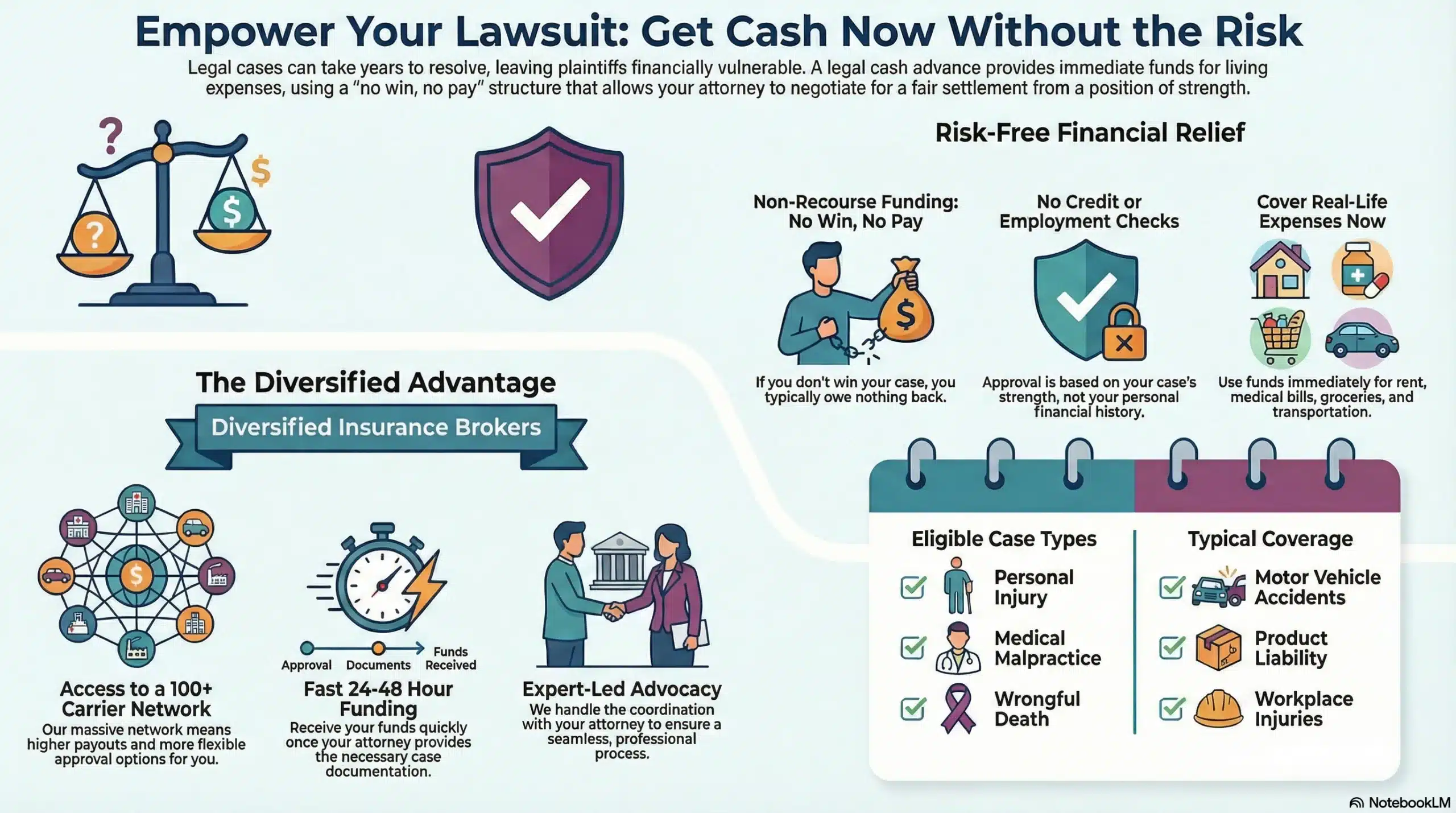
A cash advance for a lawsuit is money available to you now, while your case is still pending — before any settlement is reached, before any judgment is entered, and before any insurance company writes a check. The financial pressure that builds while a personal injury case moves through the legal system is real and predictable: medical bills continue to arrive, rent does not stop being due, income from a job you can no longer perform does not replace itself, and the legal timeline — which averages approximately 23 months for a standard tort case and 31 months for a medical malpractice claim — does not compress simply because your financial situation requires it to. Pre-settlement funding exists specifically to address this problem. It is not a bank loan underwritten on your credit or employment history. It is a non-recourse cash advance against a potential future settlement — meaning that in most agreements, if your case does not result in a recovery, you do not repay the advance. The funder takes on the risk of the case, not you personally. Our resource on what is pre-settlement funding covers the full definition and structure, and our resource on pre-settlement funding vs. lawsuit loans explains why the non-recourse distinction is critical to understanding what you are actually agreeing to.
The pre-settlement funding market reached approximately $19.62 billion in 2025 and is growing at over 12% annually — reflecting the reality that tens of thousands of plaintiffs each year face the same gap between legal timelines and financial obligations. Approximately 15% of personal injury plaintiffs seek some form of pre-settlement funding during their case. The most common use of the funds is straightforward: covering rent or mortgage while unable to work, maintaining medical treatment that would otherwise be interrupted, keeping utilities and transportation active, and avoiding the kind of financial emergency that pushes plaintiffs toward premature, undervalued settlements. Insurance adjusters are fully aware that financial pressure accelerates settlement timing and often depresses settlement amounts — a plaintiff who can maintain financial stability through the case resolution process is in a fundamentally different negotiating position than one who cannot. Our resource on how pre-settlement funding works covers the mechanics from application through repayment, and our resource on how lawsuit loans work covers the process in plain terms for first-time applicants.
We partner with one of the largest lawsuit funding networks in the country, which means we can match cases to funding sources that specialize in specific case types and often secure higher advance amounts than smaller or single-source providers can offer. Funding decisions are based on the strength of your case — liability clarity, documented damages, insurance coverage available, and anticipated resolution timeline — not on your credit score, employment history, or income. Your attorney is a required participant in the process because the advance is tied to the claim and repaid from settlement proceeds. Keeping your attorney informed and involved is not optional; it is how the process functions. Our resource on legal cash advances covers our approach to the funding network and how we work with plaintiff attorneys, and our resource on pros and cons of pre-settlement funding provides a balanced framework for deciding whether this tool is appropriate for your specific situation.
Apply for a Lawsuit Cash Advance
Fast review, attorney-coordinated, higher payouts through our national funding network.
No credit check. No repayment if you lose. Funds typically available in 24-48 hours after approval.
Request Your Cash AdvanceCase Types That Qualify — What Funders Evaluate for Each
Not every lawsuit qualifies for pre-settlement funding. Funders evaluate the specific case characteristics — not a blanket category — and different case types present different approval profiles. The table below maps the most common case types to their typical approval outlook and the factors that matter most in each evaluation.
| Case Type | Typical Approval Outlook | What Strengthens the Case for Funding | Common Timeline | Dedicated Resource |
|---|---|---|---|---|
| Car accident / motor vehicle | Very common — highest approval volume in the market; well-understood case type with clear liability and documented insurance coverage | Police report confirming fault, documented injuries, ongoing medical treatment, known insurance policy limits on the at-fault driver | 6-24 months typically; longer when liability is disputed or injuries are severe | Car Accident Lawsuit Funding |
| Slip and fall / premises liability | Frequently approved; property owner liability and insurance coverage are the key variables; comparative negligence questions affect amount | Documented hazardous condition, incident reports, medical treatment confirming injury, commercial property with liability insurance | 12-30 months; longer when liability is contested or injuries require extended treatment | Slip and Fall Lawsuit Funding |
| Workers’ compensation | Approvable but more complex; state rules vary significantly; third-party claims alongside the workers’ comp claim improve the funding picture | Third-party negligence claim in addition to workers’ comp; permanent injury documentation; active attorney representation; known employer insurance carrier | 18-36+ months for significant workers’ comp claims; settlements often delayed by disputes over permanent disability rating | Workers’ Comp Funding |
| Medical malpractice | Approvable for strong cases; requires demonstrated deviation from standard of care and documented harm; malpractice cases average 31 months to resolve | Expert witness retained, clear standard-of-care deviation documented, serious documented injury, experienced malpractice attorney with active case development | 24-48+ months; among the longest average timelines in the personal injury market | Medical Malpractice Funding |
| Wrongful death | Approvable for estate cases with clear liability; damages are typically substantial; estate representative must be authorized to act | Clear liability, established estate representation, documented economic and non-economic damages, defendant with insurance or assets to satisfy judgment | 18-36+ months; emotionally complex cases with multiple claimants can extend further | Wrongful Death Funding |
| Wrongful termination / employment | Approvable for strong employment cases; damages and timeline are more variable than personal injury cases; EEOC filing and active lawsuit required | Active lawsuit filed (not just EEOC charge), documented protected class status, strong evidence of discriminatory or retaliatory action, experienced employment attorney | 18-36+ months; employment cases have variable timelines depending on jurisdiction and complexity | Wrongful Termination Funding |
| Other personal injury (product liability, assault, premises, dog bite, etc.) | Varies by specific facts; most personal injury cases with clear liability and documented injury are eligible; product liability cases with multiple plaintiffs can be favorable | Clear defendant identification, liability insurance or assets available, documented injury and treatment, experienced PI attorney with contingency agreement | 12-36+ months depending on case complexity and defendant | Personal Injury Lawsuit Funding |
Case type eligibility and funding amounts are determined by the specific facts of each case, not by category alone. Funding availability varies by state — approximately 17 states restrict or regulate pre-settlement funding. Consult your attorney before pursuing any funding agreement. This table reflects general market patterns based on current research and does not constitute a guarantee of funding approval for any specific case.
How a Lawsuit Cash Advance Works — Non-Recourse Explained
The term “non-recourse” is the most important concept in pre-settlement funding and the most frequently misunderstood. In a conventional loan — bank loan, personal loan, credit card — the debt follows the borrower regardless of what happens. If you take out a $10,000 personal loan and an unexpected event prevents repayment, the debt still exists and the lender can pursue collection. Pre-settlement funding operates on a fundamentally different principle: the advance is secured against the potential recovery from the specific case, not against the borrower personally. If the case does not result in any recovery — if it is dismissed, if you lose at trial, if the defendant has no collectible assets — most non-recourse agreements do not require repayment. The funder absorbs the loss. This is why approval decisions focus entirely on the case, not on the plaintiff’s personal financial situation. The 7% of consumer personal injury cases that result in no recovery are the cases where funders accept a write-off — the risk they price into the rates charged on successful cases. Our resource on pre-settlement funding vs. lawsuit loans explains the legal and structural distinction in detail, and our resource on is lawsuit funding safe covers what due diligence looks like when evaluating a funding agreement.
The Application and Approval Process
The funding process is designed to be simple for the plaintiff and primarily coordinated through the attorney. The typical sequence involves four steps. First, you submit a brief application with the basic facts of your case — case type, attorney information, and a description of the incident and injuries. No credit check, employment verification, or income documentation is required at this stage. Second, the funding team contacts your attorney directly to request case documentation — attorney representation confirmation, insurance coverage information, treatment records or demand history if available, and any relevant liability documentation. Third, the funder evaluates the case’s merits — primarily liability strength, documented damages, available insurance coverage, and estimated timeline — and determines whether to approve and at what amount. Fourth, if the case is approved, you review the agreement, your attorney confirms the terms, and funds are typically sent within 24-48 hours of final confirmation. The attorney’s involvement is not optional — it is how the advance is structured and how repayment is handled at settlement. Our resource on how pre-settlement funding works covers each step in detail, and our resource on advance on a pending lawsuit covers what plaintiffs at different stages of the legal process should expect when they apply.
What Pre-Settlement Funding Costs — The Numbers You Need Before Signing
Pre-settlement funding is not free money. It is a financial tool with real costs that can be significant if the case timeline extends. Fees in the pre-settlement market typically range from 2% to 5% per month, which translates to an effective annual rate of approximately 27% to 60% or higher. Some funders charge rates that, when calculated as an effective annual rate, exceed 100% or even 150%. A $10,000 advance at a typical monthly fee structure can become a $15,000 to $20,000 repayment obligation over two years. This is not a flaw to avoid; it is the cost of the non-recourse risk structure — the same structure that means you owe nothing if you lose. But it makes one step essential before signing any agreement: ask for a written payoff schedule showing estimated totals at 6, 12, 18, and 24 months. That single document makes the real cost of the funding transparent and allows a meaningful comparison between funding agreements. Our resource on lawsuit loan rates and how to compare costs covers the cost evaluation framework in detail, and our resource on is pre-settlement funding worth it covers the analysis of whether the cost is justified by the specific financial and legal situation.
How Much Can You Actually Receive?
Advance amounts are sized as a percentage of the estimated net settlement value — the projected settlement amount after deducting attorney fees, case costs, and any medical liens. Most funders advance approximately 10% to 15% of the expected net value, with stronger cases (clear liability, documented damages, known high-limit insurance coverage) sometimes supporting higher percentages. A case projected to net $100,000 to the plaintiff after fees and liens might support an advance of $10,000 to $15,000. Cases with less certainty, ongoing treatment, or unclear liability may receive smaller advances or require additional documentation before a larger advance is considered. Our resource on how much you can get from pre-settlement funding covers the calculation framework and what variables most affect the advance amount. If you need funds but your case is still early-stage, applying now allows the funder to review what exists and provide guidance on timing even if immediate approval isn’t possible. Our resource on money during a lawsuit and our resource on need money before settlement cover the specific financial planning context for plaintiffs at different points in the case timeline.
Critical Decisions Before You Apply
Three decisions separate plaintiffs who use pre-settlement funding effectively from those who later wish they had approached it differently. First, borrow the minimum you genuinely need rather than the maximum you are offered. Because fees accrue monthly, the longer your case takes, the more the advance costs. A smaller advance at the same rate accumulates a smaller repayment obligation. Second, get a payoff schedule before signing — not a verbal estimate, a written schedule showing what you would owe at multiple time points. Third, keep your attorney informed at every step. Your attorney knows the case timeline, the insurance coverage, the defendant’s likely behavior, and the best strategy for your specific situation. A funding decision made without your attorney’s input is a decision made with incomplete information. Our resource on pros and cons of pre-settlement funding covers the decision framework, and our resource on pre-settlement funding companies covers what to look for when evaluating funders and how to compare multiple offers.
For Plaintiffs With Immediate Needs
If you need money now while your case is pending, the fastest path to funding is to have your attorney prepared to respond quickly to the funder’s information requests — case documentation, insurance information, and representation confirmation are the primary items that control approval speed. Once the attorney’s information is submitted, approvals can often be completed and funds sent within 24-48 hours. Our resources covering immediate funding needs include get cash before your case settles, get money before your settlement check, and injury lawsuit cash advance. Our resource on legal funding companies near you covers how to identify and compare funding sources in your area and how our network approach consistently produces higher advance amounts than single-company applications. Our resource on cash for lawsuit plaintiffs covers the funding landscape from the plaintiff’s perspective, and our resource on legal funding covers the full suite of pre-settlement financial solutions available to plaintiffs.
Talk With an Advisor Today
Choose how you’d like to connect—call or message us, then book a time that works for you.
Schedule here:
calendly.com/jason-dibcompanies/diversified-quotes
Licensed in all 50 states • Fiduciary, family-owned since 1980
FAQs: Cash Advance for Lawsuit
What does “non-recourse” mean and do I really owe nothing if I lose?
Non-recourse means the advance is secured against the potential recovery from your case — not against you personally. In most non-recourse agreements, if your case does not result in any recovery (is dismissed, lost at trial, or otherwise produces no settlement or judgment), you are not required to repay the advance. The funding company absorbs the loss. This is fundamentally different from a conventional loan, where the debt exists regardless of what happens to the underlying event. The non-recourse structure is what makes pre-settlement funding a risk-assumption product rather than a loan. You must still review your specific agreement carefully — “non-recourse” is a term that should be defined explicitly in writing before you sign anything.
How fast can I get funded after applying?
Funding can often be completed within 24 to 48 hours after the attorney confirms case information and the agreement is signed. The primary variable controlling speed is your attorney’s responsiveness — the funder needs attorney confirmation of representation, basic case details, and insurance information before approving. Plaintiffs who prepare their attorney in advance and have treatment records available typically move through the process fastest. Cases that are early-stage or require additional documentation take longer. Weekend and holiday timelines vary by funder.
Does my credit score affect whether I get approved?
No. Pre-settlement funding approval is based entirely on the strength of your case — liability clarity, documented injuries, available insurance coverage, and expected resolution timeline. Your credit score, employment status, income level, and financial history are not underwriting factors. This is one of the most important structural differences between pre-settlement funding and a personal loan. A plaintiff with a strong case and poor credit is as likely to be approved as one with excellent credit, provided the case facts support an advance.
How much will a lawsuit cash advance cost me?
Fees in the pre-settlement market typically range from 2% to 5% per month — which equates to an effective annual rate of approximately 27% to 60% or higher. Some funders charge rates that exceed 100% to 150% APR when calculated annually. A $10,000 advance can become a $15,000 to $20,000 repayment obligation if the case takes two years. The cost is the price of the non-recourse structure — the funder absorbs the loss on cases that don’t recover, and prices the risk across all cases. Before signing any agreement, request a written payoff schedule showing estimated totals at 6, 12, and 18 months. Never make a funding decision based on a verbal estimate alone.
Does my attorney need to be involved?
Yes — your attorney’s participation is required, not optional. The funder coordinates directly with your attorney to verify representation, evaluate case strength, and structure the repayment arrangement at settlement. Repayment is typically handled by the attorney from settlement proceeds before the remaining amount is distributed to you. An attorney who is actively representing you on a contingency basis is a standard requirement for most funders. Do not pursue funding without your attorney’s knowledge — it is both practically required and strategically important that your attorney understands the terms and timeline of any funding agreement that will affect your net settlement.
Will getting a cash advance hurt my lawsuit?
Funding itself does not affect the legal merits of your case or your ability to reach a fair settlement. In fact, the primary argument for funding is that it removes the financial pressure that causes plaintiffs to accept early, below-value settlements — meaning funding can actually support a better case outcome by giving your attorney time to build the strongest possible claim. The main risk is financial rather than legal: high fees that reduce your net settlement if the case takes longer than expected, and borrowing more than you need which compounds the cost. Your attorney is in the best position to advise on whether the funding amount and terms you are considering are appropriate given the expected case timeline and settlement range.
What is the difference between pre-settlement and post-settlement funding?
Pre-settlement funding occurs while the case is still pending — before any settlement has been reached or judgment entered. It carries higher rates because the outcome is still uncertain and the funder bears more risk. Post-settlement funding occurs after a settlement has been agreed upon but before the settlement check has been distributed — typically while waiting for paperwork, probate, or insurance processing. Because the outcome is already known, post-settlement funding generally carries lower rates and is easier to approve. If your case has already settled and you are waiting for the check, post-settlement funding may be a less expensive option than pre-settlement funding.
About the Author:
Jason Stolz, CLTC, CRPC, DIA, CAA and Chief Underwriter at Diversified Insurance Brokers (NPN 20471358), is a senior insurance and retirement professional with more than 25 years of real-world experience helping individuals, families, and business owners protect their income, assets, and long-term financial stability. As a long-time partner of the nationally licensed independent agency Diversified Insurance Brokers, Jason provides trusted guidance across multiple specialties—including fixed and indexed annuities, long-term care planning, personal and business disability insurance, life insurance solutions, Group Health, Travel Medical and Evacuation Insurance, and short-term health coverage. Diversified Insurance Brokers maintains active contracts with over 100 highly rated insurance carriers, ensuring clients have access to a broad and competitive marketplace.
His practical, education-first approach has earned recognition in publications such as VoyageATL, and contributions from his agency featured in Kiplinger and GoBankingRates— highlighting his commitment to financial clarity and client-focused planning. Drawing on deep product knowledge and years of hands-on field experience, Jason helps clients evaluate carriers, compare strategies, and build retirement and protection plans that are both secure and cost-efficient. Visitors who want to explore current annuity rates and compare options across multiple insurers can also use this annuity quote and comparison tool.
Explore All Lawsuit Loan & Legal Funding Options: Browse our complete guide to Lawsuit Loans & Legal Funding — covering pre-settlement funding, lawsuit cash advances, injury claims & more.
Last Reviewed: June 4, 2026 |
Reviewed by: Jason Stolz, CLTC, CRPC, DIA, CAA
Chief Underwriter, Diversified Insurance Brokers, Inc. | NPN: 20471358 | Diversified Insurance Brokers, Inc. — Licensed in all 50 states
Fact Checked by: Tonia Pettitt, CMIP©
Medicare Specialist, Diversified Insurance Brokers, Inc. | NPN: 14374308 | Diversified Insurance Brokers, Inc. — Licensed in all 50 states
Did you find this content helpful? Leave us a Google review — it helps others find trustworthy guidance too.
Editorial Standards: Diversified Insurance Brokers maintains rigorous editorial standards to ensure accuracy, clarity, and independence in all content. Learn more about our editorial standards and commitment to transparency.
