
Car Accident Lawsuit Loan – Fast Settlement Funding
Car Accident Lawsuit Loan – Fast Settlement Funding

Jason Stolz CLTC, CRPC, DIA, CAA
Car accident cases represent the single highest-volume category in the pre-settlement funding market — and for specific, structural reasons. The car accident plaintiff faces a financial timeline that is predictably misaligned with the legal timeline in ways that have nothing to do with the merits of the case. Medical treatment does not pause after a crash. Lost income from an inability to work does not wait for insurance negotiations. Rent, utilities, and basic household obligations do not hold. But the one thing that most experienced personal injury attorneys will tell a car accident client to do is wait — wait until Maximum Medical Improvement, the point where treatment is complete or stabilized, before submitting a formal demand. That waiting period, which can run from a few months for minor injuries to well over a year for serious ones, is the exact window where pre-settlement funding serves its purpose: providing financial stability so the wait can actually happen. Our resource on cash advance for lawsuit covers the full pre-settlement funding landscape, and our resource on what is pre-settlement funding explains the non-recourse structure that makes car accident funding different from a conventional loan.
The financial pressure that builds during a car accident case is not theoretical. Many car accident victims have Personal Injury Protection or MedPay coverage through their own auto insurance policy, and in no-fault states PIP is mandatory — but these benefits are capped, typically at amounts ranging from $5,000 to $25,000 depending on the state and policy, and they cover only medical expenses and a portion of lost wages in some states, not the full range of economic disruption that a serious car accident creates. When PIP runs out — often within the first few months of ongoing treatment — medical bills continue to arrive and the settlement that will eventually address them is still months away. Meanwhile, an insurance adjuster for the at-fault driver’s carrier may contact the plaintiff directly with a quick settlement offer. That offer, which requires permanently signing away all future claims related to the accident, is typically a fraction of what the case will eventually support — and accepting it out of financial necessity is exactly the outcome that insurance company settlement timing is designed to produce. Our resources on money during a lawsuit and need money before settlement cover the specific financial gap that plaintiffs face during this window.
Car accident cases are among the most predictable for pre-settlement funding approval because liability is typically clear from the police report, the insurance coverage picture is usually known early, and the medical documentation from consistent treatment provides an objective picture of damages. Rear-end collisions with a police report confirming fault, commercial truck crashes with corporate defendants and high-limit coverage, rideshare accidents with layered insurance structures, and DUI crashes with unambiguous liability all present funding profiles that funders understand well. The clarity and consistency of the car accident case structure — compared to, for example, a contested medical malpractice claim where liability itself is disputed by competing expert witnesses — is why car accident cases tend to move through the funding process faster and at higher advance amounts relative to settlement value. Our resource on how pre-settlement funding works covers the full process, and our resource on legal cash advances covers our network approach to maximizing advance amounts for car accident plaintiffs.
Get Car Accident Settlement Funding Today
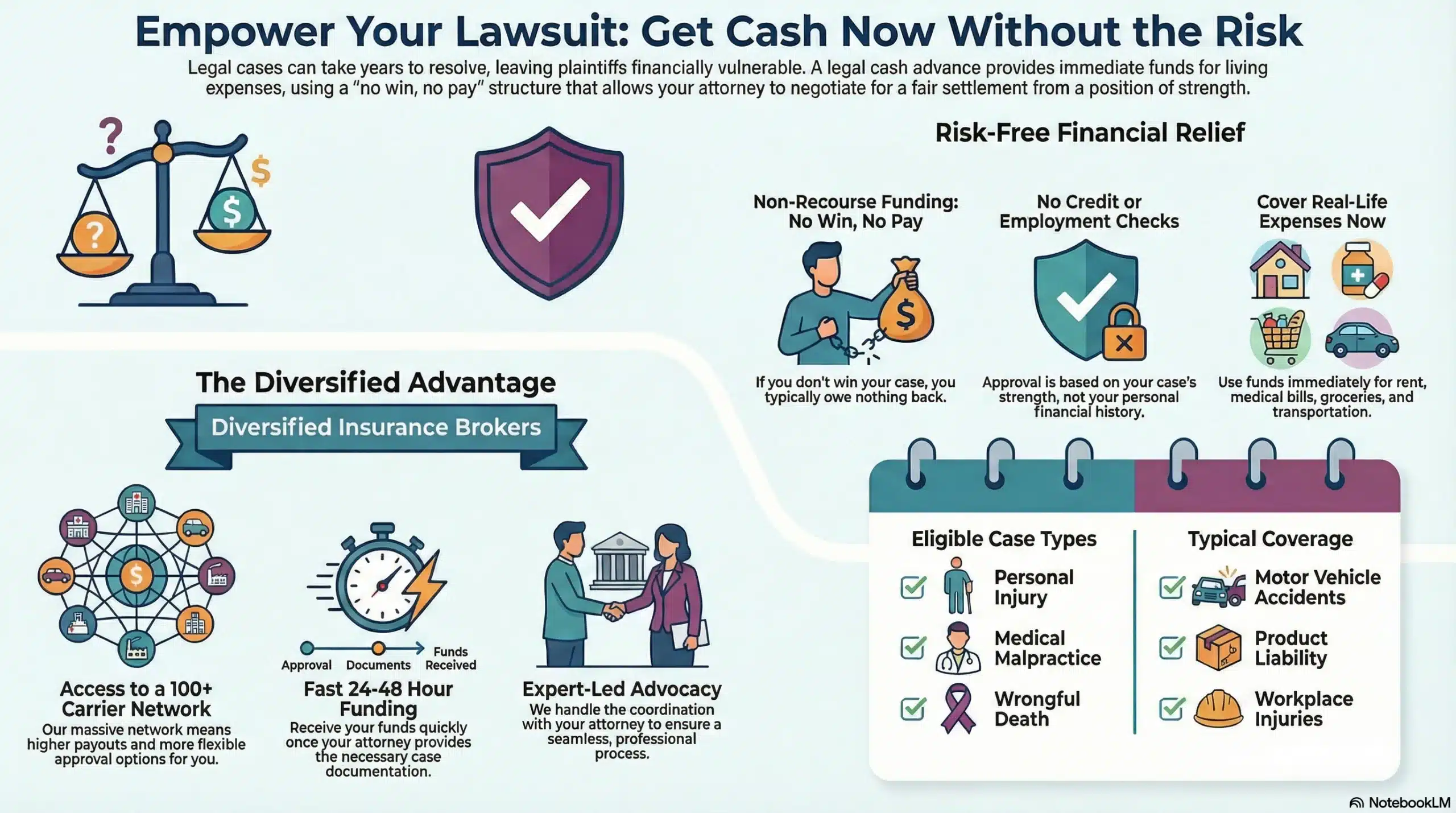
No credit check. Non-recourse — no repayment if you lose. Funds typically available within 24-48 hours after attorney confirmation.
Our national funding network competes for your case — producing higher advance amounts than most single-source providers can offer.
Car Accident Types and Their Typical Funding Profile
Not all car accident cases present the same funding profile. Liability clarity, insurance coverage available, injury severity, and expected timeline vary significantly by accident type. The table below maps common car accident scenarios to their typical funding outlook.
| Accident Type | Typical Liability Clarity | Insurance Coverage Consideration | Typical Funding Profile | Expected Settlement Timeline |
|---|---|---|---|---|
| Rear-end collision — clear fault | High — following driver at fault is well-established; police report typically confirms | At-fault driver’s liability coverage; your UM/UIM if limits are insufficient for serious injuries | Strong — one of the fastest and most straightforward case types for funding approval; injury documentation is the key variable | 3-12 months for moderate injuries; 12-24+ months for serious injuries requiring full treatment documentation |
| T-bone / intersection collision | Variable — depends on traffic control, witness accounts, dashcam footage, and police report; right-of-way disputes can complicate liability | At-fault driver’s liability; comparative negligence issues may reduce available recovery in some states | Moderate to strong when liability evidence is clear; comparative negligence states require case-specific analysis | 6-18 months; longer when liability is actively disputed |
| DUI / drunk driving crash | Very high — DUI arrest creates near-conclusive liability; criminal case often parallels the civil claim | At-fault driver’s liability; potential dram shop liability (bar or restaurant); punitive damages possible in some states | Very strong when injuries are documented; DUI cases often produce higher settlements due to clear liability and potential punitive element | 9-24 months; civil case often waits for criminal proceedings to advance |
| Distracted driving (texting, phone use) | High when phone records or dashcam confirm distraction; moderate when distraction must be inferred from circumstantial evidence | At-fault driver’s liability; employer liability possible if driver was working at time of crash | Strong when phone record evidence exists; attorneys increasingly able to subpoena records to confirm timing | 6-18 months; longer if employer liability is pursued |
| Commercial vehicle / semi-truck | Variable — commercial carriers have professional accident response teams who arrive quickly; black box / ELD data is critical | Commercial carrier policy (often $1M+ minimum); potential employer and cargo owner liability; multiple coverage layers | Very strong advance potential due to high policy limits and documented damages; reviews can take slightly longer due to case complexity and corporate defendants | 12-36+ months; trucking cases are complex and often go to litigation for fair recovery |
| Rideshare accident (Uber / Lyft) | Variable by driver status — in-app active ride has clear rideshare insurance coverage; app-off status creates coverage disputes | Rideshare company policy (up to $1M+ during active ride); personal auto policy during other periods; coverage disputes common | Strong when driver was on active ride; more complex during coverage-dispute periods; higher potential than standard personal auto case due to corporate coverage | 9-24 months; coverage dispute resolution adds time in some cases |
| Hit and run — uninsured motorist (UM) coverage | Liability established against identified at-fault driver; UM claim against your own insurer when at-fault driver is unidentified or uninsured | Your own UM/UIM coverage is the recovery source; limits depend on your policy; UM claims against your own insurer can be adversarial | Approvable when UM coverage is confirmed and case is strong; your own insurer may contest the claim more aggressively than a third-party carrier | 9-24+ months; UM litigation against your own insurer is common for serious injuries |
Funding profiles reflect general market patterns. Individual case outcomes depend on specific facts, applicable state law, insurance coverage available, documented damages, and attorney strategy. Funding availability and terms vary by state. Consult your attorney before pursuing any funding agreement.
PIP and MedPay — What They Cover and Why They Are Not Enough
Personal Injury Protection (PIP) is mandatory in no-fault states — including Florida, New York, Michigan, New Jersey, Pennsylvania, and others — and pays for initial medical costs and sometimes a portion of lost wages regardless of who caused the accident, processed through your own auto insurer. MedPay is an optional coverage available in fault states that covers medical costs similarly, though typically without the lost wage component. Both PIP and MedPay serve an important immediate function: they can pay initial emergency room, ambulance, and early treatment costs without waiting for the liability determination. The critical limitation is the cap — PIP limits range from as low as $5,000 in some states to $50,000 or more in others, and MedPay limits elected by policyholders are often in the $5,000 to $10,000 range. A serious injury — a herniated disc requiring physical therapy and specialist consultations, a fracture requiring surgery, a traumatic brain injury — can exhaust both PIP and MedPay within the first few months of treatment. When those benefits run out, medical bills continue. The settlement that will ultimately address the full scope of damages is still months away. The financial gap between PIP/MedPay exhaustion and settlement is precisely the window where pre-settlement funding matters most.
Why Insurance Company Tactics Make Funding Strategically Valuable
Insurance companies handling at-fault driver liability claims are not neutral parties working toward a fair resolution. They are businesses managing loss ratios, and the settlement offer they make represents their economic interest, not the plaintiff’s. The tactics used by insurance adjusters to reduce settlement values are well-documented and specific. Early settlement offers — often made within days or weeks of the accident, before treatment is complete and before the full scope of injuries is known — are a primary tool. These offers require the plaintiff to permanently release all future claims related to the accident in exchange for what can appear to be a meaningful sum. Accepting an early offer before reaching MMI means surrendering all claims for future medical costs, future lost wages, and any permanent impairment — costs that may not yet be fully visible. The insurance company’s adjusters know this, and the offer is sized accordingly. A second common tactic is investigation delay — requesting additional documentation, conducting recorded statement interviews, initiating independent medical examinations, and extending response timelines in ways that, while technically permissible, create pressure through accumulated financial strain. Financial pressure is the mechanism that converts a well-founded claim into an undervalued settlement. Pre-settlement funding removes that mechanism. Our resource on pros and cons of pre-settlement funding covers the strategic value and the real costs, and our resource on is pre-settlement funding worth it covers the framework for deciding whether the cost is justified by the specific situation.
The MMI Rule — Why Your Attorney Is Waiting and What You Need in the Meantime
Maximum Medical Improvement is the point at which a treating physician determines that a patient has recovered as fully as they are expected to recover, or has reached a stable plateau where further significant improvement is unlikely. It is the standard benchmark that experienced personal injury attorneys use before submitting a formal settlement demand, because any demand submitted before MMI risks undervaluing the future medical costs and impairment that have not yet been documented. A plaintiff who settles before MMI — either voluntarily or under financial pressure — cannot reopen the claim later if additional medical needs arise. The MMI standard means that for serious injuries, the demand letter may not even go out until 8, 12, or 18 months after the accident. Negotiations follow. Litigation may follow negotiations. The total elapsed time from accident to settlement check can easily exceed two years for cases involving significant injuries. Pre-settlement funding’s value is not complicated in this context: it allows the plaintiff to financially survive the interval between the accident and the settlement without accepting an early inadequate offer. Our resource on advance on a pending lawsuit covers what to expect during the case pending period, and our resource on get cash before your case settles covers the immediate steps to access funding while your attorney continues building the case.
Uninsured and Underinsured Motorist Claims — When the At-Fault Driver Has No Coverage
A significant percentage of car accidents involve at-fault drivers who carry either no insurance at all or the state minimum — which in many states is a bodily injury liability limit of $15,000 to $25,000 per person. For a seriously injured plaintiff with $80,000 in medical bills and months of lost wages, those limits are exhausted immediately. The recovery path in these situations runs through the plaintiff’s own Uninsured Motorist or Underinsured Motorist coverage — a first-party claim against the plaintiff’s own auto insurer. This dynamic creates a specific challenge: the plaintiff is now in an adversarial relationship with their own insurance company, which has the same financial motivation to minimize payout that the at-fault driver’s insurer would have. UM/UIM claims are frequently contested, sometimes go to arbitration, and can take as long as or longer than standard liability claims to resolve. Pre-settlement funding for UM/UIM cases follows the same non-recourse structure — the advance is tied to the UM/UIM recovery — and the same financial logic applies: maintaining stability during the extended resolution period without accepting a low early offer from your own insurer. For fatal accident cases involving UM/UIM or other liability sources, our resource on wrongful death settlement funding covers the specific considerations for estate representative applications.
What Makes a Car Accident Case Strong for Funding Approval
Funders evaluate car accident cases on the same core variables that determine settlement value: the clarity of liability, the extent and documentation of damages, the available insurance coverage, and the expected timeline. Cases that present all four favorably — clear liability confirmed in the police report, documented injuries with consistent treatment records, known policy limits on the at-fault driver’s coverage, and an experienced PI attorney managing the claim — move through approval quickly and support the largest advance amounts. Liability documentation means the police report confirms the crash facts and ideally cites the at-fault driver; witness statements, photos, dashcam footage, and a 911 call log add further support. Injury documentation means consistent medical records showing ongoing treatment, not gaps that could suggest the injuries resolved. Insurance coverage means knowing the at-fault carrier and policy limits — if those limits are clearly available, the settlement path is predictable. Attorney experience and engagement — an active file with a known timeline — signals to funders that the case is being handled professionally. Our resource on how much you can get from pre-settlement funding covers the variables that determine advance amounts, and our resource on lawsuit loan rates covers the cost comparison framework that every plaintiff should review before accepting a funding agreement.
Applying for Funding — What Happens After You Submit a Request
The application process is straightforward and primarily coordinated through your attorney. After you submit a brief request with basic case details — accident date, case type, attorney contact information — the funding team reaches out to your attorney to verify representation and request case documentation. The attorney provides insurance information, treatment records or billing summaries, and any case status updates such as whether a demand has been sent or negotiations have begun. Approval is based on those case facts, not on your credit score or income. Once approved, the agreement is reviewed by you and your attorney, signed, and funds are typically sent within 24-48 hours of final confirmation. Repayment occurs at settlement, handled by your attorney from the settlement proceeds before the balance is distributed to you. Our resource on pre-settlement funding vs. lawsuit loans explains why this non-recourse structure means no repayment if there is no recovery. Our resource on pre-settlement funding companies covers what to look for when evaluating funders, and our resource on legal funding companies near you covers how the network approach we use consistently produces higher advance amounts than individual funder applications. Our resource on is lawsuit funding safe covers the due diligence steps before signing any funding agreement.
After the Accident — Other Financial Vulnerabilities Worth Addressing
A serious car accident frequently exposes financial vulnerabilities that existed before the crash. Medical treatment that reveals a gap in health coverage — because a short-term or expired policy is no longer in force — is a common discovery during the treatment phase. Our resource on short-term health insurance to bridge coverage gaps covers options for plaintiffs managing active medical treatment without comprehensive health coverage. Income disruption from a crash that takes a working adult out of the workforce for weeks or months can also reveal the absence of disability income protection. Once the immediate funding and legal situation is stabilized, addressing those underlying protection gaps prevents the next disruption — whatever its cause — from creating the same financial crisis. Pre-settlement funding addresses the immediate gap. Long-term financial stability requires addressing the structural gaps that the accident made visible.
Talk With an Advisor Today
Choose how you’d like to connect—call or message us, then book a time that works for you.
Schedule here:
calendly.com/jason-dibcompanies/diversified-quotes
Licensed in all 50 states • Fiduciary, family-owned since 1980
FAQs: Car Accident Lawsuit Loan
Why can’t I just wait for my settlement instead of getting a lawsuit loan?
You can — and if you have the financial resources to wait without hardship, that is often the simpler choice. The problem pre-settlement funding solves is specific: the financial obligations that cannot wait (rent, medical bills, utilities, food) continue accumulating during a legal timeline that is entirely outside your control. When that gap creates financial pressure, the insurance company for the at-fault driver benefits directly — early settlement offers are sized to attract plaintiffs in financial distress, not to reflect what the case actually supports. Pre-settlement funding allows you to maintain financial stability during the interval so that your attorney has time to build the case properly and negotiate from a position of strength rather than urgency.
My PIP coverage ran out. Can I still get car accident settlement funding?
Yes — PIP exhaustion is one of the most common situations that prompts car accident plaintiffs to apply for pre-settlement funding. PIP covers initial medical costs up to its limit; it does not resolve the larger personal injury claim against the at-fault driver’s liability coverage. When PIP is exhausted and your claim is still pending — which can be true for many months or years in cases with serious injuries — pre-settlement funding bridges the financial gap between PIP exhaustion and the eventual settlement. Your underlying claim against the at-fault driver’s carrier is the basis for the funding approval, not your PIP status.
The at-fault driver had minimal insurance. Can I still get funding through my UM/UIM coverage?
In many cases, yes. Uninsured Motorist and Underinsured Motorist claims — which run through your own auto insurance policy — can qualify for pre-settlement funding when coverage limits are meaningful relative to the documented injuries and the case is being actively managed by an attorney. UM/UIM cases can be more complex because your own insurer may contest the claim aggressively, but funders with experience in UM/UIM cases understand the structure. Coverage confirmation and documentation of your own policy limits are key early steps in the review process.
Should I accept the insurance company’s early settlement offer instead of pursuing funding?
You should consult your attorney before accepting any settlement offer. Insurance companies typically make early settlement offers because it is in their financial interest to close claims before the full scope of injuries and losses is documented — and because accepting an offer requires signing a release that permanently bars any future claims related to the accident. An offer made before you reach Maximum Medical Improvement does not account for future medical costs, future lost wages, or permanent impairment that has not yet been fully diagnosed. An attorney who knows the case can evaluate whether an offer represents fair value. Pre-settlement funding is an alternative to accepting a low offer under financial pressure — not an alternative to evaluating your legal options.
My accident was partly my fault. Can I still get car accident settlement funding?
Possibly, depending on your state’s comparative negligence rules and the degree of your fault. In pure comparative negligence states, a plaintiff can recover damages even if they were significantly at fault — your recovery is reduced by your percentage of fault but not eliminated. In modified comparative negligence states (most of the country), recovery is barred once your fault reaches a threshold (typically 50% or 51%). Funders evaluate these cases on the same criteria — available recovery after fault reduction, insurance coverage, documented damages — but cases with substantial comparative negligence questions are reviewed more carefully and may receive more conservative advance amounts. Your attorney’s assessment of comparative fault exposure is important input for the funding review.
How quickly can I get car accident settlement funding?
Funds can often be sent within 24 to 48 hours after attorney confirmation and agreement signing. Car accident cases move quickly through the approval process because the case structure — liability from the police report, insurance coverage information, medical records — is familiar to funders and the documentation is generally straightforward to obtain. The primary variable controlling speed is how quickly your attorney responds to the information request. Attorneys who have participated in the funding process before tend to respond more quickly and produce the documentation that accelerates approval. Alert your attorney that you are applying before you submit a request.
About the Author:
Jason Stolz, CLTC, CRPC, DIA, CAA and Chief Underwriter at Diversified Insurance Brokers (NPN 20471358), is a senior insurance and retirement professional with more than 25 years of real-world experience helping individuals, families, and business owners protect their income, assets, and long-term financial stability. As a long-time partner of the nationally licensed independent agency Diversified Insurance Brokers, Jason provides trusted guidance across multiple specialties—including fixed and indexed annuities, long-term care planning, personal and business disability insurance, life insurance solutions, Group Health, Travel Medical and Evacuation Insurance, and short-term health coverage. Diversified Insurance Brokers maintains active contracts with over 100 highly rated insurance carriers, ensuring clients have access to a broad and competitive marketplace.
His practical, education-first approach has earned recognition in publications such as VoyageATL, and contributions from his agency featured in Kiplinger and GoBankingRates— highlighting his commitment to financial clarity and client-focused planning. Drawing on deep product knowledge and years of hands-on field experience, Jason helps clients evaluate carriers, compare strategies, and build retirement and protection plans that are both secure and cost-efficient. Visitors who want to explore current annuity rates and compare options across multiple insurers can also use this annuity quote and comparison tool.
Explore All Lawsuit Loan & Legal Funding Options: Browse our complete guide to Lawsuit Loans & Legal Funding — covering pre-settlement funding, lawsuit cash advances, injury claims & more.
Last Reviewed: June 4, 2026 |
Reviewed by: Jason Stolz, CLTC, CRPC, DIA, CAA
Chief Underwriter, Diversified Insurance Brokers, Inc. | NPN: 20471358 | Diversified Insurance Brokers, Inc. — Licensed in all 50 states
Fact Checked by: Tonia Pettitt, CMIP©
Medicare Specialist, Diversified Insurance Brokers, Inc. | NPN: 14374308 | Diversified Insurance Brokers, Inc. — Licensed in all 50 states
Did you find this content helpful? Leave us a Google review — it helps others find trustworthy guidance too.
Editorial Standards: Diversified Insurance Brokers maintains rigorous editorial standards to ensure accuracy, clarity, and independence in all content. Learn more about our editorial standards and commitment to transparency.
