
Settlement Funding – Fast Access to the Most Money for Your Case
Settlement Funding – Fast Access to the Most Money for Your Case

Jason Stolz CLTC, CRPC, DIA, CAA
When you are waiting for a lawsuit to settle, everyday financial obligations do not pause while the legal process moves forward. The legal system moves at its own pace — depositions are scheduled, medical records are gathered, insurance carriers conduct their own investigations, and negotiations can stretch across months before a resolution becomes achievable. Meanwhile, rent is still due, car payments still come out on schedule, groceries and utilities keep accumulating, and if the lawsuit is connected to an injury that has affected your ability to work, missed income compounds the pressure that is already building from every other direction. Settlement funding is designed to bridge that gap — to give you access to cash while your case is still pending so you can cover urgent living costs and maintain financial stability without being forced into a rushed settlement decision that leaves significant value on the table.
Instead of accepting a low settlement offer simply to stop the financial pressure, settlement funding can provide the breathing room your attorney needs to develop the strongest possible case presentation, wait for medical treatment to stabilize so that the full extent of your damages can be accurately quantified, and negotiate from a position of patience rather than urgency. At Diversified Insurance Brokers, we work with one of the largest networks of legal funding resources in the industry. Many funding companies operate as single-source providers with fixed underwriting criteria that either fit your case or do not — leaving plaintiffs with a single offer and no competitive alternative. Our network approach allows us to evaluate your case across multiple funding sources simultaneously, pursuing stronger offers with better terms and faster timelines than any single provider can reliably deliver for every case type and profile. What is pre-settlement funding covers the foundational mechanics and terminology for plaintiffs encountering this option for the first time. Legal funding and pre-settlement cash advances explains how providers evaluate claims, determine eligibility, and what makes these advances different from conventional lending products.
Apply for Settlement Funding Now
Get approved quickly and access the most competitive offers available today.
What Is Settlement Funding?
Settlement funding is a cash advance based on the expected value of a pending lawsuit settlement. You may encounter it under several names — legal funding, lawsuit funding, a settlement advance, pre-settlement funding, or a lawsuit cash advance — but the purpose across all these terms is the same: to give plaintiffs access to money now while the case is still moving through the legal process, rather than forcing them to wait until everything is finally resolved and settlement proceeds are actually disbursed. The gap between when a case is strong enough to justify an advance and when it actually settles can span many months, and settlement funding is specifically designed to make that gap financially manageable without requiring the plaintiff to compromise their legal position in order to meet immediate financial obligations.
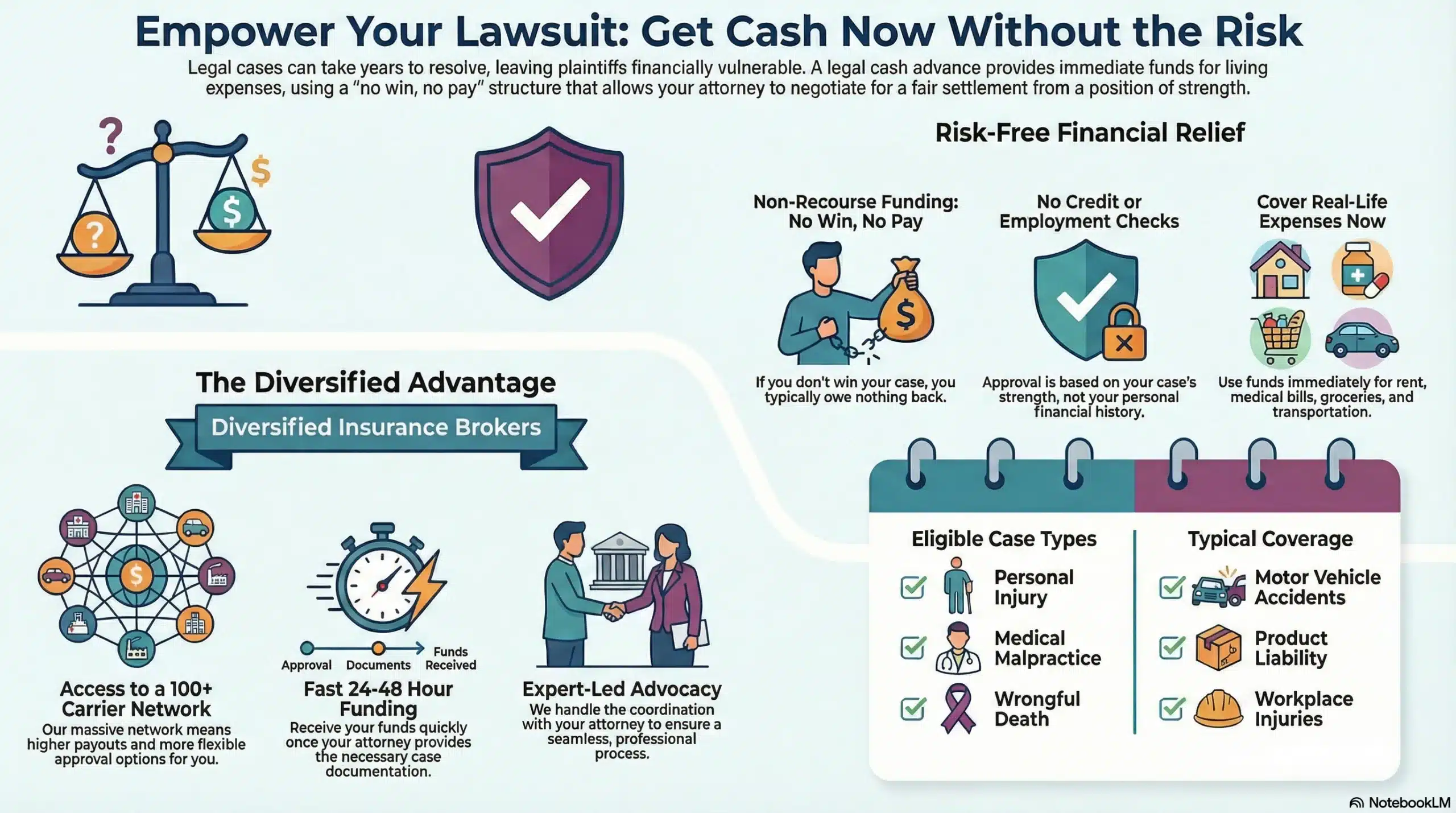
In most situations, settlement funding is structured as non-recourse funding — a critical structural distinction from conventional borrowing. Non-recourse means that repayment typically comes only from settlement proceeds if your case resolves successfully. You do not make monthly payments while the case is pending, approval is based on the strength of the legal claim rather than your credit score or income history, and if the case does not result in a recovery, you generally owe nothing to the funding company. The funding company assumes the case risk by providing this non-recourse advance, which is why the underwriting process evaluates the case itself — liability strength, damages documentation, insurance coverage, and projected recovery — rather than the plaintiff’s personal financial profile. This is why settlement funding is often available to plaintiffs who are not currently working, who have no income to document, or whose credit history would disqualify them from any conventional lending product. How lawsuit loans work covers the mechanics, terminology, and structural distinctions in detail for plaintiffs comparing different legal funding options.
Settlement Funding vs. Traditional Loan: Key Differences
| Feature | Settlement Funding (Non-Recourse) | Traditional Bank Loan |
|---|---|---|
| Approval based on | Case strength — liability, damages, insurance coverage, and probability of recovery | Borrower creditworthiness — credit score, income, employment, debt-to-income ratio |
| Repayment obligation | Non-recourse — typically owed only if case resolves successfully; no personal liability if case fails | Full recourse — repayment required regardless of any external circumstances or outcomes |
| Monthly payments | None while case is pending — repayment comes from settlement proceeds at case resolution | Required immediately and monthly regardless of financial situation or case status |
| Employment/income required | No — injured and unemployed plaintiffs frequently qualify based on case strength alone | Yes — income verification is standard; unemployment typically disqualifies applicants |
| Attorney involvement | Required — documentation coordinated through attorney; repayment structured through settlement disbursement | None — entirely independent of any legal representation or case outcome |
| Risk if case fails | Typically none — funding company assumes case risk; if no recovery, no repayment owed under non-recourse structure | Full repayment still required — borrower bears all financial risk regardless of any external circumstance |
Why Settlement Funding Exists
Most people do not plan to need settlement funding. It becomes relevant because real life does not pause while a case is pending — and the legal process that produces a fair settlement outcome requires time that financial obligations do not respect. Even when a lawsuit is legitimate, the evidence is strong, and the settlement value is meaningful, the process can take many months. Insurance carriers negotiate slowly and often deliberately — prolonging negotiations is a documented strategy for inducing financially pressured plaintiffs to accept settlements below actual case value. Medical documentation takes time to build into a comprehensive picture of the plaintiff’s injuries, future medical needs, and economic damages. Attorneys need complete evidence to make the strongest possible demand. Courts deal with scheduling delays that push timelines further than anyone anticipated when the case began.
That timeline creates a real financial problem for plaintiffs who are simultaneously managing injury recovery, work disruption, and the accumulating costs of daily life with a household budget that was already calibrated around normal income. Settlement funding exists specifically to prevent the lawsuit timeline from destroying financial stability during the case period. It helps cover essential expenses — housing, utilities, food, transportation, medical costs — so that the plaintiff can avoid making a settlement decision based on short-term financial survival rather than what the case is actually worth and what a fair resolution would provide. When financial desperation is eliminated from the equation, settlement negotiations can proceed based on the merits of the claim rather than the plaintiff’s urgency. Money during a lawsuit covers the full picture of financial options available to plaintiffs during active litigation. Cash for lawsuit plaintiffs covers the qualification and process from the plaintiff’s perspective across different case types and financial situations.
How the Settlement Funding Process Works
The settlement funding process is attorney-centered by design — because the underwriting decision is based on real case facts that only the attorney can reliably provide, and the repayment structure is embedded in the settlement disbursement process that the attorney controls. The process begins with a short application that captures basic information about the case and the attorney of record. The funding company then contacts the attorney to request documentation needed to evaluate the claim — case status and current stage of litigation, incident details and liability theory, injury documentation and treatment records, information about available insurance coverage from the responsible party, and any known liens or obligations that may affect net settlement proceeds.
Once documentation is received and underwriting reviews the file, approval decisions can move quickly for well-documented cases with clear liability and strong treatment records. Attorney responsiveness is the primary variable affecting how fast the process moves from application to funded — when the attorney provides complete documentation promptly after being contacted, the timeline from application to disbursement can often be measured in business days rather than weeks. Once approved, the plaintiff receives a funding offer that clearly discloses the advance amount, the cost structure, and the repayment terms. After agreements are executed, funds are disbursed and repayment is handled through the attorney’s settlement disbursement process when the case resolves — the plaintiff does not manage repayment independently. How much you can get from pre-settlement funding covers the specific factors that drive funding amount calculations. Legal funding companies covers how to evaluate providers across transparency, documentation requirements, and cost structures. Get cash before your case settles covers the process and timing mechanics for plaintiffs applying at different case stages.
Why Many Plaintiffs Use Settlement Funding
Settlement funding is most commonly used to cover essential expenses that continue regardless of whether the lawsuit has resolved — housing payments, utilities, groceries, transportation, childcare, and medical costs that keep accumulating while the case is pending. For many plaintiffs, the purpose of funding is not to generate extra spending capacity but to prevent the financial damage from a lawsuit’s timeline from spiraling beyond what is already significant. Eviction from missed rent, vehicle repossession from missed car payments, medical debt escalating to collections, and the credit damage that accompanies these outcomes can extend financial hardship well beyond the lawsuit itself and affect the plaintiff’s financial position for years after the case concludes — damage that funding at the right moment can prevent entirely.
The second major use of settlement funding is strategic rather than purely financial — removing the pressure to settle early and below fair value. Insurance carriers and their defense attorneys are experienced negotiators who understand that financially distressed plaintiffs have a compressed time horizon. When a plaintiff is behind on rent, facing utility shutoff, or unable to meet car payments, the pressure to accept any reasonable offer — even one that substantially undervalues the actual case — becomes functionally irresistible. With funding in place, that pressure is neutralized. The attorney can let medical treatment continue until maximum medical improvement is reached, ensuring that future medical costs, long-term disability impacts, and the full picture of economic and non-economic damages are captured in the settlement demand. Cases that settle at maximum medical improvement with complete documentation almost universally produce better outcomes than cases that settle under financial pressure before the damages picture is fully developed. Pros and cons of pre-settlement funding covers the complete balanced evaluation of the strategic benefits and cost considerations. Advance on lawsuit settlement covers how advances are structured against expected proceeds and what repayment looks like at resolution. Medical malpractice lawsuit funding covers the specific documentation and funding considerations for this complex case category.
What Types of Cases May Qualify
Settlement funding is most broadly available for civil personal injury cases where there is identifiable liability, documented damages, and available insurance coverage or collectible defendant assets from which a recovery can realistically be expected. Personal injury claims with documented injuries and established liability coverage — auto accidents, slip-and-fall premises liability claims, dog bite cases, product liability injuries, and wrongful death lawsuits — are among the most commonly funded case types. Workplace injury claims may qualify depending on jurisdiction and case structure. Cases with clear liability, strong medical documentation, and substantial insurance coverage available on the defendant’s side are typically most competitive in the funding evaluation process.
Not every case qualifies, and that is expected — eligibility depends on liability clarity, damages documentation, and the expected net recovery available after attorney fees, case costs, and liens. Cases that are early in development, have disputed liability, or have limited documentation available at the time of the funding request may not qualify until the case file develops further. The fastest way to determine whether a specific case qualifies is to apply and allow the underwriting review to assess the case through the attorney. Cash advance for a lawsuit covers the application and eligibility process across different case types. Injury lawsuit cash advance covers how funding specifically helps personal injury plaintiffs manage the financial gap between injury and resolution. Pre-settlement funding companies covers how to evaluate funding providers and what the competitive landscape looks like across different providers and case types.
Protecting Your Financial Stability While You Wait
Settlement funding addresses the immediate liquidity need during the litigation period, but many plaintiffs simultaneously face broader financial vulnerabilities that compound the impact of the injury and the lawsuit timeline. If the injury has affected your ability to work, your health insurance situation may have changed or become uncertain — particularly if employer-sponsored coverage was tied to employment status that the injury disrupted. Short-term health insurance can bridge coverage gaps while the case is pending, ensuring that ongoing medical treatment for your injuries does not expose you to catastrophic out-of-pocket costs on top of the financial strain the lawsuit period is already creating. Short-term health insurance options covers the available coverage structures for individuals in defined gap periods.
If your injuries have prevented full return to work — whether temporarily during recovery or more lastingly due to injury severity — income disruption extends beyond what settlement funding alone can address, because funding is a one-time liquidity advance rather than an ongoing income replacement mechanism. Disability insurance addresses the risk of extended income disruption from injuries or illness. Disability insurance services covers the full range of individual and group disability coverage options. For plaintiffs whose family’s long-term financial security is a concern during a period of uncertain income and ongoing litigation, life insurance ensures that dependents are protected regardless of how the case or the recovery unfolds. These protection tools work alongside settlement funding as complementary stabilizers that address different dimensions of the financial vulnerability that a serious injury and pending lawsuit create simultaneously.
Start Your Settlement Funding Application
Get the highest offers possible so you can focus on your case, not your bills.
Related Settlement Funding Pages
Explore more lawsuit funding resources to compare options, understand how advances work, and choose the best path for your case type.
Related Financial Protection Pages
While your case is pending, these pages can help you strengthen your financial safety net with coverage options that reduce future stress.
Talk With an Advisor Today
Choose how you’d like to connect—call or message us, then book a time that works for you.
Schedule here:
calendly.com/jason-dibcompanies/diversified-quotes
Licensed in all 50 states • Fiduciary, family-owned since 1980
Frequently Asked Questions: Settlement Funding
What is settlement funding and how does it work?
Settlement funding is a cash advance based on the expected value of a pending lawsuit. The advance is typically structured as non-recourse — meaning repayment comes from settlement proceeds if the case resolves successfully, and if the case does not result in a recovery, no repayment is owed under a properly structured non-recourse arrangement. The process is attorney-centered: after you apply, the funding company contacts your attorney for documentation about the case status, liability, injuries, and available insurance coverage. Underwriting evaluates the case on its merits rather than your credit score or employment history. If approved, you receive a disclosed offer, and after signing the agreement, funds are typically disbursed within business days. Repayment is handled by your attorney at case resolution as part of the settlement disbursement process.
What types of cases qualify for settlement funding?
Settlement funding is most broadly available for civil personal injury cases with identifiable liability, documented damages, and available insurance coverage or collectible defendant assets. Auto accident cases with injury and liability coverage, premises liability slip-and-fall claims, product liability injuries, medical malpractice cases with clear damages evidence, and wrongful death lawsuits with documented recovery potential all frequently qualify. Workplace injury claims may qualify depending on jurisdiction and case structure. Cases with clear liability, strong medical documentation, and substantial insurance coverage on the defendant’s side are typically most competitive in the funding evaluation. Not every case qualifies — cases with disputed liability, limited documentation, or insufficient insurance coverage may not meet underwriting criteria. Applying and allowing the underwriting review to assess the specific case through the attorney is the fastest way to determine eligibility.
How much settlement funding can I receive?
Funding amounts are based on the estimated net settlement value — the gross settlement reduced by attorney fees, case costs, medical liens, and other obligations satisfied from proceeds before the plaintiff receives the remainder. Funding companies advance only a portion of the expected net recovery because the advance plus accumulated costs must be repayable without consuming the plaintiff’s entire net share. Key factors include liability clarity and strength, injury severity and treatment documentation, available insurance coverage, the case’s stage relative to expected resolution, and existing liens. The most important principle is borrowing only what is genuinely needed for essential expenses rather than the maximum available, because funding costs accumulate over the life of the case and a larger advance paired with a longer case timeline can meaningfully reduce net recovery at resolution.
Why does working with a funding network produce better outcomes than a single provider?
Single-source funding companies operate with fixed underwriting criteria and a single pool of capital — which means a case either fits their criteria or does not, and any offer they make has no competitive pressure to improve it. Working through a network of funding sources provides access to multiple providers with different underwriting criteria, different risk appetites for different case types, and competitive pressure that drives offer quality higher than any individual provider’s opening position. Cases that one provider declines or offers conservatively may qualify for a meaningfully better offer from a different provider in the network whose criteria better fit the specific case profile. The practical benefits include better approval odds across more case types, more competitive offers when multiple sources can be compared, and faster processing when the network can pursue multiple pathways simultaneously rather than sequentially through one provider at a time.
Does receiving settlement funding affect my case or the settlement amount?
Receiving settlement funding does not affect the legal strategy or management of the case — the funding company has no involvement in or control over the lawsuit, and all settlement decisions remain entirely with the plaintiff and attorney. The primary financial effect is that the advance must be repaid from settlement proceeds at resolution, reducing the net amount the plaintiff receives. The strategic benefit is that removing financial pressure allows the attorney to negotiate based on actual case value rather than client urgency — which frequently produces a higher gross settlement amount than a financially desperate plaintiff would have accepted under pressure. In many cases, the improvement in gross settlement value from waiting for the right offer more than offsets the repayment cost, producing a better net outcome even after the advance is satisfied.
About the Author:
Jason Stolz, CLTC, CRPC, DIA, CAA and Chief Underwriter at Diversified Insurance Brokers (NPN 20471358), is a senior insurance and retirement professional with more than 25 years of real-world experience helping individuals, families, and business owners protect their income, assets, and long-term financial stability. As a long-time partner of the nationally licensed independent agency Diversified Insurance Brokers, Jason provides trusted guidance across multiple specialties—including fixed and indexed annuities, long-term care planning, personal and business disability insurance, life insurance solutions, Group Health, Travel Medical and Evacuation Insurance, and short-term health coverage. Diversified Insurance Brokers maintains active contracts with over 100 highly rated insurance carriers, ensuring clients have access to a broad and competitive marketplace.
His practical, education-first approach has earned recognition in publications such as VoyageATL, and contributions from his agency featured in Kiplinger and GoBankingRates— highlighting his commitment to financial clarity and client-focused planning. Drawing on deep product knowledge and years of hands-on field experience, Jason helps clients evaluate carriers, compare strategies, and build retirement and protection plans that are both secure and cost-efficient. Visitors who want to explore current annuity rates and compare options across multiple insurers can also use this annuity quote and comparison tool.
Explore All Lawsuit Loan & Legal Funding Options: Browse our complete guide to Lawsuit Loans & Legal Funding — covering pre-settlement funding, lawsuit cash advances, injury claims & more.
Last Reviewed: June 16, 2026 |
Reviewed by: Jason Stolz, CLTC, CRPC, DIA, CAA
Chief Underwriter, Diversified Insurance Brokers, Inc. | NPN: 20471358 | Diversified Insurance Brokers, Inc. — Licensed in all 50 states
Fact Checked by: Tonia Pettitt, CMIP©
Medicare Specialist, Diversified Insurance Brokers, Inc. | NPN: 14374308 | Diversified Insurance Brokers, Inc. — Licensed in all 50 states
Did you find this content helpful? Leave us a Google review — it helps others find trustworthy guidance too.
Editorial Standards: Diversified Insurance Brokers maintains rigorous editorial standards to ensure accuracy, clarity, and independence in all content. Learn more about our editorial standards and commitment to transparency.
