
Legal Funding Companies Near Me – Fast & Maximum Cash Advances
Legal Funding Companies Near Me – Fast & Maximum Cash Advances

Jason Stolz CLTC, CRPC, DIA, CAA
When you are involved in a lawsuit, financial pressure often builds long before your case reaches resolution. Medical bills accumulate, rent and mortgage payments do not pause, vehicle payments continue, and everyday living expenses keep arriving — regardless of how strong your legal claim may be. That is when finding the right legal funding companies near me becomes essential. Legal funding provides cash advances based on the expected value of your pending settlement or judgment, giving you access to money now so you can focus on recovery, support your family, and work effectively with your attorney rather than being forced into financially damaging decisions while your case is still pending.
For many plaintiffs, the hardest part of having a strong case is not the legal process itself — it is the waiting. Even when liability is clear and the evidence is compelling, negotiations take time. Medical treatment continues. Insurance carriers delay deliberately. Court calendars move slowly. Meanwhile, life keeps generating expenses that do not adjust to the pace of litigation. Legal funding exists to relieve that pressure so you are not forced to accept a low settlement simply because you need cash today — not because the case is weak, but because your financial position has made holding out for fair value impossible.
Get Legal Funding Fast
We work with a nationwide network of funding providers to help you secure the largest possible advance — often within 24 hours.
Apply NowWhat “Legal Funding” Actually Means
Legal funding — also called pre-settlement funding, lawsuit funding, litigation funding, or a settlement advance — provides money to plaintiffs while a claim is still pending resolution. The purpose is straightforward: help you stay financially stable while the legal process plays out, so financial desperation does not dictate the outcome of your case.
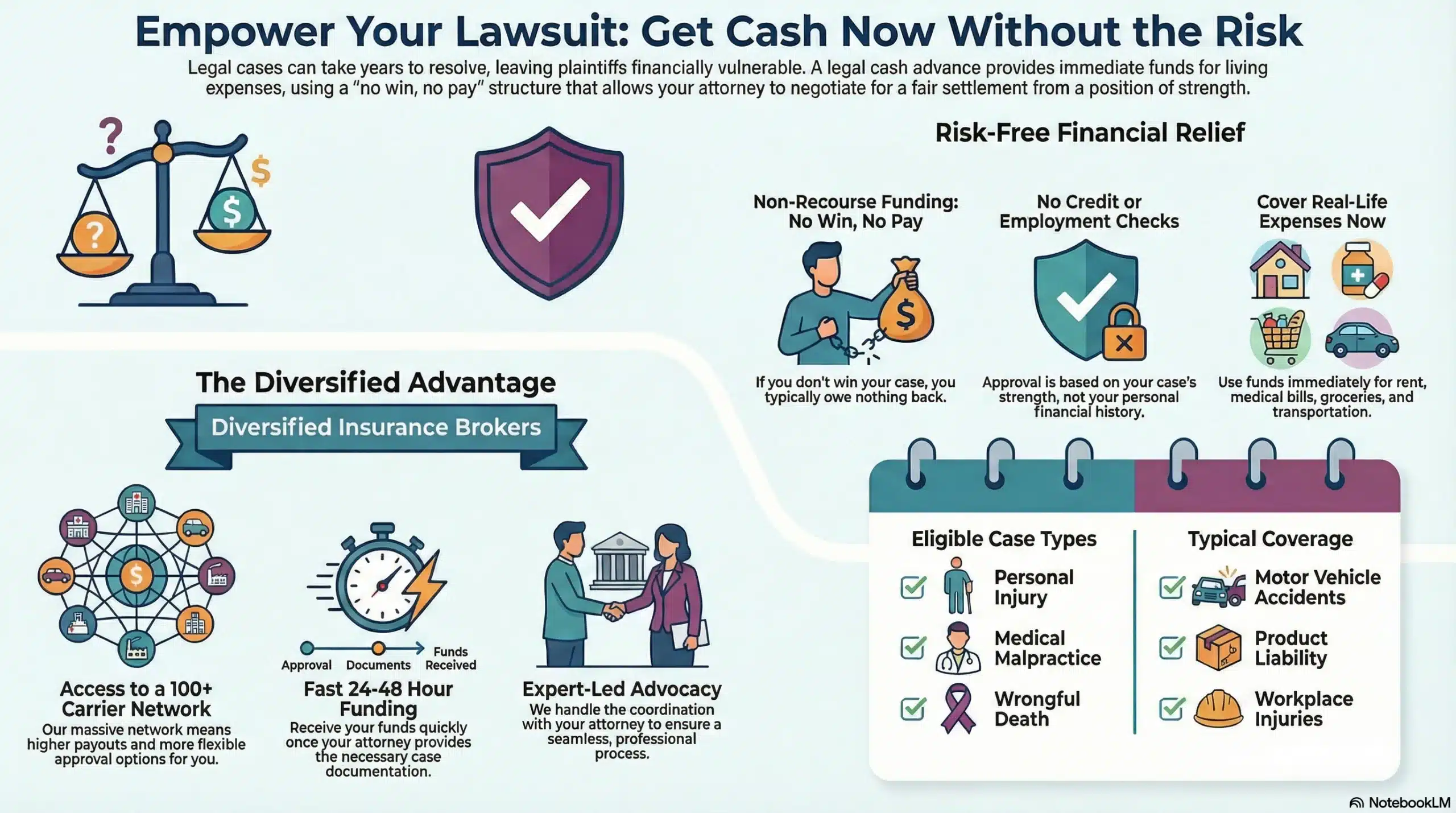
Most legal funding is structured as non-recourse. That means repayment is tied to the outcome of your case rather than to your personal financial situation. If your case resolves successfully, repayment comes from the settlement or judgment proceeds — typically coordinated through your attorney’s trust account at disbursement. If your case does not result in a recovery, you generally owe nothing back under the terms of a true non-recourse agreement. That structure is fundamentally different from a bank loan or personal line of credit, where repayment is required regardless of whether the lawsuit succeeds.
This non-recourse structure is also why legal funding decisions are case-based rather than credit-based. Funding companies evaluate the strength of your legal claim, the likely damages, the insurance coverage or defendant assets available, and the expected timeline to resolution — not your credit score, employment status, or income. A plaintiff with poor credit but a strong, well-documented personal injury case can often access legal funding that would not be available through any traditional financial channel.
How Legal Funding Works — Step by Step
Most plaintiffs want clarity about the process before they apply: how quickly can funding happen, what information is needed, and how does repayment work. While each provider has its own underwriting standards and documentation requirements, most legal funding approvals follow the same general sequence.
The process begins when you submit an application with basic case details — your name, case type, jurisdiction, a general description of the injury or claim, and your attorney’s contact information. Most applications can be completed in minutes online or by phone. Attorney cooperation is required for legitimate funding approvals — this is not optional, and it is an important signal of a reputable provider. Your attorney verifies that the case is active and attorney-represented, provides documentation that supports the underwriting review, and ultimately manages repayment coordination from settlement proceeds when the case resolves.
After the application is submitted and attorney documentation is gathered, underwriting reviews the strength and estimated value of the lawsuit. This review evaluates liability — how clearly fault is established — documented damages including medical records, treatment notes, and injury evidence, available insurance coverage or defendant collectability, and the expected timeline to resolution. Cases with clear liability, strong documentation, and favorable case timelines typically receive stronger funding offers and faster decisions. Cases with disputed liability, limited documentation, or very long expected timelines may receive smaller offers or may not qualify.
Once underwriting completes its review, you receive a funding offer with specific terms. The most reputable providers present terms clearly — including what repayment looks like at different settlement timelines — before you sign anything. After agreements are executed, funds are typically issued within 24 to 48 hours, sometimes faster when documentation is already organized and attorney response is prompt.
Why Searching “Legal Funding Companies Near Me” Matters — and Its Limits
Searching for legal funding companies near me is natural — people often assume local providers will be faster, more familiar with local court systems, or easier to work with. In some cases, those assumptions hold. A local funding company may understand state-specific legal rules governing funding transactions, typical settlement timelines in the local jurisdiction, and the local attorney community in ways that a national provider may not. Local providers may also be more accessible for in-person questions during a stressful time.
However, “near me” does not automatically equal “best terms.” The legal funding market is national, and many of the most competitive offers — largest advance amounts, clearest terms, most transparent fee structures — come from larger funding networks with the ability to compare multiple underwriting approaches rather than applying a single standard. A plaintiff who limits their search to geographically proximate providers may leave significant money on the table or accept terms that are less favorable than what the broader market would provide.
The most effective strategy is to compare options across both local and national funding providers simultaneously — and to have a network that can do that comparison efficiently on your behalf rather than requiring you to research and negotiate independently across multiple companies while managing a legal case and a medical situation at the same time.
Our Advantage: Network Access Instead of a Single Provider
Some legal funding companies offer only their own funding product — meaning you receive one approval path, one pricing structure, and one offer. For plaintiffs, this limitation can be costly. Underwriting standards differ across the legal funding industry: some funders prefer specific injury types, some concentrate in particular jurisdictions, some are conservative on liability disputes, and others are comfortable advancing larger amounts when documentation is particularly strong. The provider that offers the best terms for a personal injury car accident in one state may not be the best option for a medical malpractice claim in another.
We work with a nationwide network of legal funding partners. That means your case can be evaluated against multiple underwriting standards simultaneously — not just one company’s criteria. The practical result for plaintiffs is access to higher advance amounts when the case value supports it, avoidance of the “one-size-fits-all” limitations of a single provider’s approval standards, faster processing when one provider’s documentation requirement or timeline creates delays, and cleaner terms when transparency and fee disclosure vary across the market.
Our goal is responsible funding — cash advances that give you the financial stability you need to stay in your case without creating terms that substantially erode your final recovery. More funding is not always better if it comes with terms that consume a disproportionate share of what you ultimately receive.
What Types of Cases Can Be Funded?
Legal funding is most common in civil cases with measurable damages and a realistic path to settlement or judgment. Eligibility depends on the specific case details, documentation, and the funding company’s underwriting criteria. Common case categories that frequently qualify include personal injury claims of various types, motor vehicle accidents including car, truck, motorcycle, and rideshare collisions, slip and fall and premises liability claims, medical malpractice cases, wrongful death claims, product liability cases, and certain employment-related civil claims depending on how the case is structured.
Workers’ compensation cases present a more variable picture — some states permit legal funding on workers’ comp claims, others restrict it, and the structure of the claim matters significantly for underwriting. Mass tort and class action participation can sometimes qualify for pre-settlement funding depending on the specific litigation, the stage of the proceedings, and the funding company’s appetite for that type of risk. If you are uncertain whether your case qualifies, the fastest way to confirm is to submit your information so underwriting can assess the specific details with your attorney’s cooperation rather than trying to self-evaluate eligibility from general guidelines.
How Much Money Can You Get From Legal Funding?
Funding amounts are determined by the estimated net value of your case — not the headline gross settlement figure you may have heard discussed, but the net amount remaining after attorney fees, medical liens, insurance subrogation claims, case costs, and other obligations are satisfied. This distinction matters because legal funding companies are ultimately repaid from settlement proceeds, and their underwriting must account for all the claims against those proceeds that will be satisfied before the plaintiff receives their share.
Most funding companies advance a portion of the anticipated net plaintiff recovery — commonly in the range of 10 to 20 percent as a general guideline, though the actual figure depends heavily on case-specific factors. A case with very clear liability, strong medical documentation, a defendant with adequate insurance coverage, and an expected settlement timeline of under a year may support a higher advance relative to estimated value. A case with disputed liability, limited documentation, uncertain collectability, or an expected multi-year litigation timeline may qualify for a smaller advance or may not qualify for any advance at the current case stage.
The appropriate way to approach legal funding is as a financial stability tool rather than a mechanism for maximizing the cash advance. If a reasonable advance allows you to pay essential bills, cover medical expenses not addressed by other means, and avoid accepting a below-value settlement out of financial desperation, the funding has accomplished its purpose. Taking more funding than necessary, or accepting terms that significantly discount the final recovery, can create regret at settlement that outweighs the short-term financial relief the advance provided.
What Impacts Your Approval and Your Funding Offer?
Legal funding companies evaluate risk through the lawsuit itself, and the factors that most strongly influence both approval likelihood and the size of the offer are directly related to the case’s strength, value, and timeline. Liability clarity is one of the most important variables — cases where fault is clearly established and well-documented are easier and faster to underwrite, and approvals tend to be stronger. Cases where liability is substantially contested or where comparative fault significantly reduces the plaintiff’s expected recovery present more underwriting risk and typically receive more conservative offers or smaller advances.
Documented damages are equally critical. Medical records, treatment notes, physician assessments, ongoing care plans, and objective evidence of injury — imaging, diagnostic results, specialist evaluations — provide the evidentiary foundation for the damages estimate that drives the funding calculation. A well-documented injury with a clear medical record and a treating physician’s documented treatment plan supports more confident underwriting than an injury that is primarily self-reported without objective documentation.
Available insurance coverage or defendant collectability sets a practical ceiling on what can be advanced responsibly. Even a strong case against a defendant with minimal insurance coverage or limited assets will be constrained by the realistic recovery ceiling that coverage or collectability defines. Expected case timeline affects the cost structure of the funding — cases expected to resolve in months generate less total cost accrual than cases expected to take years, which is why timeline projections from the attorney’s assessment of the litigation path matter in underwriting.
How Legal Funding Differs by State
Legal funding is not uniformly regulated across the United States. The regulatory environment varies significantly by state, and those differences affect the terms available, the disclosures required, and in some cases whether certain types of funding are available at all in a given jurisdiction. Some states have enacted specific consumer protection legislation governing pre-settlement funding transactions, requiring clear fee disclosure, interest rate caps, right-of-rescission periods, or other protections for plaintiffs. Other states have no specific legal funding regulation, leaving the market to operate under more general contract and consumer protection frameworks.
For plaintiffs, the practical implication is that the terms available in your state may differ from what you read about in general national advertising. A provider that offers favorable terms in one state may operate under different constraints in another. The type of funding product available — whether structured as a purchase of a portion of the future claim proceeds, a loan, or another instrument — may vary by state depending on how local law characterizes the transaction. Working with a broker or network familiar with the regulatory environment in your specific state ensures that the options presented are actually available and compliant in your jurisdiction.
What Happens at Settlement — How Repayment Works
Understanding how repayment works at settlement is as important as understanding the advance itself — and it is an area where clarity before signing any funding agreement is essential. When your case settles, your attorney receives the gross settlement proceeds into their client trust account. From that amount, attorney fees are deducted first according to the fee agreement. Then case costs advanced by the attorney’s firm are repaid. Then medical liens and subrogation claims from health insurers, Medicare or Medicaid, or workers’ compensation carriers are resolved. The legal funding repayment — principal advanced plus accrued fees or interest depending on the product structure — is also satisfied from the settlement proceeds before you receive your net disbursement.
This sequence means that the total repayment amount owed to the funding company, combined with all other obligations against the settlement, determines what you actually receive. Responsible use of legal funding means understanding this math before the advance is taken — specifically, what the repayment would be at the expected settlement timeline, and whether the advance improves or worsens your overall financial position when the case resolves. A reputable funding company or network will provide clear payoff projections at multiple timeline scenarios so you can make an informed decision before accepting any offer.
What to Watch for When Comparing Funding Companies
Not all legal funding companies operate with the same level of transparency, and the differences matter significantly for your financial outcome. When comparing legal funding companies — whether local or national — certain warning signs should cause careful review before accepting any offer. Unclear payoff projections are the most consequential red flag: if you cannot see specifically what repayment would total at 6 months, 12 months, and 18 months from the advance date, you are accepting risk you cannot quantify. Reputable providers show those projections clearly before you sign.
Confusing or opaque fee language is another significant concern. Funding agreements should be readable and attorney-friendly — sufficiently clear that your attorney can review the terms, understand the repayment structure, and confirm that the transaction makes sense for your situation. Agreements that obscure fee accrual mechanisms in complex language often hide expensive structures that produce regret at settlement. Any provider that discourages or delays attorney review of the funding agreement should be avoided entirely.
Pressure to take more advance than you need is a sign that the provider’s incentives may not align with yours. Responsible funding covers essential bills and prevents financially forced early settlement — it is not an opportunity to maximize the cash advance at the cost of your final recovery. And any provider claiming you can receive large advances without attorney involvement or case documentation should be treated as a significant red flag — legitimate legal funding requires attorney cooperation and case verification as a foundational part of responsible underwriting.
Why Legal Funding Can Help You Negotiate Better
Insurance companies and their defense counsel understand something that most plaintiffs learn only through experience: financial pressure changes settlement behavior. Even when a case is strong, accumulating bills and depleted savings create a negotiating dynamic where the plaintiff’s ability to hold out for fair value is limited by their financial position rather than by the merits of the claim. Insurance carriers know this and sometimes deliberately delay negotiations to increase that pressure. A plaintiff who cannot pay rent or medical bills next month is a plaintiff who may accept a below-value offer simply to end the financial stress — not because the case warrants a low settlement.
Legal funding changes that dynamic. When essential financial obligations are covered — housing, utilities, car payments, food, medical expenses — you and your attorney can negotiate from the case’s merits rather than from desperation. You can decline inadequate early offers without immediately facing financial crisis. You can allow the case to develop properly — additional medical evidence, expert opinions, depositions, and the natural litigation timeline — rather than being forced toward resolution before the case has developed its full value. Funding does not change liability or damages. It changes your ability to hold out for fair value when the legal timeline is moving more slowly than your financial situation can absorb.
How to Apply — and What Happens Next
The application process is designed to be simple. Most plaintiffs complete the initial application in minutes by providing basic information about the case and their attorney’s contact details. Once the application is submitted, the next steps involve verifying the case with your attorney and collecting the documentation needed for underwriting review. The timeline from application to funded advance depends primarily on how quickly attorney documentation is provided — cases where the attorney responds promptly and documentation is organized typically move much faster than cases where follow-up is required multiple times.
In many straightforward situations with clear liability and organized documentation, funding can be issued within 24 to 48 hours of application. Complex cases, contested liability situations, or cases requiring additional documentation may take longer. The most important thing you can do to accelerate the process is to let your attorney know you have applied for legal funding and ask them to cooperate promptly with documentation requests from the funding company.
Apply for Legal Funding Now
Secure the largest advance possible — risk-free and often within 24 hours.
Start Your ApplicationMore Financial Protection While Your Case Is Pending
Legal funding can address a short-term cash need, but many plaintiffs also want broader financial stability during a period when injury has disrupted income, created medical uncertainty, or affected the household’s financial foundation in multiple ways simultaneously. Depending on your specific situation, additional protection options may be worth exploring alongside legal funding. Short-term health coverage can address gaps in medical insurance during the case period. Accident coverage provides additional financial protection for unexpected injuries. Disability coverage addresses income loss when injury affects the ability to work. These options are not replacements for legal funding — they address different financial dimensions — but they can help create a stronger overall safety net while your case progresses toward resolution.
Financial Protection Essentials
Explore legal funding, pre-settlement advances, and financial protection resources for plaintiffs with pending lawsuits.
Related Pages
Explore more resources on legal funding, settlement advances, and ways to get cash while your lawsuit is pending.
Talk With an Advisor Today
Choose how you’d like to connect—call or message us, then book a time that works for you.
Schedule here:
calendly.com/jason-dibcompanies/diversified-quotes
Licensed in all 50 states • Fiduciary, family-owned since 1980
FAQs: Legal Funding Companies Near Me
The most important qualities in a legal funding company are transparency, non-recourse structure, and clear fee disclosure. Transparency means the provider presents repayment projections at multiple settlement timelines — 6 months, 12 months, 18 months — before you sign anything, so you understand exactly what the advance will cost at different resolution points. Non-recourse structure means that if your case does not result in a recovery, you owe nothing back — the advance is not a personal debt that follows you regardless of case outcome. Clear fee disclosure means the agreement is readable, attorney-friendly, and uses straightforward language rather than obscure fee accrual mechanisms that hide the true cost of the funding. Beyond those foundational qualities, look for providers who require attorney involvement and documentation — the absence of this requirement is a significant red flag indicating a non-legitimate operation — and who do not pressure you to take more than you actually need to cover essential obligations while your case progresses.
Local legal funding companies sometimes have advantages in familiarity with state-specific regulations governing funding transactions in your jurisdiction, knowledge of typical settlement timelines and case values in local courts, and existing relationships with local attorney firms. However, local presence does not guarantee better terms, larger advances, or faster processing. Many of the most competitive funding offers — largest advance amounts, clearest fee structures, fastest approvals — come from larger national funding networks with broader underwriting capacity and the ability to evaluate multiple approval paths simultaneously rather than applying a single provider’s standard criteria. The most effective approach is to use a network or broker that can compare local and national options simultaneously on your behalf, so you receive the most competitive offer available for your specific case without limiting the comparison to geographically proximate providers. Comparing both local and national options through a single application process is almost always better than limiting your search to one or the other.
The timeline from application to funded advance depends primarily on how quickly your attorney provides the documentation needed for underwriting review. In straightforward cases with clear liability, organized medical records, and an attorney who responds promptly to documentation requests, funding can often be issued within 24 to 48 hours of the initial application. Cases that require additional documentation, involve contested liability, or where attorney response is delayed can take longer — sometimes several days. The most important thing you can do to accelerate the process is to notify your attorney immediately after applying for legal funding and ask them to cooperate promptly with any document requests from the funding company. Attorney delays are the most common cause of extended timelines in otherwise straightforward cases. Cases involving complex liability, multiple parties, or uncertain damages naturally take longer to underwrite regardless of how quickly documentation is provided.
If your legal funding is structured as true non-recourse — which is the standard for legitimate pre-settlement funding — you owe nothing if your case does not result in a settlement or judgment in your favor. The funding company accepted the risk of the case not recovering when they approved the advance, and that risk is theirs to bear if the case is lost, dismissed, or results in no recovery. This is one of the fundamental distinctions between legal funding and a personal loan: a personal loan requires repayment regardless of case outcome, while non-recourse legal funding is repaid only from settlement or judgment proceeds. Before accepting any funding offer, confirm in writing that the agreement is explicitly non-recourse and review the specific language with your attorney to ensure there are no conditions or carve-outs that effectively convert the non-recourse structure into a recourse obligation under certain circumstances. Legitimate providers will not hesitate to confirm the non-recourse nature of their funding and will have clear language to that effect in the agreement itself.
Yes — attorney representation is required for virtually all legitimate legal funding transactions, and this requirement exists for good reasons that protect both the plaintiff and the integrity of the funding process. Your attorney verifies that the case is active and legitimately filed, provides the case documentation that underwriting requires to evaluate claim strength and value, and manages repayment coordination at settlement — ensuring that the funding company’s repayment comes from settlement proceeds through the attorney trust account rather than directly from you. The attorney’s involvement also provides an important layer of protection for the plaintiff: your attorney can review the funding agreement terms and advise you on whether the funding makes financial sense for your specific situation before you accept the offer. Any legal funding company that claims you can receive substantial advances without attorney involvement or case documentation should be treated as a significant red flag. Legitimate operations require attorney cooperation as a foundational element of responsible underwriting and consumer protection.
Funding amounts are determined by the estimated net plaintiff recovery — the amount you are realistically expected to receive after all obligations against the settlement are satisfied, including attorney fees, case costs, medical liens, and any subrogation claims from health insurers or other entities. Funding companies typically advance a portion of this net estimated recovery, commonly in a range of 10 to 20 percent as a general guideline, though the actual figure depends heavily on case-specific factors. Liability clarity, the quality of damage documentation, available insurance coverage, and expected case timeline all influence both the approved amount and the pricing terms. Cases with very clear liability, strong objective medical documentation, a defendant with adequate insurance coverage, and an expected timeline of under a year generally support stronger offers. Cases with disputed liability, limited objective injury documentation, uncertain collectability, or very long expected timelines may qualify for smaller advances or may not qualify at the current case stage. The funding company will not advance more than what their underwriting assessment concludes can be responsibly repaid from the realistic case recovery.
Legal funding does not directly affect the settlement amount your attorney negotiates — the liability facts, damages evidence, insurance coverage, and legal strength of your claim determine settlement value, and the existence of a funding advance does not change any of those factors. What legal funding affects is your ability to hold out for fair settlement value rather than accepting a below-value offer due to financial pressure. In that sense, legal funding can indirectly improve your settlement outcome by removing the financial desperation that often leads plaintiffs to accept inadequate early offers. However, the funding does affect your net take-home amount at settlement — the repayment obligation reduces what you receive after all obligations are satisfied. This is why responsible use of legal funding means taking only what is needed to cover essential obligations rather than maximizing the advance, and why understanding the projected repayment at your expected settlement timeline before accepting the offer is essential to making an informed financial decision.
Legal funding is most commonly available for personal injury cases with measurable damages and a realistic path to settlement or judgment — including motor vehicle accidents of all types, slip and fall and premises liability claims, medical malpractice cases, product liability cases, wrongful death claims, and certain employment-related civil claims. Cases with clear liability, objective injury documentation, an insured defendant with adequate policy limits, and a realistic settlement timeline typically qualify more readily and receive stronger offers. Cases with significantly disputed liability, minimal damages documentation, or defendants with limited insurance or assets present more underwriting risk. Workers’ compensation and mass tort cases present more variable eligibility depending on state law and the specific litigation structure. If you are uncertain whether your case qualifies, submitting an application and allowing underwriting to assess the specific facts with your attorney’s cooperation is faster and more reliable than trying to self-evaluate from general eligibility guidelines.
Yes — significantly. Legal funding is not uniformly regulated across the United States. Some states have enacted specific consumer protection legislation governing pre-settlement funding transactions, requiring clear fee disclosure, interest rate caps or fee structure regulations, right-of-rescission periods, or other plaintiff protections. Other states have no specific legal funding regulation, and the market operates under general contract and consumer protection law. The product structure itself — whether the transaction is characterized as a purchase of a portion of the future claim proceeds, a loan, or another instrument — may vary by state depending on how local law characterizes the arrangement. These differences affect what terms are available, what disclosures are required, and in some cases what products are legally available in your jurisdiction. Working with a network or provider familiar with the regulatory environment in your specific state ensures that the options presented are compliant and enforceable. Your attorney can also provide guidance on the regulatory framework governing legal funding in your state.
When your case settles, your attorney receives the gross settlement proceeds into their client trust account. From that amount, the typical disbursement sequence is: attorney fees first per the fee agreement, then case costs advanced by the attorney’s firm, then medical liens and subrogation claims from health insurers, Medicare or Medicaid, or other entities with valid claims against the proceeds, then the legal funding repayment — principal advanced plus all accrued fees or interest — and finally your net disbursement. The funding repayment amount depends on the principal advanced, the fee or interest structure in the funding agreement, and the time that elapsed between the advance date and settlement. Longer cases generate more total repayment cost than cases that resolve quickly, which is one reason clear payoff projections at multiple timeline scenarios are important before accepting any funding offer. Your attorney coordinates the repayment to the funding company directly from the trust account as part of the settlement disbursement process — you typically do not handle the repayment directly.
About the Author:
Jason Stolz, CLTC, CRPC, DIA, CAA and Chief Underwriter at Diversified Insurance Brokers (NPN 20471358), is a senior insurance and retirement professional with more than 25 years of real-world experience helping individuals, families, and business owners protect their income, assets, and long-term financial stability. As a long-time partner of the nationally licensed independent agency Diversified Insurance Brokers, Jason provides trusted guidance across multiple specialties—including fixed and indexed annuities, long-term care planning, personal and business disability insurance, life insurance solutions, Group Health, Travel Medical and Evacuation Insurance, and short-term health coverage. Diversified Insurance Brokers maintains active contracts with over 100 highly rated insurance carriers, ensuring clients have access to a broad and competitive marketplace.
His practical, education-first approach has earned recognition in publications such as VoyageATL, and contributions from his agency featured in Kiplinger and GoBankingRates— highlighting his commitment to financial clarity and client-focused planning. Drawing on deep product knowledge and years of hands-on field experience, Jason helps clients evaluate carriers, compare strategies, and build retirement and protection plans that are both secure and cost-efficient. Visitors who want to explore current annuity rates and compare options across multiple insurers can also use this annuity quote and comparison tool.
Explore All Lawsuit Loan & Legal Funding Options: Browse our complete guide to Lawsuit Loans & Legal Funding — covering pre-settlement funding, lawsuit cash advances, injury claims & more.
Last Reviewed: June 14, 2026 |
Reviewed by: Jason Stolz, CLTC, CRPC, DIA, CAA
Chief Underwriter, Diversified Insurance Brokers, Inc. | NPN: 20471358 | Diversified Insurance Brokers, Inc. — Licensed in all 50 states
Fact Checked by: Tonia Pettitt, CMIP©
Medicare Specialist, Diversified Insurance Brokers, Inc. | NPN: 14374308 | Diversified Insurance Brokers, Inc. — Licensed in all 50 states
Did you find this content helpful? Leave us a Google review — it helps others find trustworthy guidance too.
Editorial Standards: Diversified Insurance Brokers maintains rigorous editorial standards to ensure accuracy, clarity, and independence in all content. Learn more about our editorial standards and commitment to transparency.
