
Wrongful Termination Lawsuit Loan – Fast Cash While You Wait
Wrongful Termination Lawsuit Loan – Fast Cash While You Wait

Jason Stolz CLTC, CRPC, DIA, CAA
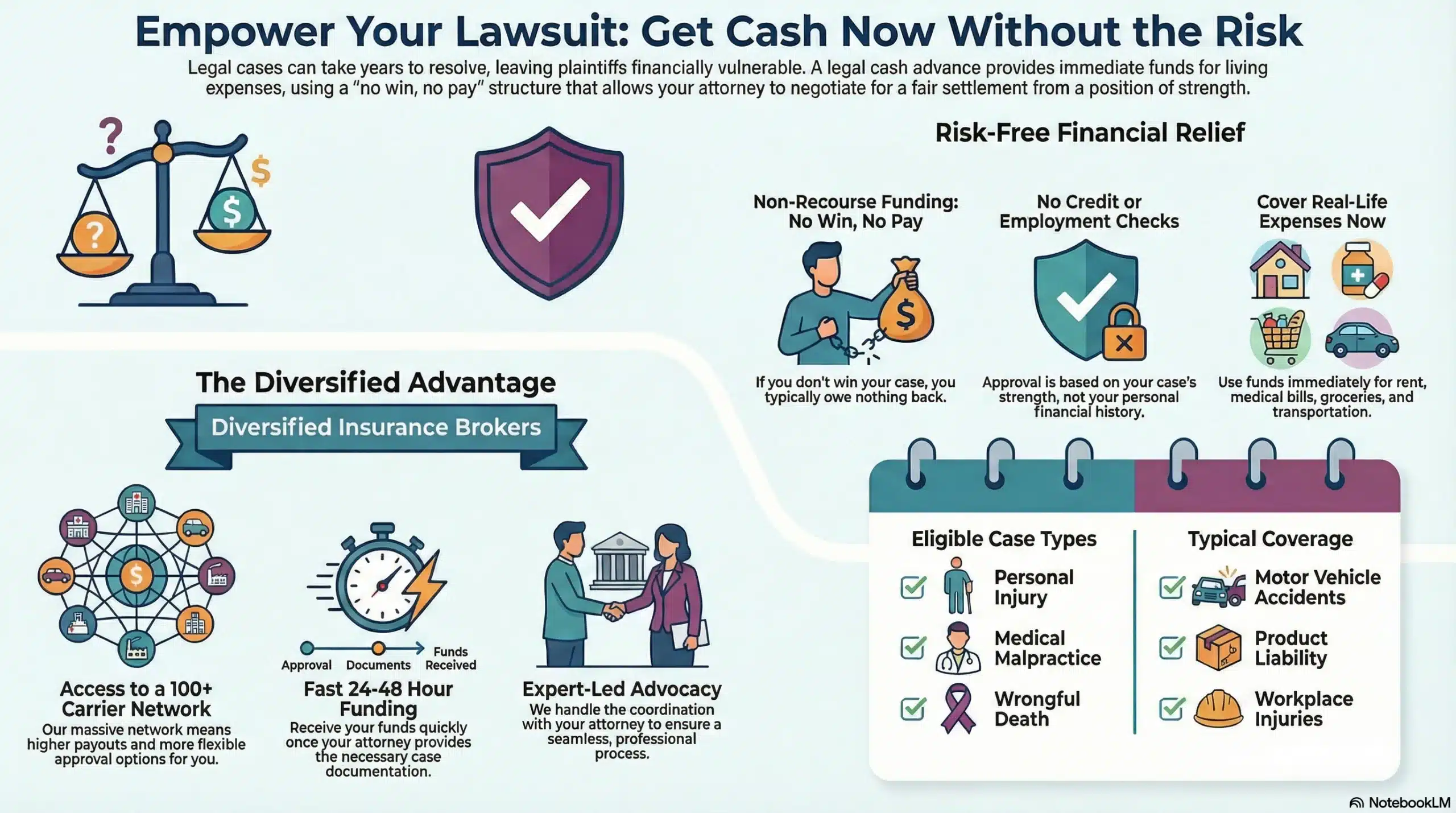
Losing your job unfairly can turn your life upside down — especially when the termination involves discrimination, retaliation for reporting misconduct, harassment, protected leave, or a violation of an employment contract. Even when you have a strong wrongful termination claim, employment cases often take time. Employers frequently contest liability, dispute documentation, drag out discovery, or delay settlement discussions as a deliberate strategy designed to exhaust the plaintiff financially before a fair resolution is reached. While the legal process moves forward, your bills do not pause. Rent or mortgage payments, utilities, groceries, childcare, transportation, and health costs can quickly create financial pressure that makes it genuinely difficult to stay in the fight. A wrongful termination lawsuit loan — more accurately called pre-settlement funding or a non-recourse cash advance — can provide access to cash now so you can stay financially stable while your attorney pursues fair compensation on your behalf.
This type of funding exists to solve a specific problem: it prevents injured plaintiffs from being forced into a low settlement simply because they need money immediately and cannot afford to wait for the legal process to run its course. When you are under significant financial strain, it is easier for the opposing side to push an early offer that feels like relief — but may be far below what your case is actually worth. A lawsuit advance gives your attorney breathing room to negotiate from a position of strength rather than urgency, which can materially affect the final outcome of your claim. If you are comparing funding options across different legal case types, our broader hub for lawsuit settlement loans explains how funding works generally and what to expect from the process.
Apply for a Wrongful Termination Lawsuit Loan
Quick approval, high funding amounts, and no repayment unless you win.
What Is a Wrongful Termination Lawsuit Loan?
A wrongful termination lawsuit loan is typically structured as a non-recourse cash advance based on the expected value of your wrongful termination claim. It is not a traditional bank loan in any meaningful sense. Instead of relying on your credit score, employment history, current income, or personal financial profile, underwriting focuses on the strength of your legal claim — the documentation supporting the termination was unlawful, the employer’s likely defenses and how well they hold up against the evidence, the damages you can support, and the realistic settlement range the case is likely to achieve. There are generally no monthly payments while your case is pending, and repayment typically comes from the case proceeds if your claim resolves successfully — not from your personal bank account, income, or assets.
Because this is case-based funding rather than credit-based lending, your attorney is central to the process. In most situations, the funding provider coordinates directly with your law firm to verify representation, confirm claim status, and review the case materials needed to underwrite the advance. If a company claims it can approve meaningful wrongful termination funding without attorney involvement or documentation review, that is a significant red flag about how the process is structured and how reliable the disclosed terms will be. Responsible funding is attorney-friendly, documentation-based, and transparent about costs and repayment from the outset.
Wrongful termination cases are distinct from personal injury claims in several ways that affect how funding is underwritten. Employment cases often involve more complex proof structures — you are not proving that a physical event caused physical harm, but rather proving that an employer’s stated reason for termination was pretextual and that the actual reason was unlawful. That distinction means documentation quality — emails, HR records, performance reviews, internal communications, termination letters, witness accounts, and the timeline of events — plays a central role in both the legal case and the funding evaluation. The stronger and more thoroughly documented the claim, the more straightforwardly funding decisions can be made.
Wrongful Termination Lawsuit Loan vs. Traditional Loan — Side-by-Side Comparison
Before examining the details of how wrongful termination funding works, the table below maps the key structural differences between a pre-settlement advance and a traditional personal loan — so the distinction between the two is clear and the decision about which is appropriate for your situation can be made with full information.
| Feature | Wrongful Termination Lawsuit Advance | Traditional Personal Loan |
|---|---|---|
| Repayment trigger | Only if case results in a settlement or award — comes from proceeds, not personal funds | Fixed monthly payments regardless of case outcome, job status, or income disruption |
| Credit check | Not required — approval based entirely on claim strength and expected recovery value | Required — credit score and debt history are primary approval factors |
| Employment required | No — terminated employees with no current income are eligible | Yes — unemployment typically disqualifies or severely limits loan availability |
| Risk if case is lost | Non-recourse — generally no personal obligation to repay if the case does not result in recovery (per agreement terms) | Full repayment obligation regardless of any external outcome |
| Monthly payments | None — no payments while the case is pending; single repayment from settlement proceeds | Required monthly — begins immediately regardless of income availability |
| Approval basis | Claim strength, documentation quality, employer defenses, damages profile, attorney representation | Credit score, income verification, employment status, existing debt load |
| Funding speed | 24–48 hours after approval in many cases, with attorney cooperation on documentation | Days to weeks depending on institution and underwriting requirements |
| Cost structure | Funding fees that accrue over time — no monthly burden, but total cost grows with case duration | Fixed interest rate with monthly payments — lower cost per dollar but requires ongoing payment capacity |
Why Wrongful Termination Cases Create Acute Financial Pressure
Unlike many personal injury cases where the plaintiff continues receiving some form of income or benefits while the claim progresses, wrongful termination cases often begin with an immediate and total disruption of the household’s primary income source. The moment the termination occurs, the regular paycheck that was funding rent, utilities, food, transportation, health insurance, and childcare stops — and the unemployment benefits that may eventually become available typically replace only a fraction of that income, take time to process, and may be contested by the former employer as part of the same adversarial dynamic that produced the wrongful termination in the first place.
Employment cases also carry their own timeline challenges that can make the financial pressure more sustained than plaintiffs often anticipate when they first file a claim. Employers in wrongful termination disputes typically have experienced legal counsel and established litigation strategies designed to extend the timeline and exhaust the plaintiff’s financial and emotional resources before a fair settlement becomes necessary. Discovery in employment cases can be extensive — depositions, requests for internal communications, HR file production, policy documentation, and expert economic testimony all take time to obtain and process. Mediation may occur at one stage, settlement discussions at another, and full litigation at a third. The total timeline from termination to resolution can range from several months to several years depending on the complexity of the claim and the employer’s posture.
Unemployment benefits, where available, typically replace 40% to 60% of prior wages depending on the state, subject to weekly maximums that may be far below what the plaintiff was earning. For employees who were earning professional or mid-level salaries, that replacement rate can leave a substantial gap that savings alone may not be able to bridge for the duration of the case. And the financial pressure is not just about immediate cash flow — missed payments accumulate late fees, falling behind on housing creates eviction risk, lapsed insurance creates coverage vulnerabilities, and deteriorating credit affects future options even after the case resolves. A wrongful termination lawsuit advance addresses the immediate cash-flow problem precisely when it is most acute, which also has the downstream effect of preventing secondary financial damage that would otherwise compound during the case timeline.
Situations That May Qualify for Wrongful Termination Funding
Funding decisions are always case-specific, and no general description of qualifying claims should be read as a guarantee of approval for any particular situation. That said, wrongful termination advances are most commonly considered for claims where there is a clear legal theory supported by documented evidence — because the funding provider’s evaluation is essentially a simplified version of the same assessment a plaintiff’s attorney makes when deciding whether to take the case on contingency.
Discrimination-based termination is one of the most common qualifying claim types. This includes termination based on race, color, national origin, sex, religion, age, or disability — all protected categories under federal law, with many states providing additional protections. Strong discrimination claims typically involve a timeline showing that termination followed a protected characteristic or a request related to one, documentation that similarly situated employees outside the protected class were treated differently, and evidence that the employer’s stated reason for termination does not hold up under scrutiny.
Retaliation claims are another significant qualifying category. Retaliation occurs when an employer terminates an employee specifically because that employee engaged in a legally protected activity — reporting workplace harassment, filing a workers’ compensation claim, participating in an EEOC investigation, reporting safety violations, or exercising rights under the Family and Medical Leave Act (FMLA), among others. Retaliation claims are often among the strongest wrongful termination claims because the causal connection — termination following closely after protected activity — can be established through timeline evidence alone, with supporting documentation reinforcing the connection.
Contract violations are a third qualifying category. When an employment contract specifies the conditions under which termination can occur, a termination that does not comply with those conditions may constitute a breach — providing a contractual basis for a wrongful termination claim that is separate from and often clearer than a discrimination or retaliation theory. Hostile work environment allegations that ultimately result in a constructive discharge — where conditions become so intolerable that a reasonable person would have no choice but to resign — can also form the basis of a wrongful termination funding application when the evidence supports the claim.
For any of these claim types, the quality of documentation and the status of attorney representation are the most important practical factors in how quickly and at what amount funding decisions can be made. A claim represented by an experienced employment attorney with a clear case file, a documented timeline, and active legal proceedings is far easier to underwrite efficiently than a claim that is early-stage, unrepresented, or supported by limited documentation.
How the Funding Process Works — Step by Step
The application process for a wrongful termination lawsuit loan is designed to be straightforward for the plaintiff, with most of the work handled through coordination between the funding provider and your attorney. Understanding what happens at each stage helps you move through the process efficiently and set realistic expectations about timing and outcomes.
The first step is the initial application. You provide basic information about your case — the nature of the termination, the employer, the state where the claim was filed, your attorney’s contact information, and your general understanding of where the case currently stands in the legal process. This initial submission takes minutes and does not require financial documentation, credit information, or employment verification. No credit check is run at any point in the process.
The second step is attorney verification and documentation review. The funding provider contacts your law firm directly to confirm representation, verify that the claim is active, and request the case materials needed to underwrite the advance — typically including the complaint or demand letter, key supporting documents, a summary of the damages being claimed, and the attorney’s assessment of case status and settlement prospects. This step is the most time-sensitive in the process, and its speed depends primarily on attorney responsiveness and how well-organized the case file is at the time of application.
The third step is underwriting evaluation. The funding provider reviews the case materials to assess liability strength, documentation quality, damages profile, the employer’s financial resources and insurance coverage, jurisdiction considerations, and the realistic timeline to resolution. Early-stage cases — where discovery has not yet begun and settlement discussions are not yet active — may be evaluated differently from cases approaching mediation or nearing settlement. Either way, the underwriting evaluation is focused on the claim’s expected value and the probability of recovery, not on the plaintiff’s personal financial history.
The fourth step is receiving and reviewing the offer. If the case is approved for funding, you receive a written offer specifying the advance amount, the complete fee and repayment structure, and a clear breakdown of what you would owe at different case resolution timelines. Approved funding typically represents 10% to 20% of the case’s estimated settlement value — so if underwriters project your claim will settle for $100,000, the advance might be approved in a range of $10,000 to $20,000. Before signing, this offer should be reviewed carefully — and ideally reviewed by your attorney — to ensure the repayment terms are clearly understood and consistent with the expected net recovery from the case.
The fifth step is funding disbursement. Once you accept the offer and agreements are completed, funds are typically transferred to your bank account within 24 to 48 hours via wire transfer. From that point, no action is required from you until the case resolves. There are no monthly statements, no payment reminders, and no ongoing repayment obligations while the case is pending.
The sixth and final step is repayment at resolution. When your case settles or results in an award, the settlement proceeds flow through your attorney’s trust account. The attorney satisfies all required obligations in the correct priority order — including attorneys’ fees, case costs, any liens, and the settlement advance — then distributes the remaining net proceeds to you. The repayment is handled entirely through the legal disbursement process; you do not take any direct payment action. If the case does not result in a recovery, the non-recourse structure generally means there is nothing to repay, subject to the specific terms of your agreement.
How Much Funding Can You Receive?
The advance amount in any wrongful termination case depends on the specific facts, documentation, and expected recovery profile of that claim. There is no universal formula, and the amount offered can vary significantly from one case to another even within the same category of wrongful termination claim. Understanding what drives the funding amount helps set realistic expectations before applying.
The primary driver is the expected net settlement value — the amount the case is realistically likely to resolve for, after attorneys’ fees and any other case costs are deducted. Most providers offer advances representing approximately 10% to 20% of that expected net value, calculated conservatively to ensure that the repayment obligation at settlement does not approach or exceed the plaintiff’s net proceeds. The fee structure used by funding providers means the total repayment amount will be higher than the advance amount — and if the case takes longer than expected, the total repayment grows accordingly. The advance must be sized so that the maximum plausible repayment still leaves the plaintiff with meaningful net proceeds from the settlement.
The damages profile of the claim also matters significantly. A wrongful termination claim with substantial documented back pay — covering a long period of lost wages between the termination date and the anticipated resolution date — and credible front pay damages for reduced future earning capacity is valued differently from a claim with limited wage loss and primarily emotional distress damages. The more specifically economic damages can be quantified and documented, the more confidently the underwriting can project a settlement range and size the advance accordingly.
Employer financial resources and insurance coverage are also underwriting factors. A claim against a large employer with clear employment practices liability insurance (EPLI) coverage is generally more fundable than an identically documented claim against a small employer with uncertain assets and no insurance, because the path to actual payment is clearer. The funding provider is not just evaluating whether the legal claim is strong — it is evaluating whether a recovery is likely to be collectible when the case resolves.
Costs, Non-Recourse Terms, and What to Review Before You Sign
The cost structure of wrongful termination settlement advances is fundamentally different from traditional loans, and understanding that structure before signing any agreement is essential. Rather than a fixed annual interest rate with a monthly payment schedule, most funding agreements charge fees that accrue over the life of the advance from the disbursement date to the repayment date. Because the repayment date is determined by when the case resolves — which may be months or years after funding is issued — the total cost is not fixed at the time of signing. It depends on how long the case takes. This time-sensitivity is the most important cost variable in any pre-settlement funding agreement.
Before accepting any offer, you should obtain and understand specific dollar figures for repayment at multiple potential resolution timelines — three months, six months, twelve months, eighteen months, and two years. You should understand whether the fee structure is simple or compounding, and if compounding, how quickly the accrual accelerates over time. You should know whether there is a cap on total fees or total repayment, and whether early repayment reduces the cost. You should understand what happens to the advance if the case settles for less than the projected value, and how that affects the repayment obligation relative to your net proceeds. None of these questions should be unanswerable by a responsible funding provider before you sign — if any of them produce evasive or unclear responses, that is a meaningful signal about the quality of the provider’s disclosure practices.
Non-recourse means that if the case does not result in a recovery, you generally have no personal obligation to repay the advance. That non-recourse protection is the most important risk-management feature of pre-settlement funding for a plaintiff who is already in financial stress — it means the funding cannot make your situation worse if the legal claim ultimately does not prevail. However, the non-recourse protection is only as reliable as the specific contract language, which is why your attorney should review the agreement before you sign and specifically confirm that the non-recourse language is unambiguous, that there are no carve-outs or conditions that would allow recourse under ordinary circumstances, and that the repayment structure is consistent with what you discussed when you applied.
Protecting Your Financial Situation Beyond the Lawsuit
A wrongful termination lawsuit advance addresses the immediate cash-flow challenge while your case is pending — but job loss can also expose broader financial vulnerabilities that deserve attention during the same period. Health insurance coverage typically changes when employment ends. If you were covered under an employer-sponsored plan, you may have COBRA continuation options for a defined period, but COBRA can be expensive. Exploring alternatives like short-term health insurance may provide coverage at lower cost during the transition period while you determine your longer-term coverage situation.
If your work situation before the termination involved self-employment, contract work, or high-income employment where income protection is a concern for the future regardless of the lawsuit’s outcome, exploring high-risk disability insurance options may be relevant if medical factors are part of your situation. And for families evaluating their broader financial protection picture during a period of transition and uncertainty, reviewing life insurance coverage or supplemental protection like accidental death coverage can strengthen the household’s overall risk profile during a period when other financial buffers may be reduced.
These financial protection steps do not replace the lawsuit advance or the legal process — they complement both by reducing the household’s overall vulnerability during what is typically an extended period of financial transition and uncertainty. For context on how settlement funding works in another common workplace injury scenario, our guide for injured workers explains the dynamics of workers comp settlement loan timing and structure in a different but related legal funding context.
Get Started With Wrongful Termination Settlement Funding
If you have an active wrongful termination claim and attorney representation, a lawsuit advance may be the most practical tool available for stabilizing your finances while your case progresses toward a fair resolution. The right advance, sized appropriately for your case and chosen from a provider with clear disclosures and transparent terms, reduces financial pressure without creating new financial risk — because the non-recourse structure means the advance cannot make your situation worse if the claim ultimately does not prevail. For additional context on how pre-settlement advances are structured across different case types, our overview of pre-settlement funding explains the general mechanics, and how lawsuit loans work addresses the most common questions about the approval process. Our overview of legal cash advances provides additional context on how different funding structures compare. If you’re ready to start, submit the form below to begin the review process with no obligation to accept any offer.
Get Started Today
Apply for a wrongful termination lawsuit loan and receive funds in as little as 24 hours.
Related Legal Funding Pages
Explore other legal funding options and guides to understand how lawsuit advances work.
Related Financial Protection Pages
Helpful resources to protect your household while your case is pending.
Talk With an Advisor Today
Choose how you’d like to connect—call or message us, then book a time that works for you.
Schedule here:
calendly.com/jason-dibcompanies/diversified-quotes
Licensed in all 50 states • Fiduciary, family-owned since 1980
FAQs: Wrongful Termination Lawsuit Loan
What is a wrongful termination lawsuit loan and how does it differ from a bank loan?
A wrongful termination lawsuit loan — more accurately called a non-recourse pre-settlement advance — is a cash advance against the expected proceeds of your active wrongful termination claim. The most important difference from a traditional bank loan is the non-recourse structure: a bank loan requires fixed monthly payments regardless of what happens to your income or legal case, and the bank can pursue your personal assets if you default. A pre-settlement advance has no monthly payments while your case is pending, requires no credit check, does not consider your current employment status, and is generally not repayable if your case does not result in a recovery. Repayment, when it occurs, comes directly from your settlement proceeds through your attorney’s disbursement process — not from your personal bank account. Approval is based entirely on the strength and expected value of your legal claim: the documentation supporting the unlawful termination, the employer’s likely defenses, the damages you can support, and the realistic settlement range the case is likely to achieve.
What types of wrongful termination cases qualify for pre-settlement funding?
Wrongful termination funding is most commonly available for claims where there is a clear legal theory supported by documented evidence. The most common qualifying case types include discrimination-based termination — termination motivated by race, sex, age, disability, national origin, religion, or another protected characteristic under federal or state law; retaliation claims — termination following a protected activity such as reporting workplace harassment, filing a workers’ compensation claim, participating in an EEOC investigation, or exercising FMLA rights; and employment contract violations, where the termination did not comply with the conditions specified in a written employment agreement. Constructive discharge claims — where workplace conditions became so intolerable that resignation was effectively forced — may also qualify when supported by strong documentation. In all cases, the quality of the supporting evidence and the status of attorney representation are the primary practical factors in how quickly and at what amount funding decisions can be made. Early-stage cases with limited documentation may be fundable but at more conservative amounts; cases approaching mediation or active settlement discussions with strong documentation are typically funded most efficiently.
How much can I receive from a wrongful termination lawsuit advance?
The advance amount depends on the specific facts, documentation, and expected recovery profile of your individual claim. Most providers offer advances representing approximately 10% to 20% of the case’s estimated net settlement value — the amount likely to remain after attorneys’ fees and case costs. If your case is projected to settle for a net value of $100,000, a typical advance might be approved in the range of $10,000 to $20,000. The specific amount within that range depends on how confidently the underwriting can project the settlement value based on the documentation available, the damages profile of the claim, the employer’s financial resources and insurance coverage, and the expected timeline to resolution. Because fees accrue over time and the total repayment grows with case duration, the advance must be sized so that the maximum plausible repayment still leaves you with meaningful net proceeds from the settlement. Requesting the minimum amount needed to address your immediate financial pressures — rather than the maximum available — often produces the best outcome, because it preserves more of your settlement for you at resolution.
What should I review before accepting a wrongful termination funding offer?
Before accepting any pre-settlement funding offer, you should have clear, specific answers to several key questions: How much do I receive today? What is the exact repayment amount if the case resolves in three months, six months, twelve months, and eighteen months? Is the fee structure simple or compounding, and how quickly does it accelerate over time? Is there a cap on total fees or on the accrual period? Can the advance be paid off early, and does early payoff reduce the total cost? Are there any administrative or processing fees separate from the primary funding fee? What is the non-recourse language and does it contain any conditions or carve-outs? How does the repayment interact with attorney fees and other obligations at settlement? None of these questions should produce evasive or unclear answers from a responsible funding provider — if they do, that is a meaningful signal about the quality of the provider’s disclosure practices. Your attorney should review the funding agreement before you sign, and should specifically assess whether the total maximum repayment is consistent with the net settlement proceeds you can realistically expect to receive from the case.
About the Author:
Jason Stolz, CLTC, CRPC, DIA, CAA and Chief Underwriter at Diversified Insurance Brokers (NPN 20471358), is a senior insurance and retirement professional with more than 25 years of real-world experience helping individuals, families, and business owners protect their income, assets, and long-term financial stability. As a long-time partner of the nationally licensed independent agency Diversified Insurance Brokers, Jason provides trusted guidance across multiple specialties—including fixed and indexed annuities, long-term care planning, personal and business disability insurance, life insurance solutions, Group Health, Travel Medical and Evacuation Insurance, and short-term health coverage. Diversified Insurance Brokers maintains active contracts with over 100 highly rated insurance carriers, ensuring clients have access to a broad and competitive marketplace.
His practical, education-first approach has earned recognition in publications such as VoyageATL, and contributions from his agency featured in Kiplinger and GoBankingRates— highlighting his commitment to financial clarity and client-focused planning. Drawing on deep product knowledge and years of hands-on field experience, Jason helps clients evaluate carriers, compare strategies, and build retirement and protection plans that are both secure and cost-efficient. Visitors who want to explore current annuity rates and compare options across multiple insurers can also use this annuity quote and comparison tool.
Explore All Lawsuit Loan & Legal Funding Options: Browse our complete guide to Lawsuit Loans & Legal Funding — covering pre-settlement funding, lawsuit cash advances, injury claims & more.
Last Reviewed: June 20, 2026 |
Reviewed by: Jason Stolz, CLTC, CRPC, DIA, CAA
Chief Underwriter, Diversified Insurance Brokers, Inc. | NPN: 20471358 | Diversified Insurance Brokers, Inc. — Licensed in all 50 states
Fact Checked by: Tonia Pettitt, CMIP©
Medicare Specialist, Diversified Insurance Brokers, Inc. | NPN: 14374308 | Diversified Insurance Brokers, Inc. — Licensed in all 50 states
Did you find this content helpful? Leave us a Google review — it helps others find trustworthy guidance too.
Editorial Standards: Diversified Insurance Brokers maintains rigorous editorial standards to ensure accuracy, clarity, and independence in all content. Learn more about our editorial standards and commitment to transparency.
