
Best Burial Insurance for Parents over 70
Best Burial Insurance for Parents over 70

Jason Stolz CLTC, CRPC, DIA, CAA
Burial insurance for parents over 70 is one of the most practical and most time-sensitive coverage decisions a family can make — because every year of delay raises premiums, and every significant health change can shift which underwriting path is available. Most families approaching this decision have a clear goal: ensuring that when a parent passes, the funeral home bill, final medical expenses, and the small mountain of financial details that accompany a death do not fall on the surviving family to cover out of pocket during an already difficult time. At Diversified Insurance Brokers, Jason Stolz, CLTC, CRPC, DIA, CAA helps families nationwide compare burial insurance and final expense life insurance options for parents in their 70s — identifying which policy type and which carrier produces the best combination of immediate coverage, affordable premiums, and long-term policy stability for the specific health profile and coverage goal. Our resource on what is burial insurance covers the foundational mechanics of how final expense coverage is structured — the essential starting point before selecting a specific policy type. Our resource on can you get burial insurance on a parents in their 70s covers the specific ownership, payer, and consent questions that apply when an adult child is managing the coverage purchase on behalf of a parent — a common and important planning detail that is separate from the underwriting and product selection process.
Burial insurance is permanent life insurance sized for final expenses — typically whole life coverage with face amounts ranging from $5,000 to $25,000, sometimes higher, designed to be accessible in later years when large traditional term policies are no longer available at practical prices. It is not a separate category of insurance that functions differently from conventional life insurance; it is life insurance built and marketed for the specific use case of covering end-of-life costs. The three underwriting pathways — simplified issue, graded benefit, and guaranteed issue — determine how a parent qualifies and whether the full benefit is payable from day one or subject to a waiting period for natural causes. Understanding which pathway is available for a specific parent’s health profile is the most important step in the purchase process, and it is the step that most families get wrong when they shop without guidance. Our resource on final expense life insurance covers the complete product category — the underwriting paths, the coverage sizing framework, and the carrier comparison approach — in the broader context of how final expense planning fits into a senior’s overall financial picture.
Compare Burial Insurance for Your Parent (Age 70+)
We identify the right underwriting path, compare immediate and graded options across 100+ carriers, and help you avoid paying more than necessary for the coverage your parent needs.
Request a Quote Call 800-533-5969Burial Insurance Policy Types for Seniors Over 70 — Quick Comparison
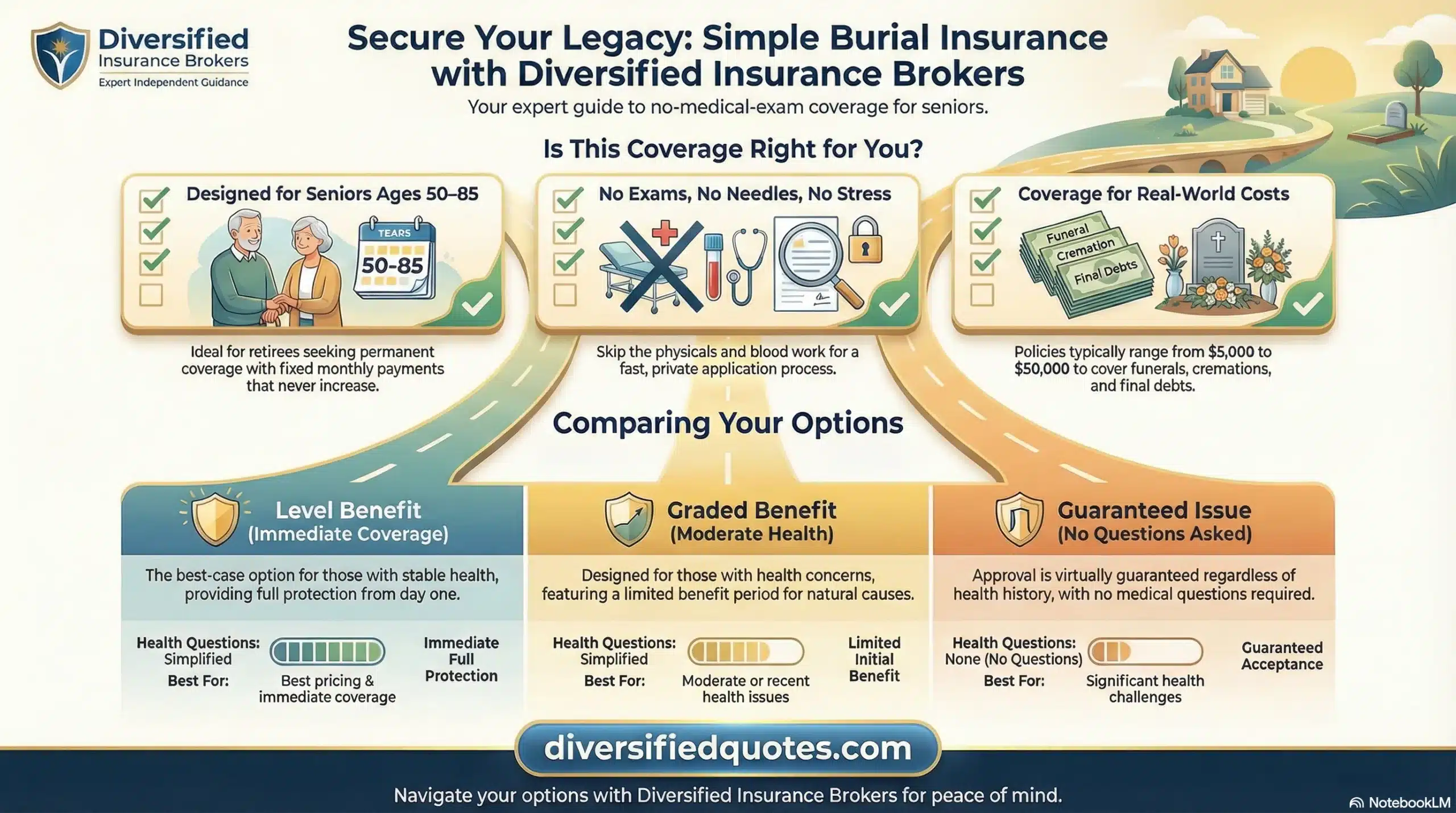
The single most important decision in burial insurance for parents over 70 is which underwriting path applies to the parent’s specific health profile. The product type — simplified issue, graded benefit, or guaranteed issue — determines whether the full death benefit is available from day one, whether health questions affect eligibility, whether premiums are at standard or higher rates, and how the carrier handles a claim in the first two years after the policy is issued. The table below maps these differences so families can quickly identify which path is most appropriate before starting the comparison process.
Monthly premium ranges are illustrative. Actual premiums depend on carrier, state, specific health profile, gender, tobacco use, and coverage amount. Rates vary significantly across carriers for the same profile.
| Policy Type | Health Questions? | Medical Exam? | Full Benefit From Day 1? | Best Health Profile | Relative Monthly Cost (Sample $10K) |
|---|---|---|---|---|---|
| Simplified Issue — Level Benefit Best value when the parent qualifies |
Yes — short set of health questions; no exam. Common conditions, controlled medications accepted. | No exam required for most applicants | Yes — full death benefit payable immediately for all causes once policy is active | Generally healthy; no recent hospitalizations, active cancer, oxygen use, or nursing home care; most controlled chronic conditions may qualify | Lowest — typically $50–$100/month range for age 72–75 female, $70–$130 for male, $10K face amount (varies widely by carrier and health class) |
| Simplified Issue — Graded Benefit Coverage with a waiting period for natural causes |
Yes — health questions asked; parent does not qualify for level benefit but does qualify for graded benefit coverage | No exam required | No — natural causes during years 1–2 typically pay return of premium plus interest; accidental death pays full benefit from day one; full benefit begins after graded period | More complex health history — prior serious conditions, multiple hospitalizations in recent years, medications that flag higher risk; may not qualify for level benefit | Moderate — typically 15–30% higher than level benefit for same age and face amount; pricing reflects additional risk the carrier accepts |
| Guaranteed Issue — No Health Questions Acceptance guaranteed regardless of health |
No health questions — acceptance is guaranteed based on age and state eligibility | No exam required | No — almost always includes a 2-year graded benefit period for natural causes; full benefit after graded period; accidental death often pays full from day one | Any health profile — appropriate when parent has been declined elsewhere, has serious or multiple conditions, oxygen use, active cancer treatment, or nursing home care | Highest — typically 30–60%+ more than simplified issue level benefit for the same age and face amount; higher cost reflects no underwriting selection |
| Standard Whole Life — Final Expense More rigorous underwriting; better rates for healthier applicants wanting higher face amounts |
Full health history review — more detailed than simplified issue but still no exam at many carriers for amounts under $25K | May require exam for amounts above $25K–$50K depending on carrier; no exam common for standard final expense amounts | Yes — full benefit from day one for qualified applicants; standard contestability provisions apply for first two years | Healthiest 70+ applicants who want maximum face amount at the best available rate; appropriate for parents whose health profile would earn favorable classification in more rigorous underwriting | Competitive — can be lower than simplified issue for the same face amount for very healthy applicants who earn a preferred health class |
The table’s most practically important cell for most families is the “Full Benefit From Day 1” column — because this is the dimension that most directly affects how the coverage actually performs if a parent passes within the first two years of the policy being in force. A family that purchases guaranteed issue for a parent who actually would have qualified for simplified issue level benefit has paid a higher premium for a product that provides less immediate coverage than was available at a lower price. The reverse mistake — assuming a parent will qualify for level benefit when their health history triggers a graded benefit or guaranteed issue outcome — leads to disappointment at the time of application. Our resource on burial insurance with no waiting period covers the immediate coverage dimension specifically — including which health conditions most commonly disqualify applicants from level benefit underwriting and what alternative paths remain available when the healthiest option is not accessible.
Use Our Burial Insurance Calculator to Get Rates
Use the calculator below to compare real-time burial insurance rates for parents over 70 across coverage amounts and benefit types. Start at $10,000–$20,000 and adjust based on your parent’s budget and coverage goal.
Why Families Help Parents Over 70 Get Burial Insurance
Most families approaching this decision are motivated by one of three clear situations — and understanding which one applies shapes what the right coverage looks like. The first and most common motivation is protecting the surviving family from an unexpected financial burden. Even a simple, dignified funeral can cost $8,000–$15,000 or more depending on the service type, burial versus cremation, casket selection, and funeral home pricing in the local market. Final medical bills, estate administrative costs, and the small recurring expenses that accompany a household transition add additional financial pressure that lands on the family within days of a death. A burial insurance policy converts that unpredictable expense into a predictable, pre-funded plan that does not require family members to coordinate credit card debt or emergency savings transfers at the worst possible moment.
The second motivation is eliminating uncertainty before health changes make coverage harder. A parent who is in their early 70s and relatively healthy today has meaningfully more underwriting options — and more affordable premium rates — than the same parent will have at 77 or 80 with an additional diagnosis or medication added to the profile. Simplified issue level benefit coverage is typically accessible to most parents in their early 70s with common managed conditions. That same parent, five years later with a new cardiac event or a COPD diagnosis, may only qualify for graded benefit or guaranteed issue — at higher premiums and without immediate full benefit. Acting when the parent is healthiest is always the most cost-effective decision, even when the immediacy does not feel urgent. Our resource on life insurance with pre-existing conditions covers the underwriting treatment of common health histories at senior ages — useful context for families who are uncertain whether a parent’s specific health profile creates a challenge for simplified issue underwriting.
The third motivation is protecting the parent’s sense of independence and legacy. Many older adults feel strongly that their death should not place a financial burden on their children or grandchildren — that whatever resources they have built during a lifetime should pass to the next generation rather than be consumed by funeral and estate expenses. A burial insurance policy gives the parent the ability to fulfill that intention concretely — with a funded plan in place rather than a hope that “everything will work out.” This motivation is particularly common among parents who have lived through difficult financial periods and place significant value on not leaving others to clean up after them financially.
The Three Underwriting Paths — How Each One Works and When It Applies
Simplified issue burial insurance is typically the best starting point for parents over 70 who can honestly answer “no” to a focused set of health questions. There is no medical exam — the carrier evaluates the application based on the health disclosures combined with database checks of prescription history, MIB records, and in some cases motor vehicle records. The specific health questions vary by carrier but typically screen for the highest-risk conditions: active cancer treatment, recent cardiac events within the past 12–24 months, oxygen use, residence in a nursing home or care facility, and advanced stage chronic illness. A parent who can answer no to all of these screening questions typically qualifies for a simplified issue policy, and many of those policies offer level benefit coverage from the first day the policy is active. The premium is typically the lowest available for the age and health profile, making simplified issue the most efficient use of premium dollars when the parent qualifies.
Graded benefit burial insurance serves parents whose health history is more complex — those who have had a serious condition within the past two years, who take medications associated with higher-risk conditions, or whose history includes events that trigger a decline for the level benefit tier but not an automatic decline altogether. The carrier issues coverage, but the death benefit structure differs during the early policy period: for natural causes of death within the first year or two (depending on the specific carrier’s contract language), the policy typically pays a return of the premiums paid plus a specified percentage (commonly 10% or more) rather than the full face amount. Accidental death typically pays the full benefit from day one even in graded benefit policies. After the graded period ends, the full face amount is payable for all causes. This structure is not a sign of inferior coverage — it is the mechanism that allows carriers to extend coverage to higher-risk applicants while managing the cost of the guarantee. The key for families is understanding the structure clearly before purchasing, so there is no surprise about how a claim would be handled in the first year or two.
Guaranteed issue burial insurance requires no health questions and offers acceptance based purely on age and state eligibility. For parents over 70 who have been declined for other coverage, who have serious or multiple conditions, who use oxygen, who are in active cancer treatment, or who reside in a nursing facility, guaranteed issue may be the only underwritten option available. The trade-off is premium — guaranteed issue typically costs more per dollar of coverage than simplified issue, because the carrier cannot select risk through underwriting and must price for the full range of health profiles the policy will cover. The waiting period is almost always present in guaranteed issue designs — typically two full years for natural causes. After the waiting period, the full benefit is payable regardless of cause of death. For families where coverage is needed despite serious health barriers, guaranteed issue provides a permanent, reliable plan even when other options are not accessible. Our resource on burial insurance quotes covers how to compare guaranteed issue and simplified issue side by side for a specific parent’s age and health profile — giving families a real-number view of what each path costs before committing to any carrier.
Health Conditions That Affect Burial Insurance Underwriting at 70+
Parents over 70 are often in the market for burial insurance precisely because they have developed one or more health conditions that make conventional life insurance inaccessible or very expensive. Understanding how specific conditions are treated in final expense underwriting — which conditions disqualify from level benefit, which are acceptable with controlled status, and which route to guaranteed issue only — helps families navigate to the right carrier and policy type without wasted applications. Many of the most common conditions in the 70+ population are manageable within simplified issue underwriting when they are controlled, stable, and within the carrier’s lookback period tolerance.
Cardiac conditions are among the most frequent underwriting questions at this age. A parent with a prior heart attack, stent placement, or bypass surgery may still qualify for simplified issue coverage if the event occurred more than 24 months ago and current management is stable. Our resource on burial insurance for people with heart conditions covers the specific cardiac history evaluation that affects which tier of coverage is available — including how recency, severity, and ongoing medication affect the simplified versus graded versus guaranteed issue determination for cardiovascular history. For parents who have experienced a stroke — one of the most common serious health events in the over-70 population — our resource on burial insurance for stroke survivors covers the stroke-specific underwriting considerations that determine which coverage path is available based on the timing, severity, and ongoing neurological effects of the stroke event.
Respiratory conditions including COPD, emphysema, and oxygen dependence are particularly relevant for the 70+ population. Our resource on life insurance for people with COPD covers how respiratory condition severity is evaluated in life insurance underwriting — and why oxygen use specifically is one of the most common triggers for routing from simplified issue to guaranteed issue only. Diabetes is also extremely common among parents in their 70s and 80s. Our resource on burial insurance for people with diabetes covers how Type 1 and Type 2 diabetes are differentiated in final expense underwriting, which complications create the most significant underwriting challenges, and which carriers are most favorable for diabetic applicants at senior ages. For parents who are veterans — a significant proportion of today’s 70-and-older population — our resource on burial insurance for veterans covers both the private market options and the VA benefit coordination considerations that affect how burial coverage should be structured for veteran parents.
What Affects Burial Insurance Rates for Parents Over 70
Burial insurance pricing for seniors is shaped by a small, specific set of factors that interact to determine the monthly premium. Understanding these factors allows families to shop more effectively, compare carriers on a level basis, and identify when a quoted premium is competitive versus when it reflects an unnecessarily conservative carrier pricing structure for the parent’s actual health profile.
Age is the most significant continuous pricing factor. A 71-year-old non-smoking female applying for $15,000 of simplified issue level benefit coverage will pay meaningfully less than the same coverage purchased at age 76 or age 79, all else equal. This age-driven pricing acceleration is steeper in the late 70s than in the early 70s, which is part of the reason acting in the early 70s — when coverage is both more affordable and more accessible — consistently produces better value than waiting. The compounding effect of higher age on both premium rate and health profile complexity is the primary driver of why burial insurance is best addressed early in the decade rather than deferred.
Tobacco use produces significant premium increases across carriers, and in the senior burial insurance market the tobacco surcharge is particularly meaningful because it interacts with an already age-adjusted base rate. Some carriers apply tobacco rates that are 40–80% higher than non-tobacco rates for the same age and face amount; others are less aggressive in their tobacco pricing. Our resource on burial insurance for smokers covers the carrier comparison that matters most for tobacco-using parents over 70 — because the variance in how carriers price tobacco at senior ages means that the best option for a smoking parent is almost always determined by active carrier comparison rather than applying to the most recognizable brand.
The specific health conditions and medications are relevant primarily at the simplified issue tier. For level benefit simplified issue, the carrier’s health question set and the database cross-referencing of prescription history determine whether the parent qualifies and at what rate class. For graded benefit and guaranteed issue, health information has less direct impact on the premium (graded benefit carriers still ask questions; guaranteed issue does not) but does determine which tier is available in the first place. The premium difference between a simplified issue level benefit policy and a guaranteed issue policy for the same age and face amount can be 30–60% or more — which is a direct financial argument for identifying the most favorable underwriting path before selecting a carrier.
How Much Burial Insurance to Buy for a Parent Over 70
The coverage amount decision for a parent over 70 typically starts with a realistic estimate of funeral and final expense costs, then adds a buffer for the adjacent expenses that arrive quickly after a death — final medical bills not covered by insurance, travel costs for family members attending services, estate administrative fees, and the household transition costs that accompany losing a household member. The realistic total for a standard funeral with burial in most U.S. markets ranges from $8,000 to $15,000. Cremation-based services are typically $3,000 to $8,000. Adding $3,000 to $5,000 for related expenses produces a practical coverage target for most families.
The most common face amount ranges for parents over 70 are $10,000 to $25,000. The $10,000–$15,000 range typically covers funeral costs and basic related expenses with premiums that are manageable long-term for most seniors’ fixed income budgets. The $15,000–$25,000 range provides additional buffer for families who want broader coverage, who anticipate specific additional expenses, or who want the policy to address some lingering debt alongside the funeral costs. The critical planning principle is that the policy must be affordable enough to maintain indefinitely — a $25,000 policy that lapses in three years because premiums became stressful provides no coverage when the claim is eventually needed, while a $12,000 policy that remains active provides exactly the certainty the family purchased. Our resource on burial insurance for parents over 80 covers how the coverage sizing and underwriting path decisions shift further into the senior age range — relevant for families who are making decisions now but planning for what the coverage structure should look like as the parent ages deeper into their 80s.
The Smart Shopping Process — Avoiding the Most Costly Mistakes
The most efficient burial insurance shopping process for parents over 70 starts with defining the goal clearly and ends with a single, well-targeted application at the carrier whose underwriting guidelines produce the best outcome for the specific health profile. The mistakes that most commonly lead to overpaying, to landing in the wrong policy type, or to receiving less coverage than was available are all preventable with a strategic approach rather than a reactive one.
Defining the goal before contacting any carrier means identifying the target face amount, confirming the budget range that is sustainable long-term, and understanding whether immediate full benefit is the priority or whether graded benefit coverage is acceptable if it produces meaningfully better affordability. Once those parameters are clear, the carrier selection is guided by which carriers are most favorable for the specific health profile at the specific age — not by brand name or advertising familiarity. Different carriers ask different health questions, use different lookback periods, and treat the same medical history with different levels of flexibility. A parent who would be routed to graded benefit at one carrier might qualify for level benefit at another carrier with slightly more permissive underwriting for the specific condition in question. This is why working with an independent broker who has access to the full market rather than a single carrier’s product line produces consistently better outcomes for families navigating the 70+ burial insurance market.
The most common mistake is applying to multiple carriers sequentially without a strategy — often because the family used online comparison tools that generated quotes without accounting for actual underwriting outcomes. Each application creates a record in industry databases, and a pattern of multiple recent applications can create questions for subsequent underwriters. The correct approach is to identify the most likely carrier first — based on the parent’s specific health profile and the carrier’s known underwriting guidelines — and submit the first formal application to the carrier most likely to produce the best outcome. Our resource on burial insurance for seniors over 60 covers the broader carrier comparison framework for senior final expense shoppers — relevant context for families evaluating parents across the senior age spectrum who want to understand how carrier selection methodology applies consistently across different starting ages. Our resource on is life insurance death benefit taxable covers the tax treatment of burial insurance proceeds — the practical question families have about whether the benefit paid to the beneficiary creates a taxable event, which affects how beneficiary designations and policy ownership are structured in some estate planning contexts.
Compare Burial Insurance Options for Your Parent
We compare immediate coverage options first, provide graded benefit alternatives if needed, and help you identify the most affordable plan your parent can maintain long-term.
Get a Burial Insurance QuoteRelated Burial Insurance Resources
Burial insurance services hub, senior-age resources, health-condition-specific guides, immediate coverage options, and coverage sizing tools.
Financial Protection Essentials
Children’s savings tools, international travel medical coverage, employer group health guidance, and specialty protection resources.
Talk With an Advisor Today
Choose how you’d like to connect—call or message us, then book a time that works for you.
Schedule here:
calendly.com/jason-dibcompanies/diversified-quotes
Licensed in all 50 states • Fiduciary, family-owned since 1980
Best Burial Insurance for Parents Over 70 — Frequently Asked Questions
The best burial insurance for a parent over 70 depends on their health profile, desired coverage amount, and budget. For generally healthy parents who can answer “no” to health screening questions, simplified issue level benefit coverage is typically the best value — offering full death benefit from day one at the lowest available premium. For parents with more complex health histories, graded benefit coverage provides the next tier of accessibility with a waiting period for natural causes. For parents with serious conditions or past insurance declines, guaranteed issue is the coverage type that ensures acceptance regardless of health. The key is identifying which underwriting path is appropriate first, then comparing carriers within that pathway to find the best premium.
The three main paths are simplified issue, graded benefit, and guaranteed issue. Simplified issue level benefit is best value for healthier applicants — full benefit from day one with health questions asked but no medical exam. Graded benefit serves parents with more complex health histories — issued coverage but natural cause death in the first 1-2 years typically pays return of premiums plus interest rather than full benefit; full benefit kicks in after the graded period ends. Guaranteed issue requires no health questions and guarantees acceptance based purely on age and state eligibility — best for parents who have been declined elsewhere or have serious conditions — but typically costs more and includes a 2-year waiting period for natural causes. Accidental death usually pays full benefit immediately in all three paths.
This depends on whether your parent can answer “no” to key health screening questions: active cancer treatment, recent cardiac events within the past 12-24 months, oxygen use, residence in a nursing home, or advanced stage chronic illness. If your parent can answer “no” to all of these, simplified issue level benefit is typically accessible. If they have had a serious condition within the past two years or take medications flagging higher-risk conditions, graded benefit may be available. If they have been declined elsewhere, have serious or multiple conditions, use oxygen, are in active cancer treatment, or live in a nursing facility, guaranteed issue is likely the appropriate path. The best approach is having a broker pre-screen your parent’s health history against specific carrier guidelines before submitting a formal application.
It is uncommon for health problems alone to prevent a parent over 70 from getting burial insurance. Final expense underwriting is specifically designed for the senior population that commonly has managed chronic conditions. Even parents with multiple conditions, recent hospitalizations, or complex medication lists can typically qualify for either graded benefit or guaranteed issue coverage. Declines are rare and typically occur when conditions are so serious or unstable that no carrier’s underwriting framework encompasses them. For parents declined by one carrier, guaranteed issue coverage remains available as a backup option that accepts all applicants regardless of health history.
The main differences are: simplified issue level benefit asks health questions and may decline applicants with serious conditions, but offers full death benefit from day one at the lowest available premium. Guaranteed issue asks no health questions and guarantees acceptance regardless of health, but typically costs 30-60% more per dollar of coverage and includes a 2-year waiting period for natural causes — meaning claims from natural causes within two years pay return of premiums plus interest rather than the full face amount. For a parent who qualifies for simplified issue, that pathway produces far better value. Guaranteed issue is the right choice for parents who do not qualify for simplified issue or have been declined by other carriers.
Start with realistic funeral costs in your area: standard funerals with burial typically cost $8,000-$15,000; cremation-based services typically cost $3,000-$8,000. Add $3,000-$5,000 for final medical bills, travel costs for family, and estate administrative fees. This produces a practical coverage target. The most common face amounts for parents over 70 are $10,000-$25,000. The $10,000-$15,000 range covers funeral costs plus basic related expenses with premiums manageable on fixed income. The $15,000-$25,000 range provides additional buffer. The critical principle is affordability long-term — a policy must be sustainable to maintain indefinitely, or it will lapse before the claim is needed.
Age is the most significant factor — premiums rise meaningfully with each additional year, especially in the late 70s and beyond. Tobacco use produces substantial surcharges — often 40-80% higher than non-tobacco rates — and tobacco pricing varies significantly by carrier. Health profile determines underwriting path, which directly affects premium — a simplified issue level benefit policy costs substantially less than guaranteed issue for the same age and face amount. The difference between simplified issue and guaranteed issue for the same coverage can be 30-60% or more in monthly premium. Gender also affects pricing — women typically pay more because claim duration is statistically longer. Face amount scales with cost — higher coverage amounts cost more per month.
Yes. Simplified issue level benefit policies pay the full death benefit from day one for all causes, including natural death, once the policy is active. This is the best immediate coverage option. For parents who qualify for simplified issue but need even broader immediate protection, standard whole life final expense policies also provide full benefit from day one but require more rigorous underwriting. Guaranteed issue policies do include a 2-year waiting period for natural causes, meaning full benefits do not apply immediately. For maximum immediate coverage, simplified issue level benefit is the pathway to prioritize if the parent can qualify.
The best time is now, while the parent is in their early 70s and relatively healthy. Every year of delay raises premiums, and every significant health change can shift which underwriting path is available. A parent who is healthy today at 72 may only qualify for graded benefit or guaranteed issue by age 77 with a new health condition. The premium difference between buying at 72 versus 77 for the same parent is often substantial. Additionally, early action provides more underwriting options and better rates. The cost-benefit of acting now while the parent is healthiest — even if the coverage feels less urgent — almost always produces better outcomes than waiting until health changes force the decision.
The biggest mistake is applying to multiple carriers sequentially without a strategy. Each application creates a database record, and a pattern of multiple applications can raise questions for subsequent underwriters. Apply to the carrier most likely to produce the best outcome for your parent’s specific profile first. Do not assume simplified issue level benefit will be available — have the parent pre-screened against carrier guidelines before applying. Do not confuse brand familiarity with suitability — different carriers have different health questions, lookback periods, and flexibility for the same medical history. Do not prioritize only price — a slightly higher premium for a carrier known to be favorable for your parent’s specific condition often produces better results than the lowest-cost option that routes to graded benefit. Work with an independent broker who has access to the full market rather than a single carrier.
Yes. Parents with cardiac or stroke history can often qualify for burial insurance depending on timing, severity, and current management. A parent with a prior heart attack, stent, or bypass surgery may still qualify for simplified issue if the event occurred more than 24 months ago and current management is stable. Stroke history is similarly evaluated — the timing and ongoing neurological effects determine whether simplified issue level benefit, graded benefit, or guaranteed issue is appropriate. The key is whether the condition is stable and within the carrier’s lookback period. Conditions more recent than 12-24 months or with ongoing complications typically route to graded benefit or guaranteed issue. Our condition-specific resources on cardiac history and stroke history cover carrier-specific approaches in detail.
The insurance is typically owned by your parent and payable to your parent’s estate or a named beneficiary. As the adult child, you coordinate the process: gather basic health information, help your parent complete the application, and arrange for the policy documents to go to your parent. The health questions and underwriting focus on your parent’s health profile, not yours. Your parent’s consent is required — the application is your parent’s legal agreement. Some specific details about parent ownership and beneficiary designations are important to clarify, and insurance agents can explain the technical ownership and tax considerations that apply to your parent’s specific situation and estate planning.
About the Author:
Jason Stolz, CLTC, CRPC, DIA, CAA and Chief Underwriter at Diversified Insurance Brokers (NPN 20471358), is a senior insurance and retirement professional with more than 25 years of real-world experience helping individuals, families, and business owners protect their income, assets, and long-term financial stability. As a long-time partner of the nationally licensed independent agency Diversified Insurance Brokers, Jason provides trusted guidance across multiple specialties—including fixed and indexed annuities, long-term care planning, personal and business disability insurance, life insurance solutions, Group Health, Travel Medical and Evacuation Insurance, and short-term health coverage. Diversified Insurance Brokers maintains active contracts with over 100 highly rated insurance carriers, ensuring clients have access to a broad and competitive marketplace.
His practical, education-first approach has earned recognition in publications such as VoyageATL, and contributions from his agency featured in Kiplinger and GoBankingRates— highlighting his commitment to financial clarity and client-focused planning. Drawing on deep product knowledge and years of hands-on field experience, Jason helps clients evaluate carriers, compare strategies, and build retirement and protection plans that are both secure and cost-efficient. Visitors who want to explore current annuity rates and compare options across multiple insurers can also use this annuity quote and comparison tool.
Explore More Burial Insurance Options: Browse our complete guide to Burial Insurance for Seniors — covering burial insurance for seniors over 50, 60, 70, 80 & parents from top carriers from top carriers.
Last Reviewed: May 31, 2026 |
Reviewed by: Jason Stolz, CLTC, CRPC, DIA, CAA
Chief Underwriter, Diversified Insurance Brokers, Inc. | NPN: 20471358 | Diversified Insurance Brokers, Inc. — Licensed in all 50 states
Fact Checked by: Tonia Pettitt, CMIP©
Medicare Specialist, Diversified Insurance Brokers, Inc. | NPN: 14374308 | Diversified Insurance Brokers, Inc. — Licensed in all 50 states
Did you find this content helpful? Leave us a Google review — it helps others find trustworthy guidance too.
Editorial Standards: Diversified Insurance Brokers maintains rigorous editorial standards to ensure accuracy, clarity, and independence in all content. Learn more about our editorial standards and commitment to transparency.
