
Burial Insurance for Veterans
Burial Insurance for Veterans

Jason Stolz CLTC, CRPC
As a veteran, you’ve already taken care of others. When it comes to protecting your family from the financial pressure that follows a death, it is common to assume VA burial benefits will cover everything. In reality, many of the biggest costs families face are the practical expenses around the service — funeral home charges, transportation, memorial arrangements, outstanding medical bills, and the administrative costs that follow a death. Burial insurance for veterans — final expense whole life insurance — is designed to put a guaranteed pool of cash in place so your loved ones can handle those final costs without financial stress, without going into debt, and without waiting on a government reimbursement process to resolve.
This page explains how veterans typically combine VA benefits with a small private policy, what kinds of policies are available, how underwriting works for veterans with service-connected health histories, and how to compare options efficiently. If you want a broader overview of how final expense policies work in general, this guide is a helpful companion: burial insurance services.
Burial Insurance for Veterans
VA burial benefits can help, but many families still face out-of-pocket funeral home and final expense costs. A small whole life policy can close the gap with cash paid directly to your beneficiary.
Request a Veteran QuoteVA Burial Benefits Versus Private Insurance: Understanding the Gap
VA burial benefits are meaningful, but they are not the same as a flexible cash benefit that your family can use to pay a funeral home directly. What the VA provides depends on the veteran’s discharge status, whether death was service-connected, and other eligibility factors. Veterans who died from a service-connected disability may qualify for a burial allowance toward funeral and interment expenses. Veterans who died from a non-service-connected cause and were receiving VA pension or compensation may qualify for a smaller burial allowance. Veterans who were not receiving VA benefits at the time of death may not qualify for any burial allowance at all, though the burial flag, a government headstone or marker, and burial in a national cemetery (space permitting) may still be available.
The core issue is this: VA burial allowances — when they apply — cover a portion of costs. They do not cover the full funeral home bill, the transportation of remains, the visitation and reception arrangements, the obituary, the monument or marker beyond what the VA provides, the flowers, the catering, or the dozen other expenses that families encounter in the days following a death. The national median cost of a funeral with burial has exceeded $8,000 for years, and in many regions it runs $12,000 to $15,000 or more when all services are included. The gap between what VA benefits may cover and what a family actually owes the funeral home is exactly what a private burial insurance policy is designed to fill. The policy pays cash directly to the named beneficiary — typically within days of receiving a completed claim and death certificate — giving the family immediate flexibility to pay the funeral home, cover transportation, settle final medical bills, and handle any other costs without pulling money from savings or using credit.
SGLI and VGLI: Why Active-Duty Coverage Doesn’t Solve the Final Expense Problem
Many veterans were covered by Servicemembers’ Group Life Insurance during active duty — a group term life benefit providing up to $500,000 in coverage while serving. Upon separation from service, veterans have the option to convert to Veterans’ Group Life Insurance, a renewable term program administered by the VA. VGLI is a meaningful benefit, and many veterans carry it into retirement. But VGLI — and any private term life insurance — is not designed to function as final expense coverage in the same way a permanent whole life policy is, for several reasons that matter in practice.
Term coverage, including VGLI, becomes progressively more expensive with age. VGLI premiums increase significantly in five-year age bands, and many veterans find that coverage becomes costly to maintain on a fixed retirement income in their 70s and beyond — the exact years when the need is greatest. Term coverage also has no cash value and provides no guarantee that coverage will be in force at death unless premiums continue to be paid. A whole life final expense policy, by contrast, charges a fixed premium that never increases, accumulates a small cash value, and is guaranteed to remain in force for the insured’s lifetime as long as premiums are paid. For veterans who want certainty — a specific guaranteed dollar amount available to their family regardless of when they die — a small permanent whole life policy designed for final expenses provides that certainty in a way that term coverage does not. VGLI and a burial insurance policy serve different purposes and many veterans benefit from having both, with the burial policy specifically earmarked for final expense obligations so that any larger life insurance proceeds can go toward income replacement or estate goals.
Who Qualifies and What Policy Options Veterans Typically Choose
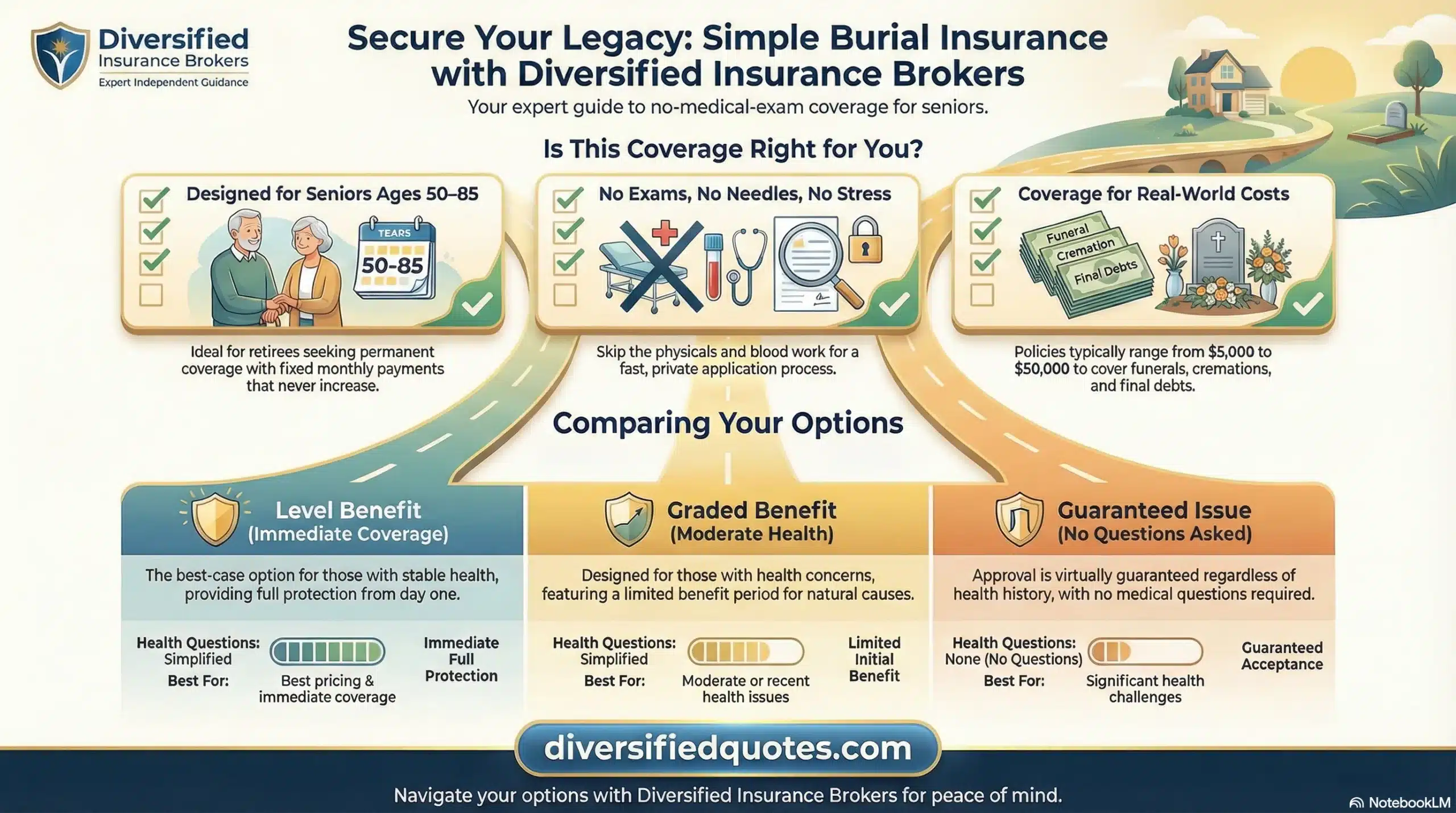
Veterans can typically choose from three practical final expense policy structures. The best fit depends on age, health history, the urgency of getting immediate coverage, and how important it is to minimize premium. Understanding the distinction between these structures helps veterans and their families evaluate options without confusion.
Level benefit policies are the most favorable structure when a veteran can answer basic health questions satisfactorily. Under a level benefit design, the full death benefit is available from the first day the policy is in force — there is no waiting period for natural-cause death. These policies are typically the best value per dollar of coverage because the insurer is accepting a reasonably healthy applicant, and premiums reflect that more favorable risk. Level policies are the appropriate starting point for any veteran comparison because they deliver the most coverage per premium dollar when available.
Graded benefit policies are structured for veterans whose health history makes a level policy unavailable. Under a graded design, the insurer accepts the applicant without requiring the same health profile as a level policy — but for natural-cause deaths occurring in the first two years of the policy (typically), the death benefit is limited, often to a return of premiums paid plus interest rather than the full face amount. After the graded period ends, the full benefit becomes payable for any cause. Graded policies provide a path to permanent coverage for veterans who would otherwise be declined or excluded from level coverage due to health history.
Guaranteed issue policies require no health questions and no medical records — acceptance is guaranteed for applicants within the eligible age range, typically 45 or 50 to 80 or 85 depending on the carrier. These policies universally include a two-year waiting period for natural-cause death and carry a higher cost per dollar of coverage than level or graded designs. For veterans who cannot qualify for any other type of coverage, guaranteed issue provides access to permanent insurance regardless of health history. For veterans who can qualify for level or graded coverage, guaranteed issue is almost always the less efficient choice.
Because underwriting rules vary significantly by carrier, comparison shopping is essential. Two carriers may look similar on the surface but treat the same health history very differently — one may offer a level policy where another requires graded, and a third may decline entirely. This is why working through a broker with access to multiple final expense carriers consistently produces better outcomes than applying to a single company. If budget is a core concern, this page provides useful context for how families approach affordability and coverage size: affordable burial insurance for low-income seniors.
Service-Connected Disabilities and Burial Insurance Underwriting
One of the most common concerns veterans bring to the burial insurance conversation is whether service-connected disabilities or health conditions developed during or after service will prevent approval. The answer depends significantly on the specific condition, its severity, how it is currently managed, and which carrier is being considered.
Many service-connected conditions that are well-managed and stable — controlled hypertension, type 2 diabetes within certain parameters, treated PTSD or anxiety, hearing loss, musculoskeletal conditions — do not prevent veterans from qualifying for level or graded final expense coverage. Final expense carriers use simplified underwriting with a limited set of health questions focused on the conditions they consider highest risk: recent cancer diagnoses, oxygen use, terminal illness, nursing home residency, and a short list of specific organ-system conditions. Many veterans find that their service-connected history does not appear on the final expense health questionnaire at all, or that their specific condition falls outside the disqualifying criteria.
For veterans whose health history is more complex — including those with recent cancer treatment, significant cardiac events, or conditions requiring substantial ongoing medical intervention — graded or guaranteed issue options provide a path to permanent coverage when level underwriting is not available. The most efficient approach is to work with a broker who can quickly assess which carriers and which policy structures fit the veteran’s specific health profile rather than applying repeatedly to individual carriers and generating a paper trail of declines. If you are unsure where you stand, requesting a quote and describing your situation is the best starting point — the broker’s job is to match your profile to the right carrier, not to gatekeep the process.
Coverage Amounts and Typical Costs
Most veterans choose a benefit amount sized to cover the realistic final expense scenario and keep the monthly premium comfortable on a fixed retirement income. The most common range is $8,000 to $20,000. At the lower end, $8,000 to $10,000 addresses a basic direct cremation plus incidental expenses in most markets. At the higher end, $15,000 to $20,000 covers a full funeral with burial in most regions, with room for transportation, reception, and the miscellaneous expenses that accumulate quickly in the days following a death. Some veterans select more — $25,000 or above — if they want the policy to serve double duty: covering final expenses and leaving a modest gift to children, grandchildren, or a surviving spouse.
Premiums vary based on age at application, tobacco use status, health class, and benefit amount. Age at application is the dominant pricing driver — final expense premiums increase substantially with each year of age, which is why veterans who are evaluating coverage are almost always better served by acting sooner rather than delaying. A veteran who qualifies for a level policy at 68 pays a meaningfully lower fixed premium than the same veteran applying at 73, and that lower premium is locked in for life under a non-cancellable design. If you want instant pricing based on your specific age, state, and benefit amount, the calculator below shows real options from multiple final expense carriers.
Burial Insurance Calculator for Veterans
Use the tool below to compare real-time pricing from multiple final expense carriers. After you have a baseline, the next step is verifying which policies match your eligibility and which structure — level, graded, or guaranteed issue — best fits your health profile and goals.
How to Apply and Get Approved Quickly
Final expense applications are designed to be simple and accessible. In most cases, the application consists of a short set of eligibility and health questions — there are no medical exams, no lab draws, no physician statements required for simplified issue policies. The application can typically be completed by phone, online, or with an agent, and decisions are often made same-day or within a few days. For veterans who prefer the least friction possible, guaranteed issue options remove health questions entirely, though as noted above, these carry a two-year natural-cause waiting period and higher cost per dollar of coverage.
The most efficient path is to start with a quote, describe your health history honestly to the broker, and let the broker identify which carriers and which policy type — level, graded, or guaranteed — are the best fit for your situation before any formal application is submitted. This approach prevents wasted time on options that don’t match your profile, avoids unnecessary declined applications, and gets coverage in place as quickly as possible. Many veterans are approved and have their policy issued within one to two weeks of starting the process.
Spouse Coverage: A Frequently Overlooked Planning Step
Veterans who are researching burial insurance for themselves often overlook that their spouse may have equal or greater need for coverage. Surviving spouses who outlive a veteran frequently face the additional challenge of managing final expenses on a reduced fixed income — one Social Security check instead of two, potentially reduced pension or survivor benefit income, and the same or higher final expense costs. A spouse who is in reasonably good health can often qualify for a level final expense policy at the same time the veteran applies, and locking in coverage for both at the same time is almost always more cost-efficient than revisiting the question later when age and health may have changed. Many carriers allow both spouses to be covered simultaneously through separate policies, and the process is no more complicated than applying individually.
Planning Tips That Often Reduce Premiums
Several practical decisions make the biggest difference in final expense premium for veterans. Applying earlier is the most impactful — because age is the dominant pricing driver, a veteran who applies at 67 versus 72 can see meaningfully lower fixed premiums for the same coverage amount, and those savings compound over the years the policy remains in force. Choosing a benefit amount that matches realistic final expenses rather than selecting the maximum available keeps premiums manageable without over-insuring. Being honest and specific about health history when working with a broker allows the broker to identify the right carrier from the start rather than discovering a mismatch after application.
Tobacco use status matters as well — most final expense carriers charge meaningfully higher premiums for tobacco users, and some carriers define tobacco use differently (some exclude occasional cigar use, others do not). Understanding how each carrier treats your specific tobacco use pattern is part of effective comparison shopping. Finally, carrier selection itself is a cost lever — different final expense carriers charge different rates for the same coverage amount and health class, and the variation across carriers for the same veteran profile can be significant. Reviewing options across multiple carriers before committing to any single policy is the most reliable way to find the best combination of coverage, cost, and contractual terms.
If you want a simple starting point, many veterans begin with a $10,000 to $15,000 coverage target and then adjust once they see real pricing in the calculator above. That approach allows you to understand the actual cost of coverage before making any decision, which prevents both overbuying and underinsuring.
Get a Veteran Burial Insurance Plan in Place
We help you compare carriers, confirm eligibility, and lock in level premiums — often with simplified approval.
Request a Personalized QuoteFinancial Protection Essentials
Explore burial insurance and final expense resources to protect your family and plan ahead with confidence.
Related Pages
Explore additional burial insurance resources for families comparing options and benefit sizes.
Talk With an Advisor Today
Choose how you’d like to connect—call or message us, then book a time that works for you.
Schedule here:
calendly.com/jason-dibcompanies/diversified-quotes
Licensed in all 50 states • Fiduciary, family-owned since 1980
Veterans Burial Insurance FAQs
No — and this is one of the most important misunderstandings veterans and their families carry into final expense planning. VA burial benefits vary significantly by eligibility category. Veterans who died from a service-connected disability may qualify for a burial allowance toward funeral and interment costs. Veterans who died from a non-service-connected cause while receiving VA pension or compensation may qualify for a smaller burial allowance. Veterans who were not receiving VA compensation or pension at time of death may not qualify for any burial allowance, though they may still be eligible for a burial flag, a government headstone or marker, and burial in a national cemetery subject to space availability. Even in the most favorable eligibility scenarios, the VA burial allowance does not cover the full cost of funeral home services, transportation of remains, visitation and reception arrangements, obituary costs, monument expenses beyond the government marker, and the many incidental expenses families encounter in the days following a death. The national median funeral with burial cost regularly exceeds $8,000 to $10,000, and many families in higher-cost markets face $12,000 to $15,000 or more. A private burial insurance policy fills the gap by paying cash directly to the named beneficiary, giving the family immediate flexibility without waiting on VA reimbursement timelines.
Yes — and this is the approach most veterans who plan carefully take. VA burial benefits and a private final expense policy serve different functions. VA benefits provide specific items — a burial flag, a government headstone or marker, potential burial in a national cemetery, and in some cases a partial burial allowance — that reduce certain costs. A private burial insurance policy provides a flexible cash benefit paid directly to your named beneficiary, which the family can deploy toward the funeral home bill, transportation, reception, outstanding medical bills, or any other expenses. The two benefits are not mutually exclusive and do not reduce each other. The practical value of having both is that the VA benefits handle certain specific items while the private policy ensures the family has immediate cash available for the full range of expenses — including costs the VA does not address — without financial stress or the need to use savings or credit while waiting for any government reimbursements to process.
Generally not. Final expense whole life insurance is designed specifically to be accessible without the medical exam requirements that larger life insurance policies carry. Most final expense applications use simplified underwriting — a short set of health questions covering conditions the carrier considers highest risk, with no blood draw, no urine sample, and no physician examination required. Decisions on simplified issue applications are typically made same-day or within a few business days based on the health questions and sometimes a review of prescription history through a pharmaceutical database. For veterans who cannot qualify even under simplified underwriting, guaranteed issue policies remove health questions entirely — acceptance is based solely on age eligibility — though these policies include a two-year natural-cause waiting period and carry a higher cost per dollar of coverage. The bottom line is that most veterans can access permanent burial insurance coverage through a straightforward application process without any medical examination.
The most common coverage range for veterans is $8,000 to $20,000, sized to address the realistic final expense scenario while keeping the monthly premium comfortable on a fixed retirement income. At the lower end, $8,000 to $10,000 covers a basic direct cremation plus incidental expenses in most markets. In the middle range, $12,000 to $15,000 covers a standard funeral with burial in many regions including transportation, reception, and typical miscellaneous costs. At $18,000 to $20,000, the policy provides a cushion above and beyond typical funeral costs to address outstanding medical bills, small debts, or a modest legacy for children or grandchildren. The right amount is determined by your local funeral market costs, what you want covered, your existing savings, and what monthly premium fits comfortably into your budget. Using the burial insurance calculator on this page to see actual pricing at different benefit amounts is the most practical starting point — it lets you see real premiums before committing to any specific coverage level.
Most final expense carriers pay approved claims within a few business days to two weeks after receiving a completed claim form and a certified copy of the death certificate. Some carriers have expedited processes that can pay even faster for straightforward claims. This speed is one of the most important practical advantages of a private burial insurance policy over relying on other payment sources: funeral homes typically require payment at or near the time of service, and families who do not have immediate cash available may face pressure to make financial decisions under stress. A burial insurance policy that pays quickly gives the beneficiary the funds to pay the funeral home directly and promptly, without using credit cards, drawing from savings earmarked for other purposes, or requesting advance payment from relatives. For level benefit policies where the full death benefit is available from policy inception, claims are processed without the waiting period complications that affect graded and guaranteed issue policies for natural-cause deaths in the first two years.
Not necessarily — and for many veterans with service-connected disabilities, the answer is that the specific condition does not appear on the final expense health questionnaire at all. Final expense underwriting focuses on a relatively short list of conditions that insurers consider highest risk: active or recent cancer, oxygen dependence, terminal illness diagnoses, current nursing home or assisted living residency, and a limited set of specific organ-system conditions. Many common service-connected conditions — treated hypertension, controlled type 2 diabetes, PTSD managed with medication and therapy, hearing loss, musculoskeletal conditions, and similar — do not fall into the disqualifying categories for level or graded final expense coverage. Veterans with more complex health histories, including recent cancer treatment or significant cardiac events, may find that graded or guaranteed issue options provide a path to permanent coverage when level underwriting is unavailable. The most efficient way to understand where you stand is to describe your health history to an independent broker who knows which carriers are most favorable for your specific profile — this prevents wasted time and avoids an unnecessary paper trail of declined applications that can complicate future coverage attempts.
Yes, in most cases. Final expense policies can be structured so that an adult child, a surviving spouse, or another trusted family member serves as the policy owner and premium payer, while the veteran is the insured. This arrangement is common when the veteran prefers to have the plan organized and managed by a family member, when the family member is handling the financial planning on the veteran’s behalf, or when the goal is to ensure that premiums are paid reliably without depending on the insured to manage the billing. The owner controls the policy, names the beneficiary (subject to any beneficiary consent requirements), and receives any policy correspondence. The insured must consent to and participate in the application process — the veteran’s health information and signature are still required — but the premium payment and ongoing administrative responsibility can rest with whoever the family decides is most appropriate. This flexibility makes final expense planning accessible even for veterans who prefer not to manage the financial administration themselves.
Final expense whole life policies are generally structured to pay a death benefit to the named beneficiary upon the insured’s death. The policy itself — as an owned asset — may have a small cash value that technically appears on a balance sheet, but the cash values in final expense policies sized at $8,000 to $20,000 are typically modest and in many cases fall within exemptions that apply to life insurance cash value for means-tested benefit calculations. VA compensation and disability benefits are not means-tested, so a burial insurance policy does not affect those benefits. VA pension — which is means-tested and based on income and net worth — has specific rules about what assets count toward net worth calculations, and life insurance cash value treatment under VA pension rules is a nuanced question that depends on the policy’s specific cash value at the time of any VA eligibility determination. For veterans who are currently receiving or actively applying for VA pension, confirming how any life insurance asset would be treated under the current VA net worth rules with a VA-accredited benefits specialist or elder law attorney before purchasing is a prudent step. For the large majority of veterans whose primary concern is simply protecting their family from final expense costs, a small burial insurance policy is unlikely to create complications.
About the Author:
Jason Stolz, CLTC, CRPC, DIA, CAA and Chief Underwriter at Diversified Insurance Brokers (NPN 20471358), is a senior insurance and retirement professional with more than 25 years of real-world experience helping individuals, families, and business owners protect their income, assets, and long-term financial stability. As a long-time partner of the nationally licensed independent agency Diversified Insurance Brokers, Jason provides trusted guidance across multiple specialties—including fixed and indexed annuities, long-term care planning, personal and business disability insurance, life insurance solutions, Group Health, Travel Medical and Evacuation Insurance, and short-term health coverage. Diversified Insurance Brokers maintains active contracts with over 100 highly rated insurance carriers, ensuring clients have access to a broad and competitive marketplace.
His practical, education-first approach has earned recognition in publications such as VoyageATL, and contributions from his agency featured in Kiplinger and GoBankingRates— highlighting his commitment to financial clarity and client-focused planning. Drawing on deep product knowledge and years of hands-on field experience, Jason helps clients evaluate carriers, compare strategies, and build retirement and protection plans that are both secure and cost-efficient. Visitors who want to explore current annuity rates and compare options across multiple insurers can also use this annuity quote and comparison tool.
Explore More Burial Insurance Options: Browse our complete guide to Burial Insurance for Seniors — covering burial insurance for seniors over 50, 60, 70, 80 & parents from top carriers from top carriers.
Last Reviewed: September 25, 2026 |
Reviewed by: Jason Stolz, CLTC, CRPC, DIA, CAA
Chief Underwriter, Diversified Insurance Brokers, Inc. | NPN: 20471358 | Diversified Insurance Brokers, Inc. — Licensed in all 50 states
Fact Checked by: Tonia Pettitt, CMIP©
Medicare Specialist, Diversified Insurance Brokers, Inc. | NPN: 14374308 | Diversified Insurance Brokers, Inc. — Licensed in all 50 states
Did you find this content helpful? Leave us a Google review — it helps others find trustworthy guidance too.
Editorial Standards: Diversified Insurance Brokers maintains rigorous editorial standards to ensure accuracy, clarity, and independence in all content. Learn more about our editorial standards and commitment to transparency.
