
Burial Insurance for Seniors Over 50
Burial Insurance for Seniors Over 50

Jason Stolz CLTC, CRPC, DIA, CAA
Burial insurance for seniors over 50 is available at the lowest premiums, broadest health qualification access, and maximum face amount options in the entire senior final expense market — and those three advantages exist simultaneously only at this age range. Every final expense carrier that operates in the simplified-issue burial market accepts applicants in their 50s. Most offer their widest coverage amounts to this age group. Level benefit day-one coverage — the most cost-effective policy structure — is accessible to more health profiles in the 50s than in any subsequent decade. And the premium that is locked in at age 52 or 57 stays locked for life, permanently below the cost of the same coverage purchased at 62, 67, or 72. The financial case for acting in the 50s rather than deferring is not subtle: a 50-year-old male can secure $10,000 of simplified-issue burial coverage for approximately $30–36 per month, depending on carrier and health profile. The same male at age 75 pays approximately $97–100 per month for the same coverage — nearly three times as much. That difference is permanent, because burial insurance premiums are locked at issue and never increase. Every year of deferral permanently increases the cost of the same coverage for the rest of the policy’s life. Our resource on burial insurance services covers the full product landscape, and our resource on burial insurance for seniors covers the complete age progression across the senior final expense market from 50 through the 80s.
The 50s also represent the age at which final expense planning first becomes practically relevant for most households — but where the urgency is not yet felt because no immediate trigger has occurred. Many people in their 50s still have employer-provided group life insurance, may still be carrying term life policies purchased earlier, and may feel that final expense planning can wait until closer to retirement or until other coverage ends. That reasoning is understandable but financially costly: the employer group life that seems to make burial insurance unnecessary today will terminate at retirement, and at that point the individual will apply for burial insurance at whatever age they happen to be — with a permanently higher premium than they would have locked in during the 50s. The term policy that is still in force will eventually expire, and the final expense gap will need to be addressed at a higher premium tier. Acting in the 50s doesn’t eliminate other coverage — it complements it by establishing a permanent, low-cost final expense foundation that stays in place regardless of what happens to other coverage over the next decade. Our resource on burial insurance vs. pre-paid funeral covers the structural comparison many families in their 50s evaluate when first addressing final expense planning, and our resource on what does burial insurance cover covers exactly what the policy pays for when it is needed.
The other audience that frequently arrives at the over-50 page is adult children — most commonly people in their 30s to 50s who are researching or purchasing burial insurance on behalf of a parent who is in their 50s or 60s. This is an entirely common and carrier-standard arrangement in the final expense market. The adult child or other family member can serve as the policy owner and premium payer while the parent is the insured, and the parent’s consent and health question responses are required for the application. For families where an aging parent has not yet addressed final expense planning independently, the adult child’s research often begins with the over-50 or over-60 age bracket depending on the parent’s current age. Our resource on best burial insurance for parents over 70 covers the parent-specific planning considerations when the parent has already passed through the 50s decade, and our resource on life insurance with pre-existing conditions covers the general framework for how carriers evaluate health history across all age brackets in the impaired-risk market.
Compare Burial Insurance Rates — Lock In the Lowest Senior-Market Premium
Simplified issue — no medical exam. See real rates in minutes and lock in before the next birthday increases your cost.
Every birthday increases the locked-in rate permanently
We compare carriers and find the most competitive rate for your age and health profile — before any application is submitted and before another year adds to the cost.
The Real Cost of Waiting — How Burial Insurance Premiums Rise With Age
The most powerful argument for securing burial insurance in the 50s is the permanent premium advantage that early action locks in. Because burial insurance is permanent whole life coverage with level premiums fixed at the time of issue, the premium difference between applying at 50 and applying at 70 is not temporary — it persists for every month and every year the policy remains in force. The table below shows approximate directional monthly premium ranges for $10,000 and $20,000 of simplified-issue burial insurance across age tiers based on market research. These are approximate ranges derived from published industry data and vary by carrier, state, gender, health profile, and tobacco status — use them as directional benchmarks for understanding the cost of waiting, not as guaranteed rates for any specific carrier.
| Age at Application | Approx. Monthly — Female, Non-Tobacco, $10K | Approx. Monthly — Male, Non-Tobacco, $10K | Approx. Monthly — Female, Non-Tobacco, $20K | Approx. Monthly — Male, Non-Tobacco, $20K |
|---|---|---|---|---|
| Age 50–54 | ~$24–30 | ~$30–38 | ~$44–55 | ~$55–70 |
| Age 55–59 | ~$28–36 | ~$36–46 | ~$52–66 | ~$66–84 |
| Age 60–64 | ~$36–48 | ~$46–62 | ~$66–88 | ~$84–110 |
| Age 65–69 | ~$41–58 | ~$54–76 | ~$76–106 | ~$100–138 |
| Age 70–74 | ~$55–78 | ~$76–100 | ~$100–140 | ~$138–180 |
| Age 75–79 | ~$71–105 | ~$97–135 | ~$130–190 | ~$175–240 |
Premium ranges above are approximate directional benchmarks derived from published market research and industry data. These are not guaranteed rates for any specific carrier, product, state, or health profile. Actual premiums depend on carrier selection, state of residence, specific health history, tobacco status, benefit amount, and underwriting tier. Tobacco users typically pay 30–50% more than the non-tobacco rates shown. Get an actual carrier comparison for your specific age and profile through the quote tool above before drawing conclusions from these ranges. Individual carrier rates vary — comparison across multiple carriers consistently produces better outcomes than relying on industry-average reference points.
Why Over 50 Is the Optimal Entry Point for Burial Insurance
Three advantages converge at age 50 that do not simultaneously exist at any later entry point. The first is premium efficiency — the rates available in the early-to-mid 50s are the lowest a senior will ever see for burial insurance, and locking them in permanently is the single most powerful financial argument for acting in this decade. The second is health qualification breadth — underwriting in the 50s accommodates the widest range of health profiles at level-benefit rates of any point in the senior market. A 53-year-old with controlled blood pressure, managed cholesterol, and no recent cardiac events has a broader level-benefit option set than the same person at 63, 73, or 83 — not because the conditions are different but because the carrier field is widest and the health qualification threshold is most forgiving at the younger age. The third is face amount access — several carriers reduce their maximum available coverage amounts as applicants age past certain thresholds (commonly age 56 or age 76 for step-downs at some carriers), which means the 50s offer the broadest face amount range available in this product category. A family that wants $35,000 or $40,000 of burial insurance to cover a generous final expense plan, anticipated medical bills, and a small legacy component has the most carrier options for that face amount in the 50s than at any subsequent age. Our resource on burial insurance for seniors over 60 covers the adjacent decade in detail, and our resource on burial insurance for seniors over 70 covers the subsequent decade where premiums are meaningfully higher and some face amount options have stepped down.
What Burial Insurance Actually Covers
Burial insurance — also called final expense insurance or funeral insurance — is permanent whole life coverage designed to pay a defined death benefit directly to the named beneficiary upon the insured’s death, without going through the estate or probate process. The beneficiary can use the proceeds for any purpose, but the policy is specifically designed to address the immediate financial obligations that arrive in the days following a death. A standard funeral service with viewing, casket, and vault averages $8,500 to $13,000 in the current market depending on geography and service selections. Cremation with a memorial service ranges from approximately $2,000 for direct cremation to $5,000 or more when a full ceremony is added. Final medical or hospice bills often arrive after death and must be paid before estate distribution begins. Small outstanding debts — a car payment, a credit card, a utility balance — may become the family’s responsibility or go unpaid, affecting the estate. And the practical costs of managing a death — family travel, lodging, administrative filings, estate attorney fees — add up quickly during the week when everyone is most emotionally and financially vulnerable. Burial insurance addresses all of these through a single, permanent, dedicated benefit that pays promptly to the beneficiary rather than waiting for estate settlement. Our resource on what does burial insurance cover covers the full scope of what the proceeds can address in a practical final expense context.
Three Policy Structures Available at Age 50+
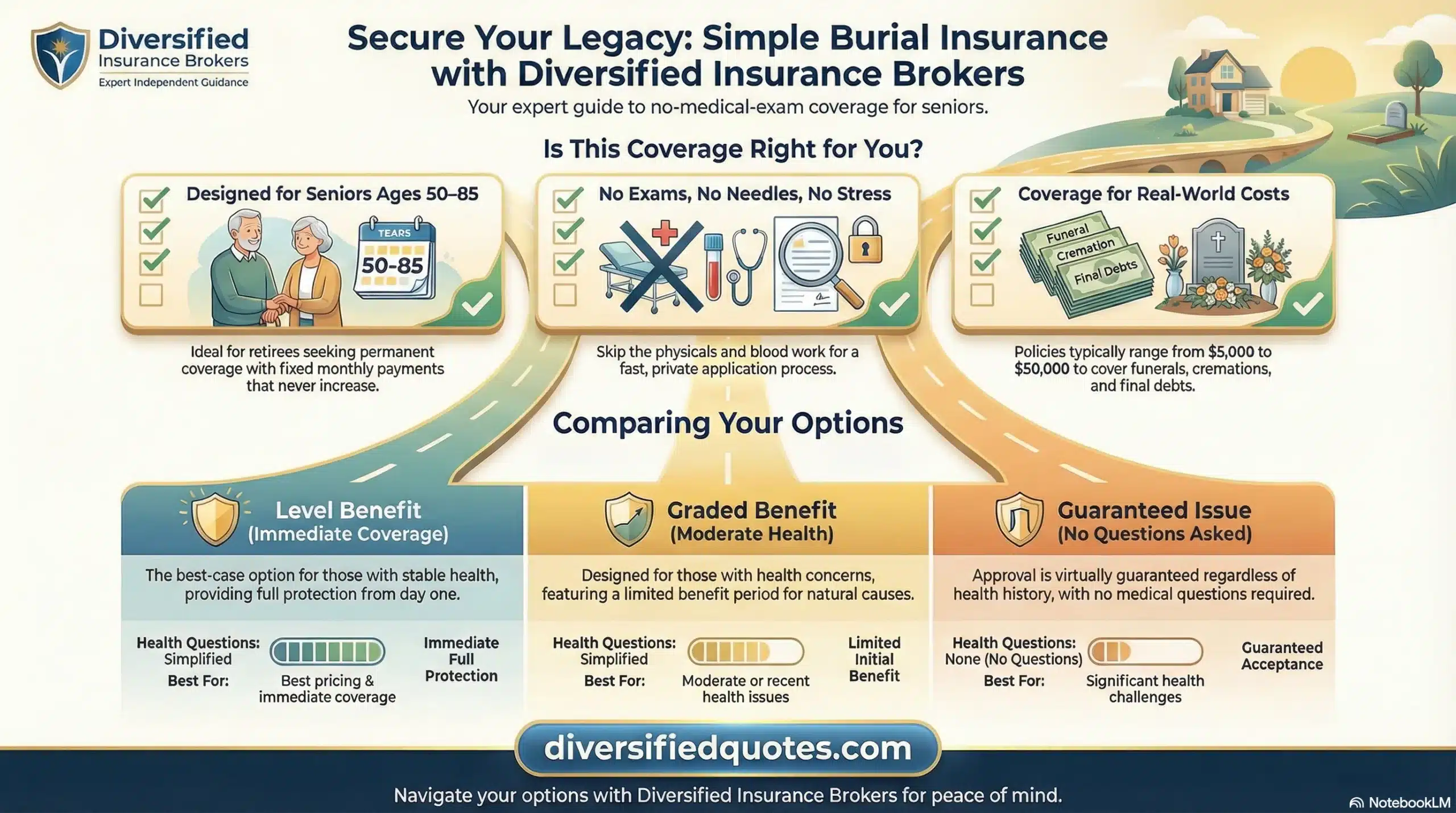
Every burial insurance applicant over 50 will encounter three policy structures, and the appropriate starting point depends on the health profile rather than a preference for the simplest application process. Level benefit simplified-issue coverage — which pays the full face amount for all covered causes of death from the policy effective date, requires a short health questionnaire but no exam, and is the most cost-effective structure per dollar of coverage — is the correct starting point for the majority of applicants in their 50s with standard health profiles. Graded benefit simplified-issue coverage is appropriate when a carrier approves the application but assigns a waiting period for natural causes based on more complex recent health history; the graded period (typically two years) passes and then full natural-cause coverage applies for the remaining policy life. Guaranteed issue — no health questions, no exam, automatic approval within the eligible age range, but always including a graded benefit for natural causes and the highest premium per dollar of coverage — is the appropriate last-resort structure for applicants whose health history makes simplified-issue approval unavailable. The critical guidance at age 50+ is this: defaulting to guaranteed issue without first evaluating simplified-issue options is almost always financially wrong, because most applicants in their 50s qualify for simplified issue at significantly lower cost. Our resource on is guaranteed issue life insurance expensive makes the cost difference between GI and simplified-issue concrete, and our resource on burial insurance with no health exam covers the guaranteed-issue pathway with a realistic explanation of what the no-question convenience actually costs per dollar of coverage.
How Health History Is Evaluated at Age 50–59
The simplified-issue underwriting system used by final expense carriers was built to accommodate the health profiles most common at middle to late-middle age — managed chronic conditions like hypertension, high cholesterol, controlled type 2 diabetes, and resolved health events from earlier in life. These are not disqualifying factors at most final expense carriers when they are well-controlled; they are the baseline health reality of the population that the product is designed to serve. The conditions that push applications toward graded benefit or guaranteed issue in the 50s are typically more acute or more recent: a heart attack within the past 12 to 24 months, a stroke within the past 12 months, active cancer treatment, home oxygen use, or significant functional limitations. Controlled chronic conditions with consistent medication compliance and physician follow-up are accepted at level benefit rates across most of the carrier field in the 50s. The carrier-specific question that determines which option is most favorable is not “does this person have any health history” but “which carrier’s underwriting guidelines are most favorable for this specific combination of conditions at this specific age.” Our condition-specific resources on burial insurance for people with heart conditions, burial insurance for people with high blood pressure, burial insurance for cancer survivors, burial insurance for stroke survivors, burial insurance for smokers, and burial insurance for overweight people cover the specific underwriting dynamics for the most common impairment categories in the 50s market.
Cash Value — The Long-Term Whole Life Benefit
Burial insurance is permanent whole life coverage, and whole life insurance accumulates cash value over time. A small portion of each premium payment builds toward the policy’s cash value — a growing, accessible balance within the policy that can be borrowed against or surrendered in future years. Cash value accumulation is not the primary reason most people purchase burial insurance, but it is a real benefit of the product design. A policy purchased at age 52 has more years ahead of it than one purchased at 72 — meaning it will accumulate more cash value over the same subsequent period. The cash value inside a burial insurance policy can serve as a small supplemental savings vehicle, an emergency access reserve (through policy loans, which reduce the death benefit if not repaid), or simply a balance that grows alongside the death benefit over the decades the policy is in force. For most policyholders the cash value remains secondary to the death benefit purpose — but it is a meaningful distinction between burial insurance as a permanent whole life product and term life insurance, which builds no cash value and expires at the end of the term. The cash value component also ensures that even if the insured lives to a very advanced age, the policy does not “run out” — it stays in force for life as long as premiums are paid.
Burial Insurance Alongside Employer Group Life and Term Coverage
Many people in their 50s have other life insurance coverage in place — employer group life that is still active, term policies from earlier working years that still have years remaining, or older permanent policies with reduced paid-up values. Burial insurance serves a distinct role within this coverage picture that does not duplicate the purpose of other coverage. Employer group life — commonly one to two times annual salary — is designed for income replacement and is temporary, tied to continued employment. When employment ends at retirement, group life terminates and the coverage gap must be addressed at whatever age the individual happens to be. Term life coverage that expires at age 65, 70, or 80 is designed for working-years income replacement and is not a substitute for permanent final expense coverage that stays in force beyond the term expiration. Burial insurance established in the 50s stays in force permanently, covering the final expense need after every other coverage layer has ended — while the premium is locked at the 50s rate, which is permanently the lowest available tier. Our resource on term life insurance calculator covers how term structures compare to permanent options during working years, and provides context for families evaluating the coverage layering question across the working-to-retirement transition.
When You’re Researching Burial Insurance for an Aging Parent
A significant portion of the families who arrive at this page are adult children evaluating burial insurance for a parent who is in their 50s, early 60s, or beyond — not for themselves. This is a common and carrier-standard dynamic in the final expense market. The adult child can serve as the policy owner and premium payer while the parent is the insured, with the parent’s informed consent and accurate health question responses required for the application. For an adult child whose parent is in their 50s, this is the most favorable possible window to establish coverage — premiums are at their lowest, the full carrier market is available, and level benefit access is at its broadest. For adult children whose parents are already in their 60s or 70s, those advantages have partially passed but coverage remains accessible and valuable. Our dedicated resource on best burial insurance for parents over 70 covers the parent-specific planning considerations for families whose parents are in their 70s. The over-60 and over-70 pages in this series — burial insurance for seniors over 60 and burial insurance for seniors over 70 — cover how the landscape shifts as the parent ages through subsequent decades.
Sizing the Benefit Amount at Age 50+
The right benefit amount for burial insurance at age 50 and above is determined by actual final expense costs plus a reasonable buffer — not the maximum the carrier will offer. A standard burial service averages $8,500 to $13,000 in the current market. Cremation with a ceremony runs $2,000 to $5,000 for most families. Final medical or hospice bills, small debts, and family administrative costs add another variable layer. Most families in their 50s select between $10,000 and $25,000 to cover the funeral and burial or cremation service, final medical bills, small outstanding obligations, and family travel costs, with enough buffer to spare the survivors from any immediate financial shortfall. Families who want a larger final expense cushion — or who want the policy to include a modest legacy component above the pure final expense amount — have access to the largest face amounts in the senior market in the 50s, with some carriers offering up to $50,000 for applicants under age 56. The key is selecting an amount that the premium will remain comfortable to pay permanently on whatever income the household will have in retirement. Our resources on burial insurance calculator, final expense insurance calculator, and monthly cost of a $10,000 burial insurance policy provide tools and reference points for evaluating specific benefit amounts before selecting a carrier. Our resource on affordable burial insurance for low-income seniors covers benefit sizing and premium management strategies for applicants where monthly budget is the primary constraint.
Talk With an Advisor Today
Choose how you’d like to connect—call or message us, then book a time that works for you.
Schedule here:
calendly.com/jason-dibcompanies/diversified-quotes
Licensed in all 50 states • Fiduciary, family-owned since 1980
FAQs: Burial Insurance for Seniors Over 50
Why should someone in their 50s consider burial insurance now rather than waiting?
Burial insurance premiums are locked at the age of application and never increase. A 52-year-old who secures a $15,000 burial policy today pays the age-52 rate for the entire life of the policy — including at age 72 and 82. The same policy applied for at age 72 carries the age-72 rate permanently. Market data suggests a 50-year-old male pays approximately $30–36 per month for $10,000 of simplified-issue coverage; a 75-year-old male pays approximately $97–100 for the same policy — nearly three times as much. Beyond premium cost, the health qualification window for level-benefit coverage is at its broadest in the 50s, and some carriers reduce maximum face amounts for applicants past certain age thresholds. Acting in the 50s locks in the optimal combination of lowest premium, broadest option access, and maximum face amount availability simultaneously.
Do I need a medical exam for burial insurance over 50?
No — burial insurance uses simplified-issue underwriting in almost all cases: a short health questionnaire (typically 5–15 questions), no medical exam, no blood work, and no physician records submission. The carrier adds an electronic prescription history database check and a Medical Information Bureau records review. Guaranteed issue policies require no health questions at all. Neither pathway requires a physical examination. The simplified application process is one of the defining features of the final expense product category, and it applies equally to applicants in their 50s, 60s, and 70s.
What health conditions affect approval for burial insurance at 50+?
The simplified-issue underwriting system for final expense insurance was built to accommodate the health profiles most common in the 50s — managed hypertension, controlled cholesterol, stable type 2 diabetes without insulin, resolved cancer history in long-term remission, and similar controlled chronic conditions. These are accepted at level-benefit rates across most of the carrier field for applicants in their 50s with consistent medical management and no recent major acute events. What typically pushes toward graded benefit or guaranteed issue is recent event history — a cardiac event or stroke within the past 12–24 months, active cancer treatment, home oxygen use, or significant functional limitations. Different carriers draw these lines differently, making multi-carrier comparison consistently more effective than single-carrier application.
How much burial insurance can someone in their 50s get?
Coverage amounts in the 50s are the highest available in the senior final expense market. Some carriers offer up to $50,000 or more for applicants under age 56; most offer $25,000–$40,000 through the end of the 50s decade. Maximum face amounts step down at certain age thresholds at some carriers — making the 50s the window when the highest burial insurance amounts are available. Most families target $10,000 to $25,000 to cover realistic final expense costs including the funeral service, final medical bills, small debts, and a buffer for family logistics. The right amount is determined by actual anticipated costs rather than the maximum available.
Will burial insurance premiums increase as I get older?
No — burial insurance is permanent whole life coverage with level premiums fixed at the time of policy issue. Premiums never increase due to age, health changes, additional diagnoses, or continued tobacco use after the policy is in force. The monthly cost locked in at age 54 is exactly the same at age 74 and 84. This permanence is one of the primary advantages of purchasing burial insurance in the 50s while premiums are at their lowest: the competitive advantage of the early application compounds over decades as the locked-in premium stays fixed while the equivalent rate for a new applicant continues to increase with each age year.
Does burial insurance make sense if I already have employer group life or term life coverage?
Yes — burial insurance serves a different, permanent purpose that is not duplicated by employer group life or term coverage. Employer group life terminates when employment ends and is designed for working-years income replacement. Term life expires at the end of its term and is similarly designed for working-years coverage. Burial insurance established in the 50s stays in force permanently and covers the final expense need after every other coverage layer has ended — while the premium is locked at the 50s rate rather than whatever rate would apply when the other coverage expires and the gap must be addressed. The most common strategy is to keep existing coverage for its intended purpose while establishing a separate, permanent burial policy as the dedicated final expense foundation.
Can I buy burial insurance for an aging parent who is in their 50s or 60s?
Yes — this is a standard arrangement in the final expense market. An adult child can serve as the policy owner and premium payer while the parent is the insured, with the parent’s informed consent and accurate health question responses required for the application. For adult children whose parents are in their 50s, this is the most favorable possible window — premiums are at their lowest, health qualification access is broadest, and the full carrier market is available. The longer the action is deferred, the higher the permanent locked-in premium will be when the policy is finally established.
Does burial insurance expire at a certain age?
No. Burial insurance is permanent whole life coverage — it does not expire at a specified age, does not reduce in benefit as the insured ages, and does not require re-underwriting at any point during the policy’s life. As long as premiums are paid, coverage remains in force for the insured’s entire lifetime. This is a critical distinction from term life insurance, which provides temporary coverage for a defined number of years and then expires. A burial insurance policy purchased at age 52 will still be in force and paying the same monthly premium at age 92, with the same face amount available to the beneficiary.
About the Author:
Jason Stolz, CLTC, CRPC, DIA, CAA and Chief Underwriter at Diversified Insurance Brokers (NPN 20471358), is a senior insurance and retirement professional with more than 25 years of real-world experience helping individuals, families, and business owners protect their income, assets, and long-term financial stability. As a long-time partner of the nationally licensed independent agency Diversified Insurance Brokers, Jason provides trusted guidance across multiple specialties—including fixed and indexed annuities, long-term care planning, personal and business disability insurance, life insurance solutions, Group Health, Travel Medical and Evacuation Insurance, and short-term health coverage. Diversified Insurance Brokers maintains active contracts with over 100 highly rated insurance carriers, ensuring clients have access to a broad and competitive marketplace.
His practical, education-first approach has earned recognition in publications such as VoyageATL, and contributions from his agency featured in Kiplinger and GoBankingRates— highlighting his commitment to financial clarity and client-focused planning. Drawing on deep product knowledge and years of hands-on field experience, Jason helps clients evaluate carriers, compare strategies, and build retirement and protection plans that are both secure and cost-efficient. Visitors who want to explore current annuity rates and compare options across multiple insurers can also use this annuity quote and comparison tool.
Explore More Burial Insurance Options: Browse our complete guide to Burial Insurance for Seniors — covering burial insurance for seniors over 50, 60, 70, 80 & parents from top carriers from top carriers.
Last Reviewed: June 4, 2026 |
Reviewed by: Jason Stolz, CLTC, CRPC, DIA, CAA
Chief Underwriter, Diversified Insurance Brokers, Inc. | NPN: 20471358 | Diversified Insurance Brokers, Inc. — Licensed in all 50 states
Fact Checked by: Tonia Pettitt, CMIP©
Medicare Specialist, Diversified Insurance Brokers, Inc. | NPN: 14374308 | Diversified Insurance Brokers, Inc. — Licensed in all 50 states
Did you find this content helpful? Leave us a Google review — it helps others find trustworthy guidance too.
Editorial Standards: Diversified Insurance Brokers maintains rigorous editorial standards to ensure accuracy, clarity, and independence in all content. Learn more about our editorial standards and commitment to transparency.
