
Best Burial Insurance with Immediate Coverage
Best Burial Insurance with Immediate Coverage

Jason Stolz CLTC, CRPC, DIA, CAA
If you’re shopping for burial insurance with immediate coverage, you’re focused on one thing that matters more than anything else: when your family needs the policy, it should pay the full death benefit right away. Not “premiums back plus interest.” Not a partial percentage. Not a benefit that slowly increases over two years. You want a straightforward final expense policy that starts protecting your family from the start. At Diversified Insurance Brokers, we help seniors and families compare burial insurance options that offer immediate (level) coverage — often with no medical exam — so you can secure the strongest benefit structure that fits your health profile and budget. Many people don’t realize that “no exam” does not automatically mean “no waiting period.” A policy can be no-exam and still have a graded or modified benefit period. If your goal is day-one protection, the underwriting path and the carrier rules matter as much as the price. This page explains what immediate coverage really means, how to qualify, how to keep premiums affordable long-term, and how to avoid the common mistakes that cause families to buy the wrong type of burial insurance policy. For the dedicated companion resource on no-waiting-period burial insurance — which covers the same day-one protection goal from the angle of which carriers formally eliminate the graded period — our resource on burial insurance with no waiting period covers that specific landscape alongside this page’s broader coverage strategy discussion.
Get Immediate Burial Coverage Options — Today
We’ll compare policies that offer day-one level benefits and match you to the best underwriting fit for your health and budget.
Get a Quote Call 800-533-5969What Burial Insurance with Immediate Coverage Really Means
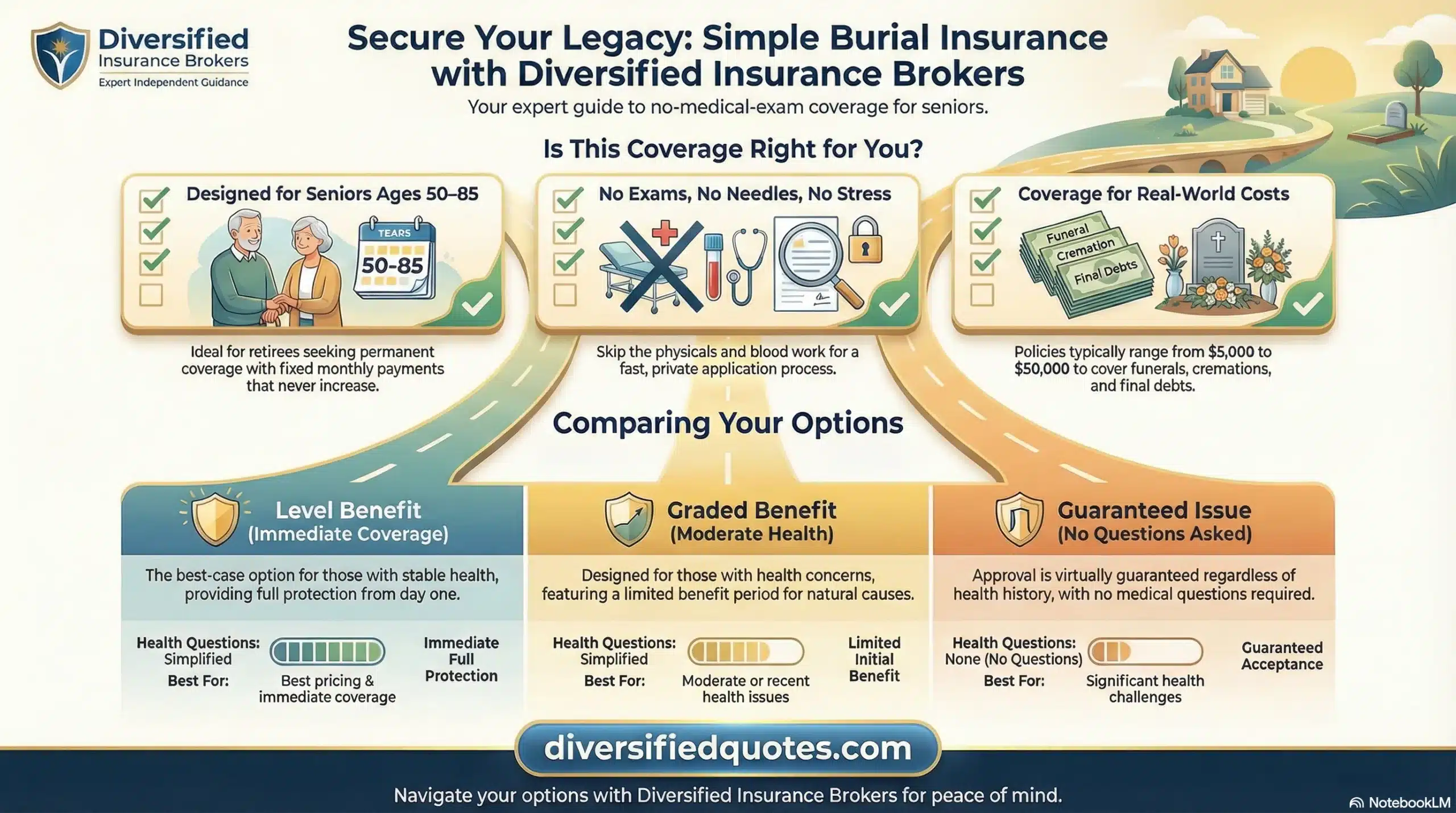
“Immediate coverage” is also commonly called level benefit coverage. It means that once the policy is active and the first premium is paid, the policy pays the full death benefit for covered causes of death — starting right away. When families ask for “immediate burial insurance,” what they’re really asking is, “If something happens soon, will the policy do what it’s supposed to do?” This matters because many burial insurance policies on the market — especially policies designed for applicants with significant health challenges — use graded or modified benefit structures. Those policies usually limit what is paid for death from natural causes during the first one to two years. Some return premiums paid plus interest. Some pay a percentage that increases over time. Accidental death is often covered immediately, but the details and definitions vary by carrier and product. Immediate coverage is typically available through simplified issue burial insurance. Simplified issue policies generally use a short health questionnaire instead of a full medical exam. The underwriter’s goal is to quickly identify whether you qualify for day-one level benefits based on recent medical history, current treatments, and overall stability. If you want a broader overview of burial insurance and how it’s designed, start here: final expense life insurance. For a service-level overview of how we shop and place these policies, you can also see our burial insurance services page. For the specific permanent policy structure that underlies most burial insurance products — and why whole life rather than term is the dominant structure in final expense planning — our resource on final expense whole life insurance covers the product mechanics that apply to immediate-coverage policies.
Why Immediate Coverage Matters for Real Families
Final expenses tend to hit fast. Funeral homes often require payment up front or within a short window. Families may also face travel costs, medical balances, and a sudden gap in household cash flow while accounts are settled. Even if a family has savings, timing matters. If money is tied up in retirement accounts, waiting on estate processes, or simply difficult to access quickly during an emotional period, financial pressure can compound stress. That’s why families who are focused on immediate coverage often aren’t “shopping for insurance.” They’re trying to prevent a specific problem: loved ones being forced to borrow, delay decisions, or pay out-of-pocket when they’re grieving. A day-one burial policy can remove that burden by providing a predictable benefit payable directly to the beneficiary. Coverage selection also becomes clearer when you understand the cost realities you want the policy to cover. Two useful planning references are how much does a funeral cost and how much does it cost to be cremated. For families evaluating burial insurance specifically for an elderly parent rather than for themselves, our resource on best burial insurance for parents over 80 covers the carrier selection and underwriting dynamics that apply specifically to that age group and family structure. For an honest comparison of burial insurance against the pre-paid funeral plan alternative — including when each approach is preferable and what the practical differences are at claim time — our resource on burial insurance vs. pre-paid funeral covers those distinctions in full.
Who Qualifies for Immediate Burial Coverage
Immediate coverage is most often available to applicants who can qualify for simplified issue underwriting. The specific health questions vary by carrier, but the theme is consistent: carriers are looking for stability. They want to see that major medical events are not recent, that conditions are reasonably controlled, and that there aren’t red flags that imply high near-term risk. Many seniors assume they won’t qualify because they have “a lot going on.” In reality, many common conditions can still qualify for simplified issue when they’re stable and well managed. Blood pressure and cholesterol medications are common. Controlled diabetes can sometimes work depending on details. A history of a procedure years ago can be acceptable if follow-ups are stable and there have been no recent complications. The details matter, and so does the carrier choice, because underwriting appetite varies widely. For a broader view of how burial insurance works specifically across different senior age brackets — including which carriers remain competitive at older ages — our resource on burial insurance for seniors provides the full age-spectrum context. If simplified issue is not available, the counterpart strategy is guaranteed issue. For the complete picture of what guaranteed issue burial insurance offers — its no-health-question structure, graded period mechanics, and when it’s the right choice — our resource on guaranteed issue burial insurance covers that underwriting path in detail so families understand both options clearly before deciding.
Health Conditions and Immediate Coverage Eligibility — General Reference
One of the most important questions families face is whether a specific health condition disqualifies a parent or senior family member from immediate (level benefit) coverage. The answer depends on the carrier, the severity and recency of the condition, and the overall health profile. The table below maps common health situations to their general immediate coverage eligibility and the key factors that determine which underwriting path applies. This is illustrative — individual outcomes vary by carrier and specific circumstances.
General reference only. Specific eligibility decisions are made by individual carriers based on full application details. This table does not constitute an offer of coverage or a guarantee of any specific outcome.
| Health Condition / Situation | Typical Immediate Coverage Availability | Key Factors That Influence the Decision | Planning Notes |
|---|---|---|---|
| Controlled high blood pressure (on medication) | Often available — controlled hypertension with stable medication is among the most common conditions that still qualify for simplified issue day-one coverage | Stability of readings, number of medications, any related complications (stroke, kidney disease); recent changes to medication regimen may trigger additional scrutiny | Most carriers accept controlled hypertension; carrier choice matters more for other concurrent conditions than for hypertension alone |
| Type 2 diabetes (diet or medication controlled) | Possible — many simplified issue carriers accept controlled Type 2 diabetes, though carrier appetite varies; insulin-dependent diabetes may narrow options | Control method (diet, oral medication, insulin), A1c stability, presence of complications (neuropathy, retinopathy, kidney disease); recent hospitalizations related to diabetes | Carrier selection is important; some carriers are significantly more favorable for diabetic applicants than others |
| COPD / chronic respiratory condition | Variable — mild to moderate COPD may qualify depending on carrier; severe COPD with recent hospitalizations or oxygen dependency typically does not qualify for immediate coverage | Severity classification, oxygen use, recent hospitalizations, concurrent conditions (heart disease, diabetes); tobacco history compounds underwriting complexity | Applicants with COPD who have not required hospitalization in 2+ years may still find simplified issue options; guaranteed issue is the fallback |
| Prior heart attack (remote, no recent events) | Possible — a remote heart attack (typically 2+ years prior) with stable follow-up may qualify for simplified issue at some carriers; recent heart attacks typically do not qualify for immediate coverage | Time elapsed since the event, current treatment stability, ejection fraction if known, whether stents or bypass were involved, any subsequent cardiac events | Carrier selection is critical; some carriers have more favorable heart attack look-back windows than others |
| Cancer history (completed treatment, stable follow-up) | Possible for some cancer types with completed treatment — skin cancer (non-melanoma) is generally most favorable; other cancers typically require longer stable periods; active or recurrent cancer generally does not qualify for immediate coverage | Cancer type, treatment completion date, recurrence history, current monitoring schedule, concurrent conditions | Cancer history is one of the areas with the most carrier variation; specialized placement with a broker who knows carrier appetite by cancer type is very valuable here |
| Active or recent cancer treatment | Typically not available for simplified issue immediate coverage — active cancer or recently completed treatment generally results in graded or guaranteed issue path only | Current treatment status, prognosis, cancer type; some carriers will not even offer guaranteed issue for terminal diagnoses | Guaranteed issue may still be available depending on carrier and state; terminal illness may limit options further; applying as soon as possible is important |
| Cognitive decline / Alzheimer’s / dementia | Generally not available for simplified issue — cognitive impairment typically disqualifies from simplified issue because carriers require the applicant to understand and consent to the policy; guaranteed issue may be available with appropriate consent process | Severity of cognitive impairment, whether the applicant can legally enter into a contract, state regulations on consent for cognitively impaired applicants | An adult child applying for a parent with dementia needs to work carefully with carrier representatives on the consent and ownership structure |
| Recent hospitalization (within 6–12 months) | Often not available for immediate coverage — recent hospitalizations are one of the most common reasons simplified issue applications are declined or redirected to graded paths | Reason for hospitalization, time elapsed since discharge, whether the condition is now stable, whether follow-up care has been completed | Waiting until 12+ months post-discharge with clear stability documentation often improves simplified issue eligibility; guaranteed issue is available in the interim |
| Congestive heart failure | Generally not available for simplified issue immediate coverage — CHF is typically a disqualifying condition for most simplified issue carriers regardless of how well-managed it is | Severity classification, recent hospitalizations, ejection fraction, number of concurrent cardiac conditions | Guaranteed issue is typically the most realistic path; some guaranteed issue carriers accept CHF applicants within their standard age eligibility parameters |
| Tobacco / nicotine use | Available at tobacco rates — tobacco use does not disqualify from immediate coverage but does increase premiums; tobacco class pricing varies significantly across carriers | Type of tobacco (cigarettes, cigars, chewing, vaping), frequency, look-back period at each carrier; combined with other health conditions can compound pricing | Some carriers price tobacco more favorably than others; comparing tobacco-class pricing across multiple carriers can produce meaningful premium savings |
Immediate (Level) Benefits vs. Graded Benefits — What You’re Really Choosing
When someone says they want burial insurance with immediate coverage, they’re usually comparing level benefits against a graded or modified structure — whether they realize it or not. A level benefit policy typically pays the full death benefit once coverage is active and premiums are current. A graded benefit policy typically limits what’s paid for natural causes during an initial period, commonly the first one to two years. Graded benefit designs exist because they make coverage possible for people who might otherwise be uninsurable through simplified underwriting. In exchange for easier acceptance, the carrier uses a benefit limitation during the early years. Many graded policies return premiums plus interest for natural causes during the graded window, and then transition to full benefits after the waiting period ends. From a planning perspective, the question is not “Is graded coverage bad?” The question is “Does the family understand the benefit rules during the early years, and is the policy sized and structured to still solve the problem?” For many seniors with serious health histories, graded coverage can still be the most responsible way to put permanent protection in place — especially when the alternative is having no coverage at all. For the complete resource on no-health-question guaranteed issue burial insurance — what it covers, how the graded period works, and when it’s the right choice — our resource on guaranteed issue burial insurance covers the full alternative path for applicants who cannot qualify for simplified issue immediate coverage.
What Affects the Price of Immediate Burial Insurance
The price of burial insurance with immediate coverage is typically driven by four main factors: age, the benefit amount, tobacco status, and underwriting class determined by health answers. Unlike term insurance, burial insurance is usually structured as a permanent (whole life) policy — premiums are generally level and coverage does not expire as long as premiums are paid on time. Age is a straightforward driver. As age increases, premiums rise. Benefit amount is also straightforward — higher face amounts cost more. Tobacco use often increases cost significantly and can limit carrier options. Health history and medications can affect which tier you qualify for, especially with simplified issue underwriting, and can determine whether level benefits are available. Carrier differences also matter more than most people expect. Two carriers can look similar on the surface, but one might be more favorable to a certain condition, medication profile, or build range. If you want a deeper planning lens for how much coverage to choose, the most practical guide is here: how much burial insurance do I need. If affordability is a primary concern, it can help to explore condition-based burial insurance education. These pages explain how underwriting and pricing commonly work for specific situations: burial insurance for smokers, burial insurance for overweight people, and burial insurance for people with high blood pressure. For the two additional health conditions that commonly affect seniors seeking immediate coverage — diabetes and cancer history — our resources on burial insurance for diabetics and burial insurance for cancer patients cover the carrier landscape for those specific underwriting profiles. For the no-exam dimension of affordability — how to access competitive pricing without a medical examination — our resource on affordable burial insurance with no medical exam covers that specific cost-efficiency angle.
How to Get the Best Burial Insurance with Immediate Coverage
The best way to secure immediate coverage is to approach the process strategically. “No exam” does not mean “no underwriting.” Simplified issue policies still rely on health questions and electronic checks. The goal is to match your profile to carriers that are most likely to approve day-one level benefits at a competitive price. One of the most common mistakes is applying blindly to multiple carriers. That can create inconsistent answers, delays, and confusion. It can also lead to a quick decline when the application is positioned incorrectly, even if other carriers would have approved the case. Another common mistake is assuming guaranteed issue is the only option because of a medical history that might still qualify for simplified issue with the right carrier. We typically begin with a simple set of facts: age, state, tobacco status, desired benefit amount, and a clear snapshot of health history and medications. Then we determine whether simplified issue level benefit coverage is realistic. If it is, we focus the comparison on carriers offering day-one benefits. If it’s not, we compare graded and guaranteed issue options so the client still has a clear path to permanent coverage. For families who want to understand how underwriting works more broadly, our resource on what is a life insurance exam can clarify why simplified issue decisions are made so quickly without a physical examination.
Instant Quote Tool
Use the calculator below to see real-time final expense rates. Then we’ll confirm which options are eligible for day-one level benefits and help you compare level-benefit vs. graded-benefit outcomes so there are no surprises.
Case Examples — How Immediate Coverage Burial Insurance Works in the Real World
In the first scenario, a 76-year-old applicant with controlled blood pressure and stable medications wants a $15,000 policy to cover funeral costs and create a small buffer for family travel. Because the health profile is stable, simplified issue underwriting is often a strong fit. The outcome is a policy with level benefits from day one, no medical exam, and a predictable premium that stays level for life. In the second scenario, a senior applies for burial insurance and is offered a graded benefit due to a medical detail that one carrier views conservatively. Another carrier may view the same detail more favorably, resulting in a level-benefit policy — especially if the condition is stable and follow-up documentation is clear. This is one of the biggest reasons shopping matters: underwriting appetite varies widely across carriers, and a positioning difference can change the entire outcome. In the third scenario, a senior has recent hospitalizations or an advanced condition that makes simplified issue unlikely. In that situation, guaranteed issue coverage can still be the best solution because it creates permanent coverage without the risk of repeated declines. While the graded period may apply, the policy still accomplishes the core purpose: putting a plan in place so the family is not left without options. If you want a broader overview of what “best burial insurance” looks like across a range of needs, our resource on best burial insurance is a helpful companion to this page because it covers how families compare policy types and features beyond just immediate coverage.
Contestability Periods vs. Graded Benefit Periods — An Important Distinction
One source of confusion for many families is the difference between a contestability period and a graded benefit period. These are two separate policy provisions that both affect early-year claims but work very differently. A contestability period — typically two years from policy issue on virtually all life insurance policies — gives the carrier the right to investigate a death claim and verify that the application information was accurate. If material misrepresentation is found during the contestability period, the carrier may reduce or deny the claim. This applies to both simplified issue and guaranteed issue policies. A graded benefit period — which only applies to certain policy designs — is a separate provision that limits the natural-cause death benefit during an early period regardless of whether the application was accurate. A level-benefit simplified issue policy does not have a graded benefit period, but it does have a contestability period. A guaranteed issue policy has both — the contestability period applies to the accuracy of age and identity information, and the graded benefit period applies to the early natural-cause payout limitation. Understanding this distinction matters because it changes what families should expect if a claim is filed in the first two years of the policy.
Why Work with Diversified Insurance Brokers?
Burial insurance is designed to be simple, but it’s not “one size fits all.” The difference between a policy that truly protects a family and a policy that disappoints often comes down to details — especially graded versus level benefits, underwriting eligibility, and carrier rules that aren’t obvious in a quick quote. Diversified Insurance Brokers is a family-owned, fiduciary insurance agency licensed nationwide. Since 1980, we’ve helped families make insurance decisions with clarity and confidence. Because we’re independent, we can compare multiple carriers and match clients to the best fit for their profile and budget, prioritizing immediate coverage whenever it’s realistically available. If you’re starting from scratch and want a simple overview of how burial insurance works, begin here: burial insurance services. If you already know you want final expense coverage and want to understand how it behaves, our guide on final expense life insurance is helpful context. For seniors and families comparing burial insurance against the pre-paid funeral alternative — including what happens at claim time with each approach — our resource on burial insurance vs. pre-paid funeral covers that comparison in practical terms.
Secure Day-One Burial Protection
Skip the waiting periods when possible. We’ll find the best immediate-coverage options for your health and budget.
Get a Quote Call 800-533-5969Related Burial Insurance Resources
Guides to choose coverage amounts, compare final expense policy types, and understand eligibility for day-one benefits.
Financial Protection Essentials
Core strategies to protect retirement income, prepare for healthcare costs, and build long-term financial stability.
Talk With an Advisor Today
Choose how you’d like to connect—call or message us, then book a time that works for you.
Schedule here:
calendly.com/jason-dibcompanies/diversified-quotes
Licensed in all 50 states • Fiduciary, family-owned since 1980
FAQs: Best Burial Insurance with Immediate Coverage
What does “immediate coverage” mean?
Immediate coverage means the full death benefit is available for both natural and accidental causes from day one — no graded waiting period applies. Once the policy is issued and the first premium is paid, the coverage is active for the full face amount regardless of how soon after issue a claim is filed. This is the standard structure for level-benefit simplified issue burial insurance, and it’s the most straightforward outcome for families who want to ensure coverage is genuine from the moment it begins. Immediate coverage is distinct from a graded benefit structure, where natural-cause claims in the early period pay a reduced amount (typically return of premiums) rather than the full face amount.
Who qualifies for day-one burial coverage?
Applicants who can pass simplified issue health questions typically qualify for day-one level benefits. Simplified issue underwriting uses a short health questionnaire — commonly 5-15 questions — plus electronic data verification through prescription history databases and the MIB. The key factors are stability: whether conditions are controlled, whether major events are recent, and whether the overall health profile suggests acceptable near-term risk to the carrier. Many seniors with common, managed conditions — including controlled blood pressure, stable diabetes, and remote health events — can qualify for simplified issue. Guaranteed issue policies, which have no health questions, generally do not offer day-one natural-cause coverage; they instead use a graded benefit period during the early years.
What if I can’t pass the health questions?
You can apply for guaranteed issue burial insurance. Guaranteed issue accepts most applicants based on age eligibility and state availability without any health questions. The tradeoff is a graded benefit period — typically two years — during which natural-cause death claims pay a return of premiums paid (often with interest) rather than the full face amount. Accidental death is typically covered at the full face amount from day one even on guaranteed issue policies. After the graded period ends, the policy pays the full death benefit for natural causes. Guaranteed issue is often the most responsible path for applicants who have been declined for simplified issue, who have recent serious health events, or who simply want acceptance certainty without worrying about underwriting outcomes.
Is accidental death covered immediately on all plans?
Yes — accidental death is typically covered from day one on both simplified issue and guaranteed issue burial policies. The day-one accidental death coverage applies even on policies that have a graded natural-cause benefit. The distinction matters practically: if someone passes away from an accident in the first year of a graded policy, the full death benefit is paid. If death is from a natural cause during the graded period, the benefit is reduced to the return-of-premium amount. Most policies define “accidental death” carefully in the contract language, and families should review that definition when comparing policies.
What ages are eligible for immediate coverage?
Many carriers accept applications for simplified issue immediate coverage from ages 50-80, with some extending eligibility through age 85. Availability, maximum benefit amounts, and pricing all vary by age, state, and health history. At older ages — particularly 80 and above — the number of carriers offering simplified issue immediate coverage narrows, and maximum face amounts may be lower than what’s available at younger ages. Guaranteed issue coverage is typically available across the same age ranges. Even within the eligible age range, not all carriers are competitive at every age — some are significantly better positioned for 75-80 year old applicants than others, which is why working with a broker who knows the current competitive landscape by age matters.
How much coverage can I get with day-one benefits?
Common face amounts for immediate-coverage burial insurance range from $5,000 to $25,000, with some carriers allowing higher benefits depending on age and underwriting results. The maximum available face amount for simplified issue coverage is often lower than what’s available from traditional underwritten life insurance, which is appropriate given the final expense purpose these policies serve. For most families, the goal is to match the coverage amount to realistic final expense costs rather than to buy as much coverage as possible. Selecting a face amount that the family can realistically maintain through level premiums for life is more valuable than a higher face amount that creates premium pressure over time.
Do premiums ever increase or expire?
Final expense whole life policies are generally designed with level premiums that never increase and lifetime coverage that does not expire as long as premiums are paid on time. This is one of the most important structural features of burial insurance — unlike term life insurance, which expires after a defined period and typically becomes prohibitively expensive to renew at older ages, whole life coverage is permanent. An applicant who purchases a burial insurance policy at age 72 will have the same monthly premium at age 85 or 90, regardless of any changes in health during that period. The level premium structure is one of the primary reasons burial insurance fits senior fixed incomes — the monthly obligation is predictable for life.
Are there waiting periods with immediate-coverage policies?
There is no graded waiting period for natural causes on a genuine immediate-coverage (level benefit) simplified issue policy. Once the policy is issued and coverage is active, the full death benefit is payable from day one. However, all life insurance policies — including simplified issue level-benefit burial insurance — have a standard two-year contestability period, during which the carrier can investigate the accuracy of the application information if a claim is filed. If material misrepresentation is found during the contestability period, the carrier may reduce or deny the claim. The contestability period is separate from a graded benefit period and should not be confused with a waiting period in the graded-benefit sense. Additionally, standard suicide exclusions — typically two years — apply per policy terms at most carriers.
Will smoking or health conditions affect eligibility?
Yes. Tobacco use typically results in a tobacco rate class rather than a non-tobacco rate class — this does not disqualify from immediate coverage but does increase premiums compared to non-tobacco applicants. Certain health conditions can affect whether simplified issue immediate coverage is available: stable, controlled conditions often still qualify, while recent serious events, advanced conditions, or active treatment often redirect applicants to graded or guaranteed issue paths. The most important planning step is accurately representing health history so the application is positioned with carriers whose underwriting guidelines best match the profile — avoiding declines that appear on the MIB record and limit future options.
Can an adult child own and pay for the policy?
Yes. With the insured’s (parent’s) consent and subject to carrier rules, a family member can often be the policy owner and premium payer while naming themselves or other family members as beneficiaries. This structure keeps premiums organized and prevents lapses due to forgotten payments from a parent on a fixed income. The parent’s informed consent is required since the insurance is on their life. For simplified issue policies, the insured (parent) must be capable of understanding and consenting to the coverage — which is why cognitive decline can complicate ownership and consent arrangements. Carrier rules on third-party ownership vary, and some carriers have specific requirements about the owner-insured relationship at older issue ages.
How fast can immediate-coverage policies be approved?
Many simplified issue applications return decisions in minutes to a few business days, depending on the carrier’s electronic verification processes. Some carriers use instant decision technology that integrates prescription history checks and MIB queries in real time, producing an approval or conditional decision almost immediately after the application is submitted. Others complete the verification in 1-3 business days. Coverage becomes effective upon policy issue and the receipt of the first premium payment, according to the carrier’s effective date rules. The no-exam structure means there is no scheduling delay for a paramed appointment — the application process is typically faster from start to coverage effective date than any medically underwritten policy.
Will replacing an old policy impact immediate coverage?
Potentially yes. When an existing burial insurance policy is replaced with a new one, the new policy’s contestability period typically restarts from the new issue date. This means a two-year period begins again during which the carrier can investigate claims for material misrepresentation on the new application. If the previous policy was already past its contestability period, replacement means losing that protection for the duration of the new contestability period. Whether replacement makes financial sense depends on comparing the new policy’s benefits and premiums against the existing policy’s features — including whether the existing policy already has day-one coverage, what its premium is, and whether the replacement produces a genuine improvement in coverage, benefit structure, or cost. Never replace a burial insurance policy without a clear side-by-side comparison that accounts for the contestability restart.
About the Author:
Jason Stolz, CLTC, CRPC, DIA, CAA and Chief Underwriter at Diversified Insurance Brokers (NPN 20471358), is a senior insurance and retirement professional with more than 25 years of real-world experience helping individuals, families, and business owners protect their income, assets, and long-term financial stability. As a long-time partner of the nationally licensed independent agency Diversified Insurance Brokers, Jason provides trusted guidance across multiple specialties—including fixed and indexed annuities, long-term care planning, personal and business disability insurance, life insurance solutions, Group Health, Travel Medical and Evacuation Insurance, and short-term health coverage. Diversified Insurance Brokers maintains active contracts with over 100 highly rated insurance carriers, ensuring clients have access to a broad and competitive marketplace.
His practical, education-first approach has earned recognition in publications such as VoyageATL, and contributions from his agency featured in Kiplinger and GoBankingRates— highlighting his commitment to financial clarity and client-focused planning. Drawing on deep product knowledge and years of hands-on field experience, Jason helps clients evaluate carriers, compare strategies, and build retirement and protection plans that are both secure and cost-efficient. Visitors who want to explore current annuity rates and compare options across multiple insurers can also use this annuity quote and comparison tool.
Explore More Burial Insurance Options: Browse our complete guide to Guaranteed Issue Burial Insurance — covering no medical exam, no waiting period & immediate coverage burial insurance options from top carriers.
Last Reviewed: June 14, 2026 |
Reviewed by: Jason Stolz, CLTC, CRPC, DIA, CAA
Chief Underwriter, Diversified Insurance Brokers, Inc. | NPN: 20471358 | Diversified Insurance Brokers, Inc. — Licensed in all 50 states
Fact Checked by: Tonia Pettitt, CMIP©
Medicare Specialist, Diversified Insurance Brokers, Inc. | NPN: 14374308 | Diversified Insurance Brokers, Inc. — Licensed in all 50 states
Did you find this content helpful? Leave us a Google review — it helps others find trustworthy guidance too.
Editorial Standards: Diversified Insurance Brokers maintains rigorous editorial standards to ensure accuracy, clarity, and independence in all content. Learn more about our editorial standards and commitment to transparency.
