
Accident Only Disability Income Insurance
As an Independent Disability Insurance Broker, we have access to exclusive discounts and negotiated pricing most captive agents can’t offer — see the full breakdown near the end of this page.
Accident Only Disability Income Insurance

Jason Stolz CLTC, CRPC, DIA, CAA
Accident only disability income insurance is a targeted income protection product designed to replace a portion of your earnings when a covered accidental injury — not an illness or medical condition — prevents you from working. It fills a specific and commonly overlooked gap in income protection planning: the scenario where an unexpected physical injury sidelines you for weeks or months, creating a paycheck disruption that your savings account, employer benefits, or family budget was not designed to absorb. Accident only disability income insurance is not a substitute for comprehensive disability insurance coverage, but for many working adults it represents the most practical and affordable first layer of income protection available — a meaningful financial backstop against the unpredictability of physical injury, without the cost structure or underwriting complexity of a full disability income policy that covers both accidents and illness.
The distinction between accident only disability income insurance and traditional comprehensive disability income insurance is the single most important concept to understand before evaluating any policy in this category. Comprehensive disability income insurance replaces a portion of income when an insured becomes disabled for any reason — accident, illness, chronic condition, mental health disorder, or any other qualifying cause. Accident only disability income insurance pays benefits only when the disabling event is caused by a covered accidental injury. That narrower scope is what makes accident only disability income insurance substantially more affordable than comprehensive coverage, and it is also what makes it essential for buyers to understand precisely what they are and are not purchasing. At Diversified Insurance Brokers, we help clients evaluate this distinction clearly before any purchase commitment — because accident only disability income insurance that is well-matched to a buyer’s situation is genuinely valuable, while accident only disability income insurance purchased by someone who needed comprehensive coverage is a missed protection opportunity. Our broader resource on disability insurance services covers the full landscape of income protection options, and our resource on why people buy disability insurance provides the risk context within which accident only coverage is evaluated.
Compare accident only disability income insurance options built around your occupation and income target.
We’ll show you benefit amounts, elimination periods, and policy designs that fit your situation and budget.
Request Accident-Only DI Quotes Explore All Disability Options
What Accident Only Disability Income Insurance Actually Covers
The coverage scope of accident only disability income insurance is defined by two intersecting concepts: what qualifies as an “accident” under the policy and what qualifies as a “disability” sufficient to trigger benefit payments. Both definitions are contained in the specific policy contract — they are not standardized across all carriers or products — and both must be understood before a purchase is made to ensure the coverage will function as expected when a claim arises.
A covered accident under accident only disability income insurance is typically defined as a sudden, unforeseen, unintentional event that occurs at a specific time and place and results in physical bodily injury to the insured. The accidental nature of the event must be documentable — there must be a definable moment when the injury occurred, not a gradual development of a condition over time. Common scenarios that meet this definition and may be covered by accident only disability income insurance include fractures resulting from falls, injuries sustained in motor vehicle accidents, dislocations and torn ligaments from sports or recreational activities, cuts, lacerations, and traumatic injuries from workplace incidents, and head injuries from direct physical trauma.
The disability component of accident only disability income insurance requires that the covered accidental injury produce a disability of sufficient severity that the insured cannot perform their occupational duties. The definition of disability used in the specific policy determines how this threshold is evaluated — whether the insured must be unable to perform the duties of their own occupation specifically, or whether they must be unable to perform any occupation for which they are reasonably suited by education, training, and experience. Our resource on own-occupation disability insurance explains this distinction in detail, and it applies equally to accident only disability income insurance as it does to comprehensive coverage.
Accident Only Disability Income Insurance vs Comprehensive Disability Coverage
The most useful framework for evaluating accident only disability income insurance is a direct comparison to comprehensive disability income insurance across the dimensions that most affect real-world protection value. The table below maps these dimensions to support an honest evaluation of which structure fits a specific buyer’s situation.
| Dimension | Accident Only Disability Income Insurance | Comprehensive Disability Income Insurance | Practical Implication |
|---|---|---|---|
| Causes of disability covered | Covered accidental injuries only | Accidents and illness / any qualifying cause | Most disabling events are illness-related — comprehensive covers the full spectrum |
| Premium cost | Substantially lower | Higher — reflects broader risk coverage | Accident only is more affordable; appropriate when budget is the primary constraint |
| Underwriting complexity | Generally simpler — medical history less disqualifying | Full medical underwriting — health conditions can affect rates or eligibility | Accident only may be accessible when comprehensive DI is declined or rated |
| Claim scenarios covered | Limited — must prove accidental cause | Broad — most qualifying disabling events | Cancer, heart disease, mental health, diabetes — all excluded from accident only |
| Benefit period options | Shorter terms common; some offer longer | Short-term, long-term, and to-retirement options | Full DI better suited for protection against career-ending disability |
| Best role in a protection plan | Starter layer or supplement; not a complete income protection plan | Core income protection for most working adults | Accident only fills a gap; comprehensive is the foundation |
The comparison table makes the critical planning reality clear: accident only disability income insurance covers one dimension of income loss risk while leaving the larger dimension — illness-related disability — unaddressed. For buyers who need comprehensive income protection, the honest guidance is to pursue comprehensive disability income insurance as the foundation. For buyers who are using accident only disability income insurance as a cost-effective supplement to existing illness coverage, or who face underwriting constraints that make comprehensive coverage inaccessible, accident only disability income insurance represents meaningful and valuable protection. Our resource on short-term versus long-term disability insurance provides additional context for understanding how different disability product structures address different risk horizons.
How Accident Only Disability Income Insurance Works: The Mechanics
The mechanics of accident only disability income insurance follow the same general structure as other disability income products, with the key distinction that the benefit trigger requires an accidental injury rather than any disabling cause. Understanding the mechanics helps buyers evaluate whether a specific policy will function as expected during a real claim scenario.
When a covered accidental injury occurs, the insured typically notifies the carrier promptly and provides documentation establishing both the accidental nature of the event and the resulting disability. Documentation commonly includes the attending physician’s report establishing the diagnosis, treatment plan, and functional limitations resulting from the injury; records from emergency care, urgent care, or specialist evaluation confirming the injury; and in some cases, an independent medical examination requested by the carrier. The carrier evaluates the claim against the policy’s definitions of accident and disability to determine whether benefits are payable.
The elimination period — the number of days of continuous disability the insured must satisfy before benefits begin — then governs when the first payment is made. If the elimination period is 14 days, the insured must be disabled for 14 consecutive days before the carrier issues the first benefit payment. If the elimination period is 30 days, the wait is 30 days. Our dedicated resource on disability insurance elimination periods explained covers how this waiting period affects both the cost and practical utility of any disability income policy, including accident only disability income insurance.
Once the elimination period is satisfied, benefits are paid at the agreed monthly benefit amount for as long as the disability continues, up to the maximum benefit period stated in the contract. When the insured returns to work — even part-time in some policy designs — the benefit payment schedule adjusts based on the policy’s return-to-work provisions. The policy’s definition of “total disability” versus “residual or partial disability” determines whether a partial return to work terminates benefits immediately or produces a proportionate reduced benefit during the transition period.
Who Accident Only Disability Income Insurance Is Best Suited For
Accident only disability income insurance is best suited for specific buyer profiles where the combination of accident risk, budget constraints, existing protection structure, and underwriting accessibility makes a targeted accident-focused product more practical than comprehensive coverage. Understanding these profiles helps identify whether accident only disability income insurance is the right tool for a specific planning need.
Workers in physically demanding occupations with high injury exposure represent the core market for accident only disability income insurance. Tradespeople — electricians, plumbers, carpenters, ironworkers, construction workers, and similar occupations — face meaningful daily injury risk through the physical demands of their work and the job-site environments they operate in. For these workers, accident only disability income insurance provides protection against the most statistically relevant income risk they face in their daily work. Our resource on life insurance for high-risk activities provides context for how occupational risk shapes insurance planning across different product categories.
Individuals who have been declined or rated for comprehensive disability income insurance due to health history represent a second important buyer profile for accident only disability income insurance. When full disability coverage is inaccessible or prohibitively expensive because of pre-existing medical conditions, accident only disability income insurance may provide meaningful income protection against the injury risk dimension that health conditions do not affect. For buyers in this situation, accident only disability income insurance is not an ideal comprehensive solution — but it is substantially better than no income protection at all. Our resource on disability insurance for new professionals covers how early career buyers can approach income protection planning systematically.
Individuals who already have employer-provided illness disability coverage and want to supplement the accident dimension represent a third buyer profile. When an employer plan provides adequate coverage for illness-related disability but has benefit limits or gaps that leave accident-related disability partially exposed, accident only disability income insurance can fill the specific gap without duplicating existing coverage. This layered approach — comprehensive illness coverage from the employer, accident only disability income insurance from an individual policy — can produce a more complete protection structure than either source would provide alone. Our resource on income protection insurance covers the full layering strategy framework.
Choosing the Right Elimination Period for Accident Only Disability Income Insurance
The elimination period selection is one of the most consequential design decisions in any accident only disability income insurance purchase, because it determines both the premium cost and the specific gap the policy fills. The elimination period represents the amount of time the insured is responsible for self-funding the income gap before the policy begins paying — which means the right elimination period is determined by how long the household can absorb an income disruption without the policy’s assistance.
Common elimination period options in accident only disability income insurance include 7 days, 14 days, 30 days, 60 days, and 90 days, though specific options vary by carrier and product design. Shorter elimination periods produce faster benefit onset and higher premiums; longer elimination periods produce delayed benefit onset and lower premiums. The premium difference between elimination period options can be significant — moving from a 7-day to a 30-day elimination period may reduce the annual premium by 20% to 40% depending on the carrier and product.
The optimal elimination period for a specific buyer depends on two household-specific factors: the liquid cash reserve available to cover essential expenses during the waiting period, and the essential monthly expense total that must be funded during that window. A buyer with 60 days of liquid reserves — cash in savings accounts not allocated to retirement or earmarked for specific planned expenses — can choose a 60-day elimination period and rely on those reserves to bridge the gap. A buyer with minimal liquid reserves needs a shorter elimination period to prevent financial disruption during the early weeks of disability.
An important practical nuance is that the elimination period in accident only disability income insurance is typically measured in days of disability, not calendar days. If the insured returns to work for even a brief period during the elimination window — perhaps attempting to work through pain before discovering the injury requires more recovery time — many policy designs restart the elimination period clock, requiring the insured to satisfy the full waiting period again before benefits begin. Confirming whether the policy uses a “days of disability” counting method or a “calendar days” method, and whether the period is continuous or cumulative, is an important product evaluation step.
Benefit Period Options in Accident Only Disability Income Insurance
The benefit period determines how long accident only disability income insurance will pay benefits once the elimination period is satisfied and disability is confirmed. Most accident only disability income insurance products offer benefit periods that are shorter than those available in comprehensive long-term disability insurance, reflecting the typically shorter recovery trajectories associated with traumatic injuries compared to chronic illness-related disabilities.
Common benefit period options in accident only disability income insurance include fixed periods of 3 months, 6 months, 12 months, 24 months, and in some products, longer terms measured in years or extending to a defined age such as 65. Short benefit periods are appropriate when the primary concern is temporary income disruption during an acute recovery period. Longer benefit periods are appropriate when the concern extends to more serious injuries — fractures, joint replacements, spinal injuries, or traumatic injuries that require extended rehabilitation — that may sideline a worker for many months or longer.
The interaction between benefit period selection and the specific occupational injury risks relevant to the buyer is important for calibrating the right design. A desk-based professional whose most realistic accident scenario involves a wrist fracture or knee injury may find a 6-month or 12-month benefit period adequate for their highest-probability recovery scenarios. A construction worker or tradesperson whose injury scenarios include more serious structural injuries — vertebral fractures, severe joint dislocations, crush injuries — may need a longer benefit period to fully protect against the income impact of extended rehabilitation and work restrictions.
The Definition of Disability: The Language That Determines Whether Claims Pay
The disability definition contained in any accident only disability income insurance policy is the contractual language that determines whether a specific real-world situation qualifies for benefit payment. This is the most legally consequential provision in the policy — more consequential than the benefit amount, the elimination period, or the benefit duration — because it is the standard against which every claim is evaluated. A policy with excellent benefit terms and a strict disability definition can deny claims that a less generous but more broadly defined policy would approve.
The most protective disability definition in any disability income policy is the own-occupation definition: the insured is considered disabled if they cannot perform the material duties of their own specific occupation, even if they could perform some other work. Under an own-occupation definition, a surgeon whose hand injury prevents surgical practice but who could still do administrative medical work would qualify as disabled. An electrician whose back injury prevents climbing ladders and working in confined spaces but who could perform clerical work would qualify as disabled. Our resource on own-occupation disability insurance covers how this definition protects specialized professional and occupational income most effectively.
More restrictive disability definitions — “any occupation” standards that require the insured to be unable to perform any occupation for which they are reasonably suited — provide narrower protection. Under an any-occupation standard, the surgeon whose hand injury prevents surgical practice but who could teach medical school or serve as a medical consultant might not qualify as disabled. Understanding which disability definition applies in a specific accident only disability income insurance policy is essential preparation before a purchase decision is made.
Partial or residual disability provisions are an additional definition dimension worth evaluating. Some accident only disability income insurance products pay a reduced benefit when the insured returns to work with restrictions — a partial return where they can work part of their hours or perform only some of their duties. These residual benefit provisions prevent an abrupt cessation of coverage during the graduated return-to-work process that characterizes many injury recoveries. Not all accident only disability income insurance products include residual provisions, and their presence significantly increases the practical utility of the policy during the recovery phase.
Accident Only Disability Income Insurance for Self-Employed Workers and Business Owners
Self-employed workers and small business owners face a specific and acute income vulnerability when an accident prevents them from working: there is no employer benefit structure to provide any coverage, no paycheck that continues during a disability period, and no group disability plan to supplement. When a self-employed person cannot work due to an injury, their income stops immediately and completely — while their business overhead often continues regardless. For this population, accident only disability income insurance can serve as an essential income floor that prevents short-term injury from becoming long-term financial damage.
The self-employed buyer evaluating accident only disability income insurance has a different frame of reference than an employed individual. The relevant question is not “what would my employer plan leave uncovered?” — there is no employer plan. The relevant question is “what is the minimum monthly income replacement that would prevent this injury from becoming a financial crisis?” That minimum threshold typically needs to cover at minimum: housing costs (mortgage or rent), essential utilities, food and transportation, health insurance continuation, and minimum debt service obligations. An accident only disability income insurance benefit amount that covers this floor — even if it does not replace the full income level — can prevent asset liquidation, retirement account depletion, and credit damage during the recovery period.
Our resource on disability insurance for self-employed workers covers the broader income protection strategy for entrepreneurs and independent contractors, and our resource on the best independent disability insurance broker covers how working with an advisor across multiple carriers produces better outcomes for self-employed buyers than working with any single carrier directly.
Layering Accident Only Disability Income Insurance With Employer Benefits
For employed individuals with some level of employer-provided disability coverage, the layering question is whether the accident only disability income insurance fills a specific and meaningful gap in the existing protection structure — or whether it duplicates coverage that already exists at the employer level.
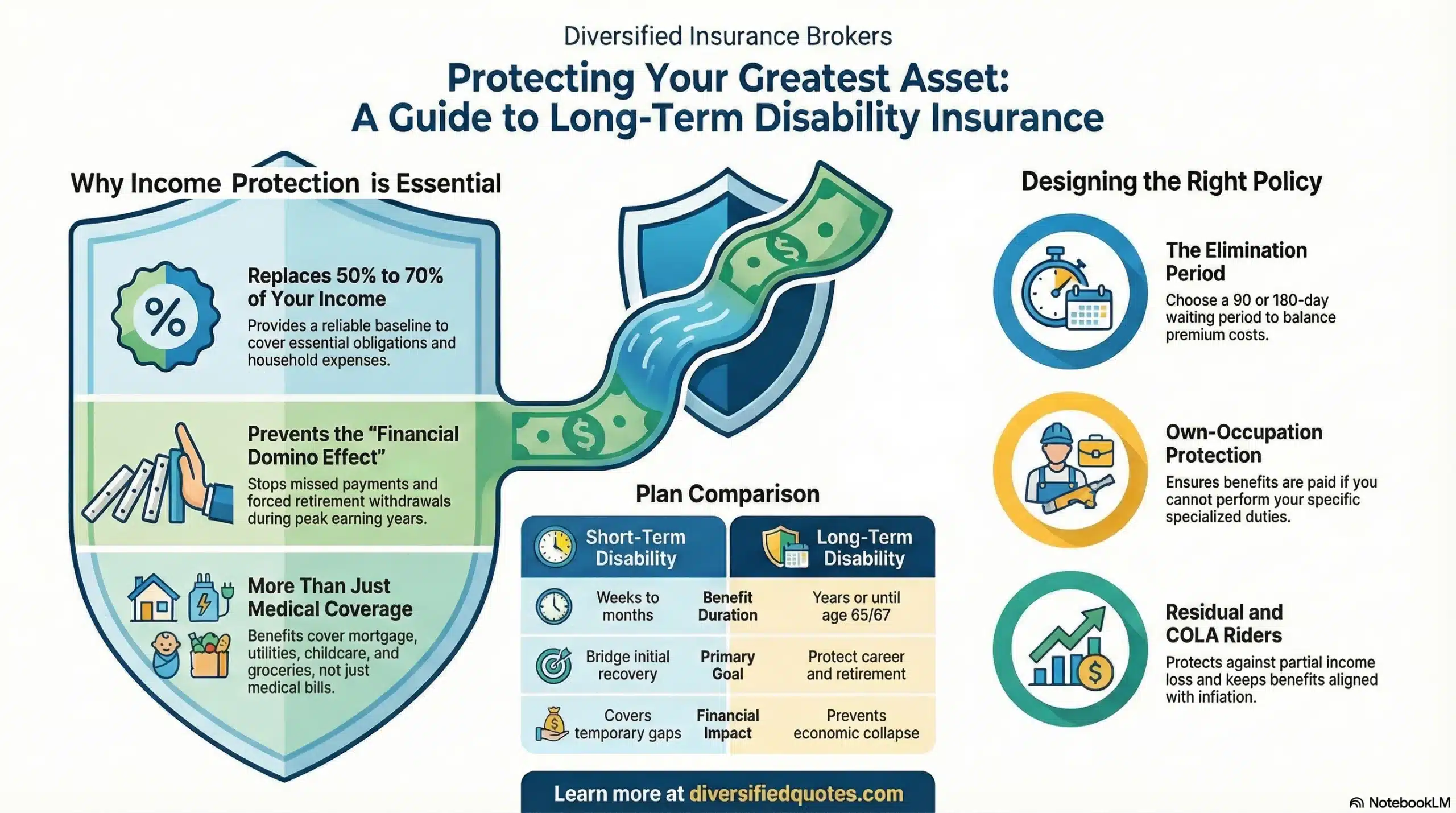
Most employer disability plans provide two types of coverage: short-term disability (typically covering 60% to 70% of salary for 13 to 26 weeks) and long-term disability (typically covering 60% of salary after a 90-day or 180-day elimination period). The common gaps in employer plans include benefit amounts capped at a dollar maximum that represents a smaller percentage of income for higher earners, definition-of-disability standards that may be “any occupation” after 24 months, benefit periods that end before retirement age, and coverage that terminates with employment — leaving workers between jobs without protection.
An accident only disability income insurance individual policy layered over an employer plan can address the elimination period gap — covering the first 90 or 180 days before the long-term disability plan activates — and can continue to provide income protection during periods between employers when the group plan is not in force. Understanding exactly what the employer plan provides — and what it leaves uncovered — is the necessary first step before evaluating whether accident only disability income insurance addresses a real gap or creates redundancy. Our resource on how to buy short-term disability insurance online covers the evaluation and purchase process for individual disability products that layer with group coverage.
Underwriting: Who Qualifies for Accident Only Disability Income Insurance
One of the most practically important differences between accident only disability income insurance and comprehensive disability income insurance is the underwriting process. Because accident only disability income insurance covers only accidental injuries — not illness — the carrier’s underwriting evaluation focuses primarily on occupational risk rather than comprehensive medical history. This narrower underwriting scope makes accident only disability income insurance accessible to applicants who might face significant challenges qualifying for comprehensive disability income insurance due to pre-existing health conditions.
The primary underwriting factors in accident only disability income insurance include: occupation class (which determines how the carrier assesses injury exposure), income verification (which establishes the basis for the benefit amount), age, and geographic location in some products. Medical history, while often reviewed, typically plays a smaller role in determining accident only disability income insurance eligibility than in comprehensive disability underwriting — because the insured’s health history is less predictive of accident risk than it is of illness-related disability risk.
Occupation class is particularly important in accident only disability income insurance underwriting because it directly affects both premium pricing and coverage availability. Carriers classify occupations into risk tiers — with lower-risk office and professional occupations in more favorable classes and higher-risk manual labor, construction, and hazardous occupations in less favorable classes. Higher-risk occupation classes typically pay higher premiums and may face benefit amount limitations or specific exclusions for occupation-related activities. Confirming your occupation classification before shopping rates prevents surprises in the final policy offer.
What Determines the Cost of Accident Only Disability Income Insurance
Premium pricing for accident only disability income insurance is determined by a specific set of rating factors that together estimate the carrier’s expected claims costs for the insured population. Understanding these factors helps buyers anticipate where their premium will land and identify which design choices produce the most cost-effective protection for their specific situation.
Age is a consistent pricing factor — younger buyers pay lower premiums because they represent fewer cumulative years of potential claim exposure. Occupation class is typically the most significant single pricing factor in accident only disability income insurance, because injury risk is directly correlated with occupational duties. The benefit amount selected determines premium in direct proportion — a $3,000 monthly benefit costs more than a $2,000 monthly benefit for the same elimination period and benefit duration. The elimination period affects premium inversely — shorter waiting periods cost more, longer waiting periods cost less. The benefit period affects premium directly — longer benefit periods cost more.
Optional riders — additional coverage features that can be added to the base accident only disability income insurance policy — can increase premium meaningfully but may add significant protection value. A cost-of-living adjustment rider that increases the benefit payment by a fixed percentage annually during a long-term disability period, similar to what our resource on disability income insurance with COLA covers, can preserve the purchasing power of the monthly benefit during an extended recovery. Return-of-premium provisions or future benefit increase options are available on some accident only disability income insurance products as optional riders.
Common Mistakes Buyers Make With Accident Only Disability Income Insurance
Several planning and design mistakes appear consistently across accident only disability income insurance buyers, and understanding them helps buyers avoid the most avoidable errors before making a purchase commitment.
The most consequential mistake is treating accident only disability income insurance as equivalent to comprehensive disability income insurance. A buyer who believes they have “disability coverage” because they purchased accident only disability income insurance — without understanding that illness-related disability is excluded — may be severely underprotected against the majority of real-world disability scenarios. Illness accounts for the majority of long-term disability events by most actuarial measures, which means accident only disability income insurance addresses a minority of the total disability risk spectrum. Buyers who need comprehensive protection should pursue comprehensive disability income insurance rather than misidentifying accident only coverage as equivalent.
The second common mistake is selecting a benefit amount too small to cover essential household expenses during a disability period. Some buyers choose a modest benefit amount to minimize premium, then discover during a claim that the benefit does not cover their core financial obligations. The right benefit amount is calibrated to household essential expenses — not to what “feels” like a reasonable number or to what minimizes the monthly premium most aggressively. A disability income benefit that covers 70% to 80% of essential expenses is more useful than one that covers 30% with a lower premium.
The third common mistake is selecting an elimination period that does not match the household’s actual liquidity. A 90-day elimination period paired with a household that has only 30 days of liquid cash reserves creates a 60-day funding gap that the insured cannot bridge — defeating the purpose of purchasing the policy. The elimination period should always be calibrated to documented liquid reserves, not to premium savings alone.
When Accident Only Disability Income Insurance Should Lead to Comprehensive Coverage
Accident only disability income insurance is often a starting point rather than a permanent endpoint in income protection planning. Understanding the circumstances in which accident only disability income insurance should prompt a transition to or upgrade toward comprehensive disability income insurance helps buyers use the product as part of a developmental protection strategy rather than treating it as a permanent ceiling.
When a buyer’s financial circumstances improve — income increases, savings accumulate, household expenses stabilize — the financial argument for upgrading from accident only disability income insurance to comprehensive disability income insurance becomes stronger. The premium difference between the two coverage types becomes more manageable relative to income, and the broader protection scope justifies the additional cost. For buyers who initially chose accident only disability income insurance because comprehensive coverage was unaffordable, reviewing the comprehensive option annually as income grows is a sound planning practice.
When health circumstances improve — a pre-existing condition that previously made comprehensive underwriting difficult resolves or stabilizes — re-evaluating comprehensive disability income insurance eligibility is worthwhile. The underwriting landscape changes over time, and a health situation that produced a decline or significant rating in a prior year may produce a more favorable outcome in a subsequent underwriting evaluation. Our resource on getting a second opinion on disability insurance covers how to efficiently re-evaluate coverage access across multiple carriers. Our comprehensive resource on long-term disability insurance quotes covers what to evaluate when a buyer is ready to move from accident only coverage to full income protection.
Related Disability Income Insurance Pages
Explore disability income strategies, product comparisons, and carrier-specific resources for income protection planning.
Financial Protection Essentials
Coordinate disability income planning with life insurance, high-risk coverage, and comprehensive retirement income protection.
Talk With an Advisor Today
Choose how you’d like to connect—call or message us, then book a time that works for you.
Schedule here:
calendly.com/jason-dibcompanies/diversified-quotes
Licensed in all 50 states • Fiduciary, family-owned since 1980
Frequently Asked Questions: Accident Only Disability Income Insurance
What is accident only disability income insurance?
Accident only disability income insurance is a disability income product that pays monthly benefits when the insured becomes disabled specifically due to a covered accidental injury and cannot perform their occupational duties. It does not cover disability caused by illness, chronic medical conditions, or any non-accidental cause of disability. The narrower coverage scope makes accident only disability income insurance substantially more affordable than comprehensive disability income insurance, which covers both accidents and illness. It is best used as a starter income protection layer, a supplement to existing illness coverage, or as income protection for individuals whose health history creates barriers to comprehensive disability insurance access.
Does accident only disability income insurance cover illness?
No. Accident only disability income insurance explicitly excludes illness-related disability. The coverage pays benefits only when the disabling event is caused by a covered accidental injury — a sudden, unforeseen, unintentional event resulting in physical bodily injury. Illnesses including cancer, heart disease, diabetes, autoimmune conditions, mental health disorders, and any other medical condition that develops without an accidental cause are not covered. If you need protection against illness-related disability as well as accident-related disability, comprehensive disability income insurance — which covers both categories — is the appropriate product. Our resource on short-term versus long-term disability insurance covers comprehensive coverage options.
Is accident only disability income insurance cheaper than full disability coverage?
Yes, substantially. Because accident only disability income insurance covers only accidental injuries rather than the full spectrum of disabling events, the actuarial claims risk is significantly narrower, which translates directly to lower premiums. For the same benefit amount, elimination period, and benefit duration, accident only disability income insurance is typically meaningfully less expensive than comprehensive disability income insurance. The cost difference reflects the coverage difference — buyers paying less for accident only coverage are receiving less protection than buyers paying full DI premiums. The right product choice depends on what protection the buyer actually needs, not which option has the lower premium.
Who should consider accident only disability income insurance?
Accident only disability income insurance is most appropriate for: workers in physically demanding occupations with high daily injury exposure (tradespeople, construction workers, warehouse workers, delivery drivers); individuals who have been declined or rated for comprehensive disability income insurance due to health conditions; individuals who already have employer-provided illness disability coverage and want to supplement the accident dimension; self-employed workers who want lean, affordable income protection against injury risk; and buyers for whom comprehensive disability insurance premiums are currently unaffordable but some form of income protection is better than none. For most working adults whose primary need is comprehensive income protection regardless of cause, comprehensive disability income insurance is the appropriate foundational product.
How do I choose the right elimination period for accident only disability income insurance?
Choose your elimination period based on your household’s documented liquid cash reserves and monthly essential expense total. If you have 30 days of liquid reserves, a 30-day elimination period is the longest waiting period your finances can absorb without creating hardship. If you have 90 days of liquid reserves, a 90-day elimination period reduces your premium while still providing adequate protection once benefits begin. Never choose a longer elimination period than your liquid reserves can support — a 90-day elimination period with only 30 days of savings creates a 60-day funding gap that defeats the purpose of the coverage. Our resource on disability insurance elimination periods explained covers this framework in detail.
Can I qualify for accident only disability income insurance if I have been declined for full disability coverage?
Often yes. Because accident only disability income insurance covers only accidental injuries rather than illness, the underwriting process focuses primarily on occupational risk rather than comprehensive medical history. Pre-existing medical conditions that would disqualify an applicant from comprehensive disability income insurance — or produce significant premium ratings — may have less impact on accident only disability income insurance underwriting eligibility. Carriers evaluate accident risk, which is more directly tied to occupation than to individual health history. Specific eligibility depends on the carrier’s guidelines and the individual’s complete profile, so requesting quotes from multiple carriers through an independent broker is the most efficient path to confirming eligibility.
Is accident only disability income insurance enough income protection on its own?
For most working adults, accident only disability income insurance is not sufficient as a standalone income protection strategy. The majority of long-term disability events are caused by illness rather than injury — conditions including cancer, cardiovascular disease, musculoskeletal disorders not caused by acute accident, diabetes complications, and mental health conditions. Accident only disability income insurance does not cover any of these causes. It is most accurately understood as a targeted supplement rather than comprehensive income protection. For buyers whose circumstances limit access to comprehensive disability income insurance, accident only coverage provides meaningful protection against one dimension of disability risk — which is substantially better than no protection — while a longer-term plan to access comprehensive coverage is developed.
About the Author:
Jason Stolz, CLTC, CRPC, DIA, CAA and Chief Underwriter at Diversified Insurance Brokers (NPN 20471358), is a senior insurance and retirement professional with more than 25 years of real-world experience helping individuals, families, and business owners protect their income, assets, and long-term financial stability. As a long-time partner of the nationally licensed independent agency Diversified Insurance Brokers, Jason provides trusted guidance across multiple specialties—including fixed and indexed annuities, long-term care planning, personal and business disability insurance, life insurance solutions, Group Health, Travel Medical and Evacuation Insurance, and short-term health coverage. Diversified Insurance Brokers maintains active contracts with over 100 highly rated insurance carriers, ensuring clients have access to a broad and competitive marketplace.
His practical, education-first approach has earned recognition in publications such as VoyageATL, and contributions from his agency featured in Kiplinger and GoBankingRates— highlighting his commitment to financial clarity and client-focused planning. Drawing on deep product knowledge and years of hands-on field experience, Jason helps clients evaluate carriers, compare strategies, and build retirement and protection plans that are both secure and cost-efficient. Visitors who want to explore current annuity rates and compare options across multiple insurers can also use this annuity quote and comparison tool.
Explore More Disability Insurance Options: Browse our complete guide to Disability Insurance Planning & Education — covering how it works, riders, elimination periods, own occupation, costs & buying guides from 100+ carriers.
Last Reviewed: May 24, 2026 |
Reviewed by: Jason Stolz, CLTC, CRPC, DIA, CAA
Chief Underwriter, Diversified Insurance Brokers, Inc. | NPN: 20471358 | Diversified Insurance Brokers, Inc. — Licensed in all 50 states
Fact Checked by: Tonia Pettitt, CMIP©
Medicare Specialist, Diversified Insurance Brokers, Inc. | NPN: 14374308 | Diversified Insurance Brokers, Inc. — Licensed in all 50 states
Did you find this content helpful? Leave us a Google review — it helps others find trustworthy guidance too.
Editorial Standards: Diversified Insurance Brokers maintains rigorous editorial standards to ensure accuracy, clarity, and independence in all content. Learn more about our editorial standards and commitment to transparency.
