
Burial Insurance for Mom and Dad
Burial Insurance for Mom and Dad

Jason Stolz CLTC, CRPC, DIA, CAA
Burial insurance for mom and dad is the search that happens at the kitchen table, at 11pm, after a difficult phone call from a parent who mentioned the cost of a neighbor’s funeral — or after a sibling texted asking whether anyone knows if mom and dad actually have life insurance. It is a search that comes from a place of love and a recognition that a specific problem exists: final expenses will arrive at some point, they will be expensive, and the family has not yet made sure they are covered. The goal at that moment is rarely complicated. It is simply to understand whether parents can still be covered, what it would cost, and how to actually make it happen without making a difficult conversation harder than it needs to be. This page addresses all of that directly. Our resource on burial insurance services covers the full product landscape, and our resources on burial insurance for parents over 70 and burial insurance for parents over 80 cover the age-specific planning frameworks in detail.
The financial stakes are concrete. A standard funeral with burial averages approximately $8,300 in the current market before cemetery charges, with the plot, grave opening and closing, and burial vault adding another $3,000 to $5,000. Cremation with a memorial service averages approximately $6,280 before additional merchandise and service costs. Final medical bills arrive in the weeks after death and must be addressed before estate distribution begins. Family travel — adult children flying in from different states, hotels, rental cars — adds several hundred to several thousand dollars depending on geography. Small outstanding debts, administrative estate costs, and the time off work that adult children take to manage arrangements add to the total. Most families face $10,000 to $15,000 or more in combined final expense costs when everything is tallied. Without a dedicated burial insurance policy, those costs land on the adult children — unevenly, with no predetermined agreement about who pays what, at the worst possible time emotionally. Our resource on what does burial insurance cover covers the full scope of final expenses that burial insurance proceeds can address.
One important practical clarification that shapes everything else on this page: there is no single “family” burial insurance policy that covers both mom and dad simultaneously. Burial insurance is individual whole life coverage — each parent is a separate insured person with their own age, health history, tobacco status, and underwriting profile, and each needs their own separate application and policy. This means covering both parents involves two processes, two premium payments, and two separate carriers if necessary — though in practice, both applications can often be completed at the same time through the same specialist. The two-policy reality is actually a feature rather than a limitation, because it means each parent gets coverage specifically tailored to their individual profile rather than a blended approximation. A parent who qualifies for level-benefit simplified issue doesn’t get pulled into a graded product because the other parent’s health history requires it. Our resource on burial insurance vs. pre-paid funeral covers the direct funeral pre-payment alternative that some families evaluate alongside insurance.
Compare Burial Insurance Rates for Mom and Dad
No medical exam — simplified issue and guaranteed issue options. See real rates by age and state for each parent.
Ready to get both parents covered?
We match each parent to the best available policy type based on their individual age, health, and budget — and can process both applications together so neither parent’s coverage is delayed waiting for the other.
How Two-Parent Coverage Works — Each Situation Is Different
Because mom and dad are separate insured individuals with different ages, health histories, and underwriting profiles, the right approach to covering both parents depends heavily on the specific combination of circumstances. The table below maps the most common two-parent scenarios to the planning considerations that matter most for each.
| Two-Parent Scenario | Typical Coverage Approach | Key Planning Considerations | Common Adult Child Mistakes |
|---|---|---|---|
| Both parents in their 70s, similar health — neither covered | Two separate simplified-issue applications processed together; level benefit likely accessible for both if health is stable | Cover both at the same time to lock in the lower premium for each while both are still in their 70s; premiums for one should not be prioritized over the other since both costs are near-equal at similar ages | Covering one parent and deferring the other — the deferred parent’s premium will be higher at next application, and a health event in the interim may close off their best policy tier |
| Parents at different ages — mom in her late 60s, dad in his late 70s | Two separate applications; dad’s application has more urgency because premiums rise faster per year in the late 70s than in the late 60s; mom’s premium will be lower and window is less compressed | Prioritize the older parent’s application to lock in the premium before another birthday; mom’s application can follow immediately after without meaningful loss; two different carriers may be optimal if one is more favorable for dad’s health profile | Treating both applications as equally urgent or non-urgent — the age gap means premium compounding is steeper for the older parent; year-by-year deferral costs more for the older parent |
| One parent is healthy (level benefit candidate), other has complex health (GI likely) | Two separate applications — the healthier parent gets the most cost-efficient simplified-issue level benefit available; the complex-health parent gets guaranteed issue immediately to start the graded period clock | Do not delay the GI application for the higher-health-risk parent waiting for ideal timing — the graded period cannot be bypassed, only started; accidental death coverage begins from day one and natural-cause coverage activates at end of year two | Applying to the same carrier for both parents and accepting a GI policy for the healthier parent when level benefit was available elsewhere — independent carrier selection for each parent separately produces better outcomes |
| One parent already covered, other is not | First audit the existing policy — verify it is still in force, confirm the face amount is still adequate for current funeral costs, and confirm beneficiaries are correct; then apply for coverage on the uncovered parent | The covered parent’s policy should be reviewed before adding new coverage; older policies may have been issued at face amounts that are now too small relative to current funeral costs; a supplemental policy may be warranted even for the “covered” parent | Assuming an old policy is still in force without verifying; lapsed policies are common and families often don’t discover the lapse until a claim is attempted |
| One parent has already passed — survivor planning only | Focus entirely on the surviving parent’s coverage; this is often the moment families finally act — do not delay further; the surviving parent is now managing on one income, which affects both premium sustainability and urgency | The surviving parent’s financial situation changed at the first death; premium sustainability on a single Social Security income needs to be reassessed; benefit amount may need to be sized more conservatively than if both parents were still living | Waiting to set up coverage until after the surviving parent has had time to “settle” — the surviving parent is now older than they were, premiums will be higher, and if they experienced health effects from grief or caregiving, their health profile may have changed |
| Both parents in their 80s — urgency and narrowing options | Treat both applications as urgent; at ages 80-84 both simplified issue and guaranteed issue are still accessible; at 85, GI is at its last year; past 86, GI is no longer available at most carriers | Parents approaching 85 with complex health histories who need GI coverage should not have their applications deferred for any reason; the GI window closing is a permanent, irreversible event | Treating the 80s as equivalent to the 70s in terms of planning flexibility — the 80s market is narrower, more expensive, and has hard cutoffs that do not exist in the 70s |
Planning scenarios shown are general frameworks based on current market patterns. Individual parent profiles may differ — specific ages, health histories, carrier guidelines, and state of residence all affect outcomes. Use this table as a planning orientation, then get actual rate comparisons for each parent’s specific profile before making decisions.
How to Have the Conversation With Mom and Dad
Most adult children who delay purchasing burial insurance for their parents are not waiting because of money or logistics — they are waiting because the conversation feels uncomfortable. Bringing up final expenses can feel like bringing up mortality, and many families have an unspoken agreement not to discuss that directly. The practical reality is almost the opposite of what the discomfort predicts: most parents, when the conversation is framed as family planning and financial protection rather than death planning, are relieved that an adult child raised it. Parents in their 70s and 80s have typically attended enough funerals of their contemporaries to understand the financial reality of final expenses firsthand. Many of them have thought about it and simply haven’t initiated the conversation themselves.
A practical framing that works for most families is to approach the conversation as a question about preferences rather than a transaction about a policy. Starting with “Mom, if something happened to you, do you know how we’d handle the arrangements? Do you have any preference about burial or cremation?” opens a conversation about wishes and preferences before the subject of coverage comes up. From there, the financial protection angle — “It would really help me and the other kids to know there’s something dedicated for these costs so we’re not scrambling” — is a natural bridge to discussing coverage. The parent’s consent and participation are required for the application regardless of who initiates the conversation, so the earlier the dialogue begins, the more time there is for the parent to be comfortable with the process before any application is submitted. Parents who are genuinely reluctant to discuss the topic often respond better when the conversation is brief and low-pressure rather than comprehensive in a single sitting.
Coordinating Coverage Among Siblings
When multiple adult children are involved — which is the majority of families in this situation — the burial insurance planning process benefits from a few structural decisions made early. The first is designating one sibling as the policy owner and primary point of contact for each parent’s policy. While siblings can informally share the cost of premiums, there is only one official policy owner per policy, and that person is responsible for the premium payment source, beneficiary designation updates, and claim filing when the time comes. Having a clear understanding of who owns each policy and who the beneficiaries are prevents coordination problems at claim time, which is the worst moment for family confusion about financial logistics. The second practical decision is ensuring that all siblings who need to know are informed that the policies exist, where the policy documents are kept, and what the claims process requires — submitting a claim form and a certified death certificate to the carrier. If that information is not communicated before it is needed, the family may spend days or weeks at claim time tracking down coverage details they would otherwise have had at hand.
The beneficiary designation question is one that families handle differently. Some families designate one adult child as the primary beneficiary with others as contingent, for simplicity and clean claim processing. Others split the benefit among siblings equally. The right approach depends on the family’s specific dynamics — who is managing the funeral arrangements, who has the clearest relationship with the funeral home in the parent’s geographic area, and whether all siblings are equally situated financially to manage and distribute funds promptly. There is no universally correct answer, but the decision should be made intentionally and recorded correctly on the application rather than discovered at claim time to be different from what everyone assumed.
The Existing Policy Audit — What Many Families Discover
Before purchasing new burial insurance for mom or dad, adult children who believe their parents may already have some life insurance coverage should conduct a brief policy audit. Existing life insurance held by aging parents has several common failure modes that leave families thinking they are covered when they are not. Lapsed policies are the most common — a parent who purchased a small whole life or term policy decades ago but stopped paying premiums at some point may have a lapsed policy they have not mentioned and perhaps forgotten about. Term policies that have expired are similarly misleading — a parent who mentions “having a life insurance policy” may be referring to a term policy that expired years ago and is no longer in force. Older permanent policies may still be in force but at a paid-up value that is significantly lower than the original face amount due to loan activity or reduced paid-up elections. And the original face amount of a policy purchased 30 years ago may have been appropriate for funeral costs at that time but is now far short of current costs. Our resource on how to find an old life insurance policy covers the practical steps for locating and verifying coverage that parents may have but haven’t mentioned or tracked. Once existing coverage is understood, the gap between current coverage and actual final expense needs determines how much new coverage is warranted.
After One Parent Has Already Passed — Covering the Surviving Parent
For families who arrive at this page after one parent has already died — often because the cost of the first parent’s death made the need concrete — the situation calls for immediate focus on the surviving parent without delay for processing or grief. The surviving parent is now older than they were, which means their burial insurance premium will be higher than it would have been before the first parent’s death. If the surviving parent experienced health effects during a caregiving period or from grief, their health profile may have changed. And the surviving parent is now managing on one income — typically one Social Security payment, sometimes a survivor pension — which means premium sustainability requires more careful benefit-sizing than it would have in a two-income household. The right benefit amount for a surviving parent should reflect both the realistic final expense cost and the single-income premium budget. Acting promptly on the surviving parent’s coverage is the most important practical step a family can take after a first parent’s death — because the surviving parent is now the only remaining person in the family to plan for, and the planning window is narrower than it was.
What Coverage Amount Makes Sense for Each Parent
The right coverage amount for each parent should be based on realistic final expense costs rather than the maximum available face amount. Based on 2026 data, a funeral with burial averages approximately $8,300 before cemetery charges; cemetery costs for the plot, grave preparation, and burial vault typically add $3,000 to $5,000. Cremation with a memorial service averages approximately $6,280 before additional costs. Final medical bills, small debts, family travel, and estate administrative costs complete the picture. Most families find that $10,000 to $15,000 per parent adequately covers these costs with a reasonable buffer. Coverage should be sized so the monthly premium is sustainable permanently on each parent’s fixed income — for a surviving parent, on a single fixed income. Our resources on burial insurance calculator, final expense insurance calculator, and monthly cost of a $10,000 burial insurance policy provide current pricing reference points for specific ages and face amounts. Our resource on affordable burial insurance for low-income seniors covers benefit-sizing strategies for fixed-income households specifically.
How the Application Works — Remote Coordination Is Standard
Adult children who live in different states from their parents, or whose parents live in different states from each other, can arrange burial insurance coverage remotely — this is entirely standard in the final expense market. The parent whose life is being insured must consent to and participate in the application; the adult child handles the coordination, premium payment setup, and policy ownership logistics. Applications are typically completed electronically or over the phone, and parents do not need to visit an office or schedule an appointment in person. No medical exam is required for any burial insurance application — simplified-issue policies use a short health questionnaire (typically 8-12 yes-or-no questions) conducted over the phone or submitted electronically, and guaranteed-issue policies require no health information at all. Decisions are often rendered within days or even the same day for uncomplicated applications. Once coverage is in place, the adult child as policy owner receives the policy documents and manages premium payments — the parent’s involvement at that point is limited to being the insured whose life the policy covers. Our resource on burial insurance with no medical exam covers the no-exam application process in detail, and our resource on best-rated burial insurance companies covers the carrier landscape for senior final expense applicants.
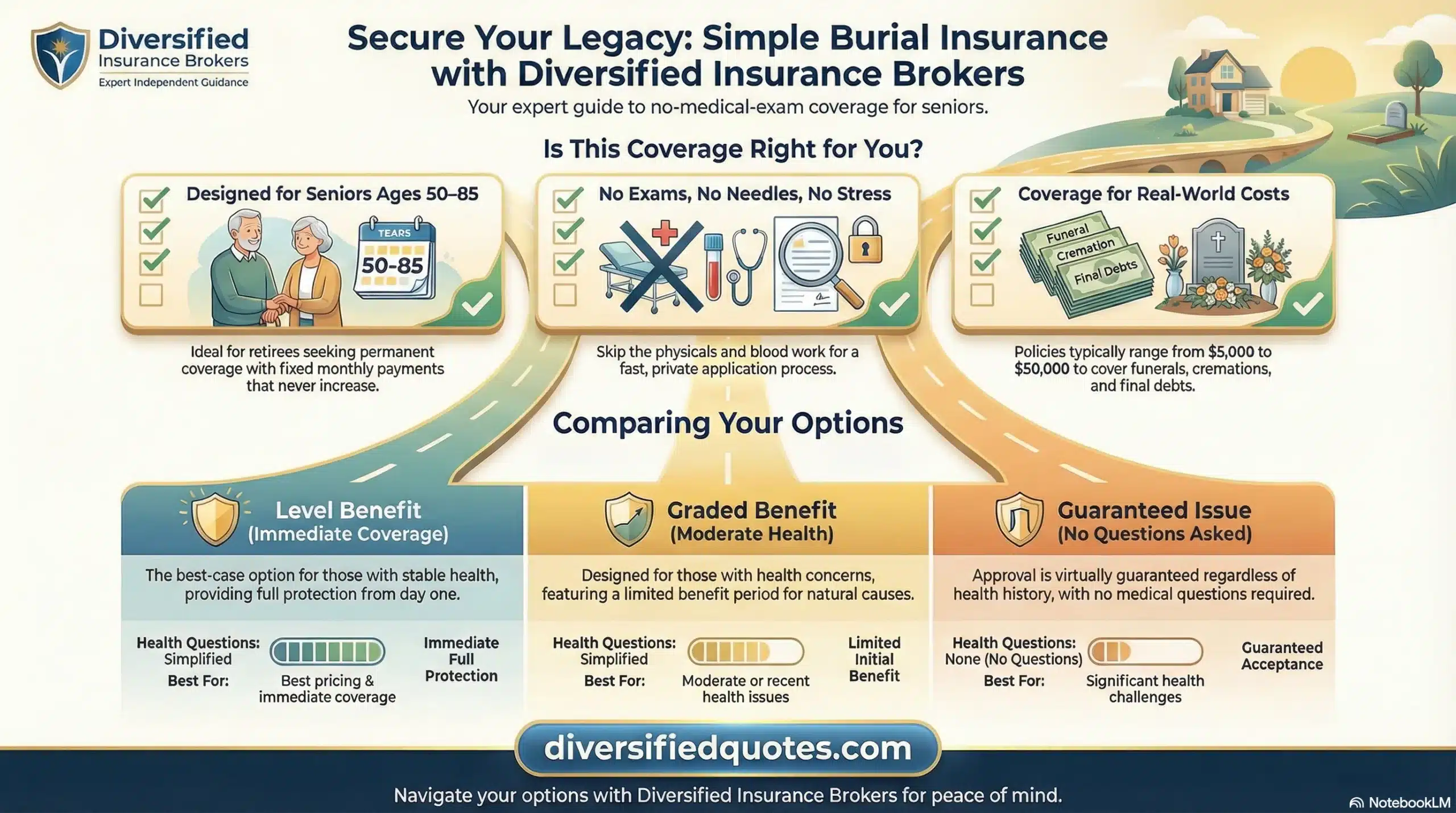
Talk With an Advisor Today
Choose how you’d like to connect—call or message us, then book a time that works for you.
Schedule here:
calendly.com/jason-dibcompanies/diversified-quotes
Licensed in all 50 states • Fiduciary, family-owned since 1980
FAQs: Burial Insurance for Mom and Dad
Can I buy burial insurance for both parents at the same time?
Yes — both parents’ applications can be processed simultaneously through an independent specialist. Each parent requires a separate policy because burial insurance is individual whole life coverage — each person is underwritten on their own age, health history, and tobacco status. There is no single “family” policy that covers both parents under one premium. Processing both applications at the same time means neither parent’s coverage is delayed waiting for the other, and any carrier-specific advantages for each parent’s profile can be matched individually rather than defaulting to a single carrier that may not be optimal for both profiles.
Do my parents need to participate in the application?
Yes — the parent whose life is being insured must consent to and participate in the application. Carriers require the insured person’s knowledge and agreement, both to prevent misuse and to ensure the insured person understands the policy exists. For simplified-issue policies, the parent answers health questions either electronically or during a brief recorded phone call. For guaranteed-issue policies, the process is even simpler — no health questions are asked, and the parent’s participation is limited to confirming consent. The adult child handles the logistics, payment setup, and policy ownership; the parent’s active participation is limited to the consent and health question steps.
Can siblings split the cost of burial insurance for a parent?
Yes, informally. Multiple siblings can agree to split the premium cost, but there is only one official policy owner on record per policy. That sibling is responsible for the premium payment source and for managing the policy. The simplest approach is to designate one sibling as the owner who collects from others and makes the single premium payment — or alternatively, to designate one sibling as owner with a premium amount that is affordable for that sibling alone, and have others reimburse informally. What matters for the policy itself is that premiums are paid consistently; the internal family arrangement for cost-sharing is outside the carrier’s interest.
My dad thinks they already have life insurance. Should I check before buying new coverage?
Yes — an existing policy audit is a worthwhile step before purchasing new coverage. Common issues with older life insurance policies include: lapsed policies that are no longer in force because premiums stopped being paid; term policies that expired years ago; older whole life policies that have taken loans against the cash value, reducing the net death benefit; paid-up policies at a reduced benefit amount; and original face amounts that were adequate decades ago but are now too small for current funeral costs. Understanding exactly what is in force and at what value helps determine whether supplemental coverage is needed, and how much. Our resource on how to find an old life insurance policy covers the practical steps for locating and verifying existing coverage.
My mom recently passed. How do I set up coverage for my dad now?
The process for covering a surviving parent is the same as any parent application — the surviving parent consents, an adult child can serve as the owner and premium payer, and no medical exam is required. The main considerations specific to a recently widowed parent are: the surviving parent is now on a single income (typically one Social Security payment), which affects premium sustainability and benefit sizing; the surviving parent may have experienced health effects during a caregiving period; and the surviving parent is now older than they were before the first parent’s death, meaning premiums will be higher than they would have been at the earlier age. Acting promptly — rather than waiting for the parent to “settle” — minimizes further premium increase and ensures coverage is in place as quickly as possible.
Who should be named as beneficiary on a parent’s burial insurance policy?
The beneficiary designation is a family decision, not a coverage question — there is no universally correct answer. Common approaches include: designating one adult child as the primary beneficiary (with others as contingent) for clean, fast claim processing; splitting the benefit equally among all adult children; or designating the policy owner as beneficiary if that adult child will be managing funeral arrangements. The most important practical guidance is to make this decision intentionally before the application is submitted, ensure it is recorded correctly on the application, and communicate it to all siblings so there are no surprises at claim time. Beneficiary designations can be updated while the policy is in force if family circumstances change.
Can I arrange burial insurance for my parents even if I live in a different state?
Yes — remote coordination is entirely standard in the final expense market. The application is completed electronically or over the phone. The parent participates in their state; the adult child manages the logistics from wherever they live. The policy is issued in the state of the insured parent’s residence, and carrier eligibility is based on the parent’s state. There is no requirement for any in-person meeting, office visit, or geographic proximity between the policy owner and the insured parent.
What happens to burial insurance premiums as my parents get older after the policy is issued?
Nothing — burial insurance is permanent whole life coverage with level premiums locked at the time of issue. Premiums never increase due to subsequent birthdays, health changes, new diagnoses, or any other event after the policy is in force. The policy cannot be canceled by the carrier due to health deterioration as long as premiums are paid. The benefit amount does not decrease as the parent ages. This permanence means that the rate locked in at age 72 or 75 is the rate that will still be in effect at age 82 and 92 — which is one of the strongest arguments for establishing coverage as early in the parent’s 70s as possible rather than deferring into the 80s when the locked-in rate will be permanently higher.
About the Author:
Jason Stolz, CLTC, CRPC, DIA, CAA and Chief Underwriter at Diversified Insurance Brokers (NPN 20471358), is a senior insurance and retirement professional with more than 25 years of real-world experience helping individuals, families, and business owners protect their income, assets, and long-term financial stability. As a long-time partner of the nationally licensed independent agency Diversified Insurance Brokers, Jason provides trusted guidance across multiple specialties—including fixed and indexed annuities, long-term care planning, personal and business disability insurance, life insurance solutions, Group Health, Travel Medical and Evacuation Insurance, and short-term health coverage. Diversified Insurance Brokers maintains active contracts with over 100 highly rated insurance carriers, ensuring clients have access to a broad and competitive marketplace.
His practical, education-first approach has earned recognition in publications such as VoyageATL, and contributions from his agency featured in Kiplinger and GoBankingRates— highlighting his commitment to financial clarity and client-focused planning. Drawing on deep product knowledge and years of hands-on field experience, Jason helps clients evaluate carriers, compare strategies, and build retirement and protection plans that are both secure and cost-efficient. Visitors who want to explore current annuity rates and compare options across multiple insurers can also use this annuity quote and comparison tool.
Explore More Burial Insurance Options: Browse our complete guide to Burial Insurance for Seniors — covering burial insurance for seniors over 50, 60, 70, 80 & parents from top carriers from top carriers.
Last Reviewed: June 4, 2026 |
Reviewed by: Jason Stolz, CLTC, CRPC, DIA, CAA
Chief Underwriter, Diversified Insurance Brokers, Inc. | NPN: 20471358 | Diversified Insurance Brokers, Inc. — Licensed in all 50 states
Fact Checked by: Tonia Pettitt, CMIP©
Medicare Specialist, Diversified Insurance Brokers, Inc. | NPN: 14374308 | Diversified Insurance Brokers, Inc. — Licensed in all 50 states
Did you find this content helpful? Leave us a Google review — it helps others find trustworthy guidance too.
Editorial Standards: Diversified Insurance Brokers maintains rigorous editorial standards to ensure accuracy, clarity, and independence in all content. Learn more about our editorial standards and commitment to transparency.
