
Disability Insurance for Dietitians
As an Independent Disability Insurance Broker, we have access to exclusive discounts and negotiated pricing most captive agents can’t offer — see the full breakdown near the end of this page.
Disability Insurance for Dietitians

Jason Stolz CLTC, CRPC, DIA, CAA
Dietitians and registered dietitian nutritionists occupy a healthcare professional position that combines the clinical demands of evidence-based nutrition therapy with the employment structures — including significant self-employment and private practice — that create the group plan gaps and workers’ comp absences that make individual disability insurance essential rather than supplemental. Bureau of Labor Statistics data places the median annual wage for dietitians and nutritionists at $73,850, with BLS projecting 6 percent employment growth through 2034 — faster than average for all occupations — reflecting growing demand from an aging population, expanding insurance coverage for nutrition services, and broader recognition of clinical nutrition’s role in disease management. Every dollar of that income depends on the sustained cognitive capacity, professional credential maintenance, and sustained ability to provide evidence-based clinical nutrition counseling and assessment that dietetics practice requires. When disability eliminates those capacities — whether from a physical condition, a mental health event, or a serious illness — the income stops. Disability insurance for dietitians provides the income floor that remains when the health event that ends clinical practice arrives.
At Diversified Insurance Brokers, Jason Stolz, CLTC, CRPC, DIA, CAA works with registered dietitian nutritionists across the full range of practice settings — hospital-based clinical dietitians with institutional employer benefits, outpatient dietitians in physician practice settings, long-term care facility RDs, community health and public health nutrition professionals, and the growing population of self-employed dietitians in private practice, nutrition consulting, corporate wellness, and telehealth nutrition services. The income protection structure appropriate for a hospital-employed clinical dietitian with access to group long-term disability coverage differs substantially from what a self-employed private practice RD who sees clients directly and bills insurance independently needs — and both require specific attention to the disability risk pathways that clinical nutrition practice creates.
Compare Disability Insurance for Dietitians
We review coverage options across 100+ carriers and identify the policy structure that fits your clinical nutrition income, practice setting, and professional risk profile.
Request Disability Insurance OptionsDietitian Disability Risk — Clinical Demands, Practice Exposure, and the Income Protection Gap
| Risk Category | Source / Clinical Context | Resulting Disability Risk | Group Plan / Workers’ Comp | DI Coverage Gap |
|---|---|---|---|---|
| Mental health and cognitive disability | Documented elevated rates of burnout, compassion fatigue, and occupational stress in healthcare professions; clinical nutrition practice involves sustained emotional labor with patients facing serious and chronic illness; documentation, billing, and administrative burden alongside clinical load | Disabling depression, anxiety, or burnout preventing sustained clinical counseling, patient assessment, and practice management; cognitive impairment affecting clinical judgment and nutrition therapy accuracy | Group plans typically cap mental/nervous benefits at 24 months; mental health entirely outside workers’ comp; self-employed RDs carry no group plan baseline | Full gap at 24 months for employed RDs; complete gap for self-employed; individual DI with unlimited mental health period is essential for clinical nutrition professionals |
| Ergonomic strain from documentation and desk work | BLS notes dietitians prepare and maintain many types of records; sustained keyboard and computer use for electronic health records, nutrition analysis software, insurance billing, and client documentation | Carpal tunnel syndrome, cervical disc disease, chronic back conditions from sustained sedentary EHR and documentation work alongside clinical patient contact duties | Cumulative ergonomic conditions disputed as occupational for employed RDs; self-employed practice owners carry no workers’ comp protection | Gap for chronic ergonomic conditions; individual DI covers qualifying disability from any cause including cumulative sedentary work conditions |
| Infectious disease exposure in clinical settings | Hospital, long-term care, and outpatient clinical dietitians have patient contact exposure to infectious pathogens; infection risk in settings serving immunocompromised, critically ill, or infectious disease patients | Serious infectious illness requiring extended recovery; long-COVID or similar post-infection syndromes producing sustained cognitive and functional impairment affecting clinical practice capacity | Occupational disease provisions for employed clinical RDs with documented exposure; self-employed practitioners with patient contact outside workers’ comp | Gap for illness-based outcomes from occupational pathogen exposure; individual DI covers qualifying disability regardless of cause |
| Private practice business exposure (self-employed RDs) | BLS notes self-employed dietitians manage appointments, employees, and insurance billing; growing private practice and telehealth nutrition sector creates self-employed professional population with no employer benefits | Disability simultaneously eliminates clinical revenue and threatens practice overhead — EMR subscriptions, billing software, office lease or virtual platform costs, and any support staff wages | Not covered — self-employed RDs carry zero workers’ comp protection and no employer group plan | Full gap; personal DI + BOE together address income and overhead; individual DI is the entire protection system for private practice RDs |
| Voice and communication disability | BLS specifically identifies speaking skills as an essential dietitian competency; clinical nutrition counseling, patient education, and group nutrition programming require sustained voice-based professional communication | Voice disorders, chronic laryngitis, or conditions affecting sustained professional speech capacity — disabilities that directly impair the counseling and education functions that dietetics practice requires | Not covered for self-employed; gradual voice conditions outside workers’ comp framework | Gap for voice-dependent clinical nutrition work; own-occupation DI covers income loss from voice disorders preventing professional practice |
| Illness-based disability (non-occupational) | Cancer, cardiac events, neurological conditions — health events entirely independent of clinical practice that eliminate the cognitive and physical capacity to provide nutrition counseling and assessment | Extended inability to conduct assessments, provide counseling, manage documentation, or generate billable clinical nutrition services | Not covered by workers’ comp; group LTD coverage where available may have benefit caps and definition transitions | Approximately 90% of long-term disabilities are illness-based; individual DI to age 65 addresses the dominant disability risk category |
The table establishes that the dietitian’s disability risk profile is anchored by the mental health and cognitive disability pathways that healthcare profession burnout research consistently documents — and that this primary risk pathway is precisely the one most inadequately addressed by group long-term disability plans through the 24-month mental and nervous condition cap. The ergonomic, infectious disease, and voice-based disability pathways add specific clinical risk factors, while the approximately 90 percent of long-term disabling conditions that are illness-based apply to RDs at population-average rates. Disability insurance by occupation recognizes that dietitians’ favorable top-tier or near-top-tier occupational class — reflecting the primarily sedentary, cognitive, professional work profile — makes comprehensive individual disability insurance genuinely affordable relative to the clinical income being protected.
Mental Health, Burnout, and the 24-Month Group Plan Gap
Healthcare profession burnout is among the most extensively documented occupational health phenomena in contemporary clinical literature — and dietitians, as healthcare professionals who provide clinical nutrition services across settings that include acute and critical care, oncology, eating disorders, chronic disease management, and end-of-life nutritional support, participate fully in the burnout and compassion fatigue profile documented across the healthcare workforce. BLS specifically identifies speaking skills and the ability to explain complicated nutrition topics clearly to patients and other healthcare workers as essential dietitian competencies — underscoring the sustained interpersonal and emotional labor that clinical nutrition practice demands across a full patient caseload. A registered dietitian nutritionist who develops a disabling anxiety disorder, depressive episode, or burnout condition that prevents sustained clinical counseling, accurate patient assessment, and the professional judgment that nutrition therapy requires has experienced a genuine occupational disability — one that workers’ comp categorically does not address and that most group long-term disability plans limit to 24 months of benefit.
The disability insurance planning implication for dietitians is direct and consequential. For employed RDs at hospitals, health systems, and outpatient clinical settings that offer group LTD, the 24-month cap on mental and nervous condition benefits terminates income replacement at exactly the point where a serious psychiatric condition has proven itself to be long-term. A dietitian who develops a serious depressive disorder that requires 36 months of treatment before stable remission receives 24 months of group LTD benefit — and then faces the any-occupation transition that requires near-total incapacity before further benefit payments would apply. Individual disability insurance with unlimited mental health benefit periods fills this gap directly, providing own-occupation protection extending to age 65 for all qualifying causes including mental and nervous conditions. Long-term disability insurance without the artificial mental health cap is the core planning priority for dietitians in employed settings with existing group coverage. Disability insurance for white-collar professionals covers the specific policy considerations that apply when cognitive and communication capacity are the primary professional assets. Short-term disability insurance fills the immediate gap following an acute mental health event before long-term coverage activates.
Private Practice and Self-Employed Dietitians — The Complete Coverage Gap
The growth of private practice dietetics — accelerated by expanding insurance reimbursement for nutrition therapy, telehealth access expansion, and the entrepreneurial appeal of direct-pay nutrition consulting — has created a significant and growing population of self-employed registered dietitian nutritionists who operate outside the institutional employment structures that provide group benefits. BLS specifically notes that self-employed dietitians and nutritionists may need to schedule appointments, manage employees, and bill insurance companies in addition to maintaining client files — a description that captures the small business owner character of private practice nutrition that creates the full self-employment coverage gap.
A self-employed RD operating a private nutrition practice — whether a physical office, a telehealth platform, or a combined model — carries no automatic workers’ comp protection for their own health events, no employer-provided group long-term disability plan, and the complete two-layer financial exposure of a small business owner: personal income loss from not being able to see clients, and the continuation of practice overhead — electronic health record subscription costs, billing software, telehealth platform fees, office lease or virtual office costs, liability insurance premiums, and any support staff wages — that continues during the disability period. Self-employed RDs need individual disability insurance as the entire protection system, not as a supplement to existing coverage. Understanding why dietitians in private practice buy disability insurance is answered by this structural reality: without it, a disability event eliminates income and threatens the practice simultaneously with no income floor in place. Whether disability insurance is worth the cost for a private practice RD is answered by calculating what a lost quarter of clinical revenue would cost against the annual premium of the policy that replaces it.
Own-Occupation Coverage and Policy Design for Dietitians
The disability definition determines whether a cognitive or mental health condition that prevents clinical nutrition counseling but theoretically permits other work generates a benefit payment or a denial. For a dietitian whose professional income derives from clinical assessment, nutrition counseling, and evidence-based dietary therapy — work that requires sustained cognitive capacity, clinical judgment, and interpersonal communication — the own-occupation definition is the contractual language that determines whether protection is real.
A true own-occupation disability insurance policy pays benefits when the insured cannot perform the material and substantial duties of their specific occupation — clinical dietetics — even if theoretically capable of other work. A registered dietitian who develops a disabling anxiety disorder preventing sustained patient counseling receives benefit payments under an own-occupation policy regardless of whether they could theoretically perform a non-clinical administrative role. Understanding how short-term and long-term disability interact in a complete architecture is important for RDs whose disability scenarios range from the short-term recoverable to the long-term chronic.
Business Overhead Expense Coverage for Private Practice RDs
Private practice dietitians who operate their own clinical nutrition businesses face the two-layer exposure that all small professional services business owners face during disability. Personal income loss is the first layer; practice overhead continuation is the second. Business overhead expense disability insurance addresses the practice’s fixed operating costs during the owner-RD’s qualifying disability — funding EHR subscriptions, billing platform costs, telehealth infrastructure, and any support staff wages so the practice infrastructure survives the disability period rather than dissolving against zero clinical revenue. The BOE structure is particularly relevant for RDs who have built substantial client bases with insurance credentialing relationships that take significant time and effort to establish — preserving those credentialing relationships and client continuity during a disability period allows the practice to resume when the RD recovers.
Occupational Class, Income Documentation, and Policy Design for Dietitians
Dietitians typically receive top-tier or near-top-tier occupational class assignments from most disability insurance carriers — a favorable classification reflecting the primarily sedentary, cognitive, professional nature of clinical nutrition work, the advanced educational credentials required for RD status, and the healthcare professional character of the occupation. This favorable classification produces competitive premium rates and high maximum benefit ceilings, making individual disability insurance genuinely accessible relative to the clinical income being protected.
Income documentation for self-employed private practice RDs uses Schedule C and business financials. For 1099-earning contract dietitians and telehealth platform practitioners, the same self-employed documentation framework applies. Hospital-employed and health system clinical dietitians document income through W-2 and pay records. How much disability insurance a dietitian actually needs depends on documented income level and household financial obligations during a disability period.
The elimination period should reflect actual financial reserves. The benefit period should extend to age 65. The rider options include the future insurability option — important for new RDs with income expected to grow — and the cost of living adjustment rider. RDs with prior mental health treatment histories should expect underwriting scrutiny of those histories. Disability insurance with pre-existing conditions is available through independent broker channels, and no-exam disability insurance may serve RDs whose health history makes traditional underwriting uncertain. Working with an independent disability insurance broker who understands healthcare professional occupation classifications and the private practice RD’s specific coverage needs consistently produces better outcomes than direct single-carrier application.
Get Your Dietitian Disability Insurance Review
We compare top-tier occupational class assignments, mental health benefit periods, and practice owner BOE structures across 100+ carriers to identify the coverage that protects your clinical nutrition income.
Request Disability Insurance Options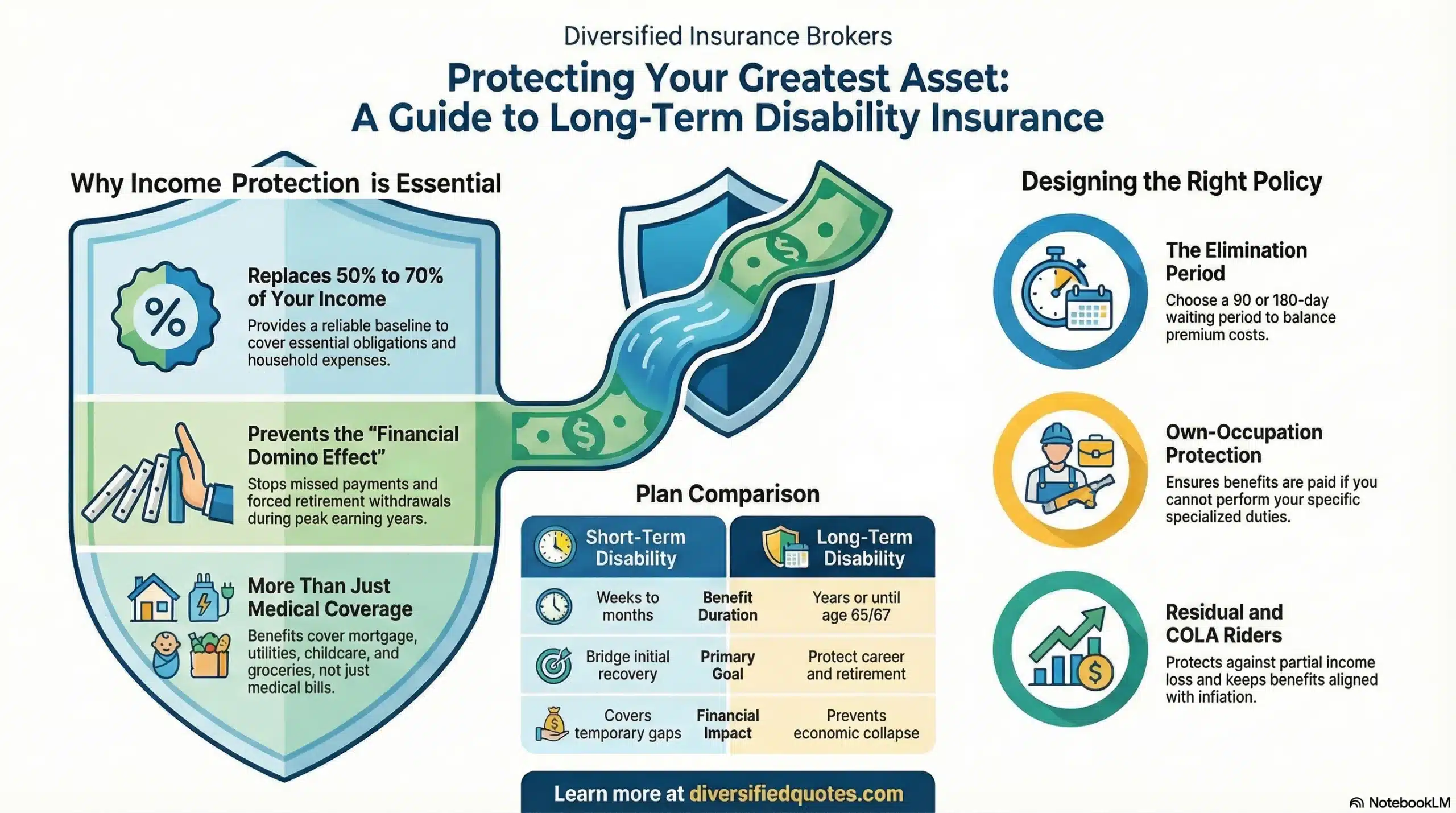
Talk With an Advisor Today
Choose how you’d like to connect—call or message us, then book a time that works for you.
Schedule here:
calendly.com/jason-dibcompanies/diversified-quotes
Licensed in all 50 states • Fiduciary, family-owned since 1980
FAQs: Disability Insurance for Dietitians
What occupational class do dietitians receive and how does it affect their coverage?
Registered dietitian nutritionists typically receive top-tier or near-top-tier occupational class assignments from most disability insurance carriers — a favorable classification reflecting the primarily sedentary, cognitive, professional nature of clinical nutrition work, the advanced educational credentials and licensure required for RD status, and the healthcare professional character of the occupation. This classification produces the most competitive premium rates and highest maximum benefit ceilings in the disability insurance market, making comprehensive individual disability insurance genuinely affordable for dietitians whose clinical income justifies the protection.
The favorable occupational class does not mean dietitians face low disability risk — it means they face low physical hazard risk. The mental health and burnout risks documented across the healthcare profession, the cognitive demands of clinical nutrition assessment and counseling, and the illness-based conditions that affect the general population all remain as significant disability pathways. A residual disability benefit provision is worth including for dietitians, particularly for private practice RDs whose disability may produce reduced but not eliminated client capacity during recovery — partial disability producing partial income loss that a residual benefit addresses proportionally rather than forcing a binary total-disability determination.
Are disability insurance benefits taxable for a self-employed dietitian in private practice?
For self-employed registered dietitians in private practice who purchase individual disability insurance and pay premiums with after-tax personal income, monthly disability benefits received during a qualifying disability are generally received income-tax-free. The full monthly benefit amount reaches the household without income tax reduction — making the coverage more financially effective than a gross benefit comparison suggests. Whether disability insurance payments are taxable is a meaningful planning input when determining how much monthly benefit is needed to replace actual take-home clinical nutrition income during a disability period that may extend across multiple months or years of practice absence.
For employed clinical dietitians at hospitals, health systems, or long-term care facilities whose employer pays group LTD premiums, the resulting disability benefits are typically taxable as ordinary income — reducing real purchasing power. A group plan paying 60 percent of salary may effectively deliver only 40 to 45 percent of actual take-home pay after taxes, a gap that represents a meaningful shortfall in income replacement during a disability period. Self-employed private practice RDs who deduct disability insurance premiums as a business expense should confirm the specific tax treatment with a tax professional, as the deduction may affect benefit taxability when a claim occurs.
Does disability insurance cover burnout and mental health conditions for dietitians?
Yes — individual disability insurance covers disability arising from mental health conditions including burnout-related depression, anxiety disorders, and other psychiatric conditions when those conditions meet the policy’s definition of disability. This is one of the most important advantages individual disability insurance holds over group long-term disability plans for clinical dietitians: healthcare profession burnout research consistently documents elevated rates of compassion fatigue, burnout, and mental health challenges across the healthcare workforce, and the most common group plan response to mental health disability is a 24-month cap on mental and nervous condition benefits.
A registered dietitian who develops a disabling anxiety disorder or depressive condition that prevents sustained clinical counseling, accurate nutritional assessment, and professional patient interaction has experienced a genuine occupational disability — one that individual disability insurance with an unlimited mental health benefit period addresses directly by providing own-occupation protection to age 65 without artificial time limits on mental health claims. For clinical dietitians who work across emotionally demanding patient populations — eating disorder treatment, oncology nutrition, end-of-life care — the mental health dimension of disability risk is especially relevant and the unlimited mental health coverage period is especially important. High-risk disability insurance options exist for dietitians with existing documented mental health histories, typically producing a partial exclusion rider for that specific condition while providing full coverage for all other disabling causes.
I’m a hospital dietitian with group LTD coverage — do I also need individual disability insurance?
For clinical dietitians in hospital and health system employment with group LTD coverage, the case for individual supplemental disability insurance centers on four structural group plan limitations that are particularly consequential for the dietitian’s specific disability risk profile. First, the 24-month cap on mental and nervous condition benefits — directly affecting the burnout, anxiety, and depressive conditions documented as elevated across the healthcare workforce — terminates income replacement at exactly the point a serious psychiatric condition has proven itself long-term. Second, the 24-month own-to-any definition transition shifts the benefit standard when a disability has proven persistent, potentially allowing denial for a dietitian who can no longer perform clinical nutrition duties but could theoretically perform some other work. Third, the group plan’s benefit amount may be capped below your actual RD income, particularly for dietitians with specialty certifications, supplemental clinical income, or private practice revenue alongside institutional employment. Fourth, group coverage ends when employment ends — relevant for any RD who changes employers or moves from institutional to private practice while managing a disability.
Individual disability insurance supplements group LTD by providing unlimited mental health benefit periods, own-occupation language extending to age 65, portable coverage through employment changes, and benefit capacity calibrated to actual clinical income rather than a plan formula. The combination of group and individual coverage — with each layer addressing the other’s specific limitations — produces the most complete income protection architecture for an employed clinical dietitian. For RDs at smaller institutions or in settings where group LTD is absent or minimal, individual coverage fills the entire protection gap rather than supplementing an existing floor.
I’m a new RD just starting my career — is it worth getting disability insurance now?
Early career is the most financially advantageous time to purchase disability insurance, and the starting-now timing advantage is particularly significant for RDs who carry student loan obligations from the educational investment required to achieve RD credential status — increasingly requiring a master’s degree as of recent professional standards. Disability insurance premiums are age-rated: younger applicants lock in lower premiums for the policy’s full duration. A new RD who purchases coverage at 24 or 26 locks in a substantially lower rate for a policy that can protect their clinical income to age 65 compared to one who waits until 35.
The mental health dimension adds specific urgency for new clinical dietitians: the burnout, anxiety, and depressive conditions that healthcare profession stress can produce have not yet had time to develop or be documented at the beginning of a clinical career. Purchasing disability insurance — including unlimited mental health benefit coverage — before any mental health condition is documented means full coverage is in force during the career stage when the stress of establishing clinical competence, managing complex patient cases, and building a practice is most acute. A new RD who develops a documented anxiety condition and then tries to purchase disability insurance will find it triggers a mental health exclusion rider — precisely the coverage most relevant to the profession’s documented risk profile is unavailable. Why young and healthy healthcare professionals need disability insurance is most directly answered by this timing: the window to purchase comprehensive coverage without mental health restrictions closes when the first documented episode occurs.
I run a private nutrition practice — what disability coverage structure do I need?
A private practice RD who owns and operates their own clinical nutrition business needs two coordinated layers of protection. The first is personal disability income coverage replacing your clinical revenue from client sessions, group programs, and any other billable nutrition services during a qualifying disability. The second is business overhead expense coverage funding the fixed operating costs of your practice — EHR and scheduling software subscriptions, telehealth platform fees, billing service costs, office lease or co-working space, liability insurance premiums, and any support staff wages — that continue regardless of whether you are seeing clients. A personal DI policy addresses the first layer; BOE insurance addresses the second.
The credentialing and insurance relationship dimension of private practice dietetics makes BOE coverage particularly valuable. Insurance credentialing relationships — with Medicare, Medicaid, and private insurance payers — take significant time and administrative effort to establish and maintain. A private practice RD who has invested years in building a credentialed, insurance-accepting nutrition practice has infrastructure that represents genuine business value beyond the physical practice space. Maintaining the credentialing relationships, the referral network connections, and the administrative continuity during a disability period — funded by BOE coverage — preserves the practice’s ability to resume full operations when the RD recovers, rather than requiring the entire credentialing and relationship-building process to restart from scratch after an extended absence.
About the Author:
Jason Stolz, CLTC, CRPC, DIA, CAA and Chief Underwriter at Diversified Insurance Brokers (NPN 20471358), is a senior insurance and retirement professional with more than 25 years of real-world experience helping individuals, families, and business owners protect their income, assets, and long-term financial stability. As a long-time partner of the nationally licensed independent agency Diversified Insurance Brokers, Jason provides trusted guidance across multiple specialties—including fixed and indexed annuities, long-term care planning, personal and business disability insurance, life insurance solutions, Group Health, Travel Medical and Evacuation Insurance, and short-term health coverage. Diversified Insurance Brokers maintains active contracts with over 100 highly rated insurance carriers, ensuring clients have access to a broad and competitive marketplace.
His practical, education-first approach has earned recognition in publications such as VoyageATL, and contributions from his agency featured in Kiplinger and GoBankingRates— highlighting his commitment to financial clarity and client-focused planning. Drawing on deep product knowledge and years of hands-on field experience, Jason helps clients evaluate carriers, compare strategies, and build retirement and protection plans that are both secure and cost-efficient. Visitors who want to explore current annuity rates and compare options across multiple insurers can also use this annuity quote and comparison tool.
Explore More Disability Insurance Options: Browse our complete guide to Disability Insurance for Nursing, Therapy & Allied Health — covering nurses, therapists, dental hygienists, pharmacists, lab techs & allied health professionals from 100+ carriers.
Last Reviewed: June 7, 2026 |
Reviewed by: Jason Stolz, CLTC, CRPC, DIA, CAA
Chief Underwriter, Diversified Insurance Brokers, Inc. | NPN: 20471358 | Diversified Insurance Brokers, Inc. — Licensed in all 50 states
Fact Checked by: Tonia Pettitt, CMIP©
Medicare Specialist, Diversified Insurance Brokers, Inc. | NPN: 14374308 | Diversified Insurance Brokers, Inc. — Licensed in all 50 states
Did you find this content helpful? Leave us a Google review — it helps others find trustworthy guidance too.
Editorial Standards: Diversified Insurance Brokers maintains rigorous editorial standards to ensure accuracy, clarity, and independence in all content. Learn more about our editorial standards and commitment to transparency.
