
Disability Insurance for Forest and Park Rangers
As an Independent Disability Insurance Broker, we have access to exclusive discounts and negotiated pricing most captive agents can’t offer — see the full breakdown near the end of this page.
Disability Insurance for Forest and Park Rangers

Jason Stolz CLTC, CRPC, DIA, CAA
Disability insurance for forest and park rangers is essential income protection for professionals who serve in one of the most genuinely multi-hazard public service roles in the American workforce — and whose occupational risk profile is consistently underestimated because the scenic environments they protect mask the genuine danger of the work they perform within them. Whether you serve as a commissioned law enforcement ranger with the National Park Service, a forest ranger with the U.S. Forest Service protecting national forest resources, a state park ranger patrolling state-managed lands, a state forest ranger with wildland firefighting and law enforcement responsibilities, or a conservation ranger with a land management agency combining natural resource protection and public safety duties — your income depends on your physical, cognitive, and psychological capacity to perform demanding multi-role public safety work in remote, hazardous, and often communication-limited environments.
Forest and park rangers occupy one of the most operationally complex roles in American public safety — simultaneously serving as law enforcement officers with arrest authority, wildland firefighters trained and deployed to active fire lines, emergency medical technicians and first responders managing backcountry medical emergencies, search and rescue specialists locating and extracting injured and lost visitors from technical terrain, and natural resource managers monitoring and protecting the ecological systems under their jurisdiction. The combination of these roles creates a disability risk profile that is genuinely multi-dimensional — drawing simultaneously from the hazard profiles of law enforcement, wildland firefighting, emergency medicine, and extreme outdoor work in remote environments without reliable communication or rapid backup access.
At Diversified Insurance Brokers, we help forest rangers, park rangers, conservation officers, and land management agency public safety professionals structure disability insurance coverage that reflects the genuine hazards of their multi-role public service work, the limitations of government employee group disability and pension benefits, and the specific conditions most likely to interrupt or end a ranger’s career and income.
Protect Your Ranger Income
Compare disability insurance options designed for forest rangers, park rangers, conservation officers, and land management agency public safety professionals.
The Multi-Hazard Occupational Profile of Forest and Park Rangers
Disability insurance for forest and park rangers begins with a clear-eyed account of what rangers actually do — because the occupational risk profile of a working forest or park ranger is dramatically more complex and genuinely more dangerous than the interpretive naturalist image that casual park visitors associate with the ranger uniform.
Commissioned law enforcement rangers with the National Park Service are sworn federal peace officers who receive training at the Federal Law Enforcement Training Center and carry firearms, make arrests, execute search warrants, and serve as the primary police authority within national park boundaries. Forest rangers with the U.S. Forest Service similarly carry law enforcement authority and enforce federal laws across some of the most remote federally managed land in the country. State park and forest rangers hold state peace officer status in most jurisdictions, with full arrest authority and law enforcement responsibility across vast geographic districts that they typically patrol alone.
Beyond the law enforcement dimension, most forest and park rangers are trained wildland firefighters who respond to wildfires within their jurisdictions — deploying to fire lines, conducting prescribed burns, and assisting with incident management during extended fire events. They serve as first responders and emergency medical technicians or paramedics for the full range of visitor medical emergencies that occur in backcountry settings — cardiac events, traumatic injuries, altitude illness, water emergencies, and wilderness medical situations where the nearest hospital may be hours away. They conduct and lead technical search and rescue operations for lost and injured visitors in terrain that is often steep, remote, and accessible only by foot. And they perform all of these roles, frequently alone, in environments where backup support and emergency medical care can be hours away and communication with the outside world is unreliable.
International peer-reviewed research specifically documents that rangers have died from motor vehicle accidents, animal attacks, drowning, and wildland fire — and that working in remote areas alone without reliable communication devices significantly increases the already high occupational risks of ranger work. The multi-hazard nature of forest and park ranger work creates a disability risk profile that is genuinely broader than any single public safety occupation, making comprehensive individual disability insurance planning particularly important for this professional population. The operational complexity and remote solo patrol hazard profile of rangers has direct parallels with the most hazardous public safety occupations, including game wardens who similarly patrol remote areas alone and face documented assault and injury rates well above other law enforcement contexts.
Wildland Fire — The Defining Acute Disability Risk for Forest Rangers
For forest rangers — and for park rangers and conservation officers in jurisdictions where wildland fire response is part of the ranger role — wildland firefighting represents the most acute and most catastrophic disability risk dimension of the profession. The CDC and NIOSH document that more than 400 on-duty wildland firefighting fatalities occurred in the United States from 2000 through 2019 — a documented mortality burden that reflects the genuinely lethal conditions of active wildland fire environments.
Active wildland fire produces a combination of hazard conditions that simultaneously threaten multiple body systems: thermal burns from flame impingement and radiant heat, smoke inhalation with toxic combustion products including carbon monoxide and particulate matter, physical trauma from falling burning trees and snag hazards that constitute the leading cause of fatalities in wildland fire suppression, vehicle and equipment accidents on fire roads and in remote terrain, and the cardiovascular demands of sustained heavy physical exertion in extreme heat while wearing full personal protective equipment that substantially limits body cooling. Published research documents that wildland firefighters are exposed to biological, chemical, ergonomic, physical, psychosocial, and safety hazards across all dimensions of fire suppression work.
Non-fatal wildland fire injuries — burn injuries, respiratory injuries from smoke inhalation, musculoskeletal injuries from terrain navigation and physical suppression work, and traumatic injuries from equipment and snag accidents — produce career-disrupting disability at significant rates across the wildland firefighting population. A forest ranger who sustains serious burn injuries during a fire entrapment event or a traumatic injury from a falling snag faces recovery timelines measured in months and potentially permanent functional limitations that prevent return to active fire line work. The wildland fire disability risk that forest and park rangers face when deployed to fire suppression is among the most severe in any public safety occupation, paralleling the catastrophic acute injury profile of other extreme hazardous operations professionals, including explosives handlers and hazardous materials professionals managing catastrophic acute injury risk in extreme occupational environments.
Respiratory Health — The Long-Latency Disability Risk of Wildland Fire Smoke
Beyond the acute injury risks of active fire suppression, forest and park rangers face documented long-latency respiratory health consequences from sustained occupational exposure to wildland fire smoke across a career that may span twenty to thirty years of repeated fire season deployments. Published research examining the health outcomes of wildland firefighter smoke exposure specifically identifies respiratory health as one of the three primary research focus areas for this occupational population — alongside mental health and inflammation/oxidative stress — reflecting the documented association between career wildland fire smoke exposure and progressive respiratory health consequences.
Wildland fire smoke contains fine particulate matter, carbon monoxide, volatile organic compounds, polycyclic aromatic hydrocarbons, acrolein, and a complex mixture of combustion products whose combined long-term respiratory health effects are the subject of ongoing research. Career smoke exposure during fire suppression operations accumulates across multiple deployment seasons — and forest rangers who respond to wildland fire events throughout their career are accumulating this respiratory exposure burden in addition to all other occupational hazard exposures. Progressive chronic lung disease from career smoke exposure represents a genuine long-latency disability risk for forest and park rangers who are deployed to fire suppression operations, producing disability outcomes that may not manifest until mid-career or late career but that are directly attributable to occupational fire smoke exposure.
Individual disability insurance covers disability from any cause — including long-latency occupational illness from career fire smoke exposure — when the condition meets the policy’s definition of disability. For forest rangers, securing disability insurance early in their career — before any respiratory health findings from fire smoke exposure have been documented in the medical record — is essential for ensuring comprehensive coverage is in place when occupational respiratory consequences eventually develop. The long-latency respiratory disability risk from career fire smoke exposure is a specifically important planning dimension for this profession that parallels documented occupational illness risks in other sustained chemical and particulate exposure contexts, including agricultural workers managing long-latency occupational respiratory illness from sustained environmental exposure.
Musculoskeletal Injuries — The Most Frequent Disability Category
Published research among wildland firefighters — the role that most forest and park rangers perform during fire season — documents that approximately 76% of personnel report occupational injuries, with tendonitis and muscle pain accounting for approximately 44% of injuries and sprains accounting for approximately 21%. These musculoskeletal injury rates reflect the extraordinary physical demands of wildland fire suppression work: carrying packs weighing approximately 25 kilograms while navigating steep terrain, operating hand tools during sustained line construction, working 12-hour or longer shifts in extreme heat, and performing physically demanding suppression work in terrain that is frequently steep, rocky, and inaccessible by vehicle.
Beyond fire season, forest and park rangers face year-round musculoskeletal loading from the physical demands of backcountry patrol, search and rescue operations that involve technical rope systems, patient packaging, and litter carries over challenging terrain, and the sustained outdoor physical activity that ranger work requires across all seasons and all weather conditions. A forest ranger who develops severe knee pathology from years of backcountry patrol and technical rescue operations faces an occupational disability that may permanently limit the strenuous physical terrain work that ranger duty requires — even if they retain the capacity for less physically demanding work in other contexts.
Research specifically documents that older and more experienced wildland firefighters — those over 35 years of age with more than 10 years of experience — face significantly higher injury probability with odds ratios of approximately 2.14 and 2.46 respectively compared to younger and less experienced personnel. This age and experience interaction means that the musculoskeletal disability risk for forest and park rangers escalates progressively over a career — precisely the trajectory that makes early disability insurance application so important for protecting the income of professionals who face increasing injury risk as their careers develop. The musculoskeletal disability risk profile of forest and park rangers from sustained extreme outdoor physical work parallels that documented for other sustained physically demanding outdoor service professions, including commercial fishermen managing cumulative physical career loading in remote outdoor environments.
Law Enforcement Hazards — Violence, Assault, and Armed Contacts
Forest and park rangers with law enforcement authority face the same violence and assault risks that characterize all law enforcement work — amplified by the remote, solo patrol context that defines ranger work. Like game wardens, rangers regularly contact individuals who are engaged in illegal activities and may be armed, resistant, or hostile. Unlike urban law enforcement where backup response is typically minutes away, a ranger who is assaulted in a remote backcountry area may be genuinely hours from any assistance — creating a vulnerability to assault-related serious injury that is structurally more severe than in populated law enforcement environments.
Gunshot wounds, physical assault injuries, and officer-involved use-of-force incidents produce serious disabling injuries for rangers across all federal and state law enforcement ranger programs. The documented elevated assault and injury rates for remote rural law enforcement officers — including the research documenting that wildlife officers are assaulted at dramatically higher rates than other law enforcement officer types — apply directly to forest and park rangers who combine remote patrol with law enforcement authority. Rangers who sustain serious injuries from law enforcement encounters face the same career-ending disability scenarios that affect all law enforcement officers — with the additional complication that their remote patrol context made the incident more severe and made emergency medical response significantly delayed.
The law enforcement assault and injury risk facing forest and park rangers is a specific disability dimension that requires individual supplemental disability insurance beyond what government group plans provide — particularly because government group disability plans commonly shift from own-occupation to any-occupation definitions after two years, potentially denying continued benefits to a ranger who remains physically unable to perform active field patrol and law enforcement duties but could theoretically perform desk-based work. The law enforcement disability planning context for forest and park rangers parallels that of other remote law enforcement professionals, including investigators and remote law enforcement professionals managing the own-occupation to any-occupation conversion risk in government group disability plans.
Mental Health and PTSD — The Psychological Disability Dimension
Mental health outcomes represent one of the three primary research focus areas for wildland firefighter and ranger occupational health — reflecting the documented psychological burden of a career that involves repeated exposure to traumatic events including wildland fire fatalities, backcountry accident scenes, drowning victims, wilderness fatality scenes, and the full range of traumatic outcomes that visitors to remote wild lands experience. Forest and park rangers serve as the first responders to these events — often alone, often in remote locations where emotional support and debriefing resources are hours away, and often responsible not just for the immediate emergency response but for the extended aftermath including notifications and documentation.
Published research specifically identifies mental health as a documented occupational health concern in the wildland firefighting and ranger population — with PTSD, depression, and occupational burnout all documented in research literature examining this professional population. The combination of repeated traumatic incident exposure, the isolation of solo remote patrol, the physical demands and environmental stressors of outdoor emergency response work, and the organizational culture characteristics of ranger agencies creates a psychological occupational health burden that accumulates across a career and can produce genuinely disabling mental health outcomes.
For forest and park rangers, evaluating mental health coverage provisions in any disability insurance policy is an important planning step — specifically checking whether mental health disability benefits are provided for the full benefit period rather than limited to 24 months, and whether the policy covers psychological conditions including PTSD and occupational depression for the same benefit amounts and benefit periods as physical disability conditions. The psychological disability risk from sustained traumatic occupational exposure and remote patrol isolation parallels documented outcomes for other isolated public safety and emergency response professionals, including emergency dispatchers managing PTSD and psychological disability risk from sustained trauma exposure in public safety roles.
Vehicle and Watercraft Accidents — Documented Ranger Fatality Causes
Motor vehicle accidents represent one of the documented primary causes of ranger fatalities — reflecting the reality that rangers drive tens of thousands of miles annually on remote roads, forest service roads, and backcountry tracks that present substantially more hazardous driving conditions than maintained highway systems. Night driving on unpaved forest roads, emergency response driving in adverse weather, vehicle operations in steep terrain with significant cliff exposure, and the physical demands of off-road patrol vehicle operations all create acute accident risk that significantly exceeds standard law enforcement patrol driving hazards.
Rangers who operate watercraft for lake and river patrol face the same drowning risk documented for game wardens and other water patrol professionals — capsizing in cold water, boat-on-boat collision during enforcement boarding actions, and watercraft accidents in remote lake or river locations where emergency response is significantly delayed. Rangers who operate aircraft — including helicopter operations for aerial patrol, wildfire reconnaissance, and search and rescue — face additional aviation accident risk that is specific to aerial ranger operations in mountainous and challenging terrain.
Each of these vehicle and watercraft accident categories can produce serious orthopedic injuries, traumatic brain injuries, and spinal trauma that require extended recovery and may produce permanent functional limitations preventing return to active ranger duty. The vehicle and watercraft accident disability risk for rangers — particularly in the context of remote locations where medical response is significantly delayed — parallels that documented in other remote vehicle-dependent public safety contexts, including pilots managing aviation accident and vehicle operation disability risk in remote and extreme operational environments.
Government Employee Benefits — Coverage Gaps for Rangers
Most forest and park rangers are employed by federal or state land management and public safety agencies as government employees — with access to employer group disability coverage and defined benefit pension plans that include disability retirement provisions. These institutional protections are meaningful but carry the same structural limitations that affect all government employee group disability programs, and understanding those limitations is essential for any ranger assessing their true financial exposure.
Federal and state government group long-term disability plans typically replace 60% to 66.67% of base salary — excluding hazard pay, overtime, and other supplemental compensation that may represent meaningful portions of a ranger’s total annual earnings. Many government group disability plans include own-occupation definitions that shift to any-occupation standards after two years of disability — meaning a ranger who is permanently disabled from active field work but could theoretically perform desk-based government employment may see benefits discontinued after the two-year period. Disability retirement through pension systems provides an additional layer but typically produces benefit amounts reflecting reduced pension accrual relative to normal retirement — leaving a ranger who is disabled mid-career with income substantially below what career completion would have provided.
Individual supplemental disability insurance fills these gaps — providing own-occupation income replacement for the full benefit period, covering total compensation rather than base salary, and remaining in force independently of government employment status and pension eligibility. For rangers who have invested years building careers in public land management and public safety, maintaining the financial security to pursue complete recovery from any disabling condition — without financial pressure forcing premature return to demanding field duties — is precisely what individual supplemental disability insurance provides. The government group disability plan gap that rangers face parallels that facing other federal and state government public safety employees, including public safety professionals managing the income protection gap between government group coverage and actual financial need.
Case Study: Federal Park Ranger Earning $74,000 Per Year
Consider a commissioned law enforcement ranger with the National Park Service, earning $74,000 annually in base salary and hazard pay. During a wildland fire deployment supporting suppression operations, this ranger sustains a serious knee injury from a fall on steep fire terrain, requiring surgical repair and eight months of rehabilitation during which active field patrol and fire line work are medically prohibited.
| Scenario | Government Group Plan Only | Group Plan + Individual Supplement |
|---|---|---|
| Monthly Benefit During Disability | ~$3,375 (60% of base salary; hazard pay excluded) | ~$3,375 group + $1,400–$1,800 individual supplement |
| Hazard Pay Protected | $0 — excluded from group plan benefit calculation | Individual policy calibrated to total compensation including hazard pay |
| 8-Month Total Income | ~$27,000 | ~$38,200–$41,400 |
| Definition After Year 2 | Shifts to any-occupation — field patrol disability may not qualify for continued benefits | Individual own-occupation definition maintained for full benefit period |
Knee injuries from steep terrain navigation during wildland fire suppression are among the most frequently documented non-fatal injuries in fire line operations. Disability insurance for forest and park rangers ensures that a fire deployment injury does not produce a household financial crisis during a recovery period that may extend substantially beyond what sick leave and workers’ compensation can adequately bridge — particularly when hazard pay that represents a meaningful portion of total ranger compensation is excluded from government group benefit calculations.
Key Policy Features for Forest and Park Ranger Disability Insurance
Disability insurance for forest and park rangers should incorporate specific policy provisions that address the multi-hazard, remote patrol, physically demanding, and psychologically burdensome nature of ranger work. The own-occupation definition is foundational — ensuring that a ranger who is permanently unable to perform active field patrol, fire response, search and rescue operations, and law enforcement duties receives ongoing benefits regardless of theoretical capacity for desk-based work. Our comprehensive resource on own-occupation disability insurance explained covers how this definition protects ranger income from the conditions most likely to end an active field career.
A residual disability rider is important for rangers whose injuries or conditions may limit field capacity without eliminating it entirely — a ranger who can perform some administrative or limited patrol duties but cannot manage full fire line, search and rescue, and backcountry patrol work earns reduced effective income without being totally disabled. Our resource on how residual disability insurance benefits work explains how partial disability coverage provides financial support during graduated return-to-duty periods. Mental health coverage provisions must be specifically evaluated for full benefit period coverage rather than 24-month limitations, given the documented PTSD and burnout risk in ranger occupational health research.
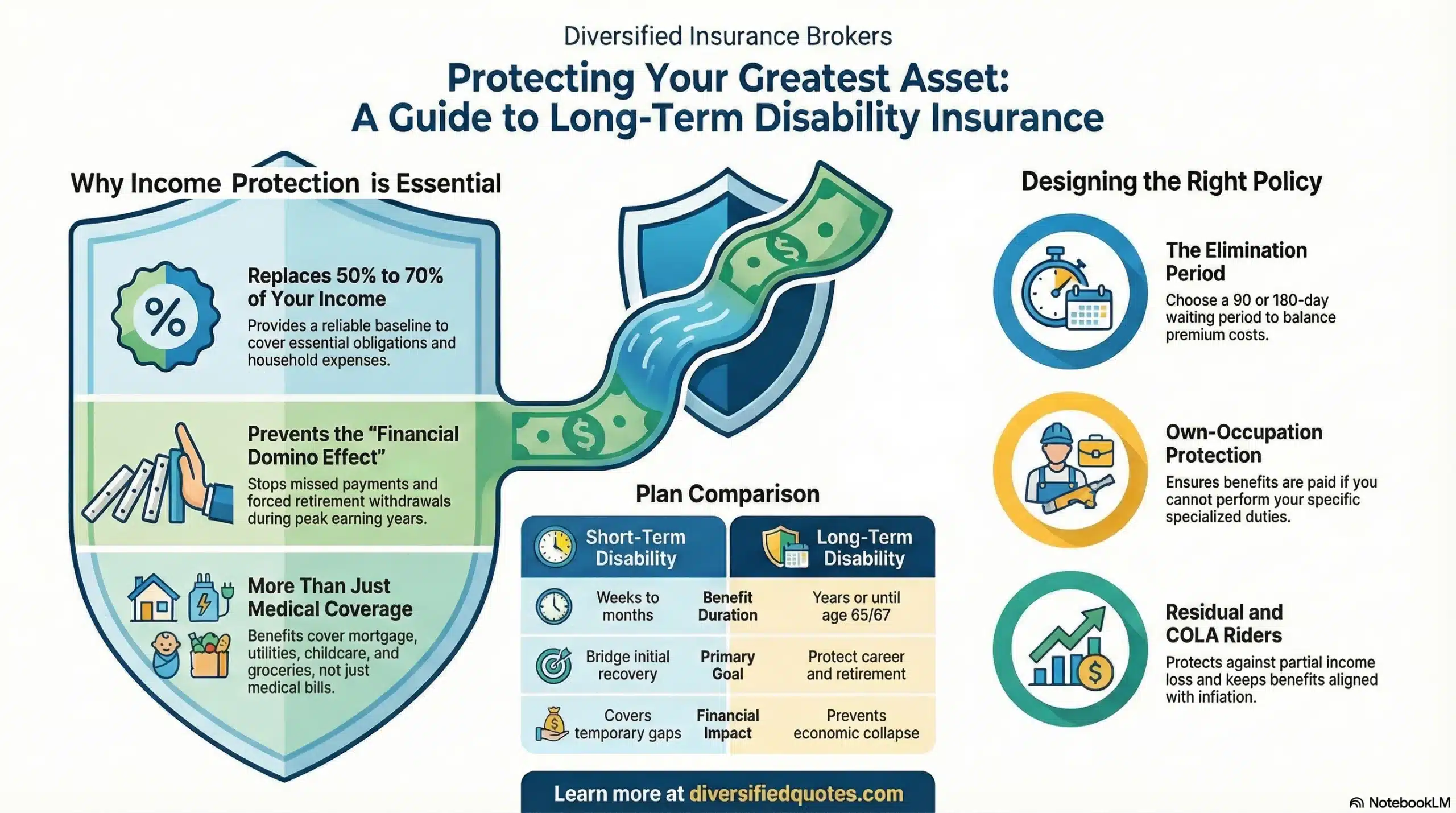
The elimination period should account for sick leave accrual and government group coverage — our guide on how disability insurance elimination periods work provides the complete framework. A cost-of-living adjustment rider preserves real benefit value across extended disability periods from progressive respiratory or musculoskeletal conditions — our resource on disability income insurance with a COLA rider explains this protection. For rangers exploring short-term coverage alongside long-term disability insurance, our guide on how to buy short-term disability insurance covers the complete income protection picture.
Why Forest and Park Rangers Need an Independent Disability Insurance Broker
Disability insurance for forest and park rangers involves multi-dimensional occupational classification considerations — spanning law enforcement, wildland firefighting, emergency medical response, and remote outdoor patrol — combined with government employment income documentation requirements, mental health coverage evaluation, and the identification of carriers whose underwriting guidelines most favorably accommodate this specific and unusual public safety occupational profile. A standard retail disability insurance application is not optimized for the ranger occupational context, and a general insurance agent unfamiliar with the complexity of ranger duties and government employee income structures will not produce the most comprehensive available coverage.
At Diversified Insurance Brokers, we work with forest rangers, park rangers, conservation officers, and land management agency public safety professionals to structure disability coverage that accurately reflects how rangers earn, what conditions would actually prevent them from serving in active field capacities, and what policy features provide the most meaningful financial protection for their professional and personal situations. Our dedicated resource on why independent disability insurance brokers matter explains the full value of this approach for public safety professionals with complex multi-hazard occupational profiles. For rangers evaluating the foundational financial case for individual supplemental disability coverage, our resource on whether disability insurance is worth the investment provides the complete financial picture of what is at stake for a government public safety professional whose group coverage leaves meaningful income protection gaps.
Final Thoughts on Disability Insurance for Forest and Park Rangers
Forest and park rangers protect some of the most treasured natural landscapes in America — managing public lands, protecting wildlife and ecological systems, keeping millions of visitors safe in remote and challenging environments, and performing the full spectrum of public safety functions from wildland fire suppression to search and rescue to law enforcement, often alone and often hours from any support. The multi-hazard occupational risks they accept in service of these responsibilities — wildland fire exposure, law enforcement encounter risks, technical rescue operations, vehicle and watercraft hazards, and the sustained psychological burden of traumatic response work — create a disability risk profile that deserves comprehensive individual income protection.
Disability insurance for forest and park rangers — supplementing government group coverage, maintaining own-occupation protection for the full benefit period, covering total compensation including hazard pay, providing full mental health benefit periods for documented psychological disability risk, and coordinating with pension disability provisions — provides the financial security that allows rangers to recover completely from any disabling event and return to public service when their physical and psychological health genuinely support it.
Related Pages
Talk With an Advisor Today
Choose how you’d like to connect—call or message us, then book a time that works for you.
Schedule here:
calendly.com/jason-dibcompanies/diversified-quotes
Licensed in all 50 states • Fiduciary, family-owned since 1980
Disability Insurance for Forest and Park Rangers FAQs
Yes, forest and park rangers can obtain individual disability insurance, though the occupational classification and carrier selection require broker expertise given the multi-hazard nature of ranger work — spanning law enforcement, wildland firefighting, emergency medical response, and remote outdoor patrol. Rangers are classified based on the full scope of their duties, and the classification determines both the available policy features and the premium rate. Some standard retail disability carriers classify ranger work under general government employment guidelines that may not fully account for the wildland fire and law enforcement exposure dimensions of the role — while other carriers with specific experience in public safety and outdoor government occupational classifications write ranger disability insurance with terms that meaningfully address the full occupational risk profile. The most important planning considerations are the own-occupation definition language, the mental health benefit period provisions, and whether hazard pay and other supplemental compensation are included in the benefit calculation. For context on disability insurance availability for other remote public safety occupations, see our page on disability insurance for high-hazard outdoor public safety professionals.
The disability risk profile for forest and park rangers is genuinely multi-dimensional, reflecting the multiple hazardous roles they perform simultaneously. Wildland fire injuries — including burn injuries from flame impingement and heat exposure, trauma from falling snags and trees during suppression operations, and smoke inhalation respiratory injuries — represent the most acute catastrophic disability risk category; the CDC documents over 400 on-duty wildland firefighting fatalities from 2000 through 2019. Musculoskeletal injuries are the most frequent disability category — published research documents approximately 76% occupational injury prevalence among wildland firefighters, with tendonitis and muscle pain (44%) and sprains (21%) as the most common injury types, reflecting the heavy physical demands of fire line work, backcountry patrol, and technical rescue operations. Law enforcement assault and gunshot wounds from armed enforcement contacts represent another documented disability source, with rangers patrolling alone in remote areas where backup may be hours away. Vehicle and watercraft accidents on remote roads and waterways are a documented cause of ranger fatalities and serious disabling injuries. And PTSD, occupational depression, and burnout from sustained traumatic incident response represent the psychological disability dimension that published research specifically identifies in the ranger and wildland firefighter population.
In most cases, government group disability coverage leaves meaningful gaps that individual supplemental insurance directly addresses. Government group long-term disability plans typically replace 60% to 66.67% of base salary — explicitly excluding hazard pay, overtime, and supplemental pay that may represent meaningful portions of total ranger annual compensation. Many government group plans include own-occupation definitions that shift to any-occupation standards after two years of disability — meaning a ranger who is permanently physically unable to perform active field patrol, fire response, and law enforcement duties but who could theoretically perform desk-based government employment may have benefits discontinued after the two-year period. Disability retirement through federal or state pension systems provides an additional layer but produces benefit amounts reflecting reduced pension accrual rather than full career completion income. Individual supplemental disability insurance fills all of these gaps — maintaining own-occupation protection for the full benefit period, covering total compensation rather than base salary alone, and functioning independently of government employment status. For context on government group disability plan limitations for public safety employees, see our resource on disability insurance for public safety and government employees managing institutional coverage gaps.
Yes — individual disability insurance covers disability from any cause, including both acute injuries sustained during wildland fire suppression operations and long-latency respiratory illness from career-long fire smoke exposure, when the condition meets the policy’s definition of disability. A ranger who sustains serious burn injuries or a traumatic injury during fire line operations qualifies for disability benefits during the recovery period. A ranger who develops progressive chronic lung disease from career smoke inhalation exposure qualifies for benefits when the condition reaches the threshold that prevents performing active ranger duties — regardless of how many years after initial smoke exposure the disabling illness develops. The long-latency nature of smoke exposure respiratory consequences is an important planning consideration for applying early: a ranger who applies for disability insurance before any respiratory health findings from fire smoke exposure appear in the medical record secures comprehensive coverage for that long-latency risk, whereas a ranger who waits until respiratory changes are documented may face exclusion riders for respiratory conditions.
Own-occupation disability insurance pays benefits when a disabling condition prevents a ranger from performing the specific duties of their ranger profession — active backcountry patrol, wildland fire suppression, technical search and rescue operations, law enforcement functions, and emergency medical response — regardless of whether they could theoretically perform other less physically demanding or less hazardous work. Any-occupation coverage only pays if the ranger cannot perform virtually any gainful employment. A ranger whose knee injury from fire terrain navigation prevents the demanding physical patrol and fire line work of active ranger duty but who could theoretically perform desk-based government work would receive no any-occupation benefits — while an own-occupation policy recognizes the genuine inability to serve as an active-duty ranger and pays accordingly. This distinction is particularly consequential because government group disability plans commonly shift to any-occupation definitions after two years — exactly the scenario where individual own-occupation supplemental coverage maintains benefits through the full recovery period and beyond. For rangers who have invested years developing the specialized physical and technical skills of their multi-role profession, own-occupation coverage is the only definition that meaningfully protects ranger career income.
Many individual disability insurance policies provide coverage for mental health conditions including PTSD, major depression, and burnout-related illness when those conditions prevent performing occupational duties. For forest and park rangers — whose career involves repeated response to wildland fire fatalities, backcountry accident scenes, wilderness drowning victims, search and rescue missions with traumatic outcomes, and law enforcement violence — PTSD and occupational psychological health disability are documented occupational risks specifically identified in published research on the ranger and wildland firefighter population. The most important planning consideration for rangers evaluating mental health coverage is the benefit period provision: many policies limit mental health disability benefits to 24 months even when the base policy would otherwise pay to retirement age. For rangers whose career involves sustained and repeated traumatic exposure, a 24-month mental health limitation may provide materially inadequate protection for a serious occupational PTSD or depression disability that requires extended recovery. At Diversified Insurance Brokers, we specifically identify carriers offering full benefit period mental health coverage when structuring disability insurance for public safety professionals with documented psychological occupational exposure.
Residual disability coverage pays proportional benefits when a disabling condition reduces a ranger’s field capacity without completely eliminating the ability to work. A ranger recovering from a serious knee injury from fire terrain may be cleared for limited patrol duties — road-based patrol, visitor contact, administrative functions — months before they can safely return to the full physical demands of backcountry patrol, fire line operations, and technical rescue work. During this graduated return period, effective field capacity and any hazard pay associated with active field status are reduced without the ranger being totally disabled. Without a residual disability rider, a total-disability-only policy pays nothing during this partial capacity period. A residual rider supplements reduced ranger income proportionally throughout the graduated return to full duty capacity, providing continuous financial support from disability onset through complete return to active ranger status. For rangers whose most likely disabling conditions — musculoskeletal injuries, respiratory conditions, psychological health disabilities — typically produce graduated functional limitations rather than sudden total incapacity, the residual rider is essential for the disability policy to function as genuine income protection across the full recovery arc. For context on residual disability riders for remote public safety professionals, see our resource on disability insurance for professionals requiring comprehensive partial disability protection.
Hazard pay represents a meaningful component of total annual compensation for many federal and state rangers — particularly during fire season when hazard pay for active fire assignment substantially increases weekly earnings. Government group disability plans are almost universally calculated on base salary only, explicitly excluding hazard pay and other supplemental compensation from the benefit calculation. This creates a meaningful income gap during disability: a ranger earning $74,000 annually with $54,000 in base salary and $20,000 in hazard pay receives group disability benefits calculated on the $54,000 base salary component only — leaving the $20,000 in hazard pay entirely unprotected. Individual disability insurance can be structured to cover total documented W-2 income including hazard pay, with the benefit amount calibrated to actual annual earnings rather than base salary alone. For federal rangers who depend on fire season hazard pay for meaningful household financial obligations, ensuring that the individual supplemental policy covers total compensation is an important planning consideration that requires specific attention to income documentation in the underwriting process. For context on how supplemental pay affects disability insurance planning, see our resource on disability insurance for professionals with complex variable compensation structures.
The elimination period selection for forest and park rangers should account for accumulated sick leave, the government group disability plan that typically activates after an initial waiting period, and the nature of the disability — whether it is work-related and therefore potentially covered by federal or state workers’ compensation, or from a non-occupational cause. Rangers with substantial sick leave accrual who are disabled from a work-related incident typically have workers’ compensation income bridging the initial waiting period, and a 90-day elimination period on an individual supplemental policy may be financially manageable with sick leave plus workers’ compensation providing interim support. Rangers disabled from non-work-related conditions — illness, off-duty injuries, gradually developing chronic conditions — receive no workers’ compensation income and should evaluate whether their available sick leave accrual alone can realistically sustain the household through a 90-day waiting period, or whether a 30 or 60-day elimination period is more appropriate. The seasonal nature of ranger income — with fire season hazard pay representing a significant income concentration period — also affects elimination period selection, since a disability occurring during peak fire season without adequate bridge income creates more acute financial urgency than one occurring during the winter administrative season.
The best time is as early as possible in a ranger career — ideally upon completing initial training and entering active field duty, before any occupational health consequences from wildland fire smoke exposure, musculoskeletal wear from backcountry patrol and fire line operations, law enforcement encounter injury history, or psychological health treatment from traumatic incident exposure have accumulated in the medical record. Disability insurance premiums are based in part on age and health status at the time of application, and younger rangers in excellent health secure the most comprehensive coverage at the most favorable rates. Published research specifically documents that wildland fire injury rates increase significantly for rangers over 35 with more than 10 years of experience — meaning that the occupational injury risk escalates precisely as career experience accumulates. Respiratory health changes from career fire smoke exposure, musculoskeletal conditions from years of backcountry patrol, or any mental health treatment connected to occupational traumatic exposure can result in exclusion riders or restricted policy terms if documented at application. Applying before these occupational health consequences develop ensures they are covered under an existing policy when they eventually appear. The non-cancelable and guaranteed renewable provision locks in the early-career health rating for the policy’s entire duration.
An independent broker with experience in public safety and government occupational classifications accesses multiple carriers and compares how each evaluates the multi-dimensional ranger occupational profile — spanning law enforcement, wildland firefighting, emergency medical response, and remote outdoor patrol — alongside the government employee income documentation requirements for hazard pay and supplemental compensation. Different carriers classify ranger duties differently, and these classification differences produce meaningfully different premium rates, benefit amounts, mental health coverage provisions, and policy feature availability. A captive agent representing a single carrier can only present that company’s approach, regardless of whether it is the most favorable for the specific combination of duties, hazard exposures, and income structures that characterize ranger employment. At Diversified Insurance Brokers, we evaluate the full competitive marketplace for every ranger we work with — identifying carriers whose underwriting guidelines most favorably accommodate the ranger occupational profile, specifically evaluating mental health coverage provisions for documented PTSD and burnout risk, ensuring hazard pay is properly documented and included in benefit calculations, and structuring supplemental coverage that accurately coordinates with government group plan and pension disability provisions.
About the Author:
Jason Stolz, CLTC, CRPC, DIA, CAA and Chief Underwriter at Diversified Insurance Brokers (NPN 20471358), is a senior insurance and retirement professional with more than 25 years of real-world experience helping individuals, families, and business owners protect their income, assets, and long-term financial stability. As a long-time partner of the nationally licensed independent agency Diversified Insurance Brokers, Jason provides trusted guidance across multiple specialties—including fixed and indexed annuities, long-term care planning, personal and business disability insurance, life insurance solutions, Group Health, Travel Medical and Evacuation Insurance, and short-term health coverage. Diversified Insurance Brokers maintains active contracts with over 100 highly rated insurance carriers, ensuring clients have access to a broad and competitive marketplace.
His practical, education-first approach has earned recognition in publications such as VoyageATL, and contributions from his agency featured in Kiplinger and GoBankingRates— highlighting his commitment to financial clarity and client-focused planning. Drawing on deep product knowledge and years of hands-on field experience, Jason helps clients evaluate carriers, compare strategies, and build retirement and protection plans that are both secure and cost-efficient. Visitors who want to explore current annuity rates and compare options across multiple insurers can also use this annuity quote and comparison tool.
Explore More Disability Insurance Options: Browse our complete guide to Disability Insurance for Agriculture, Natural Resources & Outdoor Industries — covering farmers, ranchers, fishermen, foresters, miners, oil & gas workers & outdoor industries from 100+ carriers.
Last Reviewed: June 8, 2026 |
Reviewed by: Jason Stolz, CLTC, CRPC, DIA, CAA
Chief Underwriter, Diversified Insurance Brokers, Inc. | NPN: 20471358 | Diversified Insurance Brokers, Inc. — Licensed in all 50 states
Fact Checked by: Tonia Pettitt, CMIP©
Medicare Specialist, Diversified Insurance Brokers, Inc. | NPN: 14374308 | Diversified Insurance Brokers, Inc. — Licensed in all 50 states
Did you find this content helpful? Leave us a Google review — it helps others find trustworthy guidance too.
Editorial Standards: Diversified Insurance Brokers maintains rigorous editorial standards to ensure accuracy, clarity, and independence in all content. Learn more about our editorial standards and commitment to transparency.
