
Disability Insurance for Explosives Handlers
As an Independent Disability Insurance Broker, we have access to exclusive discounts and negotiated pricing most captive agents can’t offer — see the full breakdown near the end of this page.
Disability Insurance for Explosives Handlers

Jason Stolz CLTC, CRPC, DIA, CAA
Disability insurance for explosives handlers is among the most specialized and consequential forms of income protection available in the occupational insurance marketplace. Whether you work as a licensed blaster in mining or quarrying operations, a demolition explosives technician bringing down commercial structures, a seismic explosives operator in oil and gas exploration, a pyrotechnic specialist in entertainment or special effects, or a military ordnance disposal professional transitioning into civilian explosive handling roles, your work places you in daily proximity to hazards that carry catastrophic injury potential — and that makes income protection planning not a consideration for the future, but an immediate financial necessity.
Explosives handling is one of the few occupations where a single workplace incident can produce permanent, career-ending disability in a fraction of a second. Burns, blast trauma, amputations, hearing loss, traumatic brain injury, vision loss, and the psychological consequences of working in high-alert environments across a career all combine to create an occupational risk profile that no other financial tool addresses more directly than individual disability insurance. The income an explosives handler earns reflects the extraordinary nature of the risk they accept — and that income deserves equally extraordinary financial protection.
At Diversified Insurance Brokers, we work with explosives handlers, licensed blasters, demolition specialists, and pyrotechnic professionals to structure disability insurance coverage that reflects the genuine risks and income realities of explosive handling work. Disability insurance for explosives handlers is a specialty placement that requires carrier expertise, occupational underwriting knowledge, and access to the specific markets that write high-hazard occupational classes — and those are precisely the capabilities we bring to every client in this profession.
Protect Your Income as an Explosives Handler
Compare disability insurance options designed for licensed blasters, demolition specialists, seismic operators, and pyrotechnic professionals.
Who Explosives Handlers Are and Why Their Income Needs Protection
Disability insurance for explosives handlers serves a diverse professional population whose work spans multiple industries and applications. Licensed blasters in mining and quarrying operations use explosives to fracture rock formations for mineral extraction, road construction, and aggregate production. Demolition explosives specialists use precisely sequenced charges to bring down commercial buildings, bridges, and industrial structures in controlled implosion sequences. Seismic explosives operators in oil and gas exploration create controlled detonations to generate underground sound waves used in geological survey work. Pyrotechnic specialists design and execute explosive special effects for film and television production, entertainment venues, and public celebrations.
Each of these roles requires extensive training, specialized licensure, and the kind of technical precision that comes only from experience — and each produces a meaningful income that reflects the premium placed on that expertise. Licensed blasters and demolition specialists typically earn well above median construction wages, with experienced professionals in high-demand markets generating six-figure annual incomes that reflect the irreplaceable nature of their licensed skill set. For any of these professionals, a disabling injury or illness that ends their ability to work creates an immediate and severe financial gap that no other resource can fill as effectively as individual disability insurance.
Many explosives handlers work as independent contractors or self-employed specialists, particularly in demolition, pyrotechnics, and seismic operations. This employment structure eliminates employer sick pay, group disability plans, and paid leave entirely — meaning that when a disability occurs, income stops immediately and completely with no institutional safety net in place. The financial vulnerability of self-employed explosives handlers is among the most acute in any high-risk profession, and individual disability insurance is the only meaningful protection against it. This same self-employment income risk characterizes other high-hazard independent specialists, such as big game hunting guides managing independent income protection.
The Occupational Classification Reality for Explosives Handlers
One of the most important things explosives handlers need to understand before pursuing disability insurance is how carriers evaluate and classify their occupation — because that classification directly determines what coverage is available, at what price, and under what policy terms.
Disability insurance carriers explicitly exclude explosives and explosive hazards from their standard occupational class systems. Class A occupational ratings — which provide favorable premiums and stronger policy features — are available only when working conditions involve no hazards from heat, chemicals, explosives, or heavy equipment. This means explosives handlers, by the nature of their work, fall into the lower occupational class tiers — typically Class B or below — and in some cases are classified as uninsurable by standard retail disability insurance carriers entirely.
However, uninsurable under standard carrier guidelines is not the same as uninsurable in the full marketplace. Specialty carriers and surplus lines markets that write high-hazard occupational disability policies exist specifically to serve professionals whose risk profile exceeds standard carrier thresholds. These markets impose higher premiums, more restricted policy features, lower maximum benefit amounts, and shorter benefit periods than standard occupational class policies — but they provide genuine income replacement coverage for a population of professionals who would otherwise have no individual disability insurance available at all. Accessing these specialty markets requires an independent broker with the carrier relationships and occupational underwriting expertise to navigate them effectively — precisely the expertise that distinguishes Diversified Insurance Brokers from standard retail disability insurance providers. For a clear explanation of why broker access matters for high-risk occupational placements, our resource on why independent disability insurance brokers matter lays out the full picture.
The Disability Risks Explosives Handlers Face — What Makes This Profession Unique
The occupational risk profile for explosives handlers is unlike that of virtually any other profession. The hazards are not cumulative and gradual — they are immediate, catastrophic, and capable of producing permanent, career-ending disability in a single incident. Understanding the specific injury categories that explosive handling work produces is essential for appreciating why disability insurance for explosives handlers is so critical — and why the income protection gap without it is so severe.
Blast injuries represent the defining catastrophic risk of explosive handling work. The medical literature on blast injury identifies four distinct injury mechanisms that affect explosives handlers who are exposed to an uncontrolled or poorly controlled detonation. Primary blast injuries result from the pressure wave produced by the explosion — affecting air-filled structures of the body including the lungs, ears, gastrointestinal tract, and sinuses. Pulmonary blast injury — damage to lung tissue from the pressure wave — can produce immediate respiratory failure and long-term pulmonary impairment. Blast-induced hearing loss from primary pressure wave exposure is among the most common permanent disabilities in populations exposed to explosions, and even properly protected explosives handlers accumulate noise-induced hearing damage over a career that can eventually impair occupational function.
Secondary blast injuries result from projectile fragments propelled by the explosion — debris, rock, material fragments, and casing components that travel at velocities far exceeding conventional ballistic projectiles. Secondary injuries are the most common cause of mortality in blast survivors and produce penetrating trauma to the head, neck, and extremities including amputations, eye injuries producing permanent vision loss, and penetrating abdominal and thoracic injuries requiring extensive surgical intervention and extended recovery. An explosives handler who survives a significant secondary blast injury with permanent functional limitations faces a career-ending disability that individual income protection is specifically designed to address.
Tertiary blast injuries occur when the explosion’s pressure wave physically displaces the explosives handler — propelling them into structures, equipment, or the ground. The resulting blunt trauma produces fractures, traumatic brain injuries, spinal cord injuries, and internal organ damage that can produce permanent functional limitations regardless of the quality of care received. Traumatic brain injury from blast displacement is a particularly serious disability concern for explosives handlers, as even a moderate TBI can produce cognitive and neurological impairments that make return to the precision, concentration, and judgment demands of explosives work impossible. The neurological consequences of blast-related TBI are similar in their career impact to those facing other professionals with cognitive disability risk, including boat captains whose maritime licensure depends on cognitive and neurological fitness.
Hearing Loss — The Most Prevalent Career-Long Disability Risk for Explosives Handlers
While catastrophic blast events represent the most acute and severe disability risk for explosives handlers, hearing loss is by far the most prevalent career-long occupational disability affecting this population. Every controlled detonation generates an acoustic pressure wave that, even with appropriate hearing protection, contributes to the cumulative noise exposure that produces noise-induced hearing loss over a career of blasting operations.
Noise-induced hearing loss develops gradually and progressively, often without the handler’s awareness until significant and permanent auditory damage has occurred. In mining, quarrying, demolition, and seismic explosive operations, the combination of detonation noise with the ambient heavy equipment noise of the work environment creates sustained elevated acoustic exposure that compounds the detonation-specific hearing risk. A licensed blaster who experiences progressive hearing loss to the point where it impairs communication, situational awareness in the blast area, or the cognitive processing of complex timing sequences has a genuine occupational disability — regardless of whether their hearing impairment would affect other types of employment.
Under an own-occupation disability policy, an explosives handler whose hearing loss compromises their ability to safely and effectively perform licensed blasting operations would qualify for disability benefits — even if they retain sufficient hearing for many other types of work. Under an any-occupation policy, benefits would likely be denied because the handler can technically perform other less demanding employment. This distinction — between a policy that protects the specific income of an explosives handler and one that only protects against complete incapacity — is the single most consequential decision in disability insurance planning for this profession. Our resource on own-occupation disability insurance explained covers this critical definition in full detail.
Chemical Exposure Risks in Explosives Handling Work
Beyond the physical blast and acoustic hazards, explosives handlers face meaningful chemical exposure risks from the compounds they handle daily. Explosive compounds including ammonium nitrate-based mixtures, TNT, RDX, PETN, and various sensitizing agents carry dermal and inhalation toxicity risks with sustained occupational exposure. Nitroglycerin-based explosives produce well-documented occupational health effects including nitroglycerin-induced headaches from dermal absorption, and chronic exposure to nitroglycerin compounds has been associated with cardiovascular effects including changes in heart rate and blood pressure regulation.
Post-detonation fumes — including carbon monoxide, nitrogen oxides, and other combustion products released into confined or semi-confined blast environments — create inhalation hazard exposure for explosives handlers who enter blast areas during the post-shot period. In underground mining and tunneling blast operations, where ventilation may be limited, this chemical fume exposure can reach concentrations that produce acute respiratory effects and, with repeated exposure, contribute to chronic respiratory disease development over a career.
The chemical exposure dimension of explosives handling work adds a long-latency occupational disease risk to the acute physical injury hazards that dominate the disability risk profile — meaning that disability insurance for explosives handlers must cover not just the immediate catastrophic injury scenarios but also the gradual health consequences that accumulate over a career of chemical contact. This dual risk profile — acute and chronic — parallels the occupational health challenges documented for other chemically intensive, physically dangerous trades, including well drillers facing both physical and chemical occupational hazards.
Psychological Disability Risk for Explosives Handlers
The psychological consequences of working in high-alert, high-consequence environments across a career represent a meaningful and often overlooked disability risk for explosives handlers. The sustained cognitive vigilance required to safely handle and detonate explosive compounds — the concentration, the precision, the awareness that an error in any element of the process can produce catastrophic consequences — creates chronic occupational stress that accumulates over years of blasting operations.
Explosives handlers who witness or are directly involved in a serious blast accident — whether involving themselves, coworkers, or members of the public — face significant risk of post-traumatic stress disorder. The acute psychological impact of a blast event, combined with the survivor’s understanding of exactly what could have happened and what did happen at a technical level that laypeople do not possess, creates conditions that produce PTSD in a meaningful proportion of blast accident survivors. When PTSD reaches a severity that prevents the sustained concentration and precision judgment that explosives handling requires, it constitutes a genuine occupational disability regardless of whether the handler retains the ability to perform other types of work.
Many disability insurance policies include mental health coverage for conditions like PTSD, anxiety disorders, and occupational stress-induced depression — but the terms vary significantly between carriers. Some provide full benefits for mental health disabilities throughout the benefit period; others limit mental health claims to 24 months. For explosives handlers, where the psychological dimension of occupational disability risk is real and documentable, evaluating mental health coverage provisions carefully before purchasing any disability policy is an important planning step. The psychological risk that explosives handlers face in high-consequence work parallels the experience of other high-alert professionals, including emergency dispatchers managing sustained occupational stress and trauma exposure.
Case Study: Licensed Blaster Earning $85,000 Per Year
Consider a licensed blaster working in commercial quarrying operations, earning $85,000 annually. During a routine shot sequence, an unexpected delay in a detonator produces a premature secondary detonation that propels debris fragments, resulting in a serious eye injury producing permanent significant vision loss in one eye, combined with a hand injury requiring surgical repair. Following recovery, the blaster’s state licensing authority determines that the vision loss is sufficient to require medical review of continued licensure for explosive operations.
| Scenario | Without Disability Insurance | With Disability Insurance |
|---|---|---|
| Monthly Income During Disability | Workers’ comp only (~$3,800) | Workers’ comp + $2,200–$3,000 supplemental benefit |
| Long-Term Income if License Lost | $0 — workers’ comp ends at medical maximum | Disability benefits continue through benefit period |
| Career Outcome | Loss of licensure means immediate permanent income loss | Income replacement supports career transition on financial stable ground |
| Financial Outcome | Savings depleted, financial crisis compounds injury recovery | Financial stability maintained through disability and career transition |
The licensing dimension of this scenario is critical for explosives handlers. A blaster whose injury or health condition results in loss of their state explosive handling license cannot practice their profession regardless of any other aspect of their physical capacity — and disability insurance for explosives handlers provides income replacement in exactly this scenario, bridging the financial gap between the disabling event and whatever career transition follows.
Workers’ Compensation vs. Individual Disability Insurance for Explosives Handlers
Workers’ compensation is the mandatory baseline protection for employed explosives handlers in most states, and it provides valuable coverage for work-related injury events. But workers’ compensation has significant structural limitations that make it insufficient as the sole disability protection strategy for explosives handling professionals — limitations that individual disability insurance directly addresses.
Workers’ compensation covers only work-related injuries and occupational diseases. An explosives handler who becomes disabled from cancer, a cardiovascular event, a non-work accident, or any condition not directly connected to a specific workplace event receives no workers’ compensation benefit regardless of how long their career has exposed them to the physical and chemical hazards of the profession. Workers’ compensation also provides limited income replacement — typically two-thirds of pre-injury wages — and benefit periods that end when the medical condition is determined to have reached maximum medical improvement, which may occur long before the handler has recovered the full functional capacity needed to return to explosive handling work.
Self-employed explosives handlers and independent blasting contractors who have not secured workers’ compensation coverage for themselves — which is optional for sole proprietors in many states — may have no workers’ compensation protection at all. For these professionals, individual disability insurance is the only income replacement available from any source when a disabling condition occurs. The workers’ compensation gap that self-employed explosives handlers navigate is parallel to that facing other self-employed high-risk contractors, including independent construction contractors managing their own disability coverage.
Key Policy Features for Explosives Handler Disability Insurance
Disability insurance for explosives handlers, when obtainable through specialty carrier markets, should be structured with specific attention to the features that matter most for this profession. The own-occupation versus any-occupation definition distinction is foundational — an own-occupation policy that pays benefits when an explosives handler can no longer perform licensed blasting operations is substantially more valuable than an any-occupation policy that requires total incapacity for any employment before benefits begin. Not all specialty market policies for high-hazard occupations offer true own-occupation definitions, and identifying which carriers provide this feature for explosives handling classifications is a core function of experienced broker guidance.
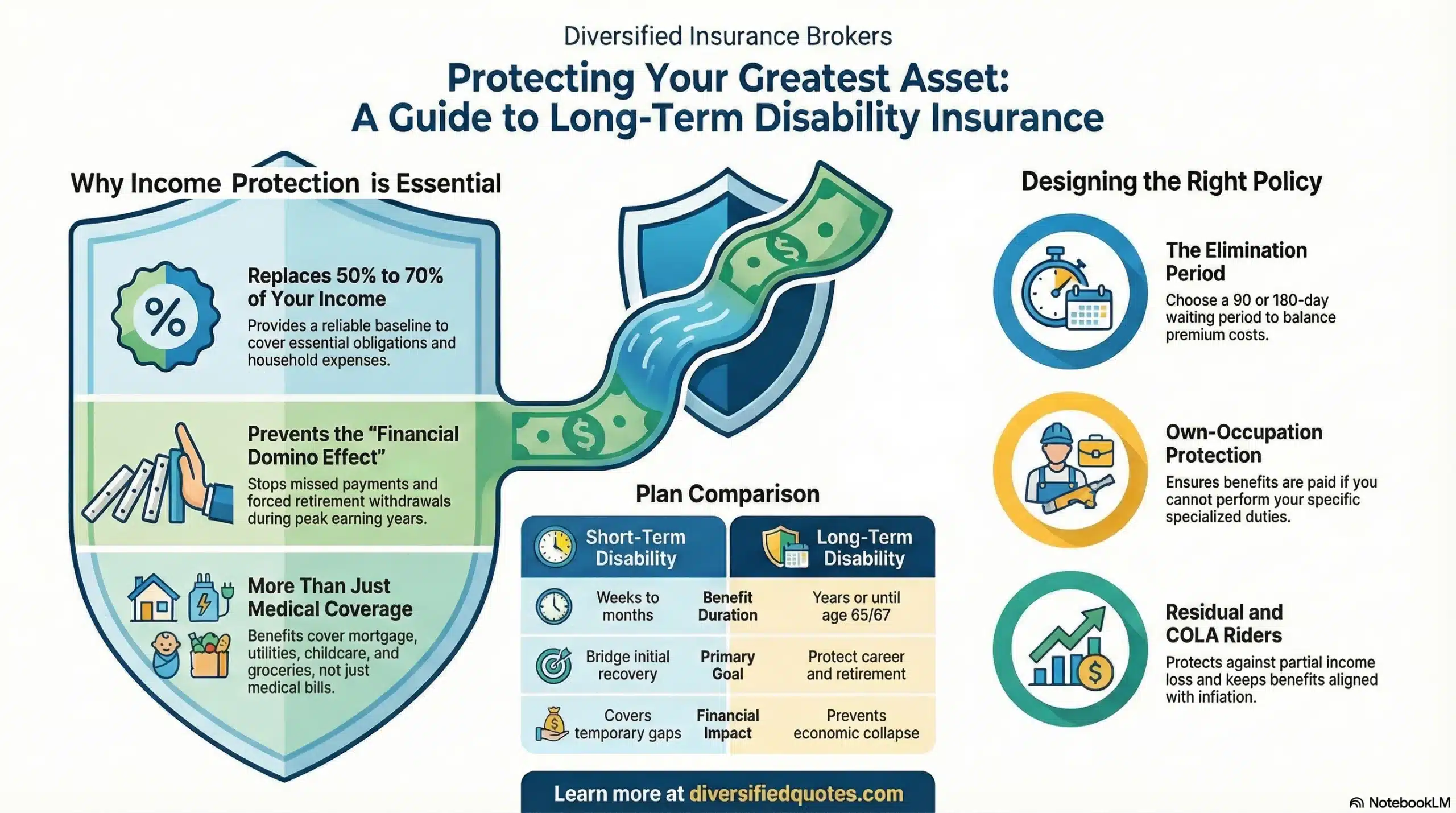
Benefit period is another critical dimension. Standard disability insurance policies offer benefit periods to age 65 or 67 — providing long-term income replacement for the remaining working years of a disabled professional. For high-hazard occupational classes including explosives handlers, some carriers restrict the maximum benefit period to two or five years rather than providing coverage to retirement age. Understanding what benefit period is available and selecting the longest available option is an important priority in structuring disability insurance for explosives handlers. Our resource on how residual disability benefits work explains the partial disability dimension that is equally important for explosive handlers whose injuries may limit rather than completely eliminate work capacity.
The elimination period — the waiting time before benefits begin — should be calibrated to the explosives handler’s financial reserves and their access to workers’ compensation income during the waiting period. Explosives handlers who have workers’ compensation coverage that activates quickly may be comfortable with a 90-day elimination period, knowing workers’ comp will bridge the early weeks of a disability. Those without workers’ comp protection, or self-employed handlers with no income backup whatsoever, should evaluate shorter elimination periods carefully. Our full guide on how disability insurance elimination periods work provides the framework for calibrating this decision to individual financial situations.
The Licensing Dimension — How Lost Certification Creates Disability for Explosives Handlers
Licensed blasters and explosives handlers hold state-issued certifications that authorize them to legally handle, store, transport, and detonate explosive compounds. These licenses carry physical fitness and sensory function requirements — including vision and hearing standards — that must be maintained for the license to remain valid. A disabling condition that results in loss of state blasting certification ends the explosives handler’s ability to practice their licensed profession, even if they retain the physical ability to perform many other types of work.
This licensing-dependent disability scenario is one of the most financially consequential for explosives handlers, and it is precisely the type of situation that an own-occupation disability policy addresses most effectively. An explosives handler who loses their blasting license due to vision loss, hearing impairment, neurological damage from blast TBI, or any other qualifying health condition cannot legally continue working as a blaster — and the income they earned from that licensed work disappears immediately. A policy that only pays when the handler cannot perform any type of work would deny benefits in this scenario. A policy with a strong own-occupation definition would recognize the genuine end of the blasting career and provide the income replacement that allows a planned, financially stable transition to whatever comes next.
Understanding how own-occupation coverage applies to licensed professional status is an important planning conversation for every explosives handler who carries state certification. For professionals in similarly licensed high-risk roles where loss of certification constitutes genuine professional disability, our resource on how licensed practitioners structure disability protection around professional certification provides parallel context on this important dimension.
Integrating Disability Insurance Into an Explosives Handler’s Financial Plan
For explosives handlers, disability insurance is the financial foundation that protects everything the premium income of their work supports — the mortgage, the family financial obligations, the retirement savings, and the long-term financial goals that a high-income hazardous career makes possible. The premium wages that explosives handlers earn reflect the extraordinary risk they accept; protecting that income against the very real possibility that the work itself produces a career-ending disability is the essential financial planning obligation that follows directly from accepting that risk.
Once disability coverage is secured, explosives handlers can build additional layers of financial protection. Understanding how tools like life insurance for high-risk public safety professionals complement disability coverage creates a more complete financial protection framework that addresses both income replacement during disability and family financial security in the event of death. For explosives handlers approaching mid-career and beginning to think about retirement income planning, ensuring that retirement savings contributions are protected during any disability period is a critical financial planning dimension that disability insurance directly enables by replacing income during recovery periods.
The combination of individual disability insurance, supplemental accident coverage, and a thoughtful approach to the specific financial vulnerabilities of explosives handling work creates the most resilient protection framework available to any professional in this high-hazard career. A COLA rider is particularly worth considering for explosives handlers who may experience long-term disability — our resource on disability income insurance with a COLA rider explains how this protection preserves benefit value across extended claim periods.
Why Explosives Handlers Absolutely Need an Independent Disability Insurance Broker
Disability insurance for explosives handlers is not available from standard retail carriers through standard application processes. The occupational classification — explicitly excluding explosive hazards from standard class ratings — means that standard carrier submissions will either be declined outright or produce policies with explosive work exclusion riders that make the coverage nearly worthless for the most likely disability scenarios.
Finding the carriers that genuinely write high-hazard occupational disability policies without excluding the very risks that define the profession requires broker access to specialty and surplus lines markets that most disability insurance agents simply do not work with. At Diversified Insurance Brokers, we have the carrier relationships and specialty market access to identify the options that exist for explosives handlers — options that standard retail agents cannot reach — and to structure the most comprehensive available coverage within the constraints of what the specialty market provides for this occupational class.
For explosives handlers, the difference between working with a standard retail disability insurance agent and working with an independent broker who understands high-hazard occupational placements is not a matter of getting a slightly better rate. It is a matter of getting coverage that actually exists and actually responds to the real risks of the profession — versus a policy with an explosives exclusion rider that leaves the most likely disability scenarios entirely unprotected. Our comprehensive resource on why independent disability insurance brokers matter for high-risk professionals covers this value in full detail.
Final Thoughts on Disability Insurance for Explosives Handlers
Explosives handlers accept extraordinary occupational risk in exchange for the premium income their licensed skills command. A blast injury, permanent hearing loss, chemical-induced health condition, or licensing-dependent disability can end that income stream in a moment — without warning, without gradual onset, and without any of the occupational safety measures that a skilled and experienced blaster employs every day being sufficient to prevent all possible disabling events.
Disability insurance for explosives handlers is the financial tool that ensures the income built on that professional expertise is protected against the very risks that expertise is designed to manage. A well-structured policy — placed through a broker with specialty market access, built around the strongest available disability definition, and calibrated to the individual’s financial situation — provides the income replacement that allows an explosives handler to manage a career-disrupting disability from a position of financial stability rather than financial crisis.
Related Pages
Talk With an Advisor Today
Choose how you’d like to connect—call or message us, then book a time that works for you.
Schedule here:
calendly.com/jason-dibcompanies/diversified-quotes
Licensed in all 50 states • Fiduciary, family-owned since 1980
Disability Insurance for Explosives Handlers FAQs
Yes, but it requires working with an independent broker who has access to specialty and surplus lines markets that write high-hazard occupational disability policies. Standard retail disability insurance carriers explicitly exclude explosive hazards from their standard occupational class systems — meaning that a standard application from an explosives handler will either be declined outright or result in a policy with an explosives work exclusion rider that eliminates coverage for the most relevant disability scenarios. Specialty markets exist that provide genuine disability coverage for explosives handling professionals, but these markets impose higher premiums, more restricted policy features, lower maximum benefit amounts, and often shorter benefit periods than standard occupational class policies. The difference between having coverage that responds to real blast and occupational hazard disabilities versus a policy that excludes them entirely depends entirely on whether the application is placed with the right carrier through an experienced broker.
The disability risk profile for explosives handlers spans both catastrophic acute events and progressive occupational health consequences. Blast injuries from uncontrolled or poorly controlled detonations produce four categories of harm: primary pressure wave injuries affecting the lungs, ears, and hollow body structures; secondary projectile injuries producing amputations, eye injuries with permanent vision loss, and penetrating trauma; tertiary injuries from blast displacement producing traumatic brain injury, spinal cord damage, and internal organ trauma; and chemical exposure from explosive compounds and post-detonation fumes. Hearing loss from cumulative occupational noise exposure is the most prevalent career-long disability, with even properly protected blasters accumulating auditory damage over a full career. Chemical exposure risks from nitroglycerin compounds, post-blast fumes in confined environments, and other explosive compound constituents add occupational disease risk on top of the acute injury hazard profile. Psychological consequences including PTSD from blast accident exposure round out a disability risk profile that is among the most severe and diverse of any profession. For context on how PTSD disability protection works, see our page on disability insurance for high-stress occupations with trauma exposure.
Own-occupation disability insurance pays benefits when a condition prevents an explosives handler from performing the specific duties of their licensed profession — regardless of whether they could theoretically perform other types of less hazardous work. This distinction is directly relevant to the most likely disability scenarios for explosives handlers. A blaster who develops significant hearing loss may retain the ability to perform many other types of work but cannot safely and effectively perform licensed blasting operations that depend on situational awareness, communication, and timing precision. A blaster who develops vision impairment that falls below licensing standards cannot legally continue explosive handling regardless of overall physical health. A blaster with blast-related TBI may retain basic functional capacity for lower-demand work but cannot perform the precision judgment and cognitive demands of explosives operations. Under any-occupation coverage, benefits would be denied in all these scenarios. Under own-occupation coverage, the genuine occupational disability is recognized and income replacement is provided. Our dedicated resource on own-occupation disability insurance explained covers this critical distinction in full.
Loss of a state blasting license is a career-ending event regardless of any other aspect of the explosives handler’s physical or cognitive capacity. State blasting licenses carry physical fitness, vision, and hearing standards, and an injury or health condition that causes the handler to fall below those standards ends the legal authority to handle, store, transport, and detonate explosives. The income earned from licensed blasting work disappears immediately and permanently. Workers’ compensation covers the acute injury recovery period and medical treatment, but workers’ comp ends when maximum medical improvement is reached — not when the handler has found a new career path and established equivalent income. Individual disability insurance with an own-occupation definition bridges this gap, providing income replacement from the onset of disability through the benefit period — whether the handler eventually recovers and returns to licensed work, transitions to a supervisory or consulting role, or moves entirely into a new profession.
No. Workers’ compensation covers injuries and occupational illnesses that are directly and demonstrably work-related — a blast injury on a job site, an acute chemical exposure event during explosives handling, a documented occupational hearing loss claim. It does not cover non-work-related disabilities of any kind. An explosives handler who develops cancer, a cardiovascular event, a non-work injury, or any condition unrelated to a specific workplace event receives no workers’ compensation benefit. Workers’ compensation also ends when the injured worker reaches maximum medical improvement — not when they are fully recovered or have transitioned to equivalent income. Self-employed blasters and independent demolition contractors who have not secured workers’ compensation for themselves may have no workers’ comp protection at all. Individual disability insurance covers disability from any cause regardless of origin, filling all these gaps and providing income replacement for the full benefit period rather than only until medical maximum improvement. Our guide on how disability insurance elimination periods work explains how to coordinate the policy waiting period with workers’ comp income during the early weeks of a disability.
Residual disability coverage pays proportional benefits when a disabling condition reduces earning capacity without eliminating the ability to work entirely. For an explosives handler who sustains an injury that limits rather than completely ends blasting work — perhaps working a reduced schedule during extended recovery, or transitioning to lower-exposure blasting work that pays less than their full specialist rate — income is reduced but not eliminated. Without a residual disability rider, a total-disability-only policy provides nothing during this partial recovery period. A residual rider supplements reduced earnings proportionally throughout the return-to-work arc. For explosives handlers whose recovery from physical injuries often involves extended partial work capacity before full function is restored, this rider provides continuous financial support across the entire recovery timeline rather than only during the acute total disability phase. Our full resource on how residual disability benefits work covers this important feature in detail.
Disability insurance can cover hearing loss when the condition meets the policy’s definition of disability. For an explosives handler with an own-occupation policy, hearing loss that progresses to the point where it impairs safe and effective performance of licensed blasting operations — compromising situational awareness in the blast area, communication with crew members, or compliance with hearing standards required for licensure — would constitute a qualifying disability under the own-occupation definition. Pre-existing hearing loss at the time of policy application may result in exclusion riders limiting or eliminating coverage for hearing-related claims. This is a powerful reason to apply for disability insurance early in a blasting career — before the cumulative occupational noise exposure of years of detonation work has produced documented auditory damage that would affect underwriting. Coverage secured before significant hearing loss appears in the medical record provides the most comprehensive protection against the most prevalent career-long disability risk in the explosives handling profession.
The elimination period — the waiting time before disability benefits begin — should be calibrated based on whether the explosives handler has workers’ compensation coverage and how substantial their financial reserves are. Employed explosives handlers with workers’ compensation coverage that activates promptly can use workers’ comp income to bridge an initial 60 or 90-day elimination period, keeping long-term disability premiums lower. Self-employed blasters with no workers’ compensation and no alternative income should seriously evaluate 30 or 60-day elimination periods that provide faster benefit access, even at higher premium cost. The financial urgency of a blast injury or occupational disability is typically immediate for a self-employed handler whose project income stops the moment they cannot work — and an extended elimination period that must be bridged entirely from savings can create severe financial hardship before any disability benefit begins. Our resource on how elimination periods work provides the full framework for this decision.
A cost-of-living adjustment rider increases the monthly disability benefit amount annually during a claim period, preserving the real purchasing power of benefits during extended disability. For explosives handlers who experience a long-term or permanent disability — from blast TBI with lasting neurological consequences, significant amputations requiring extended rehabilitation, or progressive occupational hearing loss that permanently ends a blasting career — a COLA rider ensures the monthly benefit maintains its value over years rather than being gradually eroded by inflation. If a specialty market policy for an explosives handler includes a COLA rider option, it is generally worth including, given the potential for long-term disability claim duration in this profession. Our resource on disability income insurance with a COLA rider explains how this protection works and why it matters for extended claims.
The best time is at the beginning of a blasting career — before occupational health conditions including hearing loss, chemical exposure history, or any blast-related injury have accumulated in the medical record. This timing principle is especially important for explosives handlers because the most prevalent career-long disability risk — hearing loss from cumulative occupational noise — begins accumulating from the first detonation of a professional career and progressively worsens with each subsequent blast event. An explosives handler who applies for disability insurance at the start of their career, before any documented auditory damage, chemical exposure findings, or injury history exists, secures the most comprehensive coverage at the most favorable rates. Waiting until mid-career, after documented hearing tests show progressive loss or after a workplace exposure event has been recorded, significantly narrows available options and increases the likelihood of exclusion riders on the most relevant conditions. The specialty market coverage accessible to a young, healthy explosives handler at career entry is substantially more comprehensive than what becomes available after years of occupational exposure have been documented.
For explosives handlers, working with an independent broker is not a preference — it is a necessity. Standard retail disability insurance carriers explicitly exclude explosive hazards from standard occupational class ratings and will either decline applications from explosives handlers entirely or issue policies with explosives exclusion riders that make the coverage nearly worthless for the most likely disability scenarios. Finding the specialty and surplus lines carriers that write genuine disability coverage for explosives handling occupational classes without eliminating the very risks that define the profession requires broker access and expertise that standard retail agents simply do not possess. At Diversified Insurance Brokers, we have the specialty market access, the occupational underwriting knowledge, and the carrier relationships to identify what is genuinely available for explosives handlers — and to structure the most comprehensive coverage the market provides for this extraordinary occupational risk profile. Our resource on why independent disability insurance brokers matter explains this value for high-risk professionals in full.
About the Author:
Jason Stolz, CLTC, CRPC, DIA, CAA and Chief Underwriter at Diversified Insurance Brokers (NPN 20471358), is a senior insurance and retirement professional with more than 25 years of real-world experience helping individuals, families, and business owners protect their income, assets, and long-term financial stability. As a long-time partner of the nationally licensed independent agency Diversified Insurance Brokers, Jason provides trusted guidance across multiple specialties—including fixed and indexed annuities, long-term care planning, personal and business disability insurance, life insurance solutions, Group Health, Travel Medical and Evacuation Insurance, and short-term health coverage. Diversified Insurance Brokers maintains active contracts with over 100 highly rated insurance carriers, ensuring clients have access to a broad and competitive marketplace.
His practical, education-first approach has earned recognition in publications such as VoyageATL, and contributions from his agency featured in Kiplinger and GoBankingRates— highlighting his commitment to financial clarity and client-focused planning. Drawing on deep product knowledge and years of hands-on field experience, Jason helps clients evaluate carriers, compare strategies, and build retirement and protection plans that are both secure and cost-efficient. Visitors who want to explore current annuity rates and compare options across multiple insurers can also use this annuity quote and comparison tool.
Explore More Disability Insurance Options: Browse our complete guide to Disability Insurance for Trades, Construction & Industrial — covering contractors, electricians, plumbers, welders, roofers, machinists & skilled trades from 100+ carriers.
Last Reviewed: June 7, 2026 |
Reviewed by: Jason Stolz, CLTC, CRPC, DIA, CAA
Chief Underwriter, Diversified Insurance Brokers, Inc. | NPN: 20471358 | Diversified Insurance Brokers, Inc. — Licensed in all 50 states
Fact Checked by: Tonia Pettitt, CMIP©
Medicare Specialist, Diversified Insurance Brokers, Inc. | NPN: 14374308 | Diversified Insurance Brokers, Inc. — Licensed in all 50 states
Did you find this content helpful? Leave us a Google review — it helps others find trustworthy guidance too.
Editorial Standards: Diversified Insurance Brokers maintains rigorous editorial standards to ensure accuracy, clarity, and independence in all content. Learn more about our editorial standards and commitment to transparency.
