
Disability Insurance for Big Game Hunting Guides
As an Independent Disability Insurance Broker, we have access to exclusive discounts and negotiated pricing most captive agents can’t offer — see the full breakdown near the end of this page.
Disability Insurance for Big Game Hunting Guides

Jason Stolz CLTC, CRPC, DIA, CAA
Big game hunting guides and outfitters work in one of the most physically demanding and genuinely hazardous occupational environments in the American outdoor economy — leading clients through remote backcountry terrain in pursuit of elk, mule deer, black bear, grizzly bear, moose, bighorn sheep, mountain goat, and other species across conditions that routinely involve extreme weather, rugged geography, horse and mule pack operations, heavy physical labor, and the proximity to dangerous large animals that the guiding profession requires. The income at stake is real: experienced big game guides employed at established outfitting operations earn approximately $2,000 to $3,500 per month during active seasons, while licensed outfitters running their own operations can generate substantially more from booking revenues during peak seasons — income that depends entirely on the physical capacity to perform the demanding work of moving clients, managing livestock, processing harvested animals, and operating safely in the backcountry conditions that define the profession. When a disability event eliminates that physical capacity, the income stops with it. Disability insurance for big game hunting guides provides the income floor that remains in place when a horse wreck, a fall on steep terrain, an animal encounter, or any other health event removes the ability to lead hunts.
At Diversified Insurance Brokers, Jason Stolz, CLTC, CRPC, DIA, CAA works with big game hunting guides, licensed outfitters, backcountry pack outfitters, and hunting operation owners across the western states and Alaska to build income protection structures that reflect how guiding income is actually generated — the seasonal revenue pattern of outfitting operations, the self-employed and owner-operator structure of most licensed outfitters, the multi-layered financial exposure when a disability simultaneously eliminates the owner’s guiding income and threatens the business’s overhead obligations, and the occupational class realities that govern what coverage is available and at what premium. The insurance architecture appropriate for an employed guide at a large commercial outfitter differs from what a self-employed licensed outfitter running their own operation needs, and building the right structure requires understanding both.
Compare Disability Insurance for Big Game Hunting Guides
We review coverage options across 100+ carriers and identify the policy structure that fits your guiding income, outfitter operation, and occupational risk profile.
Request Disability Insurance OptionsBig Game Hunting Guide Disability Risk — Backcountry Hazards, Income Exposure, and the Protection Gap
| Hazard Category | Primary Source | Resulting Disability Risk | Workers’ Comp Coverage | DI Coverage Gap |
|---|---|---|---|---|
| Horse and mule accidents | Daily use of horses and mules for client transport, gear packing, and meat hauling in backcountry terrain; guides routinely use stock every day to access hunting areas miles from roads | Falls from horseback producing spinal fractures, head trauma, and limb fractures; crush injuries from packing accidents; kick and bite injuries; long-term spinal disability from wreck events | Covers employed guides for acute work incidents; licensed outfitters and self-employed guides unprotected unless specifically elected | Full gap for owner-outfitters; DI covers income loss during recovery and permanent disability from wreck events |
| Falls in remote terrain | Steep slopes, loose rock, wet or icy surfaces, and difficult footing in the high-altitude and backcountry environments where big game hunting occurs; Mayo Clinic identifies falls as one of the most common serious hunting injuries | Spinal fracture, limb fractures, head trauma, permanent neurological impairment — amplified by remote location and delayed medical access | Covers employees for documented work-related falls; self-employed outfitters excluded; remote location complicates incident documentation | Full gap for self-employed outfitters; individual DI covers qualifying disability from terrain falls regardless of location or documentation complexity |
| Large animal encounters | Close-range work with wounded or startled big game including grizzly bear, black bear, elk, moose, and other dangerous large animals; Alaska requires licensed guides for nonresident grizzly and brown bear hunts specifically due to proximity risk | Mauling injuries producing severe lacerations, crush injuries, limb loss, and potentially career-ending physical trauma; spinal injury from animal contact | Covers employees for acute work incidents; self-employed outfitters and guides without specific election unprotected | Full gap for self-employed; permanent disability from animal encounters requires LTD extending to retirement age |
| Heavy physical labor — packing, field dressing, carcass hauling | Loading and unloading heavy packs on mules, field dressing large game animals, hauling quarters from kill sites across difficult terrain; Mayo Clinic documents that dragging harvested carcasses significantly elevates heart rate to potentially dangerous levels | Herniated disc, rotator cuff tears, chronic lower back syndrome, cardiac events during extreme physical exertion at altitude | Acute incidents covered for employees; chronic musculoskeletal conditions disputed; self-employed unprotected; cardiac events outside workers’ comp entirely | Significant gap for chronic and cardiac conditions; individual DI covers disability from any qualifying cause |
| Extreme weather and environmental exposure | Prolonged exposure to subfreezing temperatures, altitude, high winds, and precipitation during multi-day backcountry hunts; daily temperature swings of 30 to 40 degrees common during fall hunting seasons | Hypothermia, frostbite with permanent tissue damage, cold injury, altitude illness; cumulative cold exposure effects on cardiovascular and musculoskeletal health over a guiding career | Acute occupational disease provisions for employees; self-employed outfitters unprotected; gradual cold exposure effects disputed | Full gap for self-employed; individual DI covers disability from environmental injury regardless of acute versus cumulative origin |
| Illness-based disability (non-occupational) | Cancer, cardiac events, neurological conditions — health events entirely independent of guiding activity that eliminate the physical capacity to lead backcountry hunts | Extended inability to perform the sustained heavy physical demands of big game guiding — horseback operations, terrain traversal, carcass handling, and client management in remote conditions | Not covered — workers’ comp applies only to work-related injury and occupational disease | Approximately 90% of long-term disabilities are illness-based; complete gap for all workers regardless of employment structure |
The table captures the full disability exposure picture for big game hunting guides — a profile that spans the immediate hazard of working alongside dangerous large animals and powerful horses and mules in remote terrain where emergency medical access is hours away, the cumulative physical loading of seasons of heavy outdoor labor, and the approximately 90 percent of long-term disabling conditions that are illness-based and that arrive independently of any guiding activity. Disability insurance by occupation recognizes that big game guiding’s hazard profile places it in the lower occupational class tiers — reflecting genuine physical and environmental risk — while confirming that the income protection gap for a disabled guide is just as financially damaging as for any other professional whose income depends on sustained physical capacity.
The Physical Hazards of Big Game Guiding — Horse Operations, Terrain, and Animal Encounters
Big game guiding in the western states and Alaska is fundamentally a horseback and pack stock operation. The job posting data from established outfitters makes clear that guides must have stock experience because camps are deep in the backcountry accessed by horseback only — and that stock are used every single day to reach hunting areas, move clients, haul supplies, and pack out harvested animals. For a guide who operates horses and mules daily in steep, rocky terrain under the physical stress of fully loaded pack trips, the horse wreck is not a remote theoretical event — it is an occupational reality that experienced outfitters prepare for and that produces some of the most severe injuries in the guiding profession. A fall from a loaded pack horse on a mountain trail, a mule wreck during a river crossing, or a kick from a startled animal during packing operations can produce spinal fractures, traumatic brain injury, and injuries severe enough to end a guiding career permanently. Remote location amplifies every injury: what is a treatable fracture at an urban hospital becomes a survival and evacuation challenge when the nearest road access is hours of riding away.
The terrain and fall hazard dimension of big game guiding is documented in hunting safety literature as among the most common sources of serious hunting injuries — and for professional guides who navigate this terrain daily across entire seasons rather than occasionally as recreational hunters, the cumulative exposure to fall risk is substantially higher. Mayo Clinic health documentation on hunting safety specifically identifies falls as one of the most common serious hunting medical emergencies, with falls from steep slopes, rocks, and ledges producing injuries ranging from fractures to paralysis. A guide who slips on a wet rock face while glassing for elk above treeline, or who loses footing on a loose shale slope during a pack-out, faces the same fall physics as any hunter — but does so daily as a professional responsibility rather than as an occasional recreational choice. Long-term disability insurance addresses the extended recovery and permanent disability scenarios that serious remote-terrain falls produce. Short-term disability insurance covers the immediate recovery window — the weeks to months following injury when the guide cannot work and the seasonal booking revenue stops entirely.
The large animal encounter dimension of big game guiding is most acute in grizzly and brown bear country — and it is not coincidental that Alaska Fish and Game specifically requires licensed guides for all nonresident grizzly and brown bear hunts by regulation, precisely because of the proximity risk that this work involves. A guide bringing a client within shooting range of dangerous game, managing a wounded animal, or working near a kill site in active bear habitat is performing work that no amount of professional skill fully eliminates the risk of a dangerous encounter. The mauling injuries produced by grizzly and black bear encounters, elk charges from startled animals, and moose defensive encounters in areas where guides regularly operate produce disability injuries that can be severe enough to be career-ending, and that occur in the most remote and medically inaccessible environments the guiding profession requires. Disability insurance for high-risk occupations is specifically structured to address the physical hazard dimensions of occupations like big game guiding where the daily work involves documented dangerous animal exposure.
Heavy Labor and Physical Loading Across the Guiding Season
Beyond the acute hazard events, big game guiding involves sustained heavy physical labor that accumulates musculoskeletal loading across a career in ways that produce chronic disability through the same pathways that affect any physically demanding outdoor trade. Field dressing large game animals — elk, moose, and bison — is physically demanding work requiring sustained bending, lifting, and kneeling in field conditions. Hauling meat quarters from kill sites that may be miles from horse access through difficult terrain is extreme physical effort that Mayo Clinic research documents as capable of elevating heart rate to potentially dangerous levels even in physically fit middle-aged individuals — specifically because the combination of walking over rough terrain and dragging harvested carcasses creates exertion demands that approach cardiovascular stress limits.
Loading and unloading packed mules — managing animals that may weigh over 1,000 pounds, adjusting loads that may weigh hundreds of pounds, and maintaining pack strings across terrain — requires sustained lifting, pulling, and physical management that loads the back, shoulders, and knees in a high-repetition pattern across an entire season. A guide who develops a herniated lumbar disc from a season of heavy packing work, a rotator cuff tear from years of loading operations, or a chronic knee condition from sustained terrain traversal faces a disability that workers’ compensation handles poorly for self-employed outfitters and that individual disability insurance is specifically designed to address. The chronic musculoskeletal conditions that develop from sustained outdoor heavy labor are not acute workplace incidents — they accumulate gradually and eventually reach a threshold at which continued guiding is physically impossible.
Workers’ Compensation and the Big Game Guide — The Protection That Mostly Isn’t There
Workers’ compensation provides the baseline income protection for employed big game guides — those who work for licensed outfitters as seasonal employees. For an employed guide injured on the job at a commercial outfitting operation, workers’ comp activates as designed for documented acute work incidents. But for the substantial majority of active big game guiding professionals whose structure is not straightforward employed-guide-at-large-outfitter, the workers’ comp gap is significant and in many cases complete.
Licensed outfitters who own and operate their own hunting operations — booking clients, running camps, managing staff, holding the guide licenses, and doing substantial personal guiding work themselves — are typically operating as sole proprietors or small LLCs with no automatic workers’ comp protection for their own injuries as business owners. The person whose disability would most threaten the operation — the outfitter whose license, expertise, client relationships, and physical guiding capacity are the core of the business — is structurally the most unprotected person in it. A self-employed outfitter who takes a horse wreck in October during elk season has experienced a disability event with zero workers’ comp coverage, a business that cannot operate without the owner’s guiding, and booking revenue that will not recur if the disability extends into the following season’s booking period. Understanding why big game guides buy disability insurance begins with this structural reality.
The illness-based disability gap applies universally: workers’ compensation covers only work-related injuries and occupational diseases. The cardiac event, the cancer diagnosis, the neurological condition — the health events that account for approximately 90 percent of long-term disabling conditions — generate no workers’ comp benefit for any guide regardless of how comprehensive the outfitter’s workers’ comp policy is. Whether disability insurance is worth it for a big game guide is most directly answered by calculating what a lost hunting season — or several lost seasons — costs against the annual premium of the policy that provides income during the disability period.
Own-Occupation Coverage — The Definition That Protects Guiding Income
The disability definition in a policy determines whether a back condition that prevents horseback operations and heavy packing but theoretically permits desk work generates a benefit payment or a denial. For a big game guide whose career income derives entirely from the ability to perform sustained, physically demanding backcountry guiding — horseback operations, terrain traversal, carcass handling, animal management — the own-occupation definition is the contractual language that determines whether the coverage is real.
A true own-occupation disability insurance policy pays benefits when the insured cannot perform the material and substantial duties of their specific occupation — big game guiding — even if theoretically capable of some other less physically demanding work. A guide who develops a serious spinal condition from a horse wreck preventing the riding, packing, and terrain demands of backcountry guiding receives benefit payments regardless of whether they could theoretically work behind a desk. The policy recognizes that the guide’s income derives from a specific set of physical skills and backcountry capacities that the disability has eliminated.
Understanding how short-term and long-term disability coverage interact in a complete protection architecture matters for guides whose disability scenarios span from the recoverable — a bone fracture requiring a season of healing — to the permanent, where a serious spinal or neurological injury ends the guiding career entirely. The coverage structure should address both ends of that spectrum without gaps in timing or definition.
Business Overhead Expense Coverage for Licensed Outfitters
Licensed outfitters who own their operations face the two-layer financial exposure that all small business owners face during disability: personal income loss and business overhead continuation. The overhead obligations of a hunting outfitter operation — grazing permits and public lands fees, horse and mule care costs, equipment maintenance, vehicle and trailer payments, camp infrastructure costs, insurance premiums, and booking and marketing costs — continue whether the owner-outfitter is guiding or hospitalized. A personal disability income policy addresses the owner’s personal income. Business overhead expense disability insurance addresses the operation’s fixed costs during the owner’s qualifying disability.
The BOE structure pays a monthly benefit calibrated to the actual fixed operating costs of the hunting operation during the disability period — preserving the licenses, the grazing permits, the equipment, and the client relationships that represent years of outfitter business building. For a licensed outfitter whose business is built on a Guide Use Area allocation in Alaska, a permitted outfitting area in Wyoming or Montana, or decades-established client relationships that book years in advance, maintaining the business infrastructure during a disability period is the difference between a temporary setback and a permanent loss of the operation that cannot easily be rebuilt after a multi-year absence.
Occupational Class, Income Documentation, and Policy Design for Big Game Guides
Big game hunting guides and outfitters receive lower-middle to middle occupational class assignments from most disability insurance carriers — a classification reflecting the documented physical demands, animal encounter risk, remote terrain fall exposure, and extreme weather exposure of the occupation. This classification produces higher premiums per dollar of benefit than sedentary professional occupations but does not prevent guides from obtaining meaningful individual disability protection. Classifications vary between carriers, and some carriers evaluate the licensed and professionally credentialed outfitter role more favorably than an uncredentialed guide position. Identifying which carrier produces the most favorable classification for a specific guide’s or outfitter’s actual work profile is one of the core functions of working with an independent disability insurance broker rather than applying to a single carrier.
Income documentation for self-employed outfitters uses Schedule C and business financials. For 1099-earning independent guides, the same self-employed documentation framework applies. The seasonal income pattern of hunting operations — concentrated booking revenue during active hunting seasons with planning and preparation costs year-round — requires careful documentation to present the most complete and accurate annual income picture for underwriting. How much disability insurance a big game guide actually needs depends on documented income, household financial obligations, and for outfitters, the overhead obligations that BOE coverage addresses separately.
The elimination period should reflect actual financial reserves — particularly relevant for guides whose seasonal income pattern may produce savings reserves sufficient to sustain a longer elimination period in exchange for lower premiums. The benefit period should extend to age 65 — the serious injuries and illnesses most likely to end a guiding career are not short-term recoverable events. The rider options worth evaluating include the future insurability option and the cost of living adjustment rider. Guides with prior injury histories will find that carrier guidelines for those histories vary. Disability insurance with pre-existing conditions is available through independent broker channels, and no-exam disability insurance may serve guides whose health history makes traditional underwriting uncertain.
Get Your Big Game Hunting Guide Disability Insurance Review
We compare occupational class assignments, benefit structures, and BOE options across 100+ carriers to identify the coverage architecture that fits your guiding income and outfitter operation.
Request Disability Insurance Options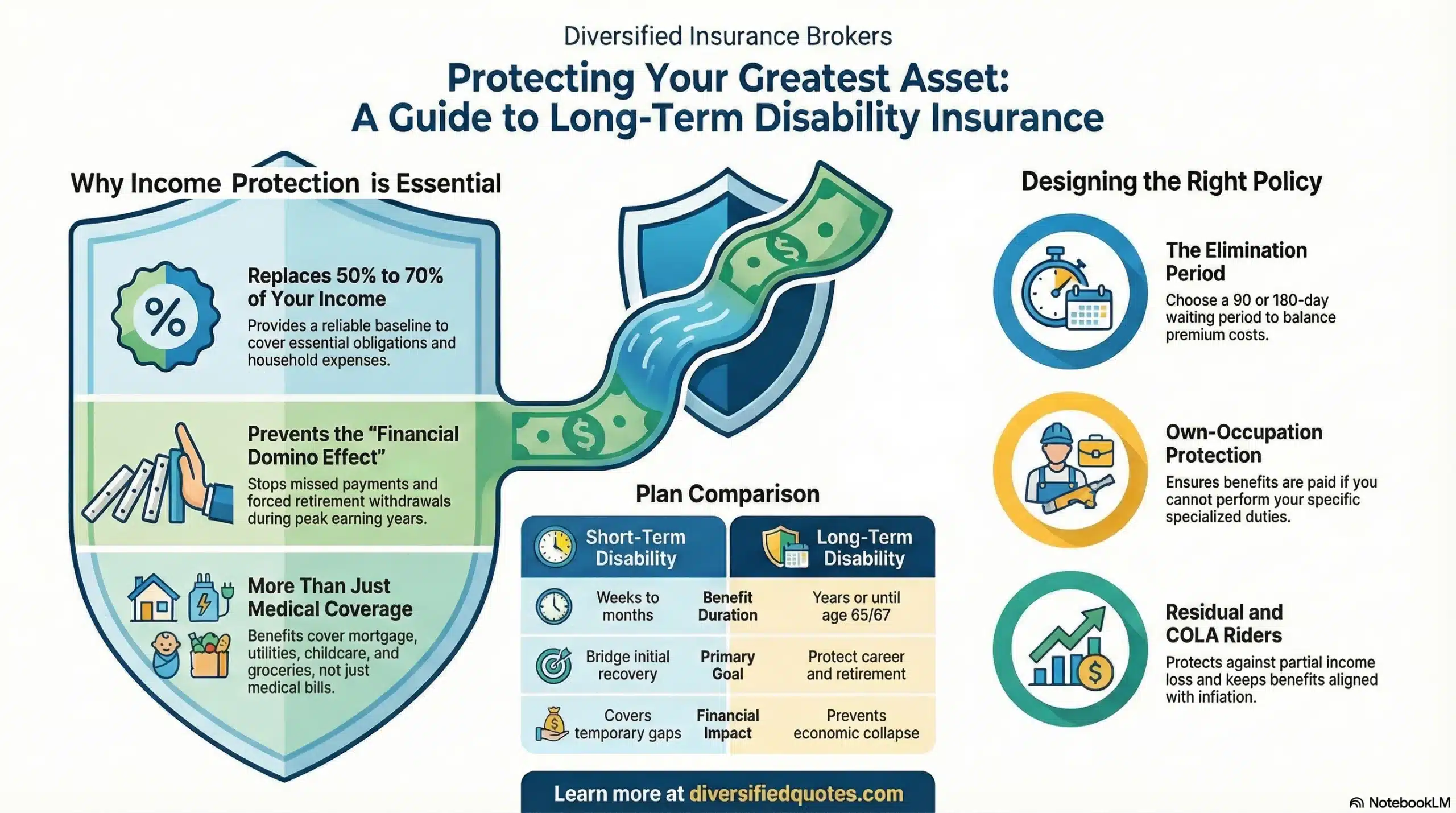
Talk With an Advisor Today
Choose how you’d like to connect—call or message us, then book a time that works for you.
Schedule here:
calendly.com/jason-dibcompanies/diversified-quotes
Licensed in all 50 states • Fiduciary, family-owned since 1980
FAQs: Disability Insurance for Big Game Hunting Guides
What occupational class do big game guides receive and what does it mean for coverage?
Big game hunting guides and outfitters typically receive lower-middle to middle occupational class assignments from most disability insurance carriers — a classification reflecting the documented physical demands, animal encounter risk, remote terrain fall exposure, heavy packing and field dressing labor, and extreme weather exposure of the guiding profession. This classification produces higher premiums per dollar of monthly benefit and lower maximum benefit ceilings than top-tier sedentary occupations, but does not prevent guides from obtaining meaningful, comprehensive individual disability protection.
Occupational class assignments for big game guiding vary between carriers — some carriers distinguish between licensed professional outfitters with structured operations and casual or seasonal guides, and the classification difference translates directly into premium differences for identical coverage terms. A residual disability benefit provision is particularly important for big game guides, because the realistic disability scenarios in the profession — a back injury that limits the ability to ride horses and manage heavy packs but does not completely eliminate all guiding capacity, or a leg fracture that prevents terrain-specific hunts but permits some lodge-based operations — frequently produce partial rather than total disability. A residual benefit pays a proportional benefit based on actual income loss from partial disability, addressing these common realistic scenarios directly rather than only the total disability endpoint.
Are disability insurance benefits taxable for a self-employed outfitter?
For self-employed licensed outfitters and independent big game guides who purchase individual disability insurance and pay premiums with after-tax personal income, monthly benefits received during a qualifying disability are generally received income-tax-free. This means the full monthly benefit amount reaches the household without income tax reduction — making the coverage more financially effective than a gross benefit comparison suggests. Whether disability insurance payments are taxable is a meaningful planning input when determining how much monthly benefit is needed to replace real take-home guiding and booking income during a disability period, particularly for outfitters whose seasonal revenue pattern produces variable monthly income that should inform benefit sizing.
For employed big game guides whose outfitter employer pays disability insurance premiums through a group plan — where such coverage exists — the resulting disability benefits are typically taxable as ordinary income. Self-employed outfitters who deduct disability insurance premiums as a business expense should confirm the specific tax treatment with a tax professional, as the deduction may affect the taxability of benefits when a claim occurs. The seasonal revenue concentration of hunting operations — significant income during active seasons, lower income during off-season preparation — makes careful benefit sizing and tax planning particularly important for outfitters evaluating their actual household income replacement needs during a disability period that might span multiple seasons.
I was injured by an animal while guiding — does disability insurance cover that?
Yes — individual disability insurance covers disability arising from animal encounter injuries, including injuries from the large game animals, bears, and stock animals that big game guides routinely work alongside, as long as the resulting condition meets the policy’s definition of disability and no specific exclusion applies to the cause. The policy does not require the injury to have occurred in a specific location, to have been witnessed, or to be documented with the specificity that workers’ compensation claims require. A guide who is mauled by a grizzly bear during a client hunt, kicked by a pack mule during loading operations, or injured by a charging wounded elk during field dressing qualifies for disability benefits under an own-occupation policy when the resulting condition prevents them from performing the material duties of big game guiding.
The contrast with workers’ compensation is significant for self-employed outfitters and guides who have not elected workers’ comp coverage for themselves: a guide injured by an animal during a self-contracted or self-operated hunt receives zero workers’ comp benefit — no matter how severe the injury — while their individual disability insurance policy activates based solely on whether the injury produces a qualifying disability. The remote location of most big game guiding work adds another dimension: documentation of the specific incident that workers’ comp claims require is often impossible to establish with legal certainty when the only witnesses were the guide and the client, but individual disability insurance bases claim eligibility on the disability itself rather than on a documented workplace incident. High-risk disability insurance options address guides with prior injury histories that affect underwriting outcomes.
I own my outfitting operation — do I need both personal disability income and business overhead coverage?
For a licensed outfitter who owns their operation, disability creates a two-layer financial crisis that personal income replacement alone cannot fully address. The personal layer is the loss of your earned income from guiding, booking, and outfitting revenue. The business layer is the continuation of fixed operating costs — livestock care (horses and mules require care regardless of whether you are guiding), vehicle and trailer payments, grazing permit fees, public lands outfitting permit fees, equipment maintenance, professional licensing fees, and any employee or contractor wages — that continue whether you are guiding or recovering from an injury. A personal disability income policy addresses the first layer. Business overhead expense disability insurance addresses the second.
The outfitting operation dimension makes BOE coverage especially important for big game outfitters because the business assets at risk — grazing permits, Guide Use Area allocations in Alaska, years-established client relationships, trained livestock, and specialized equipment — cannot easily be rebuilt if the operation is forced to wind down during an extended owner disability. An outfitter who holds a prime permitted area and has clients booked years in advance has built something of lasting value; maintaining that infrastructure during a disability period through BOE coverage preserves the ability to resume operations after recovery rather than permanently losing the business. The appropriate BOE benefit amount is determined by analyzing the actual fixed monthly operating costs of the specific outfitting operation — a number that varies enormously between a small two-horse pack trip operation and a full commercial elk outfitter with multiple employees and permit areas.
I’m an independent guide who contracts with different outfitters — am I covered for injuries on those operations?
Not automatically — and this is one of the most important coverage gaps for independent contract guides in the big game guiding profession. When working as an independent contractor for another outfitter’s operation, your coverage status depends on how the employment relationship is structured. Many outfitters hire guides as seasonal contractors rather than as employees — which typically means you are outside the outfitter’s workers’ comp coverage as a contractor rather than an employee. Unless the outfitter has specifically arranged workers’ comp coverage that extends to contracted guides, or you have independently elected your own coverage, you carry no workers’ comp protection for injuries during those contracted guiding assignments.
Individual disability insurance fills this gap because it applies to you personally regardless of whose operation you are guiding for, what employment structure exists on any specific contract, or whether the outfitter you are working for carries workers’ comp that covers contractors. A guide who is injured on a contracted big game hunt — whether working for their own operation, for a large commercial outfitter, or for any arrangement in between — qualifies for disability benefits under their individual policy based on whether the resulting condition meets the disability definition. For guides who work across multiple outfitters throughout the season, who move between employed and contracted status from year to year, or who also run some independent client hunts alongside contracted work, individual disability insurance is the only protection structure that provides consistent coverage across the full range of working arrangements the career actually involves.
My disability insurance quote seemed expensive for a big game guide — what should I do?
A single disability insurance quote from a single carrier tells you one carrier’s price for one occupational class assignment — not what the full market offers. For a hazardous outdoor occupation like big game guiding, premium differences between carriers for the same benefit terms can be meaningful because carriers vary in how they classify the specific guiding role. Some carriers distinguish between different types of guiding work — a licensed professional outfitter with a structured operation and licensed area may receive a different classification than a seasonal assistant guide — and that classification difference translates directly into premium differences for identical coverage terms. A carrier that takes a more favorable view of the professional and supervisory components of a licensed outfitter’s role produces lower premiums than one that focuses primarily on the physical hazard elements.
Beyond pricing, the policy terms most worth comparing are the disability definition — own-occupation versus modified or any-occupation — the residual benefit provision, the available benefit period options, and the elimination period flexibility. A policy with an any-occupation definition requires near-total incapacity to pay benefits, which for a big game guide could mean denying a claim from a guide whose back injury prevents riding and heavy packing but who could theoretically work in a non-physical role. An own-occupation definition pays based on the inability to perform the specific guiding duties, which is a genuinely different and more protective standard. A second opinion on your disability insurance quote through an independent broker who accesses the full market costs nothing and regularly reveals more competitive pricing, better policy terms, or both. For guides who found the first quote too expensive to act on, genuine market comparison before declining coverage is always the right response — the cost of an uninsured disability in this profession always exceeds any premium savings from going without coverage.
About the Author:
Jason Stolz, CLTC, CRPC, DIA, CAA and Chief Underwriter at Diversified Insurance Brokers (NPN 20471358), is a senior insurance and retirement professional with more than 25 years of real-world experience helping individuals, families, and business owners protect their income, assets, and long-term financial stability. As a long-time partner of the nationally licensed independent agency Diversified Insurance Brokers, Jason provides trusted guidance across multiple specialties—including fixed and indexed annuities, long-term care planning, personal and business disability insurance, life insurance solutions, Group Health, Travel Medical and Evacuation Insurance, and short-term health coverage. Diversified Insurance Brokers maintains active contracts with over 100 highly rated insurance carriers, ensuring clients have access to a broad and competitive marketplace.
His practical, education-first approach has earned recognition in publications such as VoyageATL, and contributions from his agency featured in Kiplinger and GoBankingRates— highlighting his commitment to financial clarity and client-focused planning. Drawing on deep product knowledge and years of hands-on field experience, Jason helps clients evaluate carriers, compare strategies, and build retirement and protection plans that are both secure and cost-efficient. Visitors who want to explore current annuity rates and compare options across multiple insurers can also use this annuity quote and comparison tool.
Explore More Disability Insurance Options: Browse our complete guide to Disability Insurance for Agriculture, Natural Resources & Outdoor Industries — covering farmers, ranchers, fishermen, foresters, miners, oil & gas workers & outdoor industries from 100+ carriers.
Last Reviewed: June 7, 2026 |
Reviewed by: Jason Stolz, CLTC, CRPC, DIA, CAA
Chief Underwriter, Diversified Insurance Brokers, Inc. | NPN: 20471358 | Diversified Insurance Brokers, Inc. — Licensed in all 50 states
Fact Checked by: Tonia Pettitt, CMIP©
Medicare Specialist, Diversified Insurance Brokers, Inc. | NPN: 14374308 | Diversified Insurance Brokers, Inc. — Licensed in all 50 states
Did you find this content helpful? Leave us a Google review — it helps others find trustworthy guidance too.
Editorial Standards: Diversified Insurance Brokers maintains rigorous editorial standards to ensure accuracy, clarity, and independence in all content. Learn more about our editorial standards and commitment to transparency.
