
What Makes Fixed Indexed Annuities So Popular with Pre-Retirees?
As an Independent Annuity Broker, we compare rates across 100+ carriers and 1,000 different annuities— not just one company’s product offerings — to find the best fit for your goals.
What Makes Fixed Indexed Annuities So Popular with Pre-Retirees?
Planning for retirement can feel like walking a financial tightrope. On one side is growth — the need for your money to work hard enough to outpace inflation and generate long-term income. On the other side is safety — the need to protect what you have built from market downturns that can derail years of disciplined saving in a matter of months. For Americans in their 40s, 50s, and 60s, that balancing act becomes even more critical. There is less time to recover from volatility, fewer peak earning years ahead, and a growing awareness that retirement income must last 20, 30, or even 40 years. This is exactly why fixed indexed annuities (FIAs) have become one of the most widely discussed retirement tools in today’s market. They offer a powerful middle ground: protection from market losses combined with the opportunity to earn interest linked to the performance of an external index such as the S&P 500. Unlike directly investing in the market, your principal is not exposed to downside risk. When structured properly, a fixed indexed annuity can become a cornerstone of a conservative, income-focused retirement plan designed to create stability without giving up all growth potential.

Ensure you are receiving the absolute top rates
Current Fixed Annuity Rates
Compare today’s best fixed annuity rates from top carriers.
Current Bonus Annuity Rates
See which annuities offer the highest upfront bonus today.
Request an Annuity Quote
Submit our annuity request form to get personalized rate options.
Lifetime Income Calculator
Use our calculator to see how much guaranteed income your annuity can provide.
FIA vs. Other Retirement Vehicles — Why Pre-Retirees Are Making the Switch
| Feature | Fixed Indexed Annuity | MYGA / Fixed Annuity | Variable Annuity / Brokerage | Target-Date Fund |
|---|---|---|---|---|
| Principal Protection | Full — 0% floor prevents index-related losses. Account value cannot decline due to market performance regardless of index severity. Previously credited gains are locked in annually. | Full — declared rate and principal guaranteed for the full term. No market exposure of any kind. Simplest principal protection structure available. | None — subaccounts are directly invested in equities and bonds. A 30%–40% drawdown in a severe bear market is fully realized in the account value with no floor. | None — target-date funds hold equities and bonds proportionate to the target date. A 2008-style event near the target date can cause 25%–40% losses at exactly the wrong time. |
| Growth Mechanism | Index-linked — interest credited based on index performance subject to cap, participation rate, or spread. Captures a portion of positive index returns; credits zero in negative years. | Declared fixed rate — known on day one, locked for the full term. No index-linked upside, but maximum certainty and simplicity of growth calculation. | Full market participation — unrestricted upside in bull markets. The highest long-term growth potential of the four, with the highest short-term loss risk. | Market-linked with glide path — equity allocation declines as target date approaches. Designed for accumulation; the income conversion mechanism is separate and typically involves systematic withdrawal, not guaranteed income. |
| Sequence-of-Returns Risk | Eliminated for this allocation — 0% floor ensures no negative credit years. With a GLWB income rider, the guaranteed income continues regardless of account value performance. No forced selling at depressed values. | Eliminated — no market exposure means no sequence risk for the MYGA allocation. Declared rate produces consistent, predictable growth through any market environment. | Full exposure — the most dangerous vehicle for retirees taking withdrawals during downturns. Early losses combined with systematic withdrawals create compounding depletion that markets cannot fully repair. | Partial exposure — the glide path reduces equity risk near the target date, but does not eliminate it. A severe bear market 1–3 years before the target date still creates meaningful sequence risk. |
| Guaranteed Lifetime Income | Available via optional GLWB income rider — income base grows at guaranteed roll-up rate during deferral, then pays a defined percentage for life regardless of account value. Income cannot be outlived. | Available via annuitization — converts accumulated value to lifetime income payments. Less commonly used as income vehicle than FIAs; typically used for guaranteed accumulation before income begins. | No guaranteed lifetime income available — income is a function of account balance and withdrawal rate. When the balance reaches zero, income stops regardless of life expectancy. Longevity risk fully on the owner. | No guaranteed lifetime income — systematic withdrawal assumed at target date. The fund does not guarantee income will last for any specific period. Longevity risk fully on the investor. |
| Annual Fees | No annual fee on the base contract. Optional GLWB income rider fee 0.75%–1.25% annually if elected. No hidden advisory fees or variable expense ratios. | No annual fee — the carrier’s cost structure is built into the spread between investment yield and declared rate. The simplest cost structure of all annuity types. | M&E fees (mortality and expense), subaccount management fees, and potentially administrative charges — total annual costs of 1.5%–3.5%+ in many variable annuity products. | Low expense ratios — typically 0.10%–0.15% for index-based target-date funds. No annuity-style fees, but no principal protection, guaranteed income, or annuity tax deferral advantages. |
How FIAs Work — The Core Mechanics Pre-Retirees Need to Understand
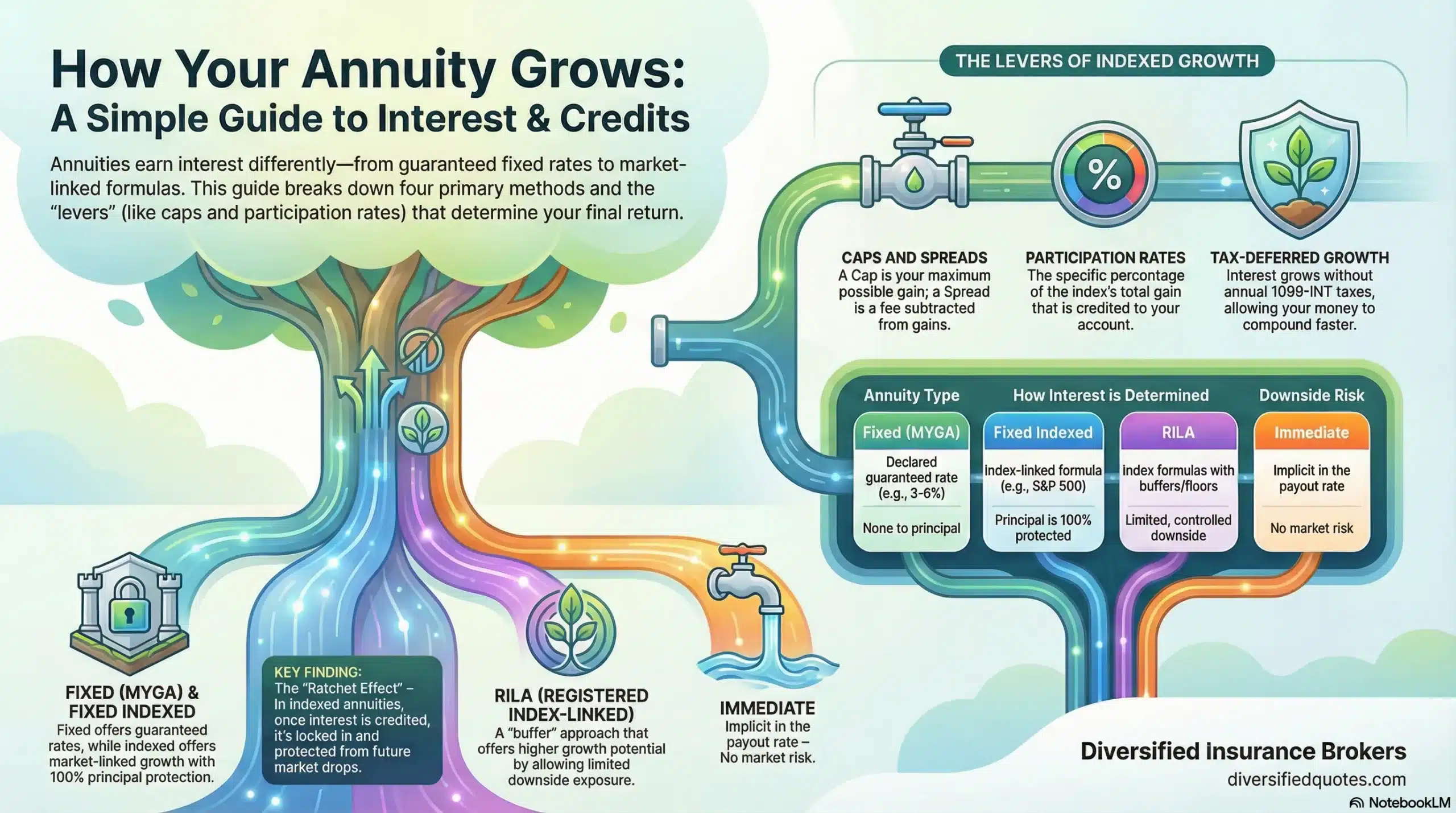
To fully understand why so many pre-retirees are exploring FIAs, it helps to examine the mechanics in detail. Fixed indexed annuities are insurance contracts designed to provide principal protection. Your money earns interest based on a crediting formula tied to an index, but you are not directly invested in that index. Instead, the insurance company uses a methodology — including participation rates, caps, or spreads — to determine how much of the index’s gain is credited to your contract. In exchange for this structure, you receive something many retirees value deeply: a floor of zero. In a negative market year, your account does not decline due to index performance. You simply receive no interest for that period, but your previously credited gains remain locked in. This ability to lock in gains and avoid losses can dramatically change the mathematical trajectory of retirement planning. Our complete resource on how a fixed indexed annuity works covers the full crediting mechanics, contract structure, and what distinguishes FIAs from direct market participation.
Sequence-of-Returns Risk — The Hidden Threat FIAs Directly Address
For individuals approaching retirement, sequence-of-returns risk is one of the greatest hidden dangers. If you experience major market losses early in retirement while simultaneously taking withdrawals, your portfolio may struggle to recover even if markets rebound strongly later. Fixed indexed annuities help address this issue by carving out a portion of assets into a protected growth vehicle. Instead of relying solely on market performance to generate income, you can incorporate guaranteed lifetime income riders that convert accumulated value into a predictable paycheck you cannot outlive. This is one reason many visitors first explore tools like our current annuity rates page — to see how today’s environment supports income-focused strategies. Interest rate conditions, carrier competition, and product innovation all influence what is available at any given time, and having access to updated information matters. For a deeper dive into how the 0% floor protects against specific market events, our resource on how FIAs protect against market downturns covers historical scenarios where the protection mechanism delivered the most meaningful benefit relative to market-exposed alternatives.
Cost Transparency, Liquidity, and Legacy Features
Another common concern among pre-retirees is cost. Many people assume annuities are universally expensive. The truth is more nuanced. Many fixed annuities and fixed indexed annuities have no annual management fee unless you elect an optional income rider. Even then, rider costs are clearly defined and built into the contract — there are no hidden advisory fees or fluctuating expense ratios. Transparency is critical, and part of our role is helping clients understand the difference between a product with unnecessary add-ons and one structured efficiently for their objectives. If you are evaluating broader questions about whether annuities make sense at all, reviewing whether annuities are worth it frames how they fit within different retirement scenarios, and whether annuities are a good investment compares them to portfolio-based alternatives with genuine objectivity.
Beyond growth and protection, flexibility matters. Many contracts include free withdrawal provisions — often allowing 10% annual penalty-free access after the first year. Understanding annuity free withdrawal rules clarifies how access works during surrender periods and what health-related waivers are available if care needs arise. Beneficiaries are typically named to receive remaining contract value at death, avoiding probate in many cases. If legacy planning is important, understanding how annuity beneficiary death benefits function within different policy structures ensures the contract’s legacy provisions align with the estate plan. Common misconceptions about these features — and many others — are addressed comprehensively in our resource on fixed indexed annuity myths debunked.
Income Riders — The Feature That Turns an FIA Into a Personal Pension
Income riders are a major reason fixed indexed annuities attract attention for retirement income planning. These optional features create a separate “income base” that grows at a guaranteed roll-up rate for a defined period, regardless of actual index performance. When you decide to activate lifetime income, payouts are based on that income base and age-based withdrawal percentages. For married couples, joint lifetime options ensure payments continue as long as either spouse lives. This can significantly reduce longevity risk — the risk of outliving your assets. Some modern contracts even include chronic illness provisions or enhanced payout features if certain health conditions occur, adding another layer of financial resilience. For buyers evaluating which specific products deliver the strongest income outcomes, our resource on the best FIAs with lifetime income riders covers the leading products and their income mechanics side by side.
At Diversified Insurance Brokers, we review dozens of contracts across multiple carriers to identify competitive caps, participation rates, spreads, and rider structures. Not all FIAs are built the same. Small differences in contract design can produce substantial differences in long-term income. Ultimately, retirement planning is not about chasing the highest possible return — it is about creating reliable income, preserving principal, and maintaining peace of mind. Fixed indexed annuities are not speculative vehicles; they are insurance-based solutions built to transfer certain risks away from you and onto the issuing carrier. Whether you are five years from retirement or already drawing income, understanding how principal protection, indexed growth, and guaranteed lifetime income work together can empower smarter decisions.
Ready to see how an FIA could fit your specific retirement timeline?
Request Your Personalized FIA Comparison
Financial Protection Essentials
Explore annuity interest examples across different investment sizes along with professional disability insurance options and long-term care planning resources.
Talk With an Advisor Today
Choose how you’d like to connect—call or message us, then book a time that works for you.
Schedule here:
calendly.com/jason-dibcompanies/diversified-quotes
Licensed in all 50 states • Fiduciary, family-owned since 1980
What is the realistic upside potential of a fixed indexed annuity compared to the stock market?
The FIA’s index-linked crediting captures a portion — not all — of positive index returns, with the trade-off being that it captures none of the negative returns. In a year when the S&P 500 returns 18%, an FIA with a 9% annual cap credits 9%. In a year when the S&P 500 falls 22%, the FIA credits 0%. Over a full market cycle including strong bull years and sharp bear years, the effective yield of a well-designed FIA often falls in the range of 4% to 6% annually — meaningfully below the stock market’s long-term historical average of approximately 10% per year (including dividends), but achieved without any of the downside years. The comparison that matters most for pre-retirees: in a market sequence that includes a significant bear market in the early retirement years, the FIA’s 0% floor can produce better cumulative real-world outcomes than a direct equity allocation that temporarily declined 30% to 40% while withdrawals were still being taken. Understanding how FIA crediting methods work — cap rates versus participation rates versus spreads, and how each affects credited returns in different index environments — is essential before selecting a specific product’s crediting strategy. The FIA is not competing with long-horizon equity investing on a pure growth basis. It is competing with the alternative of holding market-exposed assets that carry sequence-of-returns risk during the distribution phase of retirement.
At what age does it make most sense to start an FIA?
There is no single universally correct age to begin an FIA, but the decision is most commonly evaluated in the context of two different objectives: accumulation and income building. For accumulation-focused buyers using the FIA as a conservative portfolio allocation without an income rider, the relevant consideration is simply whether the surrender period aligns with the holding intention. A 55-year-old planning to retire at 65 can commit to a 10-year FIA surrender period with confidence, and the accumulation value at 65 is available for income conversion or portfolio diversification at that point. For income-focused buyers using the FIA’s GLWB income rider, the deferral period before income activation is the critical variable — and longer deferral typically produces higher lifetime income due to roll-up accumulation and higher payout percentages at older activation ages. A 58-year-old who defers income to age 68 captures 10 years of roll-up at the guaranteed rate, which combined with a higher payout percentage at 68 than at 60, can produce meaningfully more annual lifetime income than activating earlier. For buyers in their 40s and 50s, the long deferral horizon before retirement creates maximum roll-up benefit — the income base compounds for the longest period before the payout percentage is applied. The practical principle: the FIA’s income rider benefits from every additional year of deferral, while the accumulation value benefits from every year the 0% floor prevents market losses from reducing the base. Both effects are maximized by starting earlier rather than later, subject to surrender period alignment with actual cash flow needs.
How are FIA income rider fees structured and when do they apply?
FIA income rider fees are typically assessed annually as a percentage of either the income base or the account value, depending on the specific carrier and contract design. The most common range is 0.75% to 1.25% per year. These fees are charged regardless of whether income has been activated — meaning the fee reduces the account value even during the deferral phase when the rider is building the income base but not yet paying income. The practical implication of the rider fee during deferral: in years when the index credits 0%, the rider fee creates a small actual decline in the account value. If the index credits 4% and the rider fee is 1%, the net account value growth is approximately 3%. The income base, however, typically grows at its guaranteed roll-up rate regardless of index performance and without the fee deduction — the fee applies to the account value, not the income base growth. This distinction matters: buyers selecting an FIA primarily for GLWB income should evaluate the income base growth and projected lifetime income — not just the account value growth after the fee deduction — as the relevant performance metric. Buyers selecting an FIA primarily for accumulation (no income rider) face no annual fee and should optimize on cap rates, participation rates, carrier strength, and surrender period alignment rather than income mechanics. Our resource on the best FIAs with lifetime income riders covers specific products and their rider fee structures alongside the income projections they produce.
Can cap rates and participation rates change after I purchase an FIA?
Yes — this is one of the most important FIA contract terms to understand before purchase, and it is often underemphasized in marketing materials. Most FIA contracts specify an initial cap rate or participation rate that applies for the first contract term (often one year), with the carrier reserving the right to adjust these rates at renewal within limits defined by contract minimums. The minimum guaranteed cap rate — the lowest the carrier can ever set the annual point-to-point cap — is typically specified in the contract document. This minimum is the floor for crediting rate changes, not the current rate. If interest rates fall significantly or the options market becomes more expensive, the carrier may reduce the cap rate at renewal — potentially to as low as the contractual minimum. This rate adjustment risk is the most significant ongoing uncertainty in FIA contract design and is why reviewing both the current cap or participation rate AND the minimum guaranteed rate provides a more complete picture of the contract’s realistic long-term crediting potential. Understanding how FIA crediting methods work — and specifically how carriers set and adjust rates — is essential due diligence before selecting a crediting strategy. For contracts with lower initial cap rates but higher minimum caps, the long-term crediting consistency may be more favorable than a contract with a higher initial cap that could decline significantly at renewal. Asking specifically about minimum guaranteed rates and historical rate adjustment patterns for specific carriers adds important context to any FIA comparison.
How does an FIA fit alongside a 401(k) and Social Security in a retirement income plan?
An FIA integrates most effectively as the guaranteed income layer in a retirement income architecture that also includes Social Security and, where available, 401(k) or IRA assets. The income architecture most financial planners recommend separates retirement assets by function: guaranteed income covering essential expenses, and growth assets funding discretionary spending and legacy. Social Security provides one layer of guaranteed income, typically covering a portion of essential expenses depending on the benefit amount. An FIA with a GLWB income rider provides a second guaranteed income layer that — when added to Social Security — covers essential expenses completely, eliminating the need to withdraw from the 401(k) or IRA for basic living costs. This structure is particularly powerful because it removes the 401(k)/IRA portfolio’s obligation to fund essential expenses, allowing those assets to remain invested for growth through market cycles without forced selling during downturns. The sequence-of-returns risk that damages 401(k) portfolios during withdrawal years is largely neutralized when Social Security and FIA income together cover essential needs — because the 401(k) only needs to fund discretionary spending, which can be reduced during downturns without creating a financial crisis. For pre-retirees evaluating this structure, the FIA’s role is not to replace the 401(k) — it is to complement it by providing the guaranteed income floor that removes the 401(k)’s exposure to the most dangerous retirement risk: being forced to sell at the bottom to fund non-negotiable monthly expenses. How FIAs protect against market downturns explains this complementary role in the context of specific historical market events.
About the Author:
Jason Stolz, CLTC, CRPC, DIA, CAA and Chief Underwriter at Diversified Insurance Brokers (NPN 20471358), is a senior insurance and retirement professional with more than 25 years of real-world experience helping individuals, families, and business owners protect their income, assets, and long-term financial stability. As a long-time partner of the nationally licensed independent agency Diversified Insurance Brokers, Jason provides trusted guidance across multiple specialties—including fixed and indexed annuities, long-term care planning, personal and business disability insurance, life insurance solutions, Group Health, Travel Medical and Evacuation Insurance, and short-term health coverage. Diversified Insurance Brokers maintains active contracts with over 100 highly rated insurance carriers, ensuring clients have access to a broad and competitive marketplace.
His practical, education-first approach has earned recognition in publications such as VoyageATL, and contributions from his agency featured in Kiplinger and GoBankingRates— highlighting his commitment to financial clarity and client-focused planning. Drawing on deep product knowledge and years of hands-on field experience, Jason helps clients evaluate carriers, compare strategies, and build retirement and protection plans that are both secure and cost-efficient. Visitors who want to explore current annuity rates and compare options across multiple insurers can also use this annuity quote and comparison tool.
Explore More Annuity Options: Browse our complete guide to What Is a Fixed Indexed Annuity? — covering FIA education, mechanics, crediting methods & indexed annuity strategies from 100+ carriers.
Last Reviewed: June 25, 2026 |
Reviewed by: Jason Stolz, CLTC, CRPC, DIA, CAA
Chief Underwriter, Diversified Insurance Brokers, Inc. | NPN: 20471358 | Diversified Insurance Brokers, Inc. — Licensed in all 50 states
Fact Checked by: Tonia Pettitt, CMIP©
Medicare Specialist, Diversified Insurance Brokers, Inc. | NPN: 14374308 | Diversified Insurance Brokers, Inc. — Licensed in all 50 states
Did you find this content helpful? Leave us a Google review — it helps others find trustworthy guidance too.
Editorial Standards: Diversified Insurance Brokers maintains rigorous editorial standards to ensure accuracy, clarity, and independence in all content. Learn more about our editorial standards and commitment to transparency.
