
Life Insurance for High Income Earners
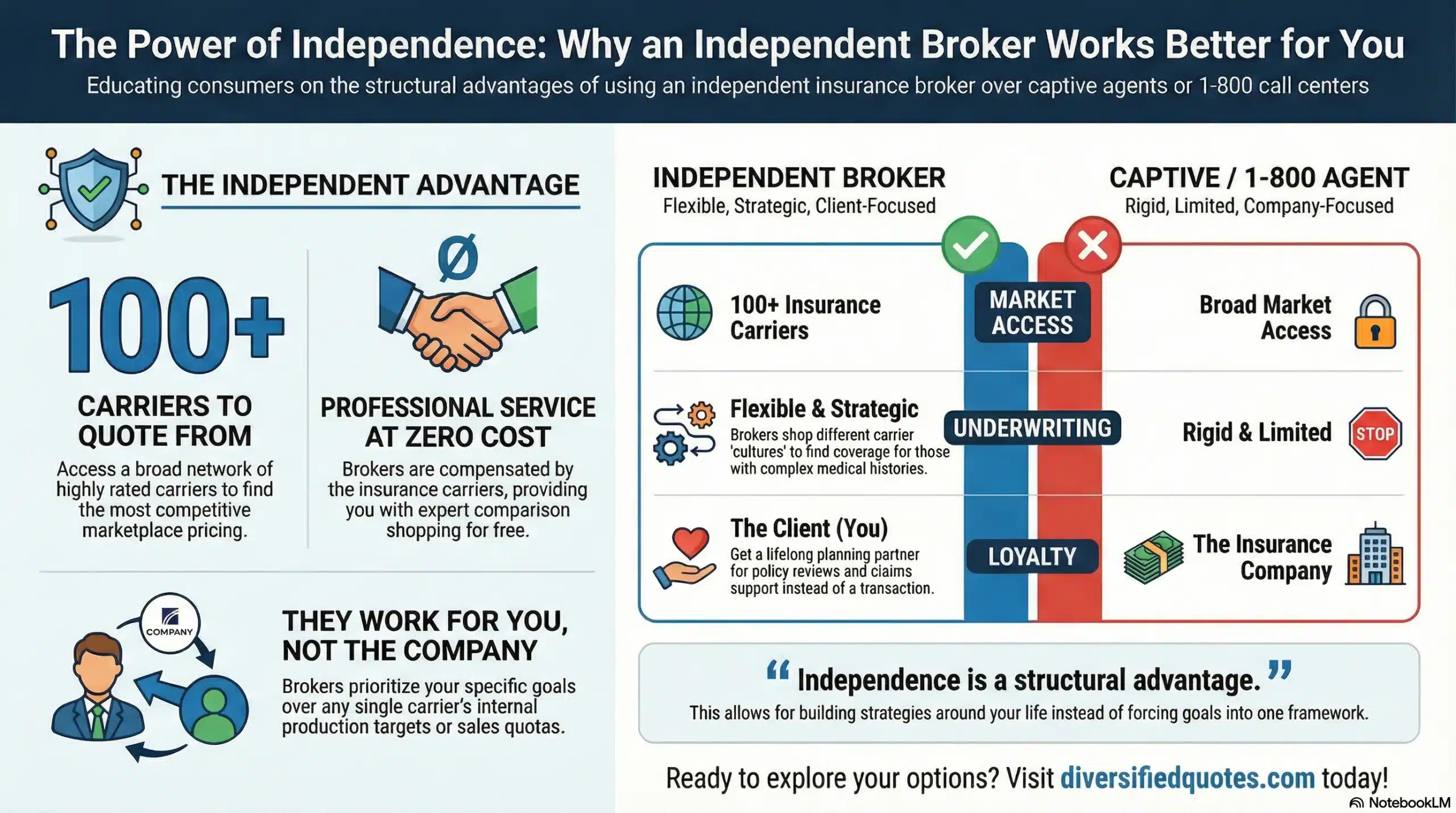
As an Independent Life Insurance Broker, we compare rates across 100+ carriers and prescreen every application before submission.
Life Insurance for High Income Earners

Jason Stolz CLTC, CRPC, DIA, CAA
Life insurance for high income earners plays a fundamentally different role than it does for the average household. When income, assets, and long-term earning potential are significantly elevated, the stakes increase across every dimension of financial planning. You are not simply protecting a paycheck — you are protecting a lifestyle that depends on sustained high income, a long-term financial trajectory that compounds meaningfully over decades, an estate strategy that may involve complex ownership structures and tax considerations, and in many cases the financial legacy of multiple generations who will benefit from or be shaped by the planning decisions made today. At Diversified Insurance Brokers, Jason Stolz, CLTC, CRPC, DIA, CAA and Chief Underwriter, helps physicians, executives, business owners, and other high income professionals across all 50 states structure life insurance coverage that addresses this full spectrum of financial complexity — income protection, business continuity, estate liquidity, and tax-efficient wealth transfer — rather than defaulting to a simple multiple-of-income calculation that was never designed for the financial architecture of a high-income household.
For high income earners, the right life insurance strategy can replace a seven-figure income that a surviving spouse and dependents depend on, fund buy-sell agreements that allow a business to survive the loss of a key owner, preserve a spouse’s retirement income plan that was built around projections that assumed both incomes would continue, and create tax-efficient wealth transfer structures that move assets to the next generation without the estate tax exposure that large asset accumulations create. When structured incorrectly — or left as an afterthought while every other component of the financial plan receives more sophisticated attention — gaps can emerge that lead to unnecessary income taxes, estate tax exposure, liquidity crises at exactly the wrong moments, and missed opportunities to use life insurance as the flexible financial planning tool it can be at higher wealth levels. Understanding the life insurance strategies the wealthy use provides the foundational framework for thinking about coverage not as a simple protection product but as a strategic financial planning tool that addresses risk, tax, and legacy simultaneously.
Design a Life Insurance Plan for High Income Earners
We help physicians, executives, and business owners structure coverage for income protection, estate planning, and tax-efficient wealth transfer.
Call 800-533-5969
Life Insurance Quoter for High Income Earners
Before implementing advanced strategies, establishing a baseline for coverage amounts and pricing provides a useful starting reference point. The quoter below allows you to model different benefit amounts and term lengths based on age and health profile — then we refine the strategy to align with the full complexity of a high-income financial picture.
See Real-Term Rates Side by Side
Life Insurance Quoter
Compare real-time life insurance quotes from top carriers. Model scenarios that protect income through retirement while layering in permanent coverage for estate and legacy goals.
Where Traditional Coverage Rules Break Down for High Income Earners
The most commonly used life insurance coverage benchmarks — 10 to 15 times annual income — were developed as accessible rules of thumb for households with straightforward income structures, limited asset complexity, and relatively predictable financial obligations. These benchmarks produce useful starting estimates for median-income households. At high income levels, they break down in several specific ways that make them insufficient as planning frameworks without significant modification.
The first limitation is that multiplying high income by 10 or 15 produces a coverage number that may be either more or less than what is actually needed — but usually without any relationship to the specific financial obligations and goals the coverage is meant to address. A physician earning $600,000 annually who applies the 10x rule arrives at $6 million in coverage, but that number reflects nothing about the physician’s outstanding medical school debt, the practice buy-sell obligation that requires a separate funding mechanism, the specific retirement income target that a surviving spouse’s financial plan depends on, or the estate tax exposure that a large life insurance benefit itself could create if owned and structured incorrectly. Each of these is a distinct financial obligation requiring distinct coverage design — not a single coverage amount derived from a salary multiple.
The second limitation is that high income earners frequently have income structures that a simple salary multiple cannot adequately capture. Base salary may be only one component of a total compensation picture that includes partnership distributions, carried interest, equity compensation subject to vesting schedules, deferred compensation arrangements that pay out over years after the income is earned, and business ownership interest whose value is independent of the salary line. A compensation package valued at $800,000 per year might generate cash income of $350,000 in the current year, with the remainder tied up in structures that vesting events, buyouts, or future distributions would eventually realize — but that a surviving spouse could not access immediately if the primary earner died. The coverage calculation for a household with this income structure must address the immediate cash income replacement need separately from the deferred asset access question, and the answers to each may require different coverage structures.
The third limitation is that high income earners typically have significant financial obligations that extend well beyond income replacement — business continuity obligations, estate tax exposure, irrevocable trust funding needs, and generational wealth transfer goals that require specific coverage types and structures that income-multiple calculations do not address. Understanding these dimensions separately, and then designing coverage that addresses each one specifically, produces a coverage strategy that is actually aligned with the financial reality rather than an approximation derived from a salary multiple.
The Coverage Needs Framework for High Income Earners
| Coverage Category | What It Addresses | Typical Policy Structure | Key Planning Considerations |
|---|---|---|---|
| Income Replacement | Sustains household lifestyle, ongoing expenses, education funding, and surviving spouse’s retirement plan without the primary earner’s income | Large-face term or guaranteed universal life covering working years; spouse retirement funding often drives coverage need past traditional income replacement horizon | Include deferred compensation timing; model surviving spouse’s retirement income gap explicitly; account for lifestyle cost at current income level rather than modest replacement |
| Business Continuity | Funds buy-sell agreements, replaces key person contributions, provides liquidity to sustain business operations during ownership transition | Business-owned key person or cross-purchase buy-sell policy; coverage amount tied to agreed business valuation formula in buy-sell agreement | Must be funded to match current business valuation; valuation method in buy-sell agreement determines coverage amount; should be reviewed when valuation changes materially |
| Estate Liquidity | Provides liquidity to pay estate taxes without forced sale of illiquid assets including business interests, real estate, or concentrated investment positions | Permanent life insurance owned by irrevocable life insurance trust (ILIT) to keep proceeds outside taxable estate; survivorship (second-to-die) policies commonly used | Proceeds must be outside the estate to avoid adding to taxable estate value; ILIT ownership is typically required; Crummey notices and trust administration required |
| Tax-Deferred Accumulation | Supplemental tax-deferred growth vehicle for high income earners who have maximized qualified retirement plan contributions | High-premium indexed universal life or whole life with maximum cash value accumulation design; often called LIRP (Life Insurance Retirement Plan) in financial planning context | Policy must be designed for accumulation, not just face amount; overfunded to below MEC limits; loan strategy for distribution should be planned at design stage |
| Disability Income Protection | Protects income during disability — the risk that terminates the income stream without creating the life insurance trigger; frequently the largest unaddressed risk for high earners | Individual own-occupation disability income policy; high earners often need supplemental disability coverage above group plan limits to reach meaningful income replacement | High income earners’ group disability coverage often covers only a fraction of actual income; individual policies with own-occupation definition are the gold standard for physicians and executives |
Income Replacement — Why High Earners Need More Than the Formula Suggests
For high income earners, income replacement life insurance must address not just the current income but the financial dependencies that current income supports across a longer and more complex time horizon than median-income households face. A physician at 45 with a partner who left a career to raise children may have a spouse whose retirement income plan was built entirely around the physician’s continued income through at least age 65 — meaning that the income replacement obligation extends 20 years and must fund both the household’s current expenses and the surviving spouse’s eventual retirement without the physician’s continued contributions. The present value of 20 years of $500,000 annual income replacement, discounted at a reasonable rate, produces a very different coverage target than the nominal $5 million the 10x formula suggests — and the difference matters enormously for the surviving spouse’s financial security.
High income earners frequently also have deferred compensation arrangements, equity compensation vesting schedules, and business interest values that would be realized over time but that a sudden death interrupts before realization. Coverage that addresses only current cash income may leave the surviving household without access to the economic value that was accumulating in these deferred structures — which for senior executives, partners, and founders can represent the majority of total economic compensation. Properly sizing income replacement coverage for high earners requires explicitly modeling each component of total economic compensation and assessing how much would be preserved and how much would be lost in the event of early death, then sizing the coverage to bridge the gap between what survives and what the household needs.
The coverage structure for income replacement at high income levels most commonly uses large-face fully underwritten term life insurance during the primary earning years — because term provides the highest death benefit per premium dollar for a defined period — potentially combined with guaranteed universal life for the portion of the income replacement need that extends to life expectancy regardless of when death occurs. Many high earners also combine income replacement coverage with a permanent policy that provides estate planning benefits simultaneously, reducing the total premium cost of maintaining separate policies for each purpose. The combination of protection for the duration of the obligation and the right structure for each component of the need produces more efficient coverage at lower total cost than a single large policy designed to serve every purpose simultaneously.
Business Continuity — The Coverage Most High-Earning Business Owners Are Missing
For physicians in private practice, executives with equity ownership stakes, and business owners in any industry, the business interest represents a significant component of total net worth that standard life insurance planning frequently fails to address specifically. The death of a key business owner creates multiple simultaneous financial crises: the surviving owners must fund the buyout of the deceased owner’s interest from the estate, the business must continue operating through the transition without the deceased owner’s contributions, and the estate must receive fair value for the business interest without a forced liquidation at distressed prices. Life insurance is the most cost-efficient mechanism for addressing all three of these simultaneously through properly structured buy-sell and key person coverage.
A funded buy-sell agreement — in which life insurance owned either by the surviving owners (cross-purchase structure) or by the business entity (entity redemption structure) provides the death benefit that funds the buyout — ensures that the surviving owners can purchase the deceased owner’s interest at the previously agreed valuation without depleting business operating capital or requiring external financing. The estate receives cash at the agreed price rather than illiquid business interest whose value in the open market might differ significantly from the agreed price, and the surviving owners retain full business control without the estate or heirs becoming unwanted business partners. Buy-sell life insurance covers the structures and considerations in detail. Key person insurance for business covers the separate but related protection that keeps the business financially stable through the transition period before a replacement can be identified and onboarded. For executives whose key person value is tied to specific relationships, technical expertise, or leadership capacity, key person life insurance for executives covers how that value is assessed and insured specifically.
Estate Liquidity — Using Life Insurance to Protect What You’ve Built
At high income levels with sustained accumulation, the estate tax becomes one of the most significant financial planning considerations available — and life insurance is one of the most flexible and cost-efficient tools for addressing estate tax liability without requiring the liquidation of assets that took decades to build. The federal estate and gift tax exemption protects substantial asset transfers without tax, but high earners and high accumulators whose total estate value exceeds the exemption face estate tax exposure that, when combined with state estate taxes in applicable jurisdictions, can represent a significant percentage of the estate’s total value paid to the government rather than transferred to beneficiaries.
Life insurance owned by an irrevocable life insurance trust (ILIT) — rather than directly by the insured — can provide the proceeds that pay estate taxes without the proceeds themselves being included in the taxable estate. When owned correctly by the trust rather than by the insured, the death benefit is not an estate asset and does not increase the taxable estate value. It is instead available to the trust to either purchase estate assets (providing the estate with liquidity to pay taxes without selling assets at distressed prices) or lend funds to the estate (providing similar liquidity with eventual repayment to the trust). Understanding what an irrevocable life insurance trust is and how it works is foundational to this planning approach. Understanding whether life insurance death benefits are taxable — and under what circumstances they can be included in the taxable estate — establishes why the ownership structure matters so significantly for high earners with estate tax exposure.
For married high earners, survivorship life insurance — also called second-to-die coverage, which pays the death benefit only when the second insured dies — is frequently the most cost-efficient structure for estate tax funding because the federal estate tax charitable and marital deductions typically defer estate tax liability until the second spouse’s death. A survivorship policy that pays at the second death aligns perfectly with the timing of the estate tax liability, and it is substantially less expensive than two separate individual policies providing equivalent coverage because the joint life expectancy of two people is longer than the individual expectancy of either. The premium efficiency of survivorship coverage for estate tax funding is one of the most compelling economic arguments for high-earning couples with taxable estates to consider this structure. Concierge-level planning that coordinates life insurance with estate planning, investment management, and tax strategy is covered through the Diversified Insurance Brokers concierge wealth services offering, and for high earners who meet the criteria, understanding what it means to be an accredited investor opens access to additional planning tools and investment structures that complement the insurance-based components.
Permanent Life Insurance as a Financial Planning Tool — Beyond Protection
For high income earners who have maximized contributions to qualified retirement plans — 401(k), 403(b), defined benefit pension, and profit-sharing — and are looking for additional tax-deferred accumulation vehicles, certain permanent life insurance structures offer a compelling combination of death benefit protection and cash value growth on a tax-deferred basis. The cash value of a permanent life insurance policy grows without current income tax as long as it remains inside the policy, and distributions can be taken through policy loans — which are not taxable events — rather than withdrawals, allowing the accumulated value to be accessed without triggering the income tax that would apply to equivalent distributions from a traditional retirement account.
This structure — often called a life insurance retirement plan (LIRP) in financial planning contexts — is not appropriate for all high earners and is not appropriate as a substitute for maximizing qualified plan contributions, which provide immediate above-the-line deduction benefits that the life insurance premium does not. It is, however, a legitimate supplemental accumulation vehicle for high earners who have maximized every qualified plan available to them and are looking for additional tax-efficient growth that is not subject to the same contribution limits, required minimum distributions, or income thresholds that affect traditional retirement accounts. The policy design must be structured specifically for cash value accumulation — funded at the maximum premium level below the modified endowment contract (MEC) threshold established by the IRS — rather than a default design that emphasizes face amount over accumulation efficiency.
Premium financing is another strategy used by some high earners with substantial asset bases to leverage existing assets to fund large permanent life insurance policies without liquidating those assets. The concept involves borrowing premium payments from a third-party lender, using the policy’s cash value and potentially other collateral to secure the loan, and continuing to accumulate returns on the assets that would otherwise have been liquidated to pay premiums. The structure introduces complexity and risk — interest rate variability, collateral requirements, and potential margin calls — that make it appropriate only for specific profiles and require careful coordination with legal and tax counsel. How premium financing works for estate planning covers this approach in detail for high earners evaluating whether it fits their specific situation.
Disability Income Protection — The Unaddressed Risk for Most High Earners
For high income earners, disability is statistically the most likely income-interrupting event during the working years — more probable than early death, and producing financial consequences that are often more severe because the high earner is still alive and needs to be financially supported while also being unable to generate the income that previously sustained the household’s financial plan. Despite this, most high earners have disability coverage that is inadequate relative to their actual income because group disability plans provided by employers typically cover only 60% of base salary up to monthly benefit maximums that are far below what a high income earner’s actual income would require for meaningful replacement.
An executive earning $500,000 in annual compensation whose employer provides a group disability plan with a $15,000 per month maximum benefit receives, in the event of a qualifying disability, annual disability income of $180,000 — replacing only 36% of actual income. The financial plan that was built around $500,000 of annual income cannot be sustained on $180,000, and the gap creates exactly the kind of financial disruption that comprehensive protection planning is designed to prevent. Individual own-occupation disability income policies — which define disability as the inability to perform the duties of the specific occupation rather than any occupation, which matters enormously for physicians and specialists whose training and licensure is specific — can supplement group coverage to reach meaningful replacement levels. Disability insurance for high earners and business owners covers the specific considerations for this population, including specialty own-occupation definitions, overhead expense coverage for business owners, and how disability coverage interacts with life insurance in the comprehensive protection plan.
Coordination with Retirement and Income Planning
At high income levels, life insurance is rarely a standalone solution — it is integrated with retirement income planning, annuity structures, investment strategy, and estate design in ways that make the total plan significantly more efficient than any individual component would be independently. The income protection that life insurance provides during the working years transitions into estate planning and wealth transfer at the later stages of life, with annuity income structures and investment portfolios sustaining the retirement income need that life insurance was protecting against during accumulation. Understanding how these pieces connect — and making sure each component is designed with the others in mind — prevents gaps in protection, inefficiencies in tax treatment, and conflicts between the objectives of different planning elements.
For high earners who are also modeling retirement income sustainability, the interaction between life insurance planning and retirement income planning is particularly relevant when the surviving spouse’s retirement income depends on assets that the primary earner’s continued income was expected to build. A retirement income model that assumes 20 more years of maximum contributions to a defined benefit plan, a 401(k), and supplemental investment accounts may produce a very different surviving spouse retirement picture than the same model with contributions stopping at the primary earner’s early death. Sequence of returns risk is a directly relevant concept for surviving spouses who may face poor early-retirement investment returns without additional life insurance proceeds to buffer the shortfall. Pension replacement strategies using guaranteed income vehicles complement the life insurance protection by providing a surviving spouse with a predictable income floor that is not subject to investment performance variability — addressing the longevity and sequence risk that life insurance proceeds alone do not resolve. For high earners who want to understand how the most affluent individuals structure multi-layered protection and growth strategies, why the top 1% use structured income solutions instead of bonds provides relevant context for the income planning component of the integrated strategy.
Build a Life Insurance Plan for High Income Earners
We’ll help you coordinate income protection, business planning, and legacy goals into one cohesive life insurance strategy.
Get a Custom Life Insurance Quote
Call 800-533-5969
Compare Term Life Insurance Lengths
Explore different term periods to find coverage that best matches your timeline and budget.
Talk With an Advisor Today
Choose how you’d like to connect—call or message us, then book a time that works for you.
Schedule here:
calendly.com/jason-dibcompanies/diversified-quotes
Licensed in all 50 states • Fiduciary, family-owned since 1980
Frequently Asked Questions: Life Insurance for High Income Earners
How much life insurance does a high income earner actually need?
The right coverage amount for a high income earner is not a salary multiple — it is the sum of specific financial obligations the coverage is meant to address. Income replacement requires modeling the full present value of income the surviving household depends on through the primary earner’s expected working life, including all components of total compensation (base salary, bonuses, equity, deferred income) and the surviving spouse’s retirement funding gap. Business continuity requires coverage sized to the agreed business valuation in the buy-sell agreement. Estate liquidity requires coverage sized to the projected estate tax liability, ideally owned by an irrevocable life insurance trust to keep proceeds outside the taxable estate. Each of these is a separate calculation producing a separate coverage amount — and the total is often significantly different from a simple 10x or 15x income multiple applied without reference to the specific obligations.
Should high income earners use term or permanent life insurance?
Most high income earners benefit from a coordinated combination of both rather than choosing one exclusively. Term life insurance addresses the high-magnitude, time-limited income replacement need during peak earning years at the lowest cost per dollar of death benefit — it is highly efficient for covering a specific financial obligation over a defined period. Permanent life insurance serves the planning functions that require lifetime coverage: estate liquidity through a trust structure, cash value accumulation as a supplemental tax-deferred vehicle after qualified plan maximization, and permanent buy-sell coverage for business interests where the obligation is not time-limited. The combination — a large term policy for income replacement layered with permanent coverage for estate and legacy functions — typically produces more total coverage at lower total cost than a single large permanent policy designed to serve every purpose simultaneously.
What is an irrevocable life insurance trust and why do high income earners use it?
An irrevocable life insurance trust (ILIT) is a trust structure that owns a life insurance policy on the insured rather than allowing the insured to own the policy directly. When the insured owns a life insurance policy at death, the death benefit is typically included in the taxable estate and subject to estate tax. When an ILIT owns the policy, the proceeds are received by the trust rather than the estate and are not subject to estate tax — preserving the full death benefit for beneficiaries rather than losing a portion to estate taxes. The ILIT also controls how and when the proceeds are distributed, which matters for beneficiary planning involving minors or structured distributions over time. High income earners with estates large enough to face estate tax exposure typically structure estate liquidity coverage through an ILIT specifically to prevent the coverage from compounding the estate tax problem it was purchased to solve.
What are the most common life insurance mistakes high income earners make?
The most common mistakes fall into five categories. First, relying on employer group life insurance as the primary coverage — group coverage is typically limited to one to two times salary, is not portable, and cannot be structured with the ownership and beneficiary arrangements that sophisticated planning requires. Second, using an arbitrary coverage amount rather than one calculated from specific financial obligations — high income creates the illusion that existing assets provide a meaningful buffer, but the obligations they were expected to fund often far exceed what survivors could access or sustain independently. Third, failing to coordinate life insurance ownership with estate planning — coverage owned by the wrong party can be included in the taxable estate and exacerbate the tax problem it was meant to solve. Fourth, neglecting disability income protection — disability is statistically more likely than early death during the working years and eliminates income without the life insurance trigger. Fifth, failing to fund buy-sell agreements with appropriate coverage tied to current business valuation.
How does life insurance integrate with a high income earner’s broader financial plan?
At high income levels, life insurance functions as one component of an integrated financial plan rather than as a standalone product. During the accumulation phase, term life insurance protects the income that is fueling investment growth, retirement contributions, and business equity accumulation — any of which would be interrupted by early death. Permanent life insurance may provide supplemental tax-deferred accumulation beyond qualified plan limits and can serve as a source of tax-efficient liquidity through policy loans. During the wealth transfer phase, properly structured permanent coverage — typically in an ILIT — provides estate liquidity and generational wealth transfer efficiency. Throughout both phases, disability insurance protects the income stream that makes all other planning possible. The life insurance strategy should be reviewed whenever a major financial change occurs: new business partnership, significant income increase, marriage, divorce, birth of children, substantial estate accumulation, or approaching retirement — because each changes the financial obligations the coverage is meant to address.
About the Author:
Jason Stolz, CLTC, CRPC, DIA, CAA and Chief Underwriter at Diversified Insurance Brokers (NPN 20471358), is a senior insurance and retirement professional with more than 25 years of real-world experience helping individuals, families, and business owners protect their income, assets, and long-term financial stability. As a long-time partner of the nationally licensed independent agency Diversified Insurance Brokers, Jason provides trusted guidance across multiple specialties—including fixed and indexed annuities, long-term care planning, personal and business disability insurance, life insurance solutions, Group Health, Travel Medical and Evacuation Insurance, and short-term health coverage. Diversified Insurance Brokers maintains active contracts with over 100 highly rated insurance carriers, ensuring clients have access to a broad and competitive marketplace.
His practical, education-first approach has earned recognition in publications such as VoyageATL, and contributions from his agency featured in Kiplinger and GoBankingRates— highlighting his commitment to financial clarity and client-focused planning. Drawing on deep product knowledge and years of hands-on field experience, Jason helps clients evaluate carriers, compare strategies, and build retirement and protection plans that are both secure and cost-efficient. Visitors who want to explore current annuity rates and compare options across multiple insurers can also use this annuity quote and comparison tool.
Explore More Life Insurance Options: Browse our complete guide to Life Insurance for Life Stage & Situational Needs — covering new parents, single parents, special needs children, and military service from 100+ carriers.
Last Reviewed: October 10, 2026 |
Reviewed by: Jason Stolz, CLTC, CRPC, DIA, CAA
Chief Underwriter, Diversified Insurance Brokers, Inc. | NPN: 20471358 | Diversified Insurance Brokers, Inc. — Licensed in all 50 states
Fact Checked by: Tonia Pettitt, CMIP©
Medicare Specialist, Diversified Insurance Brokers, Inc. | NPN: 14374308 | Diversified Insurance Brokers, Inc. — Licensed in all 50 states
Did you find this content helpful? Leave us a Google review — it helps others find trustworthy guidance too.
Editorial Standards: Diversified Insurance Brokers maintains rigorous editorial standards to ensure accuracy, clarity, and independence in all content. Learn more about our editorial standards and commitment to transparency.
