
Life Insurance for BASE jumping
As an Independent Life Insurance Broker, we compare rates across 100+ carriers and prescreen every application before submission.
Life Insurance for BASE jumping

Jason Stolz CLTC, CRPC, DIA, CAA
Life insurance for BASE jumping is one of the most technically demanding areas of high-risk underwriting — not because coverage is impossible, but because most standard carriers have no structured framework for evaluating it. BASE jumping involves fixed objects, extremely low deployment altitudes, and margins for error that are narrower than conventional skydiving in almost every dimension. That combination places the activity near the top of the recreational risk category used by most insurers, alongside cave diving, free solo climbing, and experimental aviation. The result is that most direct-to-consumer platforms and single-carrier agents encounter a BASE jumping disclosure and produce an automatic decline — not because the applicant is uninsurable, but because the system they are using was never built to evaluate the activity properly. At Diversified Insurance Brokers, we work across high-risk life insurance cases and know which carriers maintain underwriting guidelines that can accommodate BASE jumping on a case-by-case basis — and how to structure the application so that the strongest available outcome is reached the first time. The high-risk life insurance playbook covers the broader strategy for applicants whose lifestyle creates complexity — BASE jumping is among the most challenging in this category, but it is not categorically uninsurable.
Most BASE jumpers who seek coverage have straightforward goals: protect a family from lost income, cover a mortgage, fund children’s education, or maintain business stability if something unexpected happens. They are not asking for unusual terms — they are asking for the same outcome any life insurance buyer wants, from a market that is narrower and more technical than most applicants initially expect. The key is understanding that the underwriting process for an experienced, methodical BASE jumper looks nothing like the quick-click application environment that works for standard applicants, and that submitting to the wrong carrier without proper preparation produces declines that can complicate future applications and create a record with the Medical Information Bureau that follows the applicant across subsequent attempts. Starting with a strategy — not just an application — is the right approach for anyone in this category.
See Real-Term Rates Side by Side
Life Insurance Quoter
Life Insurance Review for BASE Jumpers
Work with an agency that understands extreme sports underwriting — not automatic denials.
Request a BASE Jumping Life Insurance ReviewBASE Jumping Life Insurance — Underwriting Factors, Outcome Types, and Application Strategy
No two BASE jumping cases produce identical outcomes. The underwriting result depends on a specific combination of factors that carriers evaluate individually. The table below maps those factors against their likely impact on the final offer.
| Underwriting Factor | How Carriers Evaluate It | Impact on Outcome |
|---|---|---|
| Jump frequency | Annual jumps are the primary exposure metric; carriers categorize participants by low (<10/year), moderate (10-50/year), and high (50+/year) frequency | Low-frequency jumpers with strong experience may see 50-100% above standard pricing; high-frequency jumpers (50+/year) can face 150-250% or more; some carriers draw hard lines at frequency thresholds |
| Years of experience and jump count | Total jumps completed and years active separate long-term disciplined participants from newer entrants; most carriers prefer applicants with documented experience showing a measured, progressive approach to the activity | More experience generally produces a more favorable evaluation; newer participants with fewer than 50-100 total jumps carry more uncertainty in the underwriting file; a long track record with no incidents is a meaningful positive signal |
| Wingsuit use | Wingsuit BASE jumping is treated as a materially distinct and significantly higher-risk activity from standard BASE jumping; most carriers evaluate it separately and may decline or apply larger surcharges | Wingsuit participants face a narrower carrier market and typically higher pricing adjustments; full disclosure of wingsuit use is essential — misclassification creates serious claim risks and potential policy rescission |
| Jump environments and structures | Urban jumps (antennas, bridges, buildings) carry different risk considerations than natural formation jumps (cliffs, gorges); remote or international jump environments add complexity around rescue access and incident documentation | Urban and remote international environments may be evaluated more conservatively; natural formation jumps in established jump locations tend to be described more easily in an application; environment detail helps underwriters form a more specific picture rather than assuming worst-case |
| Prior incidents or injuries | Any documented incident — equipment failure, hard landing, injury — is treated as proof that the theoretical risk materialized; this fundamentally changes the underwriting posture even when recovery was complete | Prior incidents are a major underwriting obstacle; even fully recovered applicants face higher decline rates and more conservative pricing; full disclosure is mandatory — non-disclosure creates the risk of policy rescission or claim denial at the worst possible time |
| Professional vs. recreational participation | Income from BASE jumping — competitions, sponsorships, instruction — signals higher exposure frequency and elevated risk; professional participants are treated differently from pure recreational jumpers | Professional participants face automatic decline from most simplified issue carriers and higher scrutiny from fully underwritten carriers; recreational-only participants with low frequency have more placement options |
| Compounding risk factors | Health conditions, other high-risk hobbies, driving history, and occupation all combine with BASE jumping to form a cumulative risk profile; carriers look at total exposure, not each factor in isolation | A BASE jumper with excellent health and stable records is often significantly easier to place than an applicant with multiple stacked risk factors; reducing compounding factors where possible (other hobbies, health optimization) can meaningfully improve outcome |
| Trend in activity level | Whether jump frequency is increasing, stable, or decreasing affects carrier confidence in projected forward exposure; a rapidly increasing trend creates concern about growing risk over the policy term | Stable or decreasing activity levels tend to produce more favorable evaluations; planned reductions in jump frequency should be noted clearly in the application narrative to ensure they are captured in underwriting review |
Underwriting outcomes, pricing adjustments, and available policy structures vary significantly by carrier. BASE jumping is classified among the highest-risk recreational activities by most insurers. Some carriers decline the activity outright; others evaluate on a case-by-case basis. This table is educational and does not constitute a quote or coverage guarantee. All details must be disclosed accurately and completely — non-disclosure can void a policy or result in claim denial.
Why BASE Jumping Triggers Stricter Underwriting Than Skydiving
From a carrier’s perspective, BASE jumping sits in a different risk tier than conventional skydiving — even though the two activities share parachute deployment as a core mechanic. The critical difference is altitude and time. A skydiver exits at 10,000-15,000 feet and has 45-60 seconds or more of freefall before deployment, allowing time for problem identification and emergency procedures. A BASE jumper exits from a fixed object — a building, antenna, span, or earth formation — often at altitudes that provide only 2-5 seconds of freefall before deployment is required. There is no meaningful time window for a secondary response to equipment issues, unstable exits, wind shifts, or line complications. That compressed margin is what puts BASE jumping in the same carrier-risk tier as cave diving, free solo climbing, and experimental aviation, rather than in the skydiving tier that — while still rated — has more established underwriting pathways. Understanding this distinction is important when comparing notes with skydivers who may have had more accessible coverage experiences. Life insurance for skydiving covers how that market works, and while there is meaningful overlap in underwriting concepts, the carrier appetite for BASE jumping is narrower and the evaluation criteria more detailed. The life insurance for extreme sports page covers the broader avocation underwriting framework that applies across high-risk recreational activities.
The Three Carrier Responses — And What Each Means
When a BASE jumping disclosure appears in an application, carriers respond in one of three ways. Understanding each response helps applicants evaluate their options clearly rather than treating any single outcome as the final word on coverage. The first response is an outright decline — common with carriers that have no internal BASE jumping guidelines, or that categorically exclude certain extreme activities from their underwriting appetite regardless of the applicant’s specific profile. A decline from this type of carrier says nothing about whether coverage is possible; it only says that carrier is not the right market for the case. The second response is an approval with a pricing adjustment — typically a flat extra charge (an additional cost per thousand dollars of coverage, applied on top of the base premium) or a table rating that increases the base premium by a percentage above the standard rate class. Flat extras are common in avocation underwriting because they price the activity exposure separately from the health class, allowing an applicant with good health to still benefit from a favorable base rate while carrying an additional charge for the hobby. Table ratings may be applied instead of or alongside a flat extra when other risk factors compound the exposure. The third response is an approval with an activity exclusion rider, which means the carrier issues the policy but excludes coverage for deaths specifically resulting from BASE jumping. An exclusion is not always the right answer — for applicants whose primary concern is family income protection against all causes, an exclusion policy has a meaningful gap — but for some applicants whose core obligation is broader and BASE jumping is not the only risk they are protecting against, an exclusion can still deliver substantial value. The right structure depends on the applicant’s specific goals, which is why the conversation should happen before any application is submitted.
Why Wingsuit BASE Requires Separate Evaluation
Wingsuit BASE jumping occupies a distinct underwriting category from standard BASE jumping, and applicants who participate in both should never allow them to be treated as a single activity. Wingsuits increase horizontal airspeed and require additional skill, judgment, and recovery time during flight and deployment — factors that most carriers weigh separately when assessing risk. Wingsuit fliers who also wingsuit BASE are working in what carriers consider a particularly high-exposure combination of disciplines. The carrier market for wingsuit BASE coverage is narrower than for standard BASE, and the pricing adjustments tend to be more significant. Full, specific disclosure of wingsuit use is not optional — it is one of the questions most carriers ask directly, and a policy issued without accurate wingsuit disclosure creates a real risk of claim denial or rescission if the activity contributes to a loss. The same principle applies across all BASE jumping subsets: the application narrative needs to reflect the actual activity, not a simplified description that creates ambiguity. Adjacent avocation underwriting concepts — such as how altitude, specialization, and equipment type affect risk classification — are explored in how carriers evaluate aviation activities, rock climbing, and mountain climbing, where similar factors of specialization and technical difficulty affect underwriting outcomes.
What Happens After a Prior Incident or Decline
Two scenarios create the most challenging underwriting situations for BASE jumpers seeking life insurance. The first is a prior incident — an equipment failure, hard landing, injury, or close call that was documented or treated medically. Even when the applicant has fully recovered, a prior incident proves to underwriters that the theoretical risk of BASE jumping materialized in that person’s specific experience. That is a different category of evaluation than a hypothetical risk, and carriers treat it more conservatively. The second scenario is a prior decline. When a carrier declines an application, that outcome is typically reported to the Medical Information Bureau (MIB), which means subsequent carriers can see that the application was declined. Multiple declines stack, creating an increasingly difficult placement environment and signaling to future underwriters that previous reviews concluded unfavorably. Avoiding unnecessary declines is one of the strongest arguments for getting the carrier match right before submitting anything. Life insurance with a prior decline covers how prior decline history affects subsequent underwriting, and what to do if you are denied life insurance covers the realistic options available when an existing decline is part of the situation. The best tool in these scenarios is a pre-submission strategy — how to prescreen a life insurance application covers how that process works and what it can accomplish before any formal application creates a record.
How Pricing Works — Flat Extras, Table Ratings, and What to Expect
In standard underwriting, pricing is determined by age, health class, and term length. BASE jumping adds an avocation surcharge that sits on top of that base calculation. The two most common adjustment mechanisms are the flat extra and the table rating. A flat extra is an additional charge expressed as a dollar amount per thousand dollars of coverage — for example, $5 per thousand annually on a $500,000 policy adds $2,500 per year to the base premium. Flat extras may apply for a defined number of years, for the entire policy term, or may be removed if the applicant demonstrates cessation of the activity. Table ratings increase the base premium by a percentage above the standard rate — table ratings of 50%, 100%, 150%, or higher may be applied depending on the carrier’s internal guidelines and the applicant’s specific profile. Occasional jumpers with strong experience and clean health profiles may reach coverage at pricing that is meaningful but manageable; high-frequency jumpers or those with compounding risk factors may find pricing that becomes difficult to justify against the benefit amount. The practical exercise is to identify the life insurance rates available from carriers willing to underwrite the case and evaluate whether the benefit amount justifies the premium at the realistic market price. Life insurance quotes provide the baseline comparison — the avocation adjustment is applied on top, which is why a direct quote without the activity disclosure does not reflect the real cost of coverage for a BASE jumper.
What Coverage Amount Makes Sense
The right coverage amount for a BASE jumping applicant is determined the same way it is for any life insurance buyer — by mapping the benefit to the actual financial obligation being protected. How much life insurance you need walks through the calculation: income replacement for surviving dependents, mortgage payoff, education funding, business obligations, and any other specific liabilities where the death benefit would be deployed. The avocation pricing adjustment is real, but it should not distort the coverage amount decision — undersizing coverage to reduce premium can leave the family with insufficient protection for the actual exposure, which defeats the purpose of the policy. When pricing is elevated, one useful strategy is layering: a primary life insurance policy sized for core obligations and a secondary smaller policy for supplemental needs, or pairing a rated individual policy with any available group coverage through an employer. Life insurance for high-risk occupations covers how layering strategies work when individual policy pricing is elevated by either occupation or avocation. The best high-risk life insurance companies vary by avocation type — carrier selection for BASE jumping cases specifically is not the same market as carrier selection for other high-risk categories.
Term vs. Permanent — Which Structure Makes More Sense for BASE Jumpers
Term life insurance is typically the starting point for BASE jumping applicants because it delivers the highest death benefit per premium dollar and is structured for a defined coverage window that maps to the years of greatest financial obligation. The term length selection matters: a 10-year term may align with a nearly-paid mortgage; a 20-year term covers the child-raising and wealth-building years; a longer term may be appropriate when financial obligations extend further. Because BASE jumping applicants may find that certain carriers have different appetites at different durations, choosing the right term length can sometimes be a strategic consideration alongside pure timing — a shorter term may open carrier options that would be unavailable at 30 years in this niche. Permanent life insurance is a more complex conversation for BASE jumping cases because the premium commitment is longer and carriers evaluate the lifetime exposure differently. Converting a term policy to permanent coverage later is an option worth understanding — some carriers allow conversion without new underwriting, which can be a meaningful path for applicants who want to eventually move to permanent coverage without re-qualifying on their avocation profile.
What Information to Have Ready Before Applying
Preparing a clean, complete activity profile before any application is submitted is the single most impactful thing a BASE jumper can do to improve underwriting outcomes. Underwriters are not looking for essays or justifications — they want a clear snapshot of exposure, experience, and context that allows them to categorize the risk precisely rather than broadly. The information that most carriers will request includes: number of years actively participating, total jumps completed to date, expected jumps per year going forward, whether wingsuits are involved, types of structures and environments, whether the activity is increasing or stable, whether the activity is purely recreational or has any professional component, training background and certifications, and whether any prior incidents or injuries have occurred. Having this information organized and consistent across every application creates the credibility that underwriting files reward. Inconsistencies, gaps, or ambiguous answers invite conservative assumptions — and in BASE jumping, conservative assumptions tend to mean declines or maximum surcharges rather than nuanced evaluation. If other avocation disclosures are also required — such as scuba diving or racing — those need to be consistent and accurate across the file as well, since mismatched disclosures across categories create the type of credibility questions underwriters do not resolve in the applicant’s favor.
Why Independent Market Access Is Essential for This Category
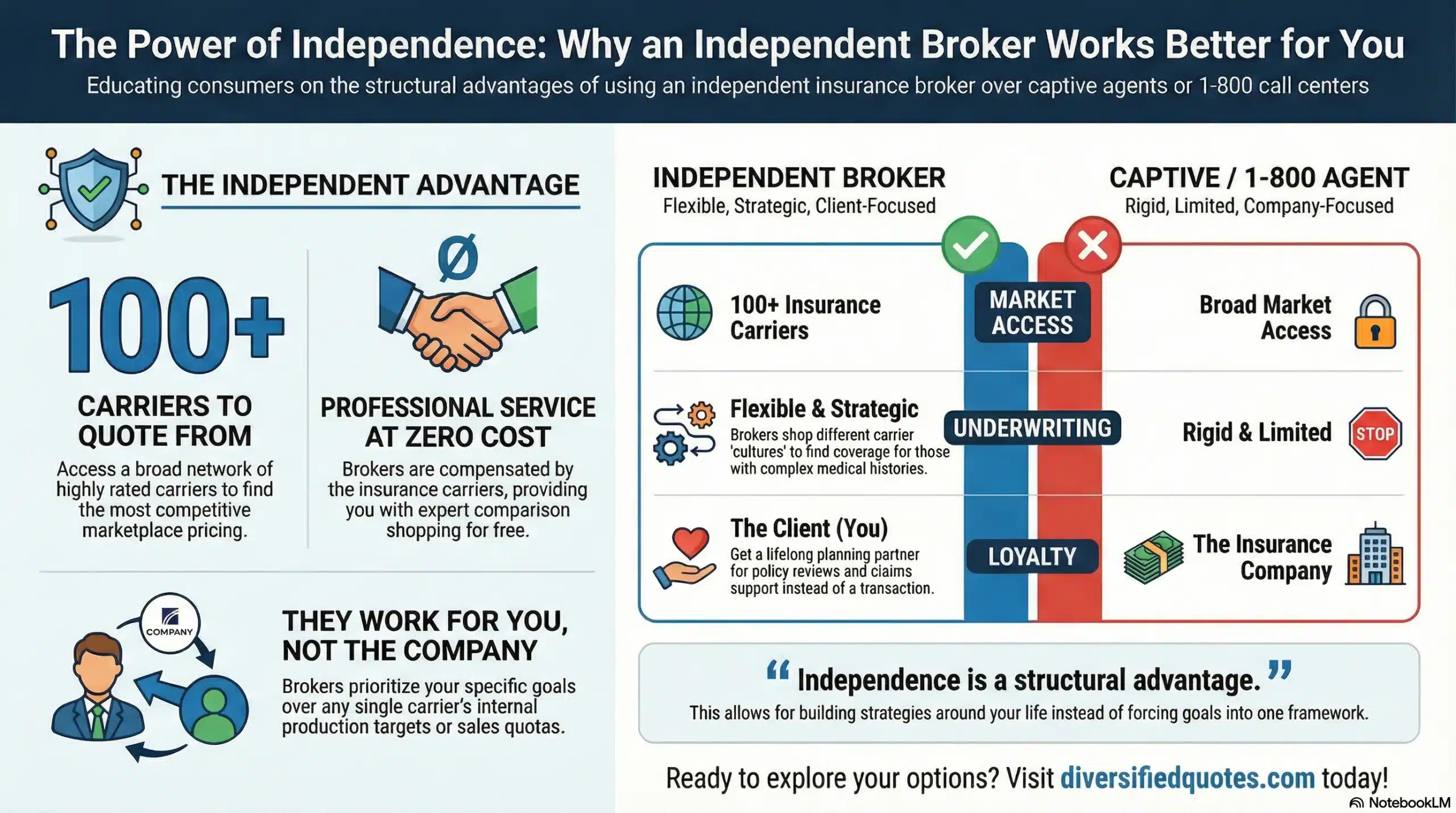
BASE jumping cases almost never belong with a single-carrier approach. When you submit to one carrier, you get one opinion — from one underwriting desk with one set of internal guidelines. For a category as specialized as BASE jumping, that single opinion is far more likely to be a decline or a maximum-rate offer than the full range of outcomes available in the broader market. An independent broker can identify which carriers are more likely to evaluate the activity case-by-case rather than decline automatically, structure the application narrative correctly before anything is submitted, and pursue multiple markets without triggering a cascading record of adverse decisions. The difference between a correct carrier match and a blind submission is often the difference between a workable offer and an MIB record that complicates everything that follows. Why work with an independent life insurance broker covers the structural advantage of independent market access in cases where carrier selection drives the outcome more than any other single variable. If you have already received a quote or a decline and want an independent evaluation of what other options may be available, get a 2nd opinion on your life insurance quote covers that process. For applicants with health history that adds complexity on top of the avocation disclosure, life insurance with pre-existing conditions covers how compounding factors affect strategy.
Compare Term Life Insurance Lengths
Explore different term periods to find coverage that best matches your timeline and budget.
Talk With an Advisor Today
Choose how you’d like to connect—call or message us, then book a time that works for you.
Schedule here:
calendly.com/jason-dibcompanies/diversified-quotes
Licensed in all 50 states • Fiduciary, family-owned since 1980
FAQs: Life Insurance for BASE Jumping
Can BASE jumpers actually get life insurance?
Yes, in many cases — but it depends on the carrier and the applicant’s specific profile. Most standard carriers and direct-to-consumer platforms decline BASE jumping automatically because they have no internal guidelines for evaluating it. A narrower group of carriers will review it case-by-case based on jump frequency, years of experience, wingsuit use, prior incidents, and overall risk profile. The goal is identifying which carriers have an appetite for the case, preparing the application correctly, and reaching the best available offer on the first submission rather than accumulating declines that complicate future applications.
How much more does life insurance cost for BASE jumpers?
When coverage is available, pricing is typically adjusted through a flat extra charge or a table rating applied on top of the standard base premium. Occasional jumpers with strong experience and clean health may see 50-100% above standard pricing; high-frequency jumpers or those with compounding risk factors can face 150-250% or more above standard. The exact adjustment depends on the carrier’s internal guidelines, the applicant’s jump profile, and whether other risk factors are present. A case submitted with full, accurate details to the right carrier will generally produce better pricing than the same case submitted without preparation or to a carrier that has limited guidelines for evaluating the activity.
Does wingsuit BASE jumping change my coverage options?
Yes — significantly. Wingsuit BASE jumping is evaluated as a materially distinct and higher-risk activity from standard BASE jumping by most carriers. The combination of wingsuit technical demands and BASE jumping’s narrow altitude margins creates an exposure profile that further narrows the carrier market and typically produces larger pricing adjustments. Full disclosure of wingsuit use is essential — a policy issued without accurate wingsuit disclosure creates real risk of claim denial or rescission if the activity contributes to a loss. Non-disclosure is never a viable strategy; the only sound approach is full transparency with the right carrier.
What is an exclusion rider and should BASE jumpers accept one?
An exclusion rider means the policy is issued and all other causes of death are covered, but death specifically resulting from BASE jumping is excluded. The policy pays for health-related deaths, accidents unrelated to the activity, and all standard covered causes — just not a BASE jumping fatality. Whether to accept an exclusion depends on the applicant’s purpose. If the primary goal is protecting a family against all causes of death including the activity, an exclusion does not fully accomplish that goal. If the coverage purpose is broader family income protection and BASE jumping-specific death benefit is a secondary concern, an exclusion policy can still deliver meaningful value. This is a decision worth working through before accepting or declining any specific offer.
What happens if I stop BASE jumping — will my rates change?
It depends on how the policy was structured. Some flat extras are written as time-limited or activity-contingent, meaning the surcharge can be removed if the applicant demonstrates they have stopped the activity for a defined period — typically with a signed statement of cessation. Other flat extras are permanent for the policy term. Some carriers allow a policy review and re-underwriting once the activity is discontinued. If you expect to reduce or stop BASE jumping in the future, asking how cessation is handled before purchasing is important — the answer should influence how the policy is structured from the start.
About the Author:
Jason Stolz, CLTC, CRPC, DIA, CAA and Chief Underwriter at Diversified Insurance Brokers (NPN 20471358), is a senior insurance and retirement professional with more than 25 years of real-world experience helping individuals, families, and business owners protect their income, assets, and long-term financial stability. As a long-time partner of the nationally licensed independent agency Diversified Insurance Brokers, Jason provides trusted guidance across multiple specialties—including fixed and indexed annuities, long-term care planning, personal and business disability insurance, life insurance solutions, Group Health, Travel Medical and Evacuation Insurance, and short-term health coverage. Diversified Insurance Brokers maintains active contracts with over 100 highly rated insurance carriers, ensuring clients have access to a broad and competitive marketplace.
His practical, education-first approach has earned recognition in publications such as VoyageATL, and contributions from his agency featured in Kiplinger and GoBankingRates— highlighting his commitment to financial clarity and client-focused planning. Drawing on deep product knowledge and years of hands-on field experience, Jason helps clients evaluate carriers, compare strategies, and build retirement and protection plans that are both secure and cost-efficient. Visitors who want to explore current annuity rates and compare options across multiple insurers can also use this annuity quote and comparison tool.
Explore More Life Insurance Options: Browse our complete guide to Life Insurance for High Risk Occupations & Activities — covering pilots, construction workers, extreme sports, scuba diving & more from 100+ carriers.
Last Reviewed: June 14, 2026 |
Reviewed by: Jason Stolz, CLTC, CRPC, DIA, CAA
Chief Underwriter, Diversified Insurance Brokers, Inc. | NPN: 20471358 | Diversified Insurance Brokers, Inc. — Licensed in all 50 states
Fact Checked by: Tonia Pettitt, CMIP©
Medicare Specialist, Diversified Insurance Brokers, Inc. | NPN: 14374308 | Diversified Insurance Brokers, Inc. — Licensed in all 50 states
Did you find this content helpful? Leave us a Google review — it helps others find trustworthy guidance too.
Editorial Standards: Diversified Insurance Brokers maintains rigorous editorial standards to ensure accuracy, clarity, and independence in all content. Learn more about our editorial standards and commitment to transparency.
