
Life Insurance for Roofers
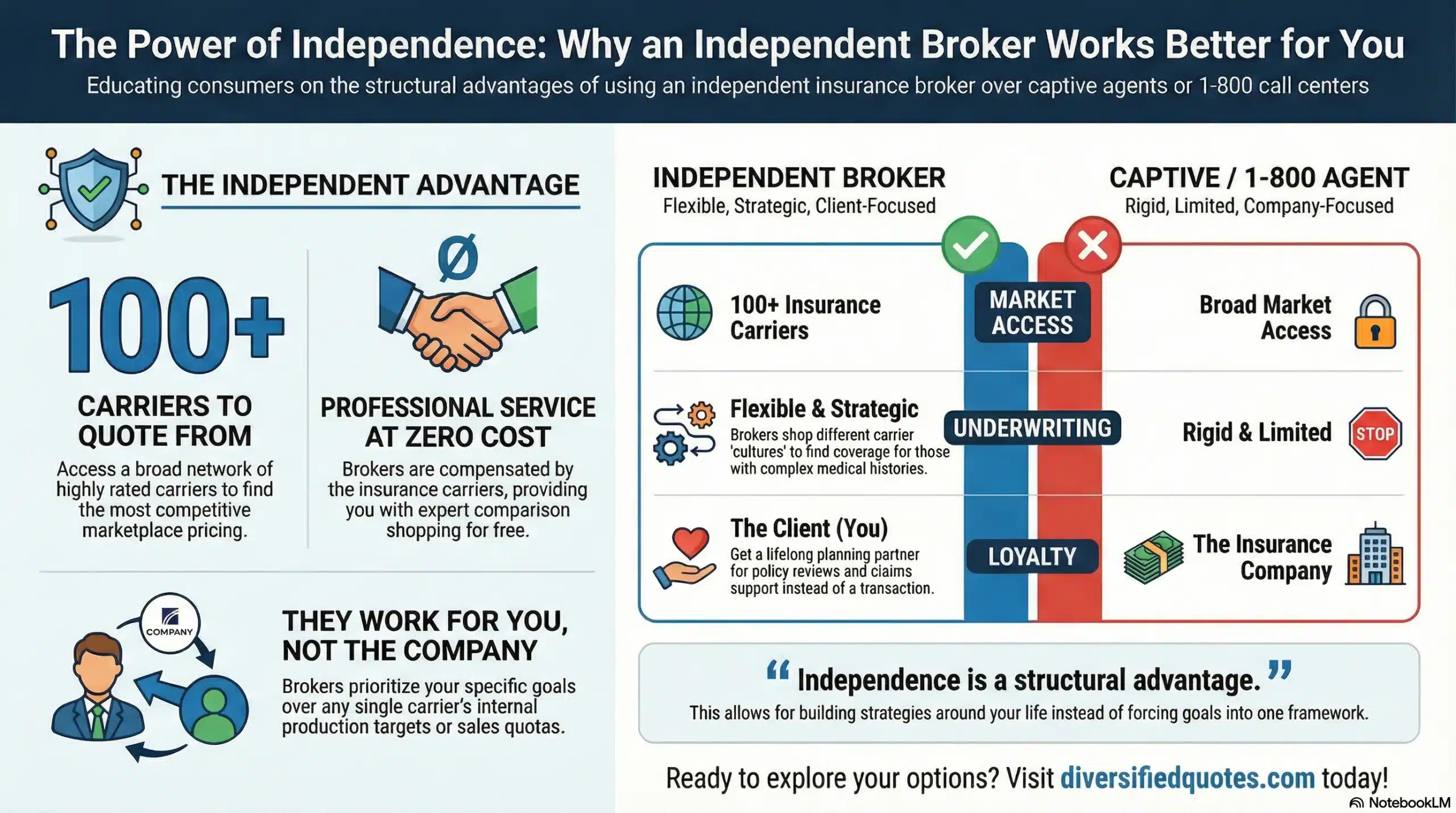
As an Independent Life Insurance Broker, we compare rates across 100+ carriers and prescreen every application before submission.
Life Insurance for Roofers

Jason Stolz CLTC, CRPC, DIA, CAA
Life insurance for roofers is one of the most important financial safeguards you can put in place when your paycheck depends on working at height. Roofing is skilled, physical work, and for many families it is the primary income source — yet it also comes with daily exposure to falls, ladder injuries, weather-driven hazards, power tools, and job-site variables you cannot fully control. The point of life insurance is not to bet against yourself. It is to make sure that if something happens, your family does not have to sell the house, drain savings, or scramble to replace income while they are already dealing with loss. At Diversified Insurance Brokers, Jason Stolz, CLTC, CRPC, DIA, CAA, helps roofers and roofing contractors secure coverage across all 50 states that is both realistic for the trade and priced fairly — by comparing options across 100+ top-rated carriers and matching each profile to the companies that consistently evaluate roofing occupations accurately rather than defaulting to the most conservative available classification.
Roofers often get lumped into generic “construction” buckets by quoting systems that do not understand job duties, safety practices, or how carriers actually classify occupational risk. That is where people get frustrated: they see an attractive online estimate, apply, and then underwriting changes the class — or a carrier pushes a higher rating simply because the occupation is misunderstood and the application left too many questions unanswered. Our job is to help you avoid that outcome by matching you with carriers that are consistently reasonable for roofing risks and presenting your work profile accurately and completely from the start. That carrier selection and file preparation step is often more consequential than anything else in a roofing life insurance placement, because the final approved offer reflects the carrier’s underwriting guidelines for your specific duty profile — not the initial quote screen estimate.
Your life insurance strategy should also fit how you actually work. If you are a W-2 employee with group benefits, you may already have some coverage — but it usually is not enough, and it typically does not follow you if you change employers or start your own crew. If you are self-employed, a subcontractor, or a business owner, you often need coverage that protects both your family and the business obligations that rely on you — especially if you are the one who bids jobs, manages crews, and keeps cash flow moving. Understanding how much life insurance you actually need is the foundational calculation that connects the coverage amount to the real financial obligations the death benefit is designed to address.
Request a Life Insurance Quote for Roofers
Compare affordable life insurance plans tailored for roofers, contractors, and construction professionals nationwide.
Call 800-533-5969
Why Roofers Need Life Insurance
Roofing has a simple reality: one bad day can change everything. Even with training, safety culture, and the right equipment, roofers still work in conditions where footing can shift, weather can change without warning, and fatigue can set in after long and physically demanding days. The reason life insurance matters so much for roofers is that your risk exposure is tied directly to the work itself — meaning the financial consequences of an accident can be larger for your family than they would be for someone in a lower-risk occupation, and the household has less redundancy to absorb that impact if income disappears suddenly.
Life insurance creates a financial cushion that can immediately replace income, pay off debts, and stabilize your household without forcing the kinds of rushed decisions that compound grief into long-term financial damage. In practical terms, it helps cover the mortgage or rent, keep kids in the same school, protect a spouse who may need time away from work, and fund everyday bills during a difficult transition period. For many roofing families, it also prevents the forced liquidation of tools, vehicles, savings, or retirement accounts at the worst possible moment — when the family is least equipped emotionally to make good financial decisions under pressure.
Roofers also tend to have stacked responsibilities that are not always obvious on paper. Many are the primary income earners, and many are also carrying business obligations such as equipment payments, vehicle notes, liability coverage costs, payroll commitments, and subcontractor agreements. A strong life insurance plan helps protect against those obligations turning into a crisis for the family or business partners who remain after a loss. Understanding how life insurance fits alongside disability insurance — which addresses the income risk of an extended injury that prevents working without resulting in death — helps roofers build a complete protection picture rather than addressing only one dimension of the financial risk their occupation creates.
Who Qualifies for Life Insurance in Roofing?
The direct answer is that most roofers can qualify for life insurance. Roofing is considered a higher-risk occupation, but it is not an automatic decline category — and this is one of the most important points to understand before approaching the process. Approval and pricing are driven by a combination of factors: your age, health history, build, tobacco status, driving record, and how the carrier categorizes your specific job duties. Many roofers land in standard or close-to-standard pricing with the right carrier match, especially when they have a stable health profile, a clean safety and driving history, and a file that accurately describes what they actually do rather than leaving underwriting to assume the most hazardous possible interpretation of the job title.
We help roofers across the entire industry spectrum — from hands-on crew members working steep-slope residential jobs every day, to commercial roofers handling flat systems and membrane installation, to foremen who occasionally climb but spend more time managing materials and crew logistics, to supervisors whose primary role is now coordination and quality control with limited direct roof exposure. The difference between these profiles matters in underwriting because carriers frequently rate a “hands-on installer at height daily on steep-slope residential” differently than a “foreman or supervisor with limited and intermittent roof exposure.” The goal is to classify you correctly based on your actual duties rather than allowing the job title to pull you into a more hazardous category than your real working life supports.
Newer roofers and apprentices who have not yet built years of job history are also approachable. In those cases, the general health profile typically carries more underwriting weight because the duty history is shorter, but it is still important to communicate duties clearly so underwriting does not assume the most extreme possible risk scenario by default. Life insurance for high-risk occupations covers the broader framework that applies across skilled trades and helps establish how occupational classification interacts with health underwriting in the combined approval decision.
How Life Insurance Companies Classify Roofing Work
When you apply for life insurance as a roofer, underwriting typically wants to understand both the “what” and the “how” of your work — because two roofers with the same job title can have very different daily exposure to risk, and underwriters are specifically trying to evaluate frequency of work at height, the type of structures you work on, the safety practices you follow, and whether specific tasks in your role increase the severity of the hazard profile beyond the baseline.
Roofers who do primarily residential steep-slope work may face carrier assumptions about higher fall exposure and more frequent ladder usage than roofers whose primary work is commercial flat roofing — where some carriers view the risk differently because the work environment may be more controlled, even though flat roofing has its own distinct hazard profile. Roofers who frequently work on multi-story structures or very steep pitches may encounter different classification questions than those working primarily on single-story residential homes. Tear-off and replacement work — which involves managing heavy materials, debris, and equipment in a demanding sequence — is typically viewed differently from targeted repair and maintenance work that involves more limited roof access for shorter durations.
| Role Type | Typical Underwriting Approach | Key Variables That Help | Key Variables That Complicate |
|---|---|---|---|
| Hands-on installer (steep-slope residential) | Higher occupational class; carrier selection most consequential; some carriers favorable, others conservative | Safety harness documentation; clean driving record; stable health profile; years of experience without incidents | Tobacco use; prior occupational injuries; health conditions; frequent medication changes |
| Commercial flat roofer | Varies by carrier; some view flat roofing more favorably than steep-slope; duty specifics matter | Controlled work environment documentation; stable employment history; clean health profile | Industrial site work; chemical or material exposure; multi-story commercial structures |
| Foreman / Crew supervisor | Often more favorable than full-time installer; underwriters credit reduced direct exposure when duties are described clearly | Clear duty description emphasizing supervisory role; documenting percentage of time on roof vs. ground | Application that is vague about duties; inconsistency between stated duties and job title |
| Roofing business owner (field-active) | Evaluated as combination of occupational and business owner risk; underwriters ask about personal vs. field vs. administrative duties | Clear description of how time is split; documenting transition toward management; business stability | Still performing majority of installation work personally; business obligations that compound financial exposure |
| Roofing business owner (management role) | Can be evaluated significantly more favorably when roof exposure is genuinely minimal; duty documentation is critical | Documentation that majority of duties are estimating, bidding, administrative; clean overall health profile | Application that does not clearly distinguish from field-active role; underwriting defaulting to worst-case interpretation |
Compare Life Insurance Rates for Roofers
View real-time quotes from top-rated carriers that specialize in construction and high-risk occupations.
How Underwriting Works for Roofers — Medical and Occupational Together
Underwriting is where the real story gets told for roofers. Many people see initial quote estimates and assume that is the final pricing. But underwriting determines the actual approved class, and for roofers, that underwriting includes both medical and occupational review as parallel and interacting dimensions. You can be perfectly healthy and still see final pricing shift if a carrier places your occupation into a higher hazard class than expected. You can also have a favorable occupational profile but see pricing shift due to health or lifestyle factors. The end result is a combined decision that reflects both dimensions simultaneously.
Most fully underwritten term policies involve a health questionnaire, possible medical records review, and often a paramedical examination depending on age and coverage amount. During the occupational portion of the evaluation, the carrier may ask how long you have been a roofer, what percentage of your working duties are performed at height, what type of roofing work you do, whether you use safety harnesses consistently, whether you have had any prior occupational injuries, and whether you supervise others or work alone. The accuracy and consistency of how you answer these questions — and how the answers align with what the records and job description indicate — has a direct effect on both the speed of underwriting and the final classification. What a life insurance exam involves helps roofers understand what the paramedical examination covers and how to plan timing around a demanding work schedule that does not accommodate easy rescheduling.
The best approach throughout is accuracy and consistency. Underwriters are trained to identify mismatches between what an applicant states and what records or job descriptions suggest. If your application implies you are on the roof daily but your role is now substantially supervisory, that inconsistency creates friction that slows the process and can lead to conservative default classifications. If your application minimizes exposure but your job title and record indicate otherwise, that can also trigger follow-up. The goal is to present your actual duties clearly and completely so underwriting can classify you in the category that accurately reflects your real daily work rather than the most hazardous possible interpretation of your title.
Life Insurance Policy Types That Work for Roofers
Life insurance for roofers usually comes down to selecting the right combination of coverage type and duration. The best policy is the one that accomplishes the specific financial job it needs to do — income replacement, debt payoff, business continuity, or legacy planning — without overpaying for structure that does not serve those specific goals or locking into a design that does not fit how your life is actually structured.
Term life insurance is the most common solution for roofers in prime working years because it offers the highest coverage amounts for the lowest per-dollar cost. Many roofers choose a 20-year term because it aligns with the years when the family is most financially dependent on the primary income and the mortgage is still a major household obligation — the period when the financial consequences of losing that income are most severe. A 10-year term can cover a shorter, defined high-risk window effectively. A 30-year term is appropriate when the goal is coverage that extends through the full working career and into the beginning of retirement planning. Term is almost always the right “bang for the buck” answer when the priority is maximum protection per premium dollar during the core working years.
Whole life insurance provides permanent coverage with a fixed premium and cash value accumulation. Some roofers find whole life appropriate when they want lifetime protection that does not expire and predictable payments they can plan around for decades, particularly for final expense planning or as a foundation layer of permanent coverage that remains regardless of future health changes. Because whole life is considerably more expensive than term for the same death benefit, it is typically used as a foundation layer — paired with term for the primary income replacement coverage — rather than as the entire solution for a household that needs significant death benefit during the working years.
Many roofers end up with a blended strategy: a larger term policy to protect income and the family’s lifestyle through the primary dependency and mortgage years, plus a smaller permanent policy to maintain a foundation of coverage that does not expire when the term ends. This structure provides maximum protection when it is needed most and maintains some permanent coverage as the working years transition toward retirement. For self-employed roofers and business owners who have partners or key employees, coverage planning may also need to address business continuity through tools like buy-sell life insurance and key man life insurance — structures that protect the business alongside the personal family coverage rather than treating the two as unrelated planning problems. The burial insurance calculator is useful for roofers evaluating final expense coverage specifically — either as a primary solution for limited coverage needs or as a supplemental layer alongside a larger primary policy.
Occupational Red Flags That Can Affect Your Rate Class
Underwriters focus on how occupational risks translate into probability of severe injury — not just the existence of risk in the abstract, but the frequency, severity, and controllability of the specific hazard exposures in the applicant’s actual role. Falls are the most prominent headline risk in roofing, and underwriting evaluates how that risk is managed: safety harness usage and consistency, fall protection systems on the job site, the physical characteristics of the structures typically worked on, and the environmental conditions (wind, heat, precipitation) the applicant regularly encounters. A consistent safety practice and a stable job history without incidents makes a materially different underwriting presentation than a duty profile with the same exposure but without the documented safety culture behind it.
Tobacco use is one of the most significant compounding risk factors for roofers in underwriting, particularly when combined with an already higher-hazard occupational class. If tobacco is part of the picture, life insurance for smokers explains how tobacco classification works in underwriting and what the pathway looks like for applicants who have recently quit. Driving history is another frequently overlooked factor that matters more for roofers and contractors than for many applicants — because tradespeople often drive frequently and extensively, and multiple violations, DUIs, or serious accidents can shift the underwriting picture independently of the occupational evaluation. Recent occupational injuries and disability claims are also evaluated because they signal elevated future risk in a hazardous occupation context. Life insurance with pre-existing conditions covers how multiple risk factors interact in the combined underwriting evaluation and how carrier selection addresses layered complexity.
Understanding how life insurance table ratings work is particularly useful for roofers who receive a rated offer — either occupationally or health-driven — because it allows them to evaluate what any given offer actually means in practical premium terms relative to what a better-matched carrier might offer for the same profile.
Roofers Who Are Self-Employed or Business Owners
If you are a self-employed roofer or own a roofing business, life insurance is often doing double duty: protecting your family and protecting the business infrastructure that generates the household’s income. Many roofing owners are the key person in the operation — meaning that if they are gone, job bids stop, crew management stalls, client relationships are disrupted, and cash flow contracts sharply within weeks. A strong personal life insurance plan helps keep the household stable during that period. Business-level coverage can create the financial runway the remaining partners, employees, or family members need to make decisions about continuation, sale, or transition without being forced by financial pressure to act faster than is wise. The benefits of key person insurance covers the business protection dimension that complements personal coverage in a roofing business owner context.
Business owners also face a different set of questions during personal life insurance underwriting. Carriers may ask how many employees you have, whether you personally perform installation work, what percentage of your duties are administrative versus field, and whether you have partners or key employees who provide operational continuity. If you have genuinely transitioned into a management and estimating role, that can be significantly favorable in occupational classification. If you still perform most jobs personally alongside crew, that may be classified in a higher occupational category. Accurate and complete duty description — not understating or overstating — is the presentation strategy that produces the best available classification rather than a conservative default. Comparing your options with an independent broker who understands how to present business-owner roofing profiles is the structural advantage that produces consistently better outcomes than a captive agent or online platform submission. Choosing the best independent insurance agent explains why that independence matters specifically for specialized occupational profiles like roofing.
What If You Have Been Declined or Rated Up?
Being rated higher due to occupation is frustrating, but it is not uncommon — and more importantly, it does not necessarily mean the outcome you received is the best the market offers. Sometimes a carrier simply has conservative occupational class guidelines for roofing that do not reflect how the risk picture actually varies within the trade. Other times, the application lacked the duty specificity that would have allowed underwriting to place the applicant in a more accurate and more favorable class than the worst-case assumption. A re-approach with a carrier that classifies roofing more favorably — combined with a clearer and more complete description of actual duties — can meaningfully change the outcome.
If you have been declined, the first step is to identify the actual trigger. Most declines in roofing cases are not due to occupation alone — they are typically driven by a combination of factors such as medical history, tobacco use, a problematic driving record, recent occupational injuries, or some combination of these. Once the actual trigger is identified, the approach shifts accordingly: different carrier selection when occupation is the primary driver, or a different combination of carrier and documentation strategy when multiple factors are interacting. Getting a second opinion on your life insurance quote is the direct path to confirming whether the offer you received reflects the best available in the full market or whether a better result exists through a different carrier with more favorable roofing underwriting guidelines. High-risk life insurance covers the full range of strategies for complex occupational profiles including skilled trades.
Protect Your Family from Life’s Unexpected Falls
Roofing is demanding work, and it takes real skill to do it well. But the job also carries risks that cannot be fully eliminated even with the best training and the best gear. Life insurance is the simplest and most efficient way to convert that unavoidable occupational risk into a manageable financial plan — so your family is protected, your debts are covered, and your household does not get disrupted by a sudden event that the job has always carried as a realistic possibility. Whether you are a crew member, a foreman, a subcontractor, or a business owner, Diversified Insurance Brokers can help you compare options across our carrier network and lock in the right coverage with the right carrier for your specific duty profile and health picture. You do not need a perfect situation to get approved — you need the right plan, the right carrier match, and a clear presentation of who you are and what you actually do.
Request Your Personalized Life Insurance Quote for Roofers
Our experienced advisors compare rates from 100+ carriers to help roofing professionals and contractors protect their families.
Call 800-533-5969
Related Life Insurance Pages
Explore these next if you’re comparing underwriting options, occupations, or other approval factors.
Life Insurance for Offshore Oil Workers
Life Insurance for Electricians
Life Insurance for Truck Drivers
Life Insurance for Police Officers
Life Insurance for High-Risk Occupations
Life Insurance with Pre-Existing Conditions
Life Insurance for Smokers
Life Insurance Table Ratings Explained
What Is a Life Insurance Exam?
Best Independent Insurance Agent
Buy-Sell Life Insurance
Key Man Life Insurance for Business Owners
High-Risk Life Insurance
Compare Term Life Insurance Lengths
Explore different term periods to find coverage that best matches your timeline and budget.
Talk With an Advisor Today
Choose how you’d like to connect—call or message us, then book a time that works for you.
Schedule here:
calendly.com/jason-dibcompanies/diversified-quotes
Licensed in all 50 states • Fiduciary, family-owned since 1980
Frequently Asked Questions: Life Insurance for Roofers
Can roofers get life insurance at competitive rates?
Yes — many roofers qualify for life insurance at standard or near-standard rates, particularly when the overall health profile is stable, the duty description accurately reflects the actual role, the carrier selected is one whose roofing underwriting guidelines are favorable, and there are no compounding risk factors such as tobacco use or a problematic driving record. Roofing is a higher-risk occupation by occupational classification standards, but it is not an automatic decline or automatically heavily rated category. The variation in underwriting outcomes between the most conservative and most favorable carriers for roofing is substantial — which is precisely why independent carrier selection and accurate duty presentation, rather than a default to whatever is most convenient, consistently produces better results for roofers than the single-carrier or online-platform experience.
How does being a roofer affect life insurance underwriting?
Roofing is evaluated as a higher-hazard occupational category by most carriers, which can affect the rate classification independently of the health evaluation. The specific impact depends heavily on the carrier’s occupational guidelines for roofing, the specific duty profile described in the application, and whether the occupation interacts with compounding risk factors in the health profile. Carriers evaluate frequency of work at height, type of roofing performed, safety practices, supervisory vs. installation duties, and whether any prior occupational injuries are present. The occupational classification is one component of the combined final decision — medical underwriting is the other — and both must be navigated correctly through appropriate carrier selection and accurate application preparation to produce the best available outcome.
Does it matter if I’m a hands-on installer vs. a supervisor or business owner?
Yes — significantly. Underwriters specifically ask about and evaluate the distinction between a full-time installer working at height daily and a supervisor, foreman, or business owner whose direct roof exposure is limited and intermittent. The more supervisory or administrative the role, the more favorable the occupational classification at most carriers — because the underwriting evaluation is about actual exposure frequency and severity, not about the job title. Clearly and accurately describing what percentage of your working time is spent on the roof versus on the ground, managing crews, estimating, or performing administrative duties is one of the most impactful steps in a roofing life insurance application. Vague duty descriptions that leave underwriting to default to a full-time installer assumption for someone whose actual role is predominantly supervisory consistently produce worse outcomes than accurate descriptions.
What type of life insurance is best for roofers?
Term life insurance is the most common and typically the most appropriate first solution for roofers in prime working years because it provides the highest death benefit for the lowest cost during the years when the family’s financial dependency is highest and the mortgage and income replacement need are most significant. A 20-year term is the most commonly selected structure for roofers with young families and a substantial mortgage, as it aligns protection with the primary dependency window. Whole life is appropriate as a foundation layer or permanent coverage component for roofers who want some coverage that will not expire. Many roofers end up with a combination: a larger term policy for primary income replacement protection, plus a smaller permanent policy as a lasting base. Business owners should coordinate personal coverage with business continuity structures like buy-sell and key man policies to address both dimensions of their financial exposure simultaneously.
What if I’ve been declined or rated up as a roofer?
A decline or occupational rating from one carrier does not represent the full market. Different carriers apply meaningfully different occupational classification guidelines to roofing, and what produces a conservative outcome at one carrier may produce a standard or modestly rated outcome at another. Most declines in roofing cases are also not due to occupation alone — they typically involve a combination of occupational classification and one or more compounding factors such as tobacco use, a problematic driving record, recent occupational injuries, or health conditions. Identifying which specific factor or combination triggered the adverse outcome determines the correct re-approach: a different carrier with more favorable roofing underwriting, a clearer duty description that allows a more accurate classification, a health-focused solution if the occupation itself was not the primary driver, or some combination of these. Independent re-shopping with targeted carrier selection consistently produces better outcomes than accepting the first adverse decision as the final word on what is available.
About the Author:
Jason Stolz, CLTC, CRPC, DIA, CAA and Chief Underwriter at Diversified Insurance Brokers (NPN 20471358), is a senior insurance and retirement professional with more than 25 years of real-world experience helping individuals, families, and business owners protect their income, assets, and long-term financial stability. As a long-time partner of the nationally licensed independent agency Diversified Insurance Brokers, Jason provides trusted guidance across multiple specialties—including fixed and indexed annuities, long-term care planning, personal and business disability insurance, life insurance solutions, Group Health, Travel Medical and Evacuation Insurance, and short-term health coverage. Diversified Insurance Brokers maintains active contracts with over 100 highly rated insurance carriers, ensuring clients have access to a broad and competitive marketplace.
His practical, education-first approach has earned recognition in publications such as VoyageATL, and contributions from his agency featured in Kiplinger and GoBankingRates— highlighting his commitment to financial clarity and client-focused planning. Drawing on deep product knowledge and years of hands-on field experience, Jason helps clients evaluate carriers, compare strategies, and build retirement and protection plans that are both secure and cost-efficient. Visitors who want to explore current annuity rates and compare options across multiple insurers can also use this annuity quote and comparison tool.
Explore More Life Insurance Options: Browse our complete guide to Life Insurance for High Risk Occupations & Activities — covering pilots, construction workers, extreme sports, scuba diving & more from 100+ carriers.
Last Reviewed: June 15, 2026 |
Reviewed by: Jason Stolz, CLTC, CRPC, DIA, CAA
Chief Underwriter, Diversified Insurance Brokers, Inc. | NPN: 20471358 | Diversified Insurance Brokers, Inc. — Licensed in all 50 states
Fact Checked by: Tonia Pettitt, CMIP©
Medicare Specialist, Diversified Insurance Brokers, Inc. | NPN: 14374308 | Diversified Insurance Brokers, Inc. — Licensed in all 50 states
Did you find this content helpful? Leave us a Google review — it helps others find trustworthy guidance too.
Editorial Standards: Diversified Insurance Brokers maintains rigorous editorial standards to ensure accuracy, clarity, and independence in all content. Learn more about our editorial standards and commitment to transparency.
