
Heart Attack & Stroke Cash Benefit Rider
Heart Attack & Stroke Cash Benefit Rider

Jason Stolz CLTC, CRPC, DIA, CAA
Heart Attack and Stroke Cash Benefit Rider — What It Pays, How It Triggers, and Where It Fits in a Layered Coverage Plan
A heart attack and stroke cash benefit rider pays a fixed lump-sum directly to you when a covered cardiovascular event occurs and the rider’s medical definition is satisfied — no restrictions on how the money is used, no requirement that the funds go to the hospital or physician. The benefit is yours to deploy against whatever the event actually costs: the deductible, the coinsurance, the prescriptions, the travel to a cardiac center, the meals and lodging for a family member staying nearby, the home help during the recovery weeks, or simply the household bills that keep arriving while income is interrupted. At Diversified Insurance Brokers, Jason Stolz, CLTC, CRPC, DIA, CAA helps clients evaluate rider designs, confirm the medical definitions and exclusions in the specific contract language, and size the lump-sum amount to their actual cost-sharing exposure rather than a generic number that sounds substantial but may underperform in practice. Hospital indemnity insurance — how the full category works, what it covers, and what it costs — is the foundational reference for anyone building a supplemental health coverage plan in which this rider sits as one component.
Why a Lump Sum at Diagnosis Is Different From Per-Day Benefits
Most hospital indemnity designs pay daily or per-confinement benefits — a fixed amount per day of inpatient admission, a separate benefit for ICU days, a confinement benefit when the admission is confirmed. Those benefits are valuable for the hospitalization itself, but cardiac and stroke events create a front-loaded cost pattern where many of the largest expenses arrive in the first 48–72 hours: the emergency room workup, the imaging, the cardiac catheterization, the intervention or surgery, the intensive monitoring. A per-day benefit accumulates gradually over the admission; a lump-sum diagnosis rider delivers a fixed amount immediately when the qualifying event is confirmed — putting cash in your hands at the moment the expenses and decisions are most concentrated. The two benefit types address different parts of the same event’s cost structure, which is why the strongest supplemental coverage designs pair them rather than choose between them. Hospital indemnity for observation stays addresses the specific scenario where hospital time is classified as outpatient observation rather than inpatient admission — a common billing pattern in cardiac workups where the classification affects what the major medical plan pays and what the per-day hospital indemnity benefit covers. How cash benefits pay differently under observation versus inpatient classification is the essential mechanical distinction for anyone designing a supplemental plan that needs to perform regardless of how the hospital ultimately bills the stay.
Get a Quote on a Heart Attack and Stroke Rider
We match the rider design and lump-sum amount to your actual cost-sharing exposure and show how it coordinates with your existing coverage.
Request My QuoteHow the Benefit Triggers — Medical Definitions, Exclusions, and Timing Rules
| Rider Provision | What It Typically Requires | What It Commonly Excludes |
|---|---|---|
| Heart attack (myocardial infarction) | New EKG findings consistent with myocardial infarction, elevation of cardiac enzymes (troponin or CPK-MB) above accepted laboratory normal levels, and confirmatory imaging — thallium scan, MUGA scan, echocardiogram, or cardiac catheterization results establishing the infarction; the diagnosis must be made and documented by a treating physician | Sudden cardiac arrest without documented myocardial infarction — many carriers specifically state that cardiac arrest alone, without the EKG and enzyme findings of an actual infarction, does not meet the rider’s heart attack definition; angina, coronary artery disease without infarction, and stress test abnormalities also typically do not trigger the benefit |
| Stroke (cerebrovascular accident) | A cerebrovascular accident producing neurological deficits confirmed by CT scan or MRI and certified by a neurologist; infarction of brain tissue, thrombosis in an intracranial vessel, hemorrhage, and embolism from an extracranial source are typically included when imaging and neurologist certification support the diagnosis | Transient ischemic attacks (TIAs) — often called “mini-strokes” — are commonly excluded because neurological deficits resolve within 24 hours without permanent damage; reversible ischemic neurological deficits are similarly excluded; the rider typically requires neurological sequelae of a lasting nature rather than temporary symptoms |
| Waiting period | A defined period after the rider’s effective date during which benefits are not payable for events that occur — typically 15 to 30 days; events that occur during the waiting period are not covered even if all other definition criteria are met | Events occurring during the waiting period — the waiting period exists to prevent adverse selection (purchasing coverage specifically because an event is already anticipated or underway); some carriers waive the waiting period during open enrollment periods when medical underwriting is not required |
| Survival period | Many riders require the insured to survive a defined number of days after the qualifying event for the benefit to be payable — common survival period requirements range from 10 to 30 days; if the insured does not survive the specified period, the lump-sum benefit is not paid, though a death benefit under the base policy would apply separately | Events where the insured dies within the survival period — this is one of the provisions that varies most across carriers and is worth confirming explicitly, particularly for buyers who want the benefit to serve as a financial backstop for their surviving family members rather than only for their own recovery costs |
The four provisions in the table — event definition, exclusions, waiting period, and survival period — are the mechanical details that determine whether the rider pays when it is needed. Reading the benefit schedule is not sufficient; the actual definitions in the rider contract language are what governs a claim. A heart attack defined as “acute myocardial infarction with EKG and enzyme findings” does not pay for cardiac arrest without those findings, regardless of how serious the event was clinically. A stroke rider that excludes TIAs does not pay for the event that most people think of as a warning stroke. Confirming these definitions before enrollment — not after a claim is denied — is the only way to know what you actually have. When hospital indemnity pays for ER and urgent care visits covers the acute care phase that immediately precedes a potential cardiac or stroke admission — including the ER benefit structure that applies before the event’s final diagnosis is confirmed and the admission classification is determined.
Sizing the Lump Sum to Your Actual Exposure
The right lump-sum amount is determined by the specific cost-sharing exposure the buyer faces under their major medical plan, not by what sounds generous or by a generic rule of thumb. The most useful starting point is the major medical plan’s deductible and out-of-pocket maximum — these two numbers define the worst-case annual cost-sharing exposure under the existing coverage. A buyer on a plan with a $3,500 individual deductible and a $7,500 out-of-pocket maximum who wants the rider to fully cover worst-case cost-sharing needs approximately $7,500 in rider benefit — not $10,000 or $25,000. Over-sizing the benefit produces a larger premium than the coverage justifies; under-sizing it produces a benefit that helps but does not meaningfully offset the largest expenses.
Additional cost categories beyond the major medical cost-sharing are worth modeling explicitly before settling on a benefit amount: prescription costs in the first weeks of recovery (cardiac and anticoagulation medications are often started immediately), transportation and lodging if the treating cardiac center or rehabilitation facility is not local, temporary home support during the recovery period before full activity is restored, and lost income during the recovery period if the buyer is self-employed or hourly rather than salaried with paid leave. For buyers on Medicare whose cost-sharing structure differs from commercial plans, how Medicare works — specifically the Part A deductible, the Part B coinsurance, and the absence of an out-of-pocket maximum under Original Medicare — establishes the specific cost-sharing exposure that the lump-sum benefit needs to address. Medicare supplement plans cover a portion of that exposure, but the Medigap structure leaves gaps that a diagnosis-triggered lump sum fills in ways that per-day hospital benefits cannot.
Where This Rider Fits in a Layered Supplemental Coverage Design
The heart attack and stroke cash benefit rider is most valuable when it is one component of a layered supplemental design rather than a standalone product. The layered approach assigns each coverage type to the part of a healthcare event it handles best: the ER and urgent care benefit covers the initial acute phase before an admission is classified; the hospital daily benefit covers multi-day inpatient admissions; the observation benefit addresses the gap when hospital time is classified as outpatient; the skilled nursing facility benefit covers the post-acute rehabilitation arc; and the diagnosis-triggered lump sum provides an immediate cash infusion at the moment the qualifying event is confirmed. Each layer addresses a distinct cost and timing dimension; the combination is what produces comprehensive protection. Which hospital indemnity riders are worth adding and which to skip provides the evaluation framework for building this layered design — distinguishing the riders with meaningful financial impact from those that add premium without proportionate benefit for most buyers. Hospital indemnity for Medicare Advantage members specifically addresses how the supplemental design integrates with MA cost-sharing structures, which differ from Original Medicare and require a different calibration for the lump-sum and per-day benefit amounts.
Pairing With a Cancer Diagnosis Rider
The heart attack and stroke rider is frequently paired with a cancer diagnosis cash benefit rider because the two products address the same underlying coverage problem — major medical insurance covers treatment costs but leaves substantial out-of-pocket exposure and non-medical costs uncovered — applied to different diagnosis categories. Together, the two riders provide lump-sum cash protection against the three most common categories of serious health events: cardiovascular events, stroke, and cancer. The cancer diagnosis cash benefit rider covers the specific design considerations for cancer-triggered lump sums — including how cancer definitions in indemnity riders differ from critical illness policy definitions and how the staging and histology of the diagnosis affects whether the benefit pays. What critical illness insurance is and how it differs from supplemental indemnity riders — standalone critical illness policies versus riders added to hospital indemnity or life insurance — establishes the product category distinction that helps buyers evaluate whether a standalone critical illness policy or a rider-based approach is more appropriate for their specific coverage architecture. Whether critical illness insurance is worth considering for a specific buyer’s situation and what critical illness coverage actually costs relative to the protection it provides are the evaluation questions that determine whether the product makes sense as part of a complete protection plan.
Buyers Who Have Already Had a Heart Attack or Stroke
Buyers who have already experienced a heart attack or stroke face a different market than those purchasing for the first time. Pre-existing condition limitation periods — typically 12 to 24 months during which benefits are not payable for conditions that existed before the rider’s effective date — mean that a recent cardiovascular event creates a waiting window before coverage for a recurrence applies. Some carriers also rate or decline applicants with recent cardiac or stroke history, making underwriting review important before applying to confirm that the specific history is insurable under the rider being considered. For buyers in this situation, guaranteed-issue hospital indemnity products and the associated supplemental riders are available through specific carriers that do not apply medical underwriting — the benefit amounts are typically more limited, but coverage is accessible regardless of medical history. Guaranteed-issue hospital indemnity at 65 covers this specific market — the coverage options available for buyers who cannot qualify for medically underwritten supplemental products. Burial insurance for people with heart conditions and burial insurance for stroke survivors address the final expense and life insurance coverage options for buyers with cardiac and stroke history, including the guaranteed-issue and simplified-issue products that do not require the buyer to be in perfect health. Life insurance after a heart attack and life insurance for heart disease are the impaired-risk life insurance options for the same buyer population — because the personal protection planning that includes a diagnosis rider also needs to address what the family receives if the cardiac event ultimately proves fatal. Life insurance for stroke survivors provides the equivalent coverage options for the stroke history market. For buyers evaluating the complete personal protection picture after a serious cardiac event — including income protection if the event has reduced working capacity — disability insurance and disability insurance for higher earners and business owners address the income replacement dimension that a lump-sum diagnosis rider does not cover. The long-term care planning dimension — what happens if the cardiovascular event leads to functional impairment that requires ongoing assistance — connects to whether Medicare covers long-term care (it does not cover custodial care), annuities with long-term care benefits, and non-qualified long-term care annuities — the funding instruments that address the custodial care costs that a diagnosis rider is not designed to cover. Whether Medicare covers nursing home care establishes the specific coverage limitations that apply after a cardiac event requires skilled nursing or rehabilitation facility care — including the 3-day inpatient stay requirement, the 100-day SNF coverage limit, and the daily coinsurance for days 21–100. For buyers approaching or in retirement whose cardiac history intersects with Social Security and Medicare planning decisions, whether working past 65 affects Social Security benefits addresses the income and benefits timing question that a serious health event in the final working years frequently brings to the surface. Annuities for conservative investors and guaranteed income from annuities provide the retirement income planning tools that complement the personal protection coverage discussion — ensuring that the financial plan is secure enough to absorb a serious health event without forcing the liquidation of retirement savings alongside the medical cost-sharing the coverage is designed to offset. Medicare supplement coverage for cancer treatment addresses how Medigap fills the Medicare cost-sharing gaps for the cancer dimension of critical illness planning alongside the cardiac and stroke rider architecture.
Design a Layered Supplemental Plan That Actually Performs
We confirm the rider definitions, size the lump sum to your real exposure, and show how every piece of the supplemental coverage plan coordinates before you enroll.
Request My Quote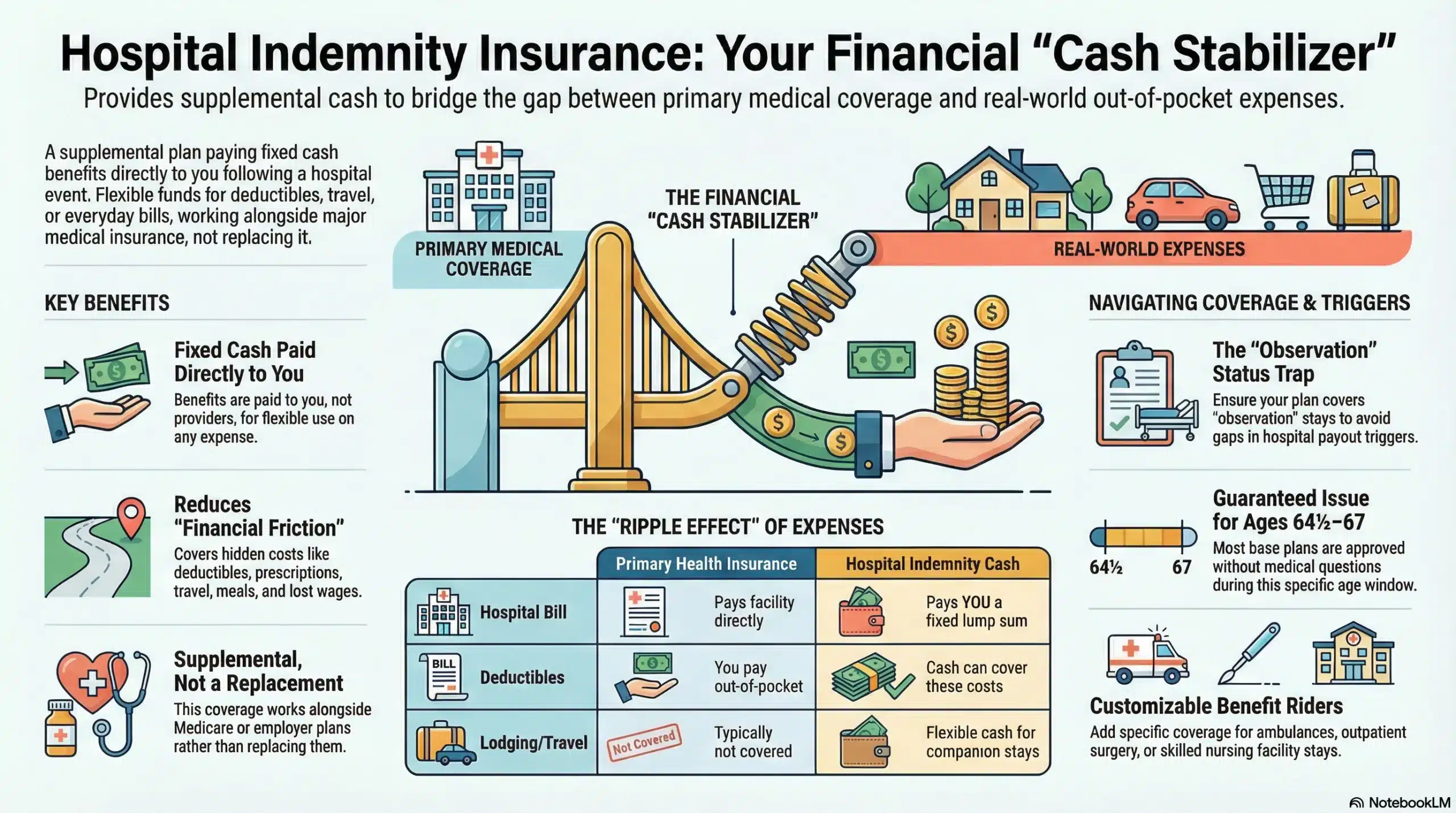
Talk With an Advisor Today
Choose how you’d like to connect—call or message us, then book a time that works for you.
Schedule here:
calendly.com/jason-dibcompanies/diversified-quotes
Licensed in all 50 states • Fiduciary, family-owned since 1980
FAQs: Heart Attack and Stroke Cash Benefit Rider
Does the rider pay if I have a cardiac arrest rather than a documented heart attack?
In most rider designs, no — sudden cardiac arrest without documented myocardial infarction does not satisfy the heart attack definition. The standard rider definition requires a confirmed myocardial infarction: new EKG findings consistent with MI, elevation of cardiac enzymes (troponin or CPK-MB) above accepted laboratory normal levels, and confirmatory imaging or catheterization results establishing the infarction. Cardiac arrest is a different event mechanically — it is the stopping of the heart’s pumping function, which can occur from causes other than a heart attack, including arrhythmia. Many carriers explicitly state in the rider language that sudden cardiac arrest without the diagnostic findings of myocardial infarction is excluded from the definition.
This is one of the most important definitions to confirm before enrollment, not after a claim. A buyer who survives cardiac arrest — which is a medically serious and potentially expensive event — and assumes the rider will pay based on the severity of the episode may be surprised to find the claim denied because the event does not meet the myocardial infarction definition. Confirming the exact diagnostic criteria in the specific rider language before purchasing is the only way to know precisely what constitutes a covered event under that contract.
Will the rider pay if I have a TIA (transient ischemic attack) instead of a full stroke?
No — transient ischemic attacks are consistently excluded from stroke rider definitions across virtually all carrier designs. The stroke definition in these riders requires a cerebrovascular accident producing neurological deficits that are lasting, confirmed by CT scan or MRI, and certified by a neurologist. TIAs, by definition, resolve within 24 hours without permanent neurological damage — and because they do not produce the lasting neurological sequelae that the rider requires, they do not satisfy the definition regardless of how serious or alarming the temporary symptoms were.
Similarly, reversible ischemic neurological deficits — events where symptoms last longer than a TIA but still resolve without permanent damage — are also typically excluded from the standard stroke definition. The rider is designed to pay for strokes that produce documented, lasting neurological consequences, not for temporary neurological events that resolve completely. Buyers with a history of TIAs who are concerned about future stroke risk should confirm both how their history affects underwriting and whether any rider in the market covers events their specific health history makes more likely — but the standard rider definition will not cover a TIA regardless of its clinical significance.
How much lump-sum benefit should I choose?
The right amount starts with your major medical plan’s cost-sharing structure — specifically the deductible and out-of-pocket maximum — because those two numbers define the worst-case annual cost-sharing exposure you face if a cardiac or stroke event requires extended hospitalization and follow-up treatment. If your plan has a $4,000 individual deductible and a $8,000 out-of-pocket maximum, a rider benefit in the $7,500–$10,000 range covers the primary cost-sharing exposure and leaves room for the non-medical costs that follow a serious cardiovascular event.
Beyond cost-sharing, the additional categories worth modeling before settling on an amount include: the cost of prescription medications started immediately after a cardiac event (anticoagulants, beta-blockers, and statins often involve out-of-pocket costs in the first weeks); transportation and lodging if the best cardiac center for your situation is not local; temporary home care or household help during the recovery period; and income disruption if you are self-employed or hourly rather than salaried with paid sick leave. Buyers on Medicare should model the Part A deductible, the Part B coinsurance exposure, and the absence of an out-of-pocket maximum under Original Medicare — the cost-sharing structure is different from commercial plans and generally warrants a higher lump-sum amount to adequately cover worst-case exposure.
Can I buy this rider if I have a history of heart disease or a prior stroke?
It depends on the carrier, the underwriting approach, and how recent and severe the history is. Medically underwritten riders evaluate cardiac and stroke history during the application process — applicants with recent events, significant residual impairment, or multiple prior events may be rated, modified, or declined depending on the carrier’s guidelines. The pre-existing condition limitation period — typically 12 to 24 months during which benefits are not payable for conditions that existed before the rider’s effective date — also applies, which means a very recent event creates a window before coverage for a recurrence begins to apply.
Guaranteed-issue and simplified-issue hospital indemnity products are available from specific carriers that do not apply medical underwriting — these products accept applicants regardless of medical history without a health questionnaire, though the benefit amounts are typically more limited and the pre-existing condition limitations are often longer than on underwritten products. For buyers with significant cardiac or stroke history who cannot qualify for underwritten riders or who want immediate coverage without waiting periods, guaranteed-issue products represent the available market. We confirm which carriers will review specific histories favorably before submitting an application — preventing declines that can affect future applications at other carriers.
Does the rider pay only once, or can it pay again if I have another event?
This varies significantly by carrier and rider design. Many riders pay a single lump sum per covered condition per lifetime — meaning the heart attack benefit pays once and cannot be claimed again for a subsequent heart attack regardless of how much time has passed. Others include recurrence benefit provisions that allow a new claim after a defined separation period has elapsed since the prior event — common separation periods range from 90 days to one year between events. A small number of designs allow multiple claims without a lifetime limit as long as the separation period is met between each event.
Whether recurrence provisions matter depends on the buyer’s age, health history, and the probability they assign to experiencing multiple events over the life of the rider. For younger buyers purchasing the rider as part of a comprehensive supplemental plan they expect to maintain for decades, a design with recurrence provisions offers meaningfully different long-term value than a one-time lifetime payment. For buyers who primarily want protection against a first event and are less focused on recurrence risk, the single-lifetime-payment design may be less expensive and sufficient for the goal. Confirming which design applies to the specific rider being considered — and whether the carrier’s recurrence provisions are limited to different event types or also cover a second event of the same type — is a detail worth clarifying before enrollment.
How does this rider coordinate with my hospital indemnity and Medicare coverage?
The heart attack and stroke rider, hospital indemnity benefits, and Medicare or major medical coverage are all independently payable — they do not coordinate with each other or reduce each other’s payment based on what other coverage pays. Medicare pays its covered portion of the hospitalization and related care. The hospital indemnity plan pays its per-day and per-confinement benefits based on the admission type and duration. The diagnosis rider pays its lump sum when the qualifying event is confirmed. All three can pay for the same event without any offset or coordination requirement.
This is the fundamental design advantage of indemnity-based supplemental coverage: the benefits are not limited by, coordinated with, or reduced by what other insurance pays. For buyers on Medicare, the combination of a Medigap plan (covering the Medicare cost-sharing gaps), a hospital indemnity plan (providing per-day and per-confinement cash benefits), and a diagnosis rider (providing a lump sum at the time of a qualifying event) creates a layered design where each piece addresses a different cost and timing dimension of the same healthcare event without any of them reducing what the others pay. The total benefit from all three sources is available to the buyer without offset — which is exactly why the layered design produces better outcomes than any single supplemental product purchased in isolation.
About the Author:
Jason Stolz, CLTC, CRPC, DIA, CAA and Chief Underwriter at Diversified Insurance Brokers (NPN 20471358), is a senior insurance and retirement professional with more than 25 years of real-world experience helping individuals, families, and business owners protect their income, assets, and long-term financial stability. As a long-time partner of the nationally licensed independent agency Diversified Insurance Brokers, Jason provides trusted guidance across multiple specialties—including fixed and indexed annuities, long-term care planning, personal and business disability insurance, life insurance solutions, Group Health, Travel Medical and Evacuation Insurance, and short-term health coverage. Diversified Insurance Brokers maintains active contracts with over 100 highly rated insurance carriers, ensuring clients have access to a broad and competitive marketplace.
His practical, education-first approach has earned recognition in publications such as VoyageATL, and contributions from his agency featured in Kiplinger and GoBankingRates— highlighting his commitment to financial clarity and client-focused planning. Drawing on deep product knowledge and years of hands-on field experience, Jason helps clients evaluate carriers, compare strategies, and build retirement and protection plans that are both secure and cost-efficient. Visitors who want to explore current annuity rates and compare options across multiple insurers can also use this annuity quote and comparison tool.
Browse More Resources: Return to our complete Supplemental, Hospital Indemnity & Critical Illness guide — covering hospital indemnity, accident insurance & critical illness coverage.
Last Reviewed: June 9, 2026 |
Reviewed by: Jason Stolz, CLTC, CRPC, DIA, CAA
Chief Underwriter, Diversified Insurance Brokers, Inc. | NPN: 20471358 | Diversified Insurance Brokers, Inc. — Licensed in all 50 states
Fact Checked by: Tonia Pettitt, CMIP©
Medicare Specialist, Diversified Insurance Brokers, Inc. | NPN: 14374308 | Diversified Insurance Brokers, Inc. — Licensed in all 50 states
Did you find this content helpful? Leave us a Google review — it helps others find trustworthy guidance too.
Editorial Standards: Diversified Insurance Brokers maintains rigorous editorial standards to ensure accuracy, clarity, and independence in all content. Learn more about our editorial standards and commitment to transparency.
