
Observation vs. Inpatient: How Cash Benefits Pay
Observation vs. Inpatient: How Cash Benefits Pay

Jason Stolz CLTC, CRPC
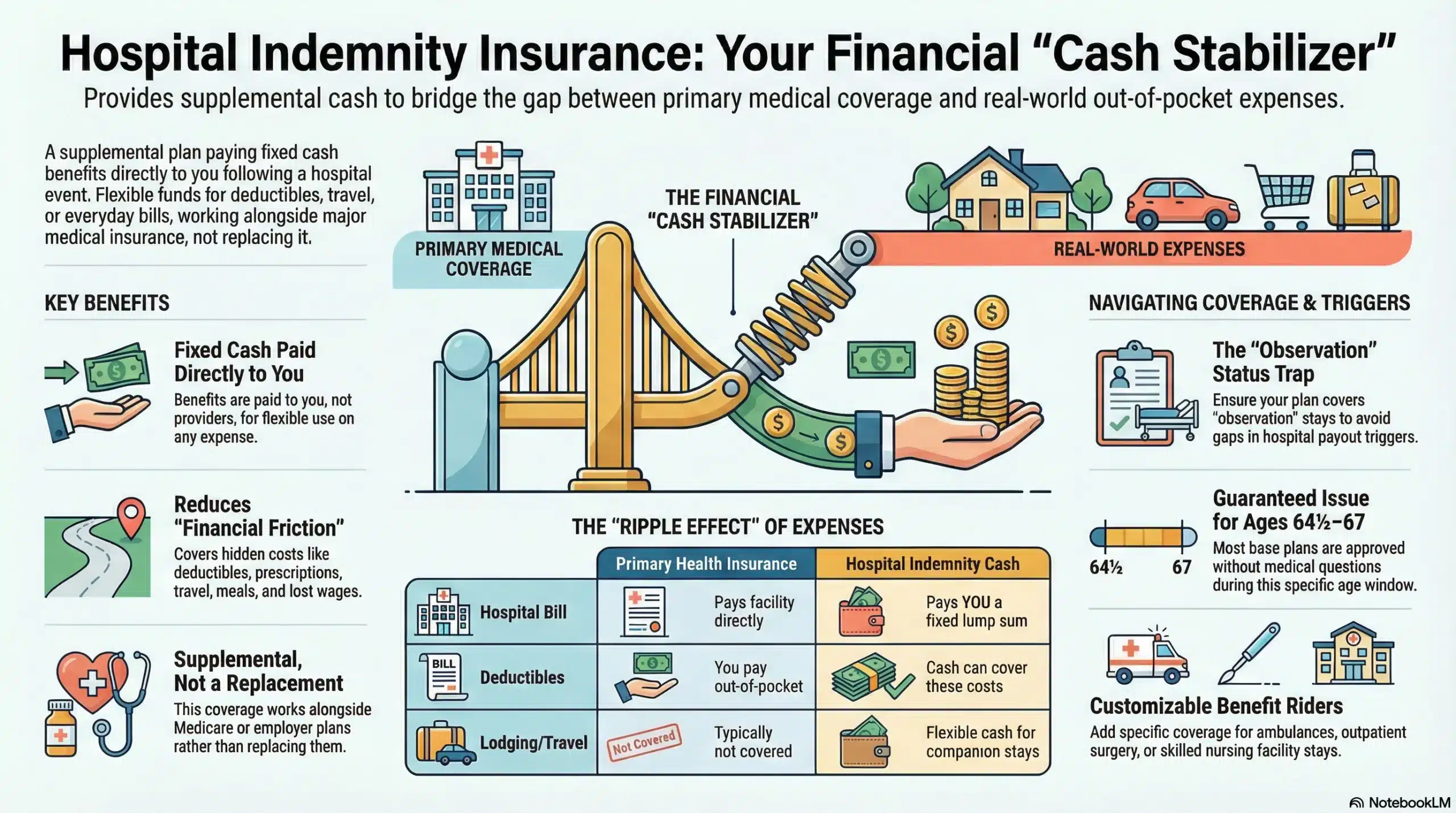
The difference between observation vs inpatient status is one of the most consequential distinctions in modern hospital billing — and one of the biggest reasons people feel blindsided by what they owe after a hospital stay. You can be in a hospital bed, receiving treatment, getting labs and imaging, and even staying overnight, while still being classified as observation rather than formally admitted as an inpatient. That label matters because it changes how hospitals bill, how your primary medical plan applies cost-sharing, and how supplemental cash benefits are triggered on certain hospital indemnity designs. Understanding observation vs inpatient before a hospital event occurs is what separates people who get the cash benefit they expected from people who feel like the plan failed them.
If you are building a strategy around hospital indemnity insurance, this page is designed to remove the guesswork. Many people buy hospital cash benefits assuming that a night in the hospital automatically triggers full inpatient benefits. In reality, the hospital status on record can be different, and the plan may pay differently — or less — if the stay is classified as observation rather than inpatient. Once you understand the mechanics of observation vs inpatient classification, you can choose benefits that recognize both statuses and reduce surprise out-of-pocket exposure.
Observation status is extremely common for scenarios like chest pain evaluation, dehydration, fainting, medication reactions, shortness of breath monitoring, infection workups, and rule-out testing. A person may arrive through the ER, get placed in an observation bed, receive a series of tests and treatments, and then be discharged the next day with follow-up instructions. From the patient’s perspective, that experience feels identical to a full inpatient admission. From the billing standpoint, it may not be classified that way at all. For cash benefits, the key idea is simple: plans pay based on definitions. A hospital indemnity plan is a contract with specific triggers, and those triggers are built around the observation vs inpatient distinction whether the policyholder realizes it or not.
Get Hospital Indemnity Quotes
Understand observation vs inpatient rules and see plans that pay cash for real hospital scenarios.
Questions? Call 800-533-5969
Observation vs Inpatient: Why the Label Matters for Cash Benefits
A helpful way to think about observation vs inpatient is to separate the experience from the status. Your experience might be: I went to the ER, they kept me, I received treatment, and I stayed overnight. The status is how the hospital coded and billed the encounter. Observation status is used when the care team needs time to monitor you, run testing, stabilize symptoms, and decide whether formal inpatient admission is necessary. Inpatient admission is used when the hospital formally admits you under inpatient criteria, typically tied to expected length of stay and medical necessity documentation. Both can feel identical to the patient — but from a billing and benefits standpoint, observation vs inpatient produces meaningfully different outcomes.
Some plans pay a daily benefit for inpatient confinement only. Some include an observation benefit that pays when you meet an hour threshold under observation status. Some pay a partial lump-sum amount for observation stays. Some pay an ER or urgent care benefit in addition to observation or inpatient benefits when the ER visit meets plan rules. When consumers are surprised after a hospital event, it is almost always because they assumed the trigger was “being in the hospital” when the contract trigger was actually “inpatient admission” — and their stay was classified as observation. The observation vs inpatient gap is entirely preventable with informed plan design. It is also important to understand that observation status is not less real care. Observation can involve serious monitoring, repeated testing, IV medications, and ongoing physician oversight. The classification is about billing and admission criteria — not about the severity or legitimacy of the care being delivered.
What Observation Status Usually Means
Observation status is commonly used when a patient needs monitoring and evaluation but the hospital has not formally admitted them as an inpatient. Observation stays are often measured in hours — many plan designs and billing patterns reference ranges like 7 to 24 hours or similar thresholds — because observation is frequently shorter than a full inpatient admission even when it includes an overnight stay. The care team uses this classification when they need time to watch lab trends, monitor cardiac markers, evaluate response to treatment, or ensure symptoms stabilize before making an admission or discharge decision. If you improve quickly, you may be discharged without an inpatient admission ever occurring. If your condition worsens, you may be converted from observation to inpatient status.
The frustrating reality for many patients is that they may not learn they were classified as observation rather than inpatient until the billing explanation arrives. The experience of lying in a hospital bed receiving care can feel identical whether the status is observation or inpatient. That is why designing a hospital cash benefit strategy cannot rely on the assumption that you will always be classified as inpatient if you stayed overnight. It is far smarter to assume that observation will happen frequently — because it does — and then ensure your plan design pays something meaningful in observation scenarios. Observation also frequently interacts with the ER visit that started the episode. If you came through the emergency room and were placed in observation, an ER benefit can help the overall payout feel complete across the front end. That layering is exactly why this companion resource matters for many households: ER and Urgent Care: When Hospital Indemnity Pays.
What Inpatient Admission Usually Means
Inpatient admission is the formal classification that most people picture when they think of hospitalization. It generally means the hospital has admitted you under inpatient criteria and expects ongoing medically necessary care beyond a short observation window. Many cash benefit designs treat inpatient admission as the primary trigger for daily hospital confinement benefits — paying a benefit per inpatient day up to a defined limit per incident or per year. Some designs add a lump-sum admission benefit on top of the daily amount, front-weighting the payout toward the most disruptive early days. From a planning standpoint, the distinction between observation vs inpatient at the moment of admission is often the single variable that determines whether the cash benefit pays in full, pays partially, or does not trigger at all.
A common misconception is that inpatient is always defined by exactly 24 hours. That threshold appears frequently in consumer explanations because many benefit triggers use it as a clean dividing line, but real admission decisions are made by clinicians based on medical necessity criteria — not by the clock alone. The most practical approach is not to assume the hospital will categorize your stay one way or the other based on how long you were there, but to select benefits that pay appropriately in both observation and inpatient scenarios so coverage does not hinge on a billing classification you cannot predict or control. Inpatient admissions also frequently lead to recovery services after discharge. When that happens, our companion resource on the Skilled Nursing Facility Rider Explained covers how post-acute recovery benefits are designed and when they apply.
How Cash Benefits Pay Differently for Observation vs Inpatient
Hospital indemnity plans vary by carrier and state, but the benefit logic for observation vs inpatient tends to follow a few consistent patterns. One pattern is a daily hospital confinement benefit that pays for inpatient days and either excludes observation entirely or pays a smaller amount under a separate observation provision. Another pattern is a lump-sum admission benefit that pays the full amount for inpatient admission and a partial benefit for observation stays that meet the plan’s hour threshold. A third pattern combines both a daily benefit and a lump-sum benefit to cover different scenarios and reduce the chance of a mismatch between what occurred and what the policy pays.
If you have ever heard someone say the plan did not pay because it was observation, what they usually mean is the plan they chose was structured primarily around inpatient triggers. When observation stays are common in your household’s risk profile — and they are common across most care pathways — the solution is to intentionally select a design that includes observation language, observation hour triggers, or a partial payout provision so that observation stays still generate meaningful cash. The most important thing to understand about observation vs inpatient benefit design is that the gap is a design choice, not an inevitability. Choosing a plan that explicitly recognizes observation status removes the classification gamble entirely. For a foundational overview of how cash benefits are structured across all hospital scenarios, see Hospital Indemnity Insurance: What It Covers and Costs. For the outpatient dimension of the episode, our resource on Outpatient Surgery and Rehab Riders covers how benefits extend beyond the hospital phase.
Why Observation vs Inpatient Status Creates Surprise Bills
Surprise bills from hospital stays happen for two primary reasons: classification and timing. Classification — specifically the observation vs inpatient determination — drives whether the encounter is billed under inpatient rates or observation rates, and which cost-sharing rules apply on the primary medical plan. Timing drives how costs accumulate: you may face an ER cost, then a hospital facility charge under observation rates, then professional fees, then imaging, then follow-up visits. When people budget for one bill, they are typically unprepared for the sequence. Observation stays amplify this because many consumers assume observation is billed like inpatient, and then learn after the fact that the billing and cash benefits do not align with that assumption.
A hospital indemnity strategy is designed to make that sequence less stressful by providing cash benefits across the episode. But it can only do that if the plan design matches the classification that will actually occur. That is why the observation vs inpatient distinction is one of the first filters we apply when reviewing cash benefit options — we want to eliminate the risk that a person experiences a real hospital event and then feels like the plan missed it because of a billing label. Observation stays are not rare edge cases. They are a common and entirely predictable part of how hospitals route patients through care. If you treat observation as a frequent front-door category rather than an exception, you begin to see why observation benefits can be just as important as inpatient daily benefits for most households. The best strategy is a design that covers both so your cash benefits follow the system the way the system actually works.
Avoid the Observation vs Inpatient Coverage Gap
We’ll match benefits to real hospital pathways — ER, observation, inpatient, and recovery — so the plan pays the way you expect.
Design Choices That Make Coverage Reliable Across Both Statuses
The simplest way to design around observation vs inpatient is to ensure your plan includes language that explicitly recognizes observation stays. That can look like an observation-specific benefit that pays when you meet an hour threshold, or a partial payout feature on a lump-sum benefit that pays something meaningful regardless of whether the stay was classified as observation or inpatient. The exact mechanics vary by carrier, but the objective is consistent: cash benefits should trigger across the scenarios that occur most often, not only on the narrower set of scenarios that fit a classic inpatient admission. A second design choice is benefit layering — pairing an ER or urgent care benefit with observation and inpatient benefits so the plan pays from the moment of the first encounter rather than only after admission status is determined.
A third design choice is thinking through the recovery phase. For many households, the most disruptive costs come after discharge — outpatient procedures, therapy, rehab visits, or skilled rehab stays. Our companion resources on Outpatient Surgery and Rehab Riders and the Skilled Nursing Facility Rider help map how benefits extend beyond the hospital walls. A fourth design choice is avoiding overbuying while still covering the most likely exposures. The best observation vs inpatient benefit designs are focused rather than comprehensive — the few benefits that map to the most common pathways and the most common financial pain points. For most households, that means ER or urgent care coverage plus explicit observation recognition plus an inpatient daily benefit. The right combination depends on how your primary plan bills for observation vs inpatient status, how your household uses care, and how you want cash benefits to behave when a real episode occurs.
Real-World Observation vs Inpatient Scenarios
Scenario one is a rule-out chest pain evaluation. A person arrives to the ER with chest discomfort, gets tested and monitored, and is placed in observation overnight before being discharged with follow-up instructions. The status may remain observation throughout — never crossing to inpatient. A plan with an ER benefit pays on the front end. A plan with an observation benefit pays when the hour threshold is met. A plan designed only around inpatient admission may generate little or no payout at all for this very common type of hospital episode. This is the exact scenario where the observation vs inpatient distinction creates a completely avoidable coverage gap.
Scenario two is dehydration or infection that escalates to inpatient admission. A person arrives to the ER, is placed in observation for treatment and monitoring, and the care team then decides inpatient admission is necessary. A layered design can pay in multiple steps — ER benefit at the front, observation benefit when the threshold is met, then inpatient daily benefit and potentially a lump-sum admission benefit once formal inpatient status begins. This is observation vs inpatient working in sequence rather than as an either-or, which is exactly the real pathway many serious episodes follow. Scenario three is a multi-day inpatient admission followed by recovery services — inpatient daily benefits provide cash during the stay, while outpatient rehab and skilled nursing riders address the post-discharge phase. And scenario four is the logistics burden: disruption costs like a spouse missing work and transportation expenses, which some supplemental designs address through travel and lodging riders covered at Travel, Lodging and Pet Care Benefits.
Common Observation vs Inpatient Misunderstandings to Avoid
The first misunderstanding is assuming overnight equals inpatient. You can spend one or more nights in the hospital under observation status depending on the clinical situation. Relying on the number of nights to predict how benefits will trigger is unreliable — the billing classification is set by the care team based on medical necessity criteria, not by how many nights you physically spent in the building. A design that explicitly pays in both observation and inpatient scenarios removes that dependency entirely. The second misunderstanding is thinking observation is not real care. Observation can involve serious monitoring, repeated testing, and ongoing physician oversight. The observation vs inpatient label is about billing and admission criteria, not about whether the care delivered was legitimate or significant.
The third misunderstanding is prioritizing benefit amounts over benefit triggers. A smaller benefit that triggers in both observation and inpatient scenarios can be more valuable than a larger benefit that triggers only in the narrower inpatient category. The fourth misunderstanding is ignoring the after portion of the episode. For many households, the financial stress continues after discharge — follow-up visits, therapy, prescriptions, and recovery costs accumulate for weeks. Designing only for the hospital phase leaves the recovery phase unaddressed. Understanding which riders cover outpatient procedures and which cover skilled rehab helps the plan support the full timeline rather than only the initial event. For a complete foundation on how all of these pieces fit together, start with Hospital Indemnity Insurance: What It Covers and Costs and Hospital Indemnity for Observation Stays: Avoid Surprise Bills.
Design Coverage That Pays When It Should
We’ll match benefits to observation and inpatient scenarios so your coverage does not depend on a hospital billing label you cannot predict in advance.
Questions? Call 800-533-5969
Financial Protection Essentials
Hospital indemnity is one layer of a complete protection plan. Explore these related coverage areas to round out your strategy.
Related Hospital Indemnity Education
Use these pages to build a benefit design that follows real hospital pathways — ER, observation, inpatient, and recovery.
Related Recovery & Rider Coordination
If your planning includes recovery phases after discharge, these pages help you coordinate benefits across the full timeline.
Talk With an Advisor Today
Choose how you’d like to connect—call or message us, then book a time that works for you.
Schedule here:
calendly.com/jason-dibcompanies/diversified-quotes
Licensed in all 50 states • Fiduciary, family-owned since 1980
Observation vs. Inpatient FAQs
Observation status means the hospital is monitoring and evaluating you but has not formally admitted you as an inpatient. You may be in a hospital bed, receiving tests, medications, and treatment, and even staying overnight — but the billing status can be entirely different from inpatient. Observation is often measured in hours rather than days, with many plan designs and billing patterns referencing ranges like 7 to 24 hours or similar thresholds. The care team uses this classification when they need time to monitor symptoms, run testing, evaluate treatment response, or decide whether formal inpatient admission is necessary.
The frustrating reality for many patients is that they may not learn they were classified as observation until the billing explanation arrives. The experience of lying in a hospital bed receiving care can feel identical whether the status is observation or inpatient. That is why designing a hospital cash benefit strategy cannot rely on the assumption that you will always be classified as inpatient if you stay overnight. A companion resource that covers this classification in the context of hospital billing is Hospital Indemnity for Observation Stays: Avoid Surprise Bills.
An inpatient admission is the formal admission category that most people picture when they think of hospitalization. It generally implies that the hospital has admitted you under inpatient criteria and expects ongoing medically necessary care beyond a short observation window. Many cash benefit designs treat inpatient admissions as the primary trigger for daily hospital confinement benefits — paying a benefit per inpatient day up to a defined limit per incident or per year. Some designs add a lump-sum admission benefit on top of the daily amount, front-weighting the payout toward the most disruptive early days of a stay.
A common misconception is that inpatient is always defined by exactly 24 hours. That threshold appears frequently in consumer explanations because many benefit triggers use it as a dividing line, but real admission decisions are made by clinicians based on medical necessity criteria and expected length of stay — not by the clock alone. The most practical approach for planning is not to assume the hospital will categorize your stay one way or the other based on how long you were there, but to select benefits that pay appropriately in both observation and inpatient scenarios so your coverage does not depend on a billing label you cannot predict in advance.
Hospital indemnity benefits are triggered by contract definitions, not by the patient’s experience of being in the hospital. A plan may define the trigger as “inpatient confinement,” “admitted as an inpatient,” or similar language that specifically requires formal admission. If your stay is classified as observation rather than inpatient, an inpatient-only benefit may not trigger — or may pay at a reduced amount under a separate observation provision if the design includes one. This is the most common reason people say their plan “didn’t pay” after a hospital episode. They assumed the trigger was being in the hospital; the contract trigger was something more specific.
The good news is that this mismatch is entirely preventable with informed plan selection. When you understand that observation is a common and predictable classification — not a rare exception — you can choose a design that explicitly addresses both observation and inpatient scenarios. Some plans include an observation benefit tied to an hour threshold, some pay a partial amount of a lump-sum benefit for observation, and some layer both. Choosing a plan that recognizes observation stays is one of the highest-leverage design decisions you can make when building a hospital cash benefit strategy. For a foundational overview of how cash benefits are structured across all hospital scenarios, see Hospital Indemnity Insurance: What It Covers and Costs.
There is no single universal rule that applies across all plans and all carriers. Many plans reference 24 or more hours as the threshold for inpatient-related benefits, while observation benefits — when offered — may apply below that threshold with common ranges like 7 to 23 hours or 7 to 24 hours. But these definitions are set by each plan’s contract language, and they vary meaningfully from carrier to carrier and from product to product. The exact hour definitions, triggers, and payout levels on any specific policy are controlled by the plan document itself — not by general industry conventions or what you may have read elsewhere.
This is why reviewing the benefit definitions before purchasing is essential rather than relying on assumptions. If you want a plan that pays something meaningful for observation stays, confirm that the policy language includes an observation-specific benefit or a partial payout provision that activates below the inpatient threshold. If the plan requires 24 or more hours and your stay is 18 hours of observation, an inpatient-only plan may not trigger a benefit at all. The hour question is also one of the first filters we apply when matching plan designs to a household’s real-world care patterns, because the “observation gap” is one of the most common sources of benefit surprises after an episode.
No — and this is one of the most persistent misunderstandings in hospital billing. You can spend a night, or even more than one night, in the hospital under observation status depending on the clinical situation and the care team’s assessment. The overnight stay is part of your experience as a patient, but the billing status on your medical record is determined by admission criteria, expected length of stay, and medical necessity documentation — not by how many nights you physically spent in the building. Many patients who experienced what felt like a full hospitalization later discover that their status throughout the entire episode was observation.
This is especially common in scenarios like chest pain rule-outs, dehydration management, medication reactions, and shortness of breath workups — all situations where the care team needs time to monitor and evaluate, but where the clinical picture may resolve quickly enough that inpatient admission never becomes necessary. From a planning standpoint, the practical implication is clear: designing around the assumption that overnight equals inpatient will leave many real hospital episodes only partially covered. A design that explicitly addresses observation — with a benefit that pays when the hour threshold is met regardless of whether inpatient admission follows — is more reliable across the full range of scenarios your household is likely to encounter.
Some do, and some do not — which is why the specific plan design matters considerably more than the general product category. Certain hospital indemnity designs offer a dedicated observation benefit that pays when a stay meets a defined hour threshold, typically something like 7 to 24 hours. Other designs pay a partial amount of a lump-sum admission benefit for observation stays — for example, 50% of the lump-sum if the stay is observation rather than inpatient. Still other designs are primarily or exclusively structured around inpatient admissions, meaning observation stays may generate little or no benefit payment depending on the contract language and the specific episode.
The best way to avoid surprises is to explicitly confirm how a specific plan handles observation before purchasing it, rather than assuming coverage exists because the product is called “hospital indemnity.” When reviewing options, ask whether the plan includes an observation benefit, what hour threshold triggers it, whether the observation and inpatient benefits can stack within the same episode, and whether there are per-year limits on observation claims. A plan that clearly articulates its observation provisions in plain contract language is almost always a safer choice than one where the observation treatment is unclear or buried in exclusions. For a deeper look at how these scenarios play out in real hospital billing, see our companion page on Hospital Indemnity for Observation Stays.
Often yes. Many hospital indemnity plans pay an ER or urgent care benefit in addition to observation or inpatient benefits, as long as each benefit’s conditions are independently satisfied and you stay within any plan-level limits such as a maximum number of ER visits per year. This layering is intentional and valuable because many hospital episodes begin in the ER — cost-sharing can start immediately at the front end of the encounter before the patient even knows whether they will be placed in observation or formally admitted. A plan that pays only for the hospital phase and not for the ER visit that triggered it can leave a meaningful gap in the overall benefit payout.
The most common sequence where stacking applies is ER arrival followed by observation or inpatient admission. If the plan includes an ER benefit that triggers on the initial visit, and an observation benefit that triggers once the hour threshold is met, and then an inpatient daily benefit if formal admission follows — each benefit pays independently for its respective phase of the episode. That layered payout structure is what makes a hospital indemnity design feel reliable across the full arc of a real hospital encounter rather than only covering one slice of the timeline. For a detailed breakdown of how ER benefits interact with the rest of the plan design, see ER and Urgent Care: When Hospital Indemnity Pays.
Most hospital indemnity carriers require documentation that confirms the event occurred, identifies the facility, specifies the dates of service, and establishes the hospital status — specifically whether the stay was classified as observation or inpatient. Because hospital indemnity benefits are fixed cash amounts rather than reimbursements of actual medical expenses, the claims process is generally simpler than filing with a primary medical plan. The goal is to verify that the event matches the plan’s definition of a covered benefit, not to itemize every expense you incurred. In practice, this often means submitting a hospital summary or discharge paperwork that shows the admission status, dates, and facility name.
The observation versus inpatient distinction becomes relevant at the claims stage because the documentation will clearly state how the hospital classified the encounter. If your plan includes an observation benefit and your stay was coded as observation, the documentation confirming that status is what triggers the benefit. If your plan requires inpatient admission and your stay was observation, that same documentation is what explains why the inpatient benefit did not activate. This is precisely why understanding the classification before you need to file a claim — and selecting a design that covers your likely scenarios — produces a far smoother experience than discovering the gap at claims time when the stakes are highest.
Many hospital indemnity plans include a short waiting period after the policy effective date during which benefits for certain conditions may not be payable. Waiting periods vary by carrier and plan design but are commonly in the range of 30 to 90 days from the policy start date. Some plans also include a pre-existing condition limitation window — typically 12 months — during which benefits for conditions that existed prior to the policy’s effective date may be reduced or excluded. The exact timing and scope of these provisions are governed by the plan document and vary by carrier and state, so they must be reviewed for any specific plan under consideration.
These provisions are standard features of most individually purchased supplemental health products and are not unique to hospital indemnity. They exist because carriers underwriting these products need to manage the risk of adverse selection — people purchasing coverage specifically because they anticipate an imminent hospital event. From a planning standpoint, the practical implication is that hospital indemnity is most effective when purchased before a known health event creates urgency. Waiting until a hospitalization is expected or scheduled often means purchasing into a waiting period or pre-existing condition window that limits the benefit precisely when you need it most. Purchasing while healthy and before a specific need arises gives the policy the full lead time to become effective for all covered conditions.
The most effective approach is to design around real hospital pathways rather than around a single idealized scenario. Start by understanding how your primary medical plan bills for observation versus inpatient — specifically, what cost-sharing applies under each status — and use that as the foundation for selecting supplemental benefits. Then choose a hospital indemnity design that explicitly addresses both observation and inpatient scenarios, so the plan pays regardless of how the hospital classifies the encounter. If your primary plan has a high deductible that applies to both observation and inpatient, a benefit that pays in both scenarios is more reliable than one that pays only for the narrower inpatient category.
Beyond the observation and inpatient distinction, consider pairing an ER or urgent care benefit with your hospital benefits so the plan pays from the moment of the first encounter rather than only after admission status is determined. For households where the post-discharge phase creates its own financial burden — outpatient follow-up procedures, therapy, skilled rehab — the Outpatient Surgery and Rehab Riders and Skilled Nursing Facility Rider extend the benefit coverage beyond the hospital walls. The overall goal is a plan design that mirrors the way real episodes unfold — from ER through discharge and into recovery — so the cash benefits feel consistent and predictable rather than dependent on billing labels you cannot control.
About the Author:
Jason Stolz, CLTC, CRPC, DIA, CAA and Chief Underwriter at Diversified Insurance Brokers (NPN 20471358), is a senior insurance and retirement professional with more than 25 years of real-world experience helping individuals, families, and business owners protect their income, assets, and long-term financial stability. As a long-time partner of the nationally licensed independent agency Diversified Insurance Brokers, Jason provides trusted guidance across multiple specialties—including fixed and indexed annuities, long-term care planning, personal and business disability insurance, life insurance solutions, Group Health, Travel Medical and Evacuation Insurance, and short-term health coverage. Diversified Insurance Brokers maintains active contracts with over 100 highly rated insurance carriers, ensuring clients have access to a broad and competitive marketplace.
His practical, education-first approach has earned recognition in publications such as VoyageATL, and contributions from his agency featured in Kiplinger and GoBankingRates— highlighting his commitment to financial clarity and client-focused planning. Drawing on deep product knowledge and years of hands-on field experience, Jason helps clients evaluate carriers, compare strategies, and build retirement and protection plans that are both secure and cost-efficient. Visitors who want to explore current annuity rates and compare options across multiple insurers can also use this annuity quote and comparison tool.
Browse More Resources: Return to our complete Supplemental, Hospital Indemnity & Critical Illness guide — covering hospital indemnity, accident insurance & critical illness coverage.
Last Reviewed: June 15, 2026 |
Reviewed by: Jason Stolz, CLTC, CRPC, DIA, CAA
Chief Underwriter, Diversified Insurance Brokers, Inc. | NPN: 20471358 | Diversified Insurance Brokers, Inc. — Licensed in all 50 states
Fact Checked by: Tonia Pettitt, CMIP©
Medicare Specialist, Diversified Insurance Brokers, Inc. | NPN: 14374308 | Diversified Insurance Brokers, Inc. — Licensed in all 50 states
Did you find this content helpful? Leave us a Google review — it helps others find trustworthy guidance too.
Editorial Standards: Diversified Insurance Brokers maintains rigorous editorial standards to ensure accuracy, clarity, and independence in all content. Learn more about our editorial standards and commitment to transparency.
