
How to Minimize Social Security Taxes
How to Minimize Social Security Taxes

Jason Stolz CLTC, CRPC
Social Security benefits represent decades of payroll contributions, and for most retirees they form the foundation of monthly income. Yet a significant and often underestimated threat quietly erodes that foundation every year: federal income taxation on those same benefits. Understanding how to minimize Social Security taxes is not a niche planning concern reserved for the wealthy — it is a practical financial discipline that affects the majority of retirees who have additional income sources beyond their benefit check. The rules governing Social Security taxation are both older than most people realize and more punishing than they appear, because the income thresholds that trigger taxation have never been adjusted for inflation since they were established in the 1980s and 1990s. That frozen threshold problem means that every year, more retirees cross the line into taxable territory simply because of cost-of-living adjustments to their benefits and ordinary investment growth.
The good news is that how to minimize Social Security taxes is an actionable question with real answers. Unlike many tax challenges in retirement, Social Security tax exposure is largely within a retiree’s control through disciplined income sequencing, account structure decisions made years in advance, and coordinated timing of withdrawals and benefit claiming. Knowing how annuities function within a retirement income plan is one piece of this puzzle, because different annuity structures interact with the provisional income formula in very different ways. At Diversified Insurance Brokers, Jason Stolz, CLTC, CRPC, DIA, CAA, works with retirees and pre-retirees across all 50 states to design income structures that address both retirement security and tax efficiency using a competitive network of more than 100 carriers.
Get a Social Security Tax Planning Review
Understand exactly how much of your Social Security is at risk of taxation — and what can be done about it.
Request a Tax Strategy ReviewHow the Provisional Income Formula Works — and Why It Matters
The starting point for understanding how to minimize Social Security taxes is the provisional income formula, sometimes called combined income. The IRS calculates provisional income as your adjusted gross income plus any tax-exempt interest you received plus fifty percent of your total Social Security benefits for the year. This formula determines what percentage of your Social Security benefit is subject to federal income tax. If your provisional income stays below $25,000 as a single filer or $32,000 as a married couple filing jointly, none of your Social Security benefits are taxable at the federal level. Once you cross those thresholds, up to fifty percent of your benefits become taxable. Cross a second set of thresholds — $34,000 for single filers and $44,000 for married couples — and up to eighty-five percent of your benefits are subject to ordinary income tax. That is the maximum; the IRS never taxes more than eighty-five percent of Social Security benefits regardless of how high your income goes.
What makes these thresholds so problematic is that Congress set them in the 1980s and early 1990s and has never adjusted them for inflation. A retiree who received a two-percent cost-of-living adjustment on their Social Security benefit and a modest distribution from a traditional IRA can find themselves pushed above the fifty-percent taxability threshold through no deliberate action at all. Reviewing how modified adjusted gross income affects both Social Security and Medicare costs is essential because income does double damage in this zone — it triggers benefit taxation while simultaneously raising Medicare Part B and Part D premiums through IRMAA surcharges. Understanding this dual exposure is central to any plan for how to minimize Social Security taxes.
The Tax Torpedo: Why the Effective Rate Is Higher Than It Looks
The most dangerous zone for retirees trying to figure out how to minimize Social Security taxes is the income range where provisional income sits between the first and second thresholds. In that band, an additional dollar of ordinary income does not just add one dollar to taxable income — it adds that dollar plus eighty-five cents more of Social Security benefits that become taxable. This creates what tax planners commonly call the “tax torpedo,” an effective marginal tax rate that can be substantially higher than a retiree’s actual bracket. A retiree in the twenty-two percent federal tax bracket who takes a traditional IRA withdrawal while in the torpedo zone can face an effective marginal rate that approaches forty percent or higher on that distribution, because each additional dollar triggers additional Social Security taxation simultaneously.
Recognizing the tax torpedo zone is the first step toward avoiding it. The practical implication is that traditional IRA withdrawals, pension income, taxable investment distributions, and even tax-exempt bond interest all contribute to provisional income and can push a retiree deeper into the torpedo. Coordinating income sources to avoid bunching distributions into torpedo-zone years is one of the most effective strategies for how to minimize Social Security taxes across a multi-decade retirement. Our resource on reducing taxes on Social Security covers the torpedo in greater depth and is worth reviewing before making any income distribution decisions.
Social Security Tax Thresholds at a Glance
| Filing Status | No Tax on SS Benefits | Up to 50% of Benefits Taxable | Up to 85% of Benefits Taxable |
|---|---|---|---|
| Single | Below $25,000 | $25,000 – $34,000 | Above $34,000 |
| Married Filing Jointly | Below $32,000 | $32,000 – $44,000 | Above $44,000 |
| Married Filing Separately | $0 (benefits almost always taxable) | Any amount | Above $0 in most cases |
| Supplemental Security Income (SSI) | Never taxable | N/A | N/A |
| Maximum Taxable Portion | N/A | 50% | 85% (cap — never more) |
Strategy One: Roth Conversions Before Social Security Begins
One of the most powerful long-term strategies for how to minimize Social Security taxes is executing Roth IRA conversions during the years before Social Security benefits begin, particularly if you retire early or delay claiming until age seventy to maximize your monthly payment. When you convert traditional IRA or 401(k) funds to a Roth IRA, you pay ordinary income tax on the converted amount in that year. However, all future distributions from the Roth account are tax-free and — critically — do not count toward your provisional income in any future year. This means that every dollar shifted to a Roth before Social Security begins is a dollar that can never push your benefits into the taxable zone later in retirement.
The conversion window between retirement and Social Security commencement is often the ideal period for this work. If you retire at sixty-three and plan to claim Social Security at seventy, you have seven years during which your ordinary income may be relatively low, your tax bracket may be favorable, and your traditional accounts can be systematically drawn down through conversion. Our detailed resource on Roth conversion planning explores this window in depth, and the companion piece on using a Roth conversion with an annuity for tax-free retirement income shows how annuity structures can complement the conversion strategy. The Roth conversion window closes once your income rises through RMDs and Social Security together, making pre-claim years the most efficient time to act.
Roth conversions are not cost-free — you pay taxes today to avoid them later. The trade-off makes sense when the current rate you pay is lower than the future rate you would otherwise face, and when you have enough years for the tax-free growth to compound. Retirees who delay Social Security to age seventy in order to maximize delayed retirement credits often have the cleanest conversion window of any demographic, because their Social Security is not yet in the provisional income formula and their RMDs have not yet begun. This combination creates a relatively low-income period that is structurally ideal for conversion work.
Strategy Two: Sequencing Withdrawals to Stay Below Thresholds
Income sequencing — the order in which you draw from different account types — is central to how to minimize Social Security taxes across a full retirement. The three primary buckets are taxable accounts (brokerage, savings), tax-deferred accounts (traditional IRA, 401(k), 403(b)), and tax-free accounts (Roth IRA, Roth 401(k)). Each source interacts differently with the provisional income formula. Traditional account withdrawals add directly to adjusted gross income and therefore add directly to provisional income dollar for dollar. Roth withdrawals add nothing. Capital gains and dividends from taxable accounts add to provisional income. Even tax-exempt municipal bond interest adds to provisional income, which surprises many retirees who assumed it was fully excluded from this calculation.
A thoughtful sequencing strategy does not follow a one-size-fits-all rule. Rather, it asks in each year: what is the optimal mix of sources to fund my spending while keeping provisional income below or within the most favorable threshold? In some years, drawing heavily from Roth funds while minimizing traditional IRA withdrawals keeps provisional income low. In other years — particularly when executing deliberate conversions — the opposite may be true. Understanding how each type of retirement account is taxed provides the foundation for this kind of planning. Our companion resource on the retirement income gap helps retirees see where their income sources stand relative to their spending needs, which is the starting point for any sequencing strategy.
Strategy Three: Qualified Charitable Distributions from IRAs
For retirees who are charitably inclined and who have reached age seventy-and-a-half, the Qualified Charitable Distribution (QCD) is one of the most powerful and underused tools for how to minimize Social Security taxes. A QCD allows an IRA owner to transfer funds directly from their IRA to a qualifying charitable organization, up to an annual limit that is indexed for inflation (the limit was $108,000 per person in 2025). The transferred amount counts toward satisfying the required minimum distribution for the year but is entirely excluded from adjusted gross income. Because it never enters AGI, it cannot increase provisional income and cannot push Social Security benefits further into the taxable zone.
The practical impact is significant. A retiree who would otherwise take a $20,000 RMD, declare it as income, and then write a check to charity gains no tax relief from the charitable deduction if they are taking the standard deduction — which the vast majority of retirees do. But if that same $20,000 goes directly from the IRA to the charity as a QCD, it never appears in income at all. The Social Security benefits that would have been made partially taxable by that $20,000 of ordinary income remain untaxed. The QCD also ripples downstream to Medicare: lower AGI through a QCD can keep a retiree below IRMAA premium surcharge thresholds, which begin at $106,000 for single filers and $212,000 for married couples filing jointly in the years for which research is available. Understanding how Medicare and Social Security interact is essential context for this planning.
Strategy Four: Delaying Social Security to Reduce Years of Taxation
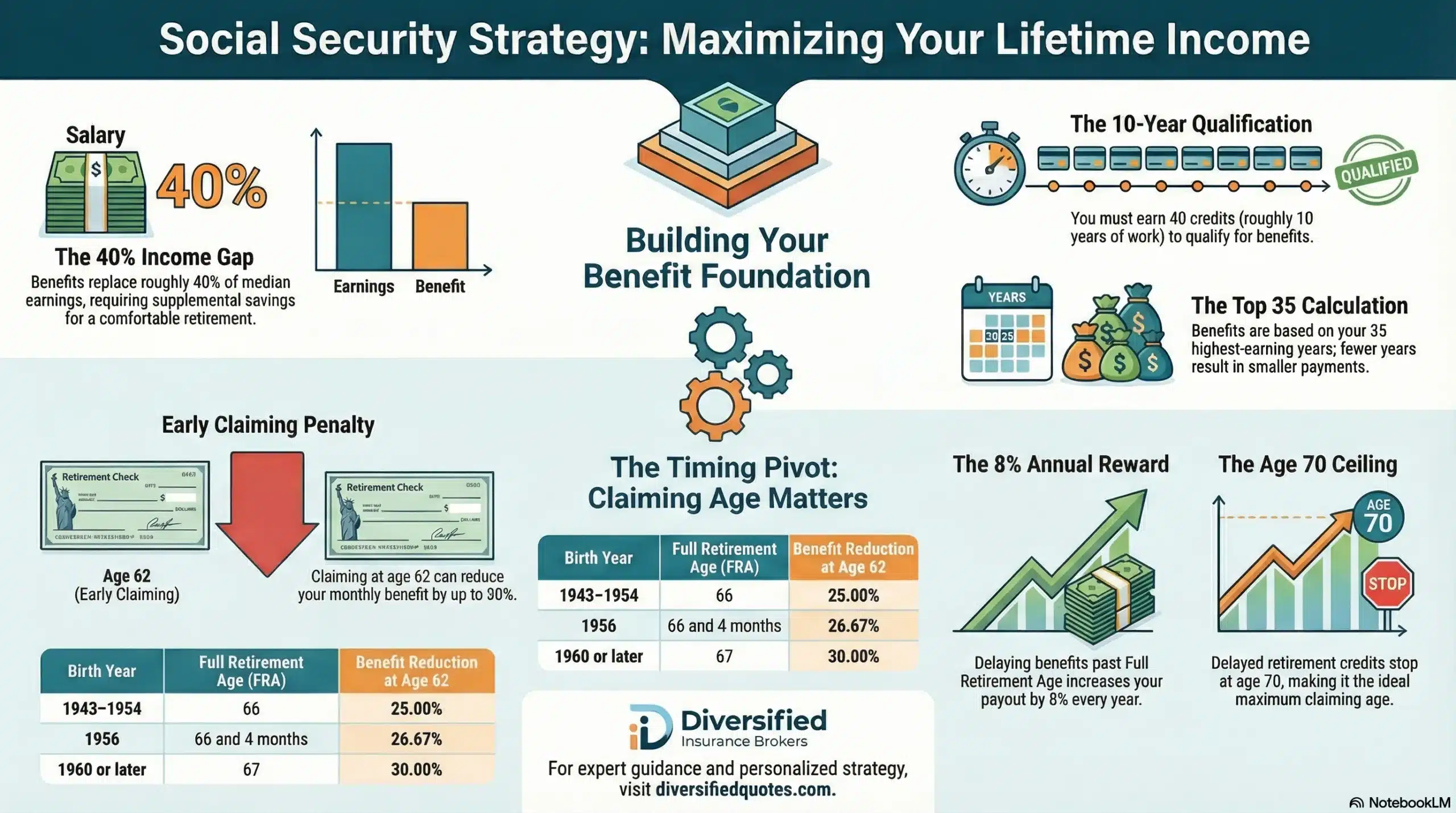
Delaying Social Security benefits is discussed primarily as an income maximization strategy — every year you wait beyond full retirement age, your monthly benefit increases by approximately eight percent through delayed retirement credits, up to age seventy. But delay also functions as a Social Security tax minimization strategy, and that dimension is less often discussed. Every year you do not receive Social Security benefits is a year in which those benefits cannot be taxed. If you retire at sixty-three and delay Social Security until seventy, you have seven years during which the fifty-percent provisional income inclusion for Social Security simply does not exist.
During those delay years, you are also free to pursue Roth conversions, strategic traditional IRA drawdowns, and capital gain harvesting at lower rates — all without Social Security adding to your provisional income base. The net result is not just a higher monthly benefit starting at seventy, but a significantly better tax position for the rest of retirement. Our resource on when to start taking Social Security benefits explores the claiming age decision from multiple angles. The companion discussion of delayed retirement credits and payout increases quantifies the benefit growth available through patience. For the tax planning dimension specifically, coordinating claiming age with Roth conversion work is one of the most impactful combined strategies available to pre-retirees.
Strategy Five: Managing Required Minimum Distributions
Required Minimum Distributions from traditional IRAs and employer-sponsored plans become mandatory at age seventy-three under current law (age seventy-five for those born in 1960 or later under SECURE 2.0 provisions). RMDs are fully taxable as ordinary income and add dollar for dollar to provisional income, making them one of the primary drivers of Social Security tax exposure in later retirement. A retiree who accumulates a large traditional IRA during working years can find that the combination of Social Security, RMDs, and other income easily pushes them well above the eighty-five percent taxability threshold, with no easy way to reduce the impact once RMDs are underway. This is precisely why proactive planning for how to minimize Social Security taxes must begin long before RMDs arrive.
Several approaches can reduce RMD burden. Systematic pre-RMD drawdowns — taking voluntary distributions from traditional accounts before age seventy-three to reduce the account balance subject to mandatory withdrawals — can spread income across more favorable years. Roth conversions accomplish the same goal by permanently removing assets from traditional accounts. The QCD strategy described earlier can satisfy RMD obligations without generating taxable income. Understanding how long your IRA will last in retirement under different withdrawal scenarios helps identify how large your RMDs will be and how much income planning they require. Our resource on the ten-year rule for inherited IRAs is also relevant for those planning distributions across generations.
Strategy Six: Annuity Structures and Provisional Income
Fixed and fixed indexed annuities interact with the provisional income formula in ways that many retirees do not fully understand — and the distinctions matter significantly for how to minimize Social Security taxes. A non-qualified annuity funded with after-tax dollars applies what the IRS calls an exclusion ratio to each payment: only the earnings portion is taxable, while the return of principal is tax-free. This means that a non-qualified annuity payment adds less to provisional income than an equivalent distribution from a traditional IRA, which is fully taxable. Understanding the annuity exclusion ratio is therefore directly relevant to Social Security tax planning.
By contrast, annuity payments from qualified annuities funded with IRA or 401(k) rollover money are fully taxable as ordinary income and add entirely to provisional income. This does not make qualified annuities inferior — their guaranteed income and longevity protection remain valuable — but it does mean the tax treatment differs based on funding source. Our pages on non-qualified annuity taxation and qualified annuity taxation lay out these distinctions clearly. The deeper question for Social Security tax planning is not just how the annuity is taxed, but how its income integrates with your overall provisional income picture — and whether the structure keeps you below, within, or above the thresholds that govern your benefit taxation. For retirees building guaranteed income alongside Social Security, our page on how Social Security and annuities work together covers this integration comprehensively.
Tax-deferred growth within a fixed or fixed indexed annuity also has provisional income implications. During the accumulation phase, interest credited inside a deferred annuity does not appear in your income and therefore does not count toward provisional income in the year it is earned. This differs from taxable CDs or bond interest, which creates income in the year credited regardless of whether you spend it. Our resource on tax-deferred annuity strategies explores how accumulation-phase deferral can be used to smooth income across retirement years and reduce peak-year provisional income.
Strategy Seven: Capital Gain and Investment Income Management
Investment income — including dividends, interest, and realized capital gains — flows into AGI and therefore into provisional income, affecting Social Security taxability. Retirees with taxable brokerage accounts face this challenge particularly acutely. Even relatively small dividend or interest income from a brokerage account can be enough to push provisional income across a threshold when combined with Social Security and other income sources. Managing the timing and character of investment income is therefore a meaningful lever for how to minimize Social Security taxes.
Long-term capital gains are taxed at preferential rates (zero percent for taxpayers in the lower brackets, fifteen percent at moderate incomes), but they still add to provisional income in the year they are recognized. Retirees who have unrealized gains in taxable accounts should model the provisional income impact of realizing those gains in a given year before executing sales. Harvesting gains in years when other income is low — for example, during the early retirement years before Social Security begins — can allow the recognition of appreciated assets at favorable rates without triggering Social Security taxation. This connects directly to the broader question of how financially sophisticated retirees minimize taxes, where income timing and character management are core disciplines.
Municipal bond interest presents a specific wrinkle that surprises many retirees. Municipal bond income is excluded from federal income tax and does not appear in AGI. However, it is added back to AGI for purposes of calculating provisional income. A retiree who holds a large municipal bond portfolio and believes it is creating tax-free income may be surprised to discover that the interest is pushing Social Security benefits into the fifty or eighty-five percent taxability zone. This is not a reason to avoid municipal bonds, but it is a reason to account for them precisely when modeling how to minimize Social Security taxes.
The Social Security Fairness Act and New Tax Planning Context
A significant development affecting Social Security taxation planning for a specific group of retirees is the Social Security Fairness Act, signed into law in January 2025. The Act eliminated both the Windfall Elimination Provision (WEP) and the Government Pension Offset (GPO), two long-standing provisions that reduced Social Security benefits for public servants — including teachers, police officers, firefighters, and federal employees covered by the Civil Service Retirement System — who also received government pensions from employment not covered by Social Security taxes. According to the Social Security Administration, the Act affected more than 2.8 million people, with retroactive payments issued beginning in early 2025 to cover benefits from January 2024 onward.
For those affected, the practical consequence is a meaningful increase in monthly Social Security income — and a corresponding increase in provisional income that may push previously untaxed or lightly taxed benefits into a higher taxability tier. A retiree who previously received a reduced benefit due to WEP and therefore sat comfortably below the fifty-percent threshold may now find that restored benefits combined with pension income crosses into the eighty-five percent zone. The retroactive lump-sum payments also created a one-time income spike for many recipients, with tax implications in the year received. The IRS lump-sum election under Publication 915 can sometimes mitigate the tax impact of retroactive payments, but the analysis requires professional guidance. Our resource on how the Government Pension Offset works provides background on the pre-Act rules and is particularly useful for those navigating this transition.
IRMAA: The Medicare Cost Dimension of Social Security Tax Planning
Every serious plan for how to minimize Social Security taxes must also account for Medicare’s Income-Related Monthly Adjustment Amount, commonly called IRMAA. IRMAA is a surcharge on Medicare Part B and Part D premiums that applies to higher-income retirees based on their modified adjusted gross income from two years prior. The first IRMAA surcharge tier begins at $106,000 for single filers and $212,000 for married couples filing jointly in reference years for which confirmed data is available. Breaching these thresholds can add hundreds of dollars per month in additional Medicare premiums — a cost that compounds annually and runs for the length of retirement.
The Medicare dimension amplifies the cost of uncontrolled AGI significantly. A traditional IRA withdrawal that triggers both Social Security taxation and an IRMAA premium increase creates a much higher effective cost than the stated marginal tax rate suggests. This is why income planning for how to minimize Social Security taxes and Medicare premium management are inseparable disciplines. Our resource on IRMAA planning strategies covers the threshold structure in depth, and the discussion of how MAGI affects Social Security and Medicare simultaneously shows how the two costs interact. For retirees who are not yet on Medicare, understanding Medicare Part D and its income-sensitive premiums is important advance preparation.
State-Level Social Security Taxation
While federal rules receive most of the attention in discussions of how to minimize Social Security taxes, state income taxation of Social Security benefits adds an additional layer of complexity for retirees in certain states. As of the most recent available data, the majority of states do not tax Social Security income at all. However, a minority of states do apply some level of taxation, and the rules vary — some states use the federal formula, others have their own income thresholds, and some phase out taxation entirely above certain income levels. States that previously taxed Social Security benefits, including Nebraska and West Virginia, have been phasing out those taxes in recent years.
Retirees who are considering relocation in retirement should factor state-level Social Security tax treatment into the overall analysis. A move from a state that taxes Social Security at the state level to one that does not can meaningfully reduce the overall tax burden on benefits without any other planning change. This state-level dimension connects to the broader retirement income question of how much income you need in retirement on an after-tax basis, because the same gross income produces meaningfully different net income depending on state of residence.
Coordinating the Full Picture: A Framework for How to Minimize Social Security Taxes
Effective Social Security tax minimization does not happen strategy by strategy in isolation — it requires coordinating all income sources, account types, benefit timing, and Medicare planning into a coherent annual picture. The framework begins with identifying your projected provisional income under a baseline scenario: add your expected AGI from all sources (IRA withdrawals, pensions, investment income, part-time work) plus tax-exempt bond interest plus fifty percent of your expected Social Security benefit. Compare that number to the $25,000/$32,000 and $34,000/$44,000 thresholds. The gap between your baseline and the nearest threshold tells you how much income management is available and worth pursuing.
From there, each strategy discussed above addresses part of the gap. Roth conversions reduce future traditional account balances. QCDs replace taxable distributions with non-income charitable transfers. Benefit delay reduces the number of years Social Security is in the formula while simultaneously growing the eventual benefit. Annuity structure choices affect whether income adds dollar-for-dollar or partially to provisional income. Investment income management controls what enters AGI from taxable accounts. Together, these levers can meaningfully reduce — and in some cases eliminate — federal taxes on Social Security benefits for retirees who engage in proactive planning. Our resource on maximizing Social Security benefits addresses the income side of this equation, while our Social Security planning services offer direct guidance on how to apply these principles to your specific situation.
Jason Stolz, CLTC, CRPC, DIA, CAA, has worked with retirees for more than twenty-five years across the disciplines of income protection, annuity design, and retirement tax planning. The intersection of Social Security tax strategy with annuity income engineering is a particular area of focus at Diversified Insurance Brokers, because the two planning domains share the same fundamental variables: income timing, account structure, and rate of return assumptions. Understanding annuity options for retirees without pensions is an important companion topic for retirees building their guaranteed income floor alongside Social Security. When Social Security is properly timed, appropriately taxed, and intelligently coordinated with annuity income, the result is a retirement income architecture that maximizes what actually lands in the retiree’s account each month — the only number that ultimately matters. For further context on protecting the assets that generate this income, see our guide on protecting your nest egg and our overview of key retirement considerations for those approaching this planning phase.
Schedule a Social Security Survivor Benefits Review
We are not affiliated with or endorsed by the Social Security Administration. Educational purposes only.
Frequently Asked Questions: How to Minimize Social Security Taxes
What is provisional income and how does it determine Social Security taxation?
Provisional income is the IRS calculation that determines how much of your Social Security benefit is subject to federal income tax. It is computed by adding your adjusted gross income, plus any tax-exempt interest you received, plus fifty percent of your total Social Security benefits for the year. This sum is compared against fixed thresholds that have not changed since the 1980s and 1990s. For a single filer, provisional income below $25,000 results in no federal tax on Social Security. Between $25,000 and $34,000, up to fifty percent of benefits may be taxable. Above $34,000, up to eighty-five percent may be taxable. For married couples filing jointly, the thresholds are $32,000 and $44,000 respectively. Because these thresholds are frozen and not indexed to inflation, a growing number of retirees cross into taxable territory each year simply through ordinary cost-of-living adjustments to their benefits and modest investment growth. Understanding what enters the provisional income formula — and what does not — is the foundation of every strategy for how to minimize Social Security taxes.
What is the Social Security tax torpedo and how can I avoid it?
The Social Security tax torpedo refers to the dramatically elevated effective marginal tax rate that occurs when a retiree’s provisional income sits in the band between the fifty-percent and eighty-five percent taxability thresholds. In this zone, each additional dollar of ordinary income — such as a traditional IRA withdrawal — triggers not only tax on that dollar but also makes an additional eighty-five cents of Social Security benefits taxable. For a retiree nominally in the twenty-two percent federal bracket, this can create an effective marginal rate of nearly forty percent or higher on additional income taken in the torpedo zone. Avoiding the torpedo requires keeping provisional income either well below the first threshold or accepting that you are in the eighty-five percent zone and planning accordingly rather than hovering in the worst part of the curve. Strategies that help avoid or mitigate the torpedo include Roth conversions before Social Security begins, Qualified Charitable Distributions in lieu of taxable RMDs, and careful income sequencing to avoid bunching distributions in torpedo-zone years. Strategic annuity design using non-qualified funding sources can also reduce the portion of each income payment that counts toward provisional income.
Do Roth IRA withdrawals affect Social Security taxation?
No. Qualified Roth IRA withdrawals do not count as adjusted gross income and are not included in the provisional income formula. This means that drawing from a Roth IRA to fund living expenses in retirement does not push Social Security benefits further into taxable territory, which is one of the primary reasons Roth conversions are such a powerful strategy for how to minimize Social Security taxes. When you convert traditional IRA or 401(k) funds to a Roth account, you pay ordinary income tax on the converted amount in the year of conversion. However, all future qualified distributions from that Roth account are tax-free and excluded from provisional income permanently. The optimal window for Roth conversions is typically the period between retirement and when Social Security benefits begin, especially if you have delayed claiming to age seventy. During those years, your income may be relatively low, your tax bracket may be favorable, and you can systematically reduce the traditional account balances that would otherwise generate large taxable RMDs in later retirement when Social Security is already adding to provisional income.
How do Qualified Charitable Distributions reduce Social Security taxes?
A Qualified Charitable Distribution allows IRA owners who are at least seventy-and-a-half years old to transfer funds directly from their IRA to a qualifying charity — up to the indexed annual limit — without those funds ever entering adjusted gross income. Because a QCD bypasses AGI entirely, it reduces provisional income by the full amount of the distribution. For a retiree who would otherwise have to take a required minimum distribution of $15,000 from a traditional IRA, directing that $15,000 as a QCD to charity eliminates that entire amount from provisional income. This can move a retiree from the eighty-five percent Social Security taxability zone to the fifty percent zone, or potentially below the threshold entirely, depending on their overall income picture. The QCD also satisfies the RMD requirement dollar for dollar. An important rule is that the transfer must go directly from the IRA custodian to the charitable organization — checks payable to the account owner that are then donated do not qualify. The QCD also creates downstream benefits for Medicare: lower AGI can keep a retiree below IRMAA premium surcharge thresholds, further amplifying the total financial benefit of this strategy.
Does tax-exempt municipal bond interest count as provisional income?
Yes, and this surprises many retirees. Tax-exempt municipal bond interest is excluded from federal income tax and does not appear in your adjusted gross income. However, it is specifically added back to AGI when calculating provisional income for Social Security taxation purposes. The IRS provisional income formula explicitly includes tax-exempt interest as one of the three components. This means that a retiree who holds a substantial municipal bond portfolio and receives significant tax-exempt interest each year is adding that interest to their provisional income even though it never appears on the taxable income line of their return. The interest is not taxed directly, but it can indirectly cause Social Security benefits to become taxable by pushing provisional income over the thresholds. This does not necessarily mean municipal bonds are the wrong choice — they may still be efficient depending on the full tax picture — but it is essential to account for this interaction precisely when modeling strategies for how to minimize Social Security taxes.
How do annuity income payments interact with Social Security taxation?
The tax treatment of annuity income in relation to Social Security depends on how the annuity was funded. For non-qualified annuities — those purchased with after-tax dollars outside of an IRA or employer plan — each payment is divided by an exclusion ratio into a tax-free return of principal component and a taxable earnings component. Only the taxable earnings portion enters AGI and counts toward provisional income. This means that a non-qualified annuity payment adds less to provisional income than an equivalent distribution from a traditional IRA, which is fully taxable. For qualified annuities funded with IRA or 401(k) rollover dollars, the full payment is taxable as ordinary income and adds entirely to provisional income. Both structures can be appropriate depending on circumstances, but understanding the difference is important for Social Security tax planning. Additionally, during the accumulation phase of a deferred annuity, credited interest is tax-deferred and does not appear in income or provisional income in the year earned — unlike taxable CD interest, which creates income whether or not it is spent.
How does delaying Social Security help with tax minimization?
Delaying Social Security benefits serves two distinct purposes: it increases the monthly benefit through delayed retirement credits at a rate of approximately eight percent per year beyond full retirement age up to age seventy, and it creates years during which Social Security income — and the fifty-percent provisional income inclusion — simply does not exist. Every year you postpone claiming is a year during which the Social Security component of provisional income is zero, potentially keeping your total provisional income below taxable thresholds even with IRA withdrawals or investment income. Those delay years also represent the optimal window for Roth conversions, capital gain harvesting, and traditional account drawdowns, all executed while Social Security is not adding to the provisional income calculation. The combined effect — higher monthly benefits beginning at seventy, fewer lifetime years of benefit taxation, and a cleaner window for pre-claim income planning — makes delay one of the most tax-efficient strategies available to retirees who can fund their spending through other means during the gap years.
How does the Social Security Fairness Act affect tax planning for affected retirees?
The Social Security Fairness Act, signed into law in January 2025, eliminated the Windfall Elimination Provision and the Government Pension Offset, restoring full Social Security benefits to more than 2.8 million public servants — including teachers, firefighters, police officers, and federal employees under the Civil Service Retirement System. For affected retirees, this means higher monthly benefit payments beginning in early 2025, plus retroactive lump-sum payments covering benefits from January 2024 forward. From a tax planning perspective, the restored benefits increase monthly Social Security income, which increases the fifty-percent Social Security component of provisional income. Retirees who previously sat below taxable thresholds may now find themselves in the fifty or eighty-five percent taxability zone. The lump-sum retroactive payments also created a one-time income event in the year received, potentially pushing annual income significantly higher. The IRS lump-sum election described in Publication 915 allows some recipients to calculate tax as if the income was received across the prior years it covered, which can reduce the impact. Affected retirees should review their entire income picture with a qualified professional.
Do states also tax Social Security benefits?
The majority of states do not tax Social Security benefits at all, but a minority do impose some level of state income tax on benefits, with varying rules. Some states use the federal provisional income formula as a starting point, others have their own income-based exemptions, and some apply taxation only above certain income thresholds. States including Nebraska and West Virginia have been in a multi-year phase-out of Social Security taxation. For retirees considering relocation, the state tax treatment of Social Security benefits is a meaningful financial variable — a move from a state that taxes benefits to one that does not can materially increase after-tax monthly income without any other planning change. When evaluating state tax exposure, it is important to look at the full picture including state income tax rates on other income types, property taxes, and estate tax rules, rather than Social Security taxation in isolation. A complete retirement income analysis accounts for both federal and applicable state-level Social Security tax rules.
How does IRMAA connect to Social Security tax minimization planning?
IRMAA — the Income-Related Monthly Adjustment Amount — is a Medicare Part B and Part D premium surcharge that applies to higher-income beneficiaries based on modified adjusted gross income from two years prior. The first surcharge tier begins at $106,000 for single filers and $212,000 for married couples filing jointly in reference years for which published data is available. Income management strategies used to minimize Social Security taxes — particularly Roth conversions, QCDs, and careful traditional IRA drawdown sequencing — simultaneously reduce the AGI figure that Medicare uses to determine IRMAA surcharges two years later. This means that the benefits of disciplined income management are doubled: you avoid Social Security taxation now and reduce Medicare premium surcharges in the future. The two-year lookback makes proactive income planning especially valuable, because the decisions you make today affect Medicare costs you will pay years from now. A retiree who keeps income just below the first IRMAA threshold through QCDs or Roth withdrawals may avoid premium surcharges that would otherwise add hundreds of dollars per month to their Medicare costs.
About the Author:
Jason Stolz, CLTC, CRPC, DIA, CAA and Chief Underwriter at Diversified Insurance Brokers (NPN 20471358), is a senior insurance and retirement professional with more than 25 years of real-world experience helping individuals, families, and business owners protect their income, assets, and long-term financial stability. As a long-time partner of the nationally licensed independent agency Diversified Insurance Brokers, Jason provides trusted guidance across multiple specialties—including fixed and indexed annuities, long-term care planning, personal and business disability insurance, life insurance solutions, Group Health, Travel Medical and Evacuation Insurance, and short-term health coverage. Diversified Insurance Brokers maintains active contracts with over 100 highly rated insurance carriers, ensuring clients have access to a broad and competitive marketplace.
His practical, education-first approach has earned recognition in publications such as VoyageATL, and contributions from his agency featured in Kiplinger and GoBankingRates— highlighting his commitment to financial clarity and client-focused planning. Drawing on deep product knowledge and years of hands-on field experience, Jason helps clients evaluate carriers, compare strategies, and build retirement and protection plans that are both secure and cost-efficient. Visitors who want to explore current annuity rates and compare options across multiple insurers can also use this annuity quote and comparison tool.
Explore All Social Security Planning Guides: Browse our complete Social Security Planning guide — covering filing strategies, spousal benefits, survivor benefits, taxes, WEP, GPO & more.
Last Reviewed: June 11, 2026 |
Reviewed by: Jason Stolz, CLTC, CRPC, DIA, CAA
Chief Underwriter, Diversified Insurance Brokers, Inc. | NPN: 20471358 | Diversified Insurance Brokers, Inc. — Licensed in all 50 states
Fact Checked by: Tonia Pettitt, CMIP©
Medicare Specialist, Diversified Insurance Brokers, Inc. | NPN: 14374308 | Diversified Insurance Brokers, Inc. — Licensed in all 50 states
Did you find this content helpful? Leave us a Google review — it helps others find trustworthy guidance too.
Editorial Standards: Diversified Insurance Brokers maintains rigorous editorial standards to ensure accuracy, clarity, and independence in all content. Learn more about our editorial standards and commitment to transparency.
