
Disability Insurance for HAZMAT Cleanup Professionals
As an Independent Disability Insurance Broker, we have access to exclusive discounts and negotiated pricing most captive agents can’t offer — see the full breakdown near the end of this page.
Disability Insurance for HAZMAT Cleanup Professionals

Jason Stolz CLTC, CRPC, DIA, CAA
Disability insurance for HAZMAT cleanup professionals is essential income protection for one of the most hazardous occupational categories in the American workforce — a profession defined by sustained, direct exposure to the chemical, biological, radiological, and physical hazards that other industries are legally required to remove, contain, and decontaminate before work can proceed. Whether you work as a hazardous materials removal worker conducting asbestos abatement, lead paint remediation, or mold remediation on residential and commercial properties, operate as an environmental cleanup contractor performing soil and groundwater contamination remediation, respond as a HAZMAT emergency responder to chemical spills and industrial accidents, conduct clandestine drug lab decontamination or biohazard remediation, work in radioactive materials cleanup at nuclear facilities or research institutions, or provide any of the other specialized hazardous environment services that constitute professional HAZMAT cleanup work — your income depends on your physical health and your body’s sustained tolerance for occupational exposures that carry documented long-latency as well as acute disability consequences.
The Bureau of Labor Statistics specifically identifies hazardous materials removal work as physically demanding and dangerous, requiring specific safety procedures and personal protective equipment to protect against injuries and illnesses whose severity ranges from acute chemical burns and respiratory injury to progressive long-latency cancers and pulmonary diseases that develop years after initial exposure. Published research documents that inhalation is the most common route of occupational HAZMAT exposure — accounting for 89% of exposure events in documented HAZMAT incident studies — and chemical asphyxiants and acids are the leading exposure substance categories. OSHA’s Respiratory Protection standard is among the top most frequently cited federal standards year after year, reflecting the pervasive nature of airborne hazard exposure in work environments where HAZMAT cleanup professionals operate daily.
At Diversified Insurance Brokers, we help hazardous materials removal workers, environmental cleanup contractors, HAZMAT emergency responders, biohazard remediation professionals, and specialized environmental cleanup professionals structure disability insurance coverage that reflects the genuine long-latency and acute occupational health risks of HAZMAT work, the predominantly contractor and self-employment income structure of the environmental remediation industry, and the policy features that provide the most meaningful protection when chemical exposure, physical injury, or occupational illness prevents continued work in this demanding profession.
Protect Your HAZMAT Professional Income
Compare disability insurance options designed for hazardous materials removal workers, environmental cleanup contractors, HAZMAT emergency responders, and biohazard remediation professionals.
Request Disability Insurance OptionsThe Occupational Hazard Profile of HAZMAT Cleanup Work
HAZMAT cleanup professionals work in environments that other industries are legally prohibited from operating in without the protective equipment, training, and safety protocols that define the HAZMAT profession. The hazard profile of this work is multi-dimensional — combining acute chemical exposure risk from toxic substance contact, long-latency carcinogen and disease-causing exposure from sustained career contact with known harmful substances, physical injury risk from the demanding and often confined physical environments of hazardous cleanup operations, and the respiratory hazard of sustained airborne toxin exposure that accumulates over a HAZMAT career in ways whose full biological consequences may not be apparent for years or decades after the initial exposures occurred.
The specific hazardous substances that HAZMAT cleanup professionals encounter across their careers span an extraordinarily wide spectrum of toxic and carcinogenic materials — asbestos fibers that produce mesothelioma and asbestosis with latency periods of 20 to 50 years after initial exposure; lead compounds that accumulate in bone and tissue producing chronic neurological, cardiovascular, and reproductive health consequences; volatile organic compounds from petroleum spills and industrial solvent contamination producing liver, kidney, and central nervous system damage; mold and biological contaminants producing respiratory sensitization and progressive pulmonary disease; radioactive materials at nuclear facilities producing ionizing radiation exposure with well-documented carcinogenicity; and the full range of industrial and household chemicals that constitute the contamination scenarios that HAZMAT remediation professionals address across a working career. The long-latency chemical exposure disability profile of HAZMAT cleanup professionals parallels that documented for other sustained toxic substance exposure professionals, including asbestos removal workers managing the specific long-latency mesothelioma and asbestosis disability risk of sustained asbestos fiber exposure.
Long-Latency Occupational Illness — The Defining Disability Risk of HAZMAT Careers
The most financially consequential and most specifically occupational disability risk for HAZMAT cleanup professionals is not the acute chemical exposure event — the spill, the respirator failure, the protective suit breach — but the long-latency progressive illness that develops from cumulative career exposure to carcinogens and toxic substances that damage the respiratory system, the liver, the kidneys, the nervous system, and the immune system gradually over years of sustained professional work in hazardous environments.
Mesothelioma — the rare and invariably fatal cancer caused by asbestos fiber inhalation — has a documented latency period of 20 to 50 years from initial asbestos exposure to diagnosis. An asbestos abatement professional who conducts decades of asbestos removal work may not receive a mesothelioma diagnosis until well into retirement age, but the disabling illness itself — and the income loss it produces when work capacity is eliminated — develops from occupational exposures that occurred throughout their working career. Individual disability insurance that covers any qualifying disability from any cause, including cancer and progressive occupational illness, provides income replacement when the disabling disease develops regardless of how many years after the initial occupational exposure the condition manifests.
Pulmonary diseases from sustained inhalation exposure — including chemical-induced pulmonary fibrosis, reactive airways dysfunction syndrome, and chronic obstructive pulmonary disease accelerated by occupational chemical exposure — represent the most prevalent long-latency disability category for HAZMAT professionals whose primary exposure route is respiratory. A HAZMAT cleanup worker whose career pulmonary function measurements show progressive decline from sustained chemical inhalation — even with appropriate respirator use — faces a genuine occupational disability when that decline reaches the functional threshold that prevents the sustained physical respiratory demands of active HAZMAT site work. The long-latency pulmonary and chemical exposure disability risk for HAZMAT professionals parallels that documented in other sustained confined-space and chemical exposure occupational contexts, including chimney sweepers and confined-space workers managing long-latency respiratory disease disability risk from career chemical and particulate exposure.
Acute Chemical Exposure Events — The Sudden Disability Risk
Beyond the long-latency progressive illness risk that defines the most serious long-term disability concern for HAZMAT professionals, acute chemical exposure events — the unexpected release, the equipment failure, the confined space accumulation of toxic gases — create sudden and potentially catastrophic disability outcomes that can end a HAZMAT career without warning. Published research specifically documents that spills and releases account for the large majority of HAZMAT incidents, with gas and vapor exposures being the most common acute exposure form.
An acute high-concentration chemical exposure event — a respirator failure during a confined space entry with accumulated hydrogen sulfide, a chemical splash that penetrates protective equipment and contacts skin or eyes, a toxic gas release that overwhelms the protective capacity of available respiratory protection during an emergency response — can produce immediate and severe chemical burns, acute lung injury from toxic inhalation, neurological damage from neurotoxic chemical exposure, and systemic organ damage from absorbed toxic substances. These acute exposure injuries can produce permanent functional limitations — chronic reactive airways disease, permanent loss of pulmonary function, peripheral neuropathy from solvent absorption, permanent vision impairment from chemical eye injury — that prevent return to active HAZMAT work even when the immediate acute injury has been medically managed. The acute chemical exposure sudden disability risk for HAZMAT professionals parallels documented hazard profiles in other extreme chemical handling occupations, including explosives handlers and extreme hazardous materials operations professionals managing acute catastrophic injury disability risk.
Physical Injury Risk in HAZMAT Cleanup Operations
Beyond chemical exposure, HAZMAT cleanup professionals face significant physical injury risk from the demanding physical environments in which hazardous material removal and remediation work occurs. Asbestos abatement, lead paint removal, mold remediation, and soil contamination cleanup frequently require working in confined spaces, at elevated heights, in structurally compromised buildings, and under physical conditions that combine the standard construction and demolition physical injury risks with the additional complexity of working in full protective equipment that limits mobility, reduces situational awareness, and creates heat stress risk from the thermal burden of impermeable protective suits in warm conditions.
Falls from scaffolding and elevated positions during building material abatement, struck-by injuries from structural elements during demolition-concurrent remediation work, confined space entry injuries from unexpected atmospheric changes or structural collapse, heat exhaustion and heat stroke from sustained work in impermeable protective suits during summer operations — all of these physical injury mechanisms produce the same serious orthopedic, spinal, and traumatic brain injuries that characterize other extreme construction and industrial work contexts. A HAZMAT professional who sustains a serious fall during an elevated abatement operation may require months of recovery during which no hazardous materials work can be performed — with the same financial consequences as any other physical labor professional facing a serious acute injury without institutional income protection. The physical injury profile of HAZMAT cleanup work from elevated work, confined space operations, and heavy protective equipment physical demands parallels that facing other extreme physical trade professionals, including well drillers and other physically demanding hazardous trade professionals managing acute physical injury disability risk in extreme occupational environments.
The Contractor and Self-Employment Structure of HAZMAT Work
The environmental remediation and hazardous materials removal industry is dominated by contractor and subcontractor structures — independent environmental remediation companies, specialty abatement contractors, self-employed biohazard remediation professionals, and emergency response contractors who generate income through project-based work rather than stable employer salary and benefits. This contractor structure creates the same acute financial vulnerability to disability that affects all self-employed and contractor professionals: when a disability prevents work, income stops immediately and completely, while business fixed costs, vehicle and equipment obligations, insurance premiums, and household financial obligations continue regardless.
A self-employed HAZMAT remediation contractor who is disabled by an acute chemical exposure event or by the early manifestation of a long-latency occupational illness has zero project revenue during the disability period — with no employer sick pay, no group disability plan, and no workers’ compensation coverage for self-employed sole proprietors who have not elected it. The self-employment income protection planning need for HAZMAT contractors closely parallels that facing other self-employed extreme physical trade operators, including independent contractors and self-employed trade professionals managing income protection entirely without institutional employer safety nets.
Even HAZMAT professionals who work as employees of environmental remediation companies face significant income protection gaps — employer group disability plans that calculate benefits on base salary while excluding overtime and hazard pay that constitute meaningful portions of HAZMAT worker total compensation, own-occupation definitions that convert to any-occupation standards after two years, and benefit amounts that fall short of the income replacement that hazardous environment work compensation levels require. Structuring individual supplemental disability insurance that covers total HAZMAT professional compensation — including overtime and hazard differential pay — fills these specific employer group plan gaps for employed HAZMAT workers.
Case Study: Environmental Remediation Contractor Earning $95,000 Per Year
Consider a self-employed environmental remediation contractor specializing in lead abatement and mold remediation, earning $95,000 annually in net Schedule C project revenue from a roster of residential and commercial remediation clients. Following a respirator malfunction during a confined space lead abatement operation, this contractor sustains acute lead poisoning producing peripheral neuropathy — persistent numbness and motor weakness in both hands — requiring eight months of medical treatment and recovery during which active abatement work is medically prohibited.
| Scenario | Without Disability Insurance | With Disability Insurance |
|---|---|---|
| Monthly Income During Recovery | $0 — self-employed, no sick pay, no group plan, no workers’ comp | $3,900–$4,750 individual benefit |
| 8-Month Total Income | $0 | $31,200–$38,000 |
| Business Fixed Costs During Disability | Equipment, vehicle, insurance continue with zero project revenue | Disability benefit addresses personal and business financial obligations during recovery |
| Long-Term Career Outcome | Financial pressure may force premature return before neuropathy resolved — risk of permanent nerve damage | Full recovery on medical timeline; return to abatement work when neurological function genuinely restored |
Lead poisoning from abatement work exposures — even with required personal air monitors and protective equipment — represents a documented occupational health risk for lead abatement professionals across their careers. Peripheral neuropathy from lead accumulation is a genuine functional disability for HAZMAT professionals whose abatement work requires sustained fine motor control and physical manual dexterity, and individual disability insurance ensures that the financial pressure of zero project revenue does not force premature return to lead exposure environments before neurological recovery is complete.
The Application Timing Problem — Why Early Application Is Critical for HAZMAT Professionals
The long-latency nature of many HAZMAT occupational health risks creates a specific and important planning urgency that differs from most other professions: the conditions most likely to produce long-term disability for a HAZMAT professional may begin accumulating in the medical record — through periodic biological monitoring, pulmonary function testing, blood lead level testing, and occupational health surveillance — years before any disabling illness has actually developed. Once these monitoring results show trends that carriers interpret as elevated health risk, exclusion riders or coverage limitations may apply to the very conditions most likely to produce long-term disability.
An asbestos abatement professional who applies for disability insurance after five years of career exposure — with no mesothelioma diagnosis and no pulmonary fibrosis finding, but with biological monitoring records showing prior elevated exposure levels — may face exclusion riders for respiratory and pulmonary conditions or for asbestos-related illnesses at application. Applying as early as possible in a HAZMAT career — ideally before any occupational health monitoring results, biological exposure markers, or pulmonary function test changes have been documented — ensures comprehensive coverage for the long-latency conditions most likely to eventually produce career-ending disability. The non-cancelable and guaranteed renewable provision then locks in that early-career health rating for the policy’s entire duration, regardless of what occupational health changes monitoring reveals in subsequent career years. The early application timing imperative for HAZMAT professionals parallels that facing other long-latency chemical and environmental exposure occupational health professions, including construction and industrial workers managing long-latency occupational health conditions from sustained career toxic exposure.
Key Policy Features for HAZMAT Professional Disability Insurance
Disability insurance for HAZMAT cleanup professionals should incorporate specific policy provisions that address the long-latency chemical illness risk, the acute chemical exposure disability profile, the physical injury risk of hazardous environment work, and the self-employment or contractor income structure common across the environmental remediation industry. The own-occupation definition is foundational — ensuring that a HAZMAT professional who cannot perform the specific physical, chemical exposure, and protective equipment demands of active hazardous materials cleanup work receives disability benefits regardless of theoretical capacity for less physically demanding or less chemically hazardous work. Our comprehensive resource on own-occupation disability insurance explained covers how this definition protects HAZMAT professional income from the chemical illness and physical injury conditions most likely to prevent continued hazardous environment work.
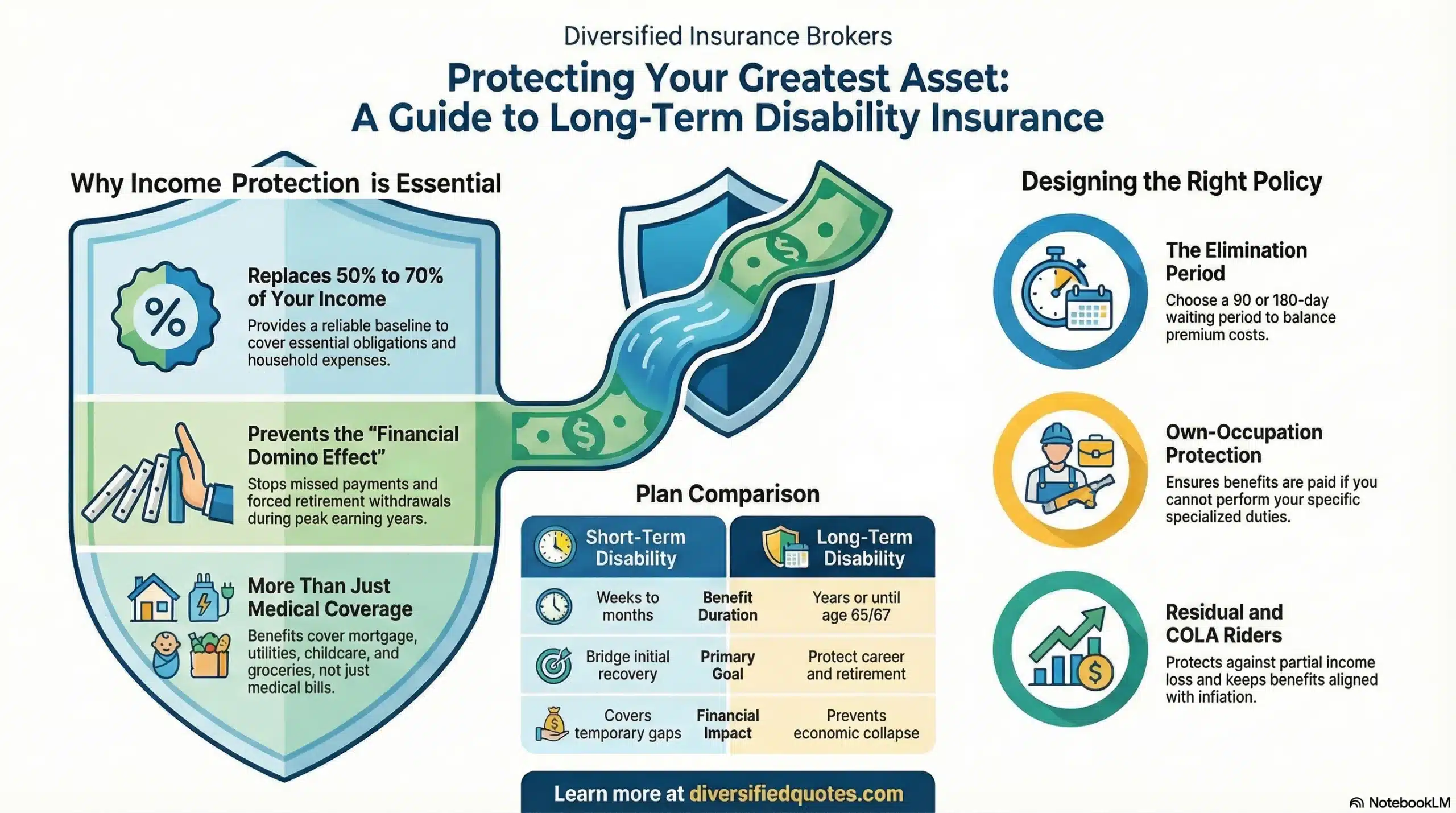
A residual disability rider is important for HAZMAT professionals whose occupational illness conditions may reduce work capacity without eliminating it entirely — a professional whose pulmonary function decline limits tolerance for full protective suit operations but who can manage less intensive remediation work earns reduced income without being totally disabled. Our resource on how residual disability insurance benefits work explains how partial disability coverage supports HAZMAT professionals through graduated capacity reductions from progressive occupational illness. The elimination period should be calibrated to available financial reserves — our guide on how disability insurance elimination periods work provides the complete framework. A cost-of-living adjustment rider preserves real benefit value across potentially extended disability periods from progressive long-latency illness — our resource on disability income insurance with a COLA rider explains this protection. For HAZMAT professionals exploring short-term coverage options alongside long-term disability insurance, our guide on how to buy short-term disability insurance covers the complete income protection picture.
Occupational Classification and Specialty Market Access for HAZMAT Professionals
Hazardous materials removal and cleanup work presents one of the most significant occupational classification challenges in the disability insurance marketplace. The documented chemical exposure risks, the physical hazard profile of confined space and elevated position work, and the long-latency occupational illness consequences of sustained HAZMAT career work place this profession in a hazard category that some standard retail disability insurance carriers decline to underwrite or underwrite only with significant restrictions that limit the coverage’s practical value.
Specialty market carriers with specific experience in extreme hazard occupational disability insurance write HAZMAT professional coverage with terms and features that are genuinely meaningful for the specific risk profile involved. The occupational classification challenge for HAZMAT professionals requires specialty broker expertise that understands which carriers have favorable underwriting guidelines for environmental remediation work, how to present a HAZMAT professional’s specific duty profile and exposure history most favorably to underwriters, and which policy features are non-negotiable for adequate income protection at the hazard level that HAZMAT work involves. The specialty market access requirement for HAZMAT professional disability insurance parallels that facing other extreme hazard outdoor professionals, including boilermakers and other extreme industrial professionals requiring specialty market disability insurance placement and crane operators and high-hazard industrial equipment professionals managing specialty carrier access for comprehensive disability coverage.
Why HAZMAT Cleanup Professionals Need an Independent Disability Insurance Broker
Disability insurance for HAZMAT cleanup professionals requires specialty market carrier access expertise, knowledge of how to present extreme chemical hazard occupational duty profiles most favorably for underwriting, experience with the long-latency occupational illness disability coverage considerations specific to HAZMAT work, and understanding of both self-employed contractor income documentation and employed worker group plan gap analysis. Standard retail disability insurance applications are not optimized for the HAZMAT professional occupational context, and a general insurance agent unfamiliar with environmental remediation occupational classification considerations will not access the specialty market carriers or structure the policy features that genuine HAZMAT professional income protection requires.
At Diversified Insurance Brokers, we work with hazardous materials removal workers, environmental cleanup contractors, HAZMAT emergency responders, biohazard remediation professionals, and all categories of hazardous environment cleanup specialists to structure disability insurance coverage that reflects the specific long-latency and acute disability risks of their professional work, accurately documents their contractor or employment income for benefit calculation, and accesses the specialty market carriers whose underwriting guidelines most favorably accommodate the HAZMAT professional occupational profile. Our dedicated resource on why independent disability insurance brokers matter explains the full value of this approach for extreme hazard professionals who require specialty market expertise. And our resource on whether disability insurance is worth the investment provides the foundational financial case that applies with particular force to HAZMAT professionals whose occupational exposure creates some of the most significant long-latency disability risks in any American profession.
Final Thoughts on Disability Insurance for HAZMAT Cleanup Professionals
HAZMAT cleanup professionals perform work that is essential to public health, environmental safety, and the remediation of the contamination that industrial activity, disaster response, and everyday chemical hazards produce across the American built and natural environment. They do this work in conditions that require sustained direct contact with the most dangerous substances in those environments — protected by training, equipment, and protocols that reduce but cannot eliminate the chemical exposure, physical injury, and long-latency occupational illness risks that define their professional hazard profile.
Disability insurance for HAZMAT cleanup professionals — applied for as early as possible in the career before monitoring results accumulate, structured with own-occupation protection for the specific physical and chemical demands of HAZMAT work, built with a residual disability rider for the graduated capacity reductions that progressive occupational illness produces, calibrated to total professional compensation including overtime and hazard pay, and placed through specialty market carriers who understand the HAZMAT occupational risk profile — provides the income protection that professionals who accept extraordinary occupational exposure on behalf of the rest of society genuinely deserve.
Related Pages
Talk With an Advisor Today
Choose how you’d like to connect—call or message us, then book a time that works for you.
Schedule here:
calendly.com/jason-dibcompanies/diversified-quotes
Licensed in all 50 states • Fiduciary, family-owned since 1980
Disability Insurance for HAZMAT Cleanup Professionals FAQs
Yes — HAZMAT cleanup professionals can obtain individual disability insurance, though the extreme hazard profile of this occupation makes specialty market carrier access and experienced independent broker guidance essential rather than optional. The specific chemical exposure risks, long-latency occupational illness concerns, and physical hazard profile of hazardous materials cleanup work place this profession in a classification category that some standard retail disability insurance carriers decline entirely or underwrite only with restrictions that limit practical value. Specialty market carriers with specific experience in extreme hazard occupational disability insurance write HAZMAT professional coverage with policy terms and features that are genuinely meaningful for the risk profile involved. The most important planning considerations for HAZMAT professionals are applying as early in their career as possible before any occupational health monitoring results or biological exposure markers accumulate, selecting a carrier whose underwriting guidelines most favorably accommodate the HAZMAT occupational classification, ensuring own-occupation coverage specifically protects the physical and chemical demands of hazardous environment work, and including a residual disability rider for the graduated capacity reductions that long-latency occupational illness typically produces. For context on disability insurance for other extreme chemical and hazardous occupational environments, see our page on disability insurance for industrial and hazardous environment workers requiring specialty market disability placement.
The disability risk profile for HAZMAT cleanup professionals spans both long-latency progressive occupational illness and acute chemical exposure injury categories that are each specific to the hazardous materials they work with. Long-latency conditions — the most financially significant disability category over a full HAZMAT career — include mesothelioma and asbestosis from asbestos fiber inhalation with latency periods of 20 to 50 years; progressive pulmonary fibrosis, reactive airways dysfunction syndrome, and COPD acceleration from sustained chemical inhalation exposure; chronic liver and kidney disease from organic solvent absorption; peripheral neuropathy from heavy metal accumulation including lead; and ionizing radiation-related malignancies from radiological materials work. Acute exposure conditions include chemical burns from corrosive substance contact, acute lung injury from high-concentration toxic inhalation, neurological impairment from acute neurotoxic solvent exposure, and systemic poisoning from absorbed toxic substances. Physical injury from falls during elevated abatement work, confined space incidents, heat exhaustion from protective suit thermal burden, and musculoskeletal conditions from the sustained physical demands of full protective equipment work round out the acute injury profile. Any of these conditions — acute or long-latency — qualifies for individual disability insurance benefits when it prevents performing HAZMAT professional duties under a well-structured own-occupation policy.
Yes — individual disability insurance covers disability from any qualifying cause including long-latency occupational illness when the condition prevents performing professional duties, regardless of how many years after initial occupational exposure the disabling illness develops. A mesothelioma diagnosis in a retired asbestos abatement professional who developed the disease from career fiber inhalation decades earlier, a progressive pulmonary fibrosis that develops from cumulative chemical inhalation over a HAZMAT career, or a chronic peripheral neuropathy from career lead absorption — all qualify for disability benefits when the condition meets the policy’s definition of disability. The critical planning implication is timing of application. Individual disability insurance requires medical underwriting at the time of application, and occupational health monitoring results — biological exposure markers, elevated blood lead levels, pulmonary function test trends, radiological surveillance findings — that show evidence of prior toxic exposure can result in exclusion riders for the specific conditions associated with those exposures. Applying for disability insurance before any such monitoring results have been documented in the medical record — ideally early in a HAZMAT career — ensures comprehensive long-latency illness coverage without exclusions for the conditions most likely to produce career-ending disability decades later. For context on long-latency occupational illness disability coverage, see our page on disability insurance for trade professionals managing long-latency occupational illness from sustained chemical and material exposure.
Own-occupation disability insurance pays benefits when a disabling condition prevents performing the specific duties of HAZMAT cleanup professional work — sustained operation in protective equipment, chemical exposure management, respiratory protection compliance, physical demands of confined space and elevated position hazardous material removal, and all the specific physical and health tolerance requirements of active hazardous environment work — regardless of whether the professional could theoretically perform other less hazardous or less physically demanding work in a different setting. Any-occupation coverage only pays if the HAZMAT professional cannot perform virtually any gainful employment. A HAZMAT professional whose pulmonary function decline from career chemical inhalation prevents sustained respirator use and physical protective suit work but who could theoretically perform sedentary office work would receive no any-occupation benefits — while an own-occupation policy recognizes the genuine inability to continue active HAZMAT professional work and pays accordingly. For HAZMAT professionals who have invested in specialized certifications, training, and years of experience building the professional expertise that commands the income premiums of hazardous environment work, own-occupation coverage is the only definition that genuinely protects that professional income from the conditions most likely to prevent continued HAZMAT career work.
Within the HAZMAT cleanup profession, specific work types carry distinct and documented disability risk profiles. Asbestos abatement carries the highest long-latency cancer risk — mesothelioma and lung cancer from asbestos fiber inhalation have decades-long latency periods and are invariably serious conditions. Lead abatement creates significant chronic lead accumulation risk producing neurological, cardiovascular, and reproductive health consequences that accumulate with career exposure duration even with proper biological monitoring and protective equipment. Petrochemical and solvent contamination remediation creates volatile organic compound inhalation and dermal absorption risk producing liver, kidney, and central nervous system consequences. Clandestine drug lab decontamination creates acute chemical exposure risk from the full range of precursor chemicals and synthesis byproducts present at these sites. Radiological materials cleanup creates ionizing radiation exposure risk with well-documented carcinogenicity. Biohazard remediation creates bloodborne pathogen and infectious disease exposure risk from trauma scene, decomposition, and infectious material cleanup contexts. HAZMAT emergency response creates the broadest spectrum of acute exposure risk because responders encounter unknown substance releases under time-compressed conditions that limit the protective equipment optimization possible in planned remediation operations. Each of these work types has a distinct disability risk profile that should inform both the policy features selected and the carrier chosen for disability coverage.
Workers’ compensation applies to employed HAZMAT cleanup professionals for work-related injuries and occupational diseases, providing medical treatment coverage and partial wage replacement for approved claims. However, workers’ compensation has specific limitations that are particularly significant for HAZMAT professionals. Workers’ compensation covers only work-related conditions — off-duty injuries, illness unrelated to work, and conditions whose work-relatedness cannot be clearly established are entirely excluded. For long-latency occupational illnesses like mesothelioma and chronic chemical-induced disease, establishing work-relatedness can require complex medical and legal documentation showing causal connection between specific occupational exposures and the eventual illness — a process that can take months or years during which income protection depends on other sources. Workers’ compensation also provides only partial wage replacement — typically 60% to 66% of regular wages — excluding overtime, hazard pay, and other compensation supplements common in HAZMAT work. Self-employed HAZMAT cleanup contractors who have not elected workers’ compensation coverage for themselves receive no workers’ compensation protection whatsoever. Individual disability insurance fills all of these gaps — covering any cause of disability, for the full benefit period, at benefit amounts calibrated to total compensation, and without work-relatedness establishment requirements. For context on workers’ compensation limitations for hazardous trade professionals, see our page on disability insurance for hazardous trade professionals managing workers’ compensation gaps with individual supplemental coverage.
Residual disability coverage pays proportional benefits when a disabling condition reduces a HAZMAT professional’s work capacity without completely eliminating the ability to work. This is particularly relevant for HAZMAT professionals because the most serious long-latency disability conditions — progressive pulmonary disease, chronic neurological effects from chemical exposure, deteriorating physical tolerance for protective equipment demands — typically develop gradually over time, producing graduated capacity reductions rather than sudden binary incapacity. A HAZMAT professional whose progressive pulmonary function decline limits sustained physical work in full respiratory protective equipment but who can manage shorter duration or less intensive remediation tasks earns reduced income without being totally disabled. Without a residual disability rider, a total-disability-only policy pays nothing during these partial capacity periods that may extend for months or years as progressive occupational illness advances. A residual rider supplements reduced HAZMAT professional income proportionally throughout the period of reduced capacity — if work capacity and income are reduced by 40%, the residual rider pays approximately 40% of the full disability benefit, providing continuous financial support from the earliest functional limitation through complete disability if the condition progresses. For HAZMAT professionals whose most likely long-term disability conditions follow gradual onset patterns, the residual rider is not an optional policy enhancement but the feature that makes disability insurance function as genuine income protection for the disability scenarios most likely to actually materialize.
Self-employed HAZMAT cleanup contractors document income through Schedule C tax returns, and the income documentation requirements for disability insurance underwriting require specific handling to accurately reflect genuine earning capacity. Project-based environmental remediation contracting income is inherently variable — a contractor’s annual revenue depends on project volume, contract size, and market conditions — and a benefit calculation based on a single atypical year may substantially misrepresent long-run earning capacity. Most disability insurance carriers use a multi-year average of Schedule C net income to determine insurable income for self-employed professionals, typically averaging two to three recent complete tax years. Business expenses that reduce gross revenues before net Schedule C income is calculated — equipment costs, vehicle expenses, subcontractor payments, insurance premiums, and other operating costs — affect the net income figure on which benefit amounts are based. For HAZMAT contractors with significant business expense structures, the relationship between gross project revenue and insurable net income requires careful documentation to ensure the benefit amount reflects actual personal earning capacity. Working with an independent broker experienced in presenting contractor business income structures for disability insurance underwriting is important for securing benefit amounts that genuinely reflect the HAZMAT contractor’s professional earning capacity and income protection need. For context on self-employment income documentation for hazardous trade contractors, see our page on disability insurance for self-employed trade contractors managing Schedule C income documentation for disability insurance benefit calculation.
Elimination period selection for HAZMAT cleanup professionals depends on employment structure and available financial reserves. Self-employed HAZMAT contractors with no employer coverage and project revenue stopping immediately at disability onset face the sharpest version of the elimination period decision — their income stops completely on day one with no institutional bridge income of any kind. For these professionals, the elimination period selection must be matched to genuine available savings: a 30-day period provides the fastest benefit access at higher premium cost, while a 90-day period requires having three full months of living and business operating expenses available in savings to bridge without financial crisis. Employed HAZMAT workers who have employer short-term disability coverage and accumulated sick leave may manage a longer 90-day elimination period on an individual supplemental policy, using employer bridge income during the waiting period before individual benefits activate. For acute chemical exposure events that produce immediate work incapacity — an exposure event that sidelines a HAZMAT professional completely from day one — the elimination period is the period of zero income before benefits begin, making a shorter period more appropriate for professionals without substantial financial reserves. For gradual onset long-latency occupational illness that produces progressive capacity reduction, a longer elimination period may be more manageable since income reduction is graduated rather than sudden.
The best time is as early as possible in a HAZMAT career — ideally before the first occupational health monitoring results, biological exposure markers, or pulmonary function tests have been conducted and documented in the medical record. This is a more urgent timing consideration for HAZMAT professionals than for almost any other occupation, because the standard occupational health surveillance programs that responsible HAZMAT employers and regulatory requirements mandate — periodic blood lead monitoring for lead abatement workers, annual pulmonary function testing for respiratory hazard exposure workers, biological monitoring for specific chemical exposures — create medical documentation of occupational exposure history that may affect disability insurance underwriting even when no disabling illness has yet developed. Carriers evaluating a HAZMAT professional’s application who see documented elevated prior biological exposure markers may apply exclusion riders for the specific long-latency conditions associated with those exposures. Applying before any monitoring program results exist in the medical record — at career entry, before occupational surveillance begins — ensures that disability insurance is in place and comprehensive before these monitoring records accumulate. The non-cancelable and guaranteed renewable provision then locks in the early-career health classification for the policy’s entire duration, regardless of what monitoring results subsequently reveal over a decades-long HAZMAT career. This early application timing is the single most important practical planning consideration for HAZMAT cleanup professionals seeking comprehensive long-latency occupational illness coverage.
An independent broker with extreme hazard occupational disability insurance expertise is essential for HAZMAT cleanup professionals for reasons that go beyond the general independent broker advantages. HAZMAT cleanup work requires specialty market carrier access that general agents and standard retail applications cannot provide — the carriers willing to write meaningful disability coverage for this occupation, at terms that genuinely address the chemical exposure and long-latency illness risks involved, are not the same carriers that appear in standard retail disability insurance comparison tools. Different carriers within the specialty market segment approach HAZMAT occupational classification, exposure history underwriting, and policy feature availability differently enough that the difference between the right carrier and the wrong one for a specific HAZMAT professional’s situation can mean the difference between comprehensive coverage and an exclusion-laden policy that won’t respond when the most likely disability scenarios actually occur. At Diversified Insurance Brokers, we evaluate the full specialty market for every HAZMAT professional we work with — identifying the carriers most favorably disposed to each individual’s specific work type, exposure history, and health status, presenting occupational duty profiles and income documentation in the most favorable way for underwriting, and structuring coverage with the own-occupation definitions, residual disability riders, and COLA provisions that HAZMAT professional disability risk specifically requires.
About the Author:
Jason Stolz, CLTC, CRPC, DIA, CAA and Chief Underwriter at Diversified Insurance Brokers (NPN 20471358), is a senior insurance and retirement professional with more than 25 years of real-world experience helping individuals, families, and business owners protect their income, assets, and long-term financial stability. As a long-time partner of the nationally licensed independent agency Diversified Insurance Brokers, Jason provides trusted guidance across multiple specialties—including fixed and indexed annuities, long-term care planning, personal and business disability insurance, life insurance solutions, Group Health, Travel Medical and Evacuation Insurance, and short-term health coverage. Diversified Insurance Brokers maintains active contracts with over 100 highly rated insurance carriers, ensuring clients have access to a broad and competitive marketplace.
His practical, education-first approach has earned recognition in publications such as VoyageATL, and contributions from his agency featured in Kiplinger and GoBankingRates— highlighting his commitment to financial clarity and client-focused planning. Drawing on deep product knowledge and years of hands-on field experience, Jason helps clients evaluate carriers, compare strategies, and build retirement and protection plans that are both secure and cost-efficient. Visitors who want to explore current annuity rates and compare options across multiple insurers can also use this annuity quote and comparison tool.
Explore More Disability Insurance Options: Browse our complete guide to Disability Insurance for Trades, Construction & Industrial — covering contractors, electricians, plumbers, welders, roofers, machinists & skilled trades from 100+ carriers.
Last Reviewed: June 8, 2026 |
Reviewed by: Jason Stolz, CLTC, CRPC, DIA, CAA
Chief Underwriter, Diversified Insurance Brokers, Inc. | NPN: 20471358 | Diversified Insurance Brokers, Inc. — Licensed in all 50 states
Fact Checked by: Tonia Pettitt, CMIP©
Medicare Specialist, Diversified Insurance Brokers, Inc. | NPN: 14374308 | Diversified Insurance Brokers, Inc. — Licensed in all 50 states
Did you find this content helpful? Leave us a Google review — it helps others find trustworthy guidance too.
Editorial Standards: Diversified Insurance Brokers maintains rigorous editorial standards to ensure accuracy, clarity, and independence in all content. Learn more about our editorial standards and commitment to transparency.
