
Disability Income Insurance for Teachers
As an Independent Disability Insurance Broker, we have access to exclusive discounts and negotiated pricing most captive agents can’t offer — see the full breakdown near the end of this page.
Disability Income Insurance for Teachers

Jason Stolz CLTC, CRPC
Teaching is among the most physically, cognitively, and emotionally demanding professions in America — and one of the most underinsured when it comes to personal disability income protection. According to a 2024 RAND survey of nearly 1,500 teachers, 60% of K-12 educators are burned out, citing that the stress and disappointments of teaching are not worth it. A 2024 RAND survey also showed that 7% of K-12 teachers quit in 2023–2024, reporting worse wellbeing than the general population of working adults. And a 2024 EDChoice survey found that 20% of K-12 teachers were absent from school in 2023 because of burnout and lack of motivation. These are not statistics about a profession with a comfortable margin for extended unpaid absence — they describe a workforce already stretched thin, with modest salaries, significant student loan debt, and limited savings cushions that make even a brief income interruption financially destabilizing.
The disability risks teachers face are specific, well-documented, and distinct from most other professions. The occupational health risk of teachers often leads to voice disorders and musculoskeletal disorders including lower and upper back pain, neck and shoulder pain, upper and lower arm pain, wrist, elbow, hip, knee, and ankle pain. Other disorders that teachers often struggle with include varicose veins, high blood pressure, autoimmune diseases, cardiovascular diseases, and sinusitis. Peer-reviewed research confirms that teachers have voice disorder rates approximately twice the general population — in one study, the adjusted odds ratio was 2.04 for lifetime prevalence of voice disorders in teachers versus non-teachers, and a Korean national health insurance analysis found the number of teachers receiving vocal nodule treatments was about four times higher than the total population rate. Physical education teachers, coaches, and those who teach in high-noise environments face additional elevated health risks on top of the baseline profile that all classroom teachers share.
At Diversified Insurance Brokers, we help teachers at every career stage — new educators establishing their first disability protection, mid-career teachers with families and mortgages who cannot afford coverage gaps, and veteran teachers approaching the end of their careers — identify the right policy structure for their specific occupational classification, their existing group and association coverage, and their income protection needs. Our independent disability insurance brokerage gives us access to more than 100 carriers so we are never limited to a single company’s product in designing a teacher’s income protection strategy.
Compare Disability Insurance Options for Teachers
We specialize in income protection for K-12 teachers, administrators, special education professionals, coaches, and higher education faculty.
Request a Disability Insurance QuoteCall 800-533-5969
The Real Disability Risks Teachers Face
Teaching requires sustained physical presence, vocal endurance, cognitive engagement, and emotional regulation over extended periods — a combination that creates occupational health risk across multiple pathways simultaneously. The classroom environment is not the benign, low-risk setting that standard occupational classification might suggest at first glance.
Voice disorders are the most distinctly teacher-specific disability risk in any profession. Continuous speaking for 6 to 8 hours per day, projecting across noisy classrooms with poor acoustic treatment, managing the vocal demands of instruction, discipline, and parent communication simultaneously — these sustained demands produce vocal nodules, vocal cord hemorrhage, spasmodic dysphonia, and chronic dysphonia at rates that are dramatically higher among teachers than any other occupational group. A voice disorder that prevents clear, sustained classroom instruction can end a teaching career just as definitively as a physical injury — and the own-occupation disability policy provision is the difference between whether a voice-disabled teacher receives benefits or is told they can still perform “some work” in another field.
Musculoskeletal disorders represent the second major disability pathway for classroom teachers. Extended standing during instruction, repetitive reaching and writing on boards, bending to assist students, managing physical classroom setups, and the sustained physical demands of special education teachers who assist students with physical disabilities all produce cumulative back, neck, shoulder, and knee problems over teaching careers. Physical education teachers and coaches carry additional musculoskeletal load from demonstrating activities, supervising physical sports, and the physical demands of athletic coaching environments.
Mental health and burnout represent the third — and statistically most significant — disability pathway for teachers in the current environment. A survey revealed that more than three in every four teachers have experienced health problems arising from the failure to handle stress. Approximately 38% experienced regular headaches or stomach aches, while another 17% experienced heart palpitations or chest pain. Clinical depression, anxiety disorders, and burnout-related conditions that prevent sustained classroom engagement represent genuine disabling events under own-occupation disability insurance — and their prevalence in the teaching workforce makes the mental and nervous provision benefit period one of the most important policy evaluation criteria for teacher disability planning.
Occupational Classification for Teachers
Disability insurance carriers assign occupational classifications that directly affect both premium rates and available policy provisions. Teacher classification varies meaningfully by carrier and by specific role, and understanding these variations helps teachers identify the carriers whose classification is most favorable for their specific assignment.
For teachers, occupational classes can vary by the insurance company. Those who teach standard academic subjects may be classified as a 3 out of 5 classes, a 5 out of 6 classes, or a 4 out of 6 classes. Some companies rate teachers at the elementary and high school levels lower than principals and administrators. Some insurers may rate you higher based on education and longevity. Some, but not all, insurers give lower occupational ratings to those who teach drivers education, industrial arts, physical education, or dance, or those who also coach sports.
This carrier variability is practically significant. A standard classroom academic teacher might receive a Class 3 or Class 4 rating depending on the carrier — a difference that produces meaningfully different premium rates for identical coverage amounts. A high school PE teacher who also coaches a varsity sport might receive a favorable Class 4 at one carrier and a less favorable Class 2 or Class 3 at another. Higher education faculty — college professors whose teaching is primarily lecture-based with significant research and writing duties — often receive Class 4 or Class 5 ratings reflecting the more office-like, knowledge-worker nature of academic faculty work. School administrators and principals, whose work is primarily office-based and administrative, often receive Class 4 or Class 5 ratings as well. Our resource on disability insurance by occupation provides the foundational framework for understanding how classification affects all the provisions available at each class level.
The Teacher’s Policy Feature Checklist
| Policy Feature | Why It Matters for Teachers | What to Look For |
|---|---|---|
| Own-Occupation Definition | Voice disorders, specific physical limitations, and cognitive conditions may prevent teaching while still allowing other work — own-occupation ensures payment regardless | True own-occupation language; avoids any-occupation crossover for the policy’s full benefit period |
| Mental/Nervous Benefit Period | Burnout, depression, anxiety, and PTSD from workplace violence are leading disability causes for teachers — a 24-month cap is inadequate | Policies that provide the standard benefit period for mental health; avoid 24-month limitation policies if possible |
| Non-Cancelable / Guaranteed Renewable | Teachers’ salaries are modest but stable; locking in coverage early prevents career health changes from affecting future premiums or provisions | Non-cancelable preferred; guaranteed renewable as minimum acceptable |
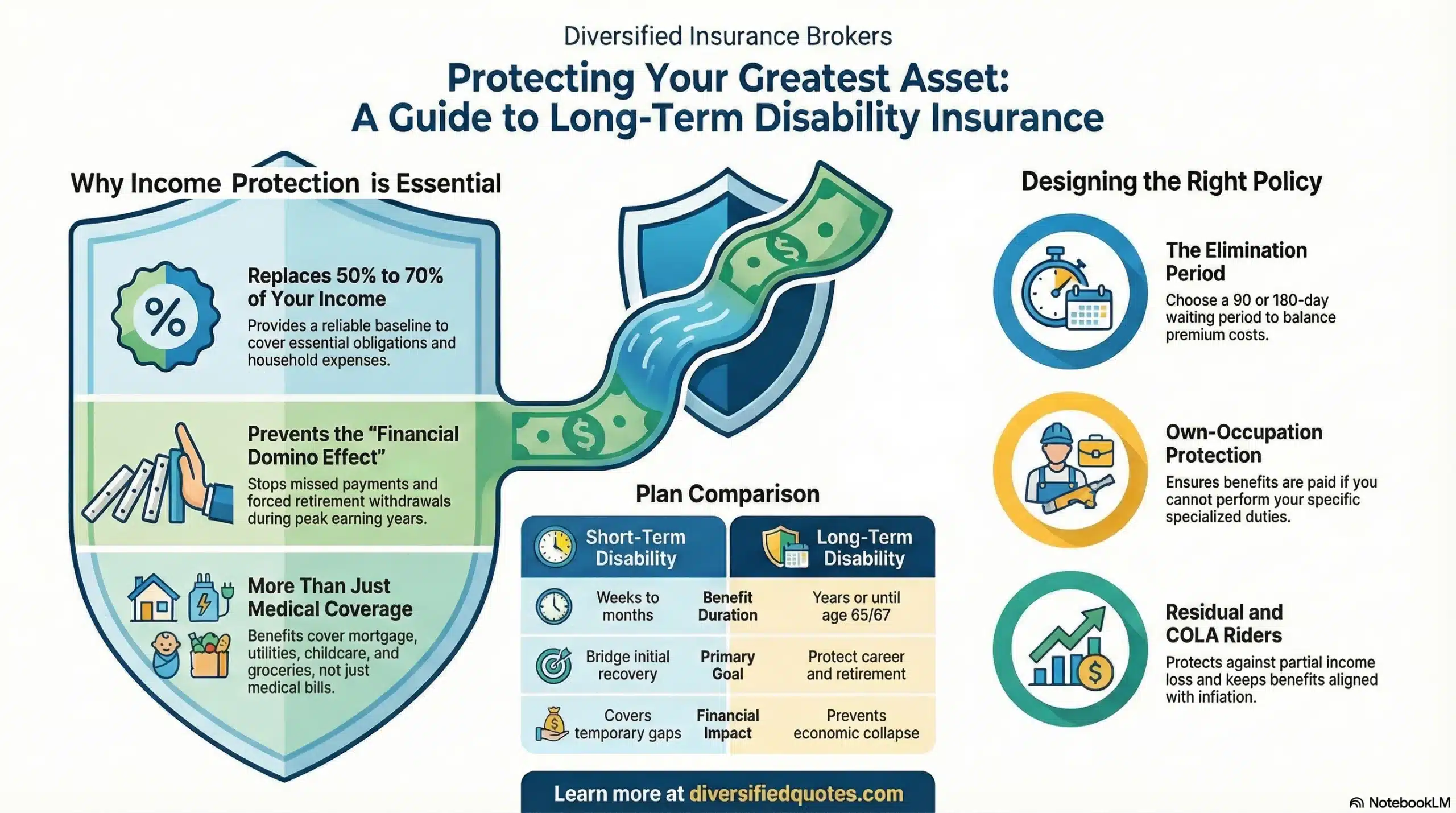
| Residual Disability Rider | Partial return to teaching at reduced capacity — common after voice or musculoskeletal conditions — produces real income reduction the residual rider addresses | Income comparison trigger at 20% income loss; recovery benefit provision |
| Future Increase Option | Teacher salaries grow incrementally through step schedules; FIO allows coverage to grow with income without new medical underwriting | Elect maximum available FIO at initial application; aligns with career salary trajectory |
| COLA Rider | Long-tenure teachers face potential disability decades before retirement; COLA preserves purchasing power over a potentially 20+ year disability period | 3% compound COLA provides strongest protection; even 3% simple is meaningful over long claim durations |
Group and Association Coverage: What Teachers Already Have
Most public school teachers have access to some form of group disability coverage through their school district, state teachers’ retirement system, or teacher union association. The National Education Association (NEA) offers its Income Protection Insurance Plan to NEA members — providing up to two-thirds of regular salary up to a maximum of $6,000 per month, with no health questions required at enrollment. NEA members can choose their monthly benefit amount, choose when payouts begin (on the 8th, 15th, 31st, or 91st day of disability), and choose short-term disability up to a maximum of two years or long-term disability to age 65. The no-health-questions enrollment is particularly valuable for teachers who have developed health conditions during their careers that would complicate individual applications.
State teacher retirement systems also provide disability benefits in varying structures. Illinois’s Teachers’ Retirement System provides both occupational and nonoccupational disability benefits, with disability benefits available to members who are unable to work due to injury or illness, with members accruing service credit while receiving both types of benefits. However, these state pension disability provisions typically apply any-occupation or very broad disability standards after an initial period — after the 12 months following the commencement of disability benefit payments, the member shall be unable to engage in any gainful occupation for which the member is reasonably fitted by education, training, or experience. This shift from own-occupation to any-occupation after year one can significantly limit the pension system’s disability coverage for teachers who develop conditions that prevent teaching but not all other work.
The NEA plan’s $6,000 monthly cap and the pension system’s broad disability definition after year one both create meaningful gaps for teachers who want comprehensive, own-occupation-defined income protection without benefit period limitations or definition shifts over time. Individual disability insurance from the private market fills these gaps — providing true own-occupation definition for the full benefit period, higher benefit amounts for higher-earning teachers, and policy terms that do not shift from favorable definitions to less favorable ones over the claim’s lifetime.
Why Own-Occupation Definition Is Critical for Teaching Specifically
The own-occupation disability definition is not a minor technical distinction for teachers — it is the provision that determines whether the most common teacher-specific disability scenarios actually produce benefit payments. Teaching requires specific functional capacities that are not required in other professions: sustained vocal production for hours each day, ability to stand and move throughout a classroom environment, sustained cognitive engagement with students across varying ability levels, and the emotional and behavioral regulation to manage classroom dynamics effectively under constant interpersonal pressure.
A voice disorder that produces hoarseness, vocal fatigue, or voice loss after sustained speaking prevents a teacher from performing the core function of classroom instruction — but may not prevent the same teacher from working in a library reference role, an administrative office, or a retail environment that does not require sustained vocal production. Under an any-occupation disability definition, that teacher might be denied benefits because other work remains theoretically possible despite the career-ending professional disability. Under a true own-occupation definition, the teacher receives full benefits because teaching — their insured occupation — requires what the voice disorder prevents, regardless of what other work might theoretically be available.
The same logic applies to teachers disabled by specific musculoskeletal conditions that prevent the physical demands of classroom work but not desk-based employment, and to teachers disabled by mental health conditions that prevent the specific emotional and cognitive demands of classroom teaching but not all professional activity. In each scenario, own-occupation language is the provision that translates the actual career-ending nature of the disability into benefit payment. Our resource on own-occupation disability insurance explains the full definitional spectrum and the claim consequences of each tier across all professions.
The Mental Health Benefit Period: A Teacher-Specific Priority
Mental health conditions — clinical depression, anxiety disorders, PTSD from workplace violence, and burnout-related conditions that progress to clinical diagnoses — are among the most prevalent disabling conditions affecting teachers. With 60% of K-12 educators reporting burnout in 2024 RAND research and more than three in four teachers having experienced stress-related health problems, the mental health dimension of teacher disability risk is not marginal — it is central. And the policy provision that determines whether a teacher’s mental health disability produces long-duration benefits or terminates at 24 months is the mental and nervous condition benefit period clause.
Many standard group LTD policies and some individual disability policies limit mental and nervous condition claims to 24 months — a cap that may be entirely inadequate for a teacher experiencing clinical depression requiring multi-year treatment, PTSD from a violent classroom incident requiring extended therapeutic intervention, or a burnout-related condition that requires a fundamental career reassessment before return to teaching is possible. Individual policies that provide the standard benefit period for mental health conditions — treating a disabling depression the same as a disabling back injury for purposes of benefit duration — are meaningfully superior for teachers whose professional environment creates elevated mental health disability risk. Evaluating this provision explicitly before purchasing, and selecting policies that minimize or eliminate the 24-month mental health cap, is teacher-specific due diligence that the general disability insurance market rarely emphasizes but the teacher workforce specifically needs.
The Physical Education Teacher and Coach Classification Challenge
Physical education teachers and coaches face a more complex disability insurance situation than standard classroom academic teachers. The additional physical demands of PE instruction — demonstrating athletic activities, supervising competitive sports, outdoor and gymnasium environments, physical contact in assisting students — and the elevated physical risk of coaching create a profile that some carriers rate less favorably than classroom academic instruction. Some, but not all, insurers give lower occupational ratings to those who teach drivers education, industrial arts, physical education, or dance, or those who also coach sports.
For PE teachers and coaches, working with an independent broker who can compare how multiple carriers classify the specific combination of instructional and coaching duties is particularly valuable — because the difference between carriers may be a full occupational class, which translates to significant premium differences for identical coverage amounts. A PE teacher who is classified Class 3 at one carrier and Class 2 at another is paying different premiums for the same policy provisions, and identifying the most favorable carrier for their specific duty mix produces real savings. Our resource on disability insurance for athletic trainers and our overview of disability insurance for coaches provide additional context for professionals whose work combines instruction with physical activity.
Student Loan Debt and the Cost of Waiting
Many teachers enter the profession with substantial student loan debt from the undergraduate and graduate education required for teaching credentials. The combination of modest starting salaries and student loan obligations means most early-career teachers have minimal savings cushions — making even a brief income interruption from disability financially destabilizing in a way that a higher-earning professional with greater liquid assets might be able to absorb. The combination of student loan debt and a modest salary means you probably have little in savings. Therefore, you can’t afford to miss even one paycheck because of an injury or illness.
This financial fragility is precisely why establishing disability coverage early in a teaching career — before health conditions accumulate and before the premium advantage of younger age is lost — produces compounding benefits. A policy purchased at age 25 with 25-year-old health locks in non-cancelable terms permanently, retaining that 25-year-old premium rate at age 40 regardless of any health changes in between. A teacher who develops a voice condition at age 32 and has a non-cancelable individual policy purchased at 25 continues paying their 25-year-old premium rate with full own-occupation coverage for the voice condition — while a teacher who waited and now tries to purchase at 32 with a known voice condition may face an exclusion rider for voice disorders, a premium loading, or a denial depending on the severity.
The future increase option is equally valuable for teachers whose income follows step-based salary schedules that produce predictable annual increases over 15 to 20 years of service. Electing the maximum available future increase option at initial application preserves the right to grow coverage proportionally with salary increases without new medical underwriting, regardless of what health changes occur in the intervening years. Our resources on the disability insurance future insurability rider and best disability insurance rates provide the framework for understanding how timing and feature selection affect the long-term value of a teacher’s disability policy.
Special Education Teachers: Elevated Physical Risk
Special education teachers and paraprofessionals who work with students with physical, behavioral, or developmental disabilities face a specific physical disability risk dimension that standard classroom teachers do not. Physical assistance with student transfers, mobility support, behavioral intervention and restraint in some settings, and the physical demands of adapted physical education for students with significant physical needs create a work profile with genuine injury risk from musculoskeletal strain, acute injury from behavioral incidents, and the cumulative physical toll of physically demanding student assistance work across a career.
Special education teachers may receive slightly different occupational classification at some carriers depending on how much physical student assistance their specific assignment involves. Accurately representing the specific duties — classroom academic instruction versus significant physical student assistance — at application produces the most accurate classification outcome and avoids the misrepresentation that could create claim complications later. An independent broker who understands the range of special education teaching roles and how different carriers classify them can help identify the most favorable carrier for a specific assignment type without the trial-and-error of multiple applications.
How the NEA Plan and Individual Coverage Work Together
For NEA members, the association’s Income Protection Insurance Plan provides accessible no-health-questions disability coverage up to $6,000 per month — a meaningful base layer that most teachers should have in place. Its primary limitation is the $6,000 benefit cap, which may leave higher-earning teachers, educators with two-income households requiring a specific income floor, and teachers with significant financial obligations seeking more complete income replacement with coverage gaps. The NEA plan’s definition also warrants review — it is a group plan, and the own-occupation definition provisions may not provide the specialty-specific teaching-function protection that individual policies offer.
The optimal structure for most teachers is the NEA plan (or district group LTD if it offers better terms) as the base layer, supplemented by individual disability insurance from the private market that provides true own-occupation language, no definition shift after year one, and enough additional benefit to close the gap between the association plan cap and full income replacement. Individual policies also provide portability that group and association plans do not — they travel with the teacher regardless of employer changes, union membership status changes, or career transitions. A teacher who leaves public school teaching for private school, tutoring, or educational consulting after 15 years retains the individual policy regardless of any of those transitions. Our resource on 403(b) retirement planning for teachers provides complementary context for the broader financial planning picture that disability protection fits within for educators.
Build the Right Disability Plan for Your Teaching Career
We compare own-occupation policies across 100+ carriers for classroom teachers, PE teachers, special education professionals, administrators, and higher education faculty.
Compare Disability Options for TeachersCall 800-533-5969
Related Disability Insurance Pages
Income protection resources for educators, school professionals, coaches, and higher education faculty.
Financial Protection Essentials
Retirement income strategies, annuity tools, and life insurance resources for educators and school professionals.
Talk With an Advisor Today
Choose how you’d like to connect—call or message us, then book a time that works for you.
Schedule here:
calendly.com/jason-dibcompanies/diversified-quotes
Licensed in all 50 states • Fiduciary, family-owned since 1980
FAQs: Disability Insurance for Teachers
What occupational class do teachers receive for disability insurance?
Teacher occupational classification varies by carrier and by specific role. Standard classroom academic teachers at the elementary and high school levels typically receive Class 3 or Class 4 ratings depending on the carrier’s classification scale and the specific duties involved. Principals and administrators, whose work is primarily office-based, often receive Class 4 or Class 5 ratings — reflecting the lower physical risk and more favorable risk profile of administrative work. Higher education faculty similarly often receive Class 4 or Class 5 ratings given the knowledge-worker nature of university teaching. Physical education teachers and coaches may receive less favorable ratings at some carriers — Class 2 or Class 3 — because of the additional physical demands and activity supervision requirements of those roles.
The practical implication is that teacher classification is worth comparing across carriers, because the difference of one occupational class can produce meaningfully different premium rates for identical coverage amounts. An independent broker who can identify which carriers classify a specific teaching role most favorably provides real premium savings without sacrificing policy quality. Our resource on disability insurance by occupation provides the broader occupational classification framework.
Is the NEA Income Protection Plan enough on its own?
For many teachers, particularly early-career educators without other group coverage, the NEA Income Protection Insurance Plan provides a valuable and accessible base layer of protection — especially because it requires no health questions for enrollment, making it available regardless of pre-existing conditions. However, its $6,000 per month benefit cap may leave higher-earning teachers, teachers with significant financial obligations, or those seeking full income replacement with coverage gaps. The NEA plan’s group disability definition also warrants review to confirm how own-occupation language is applied, particularly for the provision that governs whether benefits continue if the teacher can work in another field after an extended disability period.
The strongest total protection structure for most teachers combines the NEA plan (or district group LTD) as the base layer with individual disability insurance that provides true own-occupation language, no definition shift over the claim lifetime, and additional benefit amount to close the gap between the group plan cap and full income replacement. Individual policies also provide portability — they travel with the teacher regardless of employer changes or union membership status — which group and association plans do not.
Does disability insurance cover voice disorders for teachers?
Yes — under a properly structured individual disability policy with true own-occupation language. A voice disorder that prevents a teacher from sustaining the classroom vocal demands of instruction constitutes a disability from performing the material and substantial duties of teaching — even if the teacher could theoretically perform other work that doesn’t require sustained vocal production. The own-occupation definition is critical here: under any-occupation language, a voice-disabled teacher who could work in another role might be denied benefits despite a career-ending professional disability. Under true own-occupation language, teaching is what the policy insures — and the voice disorder that prevents teaching triggers benefits regardless of other work capacity.
Research confirms that teachers have voice disorder rates approximately double the general population and that the number of teachers receiving vocal nodule treatments is about four times the rate of the total population. This is not a rare scenario in the teaching profession — it is one of the most distinctly teacher-specific disability risks in any profession, which is why the occupational definition evaluation is so important for educators. Our resource on own-occupation disability insurance explains the full definitional spectrum and claim consequences.
Does the teacher pension system’s disability coverage provide complete protection?
No — state teacher pension disability provisions have structural limitations that leave meaningful income protection gaps for most teachers. The most significant is the definition shift that many pension systems apply after an initial period: after the first 12 months of disability payments, the standard changes from an inability to teach to an inability to perform any gainful occupation for which the member is reasonably fitted by education, training, or experience. This any-occupation standard can result in benefit denial or reduction for teachers who remain unable to return to teaching but could perform other professional work. State pension benefit amounts are also based on salary percentages that may not fully replace income, and the fiscal health of the pension fund affects benefit security in ways that an individually owned policy is not subject to. Individual disability insurance fills these gaps — providing own-occupation definition for the full benefit period, portable coverage, and benefit amounts calibrated to actual income replacement needs.
Why is the mental health benefit period especially important for teacher disability policies?
Because mental health conditions are among the most prevalent disabling conditions in the teaching workforce. A 2024 RAND survey found 60% of K-12 educators are burned out, and research consistently shows teachers experience stress-related health problems — headaches, stomach problems, heart palpitations — at rates significantly higher than the general working population. When burnout progresses to clinical depression, anxiety disorders, or PTSD from workplace violence, these are genuine disabling conditions that may require extended treatment timelines well beyond 24 months. Many group LTD plans and some individual policies cap mental health and nervous condition claims at 24 months regardless of the policy’s overall benefit period. Selecting policies that provide the full standard benefit period for mental health conditions — treating a disabling depression the same as a disabling back injury — is teacher-specific due diligence that the general market rarely emphasizes but the teaching workforce specifically requires.
Should PE teachers and coaches get different disability coverage than classroom teachers?
PE teachers and coaches should be aware that their occupational classification may differ from standard classroom academic teachers at some carriers — potentially receiving a less favorable class rating due to the additional physical demands of athletic instruction and coaching supervision. This makes carrier comparison particularly important for PE teachers and coaches, since the classification difference between carriers can produce meaningfully different premium rates for identical coverage amounts. The content of the own-occupation definition is also worth confirming for PE teachers and coaches specifically — a definition that precisely covers the physical demonstration, supervision, and athletic coaching duties of the specific role provides better protection than a generic “teaching” definition that may not address the physical function requirements of physical education work. Working with an independent broker who can compare how multiple carriers classify the specific PE and coaching duty combination produces the most favorable available outcome.
About the Author:
Jason Stolz, CLTC, CRPC, DIA, CAA and Chief Underwriter at Diversified Insurance Brokers (NPN 20471358), is a senior insurance and retirement professional with more than 25 years of real-world experience helping individuals, families, and business owners protect their income, assets, and long-term financial stability. As a long-time partner of the nationally licensed independent agency Diversified Insurance Brokers, Jason provides trusted guidance across multiple specialties—including fixed and indexed annuities, long-term care planning, personal and business disability insurance, life insurance solutions, Group Health, Travel Medical and Evacuation Insurance, and short-term health coverage. Diversified Insurance Brokers maintains active contracts with over 100 highly rated insurance carriers, ensuring clients have access to a broad and competitive marketplace.
His practical, education-first approach has earned recognition in publications such as VoyageATL, and contributions from his agency featured in Kiplinger and GoBankingRates— highlighting his commitment to financial clarity and client-focused planning. Drawing on deep product knowledge and years of hands-on field experience, Jason helps clients evaluate carriers, compare strategies, and build retirement and protection plans that are both secure and cost-efficient. Visitors who want to explore current annuity rates and compare options across multiple insurers can also use this annuity quote and comparison tool.
Explore More Disability Insurance Options: Browse our complete guide to Disability Insurance for Technology, Science & Education — covering software developers, engineers, scientists, teachers, architects & researchers from 100+ carriers.
Last Reviewed: May 18, 2026 |
Reviewed by: Jason Stolz, CLTC, CRPC, DIA, CAA
Chief Underwriter, Diversified Insurance Brokers, Inc. | NPN: 20471358 | Diversified Insurance Brokers, Inc. — Licensed in all 50 states
Fact Checked by: Tonia Pettitt, CMIP©
Medicare Specialist, Diversified Insurance Brokers, Inc. | NPN: 14374308 | Diversified Insurance Brokers, Inc. — Licensed in all 50 states
Did you find this content helpful? Leave us a Google review — it helps others find trustworthy guidance too.
Editorial Standards: Diversified Insurance Brokers maintains rigorous editorial standards to ensure accuracy, clarity, and independence in all content. Learn more about our editorial standards and commitment to transparency.
