
Disability Insurance for TSA Employees
As an Independent Disability Insurance Broker, we have access to exclusive discounts and negotiated pricing most captive agents can’t offer — see the full breakdown near the end of this page.
Disability Insurance for TSA Employees

Jason Stolz CLTC, CRPC, DIA, CAA
Disability insurance for TSA employees is an essential income protection planning consideration for Transportation Security Administration workers who perform one of the most physically demanding, environmentally hazardous, and critically important roles in American aviation security — and whose federal benefit structure, while meaningful, leaves specific income protection gaps that individual supplemental disability insurance directly addresses. Whether you serve as a Transportation Security Officer conducting passenger and baggage screening at a commercial airport, work in a supervisory transportation security specialist role, operate explosive detection equipment as part of a checked baggage screening team, serve in a federal air marshal capacity, or work in any of the other roles that make up the TSA’s approximately 60,000-person workforce — your income depends on your physical and occupational health capacity to perform duties that carry documented radiation exposure risk, biological pathogen contact risk, significant musculoskeletal physical demands, and the sustained occupational stress of a high-stakes public safety environment.
TSA employees occupy a unique position in the federal employment landscape — they are federal employees covered under the Federal Employees Retirement System and the Federal Employees’ Compensation Act, which provides a meaningful benefit foundation, but they have historically operated under employment conditions that differ from other federal agencies in ways that directly affect income protection. TSA transportation security officers have been documented as having one of the higher injury and occupational illness rates among federal agencies, reflecting the physical demands of passenger screening, the biological exposure risks of sustained passenger contact, and the occupational health hazards of working alongside baggage X-ray and full-body scanning equipment across long careers.
At Diversified Insurance Brokers, we help TSA transportation security officers, TSA supervisors, and TSA federal employees across all classifications structure disability insurance coverage that reflects the genuine occupational hazards of transportation security work, the specific limitations of FERS and FECA coverage for TSA employment, and the income protection needs that their federal employment structure leaves unaddressed.
Protect Your TSA Income
Compare disability insurance options designed for Transportation Security Officers, TSA supervisors, and federal aviation security employees managing the specific gaps in FERS and FECA coverage.
Request Disability Insurance OptionsTSA’s Federal Employee Benefit Structure — FERS and FECA
TSA employees are federal employees covered under FERS for retirement and disability retirement purposes, and under FECA administered by the Department of Labor’s Office of Workers’ Compensation Programs for work-related injury and illness compensation. This places TSA employees within the same federal benefit framework that governs most civilian federal employees — with the same FERS disability retirement provisions and the same FECA workers’ compensation structure that create the income protection gaps documented across the federal employee population.
FERS disability retirement for TSA employees provides 60% of the High-3 average salary during the first year of qualifying disability and 40% in subsequent years before age 62 — calculated on base salary only, with overtime pay, night differential, Sunday premium, and other supplemental pay excluded from the benefit calculation. FERS disability benefits are fully taxable as ordinary income, while individual disability insurance benefits paid from individually purchased policies are typically received income tax-free. The FERS qualification process requires the agency to certify that it cannot reasonably accommodate the condition and has considered the employee for reassignment to any vacant position at the same grade or pay within the commuting area — a process that can take months and that may deny FERS disability retirement to a TSO whose physical limitations prevent screening duty specifically but who could theoretically be reassigned to a sedentary administrative role.
FECA workers’ compensation provides wage-loss compensation of 75% of pay for workers with dependents or 66.67% without for work-related injuries and occupational diseases — covering medical treatment, rehabilitation, and wage replacement for approved claims. FECA covers only work-related conditions, leaving all non-work-related disability from illness, off-duty injury, or conditions whose work-relatedness cannot be established without any institutional income protection. The federal benefit framework facing TSA employees mirrors the coverage gap structure documented for other federal law enforcement and security professionals, including federal public safety dispatchers and security employees managing FERS and FECA coverage gaps.
Radiation Exposure — The Most Distinctive TSA Occupational Health Risk
The most specifically documented and most contested occupational health risk for Transportation Security Officers is radiation exposure from the X-ray baggage scanning equipment and full-body scanning systems that TSOs operate and work alongside throughout their careers. TSA transportation security officers routinely work in proximity to X-ray baggage screening conveyor systems — which emit ionizing radiation — and alongside advanced imaging technology full-body scanners as part of their daily passenger screening duties.
Ionizing radiation is classified as a known human carcinogen, and the specific cancers associated with ionizing radiation exposure — including breast cancer, thyroid cancer, leukemia, and other blood cancers — have been the subject of documented concern among TSA employee advocacy organizations and their union, the American Federation of Government Employees. AFGE locals at Boston and San Juan airports specifically raised concerns about cancer diagnoses and thyroid conditions that appeared to be occurring at higher than expected rates among transportation security officers — concerns that prompted studies by NIOSH. The agency’s position that TSOs do not require dosimeters to monitor their individual radiation exposure has been a persistent source of workplace concern, with AFGE offering to fund dosimeter purchases and TSA declining to permit their use.
The radiation exposure disability risk for TSA employees is a long-latency occupational health concern — ionizing radiation exposure does not produce immediate symptoms, and the cancer and other health conditions it may eventually cause can take years or decades to develop. For TSO employees applying for disability insurance, the long-latency nature of radiation-related illness means that applying early in a career — before any cancer diagnosis, thyroid condition, or other radiation-associated health finding has been documented in the medical record — is particularly important for securing comprehensive coverage. Individual disability insurance covers any qualifying disability regardless of cause, including cancer and other conditions that may eventually manifest from occupational radiation exposure, providing income replacement when the disabling illness develops. The long-latency radiation exposure disability risk for TSA employees parallels documented occupational illness risks in other radiation and chemical exposure professional contexts, including agricultural and environmental workers managing long-latency occupational illness disability risk from sustained environmental exposure.
Biological Pathogen Exposure — The High-Volume Passenger Contact Risk
TSA transportation security officers come into physical contact with tens of thousands of passengers at major airports over the course of a career — scanning boarding passes, operating screening equipment, conducting pat-down procedures, and handling items that passengers carry. This sustained high-volume physical contact with the traveling public creates documented biological pathogen exposure risk from the full range of infectious diseases carried by passengers transiting through American airports.
TSO occupational illness risk includes exposure to tuberculosis, influenza, hepatitis, and other communicable diseases from the sustained passenger contact that the screening role requires. During pandemic conditions — which TSOs experienced across the full operational period of COVID-19 — the biological exposure risk of the TSO role became acutely apparent, with TSOs continuing passenger screening operations while navigating the full spectrum of respiratory pathogen exposure that high-volume international air travel concentrates at screening checkpoints. The biological pathogen and infectious disease occupational illness disability risk for TSA employees parallels that documented for other sustained high-volume public contact professionals, including field investigators and public contact professionals managing biological exposure occupational illness disability risk.
Musculoskeletal Injury — The Sustained Physical Demand Dimension
Transportation security officer work is more physically demanding than the airport checkpoint environment suggests to casual observation. TSOs perform sustained repetitive physical tasks across full working shifts — lifting and repositioning carry-on baggage that can weigh 50 pounds or more, reaching and stretching to scan items at varying conveyor heights, performing pat-down procedures that require specific body mechanics across repeated applications throughout a shift, standing for extended periods at screening positions, and moving between positions throughout a screening checkpoint that requires sustained physical alertness and physical responsiveness.
The sustained repetitive physical demands of passenger and baggage screening produce the musculoskeletal injury outcomes — back injuries from sustained lifting, shoulder conditions from repetitive arm and reaching movements, lower extremity conditions from sustained standing — that are the most prevalent source of days-away-from-work injuries for TSA employees. FECA claims from TSA employees frequently involve musculoskeletal conditions attributable to the sustained physical screening workload, and TSA has been documented as having injury and occupational illness rates that reflect the physical demands of the security screening role. The musculoskeletal disability risk from sustained repetitive physical screening work parallels that documented for other sustained repetitive physical labor occupations in government and public service contexts, including game wardens and other physical government field employees managing musculoskeletal disability risk from sustained physical duty demands.
Threat Response and Physical Altercation Risk
TSA transportation security officers operate in a public-facing security environment where physical confrontations with non-compliant or aggressive passengers represent a documented occupational hazard. TSOs conduct security screening of the full spectrum of the traveling public — including individuals who are intoxicated, emotionally distressed, medically compromised, or deliberately resistant — and physical altercations during screening operations produce acute injury risk including assault injuries from physically aggressive passengers who resist screening procedures.
The threat response dimension of TSA work is reinforced by the agency’s mission — transportation security officers are the first layer of defense against aviation security threats, and their checkpoints are documented targets of adversarial attention from individuals attempting to defeat aviation security measures. The sustained operational alertness required for effective security screening, the confrontational nature of some passenger interactions, and the physical security risks of operating in a high-profile public security environment all contribute to the occupational stress and physical safety risk that TSA employees navigate daily. The public safety confrontation and threat response disability risk for TSA employees parallels the documented hazard profile of other uniformed public security professionals, including park and forest rangers managing law enforcement confrontation and physical threat disability risk in public safety roles.
The Differential Pay and Overtime Coverage Gap
TSA transportation security officers are compensated through a pay band structure that includes base pay alongside several forms of differential pay — night differential for shifts falling between 6 PM and 6 AM, Sunday premium pay, holiday pay, and in some cases overtime compensation for extended operations during peak travel periods and special security events. These differential and premium pay components can represent a meaningful portion of total annual TSO compensation — and they are excluded from FERS disability retirement benefit calculations, which compute on base salary only.
A TSO earning $52,000 in annual base salary with $10,000 in night differential, Sunday premium, and overtime — total compensation of $62,000 — receives FERS disability retirement benefits calculated on the $52,000 base alone, leaving the $10,000 in differential and premium pay entirely unprotected by institutional coverage. Individual disability insurance can be structured to cover total W-2 annual compensation including documented differential pay and overtime earnings, ensuring the benefit amount reflects genuine earning capacity. This differential pay exclusion gap parallels the availability pay and supplemental compensation exclusion documented for FBI agents and other federal law enforcement professionals, including federal aviation and security professionals managing supplemental compensation coverage gaps in federal benefit calculations.
Case Study: Transportation Security Officer Earning $62,000 Per Year
Consider a TSO with seven years of service at a major hub airport, earning $52,000 in base salary plus $10,000 in night differential and Sunday premium pay for total compensation of $62,000. Following years of sustained X-ray baggage screening proximity, this officer is diagnosed with thyroid cancer — a cancer specifically identified as a concern in the radiation exposure context of TSO work. Surgical treatment and post-operative recovery prevent screening duty for nine months.
| Scenario | FERS/FECA Only | FERS/FECA + Individual DI |
|---|---|---|
| Monthly Benefit During Recovery | ~$2,600 (60% of base salary only — taxable) | ~$2,600 FERS + $1,200–$1,550 individual supplement (tax-free) |
| Differential Pay Protected | $0 — night differential and premium entirely excluded | Individual policy calibrated to total W-2 compensation |
| 9-Month Total Income | ~$23,400 (pre-tax) | ~$34,200–$37,350 (supplement received tax-free) |
| FECA Coverage of Cancer | FECA covers only if work-relatedness is established — disputed long-latency cancer claims are complex | Individual policy covers any qualifying disability regardless of cause or work-relatedness |
Thyroid cancer is among the specific cancer types identified in documented concerns about TSO radiation exposure from X-ray screening equipment proximity — and the cancer qualification scenario illustrates one of the most important individual disability insurance advantages for TSA employees: individual policies cover any qualifying disability from any cause, including cancer, without requiring establishment of work-relatedness. FECA coverage of long-latency cancers requires establishing a causal connection between the occupational exposure and the specific cancer, which is scientifically and legally complex for radiation-associated malignancies where the exposure is chronic, low-level, and difficult to document precisely.
Key Policy Features for TSA Employee Disability Insurance
Disability insurance for TSA employees should incorporate specific policy provisions that address the radiation exposure occupational illness risk, the musculoskeletal physical demand profile, the biological pathogen exposure disability risk, and the FERS and FECA coordination requirements of federal employment. The own-occupation definition is foundational — ensuring that a TSO who cannot perform the specific physical and operational demands of security screening duty — sustained lifting, pat-down procedures, X-ray equipment operation, checkpoint alertness standards — receives disability benefits regardless of theoretical capacity for sedentary administrative work. Our comprehensive resource on own-occupation disability insurance explained covers how this definition protects TSA employee income from the conditions most likely to prevent continued screening duty.
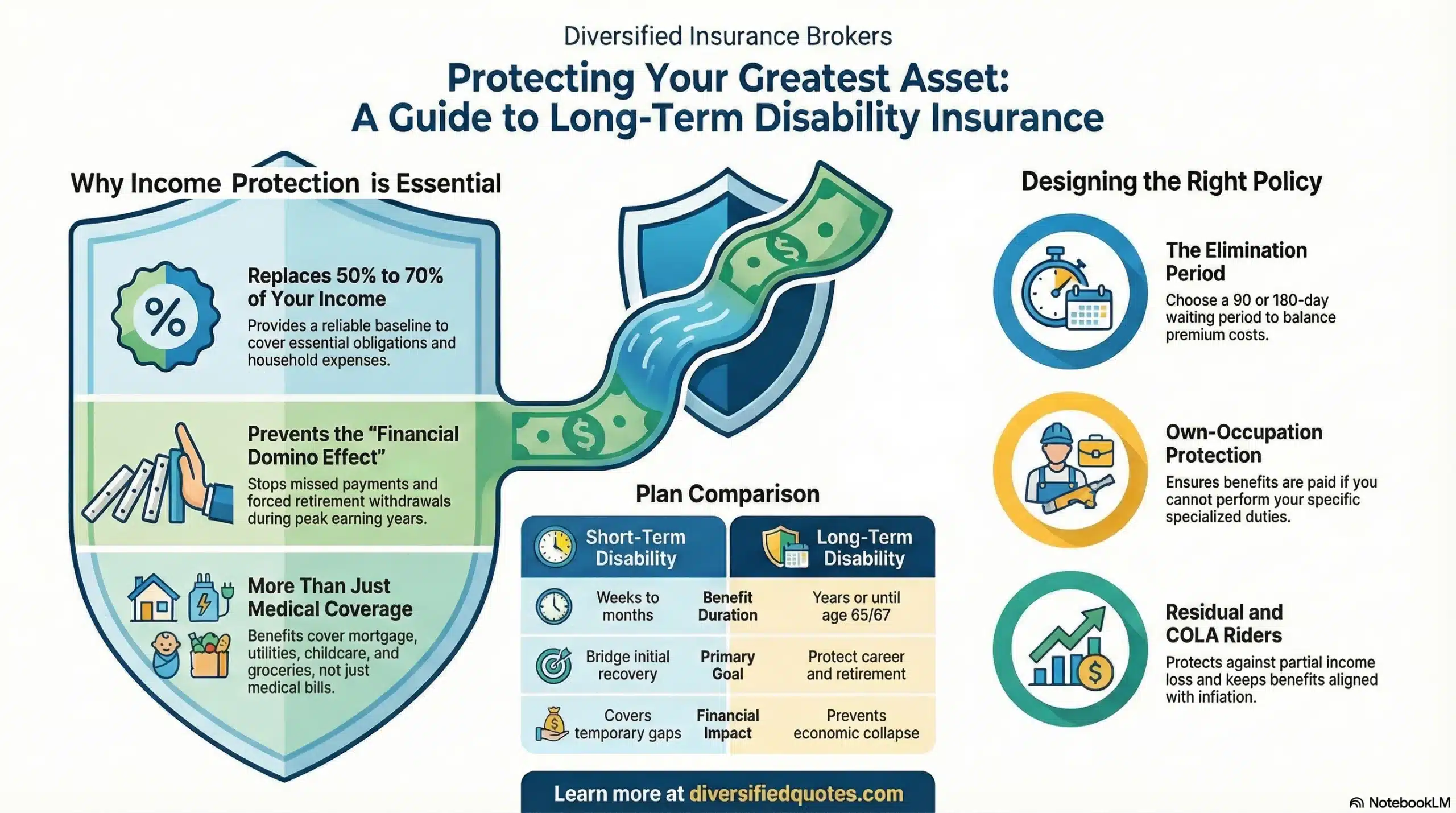
Cancer coverage provisions deserve specific evaluation — ensuring the policy covers cancer disability without carve-outs that would affect TSOs for whom radiation-associated malignancy is a documented long-latency occupational concern. A residual disability rider supports TSOs whose conditions reduce physical screening capacity without eliminating it entirely — our resource on how residual disability insurance benefits work explains partial disability coverage for graduated return-to-duty. The elimination period should account for sick leave accrual and FECA coverage for work-related events — our guide on how disability insurance elimination periods work provides the complete framework. A cost-of-living adjustment rider preserves real benefit value across extended disability periods from long-latency illness — our resource on disability income insurance with a COLA rider explains this protection. For TSA employees exploring short-term coverage options, our guide on how to buy short-term disability insurance covers the complete picture.
Psychological Stress and Mental Health — The Hidden TSA Career Risk
TSA transportation security officers operate under sustained occupational stress that is less visible than the physical hazards of their role but no less real in its disability-producing consequences. The sustained vigilance required for effective security screening — maintaining the concentration and alertness to identify security threats across thousands of screening interactions per shift, day after day — produces occupational stress and psychological fatigue that accumulate over a screening career in ways that the aviation security literature specifically documents. The responsibility for aviation security combined with the social pressure of a high-visibility public role, the interpersonal challenges of managing an adversarial passenger population, and the organizational pressures of a large federal security agency all contribute to the psychological occupational health burden of TSA employment.
Individual disability insurance that provides full benefit period mental health coverage — rather than the 24-month limitation that many policies apply even when the base policy pays to retirement age — is an important policy evaluation consideration for TSA employees whose sustained occupational stress creates genuine psychological health risk. The mental health disability risk from sustained high-pressure public safety screening work parallels that documented in other sustained public contact security roles, including white-collar government professionals managing sustained occupational stress disability risk.
The TSA Title 5 Reclassification and Its Impact on Benefits
TSA employees historically operated under personnel management authorities that differed from standard Title 5 civil service protections governing most federal workers — a status that limited certain employment protections and workforce management rights for transportation security officers. Recent legislative and regulatory changes have expanded Title 5 protections and collective bargaining rights for TSA employees, moving the workforce closer to parity with other federal agencies in terms of employment rights and appeal mechanisms.
For disability insurance planning, the most important aspect of this evolving status is that TSA employees are confirmed FERS participants with the same retirement and disability retirement framework that applies to other federal employees — making the FERS coverage gap analysis and the individual supplemental coverage need directly applicable. The evolution in TSA employment status has not changed the fundamental FERS disability retirement limitations — the 60%/40% base salary calculation, the taxability of benefits, the agency reassignment consideration requirement, and the SSDI offset — that make individual supplemental disability insurance valuable for TSA employees regardless of their personnel classification status. The federal employment status complexity for TSA employees parallels considerations facing other specialized federal workforce categories, including workers navigating non-standard employment classification and income protection planning.
Why TSA Employees Need an Independent Disability Insurance Broker
Disability insurance for TSA employees requires understanding the FERS and FECA benefit coordination framework for federal employment, knowledge of how to document differential pay and overtime earnings for benefit calculation, specific evaluation of cancer coverage provisions for the radiation exposure occupational concern, and expertise in identifying carriers whose policy terms most effectively address the specific disability risks of aviation security work. A standard retail disability insurance application is not optimized for the TSA federal employment benefit coordination context, and a general agent unfamiliar with the federal employee benefit structure or the radiation exposure concerns of TSO work will not produce the most comprehensive available coverage.
At Diversified Insurance Brokers, we work with TSA transportation security officers, TSA supervisors, and federal aviation security employees to structure individual disability insurance that fills the specific gaps in FERS and FECA protection — covering total compensation including differential pay, providing own-occupation protection for screening duty specifically, delivering benefits tax-free rather than as taxable federal retirement income, covering cancer and other conditions without work-relatedness qualification requirements, and activating faster than FERS and FECA qualification processes can deliver benefits. Our dedicated resource on why independent disability insurance brokers matter explains the full value of this approach. And our resource on whether disability insurance is worth the investment provides the foundational financial case for TSA employees whose documented occupational hazard exposure makes the investment particularly meaningful.
Final Thoughts on Disability Insurance for TSA Employees
Transportation Security Administration employees perform essential public safety work that keeps America’s aviation system secure — screening millions of passengers and billions of carry-on and checked items annually in an operational environment that exposes them to documented radiation hazards, biological pathogen contact risks, sustained physical demands, and the psychological burden of sustained high-stakes public security work. The FERS and FECA framework provides a meaningful institutional foundation but leaves specific and consequential income protection gaps — differential pay exclusion, taxable benefits, complex qualification processes, and zero coverage for conditions whose work-relatedness cannot be established — that individual supplemental disability insurance directly and specifically addresses.
Disability insurance for TSA employees — structured to cover total compensation including differential pay, provide own-occupation protection for screening duty, deliver tax-free benefits, cover cancer and other conditions without work-relatedness requirements, and coordinate with FERS disability retirement provisions — provides the complete income protection that transportation security professionals deserve for the hazardous and essential public service they perform at America’s airports every day.
Related Pages
Talk With an Advisor Today
Choose how you’d like to connect—call or message us, then book a time that works for you.
Schedule here:
calendly.com/jason-dibcompanies/diversified-quotes
Licensed in all 50 states • Fiduciary, family-owned since 1980
Disability Insurance for TSA Employees FAQs
Yes — TSA employees are federal employees covered under the Federal Employees Retirement System for retirement and disability retirement purposes, and under the Federal Employees’ Compensation Act administered by the Department of Labor’s Office of Workers’ Compensation Programs for work-related injury and illness. FECA provides medical treatment coverage, wage-loss compensation of 75% of pay for workers with dependents or 66.67% without for approved work-related injury and illness claims, vocational rehabilitation services, and death benefits. FERS provides retirement and disability retirement benefits including the 60%/40% base salary disability retirement provisions that apply to qualifying career employees. The most important planning consideration for TSA employees is understanding precisely what these institutional frameworks do not cover — non-work-related conditions that FECA excludes, differential pay and overtime excluded from FERS benefit calculations, taxable FERS benefits versus tax-free individual disability insurance benefits, and FERS qualification processes that can take months and require agency reassignment consideration. Individual supplemental disability insurance fills all of these specific gaps. For context on federal employee benefit coordination, see our page on disability insurance for federal professionals managing FERS and FECA coverage gaps with individual supplemental protection.
Radiation exposure from baggage X-ray screening equipment is a documented and ongoing occupational health concern for TSA transportation security officers. Ionizing radiation — emitted by the X-ray baggage scanning systems that TSOs operate and work alongside throughout their careers — is classified as a known human carcinogen, and TSO union advocates at AFGE have documented concerns about elevated rates of specific cancers and thyroid conditions at some facilities. AFGE locals in Boston and San Juan specifically raised concerns about cancer diagnoses and thyroid conditions that appeared higher than expected among transportation security officers, leading to NIOSH study requests. The agency’s position that TSOs do not require personal dosimeters to monitor individual radiation exposure has been a persistent source of controversy, with AFGE offering to fund dosimeter purchases and TSA declining to permit their use. The most important planning implication for TSA employees is that ionizing radiation exposure is a long-latency health concern — cancer and other conditions it may eventually cause can take years or decades to manifest. Applying for disability insurance before any radiation-associated health condition appears in the medical record ensures comprehensive coverage for conditions that may develop later in the career.
TSA transportation security officers face a multi-dimensional occupational disability risk profile that reflects the combination of physical screening demands, radiation exposure, biological pathogen contact, and sustained operational stress of aviation security work. Musculoskeletal injuries from the sustained physical demands of passenger and baggage screening — back injuries from sustained lifting, shoulder and upper extremity conditions from repetitive reaching and pat-down procedures, lower extremity conditions from sustained standing across long shifts — are the most frequently occurring disabling conditions and the primary source of FECA claims from TSO employees. Cancer and long-latency illness from radiation and chemical exposure in the airport environment are a documented long-term disability concern, with thyroid cancer and blood cancers specifically identified in the context of ionizing radiation exposure concerns. Infectious disease from sustained high-volume passenger contact — respiratory illnesses, tuberculosis, hepatitis, and other communicable diseases carried by the traveling public — represents a biological hazard disability risk that the high-volume screening role creates. Psychological health conditions from sustained occupational stress, vigilance demands, and the interpersonal challenges of public security work contribute to the mental health disability dimension of TSO careers. Physical confrontation injuries from non-compliant or aggressive passenger incidents round out the acute injury risk profile.
Own-occupation disability insurance pays benefits when a disabling condition prevents a TSA employee from performing the specific duties of their transportation security role — sustained baggage lifting, pat-down procedures, X-ray equipment operation, checkpoint alertness and responsiveness, and the physical and operational demands of active passenger screening duty — regardless of whether they could theoretically perform other less physically demanding or less operationally demanding work. Any-occupation coverage only pays if the employee cannot perform virtually any gainful employment. A TSO whose back injury prevents the sustained lifting and physical screening demands of checkpoint duty but who could theoretically perform sedentary administrative work would receive no any-occupation benefits, while an own-occupation policy recognizes the genuine inability to perform TSO screening duties and pays accordingly. This distinction is specifically consequential for TSA employees because the FERS disability retirement qualification process requires the agency to consider reassignment to any vacant position at the same grade before certifying disability retirement — potentially denying FERS benefits to a TSO who cannot perform screening duty but could theoretically be reassigned to a sedentary administrative TSA role. An individual own-occupation policy protects TSO-specific income from the inability to perform screening duties regardless of theoretical reassignment availability. For context on own-occupation coverage for federal security employees, see our page on disability insurance for federal professionals managing own-occupation protection in government benefit frameworks.
Yes — individual disability insurance covers qualifying disability from cancer when the condition prevents performing occupational duties, without requiring any establishment of work-relatedness or causation. For TSA transportation security officers whose documented radiation exposure concerns include thyroid cancer, blood cancers, and other radiation-associated malignancies, this is one of the most practically important advantages of individual disability insurance over FECA alone. FECA coverage of long-latency cancer requires establishing a causal connection between the specific occupational exposure and the diagnosed malignancy — a complex scientific and legal process for radiation-associated cancers where the exposure is chronic, low-level, and individually difficult to document, since TSA has declined to provide personal dosimeters to TSOs. Individual disability insurance requires no such work-relatedness establishment — it covers any qualifying disability from any cause, including cancer, as long as the condition meets the policy’s definition of disability. For TSA employees, applying for disability insurance before any cancer diagnosis, thyroid finding, or other occupational health concern appears in the medical record is the most important timing consideration for securing comprehensive cancer coverage without exclusion riders for conditions that may eventually develop from career radiation exposure.
Night differential, Sunday premium pay, holiday pay, and overtime compensation represent meaningful components of total annual compensation for many TSA transportation security officers working non-standard shifts at major hub airports. FERS disability retirement calculates benefits exclusively on base salary, explicitly excluding all differential and premium pay from the benefit base. For a TSO earning $52,000 in base salary with $10,000 in night differential and Sunday premium, FERS disability retirement calculates on the $52,000 base alone — leaving the $10,000 in differential pay entirely unprotected by institutional coverage. FECA wage-loss compensation similarly calculates on the employee’s regular rate of pay without including irregular premium pay components. Individual disability insurance can be structured to cover total W-2 annual compensation including verified differential and premium pay earnings, ensuring the benefit amount reflects genuine total earning capacity rather than just the base pay portion that FERS and FECA cover. Working with an independent broker who understands how to document TSA differential pay for disability insurance underwriting is essential for securing benefit amounts that reflect the full financial protection need.
Residual disability coverage pays proportional benefits when a disabling condition reduces a TSA employee’s screening work capacity without completely eliminating the ability to work. A TSO recovering from a back injury or shoulder surgery may be medically cleared for modified duty — lighter administrative assignments that avoid the sustained lifting and physical screening demands of checkpoint work — months before they can safely return to full active passenger and baggage screening operations. During this graduated return-to-duty period, differential pay associated with active screening assignments and any overtime are typically unavailable, reducing total compensation without the employee being totally disabled. Without a residual disability rider, a total-disability-only policy pays nothing during this partial capacity period. A residual rider supplements reduced TSA income proportionally throughout the graduated return to full screening duty, providing continuous financial support from disability onset through complete return to unrestricted active checkpoint operations. For TSA employees whose most common disabling conditions — musculoskeletal injuries, post-surgical recovery, cancer treatment recovery — typically follow extended graduated return-to-duty timelines, the residual rider is essential for the policy to function as genuine income protection across the full recovery arc.
Elimination period selection for TSA employees should account for sick leave accrual, FECA coverage for work-related injury events, and the nature of the specific disability — whether it is work-related and therefore eligible for FECA income replacement, or non-work-related and depending entirely on sick leave and personal savings for the waiting period. For work-related musculoskeletal injuries that activate FECA wage replacement from the early weeks of disability, a 90-day elimination period on an individual supplemental policy may be financially manageable using sick leave during the initial period and then FECA income during the remaining waiting period before individual benefits activate. For non-work-related conditions — cancer, off-duty injuries, illness, and conditions whose work-relatedness is disputed during FECA review — no FECA income is available during the elimination period, making available sick leave and personal savings the only bridge. TSA employees with limited sick leave accrual or limited savings should evaluate 30 or 60-day elimination periods that provide faster benefit access when non-work-related disability or disputed FECA claims create immediate income interruption. For context on elimination period selection for federal security employees, see our page on disability insurance elimination period planning for federal government professionals.
The best time for a TSA employee to apply for disability insurance is as early as possible in their TSA career — ideally in the first year of service, before any occupational health consequences from radiation exposure concerns, musculoskeletal loading from screening physical demands, biological pathogen exposure, or psychological health conditions from sustained operational stress have accumulated in the medical record. Disability insurance premiums are based in part on age and health status at the time of application, and younger TSA employees in excellent health secure the most comprehensive coverage at the most favorable rates. The radiation exposure concern is specifically important for timing: thyroid conditions, cancer diagnoses, and other radiation-associated health findings documented in the medical record at application can result in exclusion riders for those specific conditions — which are precisely the conditions that TSOs are most concerned about from their occupational exposure. Applying before any such findings appear ensures they are covered under an existing policy when they may eventually develop. The non-cancelable and guaranteed renewable provision locks in the early-career health rating for the policy’s entire duration. A future increase option rider allows benefit amounts to grow with TSA pay increases — including step increases, pay band advancement, and expanding differential earnings — without requiring new medical underwriting when health may have changed from years of TSA service.
An independent broker with federal employee disability insurance expertise accesses multiple carriers and compares occupational class assignments, own-occupation definition language, cancer coverage provisions, differential pay income documentation approaches, FERS coordination structures, residual disability rider terms, and premium structures across the full marketplace. For TSA employees whose disability planning involves FERS disability retirement coordination, differential pay documentation, cancer coverage evaluation for radiation exposure concerns, and identification of the most favorable occupational classification for airport security screening work, carrier differences produce meaningfully different real-world coverage outcomes. At Diversified Insurance Brokers, we evaluate the full competitive landscape for every TSA employee we work with — ensuring differential and premium pay is properly documented and included in benefit calculations, evaluating cancer coverage provisions specifically for TSOs with radiation exposure concerns, structuring coverage that accurately coordinates with FERS disability retirement provisions, and identifying carriers whose policy terms most effectively address the specific disability risks and income protection needs of federal aviation security employment. For context on the independent broker advantage for federal security professionals, see our page on disability insurance for federal and scientific professionals requiring specialized broker expertise in occupational hazard and benefit coordination planning.
About the Author:
Jason Stolz, CLTC, CRPC, DIA, CAA and Chief Underwriter at Diversified Insurance Brokers (NPN 20471358), is a senior insurance and retirement professional with more than 25 years of real-world experience helping individuals, families, and business owners protect their income, assets, and long-term financial stability. As a long-time partner of the nationally licensed independent agency Diversified Insurance Brokers, Jason provides trusted guidance across multiple specialties—including fixed and indexed annuities, long-term care planning, personal and business disability insurance, life insurance solutions, Group Health, Travel Medical and Evacuation Insurance, and short-term health coverage. Diversified Insurance Brokers maintains active contracts with over 100 highly rated insurance carriers, ensuring clients have access to a broad and competitive marketplace.
His practical, education-first approach has earned recognition in publications such as VoyageATL, and contributions from his agency featured in Kiplinger and GoBankingRates— highlighting his commitment to financial clarity and client-focused planning. Drawing on deep product knowledge and years of hands-on field experience, Jason helps clients evaluate carriers, compare strategies, and build retirement and protection plans that are both secure and cost-efficient. Visitors who want to explore current annuity rates and compare options across multiple insurers can also use this annuity quote and comparison tool.
Explore More Disability Insurance Options: Browse our complete guide to Disability Insurance for Public Safety, Military & Government — covering firefighters, law enforcement, military, pilots, TSA, SWAT & first responders from 100+ carriers.
Last Reviewed: June 8, 2026 |
Reviewed by: Jason Stolz, CLTC, CRPC, DIA, CAA
Chief Underwriter, Diversified Insurance Brokers, Inc. | NPN: 20471358 | Diversified Insurance Brokers, Inc. — Licensed in all 50 states
Fact Checked by: Tonia Pettitt, CMIP©
Medicare Specialist, Diversified Insurance Brokers, Inc. | NPN: 14374308 | Diversified Insurance Brokers, Inc. — Licensed in all 50 states
Did you find this content helpful? Leave us a Google review — it helps others find trustworthy guidance too.
Editorial Standards: Diversified Insurance Brokers maintains rigorous editorial standards to ensure accuracy, clarity, and independence in all content. Learn more about our editorial standards and commitment to transparency.
