
Disability Insurance for Graphic Artists and Graphic Designers
As an Independent Disability Insurance Broker, we have access to exclusive discounts and negotiated pricing most captive agents can’t offer — see the full breakdown near the end of this page.
Disability Insurance for Graphic Artists and Graphic Designers

Jason Stolz CLTC, CRPC, DIA, CAA
Disability insurance for graphic artists and graphic designers is essential income protection for creative professionals whose entire career depends on the sustained performance of two highly specific and surprisingly vulnerable physical capacities — the fine motor precision of their hands and wrists, and the visual acuity of their eyes. A graphic designer or graphic artist who cannot use a mouse, stylus, or graphics tablet accurately, or who cannot read and evaluate color, detail, and composition on a high-resolution monitor, is disabled from their profession in a direct and immediate sense regardless of how much creative knowledge, aesthetic judgment, and professional experience they possess. The tools of the graphic design profession are so physically specific — and the conditions that can eliminate access to those tools are so predictable and so well-documented — that disability insurance planning is not a peripheral financial consideration for design professionals. It is a foundational one.
Whether you work as a freelance graphic designer serving clients across branding, print, and digital media, operate as a staff designer within an agency or corporate creative department, work as a digital illustrator or concept artist for the gaming, film, or entertainment industries, create motion graphics and animation as a primary professional output, specialize in UX and interface design as a technology-focused creative, or provide visual identity and marketing design services as an independent creative consultant — your income depends on the sustained physical capacity to perform precise, repetitive, fine motor work at a computer or graphics workstation across long working sessions that are the documented occupational context for the most common disabling conditions in the graphic design profession.
At Diversified Insurance Brokers, we help graphic designers, graphic artists, digital illustrators, motion graphics professionals, and creative industry freelancers structure disability insurance coverage that reflects the specific fine motor and vision disability risks of design work, the predominantly freelance income structure of the profession, and the policy features that provide the most meaningful financial protection when a hand, wrist, or vision condition prevents the precision design work that generates professional income.
Protect Your Design Professional Income
Compare disability insurance options designed for graphic designers, graphic artists, digital illustrators, motion graphics professionals, and creative industry freelancers.
Request Disability Insurance OptionsThe Occupational Classification Advantage for Graphic Designers
One of the most practically important facts about disability insurance for graphic artists and graphic designers is the occupational classification that this profession typically receives — and it is among the most favorable available. Graphic design is entirely cognitive and fine motor work performed in a sedentary, office-based environment with no physical hazards, no exposure to chemicals, no manual labor, and none of the physical risk factors that drive elevated disability insurance classifications and premiums in other occupations.
Graphic designers and graphic artists typically receive the highest available occupational classification tiers for individual disability insurance purposes — classifications that provide access to the strongest own-occupation definitions, the broadest range of supplemental riders, the longest available benefit periods, and the most competitive premium rates for the coverage amount being secured. This favorable classification means that the disability insurance planning conversation for graphic design professionals is not about whether coverage is available or affordable — it is about structuring the right policy features, the right benefit amount, and the right income documentation approach for a profession whose self-employment income structure creates specific underwriting requirements. The occupational classification advantage for graphic designers is directly parallel to that available to other cognitively focused, sedentary professional practitioners, including day traders and analytical professionals whose entirely desk-based, cognitively intensive work receives favorable disability insurance classifications.
Carpal Tunnel Syndrome and RSI — The Defining Disability Risk of Graphic Design
Carpal tunnel syndrome and repetitive strain injury are so consistently documented as the primary occupational health hazards of graphic design work that occupational health literature specifically identifies graphic designers and digital artists as among the highest-risk populations for these conditions. Computer users as a group account for up to 40% of all RSI-related conditions across all professions — and within the computer user population, graphic designers face particularly elevated risk from the sustained, fine-precision repetitive hand and wrist movements that design work requires in ways that general office computer use does not.
A graphic designer’s mouse, stylus, or graphics tablet work involves continuous, precise, low-amplitude repetitive movements of the wrist and fingers — adjusting Bezier curves, manipulating anchor points, tracking fine selections, making precision typographic adjustments, and executing the thousands of small, exact hand movements that produce professional design output across a full working day. These movements are performed at high frequency and sustained duration across working sessions that routinely extend well beyond standard eight-hour office shifts when project deadlines impose extended working periods. Published occupational health research identifies repetitive forceful movements of the hand and wrist as the primary occupational factor in carpal tunnel syndrome development — and graphic design mouse and stylus work produces exactly this movement pattern across the career durations that make cumulative nerve compression the predictable consequence for a meaningful share of the design professional population.
Carpal tunnel syndrome that has progressed to the point of producing persistent numbness, motor weakness, and pain in the hand and wrist represents a specific and direct disability for graphic design work — because the fine precision of mouse and stylus control that design output requires is directly and measurably impaired by the sensory and motor symptoms of median nerve compression. A graphic designer whose carpal tunnel syndrome has reached surgical intervention stage — and whose post-surgical recovery requires months of restricted hand use — is genuinely disabled from their professional practice in precisely the way that an own-occupation disability policy responds to. Wrist tendinitis, de Quervain’s tenosynovitis, and other repetitive strain conditions of the hand and forearm produce the same functionally specific disability for design precision work. The fine motor disability risk for graphic designers from sustained repetitive computer tool use parallels that documented for other precision fine motor professionals, including film and print editors whose precision fine motor computer work creates the same carpal tunnel and RSI disability exposure.
Vision Impairment — The Second Career-Ending Disability Risk
Graphic design is fundamentally a visual profession — color accuracy, compositional judgment, typographic precision, and the evaluation of design quality all depend on the designer’s ability to accurately perceive and assess what they are seeing on the screen. A graphic designer who develops a progressive vision condition that impairs color perception, fine detail discrimination, or the ability to work comfortably at a monitor for sustained periods faces a disability that is directly functional to their professional output in ways that go beyond simple inconvenience.
Survey data from the graphic design profession documents that 13% of designers report eye problems as a health issue connected to their work — reflecting the cumulative effect of sustained high-resolution screen time across careers. Digital eye strain from extended monitor work can progress from the transient symptoms most designers experience to genuine chronic vision impairment in professionals with underlying predisposition to conditions including macular degeneration, early-onset glaucoma, detached retina, and other progressive vision diseases that extended screen exposure may accelerate or aggravate. A graphic designer who develops serious macular degeneration that prevents accurate color evaluation and fine detail discrimination is disabled from professional design practice in a direct and specific sense — even if their vision allows basic daily function without the precision demands of professional design work.
Color vision deficiency — whether from genetic predisposition or from acquired conditions — represents a similarly specific functional disability for graphic design professionals whose work requires accurate color judgment and color accuracy across print and digital color spaces. A designer whose color perception changes meaningfully cannot reliably deliver the color-accurate design output that professional clients require, constituting genuine professional disability even when general visual function for other purposes remains intact. The vision impairment disability risk for graphic artists and designers is parallel to that facing other visual precision professionals who depend on sustained fine visual discrimination capacity, including entertainment industry visual professionals whose careers depend on sustained fine visual performance capacity.
The Freelance Income Structure — Self-Employment Vulnerability
The graphic design profession is dominated by freelance and self-employed practitioners — independent designers who generate income entirely through their own professional output rather than through employer salary and benefits. This freelance structure creates the most direct and acute version of the disability insurance need: when a hand condition, vision impairment, or other disability prevents design work, freelance income stops immediately and completely, while living expenses and any studio or equipment costs continue regardless.
A freelance graphic designer who develops bilateral carpal tunnel syndrome requiring surgical intervention faces not just the medical challenge of recovery but the immediate financial reality that every week of post-surgical restricted hand use is a week of zero professional income. Client projects cannot be completed. New projects cannot be accepted. Retainer relationships are interrupted. The project pipeline that sustains a freelance design practice has no institutional shock absorber — no employer sick pay, no group disability plan, no workers’ compensation for self-employed designers — that bridges the income gap during recovery.
The self-employment income protection planning need for freelance graphic designers is structurally identical to that facing other self-employed creative and technical professionals who generate income entirely through personal professional output. Our resource on disability insurance for independent contractors and self-employed professionals covers the full income protection framework that freelance graphic designers need to understand before evaluating policy options. The income documentation requirements for freelance design income — using Schedule C tax returns, client revenue records, and multi-year income averaging — require specific broker expertise to present most favorably to disability insurance underwriters, paralleling the self-employment income documentation challenge facing other independent creative and analytical practitioners, including actuarial consultants and independent analytical professionals managing Schedule C income documentation for disability insurance underwriting.
Cervical and Lumbar Spine Conditions — The Career-Wear Dimension
Beyond the acute and most dramatic disability risks of carpal tunnel syndrome and vision impairment, graphic designers face significant musculoskeletal disability risk from the sustained postural demands of long-duration screen work. Survey data from the graphic design profession documents that 15% of designers report back problems as a significant occupational health issue — reflecting the cumulative spinal loading of sustained seated screen work in the sustained forward-head, rounded-shoulder posture that design workstation use commonly produces.
A graphic designer who develops serious cervical disc disease from sustained neck loading in a forward-head posture — particularly those working on large-format monitors where the head position is fixed for extended periods — can develop radiculopathy with hand numbness and weakness that directly impairs the fine motor control that design precision requires. Lumbar disc conditions from sustained seated work can produce disabling back pain that prevents the sustained desk-based working posture that design output demands. These musculoskeletal career-wear conditions develop gradually over design careers and can produce the progressive functional limitations that eventually prevent sustained design workstation work — constituting genuine occupational disability for a designer who has no alternative professional mode that doesn’t require sustained computer use. The career-wear spinal disability risk for graphic designers parallels that documented in other sustained desk-based professional work contexts, including financial planners and desk-based analytical professionals managing spinal and musculoskeletal disability risk from sustained sedentary computer work.
Mental Health and Burnout — The Creative Industry Disability Dimension
Survey data from the graphic design and broader creative industry documents that 17% of designers report psychosocial issues including stress and depression as significant occupational health concerns — a rate that reflects the specific occupational stressors of creative professional practice: tight deadlines, client revision cycles, creative block under commercial pressure, the financial instability of freelance income, the isolation of solo studio practice, and the sustained cognitive engagement that design work demands.
Serious depression or anxiety that prevents the focused, sustained creative concentration that professional design work requires constitutes genuine occupational disability for a graphic designer — not because the designer loses their creative knowledge, but because the sustained engagement, decision-making quality, and creative execution capacity that delivering professional design output requires are directly impaired by these conditions. Individual disability insurance that provides full benefit period mental health coverage — rather than the 24-month limitation that many policies impose even when the base policy pays to retirement age — is an important policy evaluation consideration for graphic design professionals whose creative industry occupational context creates documented psychological health risk. The mental health disability risk from creative industry freelance professional pressure parallels that facing other high-performance creative and cognitive professionals, including technology and creative digital professionals managing mental health disability risk from sustained high-performance creative and technical work demands.
Case Study: Freelance Graphic Designer Earning $85,000 Per Year
Consider a freelance graphic designer with eight years of independent practice, earning $85,000 annually in net Schedule C income from a client roster spanning brand identity, packaging design, and marketing collateral. This designer develops severe bilateral carpal tunnel syndrome — both hands equally affected — requiring bilateral surgical release and nine months of post-surgical restricted hand use during which sustained mouse and stylus work is medically prohibited.
| Scenario | Without Disability Insurance | With Disability Insurance |
|---|---|---|
| Monthly Income During Recovery | $0 — no employer, no sick pay, no group plan, no workers’ comp for self-employed | $3,500–$4,250 individual benefit |
| 9-Month Total Income | $0 | $31,500–$38,250 |
| Client Relationships | Financial pressure may force premature return, risking surgical outcome and long-term hand function | Recovery on medical timeline; return to design only when hand function genuinely restored |
| Long-Term Design Career | Compromised surgical outcome from financial pressure may produce permanent reduced hand function | Complete recovery supported by income replacement; full precision design capacity restored |
Bilateral carpal tunnel syndrome is a particularly devastating disability scenario for graphic designers precisely because both hands are affected simultaneously — eliminating the workaround of switching to the non-dominant hand that some single-hand carpal tunnel sufferers can use temporarily. A freelance designer whose both hands require surgical intervention and extended post-operative rest has zero capacity for client design output during the recovery period, making disability insurance the only income protection available for a self-employed creative professional in this scenario.
Key Policy Features for Graphic Designer Disability Insurance
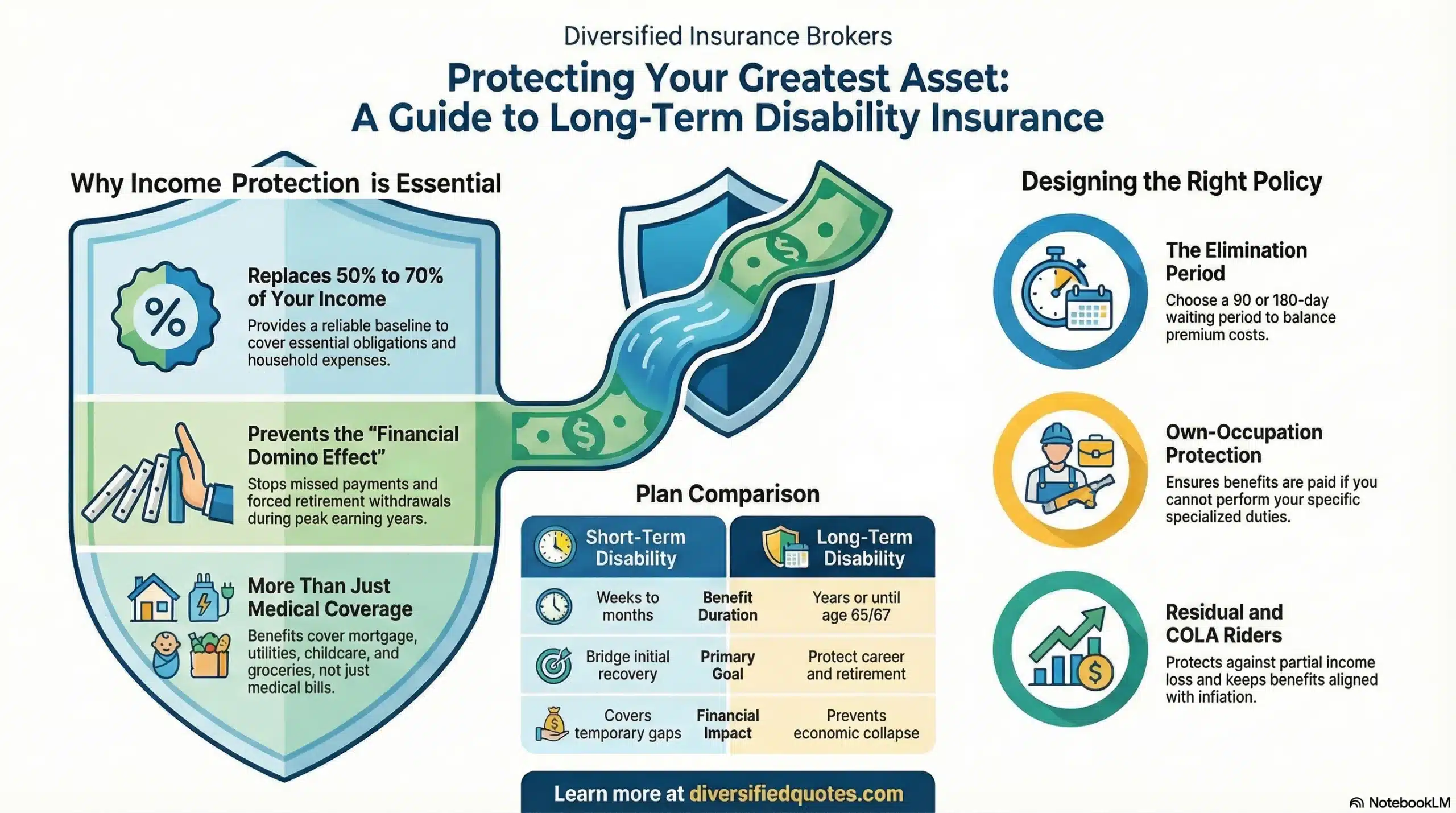
Disability insurance for graphic artists and graphic designers should be structured with specific policy provisions that address the fine motor disability risk, the vision impairment risk, the self-employment income structure, and the creative industry mental health dimensions of design professional practice. The own-occupation definition is the most important provision — ensuring that a graphic designer who cannot perform the sustained precision mouse, stylus, and keyboard work that professional design output requires receives disability benefits regardless of whether they could theoretically perform other less fine-motor-demanding or less visually precise work. Our comprehensive resource on own-occupation disability insurance explained covers how this definition protects graphic designer income from the hand, wrist, and vision conditions most likely to prevent sustained design work.
A residual disability rider is particularly valuable for graphic designers whose hand or vision conditions may reduce sustained design capacity without eliminating all design work — a designer who can manage limited design sessions but cannot sustain full-day precision work loses income without being totally disabled. Our resource on how residual disability insurance benefits work explains how partial disability coverage supports designers through graduated return to full professional output. The elimination period should be calibrated to available personal savings — our guide on how disability insurance elimination periods work provides the complete framework. A cost-of-living adjustment rider preserves real benefit value across extended disability periods — our resource on disability income insurance with a COLA rider explains this protection. For graphic designers exploring short-term coverage options, our guide on how to buy short-term disability insurance covers the complete income protection picture.
Income Documentation for Freelance and Staff Graphic Designers
The income documentation approach for graphic designer disability insurance depends on employment structure. Staff graphic designers employed by agencies, studios, or corporate creative departments typically receive W-2 income and may have access to employer group long-term disability plans — creating the standard group plan coverage gap evaluation that applies to all employed professionals whose group plan leaves income replacement shortfalls. For staff designers, individual supplemental coverage structured to fill the gap between group plan benefits and total compensation provides complete protection.
Freelance graphic designers document income through Schedule C tax returns showing net self-employment income from design work — and the income documentation approach for freelance design income requires multi-year income averaging that accurately reflects the variable project revenue streams, client concentration, and income seasonality that characterize independent design practice. A freelance designer whose income varies significantly between years — from $60,000 to $110,000 depending on project volume and client mix — benefits from a benefit calculation approach that uses averaged multi-year income rather than a single potentially unrepresentative year. The income documentation complexity for freelance graphic designers parallels that facing other variable-income self-employed creative and analytical professionals, including independent economic and financial consultants managing variable Schedule C income documentation for disability insurance purposes.
Why Graphic Designers Need an Independent Disability Insurance Broker
Disability insurance for graphic artists and graphic designers requires expertise in self-employment income documentation for creative freelance practices, knowledge of the policy features most relevant to fine motor and vision disability risk, evaluation of mental health benefit period provisions for the documented creative industry psychological health concerns, and the ability to present a freelance design practice’s income history to underwriters in the most favorable and accurate way. A standard retail disability insurance application is not optimized for the freelance graphic design income structure or the fine motor disability risk profile specific to design professional practice.
At Diversified Insurance Brokers, we work with graphic designers, graphic artists, digital illustrators, motion graphics professionals, and visual creative industry practitioners to structure disability coverage that accurately reflects how design professionals earn, what conditions would actually prevent them from performing their specific design work, and what policy features provide the most meaningful financial protection for the fine motor and vision disability risks that the design profession creates. Our dedicated resource on why independent disability insurance brokers matter explains the full value of this approach for creative professionals with variable income and specific disability risk profiles. Our resource on whether disability insurance is worth the investment provides the foundational financial case that applies with particular urgency to self-employed creative professionals with no institutional income protection of any kind.
Final Thoughts on Disability Insurance for Graphic Artists and Graphic Designers
Graphic designers and graphic artists bring sophisticated visual intelligence, technical software mastery, and creative judgment to the work of visual communication — skills that represent years of professional development and that generate meaningful professional income through the sustained precision performance of their hands and eyes at the design workstation. The specific disability risks that this professional context creates — carpal tunnel syndrome and RSI from sustained fine motor repetitive work, vision impairment from sustained screen exposure, cervical and lumbar spine conditions from sustained sedentary posture, and the mental health conditions that creative industry professional pressure produces — are predictable, documented, and financially consequential when they materialize.
Disability insurance for graphic artists and graphic designers — structured with an own-occupation definition that specifically protects design precision work, a residual disability rider for the graduated capacity reductions that most fine motor and vision conditions produce, income documentation calibrated to actual freelance earning capacity, and mental health coverage for the full benefit period — provides the financial security that ensures a hand or vision condition does not also become a financial catastrophe for creative professionals who have built their practice and their income around the sustained precision performance those capacities make possible.
Related Pages
Talk With an Advisor Today
Choose how you’d like to connect—call or message us, then book a time that works for you.
Schedule here:
calendly.com/jason-dibcompanies/diversified-quotes
Licensed in all 50 states • Fiduciary, family-owned since 1980
Disability Insurance for Graphic Artists and Graphic Designers FAQs
Yes — graphic designers and graphic artists are among the most favorably classified professionals in the individual disability insurance marketplace. Because graphic design is entirely sedentary, cognitive, and fine motor work with no physical hazards, no manual labor, and no chemical or environmental occupational exposures, designers typically receive the highest available occupational classification tiers — which provide access to the strongest own-occupation definitions, the broadest range of supplemental riders, and the most competitive premium rates for the coverage amount being secured. The primary underwriting considerations for graphic designers are not occupational hazard classification but income documentation — particularly for freelance designers whose Schedule C self-employment income requires specific documentation and multi-year averaging to support the desired benefit amount. Staff graphic designers with W-2 employment income have straightforward income documentation. Freelance designers benefit from working with an independent broker who understands how to present creative professional Schedule C income most favorably for disability insurance underwriting purposes. For context on disability insurance for other favorably classified professional creatives, see our page on disability insurance for cartographers and other favorably classified creative and technical professionals.
The disability risk profile for graphic designers and graphic artists is centered on the specific physical capacities that sustained precision design work requires. Carpal tunnel syndrome and repetitive strain injury are the most predictable and most frequently occurring disabling conditions — computer users account for up to 40% of all RSI-related conditions across all professions, and within that group graphic designers face elevated risk from the continuous, high-precision, fine motor repetitive movements of sustained mouse, stylus, and graphics tablet work. Wrist tendinitis, de Quervain’s tenosynovitis, and other RSI variants affecting the hand and forearm produce the same functional disability for design precision work as carpal tunnel syndrome. Vision impairment — from progressive eye conditions including macular degeneration, glaucoma, and retinal conditions that sustained high-resolution screen exposure may aggravate — represents the second major occupational disability risk, with survey data documenting that 13% of designers report eye problems connected to their work. Cervical and lumbar spine conditions from sustained sedentary forward-head design workstation posture produce disabling pain and in some cases radiculopathy that prevents sustained computer work. Survey data documents that 17% of designers report stress and depression as significant psychosocial health concerns — with serious mental health conditions capable of preventing the sustained focused creative concentration that professional design output requires.
Own-occupation disability insurance pays benefits when a disabling condition prevents a graphic designer from performing the specific duties of their design profession — sustained precision mouse and stylus control, fine motor graphics work, sustained screen-based visual evaluation and design production — regardless of whether they could theoretically perform other less fine-motor-demanding or less visually precise work. Any-occupation coverage only pays if the designer cannot perform virtually any gainful employment. A graphic designer whose bilateral carpal tunnel syndrome prevents the sustained precision hand control that design output requires but who could theoretically perform simple voice-assisted administrative tasks would receive no any-occupation benefits, while an own-occupation policy recognizes the genuine inability to perform design professional duties and pays accordingly. For graphic designers, the own-occupation definition is the single most important policy provision because the specific physical capacities that design work demands — sustained precision hand control and accurate visual discrimination — can be impaired by conditions that leave many other life functions intact. A designer who cannot hold a mouse accurately for more than ten minutes at a time is disabled from their profession regardless of how much design knowledge and creative judgment they possess, and only an own-occupation policy responds to that specific professional disability appropriately.
Yes — individual disability insurance covers disability from carpal tunnel syndrome and other RSI conditions when the severity of the condition prevents performing the specific duties of graphic design work. A graphic designer whose carpal tunnel syndrome has progressed to the point of producing persistent hand numbness, motor weakness, and pain that prevents sustained precision mouse and stylus control qualifies for disability benefits under a well-structured own-occupation policy. Even moderate carpal tunnel symptoms that allow some general hand use but prevent the specific sustained fine precision of design workstation operation qualify for residual disability benefits under policies with a residual disability rider. The most important planning consideration for graphic designers is the timing of policy application relative to any carpal tunnel or RSI symptom history — if a designer has documented symptoms, prior treatment episodes, or a carpal tunnel diagnosis in their medical record at the time of application, the carrier may exclude that specific condition with an exclusion rider while covering all other causes of disability. Applying for disability insurance before any carpal tunnel or RSI symptoms are documented in the medical record — ideally early in a design career before the cumulative hand loading of sustained design work has begun to produce symptoms — is the most reliable way to secure comprehensive coverage without exclusions for the conditions most likely to affect a working graphic designer. For context on RSI disability coverage for precision fine motor professionals, see our page on disability insurance for technical professionals managing RSI and repetitive strain disability coverage.
Residual disability coverage pays proportional benefits when a disabling condition reduces a graphic designer’s professional work capacity and income without completely eliminating the ability to design. This is particularly valuable for graphic designers because the most common disability conditions affecting the profession — carpal tunnel syndrome, RSI, cervical conditions, early vision impairment — typically produce graduated functional limitations rather than sudden binary incapacity. A designer whose carpal tunnel symptoms allow two hours of precise design work per day before pain and numbness prevent continuation cannot sustain a full professional client load but is not totally disabled from design work. A designer whose vision impairment allows design review but prevents sustained design production has reduced capacity without complete incapacity. Without a residual disability rider, a total-disability-only policy pays nothing during these partial capacity periods that may last months as conditions progress through treatment. A residual rider supplements reduced design income proportionally — if the designer’s capacity is reduced by 50% and their income falls by 50%, the residual rider pays approximately 50% of the full disability benefit, providing continuous financial support from the onset of functional limitation through complete recovery of professional design capacity. For graphic designers whose most likely disabling conditions follow gradual onset patterns with prolonged partial recovery periods, the residual rider is not an optional enhancement — it is the policy feature that makes disability insurance function as genuine income protection for the disability scenarios most likely to actually occur.
Disability insurance benefit amounts are based on verified earned income, and for freelance graphic designers whose income is documented through Schedule C self-employment tax returns rather than W-2 employment income, the income documentation approach significantly affects both the maximum available benefit and how the income history is presented to underwriters. Freelance design income is inherently variable — a designer may earn $65,000 in a slow project year and $115,000 in a high-volume year — and a benefit calculation based on a single year’s income may substantially misrepresent the designer’s genuine long-run earning capacity. Most disability insurance carriers use a multi-year average of documented Schedule C income — typically the two or three most recent complete tax years — to determine insurable income for freelance professionals. This averaging approach benefits designers whose recent years reflect their stable earning capacity more accurately than any single year. Working with an independent broker who understands how to document freelance design income most accurately and present it most favorably for underwriting is important for securing a benefit amount that reflects genuine professional earning capacity. Business expenses that reduce net Schedule C income — software subscriptions, equipment depreciation, home office deductions — are deducted from gross revenues before net income is calculated, and the net Schedule C figure is what carriers use for benefit calculation, making the expense structure of a freelance design practice relevant to the benefit amount discussion.
Yes — individual disability insurance covers qualifying disability from vision impairment when the severity of the condition prevents performing the specific visual demands of graphic design and graphic art work. A graphic artist whose progressive macular degeneration impairs the fine detail discrimination and color accuracy that professional design output requires qualifies for disability benefits under a well-structured own-occupation policy — even if their remaining vision allows basic daily function outside the precision visual requirements of professional design work. Vision conditions covered include macular degeneration, severe glaucoma, retinal detachment and its sequelae, and any other progressive or acute vision impairment that reaches the functional threshold of preventing sustained professional design work. As with carpal tunnel syndrome, the application timing relative to any documented vision findings is important — eye conditions, prescription changes, and vision diagnoses documented in the medical record at application may be subject to exclusion riders that limit coverage for that specific condition while covering all other causes of disability. Applying for disability insurance before any vision condition findings appear in the medical record provides the most comprehensive visual disability coverage for a profession whose income depends directly on sustained precision visual performance. For context on visual disability coverage for creative professionals, see our page on disability insurance for precision visual and analytical professionals managing vision impairment disability risk.
Freelance graphic designers with no employer sick pay, no group disability plan, and no workers’ compensation coverage for self-employed individuals face the sharpest version of the elimination period decision — their income stops completely on the first day of disability with no institutional bridge of any kind. For these professionals, the elimination period selection depends entirely on available personal savings: how many months of living expenses the designer can sustain from savings before disability insurance benefits need to activate. A 30-day elimination period provides the fastest benefit access but at the highest annual premium cost. A 90-day elimination period provides more affordable premiums but requires three months of savings to bridge. The most financially honest planning approach is to select the elimination period matched to actual savings reserves rather than the most affordable option — a 90-day elimination period is financially appropriate only if the designer genuinely has 90 days of living expenses available in savings that they can draw on without creating financial crisis. Staff graphic designers with employer short-term disability coverage and accumulated sick leave may comfortably manage longer elimination periods on an individual supplemental policy, since the employer bridge income reduces the urgency of early benefit activation. For context on elimination period selection for self-employed creative professionals, see our page on disability insurance for self-employed professional practitioners managing elimination period selection without institutional bridge income.
The best time for a graphic designer or graphic artist to apply for disability insurance is as early as possible in their professional career — ideally when first establishing their design practice or transitioning to freelance work, before any occupational health consequences from sustained design workstation use have accumulated in the medical record. Disability insurance premiums are based in part on age and health status at the time of application, and younger designers in excellent health secure the most comprehensive coverage at the most favorable rates. Any documented hand or wrist symptoms, carpal tunnel diagnoses or treatment episodes, vision prescriptions or eye condition findings, cervical or lumbar spine conditions from sustained desk work, and any mental health treatment history can result in exclusion riders or restricted policy terms if documented at application. The non-cancelable and guaranteed renewable provision locks in the health rating at application for the policy’s entire duration, regardless of what occupational health developments occur during subsequent years of sustained design work. A future increase option rider secured early allows benefit amounts to grow with freelance income as the design practice and client base develop, without requiring new medical underwriting when health may have changed from years of sustained design workstation work. The practical urgency of early application for graphic designers is high precisely because the most common disability conditions affecting the profession — carpal tunnel syndrome and RSI — develop gradually from cumulative exposure and can appear in the medical record through incidental treatment well before the designer thinks of disability as a professional planning concern.
An independent broker accesses multiple disability insurance carriers and compares occupational class assignments, own-occupation definition language for fine motor and vision disability specifically, residual disability rider provisions, mental health benefit period provisions, Schedule C income documentation approaches for freelance design income, and premium structures across the full marketplace. For graphic designers and graphic artists whose disability planning involves favorable occupational classification but specific fine motor and vision disability risk, freelance income documentation requirements, and mental health coverage evaluation for the documented creative industry psychological health concerns, carrier differences in policy language and underwriting approaches produce meaningfully different real-world coverage outcomes. At Diversified Insurance Brokers, we evaluate the full competitive landscape for every graphic design professional we work with — ensuring own-occupation definitions genuinely protect fine motor design precision work rather than just broad professional categories, securing residual disability riders appropriate for the graduated onset patterns of RSI and vision conditions, evaluating mental health benefit periods for the documented creative industry stress and burnout risk, and presenting freelance Schedule C income accurately and favorably for benefit calculation. The goal is coverage genuinely calibrated to how graphic designers earn, what conditions would actually prevent them from performing their specific design work, and what policy features provide the most meaningful financial protection for the fine motor and vision disability risks that sustained professional design work creates.
About the Author:
Jason Stolz, CLTC, CRPC, DIA, CAA and Chief Underwriter at Diversified Insurance Brokers (NPN 20471358), is a senior insurance and retirement professional with more than 25 years of real-world experience helping individuals, families, and business owners protect their income, assets, and long-term financial stability. As a long-time partner of the nationally licensed independent agency Diversified Insurance Brokers, Jason provides trusted guidance across multiple specialties—including fixed and indexed annuities, long-term care planning, personal and business disability insurance, life insurance solutions, Group Health, Travel Medical and Evacuation Insurance, and short-term health coverage. Diversified Insurance Brokers maintains active contracts with over 100 highly rated insurance carriers, ensuring clients have access to a broad and competitive marketplace.
His practical, education-first approach has earned recognition in publications such as VoyageATL, and contributions from his agency featured in Kiplinger and GoBankingRates— highlighting his commitment to financial clarity and client-focused planning. Drawing on deep product knowledge and years of hands-on field experience, Jason helps clients evaluate carriers, compare strategies, and build retirement and protection plans that are both secure and cost-efficient. Visitors who want to explore current annuity rates and compare options across multiple insurers can also use this annuity quote and comparison tool.
Explore More Disability Insurance Options: Browse our complete guide to Disability Insurance for Technology, Science & Education — covering software developers, engineers, scientists, teachers, architects & researchers from 100+ carriers.
Last Reviewed: June 8, 2026 |
Reviewed by: Jason Stolz, CLTC, CRPC, DIA, CAA
Chief Underwriter, Diversified Insurance Brokers, Inc. | NPN: 20471358 | Diversified Insurance Brokers, Inc. — Licensed in all 50 states
Fact Checked by: Tonia Pettitt, CMIP©
Medicare Specialist, Diversified Insurance Brokers, Inc. | NPN: 14374308 | Diversified Insurance Brokers, Inc. — Licensed in all 50 states
Did you find this content helpful? Leave us a Google review — it helps others find trustworthy guidance too.
Editorial Standards: Diversified Insurance Brokers maintains rigorous editorial standards to ensure accuracy, clarity, and independence in all content. Learn more about our editorial standards and commitment to transparency.
