
Travel Medical for International Students
Travel Medical for International Students

Jason Stolz CLTC, CRPC, DIA, CAA
International students face a healthcare challenge that domestic students do not: they are navigating a medical system they have likely never used before, billing practices that differ from their home country, and insurance requirements that arrive from multiple directions simultaneously — the U.S. Department of State, the host university’s international student office, and sometimes the host country’s immigration authority all have opinions about what coverage an international student must carry. Travel medical insurance for international students is the insurance category built specifically for this situation — it covers illness and injury while a student is outside their home country, it is designed to meet J-1 visa minimum requirements and satisfy most university insurance waiver standards, and it provides the emergency medical evacuation and repatriation benefits that distinguish genuine student protection from bare-minimum coverage. Without the right plan in place, an international student who needs urgent care, hospitalization, or medical transport faces not just a health situation but an immediate financial and logistical crisis far from their family and their normal support system. Our resource on travel medical insurance covers the broader travel medical landscape across all traveler categories, and our resource on short-term medical services covers the full range of temporary health coverage options for individuals who fall outside standard employer or government health plan eligibility.
The carrier referenced throughout this page — IMG Global — has provided international health insurance since 1990 and offers student-specific plans designed to meet J-1 and J-2 visa requirements, satisfy F-1 university insurance mandates, and cover the specific scenarios international students actually encounter: routine illness and injury, urgent care visits, prescription medications, mental health support, emergency room treatment, and emergency medical evacuation and repatriation of remains. IMG plans include 24/7 multilingual assistance services — a critical feature for students navigating an unfamiliar healthcare system, who need guidance on where to seek care, how authorizations work, and how to avoid using out-of-network providers unnecessarily. Plans are available to students on F-1, J-1, J-2, F-2, OPT, M-1, and other visa categories, with maximum coverage levels from $50,000 to $5,000,000 and deductible options from $0 to $500. Our resource on international major medical insurance covers the more comprehensive major medical plans available for students or scholars whose length of stay, care needs, or university requirements demand broader coverage than a standard travel medical plan provides, and our resource on major medical for foreign nationals covers the Lloyds of London option for students needing comprehensive U.S. major medical coverage rather than travel-medical-structured benefits.
For most international students, the insurance decision involves three distinct questions: What does my visa require? What does my university require? And what am I actually protected against in a real medical event? These three questions do not always have the same answer, and the gap between them is where students get caught. A plan that satisfies the J-1 minimum deductible requirement but does not include mental health coverage may fail a university waiver review. A plan that satisfies a university waiver requirement may have evacuation limits too low for a student in a remote research location. This page addresses all three questions — visa compliance, university requirements, and real-world coverage adequacy — so families can make a fully informed decision before the student arrives. Students planning extended stays or needing more robust ongoing care than travel medical typically provides should also compare our resource on international health insurance for the comprehensive international medical plan structure that fits longer-stay scenarios.
Travel Medical Coverage for International Students
IMG Global student plans — J-1 visa compliant, F-1 university waiver eligible, multilingual 24/7 assistance.
Available for F-1, J-1, J-2, F-2, OPT, M-1 and other visa categories.
View Student Plan OptionsPrefer to discuss requirements first?
Request Coverage GuidanceStudent Travel Medical Plan Features — What to Evaluate Before Enrolling
International student insurance plans vary significantly in the features that matter most when a student actually needs care. The table below maps the key plan dimensions against what to look for, what the regulatory minimums require, and what stronger plans typically provide.
| Plan Feature | J-1 Visa Minimum Required | Typical University Waiver Standard | What Stronger Plans Provide | Why It Matters |
|---|---|---|---|---|
| Medical benefit maximum | $100,000 per accident or illness | Varies — many require unlimited or very high maximums; ACA-compliant plans have no annual maximum on essential health benefits | $500,000 to $5,000,000 lifetime maximum in comprehensive plans; some offer unlimited lifetime maximums | A serious hospitalization, surgery, or extended illness can exceed $100,000 quickly; a higher maximum prevents catastrophic out-of-pocket exposure |
| Maximum deductible | No more than $500 per accident or illness | Maximum $500 per accident or illness is the standard for most university waiver requirements; some schools allow higher | $0 deductible options available in some student plans; $250 deductible common in mid-tier plans | The $500 deductible cap is both a regulatory requirement and a practical benefit — students using urgent care or physician visits should not face large out-of-pocket amounts before coverage begins |
| Emergency medical evacuation | Minimum $50,000 | $50,000 minimum; many schools require more; Virginia Tech and similar institutions mandate this level or higher | $500,000+ in stronger plans; some plans evacuate to the maximum benefit limit | Medical evacuation can cost tens of thousands of dollars; students in remote research locations or developing regions need higher limits to ensure transport to appropriate care is fully covered |
| Repatriation of remains | Minimum $25,000 | $25,000 minimum required by most universities | $50,000+ in comprehensive plans | Repatriation costs vary significantly by country of origin and location of death; minimum coverage may be insufficient for long-distance international transport |
| Pre-existing conditions | Not regulated by J-1 requirements; plan-specific | Many university waiver standards require coverage without waiting periods or exclusions for pre-existing conditions | $500 per period of coverage after 12-month stability (budget plans); full coverage with prior insurance proof (comprehensive plans) | Students with meaningful medical history must understand exactly how their plan handles prior conditions before enrolling to avoid denied claims for ongoing or recurring conditions |
| Mental health coverage | Not required by J-1 minimum standards | Many university waiver standards require mental health parity or meaningful mental health benefits as a condition of waiver approval | Outpatient counseling, psychiatric care, and telehealth mental health services included; some plans provide parity with medical benefits | Mental health is among the most common reasons international students seek care; a plan without meaningful mental health benefits may fail university requirements and leave a critical gap |
| Provider network access | Not regulated; plan-specific | Adequate provider networks in the university’s geographic area required by most waiver standards | UnitedHealthcare PPO (U.S.) + IMG Global Network (international); broad access in most university locations | In-network access reduces out-of-pocket costs and simplifies billing; students on out-of-network plans face higher co-insurance and more complex claims processes |
| 24/7 multilingual assistance | Not regulated; plan-specific | Recommended but not universally mandated | 24/7 multilingual assistance team that coordinates care, provider referrals, authorizations, and evacuation logistics | The assistance team’s quality determines how quickly a student gets to appropriate care — especially critical when navigating a foreign healthcare system under stress |
J-1 visa minimum requirements reflect U.S. Department of State regulations in effect at time of publication and are subject to change. University waiver standards vary by institution — confirm specific requirements with the Designated School Official (DSO) or Responsible Officer (RO) before purchasing coverage. Table above is educational only; confirm plan compliance with current regulatory and institutional requirements before enrollment.
J-1 Visa Requirements — What the Department of State Mandates
The J-1 exchange visitor visa is the only U.S. student or scholar visa category that carries a federal health insurance mandate — enforced by the U.S. Department of State, not U.S. Citizenship and Immigration Services. J-1 regulations require exchange visitors to maintain, for themselves and any J-2 dependents, health insurance providing at least $100,000 in medical benefits per accident or illness, emergency medical evacuation benefits of at least $50,000, repatriation of remains benefits of at least $25,000, and a maximum deductible no greater than $500 per accident or illness. These are minimums — they represent the floor, not the standard for adequate coverage. A J-1 student in a major U.S. city receiving treatment for a serious illness can face bills well above $100,000 from a single hospitalization, and a $50,000 evacuation benefit may be insufficient for intercontinental medical transport from a remote research location. The Responsible Officer (RO) at the sponsoring J-1 program organization is required to advise J-1 participants of the insurance requirement and may verify proof of coverage. Failure to maintain J-1-compliant coverage can jeopardize visa status and program participation. IMG Global’s student plans are designed to meet J-1 minimum requirements and confirm the compliance structure on their plan documentation, which the RO can review.
F-1 Students — University Requirements vs. Federal Law
F-1 student visa holders face a different regulatory structure than J-1 visitors: there is no federal immigration law that requires F-1 students to carry health insurance. The insurance requirement for F-1 students comes from the university, not the government. Most U.S. universities automatically enroll international F-1 students in the school’s Student Health Insurance Plan (SHIP) and charge the premium as part of tuition — unless the student can demonstrate equivalent coverage through a waiver process. University waiver standards are institution-specific and typically require that the alternative plan be ACA-compliant with no annual maximum on essential health benefits, provide a maximum deductible of $500 per accident or illness, include medical evacuation and repatriation benefits at the university’s specified minimums, cover mental health services, provide adequate local provider network access, and remain in force for the entire enrollment period including summer sessions and breaks. The Designated School Official (DSO) at each university administers the waiver process and can confirm what specific documentation the alternative plan must provide. International students who do not qualify for a waiver or choose not to pursue one pay the university SHIP premium — which can range from $1,500 to $5,000 or more per academic year depending on the institution — while private plans through carriers like IMG Global often provide comparable or superior benefits at meaningfully lower premiums. Non-resident alien students on F, J, M, or Q visas are not subject to the ACA individual mandate for their first five years in the United States, which means they can purchase non-ACA-compliant international student plans without penalty.
What Travel Medical Insurance for International Students Covers
The core medical benefits in a well-structured international student plan cover the scenarios that actually produce claims: physician and urgent care visits for illness and injury, emergency room treatment, hospitalization and inpatient care, surgery, diagnostic testing including labs and imaging, and prescription medications related to covered conditions. Student-specific plans often include a low copay — as low as $5 — for visits to the campus student health center, which is the first point of contact for most routine care. Beyond medical care, student plans include emergency assistance services that help a student navigate an unfamiliar system in real time — where to go for their specific condition, how to find an in-network provider, whether a referral is needed, and how prior authorization works for specialist visits or procedures. The assistance team is the operational layer that makes coverage work under stress, and its quality — 24/7 availability, multilingual capacity, and practical experience coordinating student claims — varies significantly across carriers. Our resource on emergency travel health insurance covers the full emergency travel coverage landscape for groups and individuals with specialized needs, and our resource on high-risk travel insurance covers the coverage considerations for students whose programs involve higher-risk activities, remote locations, or destinations where local medical infrastructure is limited.
Emergency Medical Evacuation — Why It Matters More Than the Limit Suggests
Emergency medical evacuation is the benefit that protects a student when local medical care cannot adequately treat a serious condition and transport to a better-equipped facility is necessary. Medical evacuation is not simply an ambulance ride — it involves clinically supervised transport, aircraft or specialized vehicle coordination, clinical handoffs at the receiving facility, and in serious cases, international transport spanning thousands of miles. The cost of uninsured medical evacuation can run from $15,000 for domestic transport to $200,000 or more for intercontinental medical airlift with clinical attendants. The J-1 minimum of $50,000 in evacuation coverage is adequate for many scenarios within the United States but may be insufficient for a student studying abroad in a developing country or remote region where evacuation requires intercontinental transport. Students enrolled in fieldwork, research programs, internships, or study abroad semesters in regions with limited medical infrastructure should evaluate whether a higher evacuation limit — $500,000 or more — is appropriate for their specific risk profile. The plan’s assistance team, not just the dollar limit, determines whether evacuation happens effectively — a poorly resourced assistance provider with an inadequate case management team can delay coordination precisely when time is most critical. Our resource on emergency medical evacuation insurance covers how evacuation benefits work, what triggers a covered evacuation, and how to evaluate whether a plan’s assistance team is adequate for the destination being covered.
Pre-Existing Conditions and Mental Health
Pre-existing condition coverage is among the most consequential plan features for international students and the area most families fail to evaluate carefully before enrollment. Travel medical plans generally handle pre-existing conditions through one of three approaches: full exclusion (no coverage for any condition that existed before the policy start date), limited coverage after a stability period (for example, $500 per period of coverage for conditions stable for 12 months), or full coverage with proof of prior continuous insurance. University waiver standards at many institutions require coverage for pre-existing conditions without waiting periods — meaning that students seeking a university SHIP waiver with a plan that excludes pre-existing conditions may have their waiver rejected. Families should confirm exactly how the plan defines a pre-existing condition, what documentation a claim would require, and whether the student’s specific health history falls within or outside the plan’s coverage structure before enrolling. Mental health coverage is the other critical dimension. International students experience elevated rates of stress, anxiety, depression, and adjustment-related mental health challenges compared to domestic students — the combination of academic pressure, cultural adjustment, distance from family, and language navigation creates a genuinely difficult psychological environment for many. A plan without meaningful mental health benefits — outpatient counseling, psychiatric care, and ideally telehealth access — leaves a significant coverage gap and may also fail university waiver requirements that mandate mental health parity or substantial mental health benefits.
Travel Medical vs. University SHIP — When Each Makes Sense
University Student Health Insurance Plans (SHIPs) are ACA-compliant, provide comprehensive benefits, and are administered by institutions familiar with student health needs. For students with complex medical histories requiring continuity of specialty care, students who prefer to use campus health facilities without network restrictions, or students at institutions where the SHIP premium is subsidized by the university, the SHIP may be the right choice despite its higher cost. Private international student plans through carriers like IMG Global frequently provide comparable medical benefits and matching visa compliance at substantially lower annual premiums — savings of $500-$2,000+ per academic year are common when comparing equivalent benefit levels. The trade-off is waiver administration complexity: the student must confirm the private plan meets every element of the university’s waiver standard, provide documentation to the DSO, and manage renewal to ensure coverage remains continuously in force throughout the enrollment period. Our resource on short-term health insurance covers the domestic short-term plan alternative that is sometimes compared to student plans — though this option is generally not available to non-U.S. residents on foreign visas and should not be confused with international student insurance. For students whose schools require or offer group coverage through an institutional plan, our resource on group medical insurance covers the group health insurance structure that underlies university SHIP and other institutional plans.
Supplemental Coverage — Dental, Vision, and Hospitalization
International student travel medical plans typically do not include standalone dental or vision benefits as standard components. Students who need dental and vision coverage during their study period — particularly for comprehensive preventive dental care, orthodontic treatment, or corrective lenses — should add these separately. Our resource on Ameritas dental and vision insurance covers a widely available individual dental and vision plan that can be purchased independently alongside a student travel medical plan. Some families also evaluate hospital indemnity insurance as a supplemental layer — a fixed-benefit product that pays defined cash amounts for covered hospitalization events regardless of what the primary medical plan pays — to offset the out-of-pocket costs that remain after the primary plan’s cost-sharing. Our resource on hospital indemnity insurance — what it covers and costs covers this supplemental approach in detail.
Group Coverage for Schools, Academic Programs, and Organizations
Academic institutions, language schools, study abroad program operators, and scholarly exchange organizations frequently need to arrange consistent coverage for groups of international students rather than managing individual enrollments one by one. Group arrangements can simplify administration, ensure compliance consistency across all enrolled students, and reduce the per-student cost compared to individual plan pricing. IMG Global works with institutional sponsors and program operators to provide group coverage solutions for student cohorts, which can also simplify the DSO or RO’s verification process. Our resource on group medical insurance covers the group health structure that underlies institutional student plans, and our resource on cheap travel insurance covers the common benefit trade-offs families should understand when comparing lower-premium options to avoid purchasing a plan that appears affordable but provides inadequate protection when a claim actually occurs.
Common Enrollment Mistakes and How to Avoid Them
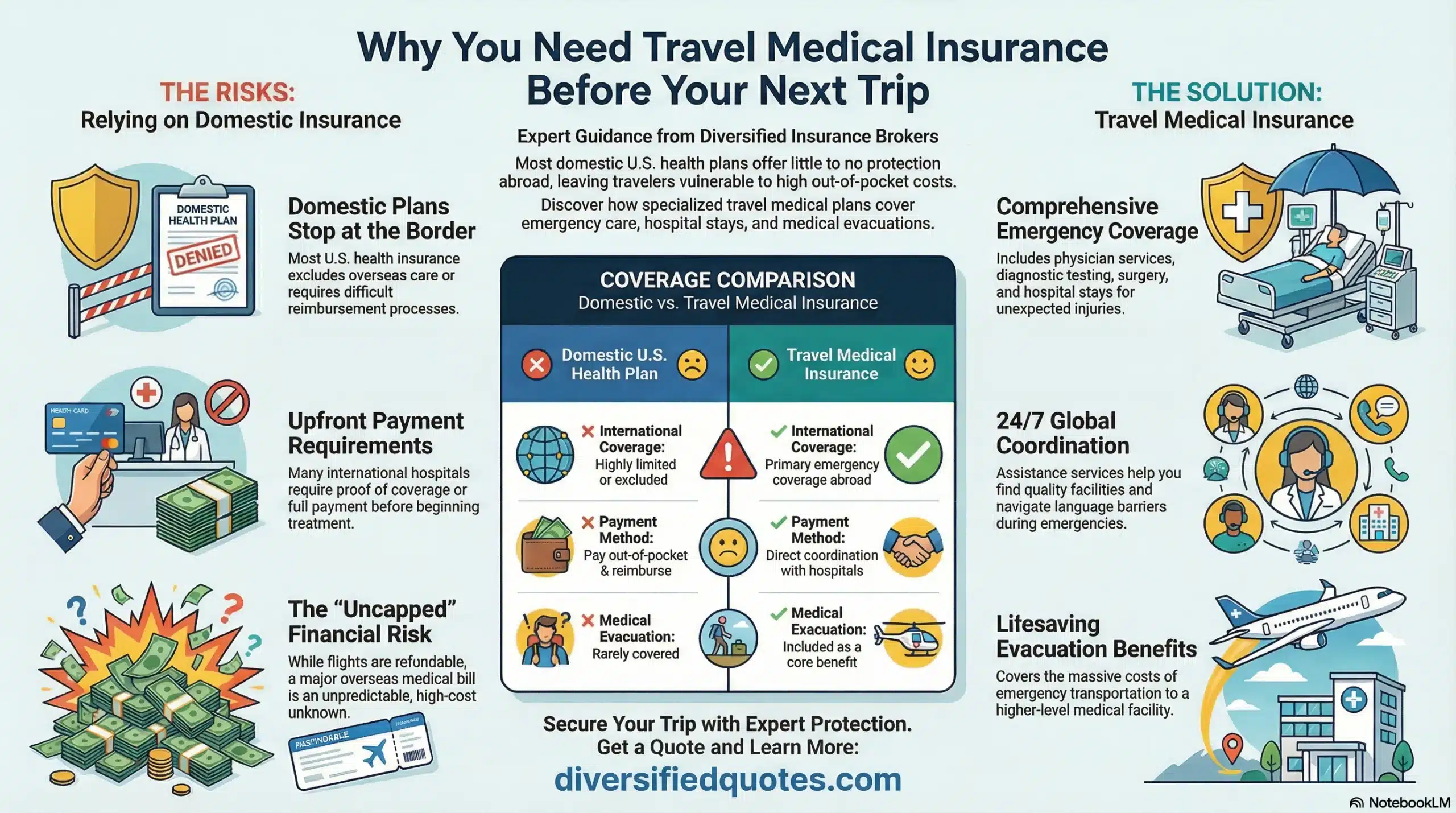
The most common enrollment mistake is assuming that a domestic plan — a parent’s employer plan or a home country national health plan — provides adequate international coverage. Most domestic plans have no meaningful international benefits, and home country national health systems do not extend coverage to citizens studying abroad. The second most common mistake is purchasing a plan without confirming it satisfies the specific university’s waiver criteria, only to discover after arrival that the waiver is rejected and the school’s SHIP premium is assessed retroactively. The third is overlooking exclusions for sports, activities, or high-risk travel — a student injured during a club sport, fieldwork, or a weekend adventure activity needs to confirm those activities are covered before the incident, not after. Waiting until after arrival to purchase coverage creates a different problem: some plans have waiting periods for certain benefits that begin at policy issuance, and students who purchase coverage late may be without protection for covered conditions during the waiting period. The simplest approach is to treat insurance as part of the study program preparation — confirm destination and program length, request the university’s specific waiver requirements in writing, compare a plan against those requirements systematically, and purchase before departure so coverage is in force from day one. For students whose programs involve elevated geographic or activity-related risk, our resource on high-risk travel insurance covers the additional coverage considerations those situations require.
Talk With an Advisor Today
Choose how you’d like to connect—call or message us, then book a time that works for you.
Schedule here:
calendly.com/jason-dibcompanies/diversified-quotes
Licensed in all 50 states • Fiduciary, family-owned since 1980
FAQs: Travel Medical for International Students
Is health insurance required for international students in the United States?
It depends on the visa type. J-1 exchange visitor visa holders are legally required by U.S. Department of State regulation to maintain health insurance meeting specific minimums: $100,000 in medical benefits per accident or illness, $50,000 in emergency medical evacuation, $25,000 in repatriation of remains, and a maximum $500 deductible. F-1 student visa holders are not required by federal immigration law to carry health insurance, but most U.S. universities require it as a condition of enrollment — typically through the university’s Student Health Insurance Plan (SHIP) or an approved alternative plan that passes a waiver review.
What is a university SHIP waiver and how does a private plan qualify?
A SHIP waiver allows an international student to opt out of the university’s Student Health Insurance Plan by demonstrating equivalent coverage through a private plan. Waiver requirements are institution-specific and typically require ACA compliance or equivalent benefits, a maximum $500 deductible per accident or illness, minimum medical evacuation and repatriation benefits, mental health coverage, adequate local provider network access, and continuous coverage throughout the academic year including summer sessions and breaks. Students must apply for the waiver before the university’s deadline — often within the first few weeks of each semester — and provide plan documentation for DSO review. A rejected waiver results in SHIP enrollment and the associated premium being assessed.
Does travel medical insurance cover pre-existing conditions?
Coverage varies significantly by plan. Budget travel medical plans often exclude pre-existing conditions entirely, or provide limited coverage — for example, $500 per period of coverage for conditions stable for the previous 12 months with a $1,500 lifetime maximum. Comprehensive plans may provide full coverage for pre-existing conditions with proof of prior continuous insurance. University waiver standards at many institutions require coverage without waiting periods or exclusions for pre-existing conditions, meaning that students with meaningful medical history and plans to pursue a university SHIP waiver must evaluate pre-existing condition coverage carefully before enrolling in a private plan.
Does the plan cover mental health services?
Mental health coverage varies by plan tier. IMG Global student plans include mental health support as a standard benefit, including outpatient counseling, psychiatric services, and telehealth mental health access. This is a critical feature for international students, who experience elevated rates of stress, anxiety, and depression due to the combined challenges of academic pressure, cultural adjustment, language navigation, and distance from family. Many university waiver standards also require meaningful mental health benefits as a waiver qualification criterion — plans that exclude mental health coverage may fail the waiver review even if they satisfy medical and evacuation minimums.
What does emergency medical evacuation cover and when is it used?
Emergency medical evacuation covers the cost of transporting a student to the nearest appropriate medical facility capable of providing required treatment when local care is insufficient. This may involve ground ambulance, air ambulance, or clinically supervised commercial transport depending on the medical situation and destination. It is used when a student suffers a serious illness or injury in a location where adequate treatment is unavailable locally — most relevant for students in remote regions, developing countries, or areas with limited specialty care. The J-1 minimum of $50,000 is adequate for many domestic situations but may be insufficient for intercontinental evacuation from a developing country. Students in fieldwork or research programs in remote locations should consider plans with $500,000 or higher evacuation limits.
Can coverage be purchased for a single semester?
Yes. IMG Global and most international student insurance providers offer coverage for defined academic periods — single semesters, academic years, or custom date ranges. Coverage can typically be extended if the student’s program runs longer than originally planned. For students planning to use the plan to satisfy a university SHIP waiver, the coverage period must encompass the entire academic term the university specifies, including summer sessions if the student remains enrolled. Exchange students and semester-abroad participants are common users of single-semester coverage, while degree-seeking international students typically purchase an annual plan that renews each academic year.
About the Author:
Jason Stolz, CLTC, CRPC, DIA, CAA and Chief Underwriter at Diversified Insurance Brokers (NPN 20471358), is a senior insurance and retirement professional with more than 25 years of real-world experience helping individuals, families, and business owners protect their income, assets, and long-term financial stability. As a long-time partner of the nationally licensed independent agency Diversified Insurance Brokers, Jason provides trusted guidance across multiple specialties—including fixed and indexed annuities, long-term care planning, personal and business disability insurance, life insurance solutions, Group Health, Travel Medical and Evacuation Insurance, and short-term health coverage. Diversified Insurance Brokers maintains active contracts with over 100 highly rated insurance carriers, ensuring clients have access to a broad and competitive marketplace.
His practical, education-first approach has earned recognition in publications such as VoyageATL, and contributions from his agency featured in Kiplinger and GoBankingRates— highlighting his commitment to financial clarity and client-focused planning. Drawing on deep product knowledge and years of hands-on field experience, Jason helps clients evaluate carriers, compare strategies, and build retirement and protection plans that are both secure and cost-efficient. Visitors who want to explore current annuity rates and compare options across multiple insurers can also use this annuity quote and comparison tool.
Explore More Travel Medical Insurance Options: Browse our complete guide to Groups & Specialty Travel Insurance — covering church groups, missionaries, volunteers, students, expats, digital nomads & more.
Last Reviewed: June 17, 2026 |
Reviewed by: Jason Stolz, CLTC, CRPC, DIA, CAA
Chief Underwriter, Diversified Insurance Brokers, Inc. | NPN: 20471358 | Diversified Insurance Brokers, Inc. — Licensed in all 50 states
Fact Checked by: Tonia Pettitt, CMIP©
Medicare Specialist, Diversified Insurance Brokers, Inc. | NPN: 14374308 | Diversified Insurance Brokers, Inc. — Licensed in all 50 states
Did you find this content helpful? Leave us a Google review — it helps others find trustworthy guidance too.
Editorial Standards: Diversified Insurance Brokers maintains rigorous editorial standards to ensure accuracy, clarity, and independence in all content. Learn more about our editorial standards and commitment to transparency.
